- Captain Albert's Website and Blog -

Ocean Liner History and Stories from the Sea, Past and Present. With an In Depth focus on Holland America Line

Category: Technical (page 3 of 11)

12 March 2020; At Sea, First day.

Because we are doing basically the same cruise back to Fort Lauderdale we also have two sea days after leaving San Diego in the same way as before when arriving. For our cruise see chartlet below. How this cruise and future cruises will develop is everybody’s guess. It all depends on what happens with the Corona Virus and what wise men & women will decide about what is best. No doubt everybody is following the news hour by hour as things keep changing all the time. Carnival Corporation is constantly reviewing the situation and we get updated all the time. Processes are refined by the day, depending on what the Experts learn or what the political situation requires. Yours truly has now also been affected by the situation as well, in So far that I cannot travel around the fleet for the time being. Continue reading

09 March 2020; At Sea.

With the Pacific Ocean behaving in a very “pacific” way, all was well in the world. The ocean surface was flat enough for the guests to pick out all the wild life around the ship and there was quite a lot as we are not too far from the shore today. We are sailing along the coast of Baja de California or the Californian Peninsula which has the large water gap of the Sea of Cortez that separates it from the Mexican Mainland. Plus we are right on the Whale – Highway between this area, Hawaii and Alaska. Whales swim from Hawaii over to the area south of Cabo San Lucas and then eventually go north to the feeding grounds of the Alaskan waters. Because they are congregating here, think in a mindset of several “whale lanes” coming together at a round-a-bout and then all going up the north lane; so this were you have the best sightings until you go to Alaska. Just before noon time today, some humpbacks gave a spectacular show on the port side of the ship, much to the delight of our guests.
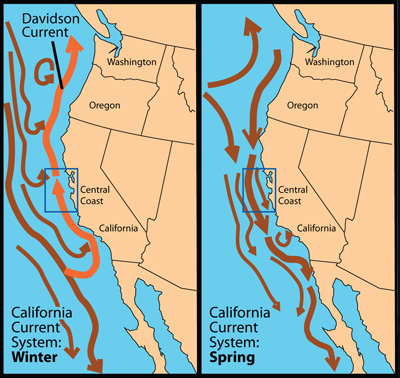
The general status of the current of California and higher up. It brings cold water to the warmer waters south of Cabo San Lucass.

Unfortunately we passed most of this south point area during the night and missed the chance of seeing the waters around Cabo San Lucas. Where apart from the whales, there are also large shoals of Blue Marlin present. Attracted by the meeting of the cold and warmer ocean currents which brings up nutrients from the ocean depths and these nutrients and small animals form the start of the food chain for all sorts of other fish. Same as the whales, also the blue marlin is a seasonal visitor which goes deep ocean for most of the year.  Around this time of the year it is high season around Cabo San Lucas when the Marlins are on the coast. The Operators have a regulated catch and return policy which means the fish stocks are not affected.  Because we passed by at night we did not see all the charter boats going out and coming in, and I am quite happy about that as they do not always follow the rules of the road when regular traffic is coming through.
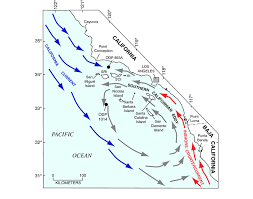
Every captain is a happy camper of he can ride the red current while going up the coast.

Then as soon as you are away from the area, the fishing boats disappear as they are all day boaters, the whale sightings get less as the area where they swim is increasing, and we get the regular ocean traffic back which is on the way from North America to the Panama Canal or vice versa.  Nasty thing for us here is, that most of the time we have the California current against us which brings cold water down from the Gulf of Alaska to the Cabo San Lucas area. Hence the reason why the whales like to travel this route; it is nice and cold.  Thus most of the time we are battling against this current on our way to San Diego. But not always; sometimes the warm counter current (which is caused by the colder water pressure coming down and replacing / pushes away the warmer water) lays a bit further off shore and we just catch it. I have never been able to predict exactly when this happens as no doubt a lot of local circumstances play a role here. Fact is, when the warm water current moves, we get more fog around the area near Cabo.
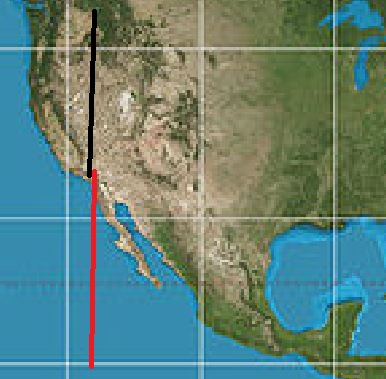
The Mercator Projection which is used by most display charts. USA and Mexico are almost the same.

Tomorrow we have our 2nd sea day and we will still be traveling along the coast of Mexico. Not many people realize how long (North/West) Mexico really is and part of that is due to the false representation on the geography maps that we use. Most of them use a Mercator projection, which is only 100% correct at the point where its projection touches the Earth’s globe. The further away from this point and the larger the distortion. That is why Greenland looks so very big, although being of a reasonable size, it does not go so wide at the top. A better projection is the Peters version, which gives the continents in the right size / context to each other but is distorted in the way it is represented as a flattened globe. The Mercator version distorts the closer you come to the poles and thus Mexico looks a lot smaller than the USA and Canada.  You only really understand this when you are on a ship and you travel for days with the same speed. Then you realizes it takes longer to sail the west coast of Mexico then the west coast of the USA.
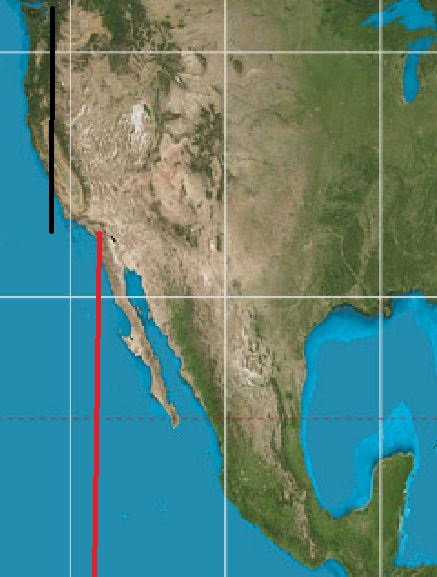
The Peters Projection. The Mexican west coast is now suddenly a lot longer.

Tomorrow we are at sea for our 2nd day. Still along the Mexican coast. Then by 04.00 on the 11th. We enters USA waters and sail for the San Diego Pilot station. Weather has been forecast to still be good and thus we should have a nice final day of the cruise.

Continue reading
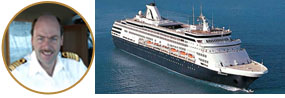
05 March 2020; Puerto Quetzal, Guatemala.

Just after sunrise in very hazy weather and it being nearly wind still as well, did the good ship Rotterdam arrive in Puerto Quetzal. The haziness indicated that it was going to be a very warm day and it was. Only in the late afternoon did it breeze up and thus we did have a bit of cooler sea air circulating over the deck. Since last summer, the local authorities have repaired the cruise terminal and thus could we dock there again. This cruise terminal is made up of fixed bollards and dolphins with a floating pontoon in the middle. And cruise ship captains are very hot on getting this dock as it means that the gangway always has the same angle because the pontoon goes up and down with the dock in the same way as the ship does. This dock has been made for the average cruise ship length and a smaller ship, such as our S class fits perfectly, and the same goes for the Vista Class. The R Class, named after the ms Rotterdam, is an in between length and that means that the Gangway location is not ideal for being landed on the pontoon. Thus we had to relocate the Gangway to the Marshalling area which is normally for luggage, stores and spare parts. But it is amazing what a few sheets and curtains can do to perk up a work area to a 5 star cruise ship lobby.  The Seven Seas Splendor, followed us again and had to dock with the cargo ships. I really am getting the idea that they just follows us, as we seem to know where we are going. See if we can confuse them tomorrow. Continue reading

04 March 2020; Corinto, Nicaragua.

This is one of the trickiest ports to get into. On bad days there is a long and deep swell running over the large area of shallow water outside the entrance which makes it hard to keep the ship steady, even with the stabilizers out. Then there are two turns while sailing in, and at the 2nd one, you can have current from 3 directions at the same time. Something that asks for careful planning. But the company is now coming to this place since 2011 with the cruise ships and thus we have a lot of experience to expect the un-expected. And there is always something.  Also today. With the Corona virus a concern of every health authority, Nicaragua has decided to do a special health check at the sea buoy before sailing in clearance is granted. And thus four doctors boarded the ship and had a discussion with the ship’s Doctor to see what the situation was on board the ms Rotterdam. Well we are completely clean, not even a little bit of Noro virus on board, and after a short time the medical quartet disembarked again and gave permission for the pilot to board. They themselves then continued with a visit on board the Seven Seas Splendor which has been following us since the Panama Canal. They were with us in Puerto Caldera and now also here in Corinto. (Maybe they do not know where they are going, so they are just following us? So I would not be amazed if they pop up as well in Puerto Quetzal) Continue reading

02 March 2020; North Pacific Ocean.

While exiting the Canal we came as close to the equator as we will get on this cruise but still over 400 Miles North of it. From now on we only be going north until we come to San Diego, the end of this cruise. And we will do that just by following the coast. The Pacific Coast of Middle America and Mexico is fairly straight and by that I mean we do not have to sail around large areas of land that are protruding. The only part that sticks out a little bit is The Californian Peninsula but even that we can do on a straight line. Continue reading

29 Feb. 2020; At Sea, Approaching the Panama Canal.

The swell is not as bad as I am normally used to over here. It seems that in the last few days the strength and the angle of the wind has been slightly different than what is normal here, and as a result the swell is lower than normal and thus the ship is not rolling as much as it can do here. That different weather can happen here if there is a cold front going over Florida which did occur on February 27. Then if the tail comes low enough, the prevailing winds change and that results in less swell or a swell from another direction. It does not always happen as it depends on how the tail of such a cold front is moving over Mexico and how far south it extends. This cold front was not very nice for Florida but it works out in our favor here in the South West Caribbean as we do not have a wobbly ship.

Continue reading

28 Feb. 2020; Oranjestad, Aruba.

Aruba is a place which make captains always think about it for a second time. And that is due to the wind. The Trade Winds which blow over the whole of the Caribbean gather more and more momentum while getting further to the west and if they are already strong to start with, they are blowing a gale by the time they reach the Dutch A, B, C islands (Aruba, Bonaire and Curacao). The problem with Aruba is, that it is flat, really flat, although it has one mountain called the Hooiberg (Hay stack) but that one is too far away from the port to provide any shelter from the wind. In Willemstad, Curacao, it is not so big a problem as the docks are more in line with the Trade Winds, so the wind does not make the ship drift or (for the docks inside the port) there is some shelter from the surrounding land. Continue reading

21 Feb. 2020 Cockburn Town, Grand Turk Island.

There is a difference between the way we as sailors see the weather and the way the guests see it. For the latter, it is nice, or it rains, or it is cold or a combination of the various options. For a sailor, especially a ship handler, it is not important if it is cold or sunny or gloomy; it is all about the elements that have a direct influence on the ships behavior.  Wind, Swell and Current. 14 days ago the guests had a great day at Grand Turk, although we had to share it with a mega liner from Carnival. Today we had an even better day as we were by ourselves.  But for the captain last cruise was a very bad day as docking was on the edge of what was possible with the Veendam. Strong winds from the wrong side so when docking we had to push full power against the wind to get alongside. The current made it even worse and the help that the Carnival ship could have rendered by acting as a wind breaker, did not happen as she only arrived 2 hours later. Then today things were much better. First of all we docked at the other side of the dock, so instead of pushing against the wind, we could break the momentum that the wind was giving the ship, which is much easier; and there was a lot less wind, swell and current, so everything was well within the parameters of feasibility.  On top of that as a bonus for the guests, we were the only ship in port today. So all reserved solely for the 1200 guests we had on board. Continue reading

15 Feb. 2020; Georgetown, Grand Cayman.

By 0700 hours we arrived at the anchorage of Georgetown Grand Cayman with good weather and what would turn out to be a glorious day. The two other cruise ships were arriving at the same time each going to their designated anchorage. Sort of, as the Aida Diva decided to stay on the engines. We got somehow the impression that the captain there was on his first visit to Grand Cayman and had never experienced anchoring on the ledge and then letting the wind keep you off the island. So they hovered close by. No problem for us, as long as each ship stays at their own anchorage area as it is all quite tight here. My old school buddy from 1976-1981 thinks that I am / we are completely nuts to do this sort of things as, according to him, nobody in his right mind would rely on the wind not to run aground. I think from my side that he is completely nuts by sailing on a container ship with only 20000 boxes to talk to, but sailing box-boats is also a special skill, so each to its own. Continue reading

12 Feb. 2020: Fort Lauderdale, Florida.

Today it was a Holland America day here with only us and the Koningsdam in port. She docked at Pier 26 which is the Holland America Terminal and which is considerably larger then terminal 19 or 20. It would even be a tight fit for the Koningsdam to be alongside pier 19. But the handy size of the Veendam fits nearly everywhere and thus we went back to terminal 19 where we were last cruise as well. Easy for the guests who only sailed with us for one week, as most of them had parked in the garage just across the road. So none of the confusion we sometimes have when due to the planning of the harbormaster and the congestion of the port a ship ends up at a completely differrent place. That does not happen that often on 7 day cruises, but it does happen on 9, 10, 11 and 12 day cruises were every so often you hit the weekend cycle of the other ships and they then go to their regular berth. I have had it in the past that one week, we were  at berth 19 and 11 days later we were at berth 4, which is at the other side of the Harbor basin. A logistical headache for the shore team was the result. Of course it always works out, but if one can avoid it……………… Continue reading

Older posts Newer posts