Koning de, Jacobus.
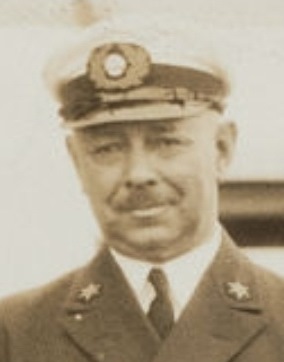
Jacobus de Koning as captain on the ss volendam (I) in 1927
Jacobus de Koning was born on 24 November 1874 in the town of Haarlemmermeer. This was a municipality, a group of towns, located in the area of the Netherlands best known for the National Dutch Airport Schiphol (sometimes called Amsterdam International Airport). Around 1874 it was an area which only had recently been completely drained of water making it a large reclaimed piece of land inside the province of North Holland in the West of the Netherlands.
As he did not attend the Maritime Academy in Amsterdam, I have no information yet about his personal back ground, so if there is a reader who can help with some information about his family, relatives and private life, please contact me on Captalbert1@aol.com. All information provided will be posted with the appropriate accreditation.
He started in the sailing trade on board the “Burgemeester Jhr. Koene” a Barque of 1200 tons burden with which he sailed around the word. At the end of his period on board he went back to school and passed his exam for 3rd mate on 22 June 1894. He then joined Holland America on the 09th. of October 1894.
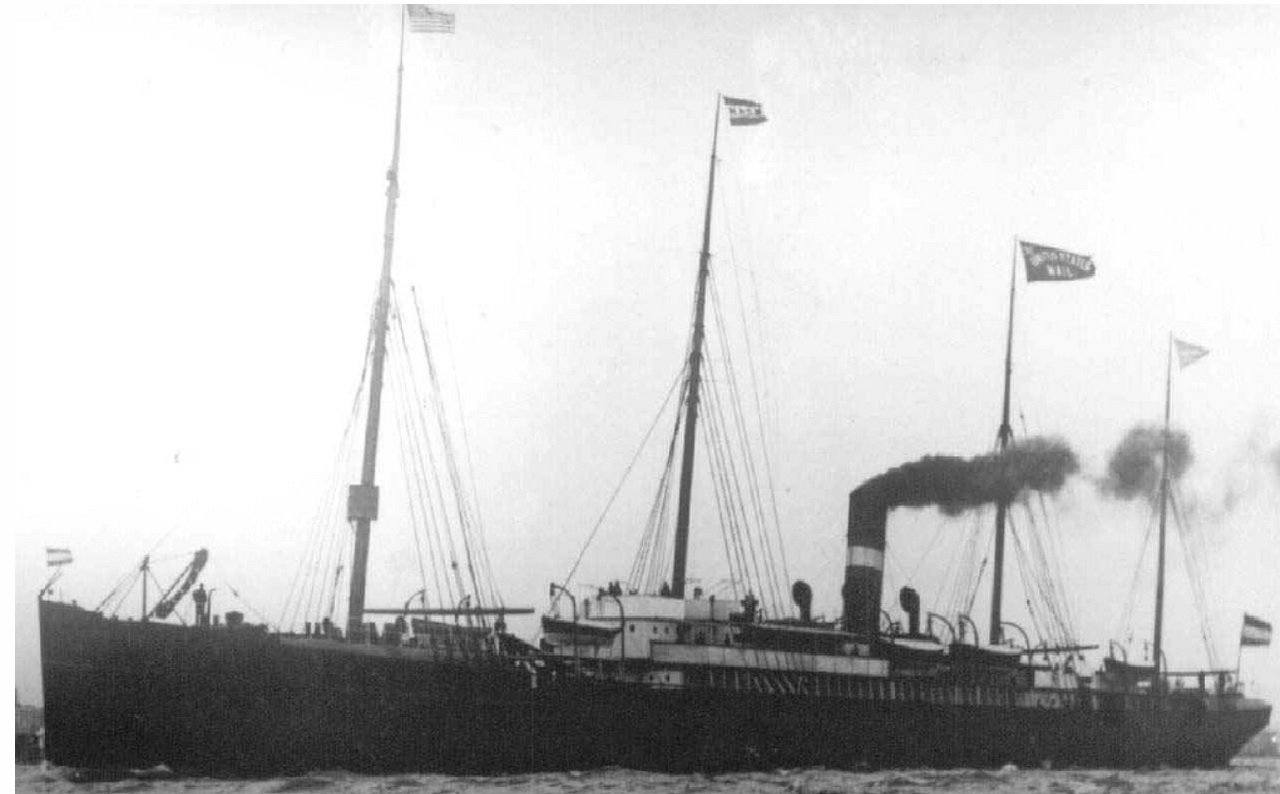
The ss Obdam of Holland America Line. (See the ships history else wereon this website) (b)
He was placed on board the ss Obdam which was engaged on the service to New York from Rotterdam. A year later he enrolled as a Royal Netherlands Navy Reserve Officer. The Dutch Royal Navy Reserve had been created in 1894 and Holland America actively encouraged their officers to join. For the company it made it easier to deal with the contracts with the Dutch Royal Mail and also it increased the chance of keeping one of its own captains in command in case a HAL ship would be requisitioned as an Armed Auxiliary Cruiser. A policy that was taking shape at that time as most passenger ships being built at that time were faster than the real navy ships.
Promotion was swift, in part due to the number of cargo ships the company bought in 1909 by taken over the Neptune Line and he is appointed captain of the ss Zaandijk (I) on 08 June 1909. The ss Zaandijk being one of those ships (the ex ss Ohio) of the Neptune Line.
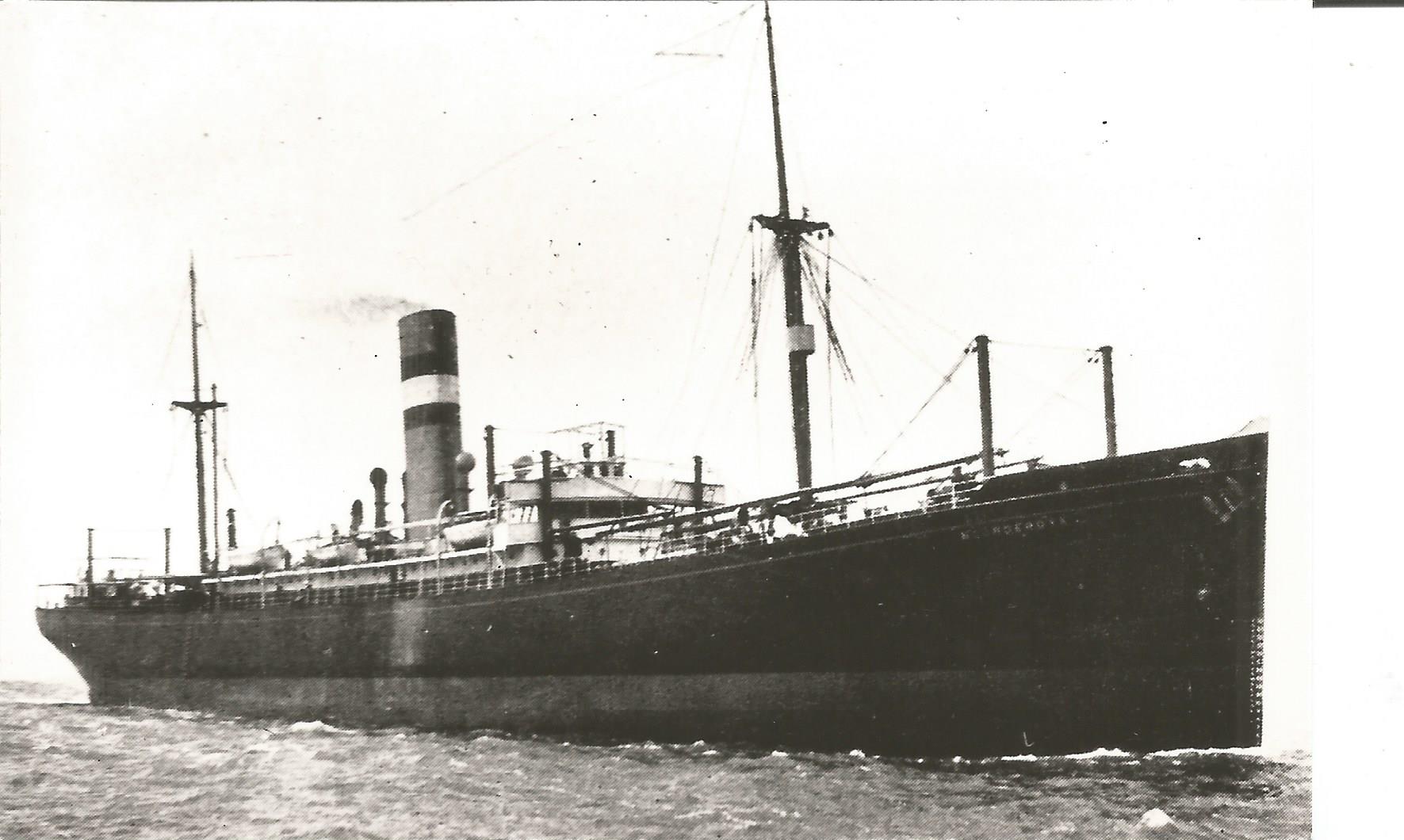
The ss Noorderdijk (I) The ship had been bought at the shipyard by HAL in 1913. Ir carried 55 crew, had a speed of 12.5 kntos and roughly 8000 tons of loading capacity. (b)
On the 6th. of April 1911 Jacobus de Koning got married to To Nanning (part of a wellknown pharmacy family in The Hague). Eventually there were 2 children. A son Jan, (passed away in his 49th. year) and a daughter Cili (1914 – 2001). They were born on the “Noorder Island” just opposite the Wilhelminakade / HAL establishments. Later they move to The Hague. (d)
On 27 July 1916 he is assigned to the ss Noorderdijk (I) employed on the cargo service to New York and nearby ports. When in 1917 Imperial Germany declares the “unrestricted U-boat war” he seeks shelter with his ship in Falmouth.
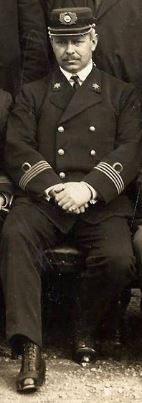
Captain de Koning in 1917 in Falmouth. this photo was croppsed from a large photo with all Dutch Captains assembled in Famouth. Here they founded the Dutch Captains Society to be able to hav more influence on the politics to which they were exposed. (b)
Many Dutch and other neutral ships are sheltering there as, being neutral they did not have any Navy protection when sailing through U-boat infested waters and the U-boats where simply waiting in the shipping lines for the ships to sail by. Under pressure from the Dutch Government, who was afraid of not getting enough grain to the Netherlands for the Dutch population, the Dutch ships were ordered to sail. Hence De Koning left port on 22 February and the next day the small Dutch convoy of 7 ships are all torpedoed by the German submarine U-21 (Kapt.-luitnant Otto Hersing) about 27 Nautical Miles west of Bishop’s Rock. Luckily the U-boat commander was a gentleman and gave Captain and crew time to disembark. All crew were safely picked up and land on 24 February at Penzance in Cornwall, England.
Captain de Koning and his crew then sailed home with various HAL ships, himself arriving in Rotterdam on 23 April with the ss Amsteldijk (I). According to the captain, the commander of the U boat who torpedoed him received 6 months leave as a thank you for torpedoing the 7 ships and seems to have spent that leave in the Netherlands. De Koning regretted that he did not have the chance to meet him and ask about the “WHY” of hitting a neutral ship. Holland America was compensated after the war for this loss. In the same convoy was another Holland America Line ship the Zaandijk (I)
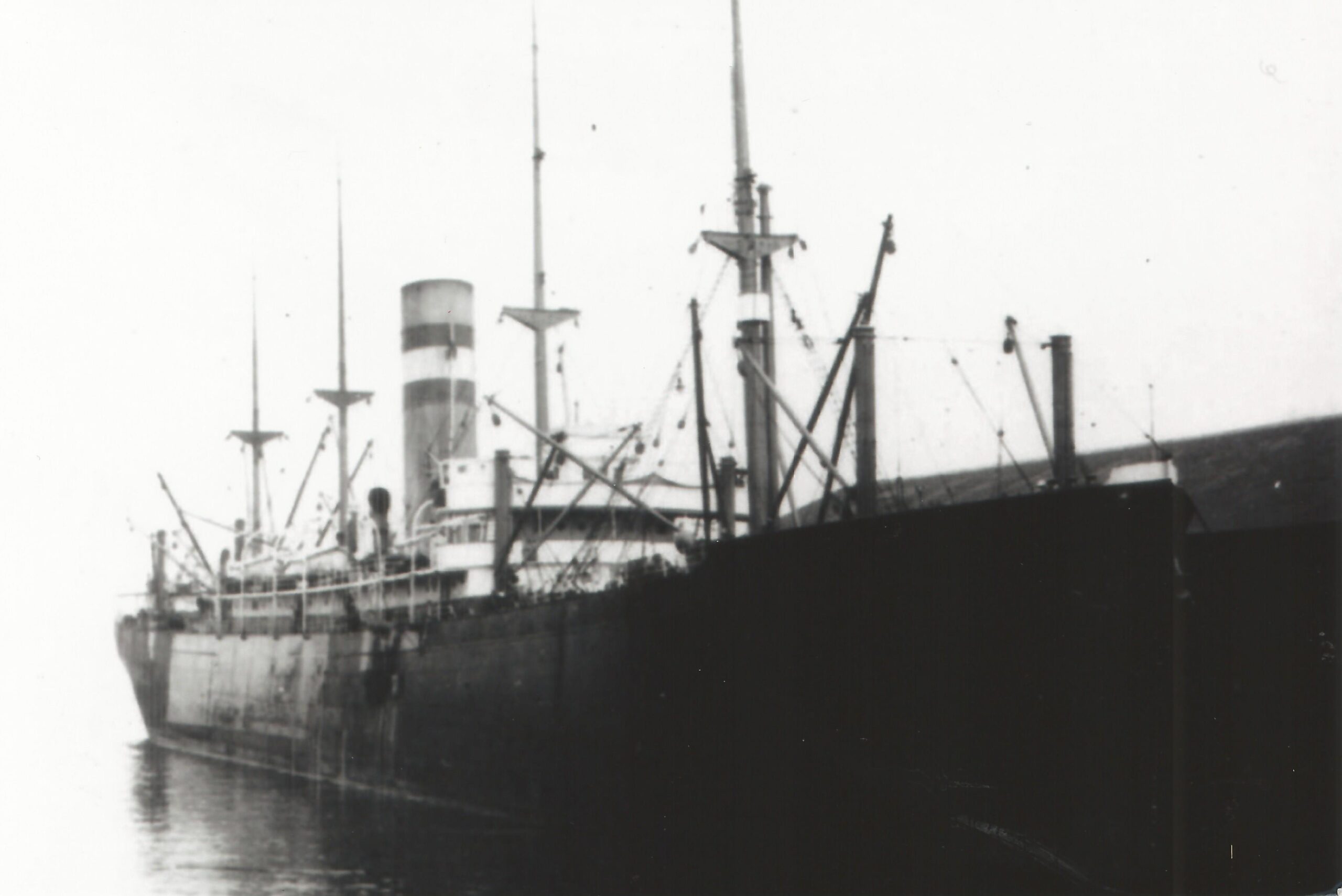
The ss Oosterdijk of 1913. Built for Holland America and taken over by the US Government on 30 June 1917 but left in lay-up under Dutch command until well into 1918. (b)
De Koning was then assigned on 12 June 1917 to the ss Oosterdijk also sailing on the North Atlantic on the grain run. The ships were now taking the Route above Scotland, the so called “Doggersbank route” to the United States as there was less U-boat activity. After a call at Halifax the ships arrives in Baltimore and is laid up. The United States is now entering the war and starts to requisition foreign ships laid up in its ports. The ss Oosterdijk is taken over on 20 March 1918 and reflagged to USS Oosterdijk. As the Netherlands is neutral in the conflict, Captain de Koning cannot stay in command of his ship and returns to the Netherlands as a passenger on board the ss Nieuw Amsterdam (I) which is exempt from being taken over by the USA. The USS Oosterdijk (Lt. Commander Arthur Webber) is sunk on 11 July 1918 due to a collision on the way to St. Nazaire. Holland America is also compensated for this loss by the US Government.
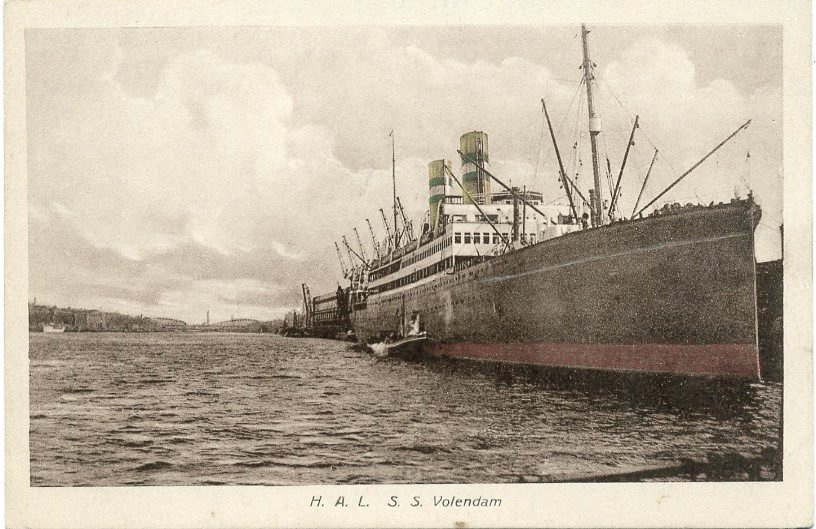
The ss Volendam (I) Here seen on a colored postcard from the early years of service. (b)
In 1920 De Koning is receives an honorable discharge for the Royal Netherlands Navy. Why he left is unknown, as he had not reached the age for this was normal. With his increase in seniority the number of assignments to the passenger ships increases and by 1924 he is permanently assigned to the passengers hips, with receiving command of the only 3 year old ss Volendam (I) in 1925. With this ship he ends up in the newspapers a few times.
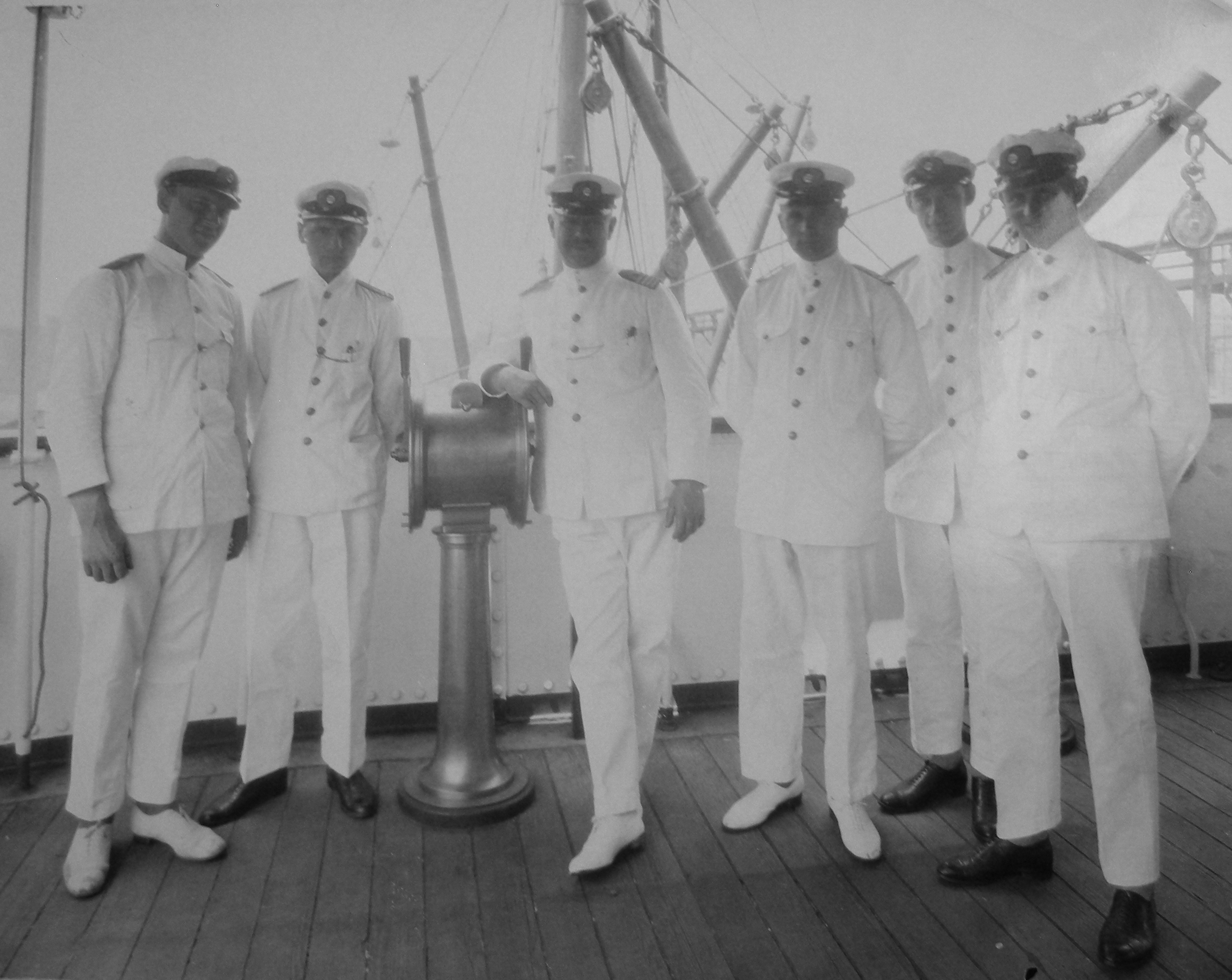
Captain De Koning and some of his officers on board the s s Volendam (I) during a cruise. Please note that some of the officers are wearing black shoes. All through history it has been for deck officers been extremely difficult to buy proper white shoes that were easy to wear and could handle sea water. Hence these gentlemen still had to find a shop somewhere in the Caribbean that sold them. (b)
In 1926 the ss Volendam with Captain de Koning hits the headlines of the newspapers with the report that the ship had saved the crowd of the Newfoundland schooner (200 tons burden) the “General Smuts”. During a North Atlantic storm the ship had sprung a leak and lost all sailing capability. The crew had to take to the lifeboats. On 5 March 1926, the officer on duty “De Graaf” (later captain) saw a light/fire in the far distance in the pitch dark night. As it could not be distinguished what was going on the Volendam continued its journey while closely watching the light. With day break a ship with torn sails could be seen wallowing in the rough seas. At once the captain turned the Volendam around. A lifeboat was launched with Chief Officer (later captain) Reifferth in command of 5 sailors and they tried to approach the stricken vessel. They asked the people on board to jump in there water so they could be picked up. However the captain (Mr. Charles A Rose) advised that most of the crew was too weak. The Volendam then poured a large amount of oil on the waves so the lifeboat could approach the wreck in somewhat calmer water and lift the crew off.
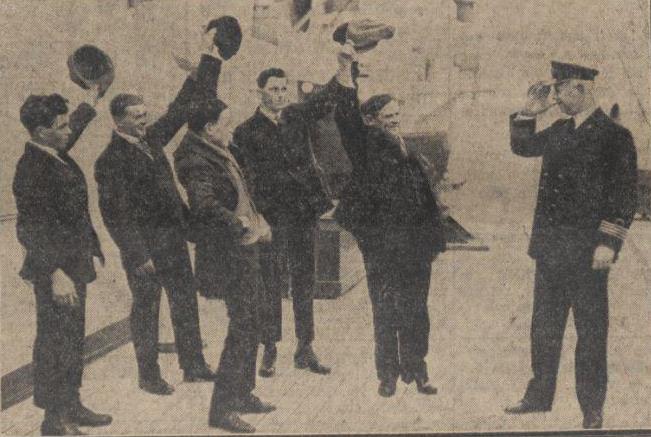
A cheer for Captain de Koning by the crew of the “General Smuts” upon leaving the ship in Plymouth. (From a contemporary Dtuch news paper)
It later became clear that the ship had left Bonanza (in New-Foundland) on 17 December 1925 with a full load of salt destined for the Grand Bank fishing fleet. Here it should have arrived in the middle of January 1926. However shortly after departure it had run into a storm which damaged all the sails. New & emergency sails were rigged but they were torn apart during a 2nd storm. Since then the ship had been making water steadily. The stricken vessel then drifted around for 77 days with ever dwindling supplies on board. In the end the rations were down to 3 biscuits a day and 1 cup of water, while at the same time the crew had to rotate continuously at the pumps to drain the water from the holds. The storm had pushed the derelict vessel so far away from the normal sailing routes that all hope was abandoned. By the time they were picked up, Captain Rose estimated that they would have lasted no more than another 30 hrs. The passengers collected about 800 Dutch guilders for the crew. (Approx. US $ 16,000 in nowadays money). Everybody was landed in Plymouth England and the 18 year old son of Captain Rose declared that he would never go to sea again.
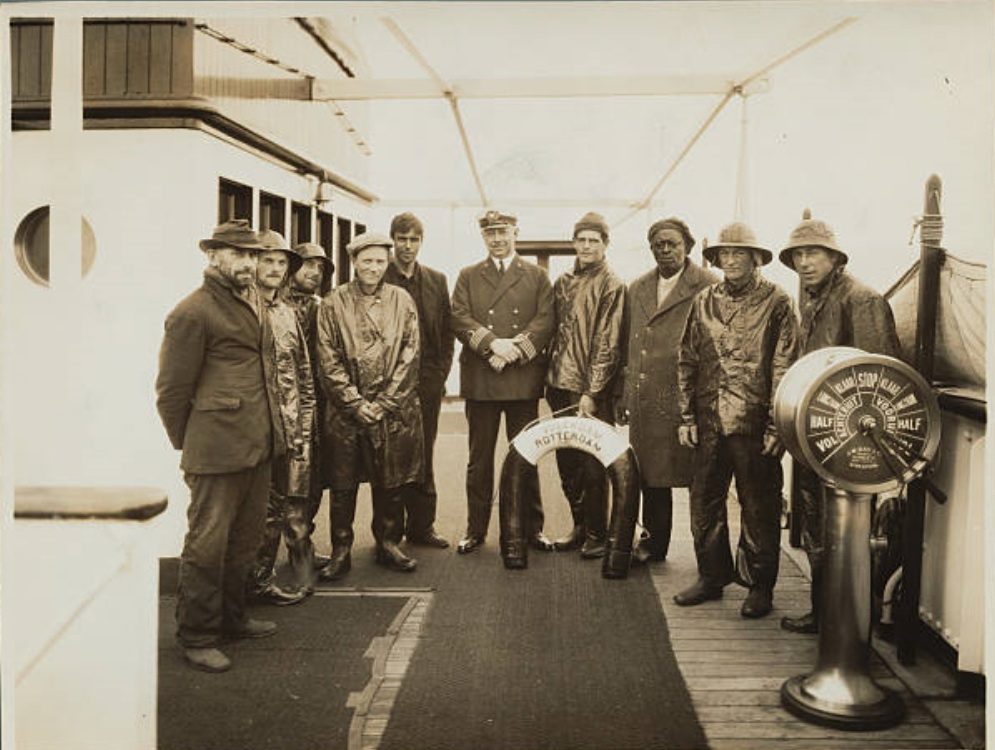
The capain & crew of the Horation Foss assembled on the bridge of the ss Volendam (I) are ahving been taken on board.
During a cruise in 1927 with 419 bankers of the “Savings Bank Association” on board the ship collected on the way back to New York (departed Bermuda on 28 Oct.) the captain & crew of the American Schooner “Horatio J. Foss. (owned by Krowell & Thrulow of Boston). This ship, registered in Boston, was on the way from Philadelphia to Guadeloupe in the Caribbean with a cargo of coal. The Volendam was sailing about 35 miles North West of Bermuda in boisterous weather, when he & his officers on the bridge saw a red flag above the waves. This turned out to be a lifeboat of the Horatio with 9 persons. They were taken on board and put to bed to re-cuperate. Later on it became apparent that the barque had sunk on 22 October in bad weather and they could not make it against wind and swell to Bermuda. They were all landed in New York.
On 08 April 1930 the ss Volendam (I) returns to Rotterdam, marking the end of Captain De Konings career.
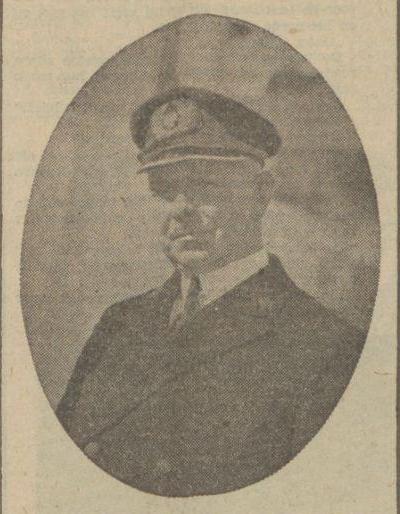
The last known photo of Captain Jacobus de Koning, taken in 1930 at his retirement. (From a contemprory Dutch news paper)
In 1932 (Newspaper of 16 December) his name surfaces one more time. The now retired captain was involved in arranging for a special wish to be granted. The wife on an American author, Mr. Bruno Lessing, had had a car accident which resulted in many months of re-cuperation. She dearly wanted to hear the “Fifth of Beethoven” performed by the Amsterdam Concert Orchestra under the guidance of the then world famous conductor Mr. Mengelberg. De Koning had met Mengelberg on board when he went for performances to New York and must have remained in contact. Mr. Lessing contacted De Koning, who contacted Mengelberg and sometime later Mengelberg performed “The Fifth” which the patient could hear via the wireless from Amsterdam to New York. As a thank you Mr. Mengelberg later received a Conductors baton made of Rose –Ivory wood. (Which is supposed to be the rarest wood in the world).
Captain de Koning passed away in 1952 and his funeral took place on the same date (18 March 1952) that his old ship the ss Volendam (I) sailed for the scrap yard.
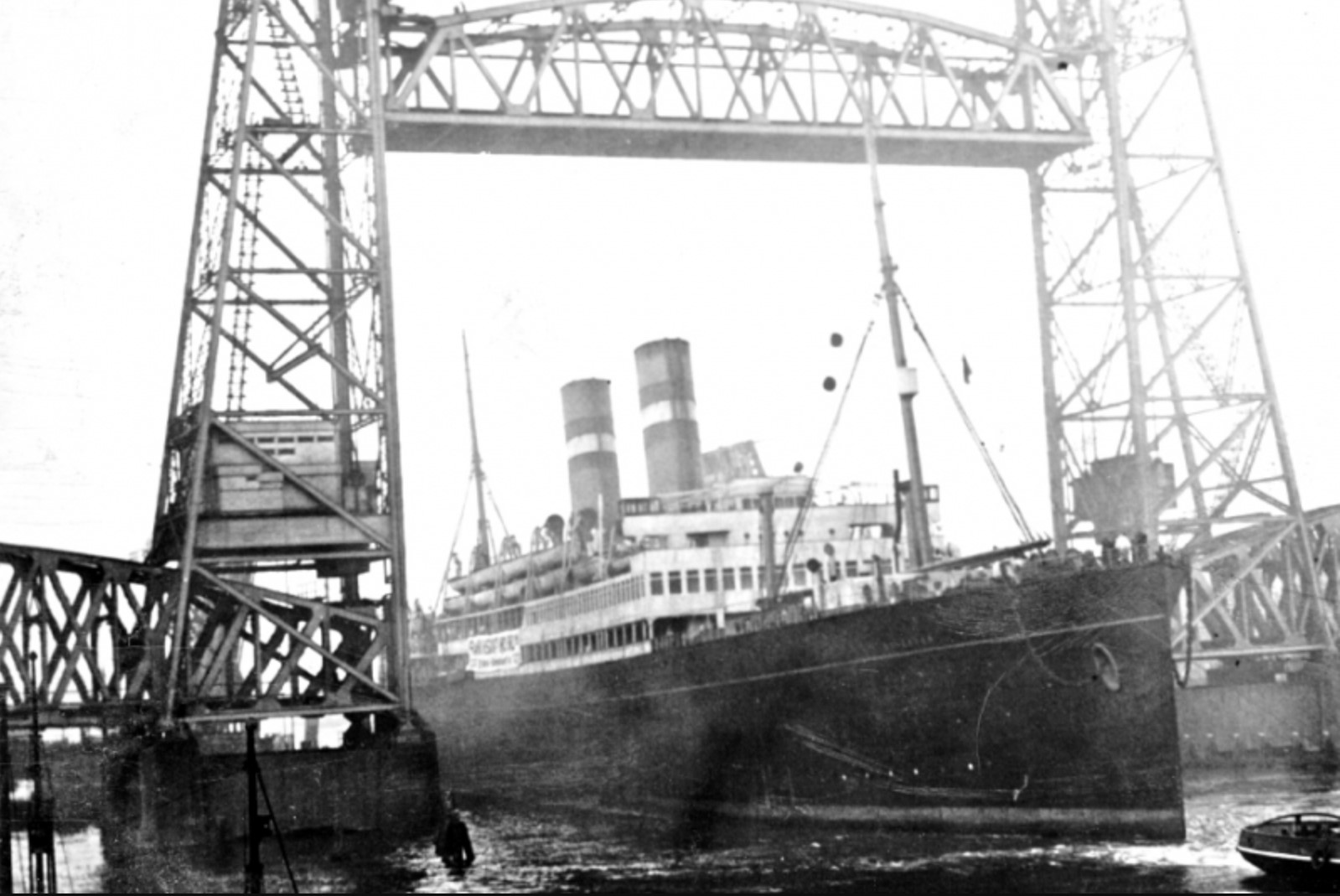
The ss Volendam sailing through the “Hefbrug” in Rotterdam, going up river to the breakers. (b)
Decorations: HAL golden medal for 200 crossings.
Sailing list: (a)
Date: Function: Ship: Wages and/or remarks.
09 Oct. 1894 4th. Officer Obdam 30,–
11 Mar. 1895 4th. Officer Maasdam 30,–
20 May.1895 4th. Officer Rotterdam 30,–
11 Sep. 1895 Temporary dismissed to join the Royal Dutch Navy.
13 Jan. 1896 4th. Officer Amsterdam 30,–
09 Jun. 1896 4th. Officer Amsterdam 40,–
14 Aug. 1896 4th. Officer Schiedam 30,–
13 Jan. 1897 3rd Officer Schiedam 50,–
10 Aug. 1897 3rd Officer Spaarndam 50,–
24 Aug. 1897 Temporary dismissed to go to school for study 2nd mates ticket Passed on 21 Dec. 1898
10 Mar. 1898 3rd Officer Edam 50,-
21 Oct. 1898 Temporary dismissed to join the Royal Navy for 3 months
06 Feb. 1899 3rd Officer Edam 50,–
09 Sep. 1899 3rd Officer Rotterdam 50,–
16 Oct. 1899 Temporary dismissed to join the Royal Navy for 6 months
02 May 1900 Act. 2nd Officer Potsdam 60.–
31 Jul. 1900 Act. 2nd Officer Statendam 70,–
12 Dec. 1900 2nd Officer Amsterdam 70,–
16 Jul. 1901 2nd Officer Jr. Statendam 70,–
28 Aug. 1901 Act. 2nd officer Sr. Potsdam 70,–
02 Oct. 1901 2nd Officer Amsteldijk 70,–
13 Mar. 1902 Act. Chief Officer Amsteldijk 90,–
26 Apr. 1902 2nd Officer Amsteldijk 70,–
29 Aug. 1902 2ND Officer Sr. Potsdam 70,–
12 Dec. 1902 Act. Chief Officer Sloterdijk 90,–
01 May 1903 Temporary dismissed to go to school for first mates license. Passed 11 Sep. 1903
18 Sep. 1903 Chief Officer Sloterdijk 100,–
27 Oct. 1903 Chief Officer Amsterdam 100,–
29 Mar. 1904 Temporary dismissed to go the royal navy for 3 month period placed on board HMS Ceberus at Amsterdam
12 Jul. 1904 Temporary Sr. 2nd Off. Rotterdam 70,–
16 Jul. 1904 Promoted to 2nd Leutnant Royal Navy
26 Oct. 1904 Temporary dismissed for the Naval Reserve
01 Nov. 1904 For a six month exercise placed on board HMS Gier
16 Nov. 1904 On board of HMS Evertsen at Willemsoord
26 May.1905 2nd Officer Rijndam 70,–
20 Nov. 1905 Act. Chief Officer Sloterdijk 90,–
18 Feb.1906 2nd Officer Nieuw Amsterdam 90,– From Belfast to R’dam
27 Feb. 1905 Act. Chief Officer Sloterdijk 90,–
02 Jan. 1907 Chief Officer Nieuw Amsterdam 90,–
16 Jan. 1907 Chief Officer Statendam 100,–
12 Oct. 1907 Act. Captain Statendam 100,– (due to illness Capt. Bruinsma)
12 Nov. 1907 Chief Officer Statendam 100,–
15 Jul. 1908 Temporary dismissed to join the Royal Navy
28 Oct. 1908 Chief Officer Noordam 100.—
20 Mar. 1909 Chief Officer Potsdam 100,–
06 May 1909 Placed in charge of looking after the ss Statendam docked in the Maashaven while waiting for the assignment as captain.
08 Jun. 1909 Captain Zaandijk 200,–
01 Jan. 1911 Due to wage review 250,–
25 Mar. 1911 Captain Amsteldijk 250,–
06 April 1911 Got married
04 Mar. 1913 Temporary dismissed for the Royal Navy.
30 Jun. 1913 Captain Westerdijk 250,–
30 Jun. 1914 Captain Noorderdijk 250,–
18 Mar. 1915 Captain Potsdam 250,–
22 Apr. 1915 Captain Noorderdijk 250,–
01 Jan. 1916 Wage increase 300,–
08 Jan. 1916 Temporary ashore
27 Jul. 1916 Captain Noorderdijk 300,–
22 Feb. 1917 Noorderdijk is torpedoed on 23 Feb. 1917 at 06.10 in the morning about 27 miles west of bishops rock by German submarine. Picked up by the ……. And landed on 24 Feb. at Penzance. Arrives home with the Amsteldijk on 23 April.
12 Jun. 1917 Captain Oosterdijk 300,–
12 Apr. 1918 Oosterdijk is confiscated and goes ashore. On standby, returns with the Nieuw Amsterdam
01 Aug. 1918 Wage increase 350,–
20 Nov. 1918 Captain Andijk 350,–
01 Jul. 1919 Captain Andijk 700,–
01 Jan. 1920 Captain Andijk 725,–
16 Feb. 1920 Discharged with honors from the Royal Navy.
15 Oct. 1920 Captain Andijk 750,–
08 May 1921 Temporary ashore
02 Jul. 1921 Captain Westerdijk 750,–
13 Sep. 1921 Captain Edam 750,–
16 Oct. 1921 Wages decreased to 685,–
24 Oct. 1921 Captain Leerdam 685,–
18 May 1922 Wages reduced 660,–
10 Nov. 1922 Temporary ashore
14 Nov. 1922 Captain Rijndam 660,–
30 Mar. 1923 Temporary ashore
25 Apr. 1923 Captain Edam 660,–
22 Mar.1924 Captain Edam 660,– Rdam – Antwerp
28 Mar. 1924 Captain Moerdijk 660,– Rdam to Hamburg
02 Apr. 1924 Captain Rijndam 685,–
25 Sep. 1924 Captain Binnendijk 685,–
12 Nov. 1924 Captain Maasdam 685,–
01 May 1925 Captain Rijndam 685,–
29 Sep. 1925 Temporary ashore
16 Oct.1925 Captain Volendam 685,–
01 Apr. 1927 wage increase 705,–
18 Nov. 1927 Captain ashore 705,–
19 Dec. 1927 Captain Volendam 705,–
01 Jan. 1929 Wage increase 725,–
01 Jan. 1930 Wage increase 745,–
26 Apr. 1930 Temporary ashore
01 Jul. 1930 Put on stand by money.
Sources:
a. “Stamboek” and “movement boeken” from the HAL archives, as held by the Municipal Archives of the City of Rotterdam.
b. Photos and other information from the Captain Albert Archives.
c. Website www. Begraafplaatsen.nl
d. Information provided by Mr. Maarten Blietz grandson of the captain.
Last Updted: 18 Aug. 2025
Leave a Reply