Stamperius, Jacob Matthias.
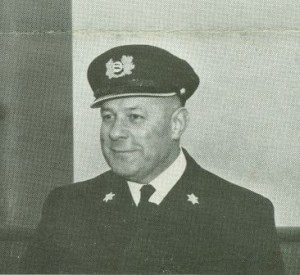
Jacob Matthias Stamperius was born at Goes on 18 September 1884. “Goes” is a small city (it has city rights) located in the Dutch province of Zeeland in the Netherlands to the South of Rotterdam. His father was Leonardus Stamperius and his profession was Baker and was located in Goes. His mothers name was Clara Hugonia de Kater.
ED: As I could not find any school records I do not know where Jacob went to school but the company records indicate that he came to Holland America directly from school for his cadet year. Goes is sort of halfway between Rotterdam and Vlissingen by train, so he could have gone either way as both cities have Maritime schools.

The ss Rotterdam (III) had been built for Holland America in 1897. She would only have a short career with HAL as she was sold in 1906 to Denmark. She could carry 212 in First Class, 112 in Second class and 837 in Third class with a tonnage of 8187. Stamperius was one of the 90 crewmembers on board. (c)
On the 12th. of August 1903 he was placed on board the ss Rotterdam (III) for most of his cadet year but did 2 months at the end on the cargo ship ss Amsteldijk (I). Then he went back to school and passed his 3rd mate certificate on 23 December 1904.
He returned to Holland America and then made steady progress through the ranks. Receiving his first assignment as captain of the ss Zaandijk (I) on 23rd. of March 1915.

The ss Zaaandijk (I) of 1899. This ship still very much resembled a sailing ship with a bow sprit, a bow figure and barque like stern. (c)
Mostly likely because Captain Stamperius did not opt to join the Netherlands Royal Navy Reserve program his career was mainly on the cargo ships. This apart from a 4 day fill in on the (then new) Veendam (II) in 1923 when the Sr. Captain assigned to the ship was not available. He sailed the ship from Rotterdam to Santander where a more Senior captain took over.
During World War I he is lucky, as although he sailed most of the time on the north Atlantic service to New York, he was never involved in a war like situation. Not until 17 July 1917 when his ship the ss Amsteldijk (I) (the same ship he was a cadet on) is seized by the US Government as the USA entered World War I. The Amsteldijk had been laid up in New York since 29 June 1917 as Holland America found it too dangerous to sail its ships due to the “Unlimited U-boat war” whereby now also neutral ships were targeted on purpose.
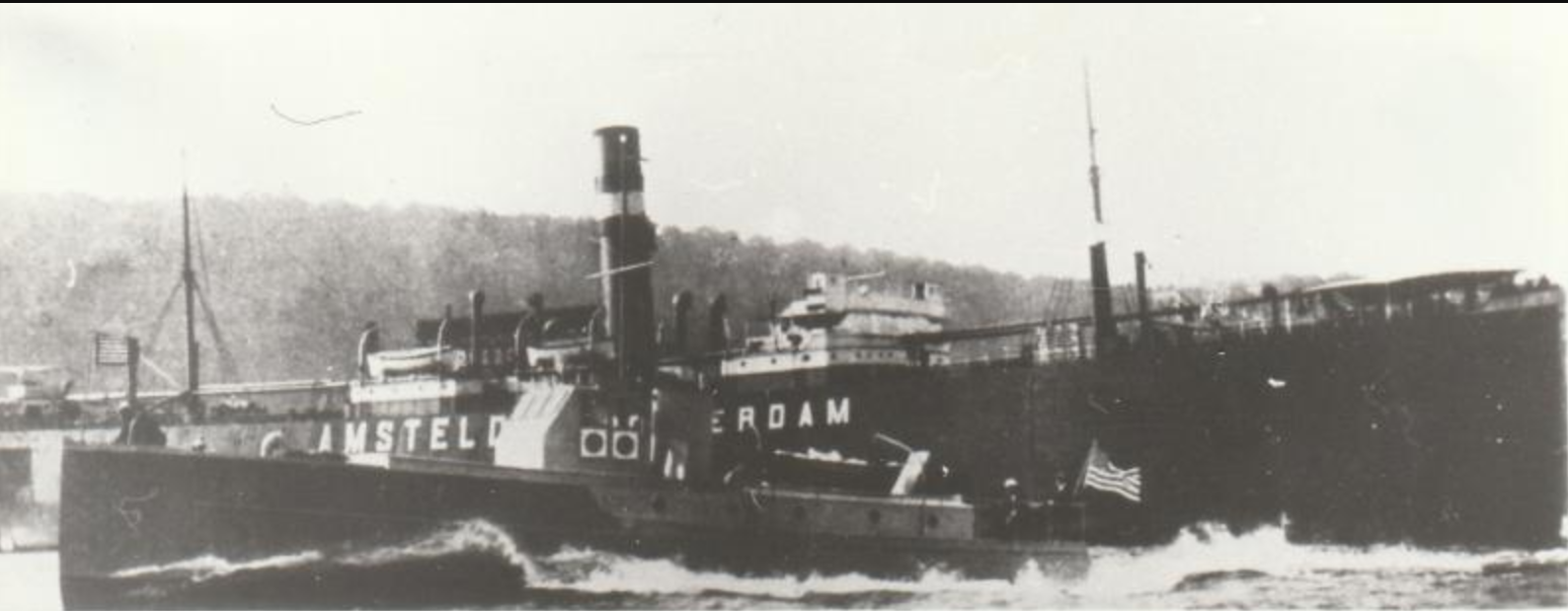
The ss Amsteldijk (I) seen here during World War I with neutral lettering on the sides. (c)
Captain Stamperius remained with his ship until 19th. of August 1918 when the US Government actually took over the ship with the intention to use it for war purposes. As the Kingdom of the Netherlands was neutral during the First World War, Holland America could not keep its crews on board and Stamperius returned home as a passenger on board the ss Nieuw Amsterdam (I); together with many other HAL crews who were in the same situation. The ss Amsteldijk (I) indeed entered service for the USA, as the USS Amsteldijk and made voyages to South America.
Somewhere after WWI he married Jennet Cornelis van Schaik (born 12 Feb. 1887) and settled down in Rotterdam. On 06 April 1920, a daughter Helena Jacoba Cornelia was born, followed by Jeannette Cornelia on 16 January 1922. There are no records of other children.
For any family member or relative who reads this biography, I do not know anything about the captains family circumstances. So if you have any information, or want to share some photos, please contact me on CaptAlbert1@aol.com. It would be nice if we could make this biography more complete.
An unusal moment in his career was the assignment to the ss Hoogkerk of the V.N.S (United Steam). Several Dutch companies including HAL had jointly founded in 1920 a new company which was to focus on services from The Netherlands to the Far East (as far as China) and also around South Africa. Until 1929 Holland America made ships and crews available for this new company. It only stopped when the VNS had enough own ships and crews available.

The ss Hoogkerk of the VNS. Built in 1911 for a German company it was bought in 1921 by the VNS and renamed in Hoogkerk. (Photo Courtesy: Wikimedia, open domain)
Thus Captain Stamperius was assigned from 14 May 1923 to 10 October to the ss Hoogkerk which was not owned by HAL. He made one voyage from Hamburg via the Suez Canal to as far as Rangoon and Colombo and then back again.
On 03 December 1929 he was assigned to the ms Drechtdyk, which was in service on a route from Rotterdam through the Panama Canal to Vancouver. On average a 3.5 month round trip. On this route he remained until assigned to the ms Zaandam (II) in 1939. All the ships on this service (carried out together with British companies) had names starting with the letter D and when switching ships he was also in command of the ms Damsterdyk and ms Delftdyk.

The ms Delftdyk, seen here entering Vancouver Harbour. Photo taken from a vintage point at Stanley Park.
The Delftdyk had entered service in 1929 and Stamperius was assigned to her on 11 August 1932. Ports of call included London, Swansea, then the crossing and Willemstad, Puerto Colombo, Panama Canal Guyaqui, Los Angeles, San Francisco , Seattle, Vancouver, and then south again. However, if there was somewhere cargo available, many other ports could be included. From the westcoast came paper products and wood and from middle America tropical plants and other local products. The ms Delftdyk had a capacity of 30 passengers in First Class accommodation. The companis marketing machine mainly targeted businessmen to sail with the D ships, so they could either sail with their cargo to the port of destination or conduct business in each port the ship stopped. A lay-over was often a few days, even ample time to meet business relations.

The main lounge on board the ms Delftdyk. For a cargo ship with only a small passenger capacity (30 pax.) its was of a first class standard and the D-ships were very popular with the travelling public (c)
What Holland America had not expected, but was a nice extra revenue earner, was that during the school holidays many families opted for a coastal voyage. Taking one ship down the coast and the next one in the liner service up the coast again; to go sightseeing in each port . (And vice versa)
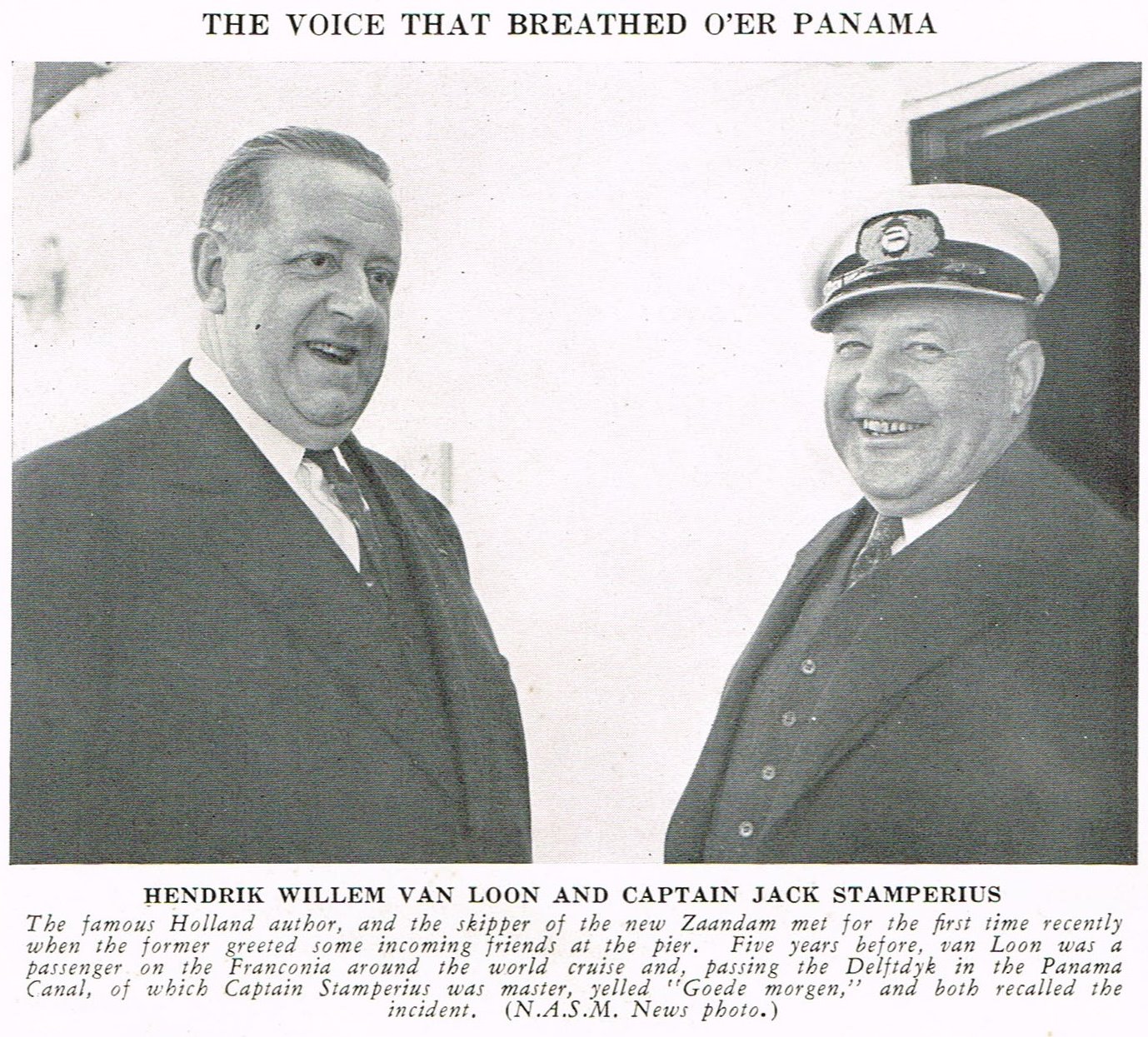
Meeting at sea. This photo is one of the very few photos that exist in the HAL Archives (NASM news) depicting captain Stamperius. Many HAL captains were very adverse of publicity but when assigned to the passenger (cargo ships) a certain amount of P.R could not be avoided.
By 1938 he had been in HAL employ for 34 years and his seniorty started to count. Hence he was assigned to the new Zaandam (II) one of the four Passenger Cargo ships built by HAL for the direct Rotterdam to New York service. He took the ship out for 4 trial trips (The ship had some engine issues in the beginning) and then on its maiden voyage from Rotterdam on 07 January 1939.

The ms Zaandam (II) as built. Seen here departing for her final trial trip from Rotterdam to the North Sea.
With a capacity for 125 passengers in First Class accommodation, the ship initially sailed on the service to New York. Although this was meant to be a direct serviceb, ut until the war started it also called at Plymouth (England), then New York, followed by Paulsboro, Philadelphia and then back to New York, before crossing back to Rotterdam. Apart from general cargo, grain was an important part of the cargo which was loaded in bulk in the cargo holds.
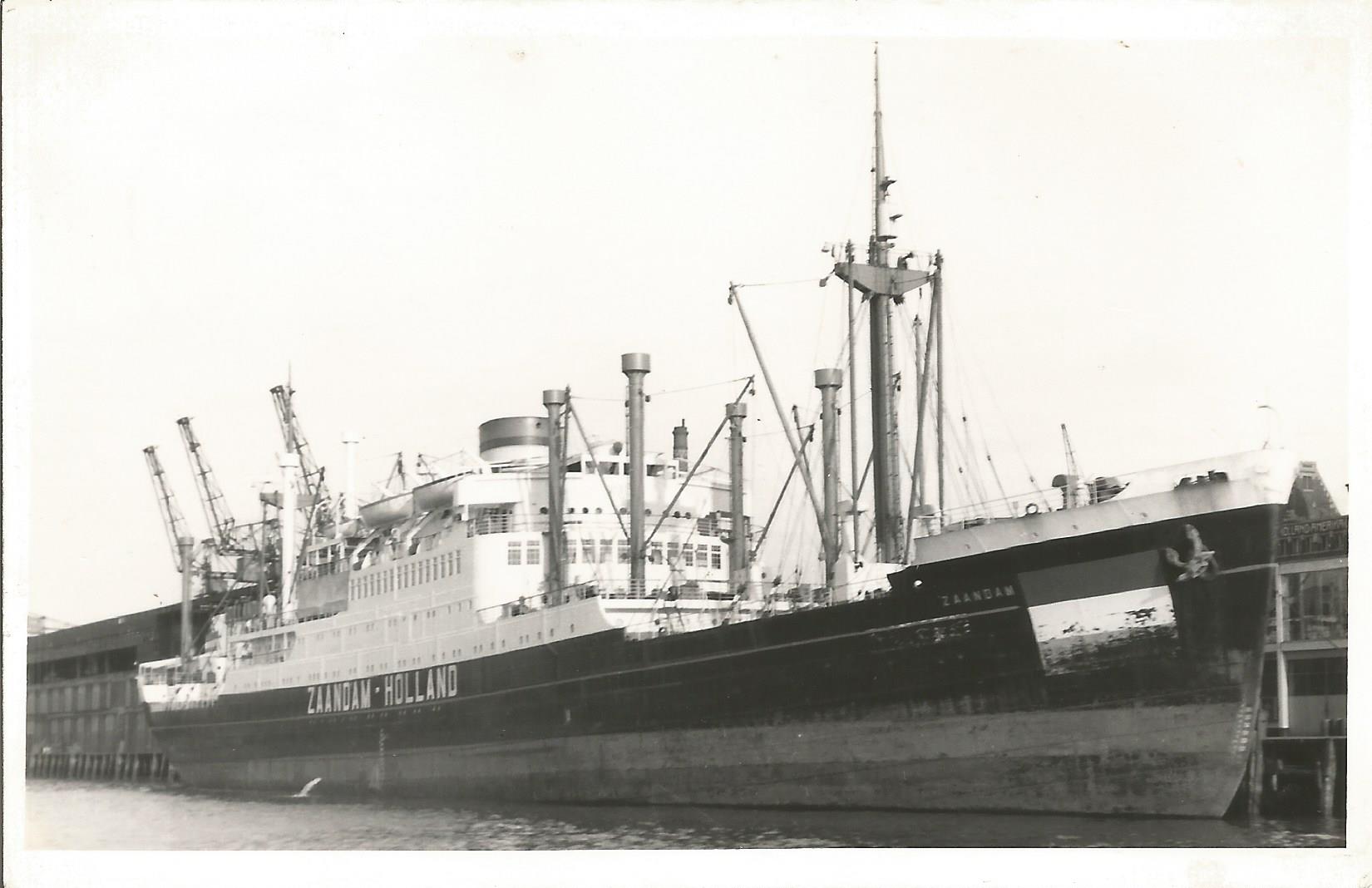
The ms Zaandam (II) with the neutral lettering and the Dutch flag on the side of the ship. Seen here docked in Rotterdam (c)
By April 1940, the chance of the Netherlands becoming involved in the 2nd World war was so great that it was decided to move the Zaandam and her sister the ms Noordam (II) to the Dutch East Indies service from New York. First sailing via Capetown but later via the Panama Canal and the West Coast of the USA,
By the beginning of 1942 the Dutch Government became very concerned about the rapidly advancing Japanese Troops, so it decided to startevacuating as many Dutch Citizens as possible from its colony in the Dutch East Indies (After 1945 Indonesia).
The Zaandam had arrived in Tjilatjap (Located on the island of Java) on 10 February1942 coming from San Francisco with a cargo of fighter planes to be used against the Japanese. The planes were not landed as it looked that they would not make much of a difference against the fast approaching Japanese and the ship was to be diverted to Melbourne to safe guard them.
The captain reported about this voyage: He first sailed on Feburary 27 with the expected order to return the next day. Before sailing the ship had received two – 37 mm Anti-Aircraft guns and a 4 inch deck gun. Also 4 machine guns had been promised but they did not make it before departure. For the manning of these guns there were 2 professional gunners on board. The ship’s sailors had been trained as well and continued training under the instruction of the 3rd. officer. The A.A guns were manned by members of the Hotel department, available until the passenger accomodation would be used again. Constant watch was maintained and training continued as the ship had 200 training grenades on board.
On the morning of the 28th. the ship was about 100 miles away from the port, in open waters ,sailing towards Tjilatjap again at 16 knots, while maintain a e xtensive zig-zag course. (Against torpedoes). The Radio Officer constantly reported S.O.S signals and thus the whole ship was on full – battle -stations. At 08.30 hrs. 3 air planes were seen approaching on the port side. As these had to be Japanese fire was opened at once and the Engine Room was advised to provide full speed. The captain started, with the ship now at full speed, making circles and he was very happy with the ships maneuvrebility (Quote: she turned like a rowing boat) The protective fire was sucessful and the 3 planes disappeared into the clouds. Then it turned out that the ship had shot down its own radio antenna but luckily an emergency attenna was available. After some time the 3 planes showed up again and the ship responded with full fire again and making circles. All as an attempt to make it as difficult as possible for the pilots to aim properly. Four or five bombs were dropped near the stern, which all missed the ship but splinters were later found on deck. The planes returned again, now aiming for the funnel which was perforated. Again four or five bombs were dropped near the bow and again splinters where found on deck. Then the planes disappeared. It was later theorized that the airplanes had not expected any resistance from the ship as at that moment most merchant navy ships in the area where still un-armed.
Once back in port, the evacuation of the area started and in total 892 civilians were embarked. On the 6th. of March the ship finally sailed from Tjilatjap to Melbourne in Australia. A total of 30 ships were involved in this operation and 11 of them did not survive the journey.
While on the way Captain Stamperius stopped at sea, still within reach of the Japanese, and saved 30 survivors of the ss Tomohon (Royal Dutch Paket). About 600+ evacuees were landed in Fremantle and the remaining 309 at Melbourne. (d)
Then with the Netherlands occupied by Nazi Germany and the Dutch East Indies over run by the Japanese, the Dutch government seized the last ships the company still had trading, for the war effort.

There are not many photos of the ms Zaandam (II) in war colours as the ship was sunk so early in the war. (ED: this is the only photo I am aware off) (c)
As the ship was in the Pacific, she and her sister were chartered out by the Dutch Government to the USA for war service. The Americans were very happy with these sort of ships as it gave the option to transport war materials such as airplanes or tanks and with it a complete group of maintenance staff. The ms Noordam (II) stayed in the Pacific but the Zaandam was directed to New York.
There on 13 July 1942 she joined her first convoy (WS 21P) to sail to the Clyde in Scotland and from there to the south point of Africa. From Capetown the ship was sent to Aden and then back again to Capetown arrving there on 02 September 1942.
After waiting for her next instructions for nearly 6 weeks, the Zaandam left Capetown on 21 October and was to sail without any escorts to New York. On board were 128 crew and 174 passengers (mainly crews of American ships that had been torpedoed in the Capetown area). A group of American Marines were on board for manning the various guns.
The ship sailed across the South Atlantic with the plan to follow the Brazilian coast northbound and thus be as much as possible in American controlled waters, or at least as far was possible away from patrolling German U-boats.
On 02 November at 16.27 hours the ship was hit by a torpedo on the portside in the aft part of the engineroom. This caused all machinery to stop. The ship started to list quickly and sink rapidly. At 16.32 the ship was hit by a 2nd torpedo and sunk within 30 seconds. The U-boat (U – 174 commanded by Ulrich Thilo) then surfaced and questioned the crew in one of the lifeboats. 2 lifeboats had been destroyed and one damaged . Two others with 106 persons on board set sail for the shore and where picked up on 07 November by the American Tanker ss Gulf State who landed them at Trinidad. A 3rd lifeboat, damaged and capsized, was rightened and provionally repaired. It sailed around the area and collected about 60 people. They also headed for the coast and landed on 10 November on a beach in Brazil. Apart from having two holes in the ship, the fact that it was loaded with copper ore for the USA did not help with staying afloat for very long. The ship sunk in position 01o 16′ North and 036o 51′ West. This is about 100 miles East of the Amazon River estuary.
In total 69 people died, including Captain Stamperius (*), 10 Javanese crew and 10 Americans. Also among the casualties was Captain Wepster, who sailed with the ship after having been relieved from command of the ss Nieuw Amsterdam (II) in Capetown. He was on his way to New York to be assigned to another ship. 3 crewmembers were found after 83 days at sea floating on a raft. The remarkable thing wass that they all returned to service after having recuperated. This survival record stood for a very long time until a sailor of a sunken ship survived for 103 days under similar circumstances.
(*) Note: Declaring somebody dead whose body was never found is not that easy and there is normally a certain waiting period required, just in case the supposed-to-be-deceased suddenly turns out to be still alive. That rule is the same for everybody also for those lost at sea. Although it was certain that Captain Stamperius perished on 02 November 1942, it was not until 20 March 1954 that the Regional Court in Rotterdam officially issued a death certificate. His name is engraved on the Holland America Line War memorial with 263 other HAL personnel. This memorial is located in the borough of Katendrecht in Rotterdam opposite the stern of the hotelship, the ss Rotterdam (V).
In the 1960’s Holland America Line was involved with helping a Public Housing Association with creating 5 Apartment buildings in Dordrecht. Holland America Line personnel could rent a flat here as with the post war baby boom housing was scarce. These apartment buildings were all named after Merchant Navy captains who had perished during the war and the complex was opened on 10 May 1965. One building was named after our captain and is known as the “Stamperius flat”. (Witte De With straat postal code 3333 CG, Dordrecht) A plaque was placed in the lobby as a memorial.

The entrance to the Kapitein Stamperius Flat in the town of Dordrecht. (b)
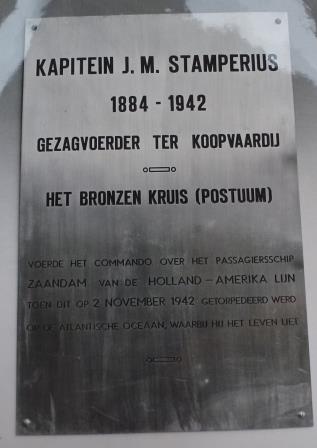
The plaque installed in the Flat. (c)
Decorations:
- June 1920, silver medal of the Royal Netherlands Meteorological Institute (KNMI) for the careful maintaining of weather observation journals.
- Posthumously the “Bronze Cross” of the Dutch Government.
- Posthumously Dutch War Memorial Cross with 3 bars. ( War service Merchant Navy 1940 – 1945). (Java Sea 1941 – 1942) (East Asia – South Pacific 1942 – 1942)
Sailing List: (a)
Date: Function: Ship: Wages and/or remarks.
03 Aug. 1903 Joined Holland America
12 Aug. 1903 Cadet Rotterdam 10,–
19 Feb. 1904 Cadet Rotterdam 15,–
17 Aug. 1904 Cadet Amsteldijk 15,–
29 Sep. 1904 Temporary dismissed to go to school for 3rd mates exam. Passed 23 Dec. 1904
27 Jan. 1905 Act. 4th. officer Statendam 20,–
14 Apr. 1905 4th. officer Statendam 30,–
11 Oct. 1905 4th. Officer Soestdijk 30,-
09 Apr. 1906 4th. officer Sloterdijk 30,–
18 May.1906 4th. officer Soestdijk 30,–
02 Jun. 1906 4th. officer Potsdam 30,–
26 Oct. 1906 3rd officer Potsdam 40,–
16 Jan. 1907 3rd officer Noordam 40,–
07 Feb. 1907 Temporary dismissed due to illness
13 Feb. 1907 3rd. officer Rijndam 40,–
18 Sep. 1907 Temporary dismissed to go to school for 2nd mates license Passed 16 Dec. 1907
23 Dec. 1907 3rd officer Noordam 50,–
02 Jan. 1908 3rd officer Soestdijk 50,–
03 Apr. 1908 2nd officer Soestdijk 60,–
15 May 1908 3rd officer Soestdijk 50,–
30 Nov. 1908 3rd. officer Potsdam 50,–
18 Jan. 1909 3rd officer Soestdijk 50,–
03 May 1909 2nd officer Rotterdam 60,–
05 Nov. 1909 2nd officer Rotterdam 70,–
19 Dec. 1909 Temporary ashore to go to school for 1st mates license passed 09 march 1910
11 Mar. 1910 Act. Chief Officer Maartensdijk 100,–
01 Jan 1911 due to wage review 130,–
26 Feb. 1911 2nd. Officer Nieuw Amsterdam 130,–
01 Aug. 1911 promoted to chief officer 140,–
01 Aug. 1911 Chief Officer Maasdijk 140,-
31 Oct. 1912 Chief Officer Zuiderdijk 150,-
31 Oct. 1912 wage increase 150,–
23 May 1913 Wage increase 160,-
27 Feb. 1914 Chief Officer Zuiderdijk 175,–
28 Jul. 1914 Chief Officer Potsdam 190,–
18 Mar. 1915 Temporary ashore
23 Mar. 1915 Captain Zaandijk 250,–
26 Nov. 1915 Captain Westerdijk 250,–
10 Jan. 1916 Captain Poeldijk 250,–
24 Oct. 1916 Captain Amsteldijk 250,–
01 Aug 1918 Wage increase 300,–
19 Aug. 1918 temporary ashore returns with the ss Nieuw Amsterdam
16 Dec. 1918 Captain Zijldijk 300,–
01 Jul. 1919 Wage increase 625,–
07 May. 1920 Captain Waaldijk 625,– with the Rotterdam to N.Y
01 Jan. 1920 Wage increase 650,–
15 Oct. 1920 Wage increase 675,–
06 Jun. 1921 Captain Burgerdijk 675,–
06 Oct. 1921 Temporary ashore
Suspended for a period of six months starting 01 Oct. 1921
16 Oct. 1921 Wage decrease 610,–
03 Apr. 1922 Captain Zijldijk 585,–
16 Oct. 1922 Captain Boschdijk 585,– At Belfast
26 Oct. 1922 Captain Schiedijk 585,–
14 May.1923 Captain Hoogkerk 625,– In service with the VNS
10 Oct. 1923 Temporary ashore
10 Nov. 1923 Captain Veendam 585,–
14 Nov. 1923 Captain Spaarndam 585,– At Santander
22 Nov. 1923 Temporary ashore
13 Dec. 1923 Captain Boschdijk 585,–
24 Dec. 1923 Captain Schiedijk 585,–
16 May. 1925 Wins the silver medal of the Royal Dutch meteorological Institute.
24 Aug. 1925 Captain Westerdijk 585,–
15 Mar. 1926 Temporary ashore 585,–
17 Mar. 1926 Captain Andijk 585,–
01 Apr. 1927 Captain Andijk 605,– wage increase
16 Aug. 1927 Captain ashore 605,– regular leave
19 Aug. 1927 Captain Bilderdijk 605,–
11 Feb. 1928 Captain Vechtdijk 605,–
01 Jan. 1929 wage increase 625,–
23 Mar. 1929 Captain Moerdijk 625,–
24 Nov. 1929 Temporary ashore 625,– assigned to Drechtdijk
03 Dec. 1929 Captain Drechtdijk 625,–
01 Jan. 1930 Wage increase 645,–
02 Jul. 1931 Captain ashore 645,–
12 Nov. 1931 wage decrease 516.—
And put on 70% standby money
30 Nov. 1931 Captain Damsterdijk 516,–
13 Jul. 1932 Temporary ashore 70% 516,–
11 Aug. 1932 Captain Delftdijk 516,–
01 Nov. 1932 Wage decrease 466,–
28 Jun. 1933 Wage decreased with 5% in acc. with circulaire no 929 dated: 27 June 1933
28 Dec. 1933 Wage decreased with 5% in acc. with circulaire no 929: dated 27 june 1933
01 Oct. 1934 Wage decrease 403,–
26 Nov. 1936 Captain Delftdijk 403,–
01 Oct. 1937 Accordance to new regulations 455,–
01 Dec. 1938 Captain Zaandam for trial trips and onwards.
15 Mar. 1940 Captain Zaandam
05 Mar. 1941 On leave during coastal trip until 25 march
25 Mar. 1941 Captain Zaandam
01 Aug. 1941 Captain Temporarily placed ashore (03 August to 13 November on leave at San Pedro, California)
20 Nov. 1941 Reassigned as Captain to the Zaandam.
02 Nov. 1942 Captain Zaandam / went down with ship
20 Nov. 1942 Captain London Dutch Government awards the Dutch Bronze Cross.
Sources:
a. Stamboek & Mouvement boeken of the HAL Archives as held by the Municiple Archives of the City of Rotterdam.
b. Photo of flat entrance: Courtesy Google Earth.
c. Photos from Captain Albert collection.
d. Information from the captains voyage report provided by Maritime Historian Laurens van der Laan.
Last Updated: 27 August 2025.
August 23, 2025 at 9:21 pm
Hello,
I am writing a history paper on the sinking of the MV Zaandam II and would like to use the photo of Captain Stamperius in my paper for possible publication in a maritime journal. I would gladly credit you and your website in my paper with the photograph.
Sincerely,
Eric Pearson
P.S. My father sailed as Captain for American Export and Lykes Lines before becoming a pilot for the Port of Houston. I am a retired NASA programmer.