Dulken Van, Johan
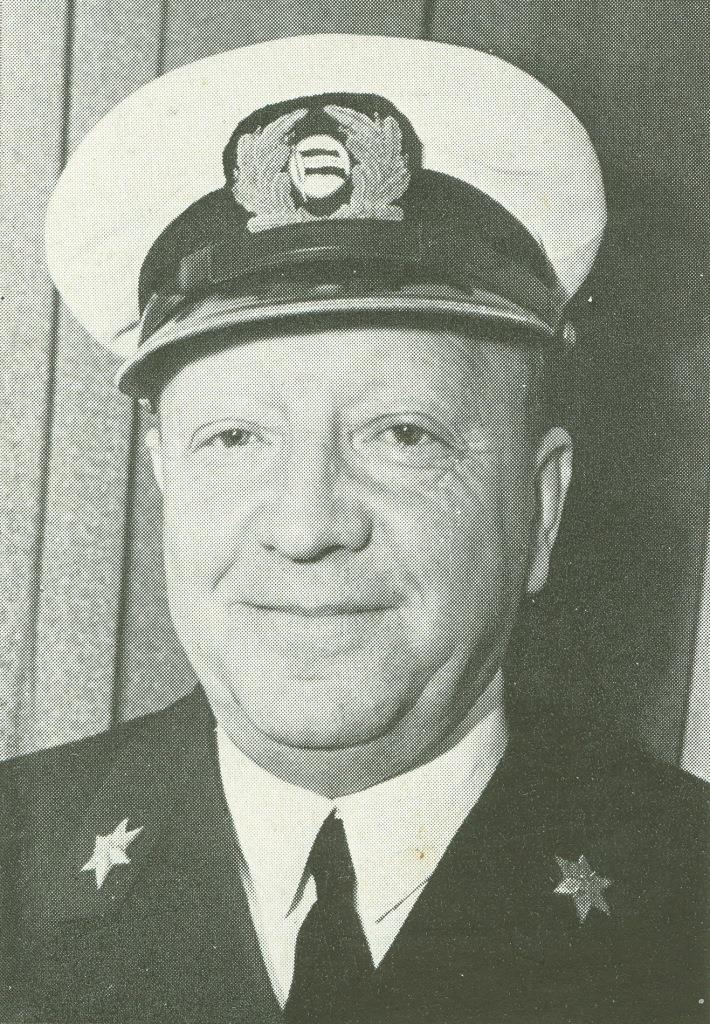
Captain Johan van Dulken This is a 1939 company photo. (b)
Johan van Dulken (calling name “Jo”) was born on 09 August 1882 in Rotterdam as the son of Hendrik Pieter van Dulken (his profession being given as a “Haulier”) and Johanna Elizabeth van Os. In 1890 his mother passed away. (g)
It is assumed that he attended the Maritime School in Rotterdam but this can not be verified as no records of this school survive from before 1936.
Upon completion he joined the Holland America Line as Cadet on 01 August 1899 and was placed on board the ss Rotterdam (III), a passengership which had just been superseded as the flag ship of the company by the ss Statendam (I) of 1898. While most cadets served on at least 2 ships, Jo van Dulken remained for the full year assigned to the ss Rotterdam (III).
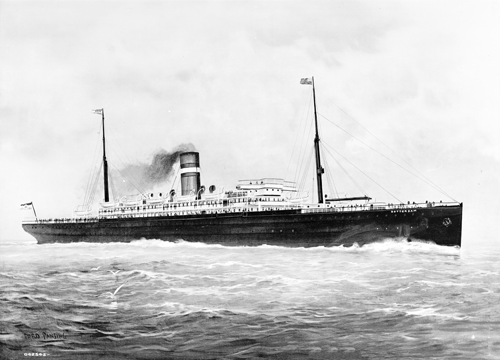
The ss Rotterdam (III) of 1897. There are only 5 or 6 photos known of the ship but the company also had artists commissioned. This is a painting by Mr. Fred Pansing of New York, who later would design a whole series of company postcards. (a)
In November 1901 he moved from Rotterdam to Utrecht with his father. He had remarried in 1891 with a widow who had a daughter who was going to follow a study for Apothecary. This daughter might therefore have met in 1902 a lady called Ida Istace (*) who had come from Paris to study for the same career . Most likely the two ladies met at school and through his stepsister, Jo van Dulken might have come in contact with his future wife, Ida Istace. In any case they were in contact in 1905, as Jo sent her some postcards, postmarked 1905 Hoboken. (g)
(*born 06 Dec. 1885 at Brussels as one of 8 children to a Belgian father an a Dutch mother. While in the Netherlands she stayed with the grand parents from her mothers side)
After obtaining his 3rd mates license he returned to the company and was assigned to the ss Maasdam (II) one of the older units of Holland America. He remained on the passenger ships until he made captain in 1912, when in accordance with the company seniority system, he was assigned as the youngest captain to the oldest / smallest ship. And indeed he was assigned to the ss Soestdijk (I) which was the first – cargo only – ship built for the company in 1900.
Ida Istace’s parents, orignally from Utrecht had moved via Brussels to Paris and where still living there when Johannes and Ida decided to get married. Thus the two married on 06 July 1909 in Paris but settled down in Rotterdam in the Lusthofstraat. This street survived the war unscathed and is a main shopping street in Rotterdam North. (Suburb of Hilligersberg). (g)
Eventually there were 3 sons:
Robert Jules Pieter Hendrik (Born 02 March 1911 at Rotterdam)
Emile Leopold (Born 23 July 1913 at Rotterdam)
Johan (Born 27 March 1917 at Rotterdam)
They remained in Rotterdam and the family was listed as living at Statensingel 120b during the war years. The address still exists and is a first floor apartment with its own entrance on the groundfloor. This sort of apartment in Rotterdam was very much in favor by people at sea as with the husband away there was no garden to look after.
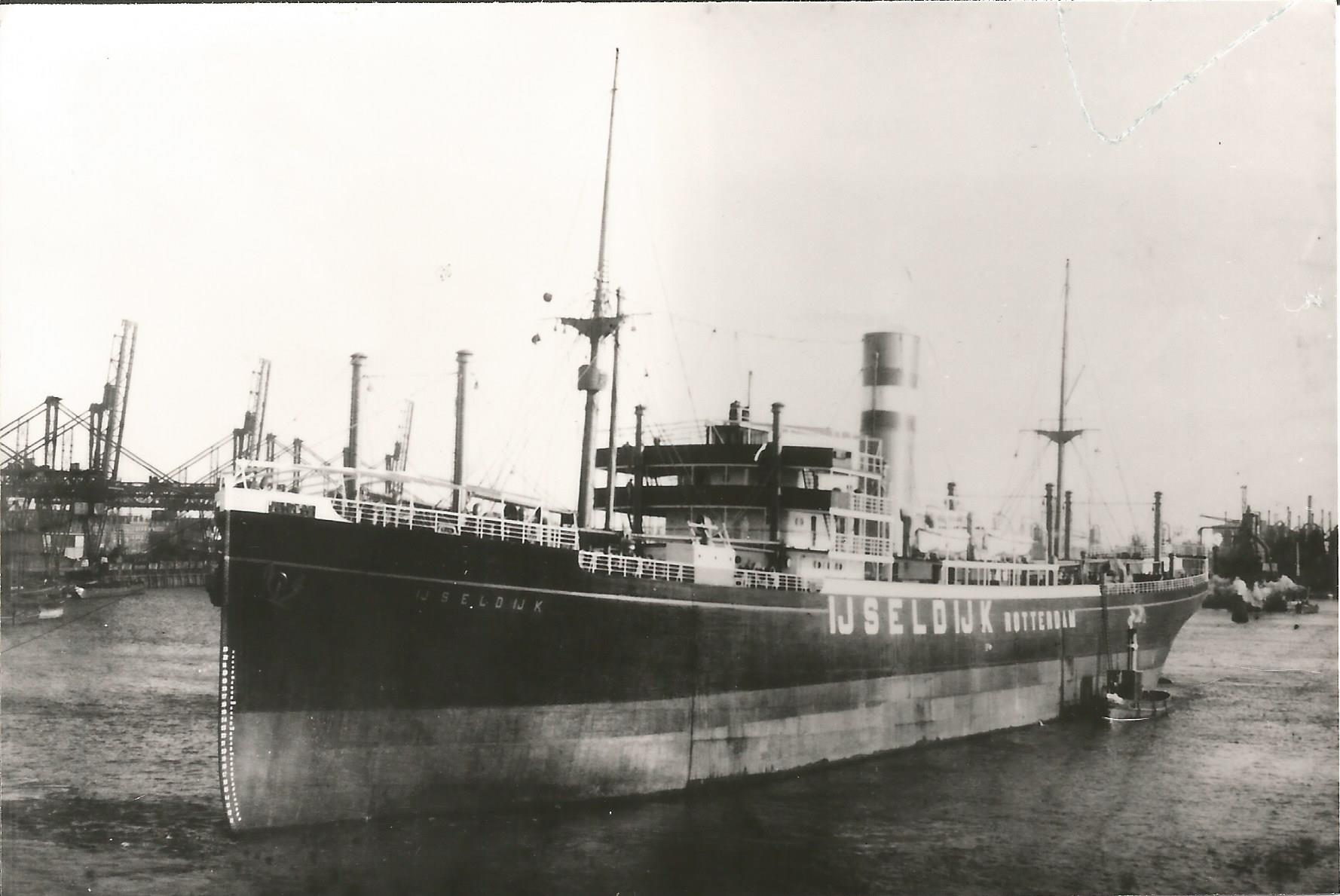
The ss IJseldijk of 1916. Built in the Netherlands she would eventually be transferred to United Steam (VNS) in 1921, a new company in which HAL participated. In 1926 she was taken over by the VNS and renamed in IJselkerk. This photo is from the first world war period as the neutral lettering can be seen on the side so it must have had Captain van Dulken on board. (a)
In 1916 he was assigned to a brand new ship, the ss IJseldijk, named after one of the rivers in the East of the Netherlands. Built in the Netherlands it commenced its maiden voyage on 02 December 1916.

Van Dulken as captain in his early years on the bridge of one of the HAL cargo ships holding a sextant. (a)
In December 1917 she was put on the East Indies Line of the company which ran from New York to the Dutch and British Far East (Singapore etc.) This was a long route service and each HAL officer was assigned to this service eventually which meant being away from home for a year.
This was the routine in peace time, a maximum of one year away.
However World War I was going on and by 1918 hardly any ships could return to Rotterdam and who could have taken Van Dulken on board. As a result he left Rotterdam on 17 March 1917, had a period up of lay up in New York due to the U boat danger on the North Atlantic and was then assigned to the Far East service. He was finally relieved in New York on 21 March 1919 and then came home with the ss Rotterdam (IV) as a passenger. Having been away for just over 2 years.
He received two months vacation and was then assigned to the next cargo ship. In 1923 and 1924 he was asked to sail as 2nd Captain on board the ss Rotterdam (IV) for the long cruise to the Holy Land from New York.Contrary to the North Atlantic service, on cruises the captains were expected to socialize a lot more, and hence a “2nd captain” was very useful. Before that he had made one voyage on her as captain. (Voyage 103 between 15 November and 17 December) This to fill the gap between the old Commodore and the new one.
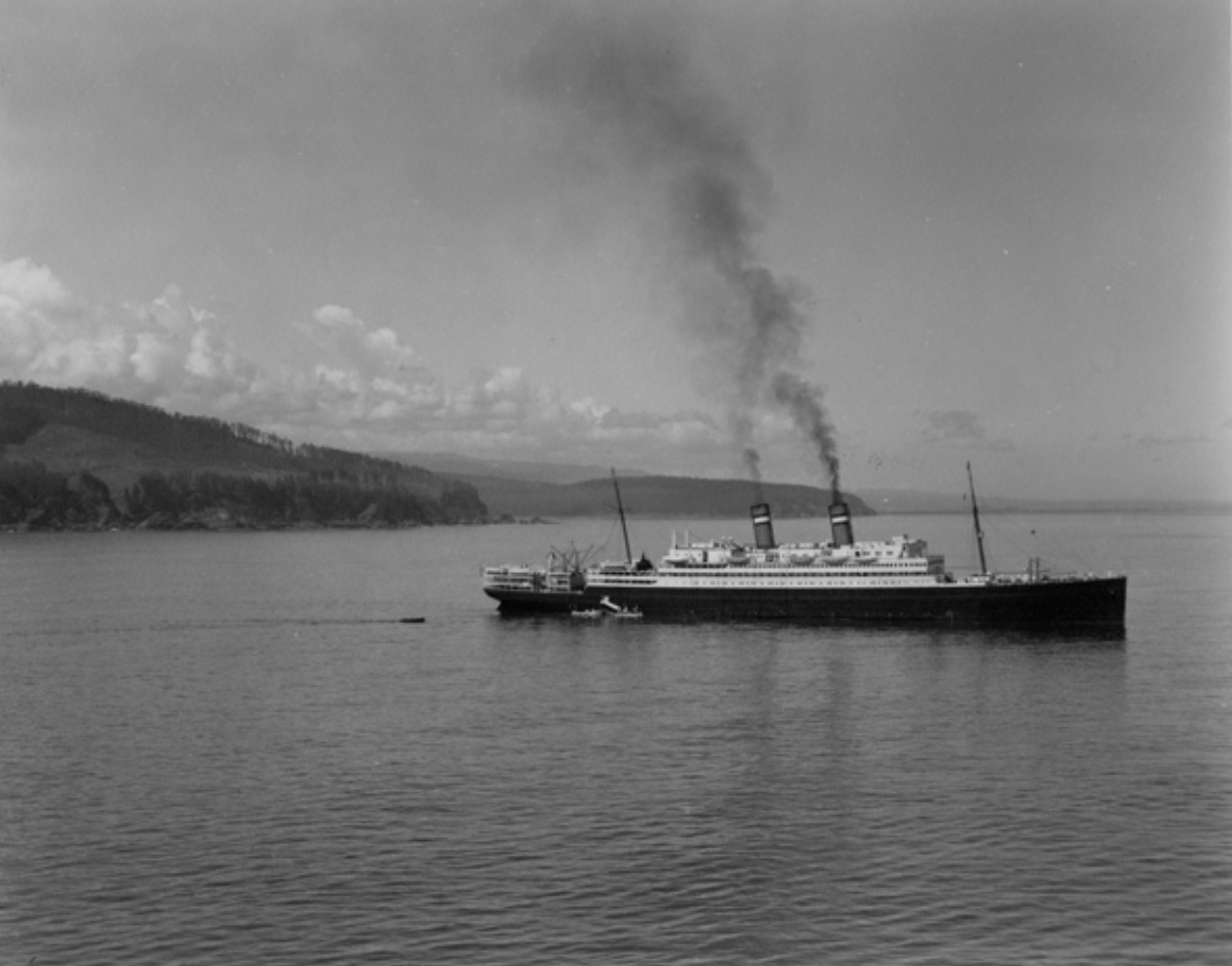
The ss Rotterdam (IV) at anchor off an European port during one of her long cruises. (a)
In between there is a voyage on the cargo ship ss Moerdijk (I) from Rotterdam to Vancouver. Holland America had begun this North Pacific service with some ships that had cool and freeze capacity. (First with charter ships before the first world war and then with own tonnage after the war). The service was maintained as a joint venture with British Companies, with a mixture of cargo only ships such as the Moerdijk (I) and cargo ships with an enlarged passenger capacity (Eventually reaching up to 100 passengers). In August 1924 he made one voyage on such a ship, being the ss Dinteldijk (I).

Air Photo of the ss Dinteldijk (I) seen here on departure fron Vancouver. This is roughly the location where later the “Lions Gate” Bridge would be built. (a)
While in command of the ss Moerdijk (I) he had a collision with the english steamer ss Cito while homebound for Rotterdam (arrival 01 Nov.). The ship sustains several damages on the starboard stern at hatch no 7. The ss Cito continues to London with damage to the anchor hawse pipe and goes in dry dock. Captain Van Dulken is cleared of any blame during the subsequent Board of Inquiry investigation (Dutch: “Raad voor de Scheepvaart” located in Amsterdam) as the ss Cito un-expectedly turned to port and crossed over, hitting of the stern of the ss Moerdijk (I).
Then it is back to the passengerships.

The ss Leerdam (II) aground on the islet of Topo off the coast of the larger island Sao Jorge. (a)
While in command of the ss Leerdam (II), (bound for Havana) the ship ran aground on 06 July 1929 on St. George Isle (Sao Jorge) in the Azores. The 150 passengers were taken ashore but later reboarded when it became clear the ship was still sound. She then sailed to Fayal in the Azores . Some tanks were reported leaking and as repairs could not be made in Horta the ship returned to Vigo in Spain. The passengers remained in Horta and were there picked up by the ss Spaarndam (II) on July 16. The ss Leerdam (II) is subsequently found to be in a good enough condition to sail to Rotterdam (arrival 18 July).
Later the Board of Inquiry decided that the captain had sailed too close to the shore while approaching the next port. Holland America partly agreed with this and suspended Van Dulken (so no pay) for six months but then assigned him as captain again in January 1930 to the ss Sommelsdyk (II), being the oldest ship in the fleet and about to be sold. Reason for the company to keep him on, and in rank, was that HAL shoreside was not without blame themselves as their nautical department had sent him to sea with an outdated chart for the area.

The ss Sommelsdyk (II) built in 1909 and acquired in 1912 by HAL together with several other ships. (a)
By May 30 he is back on the passengerships and he is put in command of the ss Nieuw Amsterdam (I), followed by the ss Veendam (II) and then the ss Rotterdam (IV) in 1932. Due to the depression this ship made a large number of cruises in the 1930’s as the flagship of the fleet (the ss Statendam III) could maintain the North Atlantic express service easily by herself in the winter months. The ss Rotterdam (IV) normally made 8 or 9 West Indies cruises from New York in January, February and March and then at least one long cruise from New York to Northern Europe in the summer. By 1933, there were then also Autumn cruises from New York to the West Indies added.

This is a very wellknown press photo of the ship aground. The photo was taken from the ss Ariguani while in position for taking over the passengers. (a)
Captain van Dulken was once again unlucky when on 30 September 1935 the ss Rotterdam (IV) ran aground on Morant Cays (South East of Jamaica). The ship was on its way from Curacao to Kingston, Jamaica as part of a West Indies cruise from New york. When are aground you can not sink so its passengers were safe but they were taken off shortly after by the British steamer Ariguani. Crew and (passenger) luggage followed later with the Dutch steamer ss Midas (Royal Boat / KNSM of Amsterdam). The passengers were landed in Kingston and Holland America dispatched the ss Volendam (I) from New York to collect them all and return them to New York (ss Volendam (I) voyage 104a 02 Oct. – 11 Oct. 1935)

The transfer of the passengers to the ss Ariguani. Post huricane weather made for a beautiful day with fairly smooth seas so the whole thing was looked at as being an “excursion”. Please note all the Gentlemen and Ladies are wearing hats, regardless of the situation. (a)
Holland America contracted the Dutch tugboat ss Indus (Smit International) to pull the ship off the rocks. It succeeded after first having paid out 8 anchors and then by having the ship pull on all those anchors (with the anchor and mooring winches) and the power of the tug. The ship was deemed safe to sail to New York and after initial repairs there arrived in Rotterdam at the Wilton shipyard on 09 December. There the final repairs took a full month and then ship went into lay-up until May 1936.
Captain van Dulken once again appeared in front to the Board of Inquiry who decided that he had not navigated carefully and punished him with losing his license for a month. He then returned to sea as captain of the ss Burgerdyk in Febr. 1936. Although the company did not comment publicly on the reasoning of the Board of Inquiry, it most likely did not agree with the decision. (HAL History has shown that this happened quite often)

Captain John van Dulken in his cabin on board the ss Rotterdam (IV) in 1934. The ship had been built in 1908 in late Victorian style hence all the dark wooden panneling. Above his desk photos of his wife and his 3 sons. (a)
ED: If I look at this case, having sailed for most of my career each winter in the Caraibbean Sea, there is the phenomenon that after a huricane is it possible that the normal westerly current under Jamaica can reverse itself to an easterly current. A hurricane (which nornally travels on a west to northwest trajectory) can “push” too much water to the west. Too much water for the Gulf Stream to handle and to flow through Yucatan Strait. That water then flows back creating an un-expected counter current. What could not be known in those days was how strong that counter current would be. Also when there was overcast weather all the ships sailed by dead reckoning (no light houses, no stars and no sun to fix a position) and then this un-expected current could push the ship considerably off track. Nothing could be done about this, however skiful the Master might be. Van Dulken had set a course passing the Morant Cays at a 10 mile distance but it in this case it was not enough. The question was and the Board of Inquiry did not answer that one: “how much should he have stayed clear then ??? Is 10 nautical miles enough of a safety zone or not ???”

The ss Burgerdyk, one of a series of B class cargo ships taken into service by Holland America after 1921 as compensation for the sinking of the ss Justicia (ex Statendam II) during WWI. (a)
From the HAL’s point of view, the ship was on a cruise , it had to go to Montego Bay and it had to arrive on time. It had to sail on time and it had to arrive on time in New York. In New York there a wedding was planned on board with 1000 guests. (And with captain van Dulken as the best man).
So he was sent back to the cargoships although they could have dismissed him, as at that moment during the depression,they had more than enough Sr. Officers to replace him. Remained assigned to the cargo ship ss Burgerdyk until 1938 and then Holland America bought the Red Star Line.
This was originally a British – American – Belgium company operating from Antwerp to New York until it was been bought by Arnold Bernstein of Hamburg, Germany, who was branching out in the (Tourist class) passenger business after having established himself with ships exporting cars.

The ss Pennland when sailing for the Red Star Line but with the funnel markings of the American Line. Most unusual, the ship were had 3 screws as there were not many passengerships out there with 3. Most had 2 or 4 (for the very fast ones)
Unfortunately Bernstein was jewish and thus he ran into problems with the Nazi Regime. By 1938 his American Bankers were getting so worried about their invested money that they decided to sell the two ships while Bernstein was under hosue arrest. (After the war Berstein took those bankers, and Holland America, to court and a better settlement was reached with the approval of Bernstein)
The management of Holland America had been dreaming for years about having a service from Antwerp and bought the company (consisting of the passengerships ss Pennland and ss Westernland) at once. The British crews went home and were replaced by HAL crews. Captain van Dulken was put in command of the ss Pennland. So he was once again back on the passengerships.

The ss Pennland sailing for HAL. This photo was taken on 15 November 1939 when arriving in New York. The second World War had started, the Kingdom of the Netherlands was neutral, and hence the Dutch flag was on the bow and the name of the ship and home country on the side. (Not well visible but the word “land” can just be seen on the Promenade deck . when the canvas covers came down they spelt out the ships name under blazing spot lights) (a)
The ship sailed for Holland America Line’s “Red Star service” from 04 June 1939 to 20 May 1940 on north Atlantic voyages from Antwerp. When the Netherlands were invaded on 10 May 1940, the ship had been kept in Southampton between 05 and 08 may, pending developments and then returned to New York and into lay-up. By June the Dutch Government had given most of the Dutch fleet in charter to the British Ministry of War Transport and hence the ss Pennland became a troopship. She arrived on 17 July 1940 in Liverpool to be converted.
Her first main duty was “Operation Menace”. E.G to carry (together with her sistership the ss Westernland) General DeGaulle with 1200 Free French to Dakar to “liberate” the french colonies there. On arrival it turned out that the French troops there (under command of the Nazi friendly French Vichy Regime) did not wanted to be liberated, they were quite happy with the situation they were in. Not really occupied and also not really having to fight.
De Gaulle did not wanted his French to fight against the local French and it was decided to cancel the operation and land everybody in Freetown Monrovia. The ss Pennland sailed from there to the Caribbean for the transport of prisoners of war and arrived in Halifax, Canada, on 12 December 1940. From there it went to Gourock in Scotland with troops and then into dry dock at Belfast around Christmas 1940.

The ss Pennland on fire and abandoned. This is the only known photo of the ship being on fire and before sinking. Luckily the sea was smooth so the abandoning of the ship was not complicated by wind, sea or swell. (a)
Then a long journey started with taking troops from Gourock to Freetown, onwards to Durban, further with troops to Suez and through the Suez Canal to Alexandria. Here week long repairs were carried out to ready the ship for the invasion by British Troops of Greece to stop the advance of the Germans.
On 03 April 1941, 2400 troops were landed in Pireaus. The ship went back to Alexandria for the next load which were put ashore in Phaleron Bay on 12 April. As the German forces were much too strong for the Allied troops, the ship was directed to Megara Bay to retrieve as many soldiers as possible.

Pennland officers and crew marching across Crete to their rendezvous point for further transport. Note the bare feet. (Photo courtesy: the Estate of Captain A.M van Gemert. 3rd officer at that time)
While on its way there with approx. 300 crew on board the ship is torpedoed on 25 April by a German war plane after several earlier bombings. Four crew die in the final attack. Captain van Dulken was injured in the attack (most likely caused by bomb shrapnel that reached the bridge) and handed over command to his chief officer Peter van Beelen. He could do not much more than order bandon ship as the ship was now severely damaged and on fire.
Luckily the weather was very nice and the British HMS Griffin took all the crew on board. (See the biography of Captain Van Gemert for more details). This Royal Navy ship then damaged the hull so severely by gun fire that the ship sank so it could not fall into enemy hands. The Officers and crew were landed in Crete and eventually Captain van Dulken ended up in New York a few months later. Here he was given a long leave until October 1941 and then went by train to San Francisco to take command of the ss Noordam (II).

The ms Noordam (II) seen here painted in “war time grey” at San Francisco in 1942. (a)
The ms Noordam (II) was first employed for the HAL & Dutch Government on a liner service between the Indonesian Islands and San Francisco. When the US entered the war, the ship is handed over on 18 March 1942 to the US War Shipping Administration in New York and promptly sent back to the South Pacific. Here she operated as a cargo/troop ship supplying the American “Island hopping” forces with troops and goods. She was a very much appreciated ship as, due to being a combo liner, she could carry airplanes in the holds and a complete group of support staff in the accomodation at the same time. She was also known to carry entertainers to the various military camps in the South Pacific. Between 12 October 1941 and 25 July 1942 Van Dulken made 6 voyages (nbr 21 to 27) across the Pacific with the ship going as far as Sydney in Australia to the West, Callao in Peru to the East, Honolulu in Hawaii to the North and viisted many islands in between.
On 25 July 1942 when arriving at San Francisco he was relieved by Captain Lagaaij Sr. (Who was with him during “Operation Menace” while in command of the ss Westernland). Van Dulken had now reached the mandatory sea-going retirement age of 60. He returned to New York and worked as Nautical Inspector at the company’s Hoboken docks until 1945. On 31 August 1945 he departed from New York as passsenger on the ms Delftdyk (Captain Scriwanek) and arrived in Rotterdam on 11 September 1945 having been away from home for 5 years and 7 months. In March 1946 he offiically retired.

Captain van Dulen in front of the NEVAS flag during an exhibition. The pots and boxes on the table are on display to indicate who important the Merchant Navy was for the Netherlands. (g)
In retirement Van Dulken remained active in relation to the maritime profession as in 1946 he was part of a group of people who created Nevas (Netherlands Society for the adoption of ships) with the idea that schools in The Netherlands should adopt a Dutch merchant ship and in that way create and keep interest in the Dutch Mercantile Marine. (The NEVAS was active until at least 1972) He was appointed Vice chairman and shortly after Chairman. This then takes up all his free time in retirement. Part of his promotional work was to facilitate a radio program under the pseudonym “Captain Kromhout” during the (Dutch) National Merchant Navy weeks.
For the many years of hard work in promoting the Dutch Merchant Ships and companies he is awarded the “De Ruyter Medal” on the 22nd of March 1952 . Which is the highest honour in the Dutch Shipping Industry.

Captain van Dulken, on a photo taken sometime after his retirement, after given a TV interview in 1958. The man on the left is the Producer Bert Garthoff and the man in the middle Captain Pieter Lagaaij Sr. (1887 – 1982) (g)
Captain van Dulken passed away at the age of 90 after an eventful career on 03 September 1972 in the town of Bilthoven in the central Netherlands. He had moved there sometime after his retirement as he was a free-mason and could find a place in their retirement home. (“Huize Het Oosten” still exists but is now open to everybody with a positive attitude to life)
He was survived by his wife, his three children, grand children and great grand children.

Captain Jo van Dulken and his wife Ida on the day of their 50th. wedding day anniversary. (g)
Decorations:
Mobilisation Cross Netherlands 1914 – 1918. (Reason unknown)
Gold Medal of Royal Netherlands Meteorological Institute (1923 for services to Meteorology)
Dutch Bronze Cross with commendation (08 may 1942) later retracted and upgraded to the Bronze Lion due to the sinking of the ss Pennland)
Received the Distinguished Service Cross (British DSC) on 01 August 1943 for the leadership shown during the attack and sinking of the ss Pennland while evacuating troops from Greece and assisting the British Royal Navy.
The “De Ruyter Medal” on the 22nd of March 1952. For services to the Dutch Maritime Industry,
Timeline: (d)
Date: Function: Ship: Wages and/or remarks.
01 Aug. 1899 Cadet Rotterdam 10,–
22 Mar. 1900 Act. 4th. officer Maasdam 15,–
24 Aug. 1900 Temporary dismissed to go to school for 3rd mates license. Passed on 16 oct. 1900
26 Oct. 1900 4th. officer Maasdam 30,–
08 Jan. 1901 4th. officer Rotterdam 30,–
01 Jan. 1902 Appointed Ensign extraordinary Royal Dutch Navy Reserve.
03 Jan. 1902 Temporary dismissed for royal Navy Reserve service.
08 Apr. 1902 3rd. officer Noordam 50,–
16 Jan. 1903 3rd. officer Statendam 50,–
24 Jan. 1903 3rd. officer Noordam 50,–
11 Apr. 1903 3rd. officer Rijndam 50,–
15 Dec. 1903 Temporary dismissed to go the exam for 2nd officer Passed 20 Dec. 1903
22 Dec. 1903 2nd officer Soestdijk 70,–
06 Apr. 1904 Act. 2nd Officer Amsteldijk 60,–
04 Jul. 1904 Act. 2nd officer Soestdijk 60,–
26 Mar. 1905 Act 2nd officer Jr. Potsdam 60,–
23 Dec. 1905 Temporary dismissed for Royal Navy Reserve and first mates ticket study passed 14 nov.1906
11 Jan. 1906 Stationed as Ensign first class on board HM Gier.
24 Nov. 1906 2nd officer Sr. Rijndam 70,–
04 Jan. 1908 Temporary dismissed due to illness
02 Mar. 1908 2nd officer Nieuw Amsterdam 70,–
22 Dec. 1908 2nd Offcier Rijndam 70,–
10 Apr. 1909 2nd officer Statendam 70,–
26 Apr. 1909 Chief Officer Noordam 100,–
21 Sep. 1910 Temporary dismissed for the royal navy reserve for a 3 month exercise.
01 Jan. 1911 due to wage review 175,–
09 Jan. 1911 Chief Officer Rotterdam 175,–
06 Feb. 1911 Chief Officer Noordam 175,–
18 Aug. 1911 Wage increase 190,–
22 Mar. 1911 Temporary dismissed awaiting assignment to the ss Soestdijk
02 Apr. 1912 promoted to captain 250,–
02 Apr. 1912 Captain Soestdijk 250,-
23 Oct. 1912 Temporary dismissed. Assigned to ss Zuiderdijk
31 Oct. 1912 Captain Zuiderdijk 250,–
16 Jul. 1914 Temporary ashore
17 Aug. 1914 Captain Gorredijk 250,-
29 Oct. 1914 Captain Zijldijk 250,–
01 Jan. 1916 Wage increase 275,–
06 Jul. 1916 Captain Amsteldijk 275,–
24 Oct. 1916 Temporary ashore
14 Nov. 1916 Captain Ijseldijk 275,–
01 Aug. 1918 Wage increase 325,–
21 Mar. 1919 Temporary ashore arrived home with the ss Rotterdam
26 Jun. 1919 Captain Maartensdijk 325,–
01 Jul. 1919 wage increased 675,–
05 Jul. 1919 Temporary ashore
25 Aug. 1919 Captain Gorredijk 675,–
01 Jan. 1920 Wage increased 700,–
15 Oct. 1920 Wage increase 725,–
08 Oct. 1921 Captain Blijdendijk 725,– with the Harwich boat to Belfast
16 Oct. 1921 Wage decreased 660,–
16 Mar. 1922 Wage decreased 635,–
22 Apr. 1922 Temporary ashore
21 Jun. 1922 Captain Blijdendijk 635,–
11 Dec. 1922 Temporary ashore
05 Jan. 1923 2nd captain Rotterdam 635,–
29 Feb. 1923 Receives the gold medal of the Royal Dutch Meteorological society.
20 Apr. 1923 Temporary ashore
07 Jul. 1923 Captain Moerdijk 635,–
15 Nov. 1923 Captain Rotterdam 635,–
02 Jan. 1924 2nd captain Rotterdam 635,–
29 Mar. 1924 Captain Edam 635,– Returns from Naples
24 May.1924 Temporary ashore in hospital in Havana.
03 Jul. 1924 Returns home with the ss Leerdam and temporary ashore
13 Aug. 1924 Captain Dinteldijk 635,-
11 Dec. 1924 Captain Rotterdam 635.–
05 Apr. 1925 ashore
01 May 1925 Captain Maasdam 635,–
10 Jan. 1926 2nd captain Rotterdam 635,–
08 Apr. 1926 Temporary ashore
10 May 1926 Captain Leerdam 635,–
01 Jan. 1927 Wage increased 655,–
18 Jul. 1929 Suspended for six months due to stranding
17 Jan. 1930 Captain Sommelsdijk 675,–
01 Jan. 1930 Wage increased to 695,–
18 May 1930 Temporary ashore due the sale of his ship 695,-
30 May 1930 Captain Nieuw Amsterdam 695,–
05 Nov. 1931 Temporary ashore 695,–
12 Nov. 1931 Wage decreased to 70% and put on standby money 556,–
04 Jan. 1932 Captain Veendam 556,–
08 May 1932 Captain Rotterdam 556,–
15 Sep. 1932 Captain Rotterdam on 70% 556,–
19 Oct. 1932 Captain Statendam 556,–
19 Nov. 1932 Temporary ashore 70% 556,–
12 Dec. 1932 Captain Drechtdijk 556,–
10 Apr. 1933 Captain Bilderdijk 556,–
16 May.1933 Captain Rotterdam 556,–
28 Jun. 1933 Wage decreased with 5% in accordance with circulaire no 929 dated 27 June 1933
02 Jul. 1933 Captain Ashore 556,–
10 Jul 1933 Captain Statendam 556,–
04 Aug. 1933 Temporary shore 556,–
14 Aug. 1933 Captain Rotterdam 556,–
03 Oct. 1933 Temporary shore 556,– Regular leave
01 Nov. 1933 Captain Rotterdam 556,–
28 Dec. 1933 Wage decreased with 5% in accordance with circulaire no 929 dated 27 June 1933
01 Oct. 1934 Wage decreased 480,50
Starting 18 Jan. 1936 suspended for one month by the “Raad voor de Scheepvaart” (Maritime Board of Inquiry) due to stranding of the ss Rotterdam on one of the Morant Cays on 30 Sept. 1935.
18 Jan. 1936 Wage reduced to 415,– a per cirulaire from accounting date 28 Jan. 1936
29 Jan. 1936 Temporary ashore 415,–
18 Feb. 1936 Captain Burgerdijk 415,–
01 Oct. 1937 According to new arrangement 430,-
End of available archives. The company went to a different administrative system in 1937 and those records are under lock with the Merchant Navy pension fund. (e)
18 Feb. 1938 Captain Burgerdijk until 27 November 1938
GAP in records. Most likeley he stayed with the ss Burgerdyk until16 May 1939 (end of dry-dock) and then transferred directly to the ss Pennland.
04 Jun. 1939 Captain Pennland 493.50
until 25 April 1941 (ship sunk by enemy action)
Sails home on the US transporter ss Evangeline
14 Oct . 1941 Captain Noordam 493.50 / 543.50
until 25 July 1943 Disembarked in San Francisco due having reached the mandatory retirement age of 60 in 1942.
Wages as of 01 Jan. 1943 fl 635,–
01 Oct. 1943 Nautical Inspector at Hoboken until 08 Novmber November 1945.
01 Jan. 1944 Was placed in the 2nd reserve. (Back up pool of officers on standby incase needed at sea)
Sources:
(a) Photos from authors collection. If the original source is known, then this is mentioned under the photo.
(b) Holland Amerika Lijn Archives.
(d) Stamboek from the HR records of the HAL archives as held by the Municipal Archives of the City of Rotterdam.
(e) Movement books from the Directors Archive of the HAL archives as held by the Municipal Archives o the City of Rotterdam.
(f) Mr. E.H Kruidhof (MarHisData)
(g) Mr. Johan (Han) van Dulken. (son of the 3rd son of Captain van Dulken)
Last updated: 27 November 2025
Leave a Reply