Another day, another port and today that port was Juneau Alaska. Capital of the Alaskan State and also the shopping capital for the cruise ships. Although Skagway is trying very hard to beat them, they still do not succeed as Juneau has more/bigger ships in port and for a longer time. Although that was not the case today. The Franklin dock was vacant in the morning but was filled in the early afternoon by the Carnival Legend but then the Norwegian Jewel who was there in the morning left as soon as the Legend had lined up at her berth. As both ships are about the same size, the amount of shoppers in town remained about the same. Behind us was the Celebrity Eclipse and that made the Westerdam the smallest cruise ship in the port. The sort of thing that can you give you an inferiority complex but then we were the only “blue boat” in port and thus the whole world could see that we were different. Continue reading
Category: Technical (page 7 of 12)
We had a 50% chance of rain and we got it. 50% wet in the morning and 50% dry in the afternoon. Haines remained overcast all day and the weather stuck to the 50%. Our scheduled neighbors did not show up but we had an ex Holland America Line ship with us in the Marina. So not a big ship but a former tour boat from Westours from the 1980’s. A nice little boat from the days that our operations were still small and a 1000 guests a day in port (One ship the ss Rotterdam V) was a big day for the shopkeepers and the tours. The Glacier Queen I soon became too small and was then replaced with the Glacier Queen II. Later on all the tour boats were sold and we are now just hiring for the season. I believe the current tour boats in the Lynn Canal are owned by the local tribe who basically runs the same tours as we used to do in the 70’s and 80’s. Especially in the days that Holland America did not call at Skagway but used a Tour boat, the Fairweather, to transport guests from Auke Bay near Juneau through beautiful Lynn Canal up to Skagway. Those guests did three days on the ship and then went inland. A similar number came the other way and then sailed the other 3 days on board. (For that we did not count arrival Vancouver as a separate day). So the good old Glacier Queen is still there and it looks that she is under re-construction as since last week her aft super structure has changed.
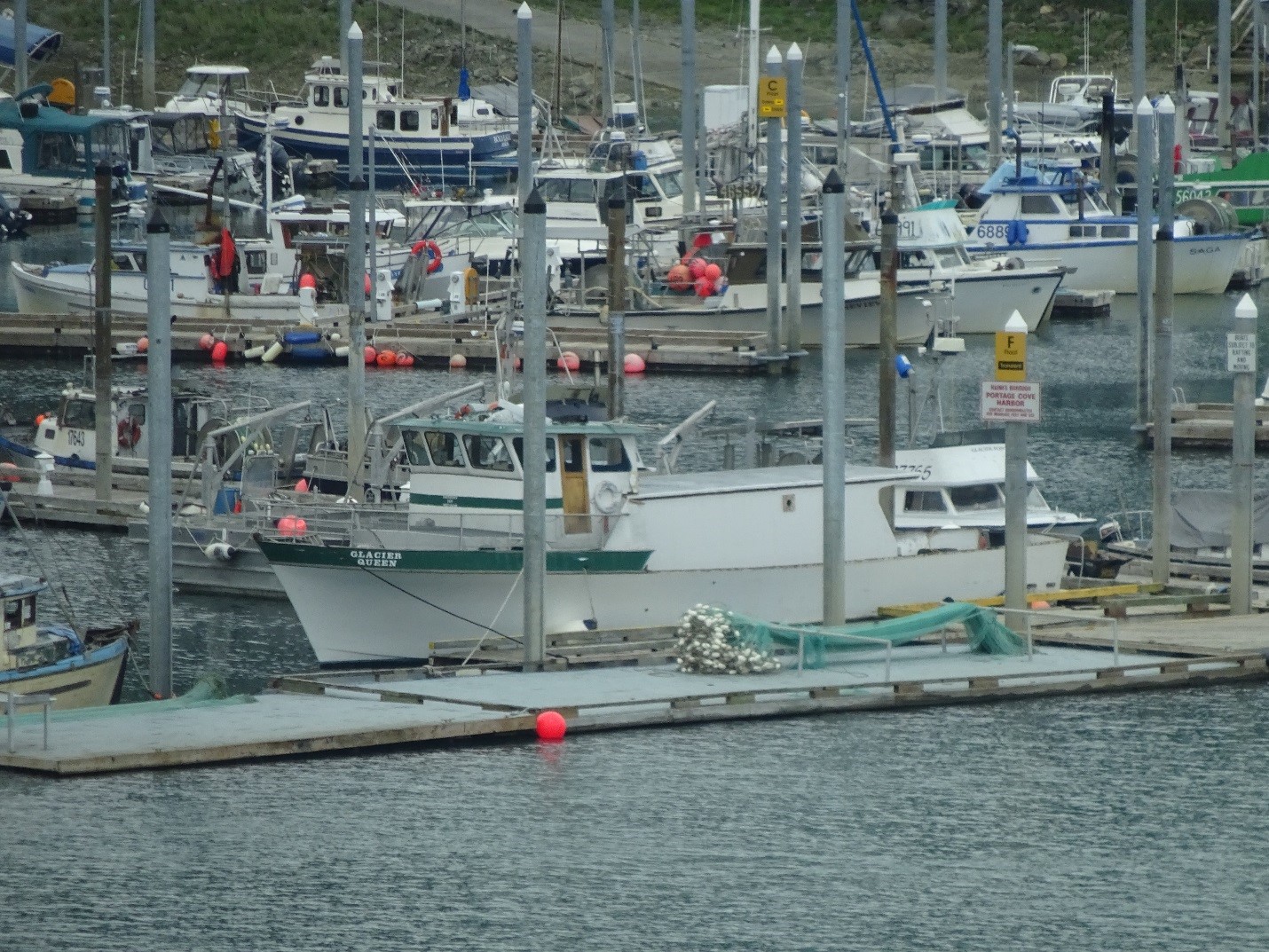
The ms Glacier Queen (I) in service on the Lynn Canal and related in the late seventies and early eighties.
We were having a drill day in Haines and that consisted of an Emergency Response drill (Gathering of the initial response teams) and a General Emergency Alarm (= everybody assembling at the lifeboat and life raft stations). Most of the time the First Response Teams are called to deal with a Fire emergency, but that is not always the case. The First Alarm is there to gather as quickly as many skilled crew as possible to offer a quick response to an escalating situation. Today that was an unconscious crewmember in a ships tank. Crewmembers dying in ships tanks is one of the major death causes in the Merchant Marine. There are about 62000 ships out there that go deep sea and it is estimated that approx. 500 crew die every year from entering a tank and then succumbing from fumes and/or lack of oxygen. All caused by not following (or not having or not knowing) the required protocols.
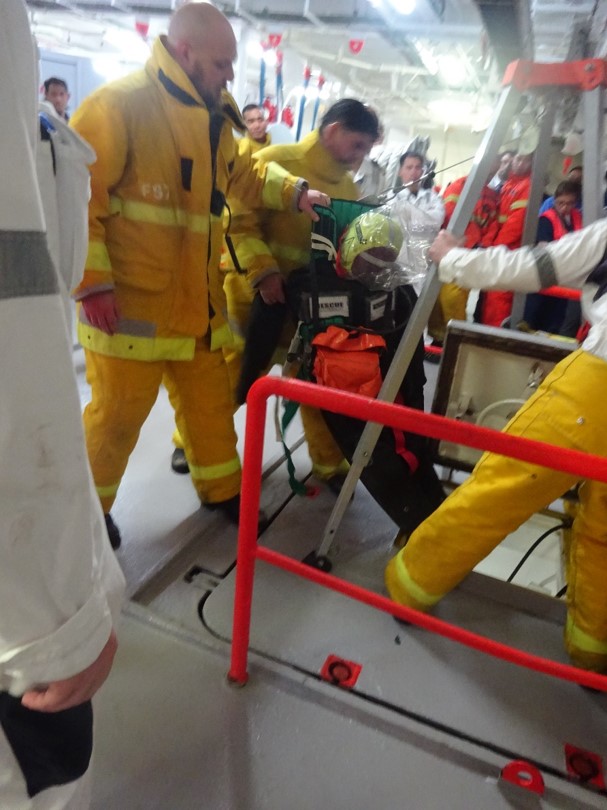
Mr. Dummy has been winched out of the deep tank by means of a tripod and is about to be handed over to Medical. The plastic bag over his head is an Emergency Breathing Device which is connected to the orange pouch in which there is a small air bottle.
If this happens then you have to get the person out again, hopefully quick enough so that he/she is still alive. For that we have a plethora of equipment on board. When asked by the Engine Room staff I try to set something up in the Bo ‘sun store. That is much bigger than a tank, but it has a small hatch to the deck below and then everybody can gather around and get an idea of what it is. So we dropped Mr. Dummy in the tank, sent a rescue squad down with Emergency air bottles, put Mr. Dummy in a special medical harness (Neil Robertson stretcher) and winched Mr. Dummy out of the tank again. We do have all that equipment on board.
The General Emergency Alarm stage consisted of Life raft training and for that we do inflate a life raft. A training life raft that we ourselves can repack. (We cheat a bit as we do not have to keep the normally required inventory of food and water inside). The real life rafts stay in their canisters and are landed ashore once every two years and are then opened, inspected and repacked. That is work for specialists and we would need a lot of training to do this ourselves. So we don’t and we can’t as the rafts needs to be re-certified for the next two years by an authorized surveyor.
The life rafts would normally be inflated during an emergency so the occupants can step inside on the embarkation deck. If the ship would sink so fast that there was no time for this, then the life rafts would float free from their cradles once 2 meters under water. (Each life raft has a Hydrostatic Release which under water pressure clicks open and releases the securing straps)
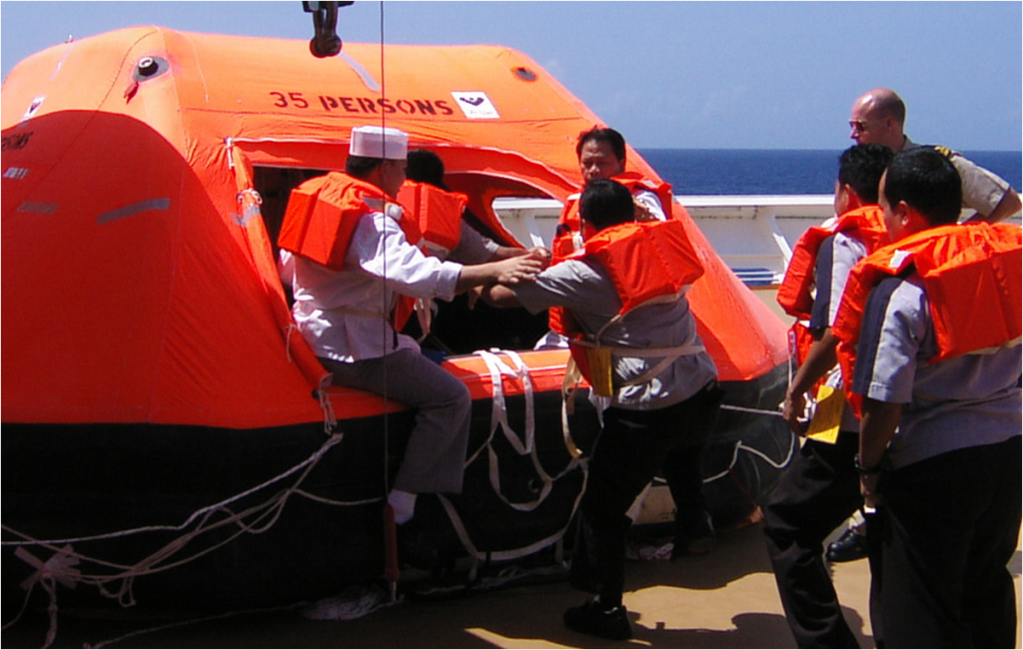
Loading a life raft. The Raft Commander and Assistant Commander sit astride in the opening and pull in the crew as quickly as possible and divide them evenly in the liferaft do it does not tilt to one side.
The life rafts are prepared by a launch team which is made up of Cooks from the Kitchen. We have four launch cranes with each six rafts. The legal requirement is for everybody to be off the ship in 30 minutes after the Abandon Ship Alarm has sounded, so the Cooks have to inflate, make ready for embarkation and then lower away into the water 6 rafts in 30 minutes. That is 5 minutes per raft, including 35 crew hopping in. We manage this but it needs a lot of training to reach that level of proficiency. Hence the reason that we have weekly drills.
Tomorrow we are in Juneau. And then we will not be alone as the Celebrity Eclipse, The Norwegian Jewel and the Carnival Legend will keep us company and the shopkeepers happy. Weather: Overcast with a 60% of showers and 16oC /61oF but not much wind so it will not be chilly.
The forecast lived up to the weather or vice versa and we are having a very quiet day in the Gulf. Last night the bridge team paid the price for that sunny Seward day and had to find its way through dense fog for a while. But weather systems are local and now we are back in the system that dominated the weather we had before coming to Seward. Overcast with rain in the distance. Also for the coming days showers have been predicted but with percentages under 50% and that is enough to make us happy. 50% and over means it will rain but not all the time, 50% and under means it might rain but not necessarily. All reasons to be positive while we are heading back towards Vancouver. Continue reading
Well after a lot of somber and rainy weather we had sunshine. High summer at least for Alaskan standards and it was T shirt time all day for those who were in and about the town. The forest fires up country are still raging and the pilot reported this morning that over a 100,000 acre area, just outside Seward, had now been affected. Fire fighters were out in force but were and are hampered by the dry weather and the winds that are blowing. Today there was hardly any wind so maybe they can make some headway in stemming the fires; but in the afternoon a gentle sea breeze started to come in and that might make life difficult again. So I wish them luck up the road and I wish I was a wizard who could divert some of the rain we had in Ketchikan and Juneau up this way. Continue reading
A good day today, at least for what could have been. The skies remained overcast with a gentle breeze from the SE and that caused rain clouds drifting over but it also meant no “clouds” at seawater level so the bridge had a good view at all times and the Captain could stay in bed during the night. There was a low swell running from the South West but it was less than a meter and that is not enough to rock the boat. And even that low running swell disappeared in the course of the day, leaving us with an oily looking sea without any wind. A Vista Class ships needs about 10 feet of swell & waves to get going so 3 feet is nothing. All the guests would have liked sunshine but that comes with the inherent fog and then it is hard to sleep in the balcony cabins as the horn will be blowing every 2 minutes to warn the world that we are there. So give me overcast skies here at any time, better for a good night’s rest and although the guests might like sunshine, I do not think they are on an Alaska cruise to go sun bathing……………… Continue reading
It is my personal opinion that for a compact large city, Vancouver is one of the nicest ports to sail into, together with Venice and maybe Naples. With compact I mean, you enter and there is constantly something to see. New York is also impressive with the Verrazano Bridge, the Statue of Liberty and downtown Manhattan but it is all far apart. Same for San Francisco, again an impressive bridge, followed by Alcatraz but is takes place over a considerable distance. Vancouver only takes 30 minutes from 1 mile before the Lions Gate Bridge to the dock and in those 30 minutes there is a constant impact on the senses. I have never heard anybody complaining on the bridge about sailing into Vancouver while normally, a long sail in gives rise to grumbles among the navigators; and they are very good in grumbling. (Not to say moaning). Continue reading
There is a lot of confusion over what the Inside Passage exactly is as there are so many routes. Holland America tries to show as much of the Inside Passage as possible but it depends on the available time frame and what we can do then. And we can do less than in the past. The main focus point is the need to make Seymour Narrows on the slack tide. This is a narrow channel north of Discovery Pass where the tides rush through at any time except slack tide, the moment when it goes from ebbing to flooding. At maximum flood or ebb, there can be as much as 14 knots of current and then a ship cannot get through safely. This there is only a certain length of time, a window of opportunity, when the current is weak and the ship can sail through without being pushed all over the place. That window is normally between 4 knots of flood and 4 knots of Ebbing tide. Most of the time we go through when it is less than three knots. We are not the only ones waiting for this window, so there is a whole line up of cruise ships, cargo ships, tug and tows and sometimes yachts who also want to go through at that time. Continue reading
With the South East Alaskan pilots on board the ms Westerdam turned into the Inside Passage at 06.30 this morning. The Pilot Station is located at Cape Spencer at the end of the West Indian Passage. And the two pilots will now remain on board until we depart from Ketchikan. One of our pilots is a lady and although that is nothing unusual anymore it was when she started 25 years ago. And I know her since that time as well: 1996. I think at that time she was the first female pilot on the West-coast and certainly in Alaska. Like all of us from those days we are coming closer to our retirement and she will bow out most likely next year. I keep an eye on my number of sailings to Alaska and this is cruise 252 through the Inside passage. I clocked up a lot of those cruises in the 1980’s when Holland America’s fleet was always in Alaska for the summer season and it could happen that your schedule made you are arrive on the first day of the season and had you leave on the last day of the season. And that would then be 20 or 21 Alaska cruises in a row. Now with our large fleet we have officers who have been several years with the company and have never been to Alaska. Continue reading
Today we are sailing in the Gulf of Alaska which is behaving itself very nicely. There was on and off fog during most of the night and that might not have been very nice for the balcony cabins as the fog horn was blaring its repetitive message every two minutes. The Collision Regulations say that the whistle shall be blown at least every 120 seconds when sailing at sea. And I always find it amazing that on every ship I sail on it is set on exactly 120 seconds of the maximum limit of 2 minutes. That is simply a sort of default setting as nobody wants to hear more noise than necessary. If ever in the future the 120 seconds would be increased to 150 seconds or reduced to 100 seconds then that would very quickly become the standard setting for all the ships. The law gives 120 seconds as a maximum so shorter intervals can be chosen. I have that seen happening and have done it myself as well. Especially on rivers and when near ports with a lot of Sunday sailors around. Los Angeles / San Pedro is one of those areas. There is a very complicated Vessel Traffic Separation Scheme regulating the flow from the North, the South and from San Pedro and Long Beach harbors; and in the weekends it is full of boats who do not have a clue about those arrangements and happily sail towards every sound they hear. And we cannot see in the fog what a big ship is or a small boat is as radar reflectors just give an average echo and the absence of an AIS signal does not mean it is a small boat. Luckily here in the Gulf it is a lot quieter. Apart from an occasional fisherman or a tug and tow there is no traffic. But still we blow the horn as you never know. Continue reading
Today we are in Bergen after having sailed the Inside Passage between Flam and Bergen with very sunny weather. Although we had a bit of mixed weather this cruise, the sun has been coming out at the right moments with the extra bonus of having sunshine in Honnigsvag. So a very good last cruise for our elegant explorer. While I am writing today’s blog, the weather in Bergen is following the weather forecast. It was sunny in the morning, overcast in the afternoon and it looks like rain in the evening. Weather forecasting for Bergen is not always easy as the port is surrounded on three sides by mountains so only when the weather comes in straight from the west, you can be spot on; with weather from other directions it can be a bit hit and miss as the (rain) clouds can bounce of the mountains bringing more and or stop the rain from coming over. But today it sort of worked out in accordance with the forecast plan. Continue reading
Captain Albert
© 2026 – Captain Albert's Website and Blog –
Theme by Anders Noren — Up ↑