Another day, another port and today that port was Juneau Alaska. Capital of the Alaskan State and also the shopping capital for the cruise ships. Although Skagway is trying very hard to beat them, they still do not succeed as Juneau has more/bigger ships in port and for a longer time. Although that was not the case today. The Franklin dock was vacant in the morning but was filled in the early afternoon by the Carnival Legend but then the Norwegian Jewel who was there in the morning left as soon as the Legend had lined up at her berth. As both ships are about the same size, the amount of shoppers in town remained about the same. Behind us was the Celebrity Eclipse and that made the Westerdam the smallest cruise ship in the port. The sort of thing that can you give you an inferiority complex but then we were the only “blue boat” in port and thus the whole world could see that we were different. Continue reading
Page 21 of 240
We had a 50% chance of rain and we got it. 50% wet in the morning and 50% dry in the afternoon. Haines remained overcast all day and the weather stuck to the 50%. Our scheduled neighbors did not show up but we had an ex Holland America Line ship with us in the Marina. So not a big ship but a former tour boat from Westours from the 1980’s. A nice little boat from the days that our operations were still small and a 1000 guests a day in port (One ship the ss Rotterdam V) was a big day for the shopkeepers and the tours. The Glacier Queen I soon became too small and was then replaced with the Glacier Queen II. Later on all the tour boats were sold and we are now just hiring for the season. I believe the current tour boats in the Lynn Canal are owned by the local tribe who basically runs the same tours as we used to do in the 70’s and 80’s. Especially in the days that Holland America did not call at Skagway but used a Tour boat, the Fairweather, to transport guests from Auke Bay near Juneau through beautiful Lynn Canal up to Skagway. Those guests did three days on the ship and then went inland. A similar number came the other way and then sailed the other 3 days on board. (For that we did not count arrival Vancouver as a separate day). So the good old Glacier Queen is still there and it looks that she is under re-construction as since last week her aft super structure has changed.
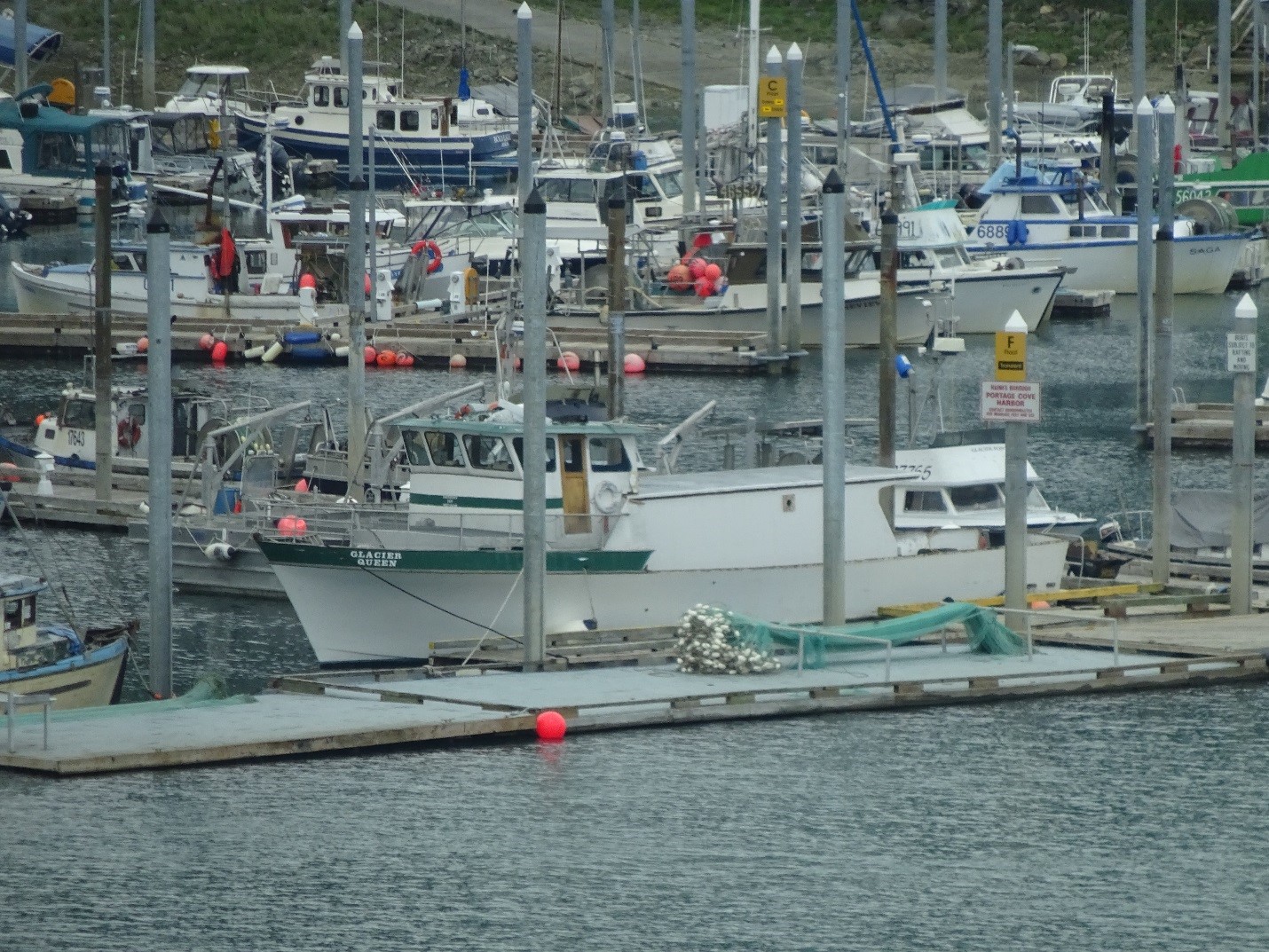
The ms Glacier Queen (I) in service on the Lynn Canal and related in the late seventies and early eighties.
We were having a drill day in Haines and that consisted of an Emergency Response drill (Gathering of the initial response teams) and a General Emergency Alarm (= everybody assembling at the lifeboat and life raft stations). Most of the time the First Response Teams are called to deal with a Fire emergency, but that is not always the case. The First Alarm is there to gather as quickly as many skilled crew as possible to offer a quick response to an escalating situation. Today that was an unconscious crewmember in a ships tank. Crewmembers dying in ships tanks is one of the major death causes in the Merchant Marine. There are about 62000 ships out there that go deep sea and it is estimated that approx. 500 crew die every year from entering a tank and then succumbing from fumes and/or lack of oxygen. All caused by not following (or not having or not knowing) the required protocols.
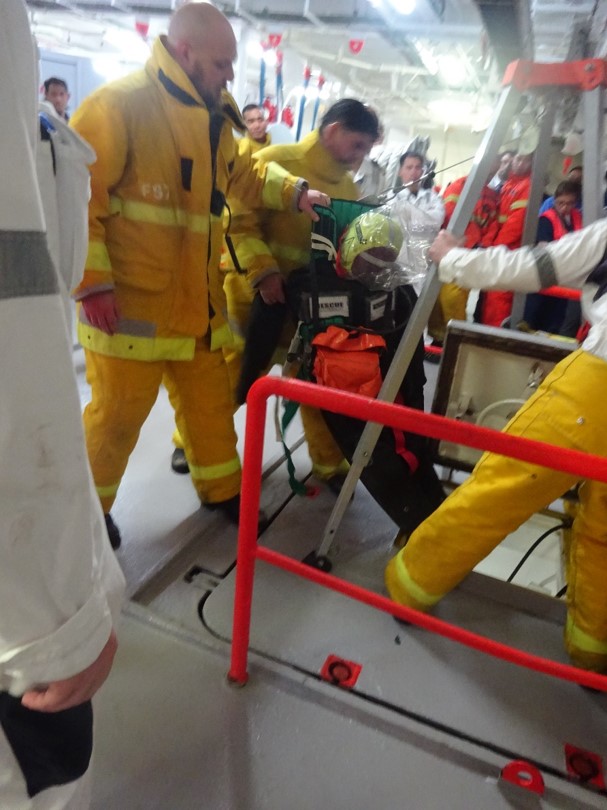
Mr. Dummy has been winched out of the deep tank by means of a tripod and is about to be handed over to Medical. The plastic bag over his head is an Emergency Breathing Device which is connected to the orange pouch in which there is a small air bottle.
If this happens then you have to get the person out again, hopefully quick enough so that he/she is still alive. For that we have a plethora of equipment on board. When asked by the Engine Room staff I try to set something up in the Bo ‘sun store. That is much bigger than a tank, but it has a small hatch to the deck below and then everybody can gather around and get an idea of what it is. So we dropped Mr. Dummy in the tank, sent a rescue squad down with Emergency air bottles, put Mr. Dummy in a special medical harness (Neil Robertson stretcher) and winched Mr. Dummy out of the tank again. We do have all that equipment on board.
The General Emergency Alarm stage consisted of Life raft training and for that we do inflate a life raft. A training life raft that we ourselves can repack. (We cheat a bit as we do not have to keep the normally required inventory of food and water inside). The real life rafts stay in their canisters and are landed ashore once every two years and are then opened, inspected and repacked. That is work for specialists and we would need a lot of training to do this ourselves. So we don’t and we can’t as the rafts needs to be re-certified for the next two years by an authorized surveyor.
The life rafts would normally be inflated during an emergency so the occupants can step inside on the embarkation deck. If the ship would sink so fast that there was no time for this, then the life rafts would float free from their cradles once 2 meters under water. (Each life raft has a Hydrostatic Release which under water pressure clicks open and releases the securing straps)
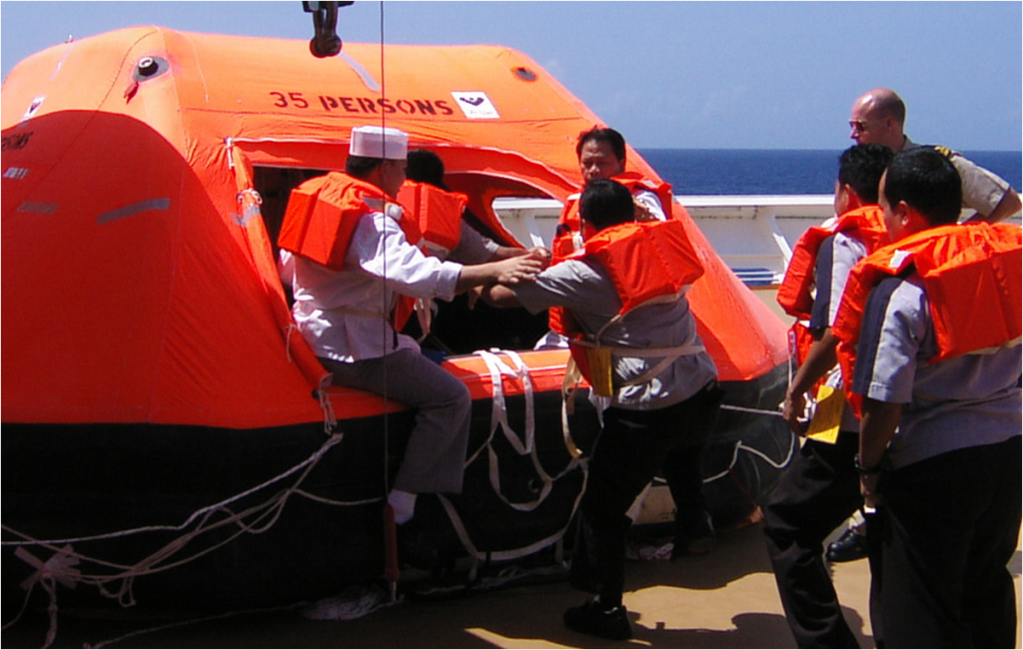
Loading a life raft. The Raft Commander and Assistant Commander sit astride in the opening and pull in the crew as quickly as possible and divide them evenly in the liferaft do it does not tilt to one side.
The life rafts are prepared by a launch team which is made up of Cooks from the Kitchen. We have four launch cranes with each six rafts. The legal requirement is for everybody to be off the ship in 30 minutes after the Abandon Ship Alarm has sounded, so the Cooks have to inflate, make ready for embarkation and then lower away into the water 6 rafts in 30 minutes. That is 5 minutes per raft, including 35 crew hopping in. We manage this but it needs a lot of training to reach that level of proficiency. Hence the reason that we have weekly drills.
Tomorrow we are in Juneau. And then we will not be alone as the Celebrity Eclipse, The Norwegian Jewel and the Carnival Legend will keep us company and the shopkeepers happy. Weather: Overcast with a 60% of showers and 16oC /61oF but not much wind so it will not be chilly.
With overcast skies, but dry weather, we sailed into Glacier Bay. The lack of glare from the sun gave excellent visibility and the Rangers were able to point out all sorts of wild life that otherwise might have been hard to see. Mountain Goats (conveniently grouping in clusters) were clearly visible against the grey stone of the mountains and whales were frolicking in the middle of the middle bay while we were sailing up towards the Glacier. On the way up we look for mountain goats by sailing along a steep cliff side and on the way down we sail past a small island which normally is inhabited by sea lions. Often Stellar Sea Lions which are quite rare. With our ships we normally only see them when sailing past Cape Spencer (so this morning) and when we are going to Valdez. So the rangers are quite excited to point them out to everybody on board. Continue reading
The forecast lived up to the weather or vice versa and we are having a very quiet day in the Gulf. Last night the bridge team paid the price for that sunny Seward day and had to find its way through dense fog for a while. But weather systems are local and now we are back in the system that dominated the weather we had before coming to Seward. Overcast with rain in the distance. Also for the coming days showers have been predicted but with percentages under 50% and that is enough to make us happy. 50% and over means it will rain but not all the time, 50% and under means it might rain but not necessarily. All reasons to be positive while we are heading back towards Vancouver. Continue reading
Well after a lot of somber and rainy weather we had sunshine. High summer at least for Alaskan standards and it was T shirt time all day for those who were in and about the town. The forest fires up country are still raging and the pilot reported this morning that over a 100,000 acre area, just outside Seward, had now been affected. Fire fighters were out in force but were and are hampered by the dry weather and the winds that are blowing. Today there was hardly any wind so maybe they can make some headway in stemming the fires; but in the afternoon a gentle sea breeze started to come in and that might make life difficult again. So I wish them luck up the road and I wish I was a wizard who could divert some of the rain we had in Ketchikan and Juneau up this way. Continue reading
A good day today, at least for what could have been. The skies remained overcast with a gentle breeze from the SE and that caused rain clouds drifting over but it also meant no “clouds” at seawater level so the bridge had a good view at all times and the Captain could stay in bed during the night. There was a low swell running from the South West but it was less than a meter and that is not enough to rock the boat. And even that low running swell disappeared in the course of the day, leaving us with an oily looking sea without any wind. A Vista Class ships needs about 10 feet of swell & waves to get going so 3 feet is nothing. All the guests would have liked sunshine but that comes with the inherent fog and then it is hard to sleep in the balcony cabins as the horn will be blowing every 2 minutes to warn the world that we are there. So give me overcast skies here at any time, better for a good night’s rest and although the guests might like sunshine, I do not think they are on an Alaska cruise to go sun bathing……………… Continue reading
This was not a day that will go down in history as a Sunny Day in Glacier Bay. It was a Regular Day in Glacier Bay. The lower bay was fogged in all day so the bridge only saw the Rangers coming and going by boat on the radar screens and once in the upper bay it was clear but cold and overcast. I always debate with myself what is better for the guests, have an off day which is sunny and warm so it is nice to be outside or have this weather which shows Glacier Bay as it is. A rugged glacial area, untamed by humans and not habitable for those who not adapt themselves. In the past people have lived here and with that I mean the upper bay area, first of all the Indian Tribes and then also gold prospectors or those who wanted to be close to nature. Now since it is a National Park, human presence is regulated by permits and approval and those who live here, live here temporarily either for vacation or for science purposes. And we do see little tents and kayaks along the shore line. Continue reading
Skagway lies at the end of the Lynn Canal which is a long and narrow fjord that pierces deeply into the mountain ranges on the border of USA and Canada. As a matter of fact it is only a short drive from the port up the road to get to that border. I did that once, a number of years ago, with a friendly Alaskan pilot who had a car there and who wanted to show me a regular border crossing and not the big work that I was used to when coming into the USA or Canada to join the ships. As everybody knows everybody here the CPB officer was more than willing to have a chat as business was slow. All he processed thus far in the morning, was one RV, two cars and a Moose. The appearance of the moose was a fairly regular occurrence but most of the time the animal avoided the road and crossed the border through the greenery, today it had attempted to do so by road and that had caused some divertissement when it came to the barrier. But the CPB Officer was getting ready for the arrival of the Alaska Marine Highway ferry that arrives around 13.00 hrs. in the summer and sends ashore a whole convoy of RV’s and trucks that come up from the lower states and then go on into the interior. Those going north are not a problem for the Americans, they let the Canadians deal with them; those coming south and are not a problem for the Canadians, they let the Americans deal with them. And by ignoring the Moose the whole world was perfectly in balance. Continue reading
Today we are in Juneau and the shopkeepers must be very happy and also the shore excursions people as it is a full house in the port. We have in port the Royal Princess (3600 guests), Azamara Quest (686 guests), Crystal Symphony (848 guests), Star Princess (3100 guests), Westerdam (approx. 2100). So based on lower bed capacity we are already talking over 10000 guests. I put approx. 2100 for the Westerdam as normally the number is lower but it being high season we have a lot of families on board and then the bunk beds fill up. This also means approx.4000 crew in the port and if 50% would make it ashore then it is even busier. Most crew are going to the supermarkets and Costco in the valley for which a whole myriad of shuttle buses are in existence. It is known that Costco stocks up on gadgets when the tourist seasons starts as they know that this is of great interest to the crew. They cannot take TV’s home but small electronics they can. And a lot of crew have extended families with lots of nephews and nieces and they all want a present when the sailor comes home. I once saw a Filipino bar tender going home with 41 fluffy toys in a box. He told me that his wife had sent him a list of so many in pink, so many in green and so many in blue and preferably Pokémon characters. He was quite happy as he gotten them for a very good deal in Chinatown Vancouver. But for the older ones, electronic gadgets are needed and that is all out there. Continue reading
Today we are in Ketchikan and this is the Ketchikan I recognize. Drizzle, Rain and Swirling Clouds around the mountains high above the town. The Westerdam arrived early as we had to drop off a container, and instead of going alongside the berth and getting a flatbed truck onto the dock with a big crane, the ship sailed to the Ketchikan Shipyard and went briefly alongside the fitting out pier and the shipyard crane hoisted the container ashore. And then the captain just sailed the ship astern (backwards) to our regular dock. By 05.30 we were all fast and all the hard workers went back to bed. Sailing a mile or so from the ship yard to the dock with wind and current can be a challenge but Azi-pods ships have so much power that it is not really a challenge. Azi-pod ships are often better in sailing astern than in sailing forward as pulling the ship is often easier than pushing it. Continue reading
Captain Albert
© 2026 – Captain Albert's Website and Blog –
Theme by Anders Noren — Up ↑