When we left last night we were in quite a hurry as the tide window started around 22.30 hrs. From Lions Gate Bridge to Discovery Pass is 90 Nautical Miles and when passing the bridge at 17.00 hrs. to getting there then gives 5.5 hrs. 90 miles at 20 knots. Is 4.5 hrs. at full speed but the last part, when sailing into Discovery Pass leading up to Seymour Narrows, the speed has to come down to 16 knots and then 10 knots due to traffic and no wake sailing close to the coast. That costs another 30 minutes and you suddenly are looking at less than an hour for any un-expected happenings. And you have to prepare for that as there is a lot of barge traffic in the area and as it is high summer, fishermen both professional and amateurs. Thus while in the open waters of Georgia Strait the Captain let the Westerdam come up to sea speed to build up a little plus and so to ensure that we would be on time. Continue reading
Page 22 of 240
It is my personal opinion that for a compact large city, Vancouver is one of the nicest ports to sail into, together with Venice and maybe Naples. With compact I mean, you enter and there is constantly something to see. New York is also impressive with the Verrazano Bridge, the Statue of Liberty and downtown Manhattan but it is all far apart. Same for San Francisco, again an impressive bridge, followed by Alcatraz but is takes place over a considerable distance. Vancouver only takes 30 minutes from 1 mile before the Lions Gate Bridge to the dock and in those 30 minutes there is a constant impact on the senses. I have never heard anybody complaining on the bridge about sailing into Vancouver while normally, a long sail in gives rise to grumbles among the navigators; and they are very good in grumbling. (Not to say moaning). Continue reading
There is a lot of confusion over what the Inside Passage exactly is as there are so many routes. Holland America tries to show as much of the Inside Passage as possible but it depends on the available time frame and what we can do then. And we can do less than in the past. The main focus point is the need to make Seymour Narrows on the slack tide. This is a narrow channel north of Discovery Pass where the tides rush through at any time except slack tide, the moment when it goes from ebbing to flooding. At maximum flood or ebb, there can be as much as 14 knots of current and then a ship cannot get through safely. This there is only a certain length of time, a window of opportunity, when the current is weak and the ship can sail through without being pushed all over the place. That window is normally between 4 knots of flood and 4 knots of Ebbing tide. Most of the time we go through when it is less than three knots. We are not the only ones waiting for this window, so there is a whole line up of cruise ships, cargo ships, tug and tows and sometimes yachts who also want to go through at that time. Continue reading
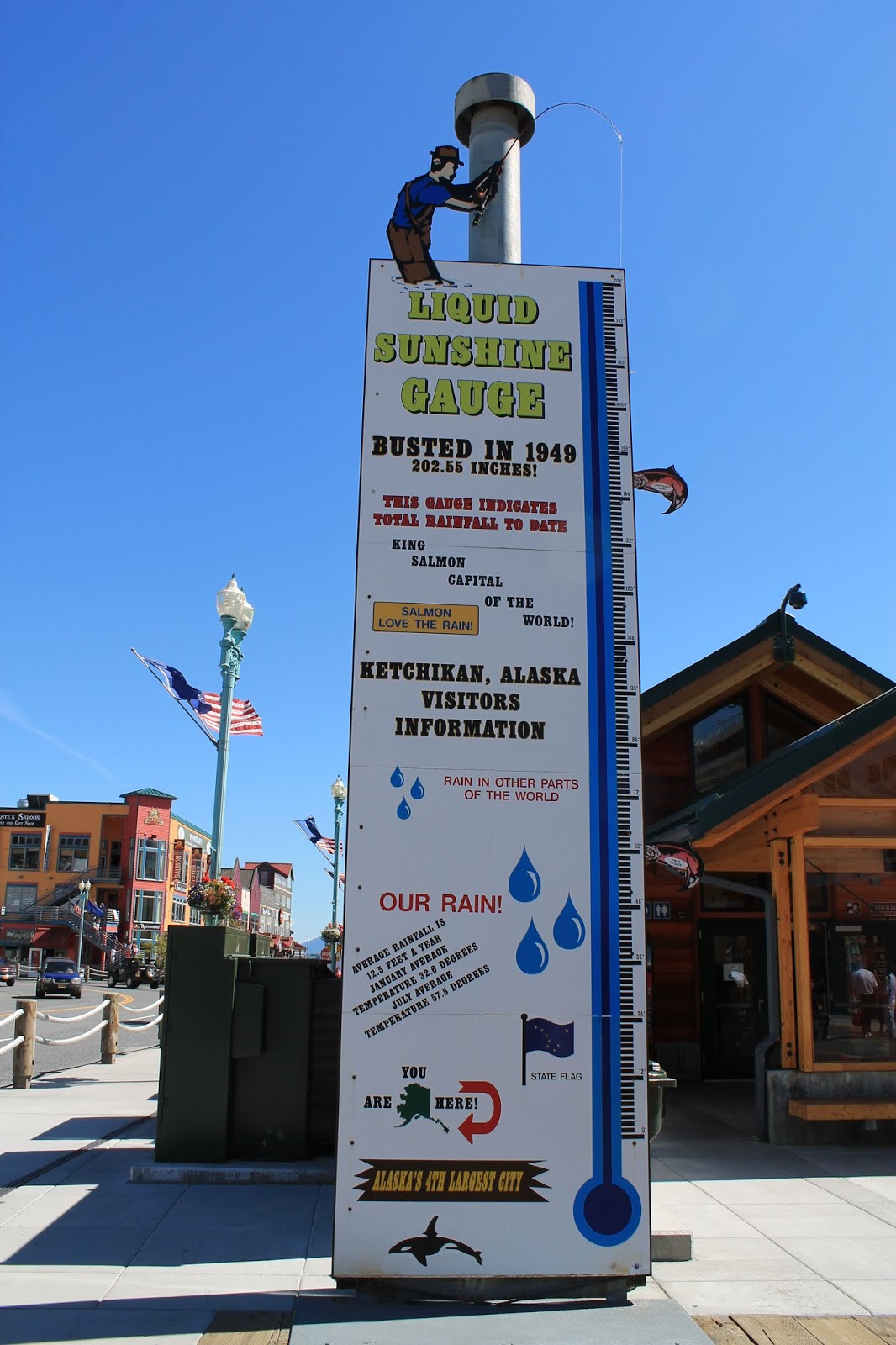
Rain meters or liquid sunshine gauge. are a favorite in Ketchikan. They call themselves the rain capital of the world, but also the salmon capital of the world and The First City of Alaska.
I suppose when you are a weather forecast guru you can always hedge your bets by calling it partly cloudy or partly sunny or overcast with a chance of showers. That way you are nearly always right. So we were expecting a chance of showers and what we got in the morning was fog and a steady drizzle and that lasted to the early afternoon. Then the clouds pulled away and the sun was brightly shining in Ketchikan. There was a chance of showers and we got the constant drizzle in the morning so I suppose the weather forecast was right. In the past the weather prediction was nearly always rain or a variation of it as it did nearly always rain in Ketchikan. 332 days of the year in the 1980’s. So if you then predict rain, you do not have more than a 10% chance of being wrong. And that is not bad in the Art of Meteorology. But we have seen more and more days of sun in Alaska and that includes Ketchikan. Thus now the weather is not as predictable as it used to be and thus we had overcast with showers for today and I had to get my sunglasses out and sun block 35 to protect my brain cover. But on the other hand in August 2017 they had the highest recorded monthly rain fall since 1967 and those aberrations do not make weather predicting any easier. But the locals say on average it now does rain less. Continue reading
Juneau is the capital of Alaska and is so because of historic reasons as the city of Anchorage is much bigger and it could be expected that that was the capital. Every so often there are voices heard that call for making Anchorage the capital but thus far all change has been resisted.
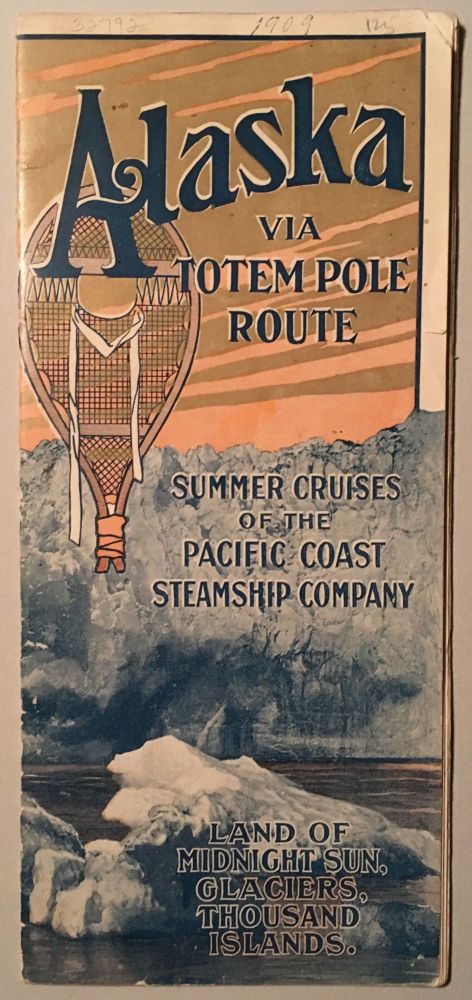
Alaska cruising the early days. Follow the Totem pole route.
Because of having the State legislative buildings and operations there, the town was never reliant on the Tourist Industry as such. It had the politicians, it had a gold mine and there were the canneries for the salmon fishing. That does not mean there were no tourists coming here and also that there were no cruise ship passengers. From as long as there have been steamships involved in regular ferry service to the various ports of Alaska, they brought with them passengers who were on sightseeing adventures, then called excursions. The name cruise came only later. Operators such as the Alaska Steamship company or the Canadian Pacific Railroad brought early travelers to Alaska and even provided “cruise excursions” by sailing to Glacier Bay. Continue reading
Haines is always an early morning arrival as the first tour, with the tour boat, from Haines leaves at 06.00 hrs. That is a very beautiful scenic cruise up the Lynn Canal to Skagway and by that time it is full day light so nobody has to miss anything from the scenery. Today it was day light with a golden glow. It was wind still all day and thus the smoke/soot of the forest fires hung still between the mountains on either side of the fjord. Beautiful to see but it should not be there of course. The people inland are praying for rain so the fires will be extinguished and then we will only have the golden glow again, at the time it supposed to be here, during the Indian summer in autumn. But it made for wonderful views today. Continue reading
With the South East Alaskan pilots on board the ms Westerdam turned into the Inside Passage at 06.30 this morning. The Pilot Station is located at Cape Spencer at the end of the West Indian Passage. And the two pilots will now remain on board until we depart from Ketchikan. One of our pilots is a lady and although that is nothing unusual anymore it was when she started 25 years ago. And I know her since that time as well: 1996. I think at that time she was the first female pilot on the West-coast and certainly in Alaska. Like all of us from those days we are coming closer to our retirement and she will bow out most likely next year. I keep an eye on my number of sailings to Alaska and this is cruise 252 through the Inside passage. I clocked up a lot of those cruises in the 1980’s when Holland America’s fleet was always in Alaska for the summer season and it could happen that your schedule made you are arrive on the first day of the season and had you leave on the last day of the season. And that would then be 20 or 21 Alaska cruises in a row. Now with our large fleet we have officers who have been several years with the company and have never been to Alaska. Continue reading
Today we are sailing in the Gulf of Alaska which is behaving itself very nicely. There was on and off fog during most of the night and that might not have been very nice for the balcony cabins as the fog horn was blaring its repetitive message every two minutes. The Collision Regulations say that the whistle shall be blown at least every 120 seconds when sailing at sea. And I always find it amazing that on every ship I sail on it is set on exactly 120 seconds of the maximum limit of 2 minutes. That is simply a sort of default setting as nobody wants to hear more noise than necessary. If ever in the future the 120 seconds would be increased to 150 seconds or reduced to 100 seconds then that would very quickly become the standard setting for all the ships. The law gives 120 seconds as a maximum so shorter intervals can be chosen. I have that seen happening and have done it myself as well. Especially on rivers and when near ports with a lot of Sunday sailors around. Los Angeles / San Pedro is one of those areas. There is a very complicated Vessel Traffic Separation Scheme regulating the flow from the North, the South and from San Pedro and Long Beach harbors; and in the weekends it is full of boats who do not have a clue about those arrangements and happily sail towards every sound they hear. And we cannot see in the fog what a big ship is or a small boat is as radar reflectors just give an average echo and the absence of an AIS signal does not mean it is a small boat. Luckily here in the Gulf it is a lot quieter. Apart from an occasional fisherman or a tug and tow there is no traffic. But still we blow the horn as you never know. Continue reading
And thus I arrived on my next ship the ms Westerdam. After a quick visit to Seattle Office, where I got equipped with a new cell phone (I am now entering the “Apple” phase of my life), a new laptop and a new ID card. As it was right around the 4th. of July, it also gave me the chance to see the Seattle Fireworks around Lake Union. Very nice; but I always have a challenge to bring up much enthusiasm for fireworks as I have seen them in Sydney Australia, and what else can you then ask for. Still Seattle is famous for its local craft beer so I had nothing to complain about. The only way to reach a ship in Seward is to fly to Anchorage and from there take a 2 hr. shuttle/taxi drive to the port. There is also a small plane service but you never know if it can fly or not so the agents bundle arriving people in taxis. I was quite happy with that, as I got worried about the plane option as there are forest fires raging at the moment and most of the time. And indeed most of the time we drove through mountains ridges enveloped in a brown haze. Where there was no haze, the scenery was impressive as usual. Once approaching Seward port it was dense fog (less than 1000 feet visibility) and again I severely doubted if the local plane option would have been feasible. Continue reading
Today we are sailing in the North Sea and are on our way home to Amsterdam. This is our final port of destination and the end of the final cruise of the ms Prinsendam. Voyage 307 will come to an end and with it 17 years of cruising under the Holland America Line banner. All guests and 270+ of the crew will disembark but a small skeleton crew will sail her to Hamburg. There she will be handed over in Dry dock after the new owner has checked if all the propellers are still there. The last of the crew will then leave on the 7th. of July. The ship will receive an extensive refit and come back into service in August. Not too much will change. The Casino will go out and be replaced by 10 new Guest Cabins and the Explorers Lounge will receive a new bar area. Continue reading
Captain Albert
© 2026 – Captain Albert's Website and Blog –
Theme by Anders Noren — Up ↑