- Captain Albert's Website and Blog -

Ocean Liner History and Stories from the Sea, Past and Present. With an In Depth focus on Holland America Line

Page 115 of 242

28 June 2014; Skagway Alaska.

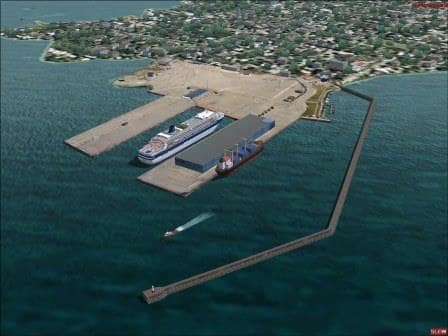
As mentioned yesterday we were going to dock at the Railroad dock, this is the largest dock in the port and can handle two 1000 ft. ships. For a ship’s captain it is also the best dock as it is sheltered from the Lynn Canal wind.  This wind is a local phenomenon that regularly occurs in the afternoon. The ship will arrive during wind still weather in the morning but by 3 pm in the afternoon it is blowing 30 to 40 knots from the south. It is a funnel wind caused by the warming up of the land to the south and then enhanced by the fact that most of Lynn Canal is straight and has fairly high mountains on either side.

As the wind is not there on arrival, every dock is an easy gig to dock at. There are four larger docks in total: Rail Dock Forward, Rail Road Dock Aft, the Broadway Dock and the Ore dock. The latter was built for Ore transport from the interior but it takes some time to get sufficient ore from the interior to load a ship, so we only see a Bulk carrier here once in a while.  Then there is a small dock that is used by the Alaska State Ferry or the very small cruise ships.

Thus captains have no issue with the docks on arrival. But when it comes to departure it is a different story. The wind is then very strongly blowing (the most I have experienced was 75 knots of sustained wind) and when you are then docked at Broadway or at the Ore Dock it can be a real challenge to get out. That is caused by the fact that the wind hits the port under an angle. If the wind would blow straight on the stern then it would not matter but it hits the ship (and the funnel) about 30 degrees on the side. That means that the ship will be pushed straight back alongside if it is along the Ore dock or is being blown away if docked at the Broadway dock.  In principle the Broadway dock is my favorite as it has the shortest walking distance to town (to Broadway, hence the name of the dock) but I also like to leave on time, so when I can park my ship at the Rail Road Dock, there I go.  And every other cruise ship captain will do the same.

Normally the Rail Road dock is occupied by the Big Boys, those who would have a hard time docking at Broadway. So when the ships are on a Saturday/Sunday cruise cycle, the whole parade heads for Skagway on Wednesday or Thursday and then the biggest ones go to the Rail Road dock. Holland America operates medium sized ships, so we go to Broadway. Great for the guests but a headache for the captain who needs to sail on time.

When this funnel wind is blowing, leaving from the Rail Road Dock is not an issue. When undocking you are still in the lee of the mountains and by the time that the wind is catching the ship, the ship has enough speed to make it to the middle of Skagway harbor  where it can drift all over the place without the danger of hitting anything.

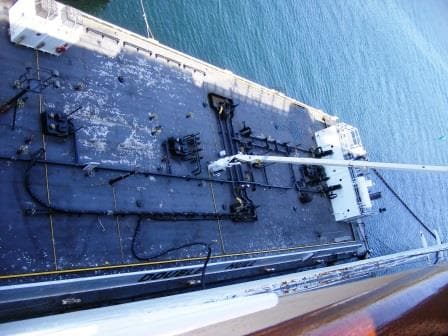
Skagway Rail road dock fwd. In the distance the train that takes the guests on the Trail of 98

Skagway Rail road dock fwd. In the distance the train that takes the guests on the Trail of 98

The Volendam is a Wednesday ship and thus there is no pecking order. So it could happily dock in the lee of the mountains, even leaving room for the Seven Seas Navigator to go behind on the aft section. The wind did pick up during the day and by looking at the waves near the Broadway docks I estimated a wind force 7 and that is not as bad as it can be. For the guests this is all of no concern. Those who left us today, hopped on the Bus, those who joined us hopped off the Bus, and everybody enjoyed a sunny day.

Sailors are superstitious. We live too close to nature to believe that not everything has a rational explanation. Thus we have mascots. In the archives of my blog you can find somewhere the mascots of the Veendam and the Statendam, but also the Volendam has a collection.

Now the logic is that a mascot only works if it is given by coincidence as a genuine gift, without any second thoughts.  Then the puppet or whatever it is will be placed on the Bridge.  So a guest pushing to give a charm to the bridge with the intent to have THEIR charm there, results in an opposite effect. So the mascots arrive on the bridge by coincidence, by sheer luck, by the spur of the moment.

Most danger comes from ahead and thus the mascots are keeping a sharp look-out

Most danger comes from ahead and thus the mascots are keeping a sharp look-out

That does not mean that the sailors cannot have a bit of fun with it, and therefore the Chief Mascot on the bridge (there are 6 in total) is wearing a (doggy) lifejacket to ensure that he is prepared for any eventuality.

Tomorrow we are in Glacier Bay. Marjorie Glacier is very active at the moment, so hopefully we will have a great show of “White thunder” crashing down.


27 June 2014; Juneau, Alaska.

As was expected yesterday the weather in the Alaskan Inside Passage was glorious. Lots of sun and most of the wind was caused by the ship itself, so not annoying. The temperatures were fairly cool in the morning and that meant clear skies and thus excellent visibility. Summer has just started here and thus there is still a lot of snow on the higher part of the mountains; and the combination of the blue sea, the green slopes, the black mountain faces and the snow topped mountain peaks, produced an awesome sight. People are going to be very lucky this cruise if this weather lasts. The ship picked up the Alaskan pilot at the metropolis of Kake (population 150 souls, as far as I have been told) but as it has a plane connection with the outside world it is good spot for pilots to board and thus it is an official pilot station. That was in the early morning and from that moment it is a good 7 hours sailing to the dock at Juneau.

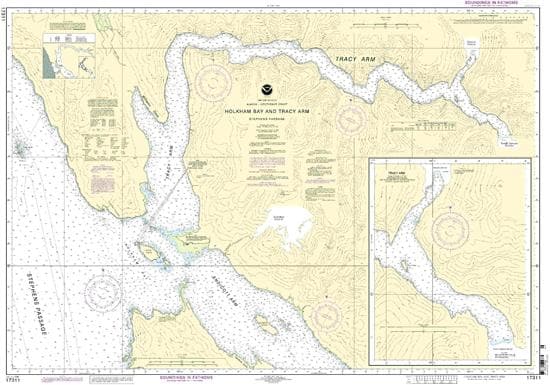
When coming closer you pass the entrances to Tracy and Endecott Arm which is for some of our ships a scenic stop, a sort of mini Glacier Bay. Not however for the Volendam on this cruise. Inside these fjords or arms as they are called in this case (Seen from the top they look like a bent arm) are glaciers and sometimes the ice bergs are large enough that they make it all the way into the main deep water area. Exciting for the guests, as it was the first piece of ice they could see on this cruise. There will be lots more in two days from now.

One of the reasons it takes a while to get into Juneau, is the fact that the last 5 miles go very slow. This is when entering Gastineau Channel, the entrance Fjord to Juneau harbor. Due to civilization on the sides of the channel, speed restrictions have been imposed to avoid damage to boats or excessive surf along the shore.  When the ship comes charging in at 21 knots, it has to come down to 16 knots for the first 3 miles, then to 10 knots for the next mile, then to 7 knots for the next mile and before entering the harbor itself: the speed has to be down to 5 knots. For the rest there is no restriction and that is also not really needed as every captain or skipper will ensure that his/her ship has stopped before it arrives at the dock. Failures in the past have proven that the alternative results in way too much paperwork.

By 1300hrs. the Volendam was parked at the Cruise Terminal, which is the 2nd berth in the port. The smallest is the Alaska Steam Ship Dock which is long enough for the Statendam Class ships and anything shorter. The Volendam is one size too big for that dock. Although the Volendam is an evolution from the Statendam it is longer (as it has a 3rd = center staircase) and thus it docks at the center dock, which we call the Cruise Terminal. Then there are two more docks further out, at the southern edge of the harbor.

What used to a lumber and general cargo dock, since long transformed into a Tourist - tour assembly area.

What used to be a lumber, fish and general cargo dock, has long since been transformed into a Tourist – Tour assembly area.

The Alaska Steamship Dock and the Cruise Terminal are supposed to be gone by next year, as the city of Juneau is planning to build a very long floating dock at the same location. That floating dock has the advantage that it will go up and down with the tide (which can reach up to 14 feet or so) and that saves all the hassle of adjusting the mooring ropes and moving the gangway every 3 or 4 hours, when the main access break to the ship disappears or re-appears under or above dock level. The Volendam is a Wednesday ship (= departure from Vancouver on Wednesday) and that is an unusual day.

The only other cruise ship in port, docked at the furtherest dock away from downtown.

The only other cruise ship in port, docked at the furtherest dock away from downtown.

Most ships leave on Saturday or Sunday and if you are one of those ships, then it is really a convoy sailing to Alaska and the ports are always full. Now when sailing out of synch with the normal world means that there are not that many ships in port, which is of course good for the guests. The only other ship in today was a Mickey Mouse Boat.  A quiet day for Juneau as there were only about 3,500 guests milling around. The crew, if off duty, does not mill around, they take the shuttle to Costco. I honestly believe that the revenue of that retailer must double during the cruise ship season as it is amazing what the crew brings back from there. Tomorrow we will be Skagway. Again because the ship is on this unusual cycle, there will be only one other ship in, the Seven Seas Navigator and that means that both ships will be at the Rail Road Dock. Which is every captain’s favorite location as it is sheltered from the afternoon winds blowing up the Lynn Canal

26 June 2014; Inside Passage, Canada.

There are several routes a ship can take to go to Alaska and the one that is taken, mainly depends on time available and distance to travel.  If the ship is going to Ketchikan from Vancouver and the Seymour Narrows tide is early, then a lot of sightseeing through the Inside Passage can be done and various routes can be taken, while still making it on time to Ketchikan. It then comes down to the weather and the captain’s preference of where the ship exactly goes.

Coming from Seattle makes the schedule a lot tighter as there is the additional distance from Seattle to the Vancouver area to travel. Then you still have to go for a slack tide at Seymour and have to arrive at your destination on time. Whether you can do much sightseeing will all depend on what time slack water is at Seymour Narrows. If it is not favorable then a captain will sometimes decide to go outside, sailing around Vancouver Island and catch the normal Inside Passage route near the Queen Charlotte Islands. If the weather is bad outside, then the Inside passage has to be taken but once being past Seymour Narrows, the shortest route possible has then to be used, to make it on time to the next port.

Then there is the 3rd situation and that is the one of the Volendam. She has to make Juneau as a first port of call after Vancouver. That is a very tight schedule and it means that the ship cannot do the maximum amount of sightseeing in the Canadian Inside Passage, which it could have done if going to Ketchikan.  But what it loses in the Canadian Inside Passage, it gains in the Alaska Inside Passage.

So last night we sailed through Johnstone Strait, after Seymour Narrows and then dipped into Queen Charlotte Sound once past Pine Island. This is an open area, with little land but famous for wildlife and indeed many whales, dolphins and flying fish were seen. The ship is booked to capacity with about a 100 children on board and they saw flying fish everywhere.

In the late afternoon, the course went west into Dixon Entrance, where the weather can be really bad with storms from the Pacific rolling straight in, in the winter. But we have wonderful weather at the moment and then taking the short cut into the Pacific Ocean is a nice option. This route avoids sailing by Ketchikan altogether. Ketchikan is on most cruises the first port of call and then you go through the Inside Passage to Juneau but by night.

We will pick up that Inside Passage tomorrow around 0500 when we will be in Chatham Strait.  Once we come in more confined waters, near the town of Kake, we will board the American Pilots who will be with us for the next 4 days.  Sailing from Kake is all the way in inside waters and here the guests gain what they lost today. Ketchikan ships do this stretch by night so they do not see very much, but as the Volendam will arrive at Juneau around 1 pm In the afternoon, there will be some glorious sightseeing in the morning.

This is my 236th cruise to Alaska and I will not see very much of it, as I will be cooped up in the ships training room for today and tomorrow while teaching  48 crewmembers the inner secrets of how a lifeboat works.  I am having a very varied audience, from Cast members to the kitchen, dining room and BLD all the way to Laundry crew and shop persons.

In 14 days they will learn how to operate a lifeboat, how to deal with nervous guests that might be in the lifeboat and a 1000 other small details that will result in a safe emergency operation.

So tomorrow morning, we will sail part of the Alaskan Inside Passage and then we will arrive in Juneau around 1 pm.  The weather looks great and in Juneau a gentle breeze with a sunny temperature of 75oF is expected. I hope there will be a little bit of wind, otherwise we might get those very low hanging clouds again and that is not good for anybody. Not for me either as I have an outside cabin right under the Radar Mast where they have that whistle that blows every 2 minutes, if there is no visibility.


25 June 2014: Vancouver, Canada.

In the early morning I flew from Seattle to Vancouver to join the Volendam. My first plan had been to take either the train or the bus, as it saved the company money and secondary it is the more scenic route. I was advised against this, as both options are very busy with cruise guests which increases the time at the border and that normally makes it also more complicated to explain what I am going to do on the ship, in relation to having the right visa. So I ended up on the 40 minute flight to Vancouver, courtesy of air Alaska but carried out by Horizon air with a propeller plane. I felt as if I was flying from England to Holland where we use propeller planes as well during off-peak hours. Then my plan was to take the Sky train to downtown but lack of Canadian dollars put a hold to that one. I was expecting a fee of 3 to 4 dollars, but if you use the ticket machine at the station they add a $ 5 cover charge because you use the machine. With the extra charge for using a foreign credit card that was going to make it an expensive train ride. So I paid a bit more and took the cab. Continue reading

24 June 2014; Holland America Line, Head Office Seattle.

24 June 2014; Holland America Line, Head Office Seattle.

This will be my last blog before I will venture out to the fleet. Tomorrow I will join the Volendam for 14 days (25 June to 09 July) followed by the Amsterdam for another 14 days. (10 July – 27 July) This is all to help out with the implementation of the upgraded Lifeboat drill system.   Continue reading

20 June 2014: Seattle Holland America Head Office.

Today we continue our tour of the building and we are still on the 4th floor. Here we have Fleet Operations, Finance, Marketing and near to my office Logistics. The latter is the group that has to get items that the fleet orders to the ships.  With normal items such as vegetables, meat and let’s say toilet rolls that is not so complicated. There are vendor contracts and they take care of the delivery. It gets more complicated when the ship needs a one-off item that can only be obtained from one company that might be located in the depths of Idaho.  Of course the ship needs that item yesterday and then it has to be air freighted to a port where the ship will call at.  So for this group of people it is a daily puzzle to get those items where they have to go.  Even deciding whether to send an item to Juneau or to Skagway in Alaska is something to think about. Skagway does not have any easy road or air connection so an item would have to go to Juneau and then by ferry to Skagway. Then you have to know the ferry times, make sure that the agent picks it up and gets it to the ship in time. Juneau is much easier then but that does not make the ship happy as they wanted the item yesterday.  Things are not always as easy as it seems.

Fleet operations consists out of Nautical and Technical. Under each header there might be sub divisions, such as Newbuilding and Interior design.  Holland American and Seabourn are here mixed in to a certain extent as a lot of work gets done in a combined way.  Everything is overseen by a Sr. Vice President to whom reports a Vice President Nautical and a Vice President Technical. Then there is also a Vice President Compliance but that department is on the 5th Floor. But again it mixes in as the boundaries are not clear cut. I work for Nautical but at the moment I am sort of helping out Compliance by writing training power points for the new 3 alarm system. The roll out of that system is again a joint venture between Nautical and Compliance.

The similator gives the option to reply Radar, Electronic Chart and other Nautical Data

The similator gives the option to replay Radar, Electronic Chart and other Nautical Data


Staying with Nautical, there are a few things that make it possible to see that you are in the nautical world here. The most obvious one is that we have our own little Simulator. Very small and mainly meant to replay sequences from the Black Boxes on the ships in case that is needed.  If something has happened on a ship and the bridge was involved then there is the option to download the Black Box of that ship and replay the evolution in the office.

This also shows that technology advances. In the old days it was always hoped when the ship went down that the captain took the last logbook with him. Now the request is to pull out the hard drive from the Black Box back up in the Captain’s cabin. This in case that the Black Box pod, which is located on the top deck, does not float free and cannot be retrieved again.

A stick for the Bow thrusters and two circular handles for the Pods

A stick for the Bow thrusters and two circular handles for the Pods

Next to it is a small maneuvering console. This came to Seattle when the first Azipod ships arrived, to give everybody the chance to do a bit of familiarization.


This is the Azipod line up for going ahead

This is the Azipod line up for going ahead

Handling Azipods requires a different way of thinking as the propellers are not pushing the ship forward, as is the case with conventional ships, but they are pulling the ships forward, as the propellers are located at the front of the Pod.


When maneuvering the Pod can be turned 360o and the manufacturers advise that it is better to always use ahead thrust. So if you want to stop the ship, you turn the pod 180o and give ahead in the astern direction.  When going sideways, you do the same, one pod is pushing towards the dock and the other pod is kept ready to slow down the momentum by pushing ahead the other way. It is a very clever and flexible system but you have to think about the planned maneuver in different way.

The spare Prinsendam Bell

The spare Prinsendam Bell

I showed in a previous blog the big bell of the Rotterdam V.  We have another big bell on the 4th floor. This was a bell that was meant for the Prinsendam in 2002 when it transferred to the HAL fleet from Seabourn. However it turned out that one had already been installed and thus it came as decoration to Seattle and is now standing in one of the conference rooms of the finance department.


One final thing that really appealed to my sense of humor is that visitors are warned about the fact that we are really working here. Warning signs are deployed in the corridors accordingly.

DSCF0283

17 June 2014; Seattle Holland America Line Head Office.

17 June 2014; Seattle Holland America Line Head Office.

Today a small intermezzo before we continue our tour of the office. I have been asked by one of the blog readers about the flag that a ship flies from the bow. It seems that every company does something different.  And that is indeed true and most of it is steeped in tradition and history. Continue reading

14 June 2014; Holland America Line Seattle, Head Office.

Most of the building is occupied by Holland America and since 2011 also by Seabourn Cruise Lines. Although Seabourn is a separate company in its operation, in the office the Seabourn People are nicely mixed in with the Holland America personnel.  Nautical is grouped with Nautical, Marketing with Marketing, etc. etc. The offices are scattered over the 1 st. 3rd and 5th. Floor.  A result of the constant expansion of  Holland America since it came to Seattle in 1983.  The 2nd floor and some of the 5th. Floor is occupied by other companies. Most of them have a connection with Medical, Hospitals and Pharmaceuticals.

Section lay out of the 4th. floor

Section lay out of the 4th. floor


When you come to the building for the first time, it can be very confusing. Not just because it has a warren of cubicals and offices but also because the building is not square or oblong but curved. Curved in the form of a U with indeed two legs but where the U curve is, that curve is mirrored, so the center of the U has a curved façade at both sides.  That makes it very confusing when walking around as a human being is used to square and oblong things or perfect rounds. Certainly for somebody like me, who comes from the ships with their straight corridors, it takes a while to figure out how the whole layout works.  There are four elevators centered around the main lobby and from there all sorts of sections veer off into the two legs of the U.

my short term memory spread over the desk

my short term memory spread over the desk


We will get to various levels in due course but let me start with where I have been parked for the period that I am in the office.  As I belong to Nautical, I reside in a section called Fleet Operations. I am not an expert on office configurations so I do not know if what I see here is an industry standard but  we have a central area with cubicals flanked with separate offices surrounding it.  There is a sort of pecking order with the highest functions having the largest offices with a window. Then there are inner offices that face the cubicle square for the lesser Gods and then there are the people who occupy the cubicles.

A whole sea of cubicles

A whole sea of cubicles

A friend of mine used to say, that that is the area where the real work gets done.


As I am supposed to be sea side for most of the year, I do not have my own office. I am currently parked in an office overlooking cubicle square that was occupied before me by a Deputy Director Nautical and before that by a Lady who did something for the Mariners Society.

As it is a shipping company, the hallways, offices and cubicle areas are littered (I suppose that is not exactly the right word as some of it is quite historical and valuable) with shipping memorabilia and that makes it look different to a regular office. I do not think that the Offices from the Hospital companies here in the building will be adorned in the same way. I do not expect that those corridors are filled are with stretchers and wheelchairs from the bygone days to the current time.

Also on the 4th. Floor there are some gems to be found. When the company left for the States in 1973, most items from the Head Office in Rotterdam were handed over to the local maritime museum and thus saved for prosperity. Some items did come over, especially what had been hanging in the Director’s offices. I have been told those offices where simply packed up lock, stock and barrel in containers and unloaded directly into the new office with everything included. Other items came to the American head office when various Sales Agency’s in the major US cities were closed.

My highlight of the fourth floor is a Jacobsen painting of the Maasdam from 1889.  The painting is dated either 1891 or 1897. Anthony Jacobsen painted for a living and basically did what professional photographers do nowadays. Shipping Company’s ordered paintings from him in the way they now order photos. So the majority of his paintings are of a similar composition. The ship is always under an angle, due to the wind blowing into the sails, and the seas are either choppy to very boisterous or even stormy but never flat. He painted a lot of ships and also quite a few for Holland America Line. He lived in Hoboken near the docks so that made it quite easy as well. Nowadays these are scattered all over the place, some in Musea and some in private hands but Holland America still has one as well.

SS Maasdam 1889 by Anthony Jacobsen

SS Maasdam 1889 by Anthony Jacobsen

It is hanging in one of the meeting rooms on the fourth floor. The painting is interesting for two reasons: First it shows the passengers on deck in roughly the right dimensions to the ship and that gives us an impression of how relatively small the ships were in those days but still they managed to cram nearly 1100 people inside the hull.  (Maasdam of 1889: 3,983.84 tons 150 first, 60 second, 800 3rd. 85 crew)

Secondly, the name plate under it: Netherlands Line. Holland America was in those days officially called the Noord Amerikaansche Stoomvaart Maatschappij or NASM which of course nobody could pronounce.  So everybody called it the Holland America Line. In a similar way that they used the word Cunard as a simpler name for the British & North American Steam Packet Company.  However the HAL Directors in those days did not like this plebian naming of their company (they held out until 1896 before admitting defeat) but the word Netherlands Line was found acceptable, as it more or less indicated that there was only one Steamship Company in the Netherlands. Holland America always considered itself the foremost company in Holland so the thinking was not that  usual.  (There was a real Netherland Line as well which sailed to the Dutch East Indies) As Mr. Jacobson hoped for more assignments he of course ensured that the painting was labelled properly.

12 June 2014; Seattle Head Office.

Once inside the main entrance door, there is a large waiting area and on display is the Bell of the ss Rotterdam V. It is I think the biggest bell that has ever graced a Holland America ship as it weighs over 300 pounds.  How it got there is a nice story as well. Yours truly was assigned as Chief Officer on the Rotterdam V when it was going out of service after having been sold to Premier Cruises.

Rotterdam bell in the Foyer

Rotterdam bell in the Foyer


So apart from doing my CO’s job, my interest was directly peaked into the direction of the artefacts on board. It is not unusual that a new company throws everything out that does not fit in their corporate style and also does so because it does not have any affinity with the history of the ship.  Still the New Owners wanted to keep everything so in principle everything would have to stay, but our legal counsel said that everything that had the name Rotterdam on it would remain property of HAL.  Well that gave me some options. Because the ships name was Rotterdam but also the ships registration was Rotterdam.

The ship was going out of service on 30 September 1997 a deadline that had to be adhered to as the new Rotterdam (VI) was coming into service on October 1st.  You cannot have two Rotterdam’s in one company at the same time, it is too confusing. It was already confusing enough during the new build period, as we on board were getting mail meant for the Rotterdam under construction and the construction team in Italy was receiving things meant for us in Alaska.

The final cruise was a Trans Canal cruise which had been booked solidly with Rotterdam aficionados more than a year before. Everybody who was anybody on the regular world cruises, had to be on board, to say goodbye to the “Grand Dame of the Seas”, as the ship had been nicknamed for quite a few years already.  I was a bit wary about all these particular guests coming on board as it could be expected that they would bring screwdrivers with them to “procure” a final souvenir. We had during the final voyage extra security on patrol, just in case of. However they all found out that every valuable decoration had been very strongly attached to the ship. A mere screw driver was not enough……. and luckily nobody had thought about bringing a hammer.

Bow of the ship with the bell in the center

Bow of the ship with the bell in the center

Just to be on the safe side I made arrangements to have everything off the bulkheads that was screw driver accessible before the last cruise started. In the end we only lost a Japanese Samurai helmet and whether that was a guest or a crewmember, we will never know. The First Port Call plaques hanging in the ship, and some of them were very nice, we auctioned off to the guests and we raised about $ 12000 for the Old Sailors Home in Holland. The plan was to buy a billiard for it but I never saw the result as a few years later, the sailors home was closed. Nowadays retired sailors prefer to live in regular Retirement Homes.

Anyway I had to ensure that all that could go off was saved before the last cruise started.   There was still quite a bit of stuff that carried the name Rotterdam, such as the builder’s plates, Chinese vases, the bust of Queen Juliana who baptized the ship, etc. etc.

And also the Bell. Nicely cast into the bell was the name SS Rotterdam.  So it was ours.  The carpenter made a beautiful box and the bell was duly landed in Norfolk dry dock.  Solas requires that each ship carries a bell on the bow to give danger and fog signals. It also describes that the minimum size of the bell mouth should at least be 300 millimeters in diameter. Otherwise there would be ship owners who would hang a Christmas ornament on the bow, just to save money.  The diameter of the Rotterdam bell is 1000 millimeter or one meter.  So when the replacement bell was installed, it looked a bit poorly and the new owner was not very happy.  But we conformed with Solas and to the contract and I had saved the bell.

And now it stands here in the entrance of the office building as a reminder of one of the greatest ships the company had ever built.

The greatest HAL Ship ever ???

The greatest HAL Ship ever ???


10 June 2014; Holland America Head Office, Seattle.

office bay park blogBefore we go inside there are two other items of interest. First off all, the building has an official name and that is: Elliott Bay Office Park. That was a new one to me as well, as most people simply refer to it as the Holland America Building. Courtesy of the fact that the companies name is on big letters on the front of the building.  But as there are other companies having offices inside, I suppose calling it the Holland America Building would not be correct, however nice it may sound. Continue reading

« Older posts Newer posts »