- Captain Albert's Website and Blog -

Ocean Liner History and Stories from the Sea, Past and Present. With an In Depth focus on Holland America Line

Page 105 of 241

02 Dec. 2014: Praia, Cape Verdes.

And so we arrived at the most southern port on the most Southern island of the Cape Verdes. The weather forecast was correct and we arrived on a sunny morning. 
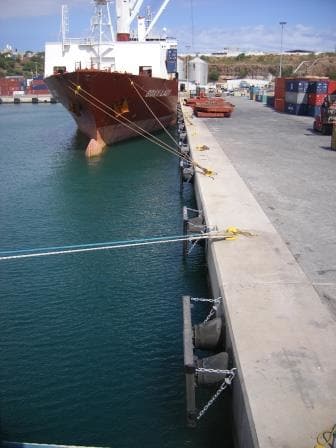
The "Boxy Lady docked behind us, loading and discharging boxes.

The “Boxy Lady docked behind us, loading and discharging boxes.

It has been indicated to us that the port/ dock was being upgraded but it was interesting to see that this meant an extension of the old pier, a complete renewal of the pier surface and the construction of a new container area. And it was all new; the wet paint had not dried yet so to speak. With the new pier, there was enough for two ships and behind us was docked the “Boxy Lady” which I think is a very appropriate name for a container ship. I would love to meet the person who had the sense of humor to come up with that name.

After 7 days at sea, most guests were very eager to get ashore but also the bridge officers were itchy as too many sea days plays havoc with practical training such as lifeboat drills. Also some other trainings and tests we prefer to do in port, needed to be done.    The trainee’s had three items on the agenda today. Witness water-mist release onto the main engines, follow the officers during raft and boat drill instruction and observe a simulation with the tender to sail out the oil spill boom.

Water-mist is a sort of shower system that we have above our engines. If an engine would go on fire, we will open the valve and a very dense water mist would descend over the engine. It is a very effective way of stopping an engine fire as the very small mist particles have a very high cooling capability and cool the surrounding area down so much that there is not enough heat to sustain the fire.  Beautiful system and more and more ships have it.
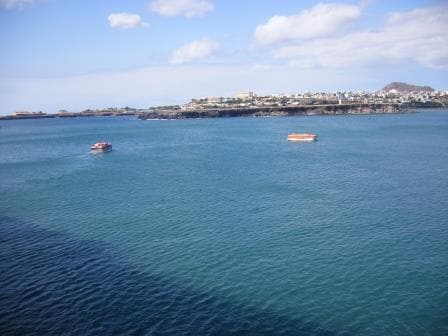
A nice view . Praia on the plateau overlooking the harbour, while our lifeboats are exercising.

A nice view . Praia on the plateau overlooking the harbour, while our lifeboats are exercising.

Boat and raft drill is of course a common occurrence on our ships and the trainee’s had to observe what the regular deck officers were doing and how. Hopefully they will learn something and will do it as well and maybe even better than what they saw today.


Simulating an oil-boom deployment is something a little bit more obscure. All Holland America ships have an extensive oil spill containment and clean up kit onboard. We instruct and we train with everything we have, except with the oil boom.
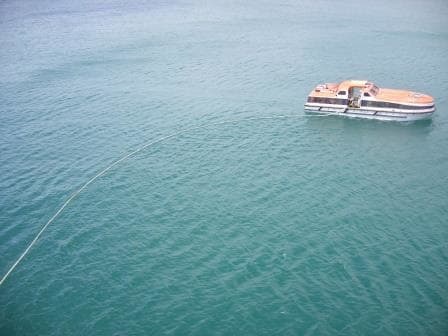
slowly pulling the boom towards the ship, while catching the "simulated" oil.

Slowly pulling the boom towards the ship, while catching the “simulated” oil.

The boom is made of soft and absorbent material and can only be used once.  So the accountants would not enjoy seeing us using the real boom for training. But we can substitute a floating mooring rope for the boom and do it that way. As you need some specialized knowledge to do that in a successful way, I gave some training yesterday and this morning we did the real thing.


By the time that was finished it was nearly noon time and then it was time to explore Praia. The chance that we will come back here in the very near future it not so great so I urged all of them to grab the one chance they might have in their sailing career. Not that this meant that I was staying onboard as it might be my only chance as well.  Due to the new dock, it was quite a distance to the main town and as it is located on a plateau up the hill as well, it meant getting taxis. Luckily there are plenty of them and they are not expensive, even when they try to hike up the –tourist- price a little bit, they are still a very good deal.
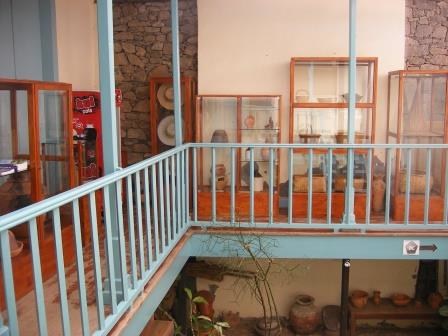
blog etnographical museum in Praia I teamed up with one of the trainee’s whom I bumped into in the corridor and we did the sights.

Visit the anthropological museum in the Capital (all two rooms of it).


Then we drove to the old town Ribeiro de Santiago which was overrun so often by the pirates that most people moved to Praia. When we got there, I understood why: a fertile valley between two cliffs with a good anchorage, a prefect hideaway for any self-respecting Captain Jack Sparrow with his Black Pearl.

Then by 4 pm it was back to the bridge as the trainees have now accumulated enough knowledge to start getting the bridge (with all its instruments) ready for departure. It all went well as the ms Rotterdam sailed without any issues out of the port at 17.30 hrs.  Tomorrow we are in Mindelo, still in the Cape Verdes, but at the North side and we are staying overnight there.
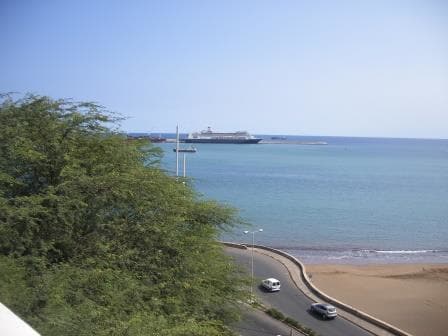
 

the ms Rotterdam docked in Praia as seen from downtown
The ms Rotterdam docked in Praia as seen from downtown


01 Dec. 2014; At Sea.

It was still dark and gloomy when day broke this morning but in the course of the day the weather followed the forecast and the sun came out. Something else was put in place instead. A very long moderate swell running from the North. Thus far Africa had been acting as a wave breaker and we had been in calm seas but when we fully cleared the main land the ship started to pitch a little bit. Observing the waves rolling in, I estimated them to be about 10 to 12 feet high. With a speed of 15 knots the ship rode the waves very nicely with movements varying from almost none to a nice lift up and down. Those who had been asking for real sea days with a bit of motion of the ocean, they got their wish today.

While on the south side of the equator we were under the influence of the South Equatorial current which pushed us to the East. Now on the other side we are being pushed to the West. Courtesy of the North Equatorial Counter current.  A current that is instrumental in bringing all the water back that was pushed into the North Atlantic by the Gulf Stream.

Currents produce water flow and normally also a mixture in the temperature of the sea water. Animals love that as it means that there is food.  Thus there was wild life a-plenty. Flying fish, small whales (still searching for the right name) and something that looked like Tuna; although that fish is not common and/or present in this area as far as I know.  Still, for the guests onboard who took the time to watch the sea, there was plenty to see.


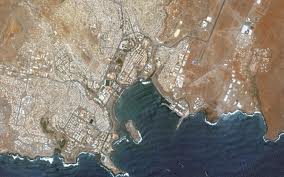
Air photo of the port of Praia on the south side of the Ilha de Santiago

Air photo of the port of Praia on the south side of the Ilha de Santiago

Tomorrow we are in Praia on the Ilha de Santiago. It is the largest city in the Cape Verdes and also the capital. It has a small port but with a long pier and hence the ms Rotterdam can dock there. Looking at photos, the town seems to be quite close.  The town was founded in the 16th. Century and as it sits on a small plateau it could be defended against Pirates and that caused its upswing to being the largest city.

The Cape Verdes were a colony of Portugal until 1975 but it has been independent ever since. Independence also kick started its expansion as well.  Approximately 140,000 people are living there now and thus our arrival, with its subsequent invasion of land- thirsty shoppers will not make that much of an impact.

The city and the harbor are located on the south side of the island and as we are approaching from the south, it will be a straight shot for the dock. Sunrise is at 06.44 tomorrow morning and that means that the ship will dock while the sun is above the horizon and thus dock during day light. If a port is not familiar with a navigator then an arrival in day light is always preferred.  If you know a port well it is less of an issue as you  have already seen what can be lurking in the dark.

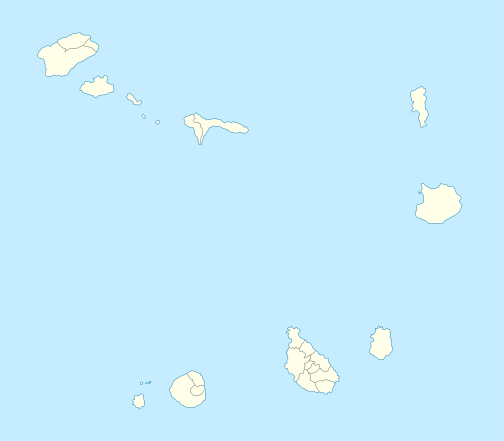
lha de Santiago is the largest Island  near the bottom of the chart

lha de Santiago is the largest Island near the bottom of the chart

Cape Verdes is a group of widely dispersed volcanic islands. Thus when going from Praia to Mindelo tomorrow evening we have to sail through a widely spaced out archipelago. On the way we will pass the island of Fogo with its erupting Volcano. If it is really active, then we might see some clouds and smoke, but only on the horizon as we will still be a considerable distance away.

The Weather Forecast for tomorrow looks very good. Temperatures around 25oC / 77oF. The sun is far in the south as it is nearly 21 December and thus it is considered winter here. For our standards a warm winter but I can deal with that sort of winter.


30 Nov. 2014: At Sea.

Today another day at sea and it was an overcast and rainy day. As a matter a fact it was a gloomy day. We are right in the middle of a frontal system which we ran into late yesterday afternoon.  We should run out of it by tomorrow as the weather for the Cape Verdes is forecast as  sunny and in the high seventies (oF)  At the same time we are moving away from the sun and thus is gets day light later and later.  Altogether it made for a gloomy day.

With the ship we have just passed the border with Monrovia and are now getting further and further away from the coast heading toward the Cape Verdes which are sort of on the same line or just north of Dakar. And Dakar is on the extreme west side of Africa. We still have one day to go and then we will arrive at Praia. Or to give it its full title Praia de Ilha de Santiago. Everybody onboard is looking forward to it. For the guests as we are finally hitting land again but also for the crew as I think that nobody has been there before.  I certainly have not. I have been to Mindelo which will be our second port of call but Praia is completely new.  So it is very high on my checklist to go ashore and have a look around.

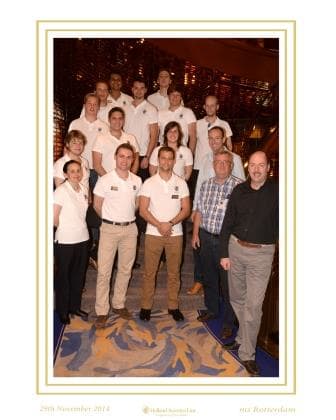
13 Officers on board  as part of our Nautical and Engineering Excellence courses. To the right Capt. Marco Carsjens, Chief Engineer Willem Dullaert (Ret) and Yours Truly.  (Photo courtesy Grace and her team of ms Rotterdam Image Creators)

13 Officers onboard as part of our Nautical and Engineering Excellence courses. To the right Capt. Marco Carsjens, Chief Engineer Willem Dullaert (Ret) and Yours Truly. (Photo courtesy: Grace and her team of ms Rotterdam Image Creators)

In the meantime life goes on onboard and that means that training continues. We are now 16 days into the program and slowly but steadily we can leave the theory behind and turn to practical items. It takes a while, many days in fact, before the group was ready to start tying all the strands together of what was discussed so it starts making sense.  And now we are getting there.

While the engineering group continued their voyage of discovery into the workings of engineering items, the deck side was moving towards the practical side of watch keeping. In groups of two they are now observing the watch keeping sequences and routines on the bridge and by the time that they join their own ship it should be familiar for them.

One of the ways that we do this is by means of touch drills.  It is something that we picked up from the Navy and it is a very clever way of getting familiar with certain routines. As an example we discussed what should be done on the bridge when a fire alarm comes in.  After a lot of discussion a list of items were compiled and these lists basically became a checklist that could be worked from.  Then it was time to go to the bridge and reenact step by step this checklist.  Not just by pointing, but step by step, going to each panel and simulating (touch – drill) pushing each button that is involved, making the announcement that goes with it and acting through the whole sequence.

Another item we are introducing now are case studies.  Incidents that have been investigated can work as lessons for the future and can be compared with the company regulations and doctrines that are there to avoid these incidents from happening again. It also helps to create a greater picture of what needs to be thought about when being on the job.

In the coming days, when we visit ports again, it will be a focus to run as many practical lessons as possible.


29 Nov. 2014; At Sea.

Today we have been sailing along the coast of middle Africa along the SW corner.  And by 19.00 hrs. we passed the town of Monrovia, after which the Country of Monrovia is named, The next well known city is located more towards the north is called Freetown, in Sierra Leone and thus it will take a while to get there.

Sometime in the past I dedicated some blogs to “Un-sung Heroes” onboard the ship. Crew members who work behind the scenes, and who are seldom seen, but who do play a vital part in the operation of the vessel. Whether on deck, in the engine room, or in hotel.  Functions onboard which are not noticed, until the toilet stops working, the laundry does not arrive, or the daily newspaper does not show up. One of those functions onboard is the florist.

For a long, long time Holland America has prided itself on having fresh flowers on its ships.  In my records I have proof that this was a regular routine since the 2nd world war. I would not be amazed if they did it before that time as well.  In those Trans-Atlantic days it was fairly easy to accomplish this. The ships were in port every 7 days and a local florist could wheel everything ready made onto the ship.  Also when the ships went cruising it was not that difficult as apart from the World Cruise most cruises were of 10 to 11 days length or shorter and the ship returned to the same home port. There a local florist could again just wheel all the needed flower arrangements onboard.

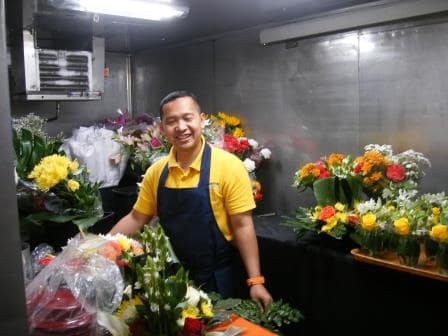
Mr. Rustadi, the ships florist on board the ms Rotterdam.

Mr. Rustadi, the ships florist on the  ms   Rotterdam.

But Holland America started to make their cruises longer and longer and the logistics became more and more difficult. So a number of years ago it was decided to appoint an in-house florist but who works for an outside company.  While onboard the Florist reports partly to the Exe. Housekeeper and partly to his Boss ashore. All the ships florists come from Indonesia and thus fit in seamlessly with the Housekeeping Department.

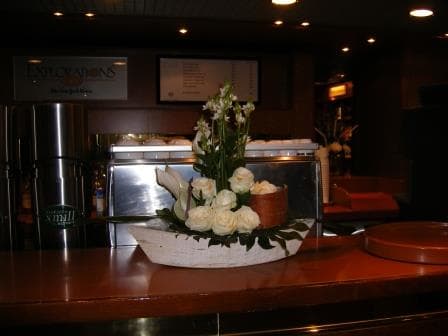
A small display on the counter of the Explorations Cafe.

A small display on the counter of the Explorations Cafe.

Working with an outside company, solved one big headache for the company and that was to get flowers onboard on a regular basis; especially when on a long cruise such as a World Cruise or what we are now doing now, going around Africa.  The whole African continent is full of beautiful flowers but getting them on the ship is another matter. For an outside expert it will be much easier to arrange what is needed than for the company itself whose purchasers and buyers do not necessarily have the expertise to get on board what is needed, desired and to timely source it.

The Florist has his own little Green house down stairs, although it is really a cold store to keep the flowers in good order until they are needed. There the large and small bouquets are made and then distributed in the ship according to a pre-approved location plan.

 
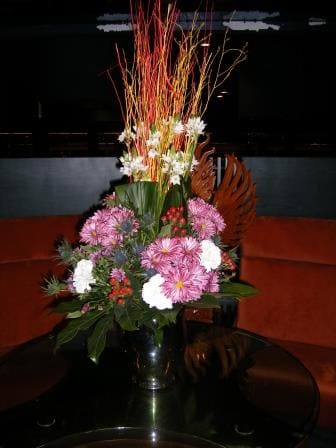
A large composition in the entrance of the Dining Room

A large composition in the entrance of the Dining Room

On top of that the florist also takes care of the fixed plants and flowers in the ship such as the Orchids on the Lido Tables and the greenery in the various public rooms. The latter took a headache away from us to. Before the Florist was there, looking after the plants was in the hands of the Dining room, which is the most creative department we have here when dealing with displays. The Dining stewards appointed to look after the greenery onboard where quite often very exuberant with water and killed everything with kindness. Exactly the opposite of what they were trying to achieve.

So now we have the florist and as you can see, he has some beautiful creations on display in the ship.  One of our unsung heroes……. Crew members who make a Holland America Cruise just a touch more special.

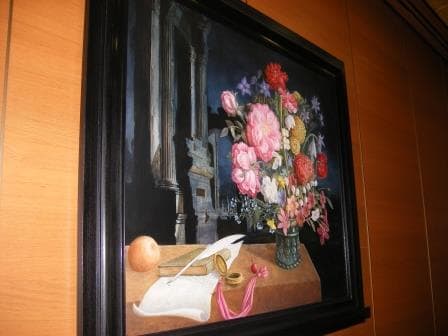
What would we do, if a shipment of flowers would miss the ship?  We have a plan B. Look at our art onboard.  In the aft staircase on deck 4:  Flower Still Life called “Bouquet by night” by the Dutch painter Reynier de Muynck.

blog painting

Tomorrow we are at sea again and then in the late evening we should start approaching Dakar where the ship can take a straight course to our next port of call, Praia in the Cape Verdes.

28 Nov. 2014; At Sea.

We are sailing North West and although it is more North than West, it still means that every day the sun rises a little bit later. We also went over the Greenwich Prime Meridian.  Thus we entered another time zone which meant that last night we put the clocks back one hour.  As a result we are now on British Time.  Everybody who has travelled knows about the issue with time changes and most cruises have one or several of them.  From one hour in Caribbean between the USA and all the Islands in the summer time; to losing a complete day when on a world cruise.

This around Africa cruise is more of a vertical than a horizontal cruise and that limits the time changes needed to stay on local time when in port.  From Rotterdam it was one hour forward to Greece and then another hour forward to the Suez Canal.  When going south the time stayed the same and when finally heading west the hours went back.  Since Capetown we have had 2 hours back and that will be it for the time being.  Once we are nearing the Continent again we will have to put the clock forward again.

On a world cruise putting the clock back is an almost daily occurrence when the ship is on a crossing. That is the good part as every evening there is an hour more to enjoy. The fact that you lose a complete day is hardly noticed.  Going the other way is much more irritating as you do gain a day but nearly every night on a crossing is an hour shorter.  Hence Holland America World cruises go west when you gain hours, not lose them. It was tried in the past to go the other way but the feedback was not very positive.  Not from the guests and certainly not from the crew.  There are still cruise company’s out there that go “the wrong way around” and they must fill the ships otherwise they would not do it but it must call for very empty ships in the evening and/or very quiet mornings as nobody wants to get out of bed.

To make things as best as possible we try to get the most out of these hours. If we can wrangle it the hour back is during formal nights, our crew shows are during hour back nights, and so are show buffets. We had the Indonesian crew show during the previous hour back and so last night, late-nite-comedy was scheduled in. It still gave the option for everybody to be in bed by 11 pm. – new time- if they wanted to go.  If most guests go, I do not know as I was in bed by that time. I normally get up at 06.00 to review the day’s trainings and by 06.30 it was still very quiet in the Lido.  Maybe a lot of people stayed out for Happy Hour which runs four times a day, including at 11.30 pm. offering the 2nd drink for $ 1,–.

What is also different on a longer cruise are the lectures and the entertainment.  During a 3 month cruise you have to offer new things and thus entertainers fly in and join the ship in various ports of call. Same for the lecturers although if a lecturer has a large repertoire than he/she can fill a whole cruise. You have to see that in context I suppose. I was a bit bemused the other day to see a lecture about penguins while we were sailing in the tropical waters of the equator. You seldom see penguins there. But it was part of a series on Nature & the Sea so it did make sense in the context.  Today the lectures were about Woman Pirates and Wildlife of the Tropical Islands, while the Shorex Team and the Location Guide got everybody informed about the Canary Islands.

Looking through the daily program there is another significant item. More and more extensive – fitness options.   07.00 sunshine stretch, 07.30 Fab abs, 08.00 Tai Chi, 10.00 Healthy habits, 11.00 Spa Seminar, 11.00 Acupuncture,  11.00 Hot Stones,  11.30 Dance Class. And then it starts all over again in the mid afternoon.  If you do not want to be fit, the only places you can hide is at the Lectures or in the computer classes. Or go to High Tea in the dining room.

Today we had mixed day at sea with a bit of everything. The winds varied and the cloudiness varied. We are now nearing the continent again having passed over the Basin of Guinee and tomorrow morning we will be sailing past Harper which is in South East Monrovia. From there the land will move away from the course line again but our courses will now follow the coast of West Africa until we can turn to the north but that will be another day.


27 Nov. 2014; At 00.00 – 000.00

Today we reached a highlight of our cruise which gave everybody the possibility to walk in four quadrants within a minute. North Western half, North Eastern half, South Western half and the South Eastern half.  At 3 pm we reached Point Zero. The crossing of the Prime (Greenwich) Meridian and the Equator.

As you can understand, the ship was not letting this pass by without it being properly celebrated. Hence the plan of just sailing over the mark was not going to happen. The ship had to be stopped to make it possible for all the guests to get “on the mark”. King Neptune was invited and the Cruise director grabbed the chance to throw a party.

I was a bit disappointed in King Neptune. You would expect that if he and his better half were invited to come to the ms Rotterdam he would arrange for perfect weather. Well the sun did shine but also the wind did blow. We are officially not yet out of the doldrums but it seems that the doldrums had decided to take a break as it was blowing up to 30 knots. That made it a lot more difficult for the captain to get the ship on the spot and to keep it there. Thus I am disappointed in King Neptune as I had expected better from him.

To make it even more complicated it was decided that the zero position should not be on the bridge but in the Lido pool making it possible for all the festivities to take place right on Point Zero.  This meant that it had to be calculated how much the bridge had to be north of the Equator to get the Zero – Zero exactly in the Lido Pool. Once that was achieved the ship had to be kept there for 45 minutes while all the fun took place in the pool area. Together with the North Equatorial Current pushing the ship to the East and the strong winds pushing the ship to the North West it made the whole affair a challenge to say the least.

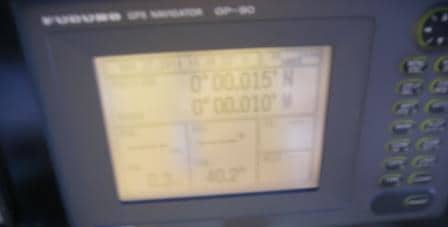
We are there. The  Lido pool is about 30 meters aft of the GPS antenna and to sb. hence the numbers not being zero.

We are there. The Lido pool is about 30 meters aft of the GPS antenna and to sb. hence the numbers not being zero.

However, what the Cruise Director wants, the Captain shall deliver and thus it was done. Not as easy as everybody had hoped for, as the wind tried to keep pushing the ship to the North West but by using all the maneuvering capabilities of the Rotterdam, the “Zero” was kept in the pool.

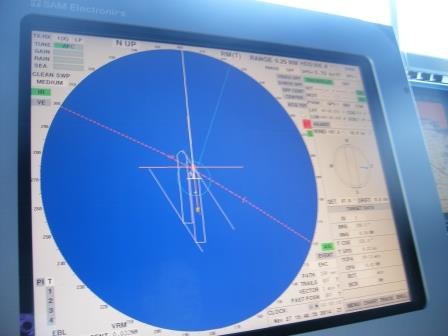
How they did it. Put the bow in the calculated position, have a blue circle on the pool location and then watch the predictor (2nd ship's layout on the screen). As long as the predictor stays on top of the ship, the ships maintains position.

How they did it. Put the bow in the calculated position, have a blue circle on the pool location and then watch the predictor (2nd ship’s layout on the screen). As long as the predictor stays on top of the ship, the ship maintains position.

On deck other things were happening:

First King Neptune and his Queen popped up and were parked in the orchestra booth so everybody could see him & her and after he granted “ safe passage” (although a windy one) to all on board, we had a little show featuring a cultural aspect from each of the four quadrants.  Russian Dancers represented the North, Indian Dancers the East, the South was represented by South African paintings and local music and the West by Argentine Tango dancers.

For those who were more into Alcohol than Culture, the Beverage Department had created 4 special drinks commemorating each quadrant to enhance the party atmosphere and indeed some guests did look very happy indeed.

By 16.00 hrs. the good ship Rotterdam was on its way again continuing on a North Westerly course towards the Cape Verdes. We are almost halfway now, so we still have a few glorious days at sea to enjoy.

Barely an hour after we left Point Zero, the wind fell completely away. The doldrums were back from their break. We could have done with that wind still weather while we were at Point Zero. King Neptune will have some explaining to do when he steps onboard next time.

HAPPY THANKS GIVING TO ALL MY AMERICAN READERS.

26 Nov. 2014; At Sea.

Slowly but steadily we are nearing the equator but what is more exciting is also the Greenwich meridian. The captain is going to attempt to get 00.00 N/S & 000.00 W/E on the GPS so that the ship is exactly on the equator and the zero Meridian at the same time. Getting to the main zeros is not so difficult but getting to ALL the zeros is extremely difficult. It means that the navigation team has to get the GPS antenna within 3 feet of the crossing of the two imaginary lines.  Thus 800+ feet of ship has to sail within three feet of accuracy to get the magic number.  So I am keeping my fingers crossed. I managed with my own ship the 00.00 Equator once but I have never gotten the chance to go for the “All around zero”. For a navigator this is exciting stuff as it goes beyond the regular pin point navigation. 3 feet is hard to achieve and we do not get a 2nd chance. It is not as if we can turn the ship around and try it one more time. Today we are 3 degrees south of the equator so we are not there yet. Expected time is approx. three o’clock tomorrow afternoon and the Cruise Director has planned a special party on the Lido Deck for this “once in a life time event”. He might be right there because the chance that somebody will make another cruise that follows the same cruise track is fairly slim. Plus it is Thanks Giving tomorrow for our American Guests and that could make it even more special.

For us the school class life goes on below decks. The 13 trainee’s in the group spend their day partly together and partly split up.  In the morning it was your’s truly who discussed the company’s fire fighting doctrines and the need to stick to the protocols when going through a fire evolution and later on the navigators got immersed in sprinkler systems and the engineers in something highly technical and complicated in the engine room.

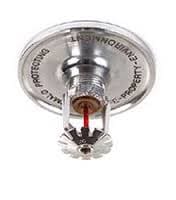
Nowadays all ships have sprinklers systems. Those little nozzles that stick out of the ceiling in your cabin with the little warning on it: “Do not hang articles from sprinkler heads”.  Each nozzle has a little colored break glass that will crack if the room temperature goes up too high; which then normally indicates that the cabin is on fire.  Many a cruise

One of the many types out there. The red glass will burst if the temperature goes above 68oC

One of the many types out there. The red glass will burst if the temperature goes above 68oC

ship fire has been extinguished before it became a real problem by means of this system. There are several variations on this system, such as Hi-Fog etc. depending on how fine the droplets are that are being dispersed from the nozzle.  Whatever the system that is in use and we have several onboard our ships, it is extremely important to know how this life-saver exactly works and how to deal with it.

If somebody would knock a glass out of the nozzle then 9 bar of pressurized water comes spouting out. That is a lot of water. In that case we all run to close the valve. A: to prevent the cabin from total flooding (and mostly also the whole neighborhood as it is an awful lot of water that comes out) and B. to prevent seawater from coming into the lines. Once the glass has been broken the water flows out. That causes a pressure drop and that starts a pump. The water in the sprinkler lines/pipes is fresh water to prevent the pipes from rusting. That water sits in a pressurized tank. As soon as the water starts flowing that fresh water is very quickly pushed out of that tank and towards the location of the broken nozzle. Then automatically a pump starts and that pump supplies salt water to keep the extinguishing going until we stop it. We do not like that salt water in the pipes so as soon as the fire is out, or if there is not fire but a broken glass we we want to close the section valve even faster. Everybody has to know the location of the section valves (39 in this ship) and how to deal with them. That took up most of the afternoon as my colleague also included an engine room tour.

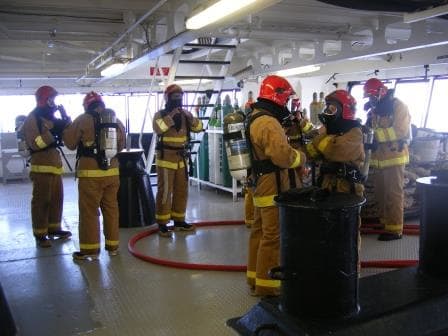
Dress up. Check your partner to ensure that there is no exposed skin.

Dress up. Check your partner to ensure that there is no exposed skin.

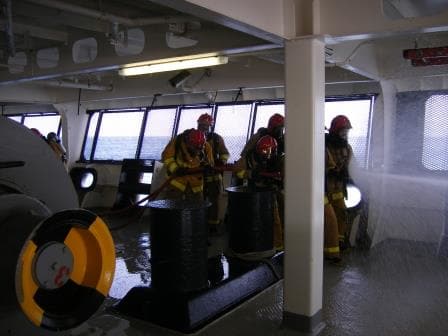
In the mean time I prepared a little fire hose training. Most deck and engine officers will be part of the fire fighting squads eventually and the earlier we start the training the better it is.  Apart from the regular hose control exercises I also let them do the soccer game. The objective is trying to push a large ball into two goals by means of a fire hose handled by two opposing teams. That is nearly impossible due to the pressure on the water jet but it is a good excuse to get each other soaking wet. And thus it happened.  A very happy but extremely wet group of trainee’s finished another fruitful day at sea.

Two hose attack. One for protection the other to fight the fire.

Two hose attack. One for protection the other to fight the fire.


25 Nov. 2014; At Sea.

Today is our first day of that long haul all the way along the West side of Africa. The area that we are now in, close to the equator, is known to sailors as the Doldrums. 

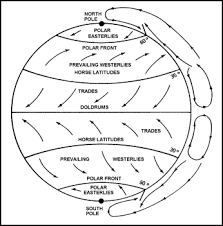
downloadThe area of very little wind.  It is caught between two area’s of trade winds and as a result there is basically “no wind left” to blow here. And indeed outside there is hardly more than about 3 knots of wind blowing. We call that a light Air.  It is almost always the same here and in the old days sailing ships could float here in becalmed weather for weeks, causing food and water to run out and scurvy to set in. Not nice at all. That was also one of the reasons for steamship companies to be very quickly established to Africa as well.  The North Atlantic was the first as the steamships reduced the crossing time (here mostly due to too much wind = bad weather) from six weeks down to 14 days, but this was quickly followed by routes to West Africa. Especially the British were very active here. There was a Dutch company as well but it was never very prominent. The Belgians had a much larger presence in this area as they owned the Belgian Congo.  A good second were the Portuguese who had the colonies Angola and Mozambique. The name Doldrum is 19th. Century and means dullard which in those days was a sluggish fellow.

Another piece of interest that surfaced today and had the guests focusing on was the volcano eruption in Cape Verdes. Everybody was at once concerned about having to cancel yet another port but there was no reason for alarm. The Cape Verdes are full of volcanos and this one has its own island. Basically the island of Fugo is the Volcano. There are houses scattered all over the mountain slope and there is a little town but it is all up and against the cone of the Volcano. Thus there is no point of refuge on the island and hence the call has gone out to evacuate everybody to one of the other islands. We will see the island on our portside when leaving the port of Praia. There is about 33 miles between the islands and if the Volcano is really active we should be able to see something as long as it is safe to sail by. It is not a good idea to be in the area when it starts raining pumice so we have to careful.

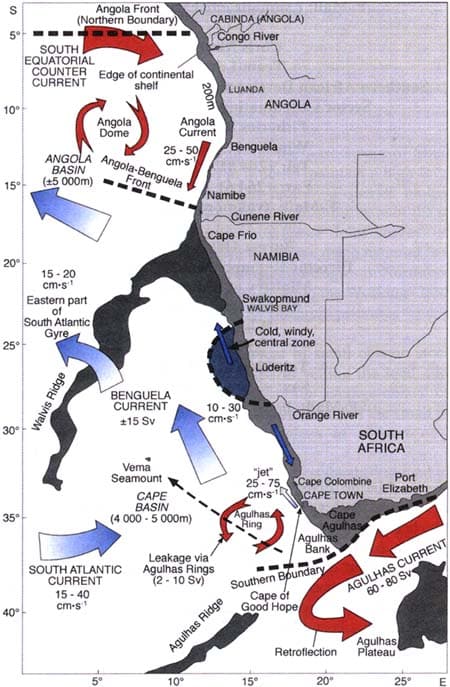
The land area under the sea is called the Angola Basin and the sea reaches depths up to about 5000 meters. Then it stays that deep (give or take a 1000 feet) until the ocean floor climbing again near the Mid Atlantic ridge. Above it the water swirls around quite nicely. The ship is now coming under the influence of the South Equatorial Counter Current which is part of that mid Atlantic rotating current system which I mentioned the other day. It flows from West to East along the Equator and when nearing the African coast takes on the name of Angola current. It then follows the coast a little bit to the south before it turns west again. While going west it gets a little push from the Benguella current, which brings cold water up from the Cape area.

The SEC Current is thus pushing the ship to the East but luckily not full onto the bow and hence the ship does not lose too much speed. The deck officers only have to steer for drift to counteract this push in order to stay on the course line.  Although one would think that we are in the middle of nowhere here, this is not the case, as all the ships that are heading to or coming from Cape of Good Hope near Cape Town are on nearly the same courses as the Rotterdam.  Today we saw traffic that was related to the oil offshore industry and liner service to the ports on the South West coast of Africa but by late tomorrow afternoon we should see Tanker traffic going to and from the Persian Gulf. For these large tankers it is economically worth while to sail all the way around Africa and not to go through the Suez Canal. Although some of them are (still) too large to transit the Canal that might change in the near future as Egypt is going to build a new Canal parallel to the old one with the hope of attracting more traffic and also larger ships.

Tomorrow will be our second day at sea and we will be coming closer and closer to the Equator.

24 Nov. 2014; Luanda, Angola.

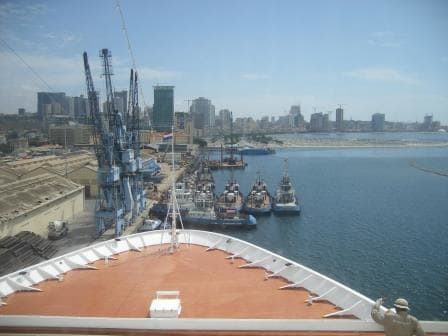
By 7 am we were docked in Luanda. This place has always been an important port for the region and even Holland America ships were calling there in the 1960’s. While HAL was not really an “African” specialist, then it was mainly the export of local products, now it is used mainly for off shore, due to oil exploration, which is becoming very important. As a result the whole bay area in front of the docks was full of Supply Boats when we got in.

The Luanda sky line. Fast developing if counting the number of cranes.

The Luanda sky line. Fast developing if counting the number of cranes.

The port does not have a dedicated Cruise Terminal; as a matter of fact they are not really focused on cruise ships at all. We are docked at the Cement Terminal and this morning when we arrived Port Security did not even know that we were coming. Somebody forgot to advice somebody, I suppose.  Also immigration was about 90 minutes late but at least then they cleared the ship in 30 minutes. If you expect to find on these sorts of cruises everything well organized on the shore side, then you had better stay home. On these real explorer cruises you have to go with the flow. Whatever that flow is. The fact that we are on some sort of expedition is shown by the requirement of having a valid yellow fever vaccination with you. Thus in the last few days the medical department has been busy ensuring that all the booklets were handed in and checked for validity.  No valid yellow fever vaccination, No go ashore.

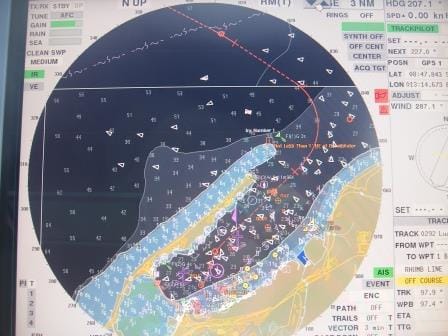
All the white dotson the radar screen  are AIS indicators from boats involved in the off-shore industry

All the white dotson the radar screen are AIS indicators from boats involved in the off-shore industry

Most people took tours today as that was the safest way to see the area. We were advised that the boulevard was safe but warned not to go too deep into the side streets. Since the end of the Civil War, Angola is slowly coming back to normal but there is a very sharp divide between rich and poor and thus there are a lot of people who would like to go from poor to rich in a quick and easy way.  I walked ashore briefly but as we were also warned that taking photos of official buildings etc. is not allowed without permission, I have not much proof to show for it.  If you do take photos and you get caught, a prison sentence awaits or a hefty fine. As I was absolutely not interested in visiting the local prison, so I kept my camera my pocket. The boulevard is about 4 kilometers long and everything of some importance is along this boulevard. Shops, Restaurants, Cafés and a lot of official looking buildings. The oil exploration is bringing lots of money in and everywhere there is construction going on; although I did not get the impression that it was going very fast.  But maybe Monday is not a construction day in Luanda.

It is a real pity that this cruise has been affected by the EBOLA situation which required a number of ports to be cancelled. Thus Luanda is basically the only real Central African port that we visit. There are not that many ports around that we could divert to without running into some sort of issue. When we leave tonight at 10.30 pm. It will be followed by 7 days at sea until we come the Cape Verdes Islands.

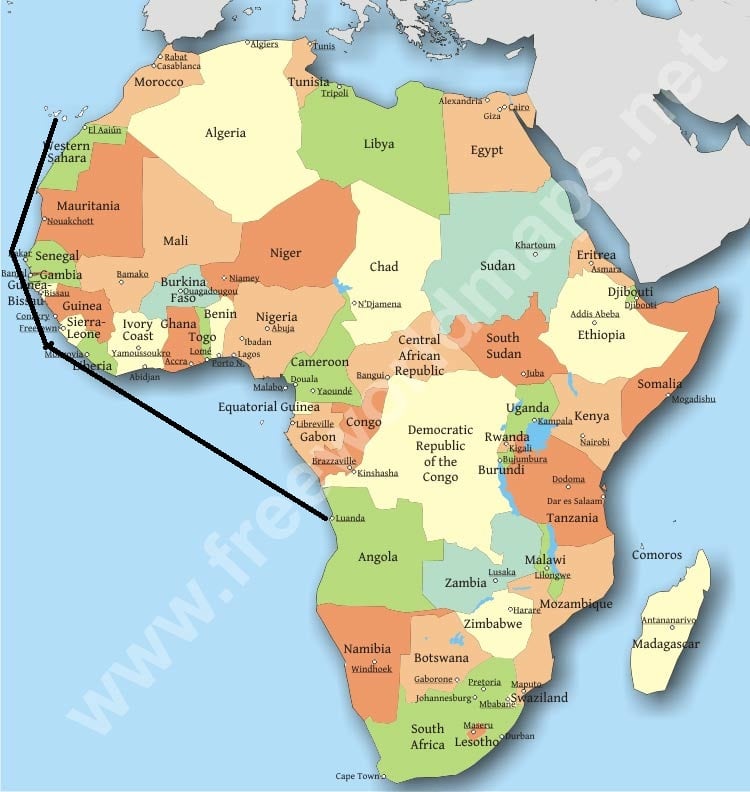
blog africa mapWe will first sail on a straight North Westerly line to the corner of West Africa and follow the coast line until we can sail straight to the Cape Verdes. These Islands are located off shore from Africa and are not really any part of the Continent at all as they are volcanic in origin, being located on one of the fault lines in the North Atlantic Ocean. The Canary Islands which we will visit afterwards are a result of the same situation. An open crack in the earth’s core, causing lava to come out, which eventually gets so high that a Volcano rises out of the water and turns into a habitable island.

Map credit to: Daniel Feher www.freeworldmaps.net

Mr. Feher makes a lot of maps and charts and for those interested, his work can be found here: http://www.freeworldmaps.net/africa/ …………………

Thus we will have seven days at sea and my colleague and I will have our hands full with our training classes. The program calls for 8 hour days of training and instruction and then we need at least 2 hours in the evening to prepare for the next day.  I am only now starting to realize how specialized the work on a cruise ship is. A lot of people think that cruise ship officers spend their days around the pool, chatting up young and nubile ladies, but our work is as highly specialized as working on a Gas Tanker or in a Nuclear Sub. (Although we have the advantage that we cannot blow up so easily………………) Because of that, new joining officers have an enormous amount of indoctrination work to get through and this course is hopefully a good way to reduce that initial burden.  It should make it a lot easier for the new officers to settle into their job when they get to their own ships.

So tomorrow we are at sea, sailing far away from the African Coast until we come closer again near Liberia in about 3 days from now.

23 Nov. 2014: At Sea.

Then suddenly it got warmer around the ship in early evening of last night.  One would expect that it would cool down after dark and it did, but not that much. This sudden change was caused by the fact that the ship left the colder Benguela current and entered the warmer Angola current. We are getting into sub-tropical waters again.

As all the world’s oceans are connected there is a constant movement of water going on. Caused by the rotation of the Earth, by the pull of the Moon and the Sun but also because of constant winds such as the Trade Winds. As a result there is a flow around the continents but also rotating currents that circle between the continents.

There is a very sharp boundary between the cold water from the South going north and the warm water from the north coming South

There is a very sharp boundary between the cold water from the South going north and the warm water from the north coming South

The Benguela current comes from the south, from the Antarctic area and pushes cold water north along the west coast of the southern part of Africa. The winds which blow predominantly from the south along the coast of Namibia (something we witnessed in the past days) help to push this current up towards Angola.  Here it meets a down coming current, the Angola current which is part of this rotating system in the South Atlantic Ocean.  The approximate area where the Benguela current moves away from the coast is near Cape Frio, the cold cape, which makes sense in a way.

So in a couple of hours, the sea water temperature went up with nearly 6 degrees Celsius. Six degrees do not sound that much but taking into consideration how large this body of water is, six degrees is an enormous amount of energy that the sun had to spend to get it that warm.  It also has a direct influence on the outside temperature as the cooling effect of the cold seawater on the air has fallen away. Basically the temperature last night did not drop anymore from lunchtime but remained the same at 77oF or 25oC.

Tomorrow the temperature will vary again during day and night time but then at a higher level as we will remain in warmer waters now. It will not be until we are a long way past the equator before the sea water will get cooler again.

Most of this happened outside the scope of the Trainee’s in our little school class, who tackled today the art of giving training. At least the 8 deck officers. The 5 engineering officers were engrossed in pipes and steam and propulsion systems but the deck group needed to learn how to perform. At least that is the word I prefer to give to it.  If you want to pass on knowledge then the better your performance is in front of a group, the better the chance is that they will absorb at least something of the training/instruction that is been given.

Public speaking is not something everybody knows how to do and not everybody likes to do it but ground rules can be learned and that will then make the experience for audience and trainer already a lot better.  Apart from that the presentation itself is important. Not only the contents but the structure of the presentation. A lot of trainings and presentations do not have the desired effect because there is no structure or –even more important- there is no ending. It suddenly stops as the speaker has run out of material. Then the audience will only remember the “black hole” at the end and not the message that had to be brought across.

So today we spent time on what to train; the topic was lifeboats and life rafts, but also to ensure that each training had a beginning, a middle part, and an ending. And if possible that ending should have a cliff hanger. One wise sentence that the group which has received the training will take with them and remember.

Tomorrow, in two groups of 4 they will have to give a 20 minute training presentation. I will be less interested in the contents than in the way that they will engage the audience to get the message across.  If that all works out, then it will be a half day for them, and they can go ashore and explore Luanda in the afternoon.

We are expecting to dock around 07.00 hrs. The clearance should take about 90 minutes so everybody should be able to go ashore by 08.30. Noon temperatures are expected to reach 84oC or 28oC.


« Older posts Newer posts »