- Captain Albert's Website and Blog -

Ocean Liner History and Stories from the Sea, Past and Present. With an In Depth focus on Holland America Line

Page 104 of 241

13 Dec. 2014 Tangier, Morocco.

This is our last port visit in Morocco. During the coming night we will cross the Straits of Gibraltar and 54 miles later we will be in Cadiz, Spain. This is the moment that the ship is leaving the African Continent behind after having made a full circle. I will be able to see tomorrow in the chart at what point we completed the loop with the old course line – going into the Straits and the Med – crossing the current and – going up to Europe.  We will not re-enter the Mediterranean as Cadiz is located on the Atlantic side of Spain.

Last night we sailed along the coast but kept well away from it. The fishermen were out in force, close to the coast again but the ms Rotterdam was sailing along on a deep water course, having for most of the night almost a 1000 feet under the keel. That is too deep to throw your fishing rod in and thus the fishermen were making noises closer to the coast.
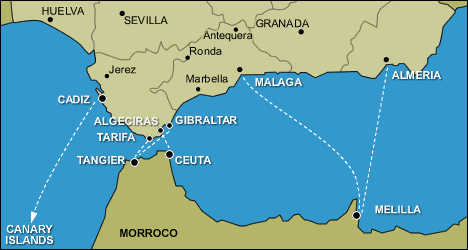
ferries-mapTangier obtains it’s prominence from being the main gateway port for Europe. There is constant ferry traffic going in and out, to and from the ports in Spain. For those interested in Ferries, this is a real candy – land for the ferry spotter. Not only the numbers that can be seen, but also the variations that are in use.
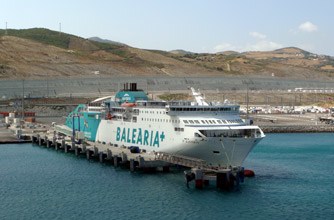
Morocco-ferry-tangierBasically there are two main variations out here. The regular ferry as we all know them. Not unlike a cruise ship but always with a large garage to facilitate ro – ro traffic.  Often in use for the slightly longer runs but also needed for the cargo traffic.
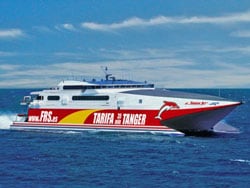


ferry_tarifa_tangerThen there is the Fast Ferry which are mainly Catamaran type boats propelled forward by water jets, which maintain the pedestrian traffic. Although some of them can also take a limited number of cars and Lorries. These ferries can make an average speed between 25 and 30 knots providing a crossing time to Spain between 45 and 70 minutes.  There are two ports in Spain which are on the other end of this run: Algeciras & Tarifa. The 3rd one is Gibraltar which is in Great Britain. Although Algeciras also has ferries running to Ceuta which is located in Spanish Morocco.  Due to the short crossing time, you could decide to go on an excursion to Europe while docked at Tangier, if you had been here before. I do not know how easy Immigration and Customs would be on the other side but for me with a Dutch/European passport it should be easy as I would basically be “coming home”. Going the other way again might be a different story; as Moroccan immigration might raise an Arabic eyebrow if you come to the counter with the explanation that you just hopped over for the day while on a luxury Holland America Line Cruise. They expect you to visit the local sites, not to go to “the other side”.

It is interesting to note that the port of Tarifa used to be a toll port, from which our word Tariffs come. Nowadays there is no more toll levied but there is still a traffic/reporting station that keeps an eye on everybody going to and from.   Approx. 500 ships pass through the Straits every day, varying from very small fishermen to very large Container ships and Super Tankers.

That will in the future be even more as Egypt is planning to build a 2nd Suez Canal which will be able to take even larger ships.   I think they are aiming for an opening in 2018. Then we will see the largest container ships going directly from the Panama Canal and its new locks to the Mediterranean and the new Suez Canal.  Knowing ship owners, they will then probably start building even larger ships so that both the new Panama Canal Locks and the new Suez Canal are going to be too small again.

The Captain decided this morning that he is staying longer in Tangier and thus the ship will as well. The reason is the wobbly weather that we are expecting. With only 54 miles to travel, it means an average speed to make of about 5 knots if we leave at the normal time. With 5 knots the stabilizers do not get enough flow and thus cannot help to stop the rolling of the ship. Our new departure time is now 22.00 hrs. and that will bring the average speed up to over 8 knots, giving enough flow for the stabilizers to keep us all comfortable.

Thus we are expecting a ship that will move a bit during the night, before we arrive in Cadiz in the morning. Tomorrow will be a Sunday and everybody might be in church in the morning and turn Cadiz into a very quiet place.
12 December 2014; Casablanca, Morocco.

During the night and the morning the swell did build up as predicted and to such an extent that there was a surge going through the port. Even the ships deep in the harbor, protected by two finger piers felt it. A surge is not really a swell or waves that run through a port it is more a sort of pressure wave caused by the sea outside that is pushed through the breakwaters and into the harbor. It runs all the way in and is then sucked all the way out again. Only to be repeated a few minutes later. As a result all the ships were riding along the dock, causing the occasional rope to break.  But for the rest it was a great day. Sunshine and not too warm or too cold and that is always good news for the tours.

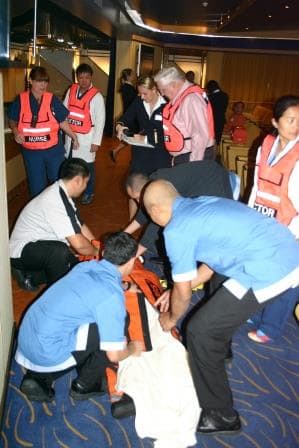
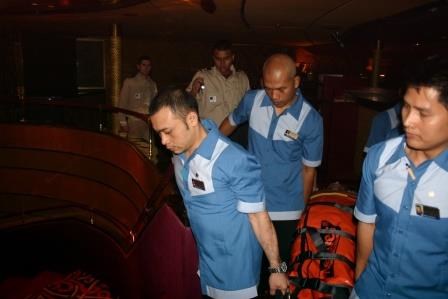
On board we geared up today for a big drill, Fire drill combined with Triage. This means that we simulate a fire or a collision with multiple casualties and then the ships complement has to support the medical team here to deal with a large influx of patients. This time I managed to get 25 volunteers and they all acted out, with great gusto, the various injuries that were given to them. From being near death, to being hysterical, to having a broken arm, to missing both legs or suffering from burns or gas inhalation.

After the Emergency Response Teams have fought the fire and secured the area, a Medical Officer is let into the disaster area and will triage ( = assess & select) the casualties, which are then taken to separate area’s for further  treatment.  That goes by colors.

We use Triage Flags, same as in the army, to indicate the treatment area's.

We use Triage Flags, same as in the army, to indicate the treatment area’s.

Green = walking wounded ————— not urgent

Yellow = need treatment ——————– but can wait

Red = urgent ———————— if treated now, we might save a life

Black = lost causes.

Transport of the casualty

Transport of the casualty


While the Triage Officer is color coding, support troops, stretcher teams etc. are starting to move the casualties to the various treatment areas.  The rest of the medical team will be in the Red Zone, as those are critical, the rest can wait. The challenge of the drill is to do it safely, fast and with good communication.


A drill like this takes nearly a full day to set up and that cannot be expected from the ship and thus I always offer to organize one when I am on board.  It is a three day stage, the first day, table top = discussion of what is going to happen, 2nd day the drill, 3rd day, review and lessons learned. All the observations and comments that are made by those who have to do it, are taken on board and go with me to the home office for further review and hopefully they will help to improve our procedures.

The medial team dealing with a "Red" case

The medial team dealing with a “Red” case

Today was a very good drill. The volunteers acted with great passion, all the teams were very enthusiastic and the team work ensured that all objectives were reached.  The latter is for a drill like this with about 80 people involved not so easy to achieve. But Team Rotterdam did it. I was genuinely impressed.

We left this evening just after 7 pm. As soon as all the tours had returned. The Captain had warned everybody that we would roll again when going outside but as expected it was less then when coming in. It is always better for a ship to catch the swell on the bow than on the stern as swell has a tendency to lift the stern, while the bow just cuts through it.


Tonight we are sailing along the coast of Morocco again, safely away from the fishing boats. If my past experience guides me, then there will be a lot more tonight – further north up the coast – than yesterday – further south down the coast -.

Then tomorrow we will be docked at Tangier by 0800 in the morning. Noon time temperature will be a balmy 17 oC / 63 o F.

(note: All photos courtesy 3rd Officer Chris Troisfontaine)

11 Dec. 2014: At Sea and suddenly Casablanca.

And thus we plodded along the coast with a nice slow speed, avoiding all the bumps in the road by riding nicely over them with that slow speed.  The ships course line followed the coast and this time the precaution was taken to stay west of the 100 meter line. This is what most ships do if the people on board use their brains.

Especially in the Morocco the local fishermen sit on the 100 meter line. West of it, the depth of the ocean increases very rapidly and as a result cold water is being pushed up from the deep. Fish love that and so they congregate where the nutrient rich water comes up from below.  And fishermen love fish, so they congregate in the same locations.

Thus if a ship decides to sail over, or nearby, that 100 meter line it will meet all these fishermen. It gives a lot of headache for the navigators as they do not know what a fisherman will do and it makes the fisherman unhappy as he/she does not want to move and he/she does not know if the ship will move. So it results in a lot of unhappy people which can be avoided if a ship stays west of that 100 meter line.  When I sailed here in the past, I made sure we stayed “wide” from it all even if it meant burning more fuel. But throughout the night we then heard irate fishermen screaming at ships who sailed inside their fishing grounds. “captain, captain think about my children” etc. etc.  I do not speak Moroccan but if I hear !@#$%@#$%& on the VHF, I know that somebody is not really happy.

Who was also not really happy, or better said very concerned, was the Master of the Vessel, Capt. Hans Mateboer. He had been following the wind and wave forecast and for early morning 12 Dec. the predictions for the bar at Casablanca entrance were for waves between 3 to 4 meters. That is 9 to 12 feet sustained swell, which will hit the ship sideways while it lines up for the port entrance. 9 feet might not sound as very much but if it comes in the form of a long rolling swell building up on shallow water, it can have an enormous impact on the ship and cause it to roll considerably.

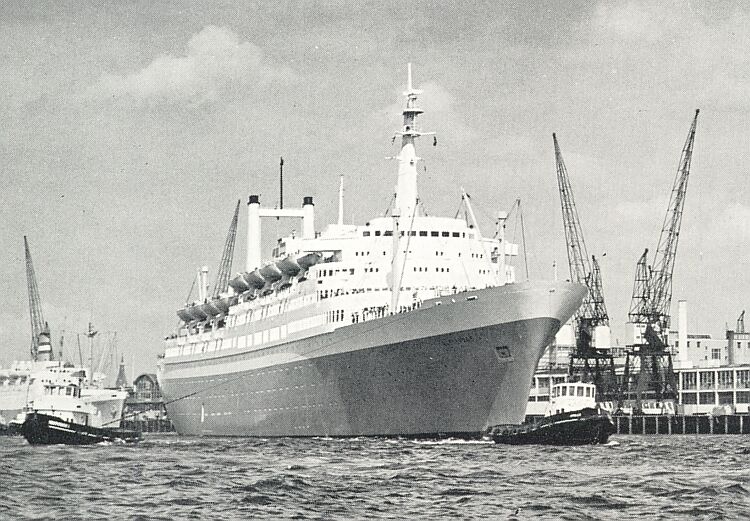
As the ss Rotterdam V looked like in 1976. Seen here departing from Rotterdam port

As the ss Rotterdam V looked like in 1976. Seen here departing from Rotterdam port

Some of us in the company still remember the roll of the ss Rotterdam in 1976. When it got caught in a freak wave also on the bar while it was waiting for the pilot. That caused the ship to list 43o and roll back again. I figured the amount of roll out in 1986 when I was on board and the purser gave me all the old reports. In the reports it mentioned that a certain type writer had shifted off the table and ended up in a crate/ box in the corner of the Front Office. By reconstructing the set-up we found out for this type writer to make that move a minimum list of 43o was needed. So maybe it was even more. One of the reasons that the Rotterdam survived was that it had an overhanging promenade deck and the water could not get into the ship. But Casablanca entered Holland America Line history that day as being a very dangerous port.

Thus the captain was faced with two options, A. hope for the best and see tomorrow morning if the weather forecast was exaggerated or B. get there before the swells started to build up.  The latter made more sense as it avoided the fair chance of cancelling the port and thus the Rotterdam sailed a bit faster and we arrived this evening at the pilot station at 17.00 hrs.. All the guests were warned that the ship would still roll a bit and everybody sat down happily clutching their drinks in their hands while the ship made the turn into the port.

There is a good solution for every challenge.

The ship will spend an overnight alongside the dock and then the doors will open at the regular arrival time. Tonight nobody can get off as the authorities were not able to arrange on short notice sufficient security to comply with the security regulations that are in force. No special regulations just what is required for every port, but it still takes man power to comply and that man power might have been already allocated somewhere else.

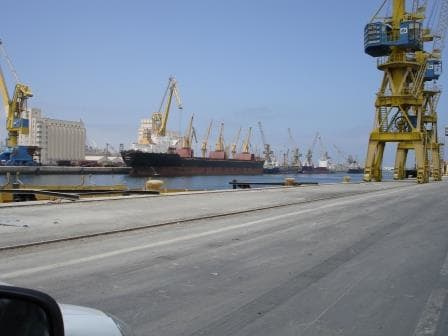
This is what we should see when we wake up tomorrow morning. Casablanca has a very large port.

This is what we should see when we wake up tomorrow morning. Casablanca has a very large port.

Casablanca is a working port, 24 hours a day so I hope they will not make too much noise, or smell while we all sleep. Last time I was here they were loading Tapioca and the smell penetrated the whole ship. Switching off the A.C. was no option as it was a very warm day so we were forced to think about fried fish all day long.

10 Dec. 2014; Agadir, Morocco.

So while the sun was rising, the ms Rotterdam docked at Agadir in Morocco. The port is basically a U shape piece of concrete sticking out of the desert. A cold desert as well. It was barely 50oF when the ship arrived.

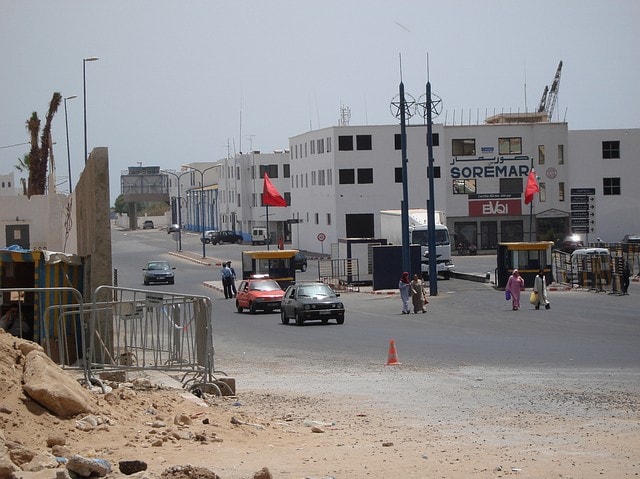
The entrance to Agadir Port

The entrance to Agadir Port

As far as I could see there was not a single bit of greenery in sight only sand and rocks. This is a real desert area. I later heard from the guests that further out it was not that bad.  Also not a port to just wander around in but a place to take the shuttle bus to the town itself. Which is of interest due to an ancient Kasbah just outside the city; the old port (on the landside of the port) and the local museum. In 1960 there was a devastating local earthquake with many fatalities and that is also remembered at various locations.  Another thing which Agadir seems to be famous for is the largest collection of beehives in the world. 

For those who were not going ashore, the art instructor (we have an arts and crafts lady on board for the whole cruise) had her class make little beehives.  Apart from her, there is also a water colorist on board, with a very successful class and the results of their undertakings are visible on various cabin doors throughout the ship. To keep the more vocal ones busy, tomorrow the Cruise Director is starting the Christmas choir. They will perform near the end of the cruise and most of the time it turns out into an amazing performance. With over 1000 guests,  there are always a number of very talented people among them, from gifted amateurs to near professionals, or retired professionals.  They always draw a full house in the show lounge and it always ends with a standing ovation.

Deck 5 on the way to the diningroom, for all to admire.

Deck 5 on the way to the diningroom, for all to admire.

While the guests were ashore, the ship’s crew started to transform the ship. The Christmas decorations were going up. It will take a few more days to complete but in the main area’s the first pieces arrived so we can spend the next 11 days before the cruise ends in a Christ- missy atmosphere.  The challenge is always to get sufficient pieces in to fill up an area and at the same time not to overdo it. And as a ship has some very large area’s that is not always easy.  Here on the Rotterdam we can easily fill up the Atrium but I wonder how they do it on the very large ships where they have these atriums that go 10 stories high with four or eight elevator banks in them.

With a lot of attention to detail.

With a lot of attention to detail.

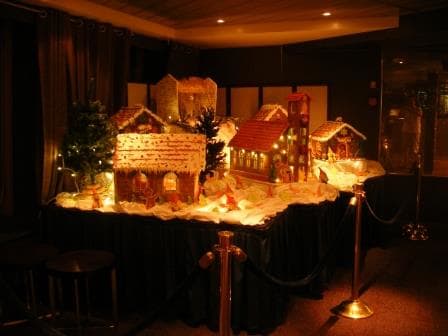
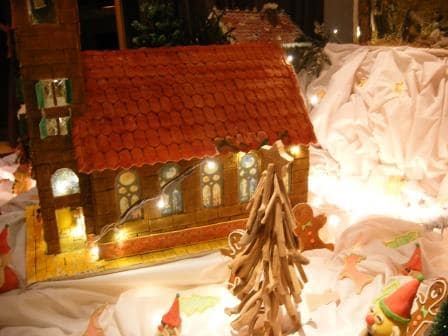
A set piece that somehow always shows up in a Holland America Line ship is a Christmas village. Supposedly completely made from edible materials but in reality only the coating is made that way, with the effect to make it look like a Hans and Gretel village.  If we made it all from edible material, the houses would quickly collapse as they would dry out from the ships Air – Conditioning. Thus they are the creation of the ships carpenter who makes them out of plywood, before they go to the kitchen to be turned into pieces of Winter Wonderland. A bit of white Taffeta and some Christmas lights and voila you have a whole corner full of nostalgia.

The main challenge with all this decorating is always that there are never enough electric sockets. If they are in the vicinity then never at the location where the decorator needs them. Creativity and ships design do not go always hand in hand. The result is that Housekeeping has to create ingenious ways of getting electric wires across pathways and hallways and under carpets and along plinths. All done in such a way that it is safe for passing traffic and up to the satisfaction of the Chief Electrician. Especially to be safe for the motorized version of ships traffic. We have quite a few scooters on board and some of them are not unlike all-terrain vehicles with extra grip tires on them. Those tires and thin electric cables do not go very well together. As a result Holland America is a very good client of 3M for buying large quantities of Masking and Duct Tape. Maybe it would be an idea for the manufacturer to produce a Christmas version of these adhesive tapes no doubt it would sell very well.

From Agadir it is about 300 miles up the coast to Casablanca which is also in Morocco. Too much distance to cover in one night and thus we spend a day at sea. A good idea anyway to go slow as the sea is supposed to be a bit wobbly during the coming night and with a reduced speed the ship will ride the waves nicely instead of banging straight into it. For the rest the weather should be good, if a bit chilly as all the North Atlantic mayhem is currently focusing on the West coast of Great Britain. Not nice at all, but a good feeling for me as my apartment is on the East coast.


09 Dec. 2014; Arrecife, Lanzarote, Spain.

This was our last relatively warm day of the cruise, unless we are going to get a very local Green House effect in the coming days. Tomorrow we will be in Agadir, Morocco, and the temperatures will plunge to 15oC / 60oF.  Time to start thinking about Christmas and snowy things.

Most appropriately the crew started today with un – earthing the Christmas decorations. One of the side – wings of the dining room was a forest of Christmas trees in the process of being assembled. Most of our Christmas material is supplied year by year by an outside firm. That has the advantage that the company & ships can follow the latest trends in decorating and we are always on par with what is shown in the shops ashore.  The Rotterdam, being equipped for longer cruises, also carries some own materials that stay onboard all year around. There is a little bit of storage space here and there and previous ships management has put away a few trees, balls and dwarf height toy soldiers, in the course of the years.

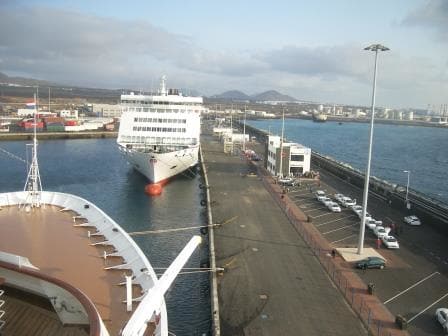
But today we were in Arrecife on Lanzarote and this is a smaller port at least compared to Las Palmas.

There was a local ferry docked ahead of us, so we could not dock in front of the terminal

There was a local ferry docked ahead of us, so we could not dock in front of the terminal

It is in lay out the same as Santa Cruz of two days ago; only the other way around. The open end to the pier is facing south, while in Santa Cruz it was facing north.  But again the breakwater is also serving as the major pier of the port and the ms Rotterdam was docked in the middle part where there is also a small cruise terminal.  As mentioned yesterday the local shopping center ran a shuttle which was a good idea as the town is quite far away from the port. It was a very good day for the local taxis.

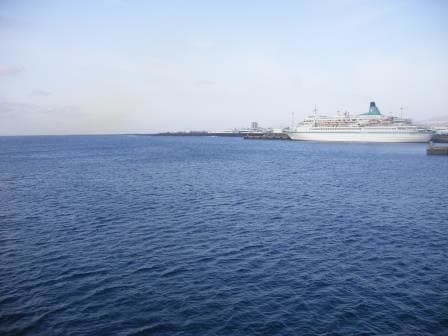
blog rvsOpposite to us was for the 3rd port in a row the ms Albatros. It is chartered by a German company called Phoenix Reisen and offers 3 star package holidays for the German Market. Once this ship was the Royal Viking Sea built in 1973 for Royal Viking Line. In those days it was a six star ship. When Royal Viking was bought by NCL the ship was eventually sold to Royal Cruise Lines in 1991 and ended up after a few more renaming’s with Phoenix See Reisen in 2004, being chartered from an investment company. Royal Viking was also the company which built the Royal Viking Sun which has now become our Prinsendam (II).  I should not really post cruise ships from other company’s but the Royal Viking Sea was one of three sister ships which were really trend setters for the cruise industry when it slowly started to take off in the 1970’s. So we have been looking at a piece of Cruise – history in the last few days.

Holland America was that in a similar way as it had the first ships with such novelties as a self-service Lido Restaurant (pioneered in 1968), Crows nests on all ships except the Rotterdam V and what was taken over by nearly all cruise companies, the Holland America Line swivel. This means that there is a path way that runs from the bow to the stern on the major public room deck and it means that you do not have to go “up and over” to get to the most important lounges onboard. More company’s had something similar but HAL was the first one who had come up with the concept in 1958 on the ss Rotterdam when it designed two full horizontal decks for both First and Tourist Class. On the little Prinsendam (I) it got the current form and has not changed very much since.

I had to think about that this evening, when I “swiveled” towards the stern and then realized that with the start of the S – class in 1992 you did not end up anymore in the Lido Restaurant as was the case with the earlier ships but in the Dining room as it had been raised to two levels. The Lido Restaurant was bumped up to the higher decks.

Tonight we will cross the North Atlantic Ocean between the Canaries and Morocco and tomorrow we will be in Agadir arriving at 08.00 hrs.  just after sunrise which has been scheduled for 07.35 am. to take place.  At least according to our daily program and thus far it has always been correct.

08 Dec. 2014; Las Palmas, Gran Canaria.

Gran Canaria is the largest of the islands that we are visiting in the Canary Islands group and the fact that it is big was clearly visible on arrival as it has a very large port.  The cruise terminal is located deep inside the port and it is only a matter of just crossing the street and you are in the town. Right on the edge is a shopping Centre; always handy for the crew and it is 5 minutes from the beach if you cut straight through town and over the low hill. Although I say handy for crew members; I have learned by now that foreign shopping centers act as real magnets on our guests and this afternoon I saw quite a few marching through it, looking at the various “Spanish” things for sale. One gentleman was making eyes on a cast iron standing lamp; giving me the vision of him carrying it as hand luggage all the way home on the plane.

This morning most of the trainee’s from the class left and I picked up on my regular activities again; this time teaching the cooks from the kitchen how to search cabins in an emergency and how to deal with crowd control.

Las Palmas has one of the best tourist inventions of the 20th century ———— the big red bus. Wherever my wife and I travel, my one and only stipulation is, if we go there for the first time then I want to go on the Big Red Bus for the sightseeing trip around the town.  In an hour you get a very good idea of what there is and how to get there and then you just stay on and hop off (and later hop back on) until you get where you want to start exploring. I assume that more of the guests have discovered this great invention as the bus company had constantly a bus standing at the entrance of the pier for the Rotterdam, and the bus was full most of the time, including Yours Truly.

Las Palmas (not to confuse with Las Palmas on Mallorca in the Mediterranean) is a nice place but it is clearly visible that it really got a boost in the 1970’s when the package Holidays came about from England, Holland and Germany. Just around the corner from Las Palmas is Playa de Americas which is one big tourist area with little national enclaves of British and Dutch. Sometimes I wonder why you would go on vacation if you are basically going from a Dutch town without sun, to a Dutch town with sun and the rest remains the same.

The other day I held my Holland America Line lecture and that generated a lot of response on the side. It is amazing how many people come back to us because they either worked at HAL for a while a long time ago, or because they had family immigrating with HAL to the new world.  Today I had the privilege to meet a couple of which the gentleman’s Grandfather had come across on the Maas (Later Maasdam I) in 1881. His other grandfather came over on Nieuw Amsterdam in 1911 and his grandmother on the Potsdam in 1912. Basically without Holland America he would have never been living in the USA. Luckily I could fill in a few gaps in the history, mostly the why, behind the ships and that gives a good feeling.

Tomorrow we will be in Arrecife on Lanzarote and I wonder if they have a big red bus there. There will be free transport for the guests if they want to, as the local shopping Centre is laying on a shuttle bus. Maybe our friend of the cast iron lamp will get a 2nd chance to buy one.

The temperature dropped another 2 degrees today and is now down to 21oC / 70oF and that is out of the wind and in the sun. I wonder how cold it will be in Morocco.

06 & 07 Dec. 2014; At Sea & Santa Cruz de Tenerife.

My apologies for the delayed uploading , we were docked yesterday in such a way that the funnel blocked the Internet connection.

And so after a lot of preparation the big drill took place. The objectives had been read.


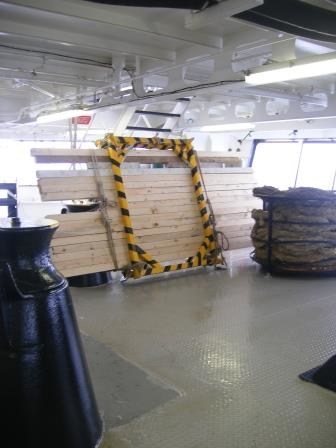
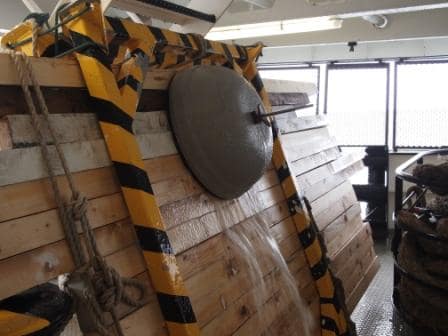
the simulated hull with a hole in it

The simulated hull with a hole in it

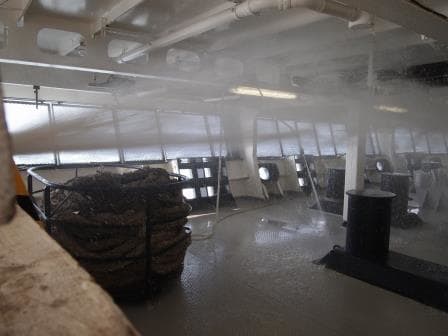
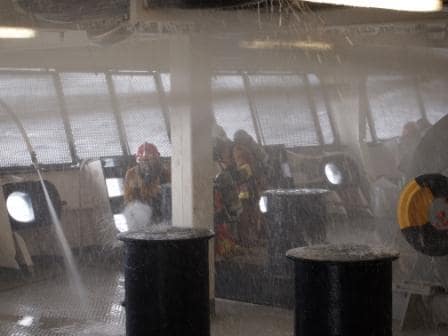
Long discussions took place about how to do this and then it was time for the real action.  The main challenge to deal with was, all the water that was produced by the 5 fire hoses hooked up behind the wooden wall, simulating the ship’s hull.  That hole was the simulated breach in the hull and the water spouted though.

Six nozzles of water spraying through

Six nozzles of water spraying through

Using the mooring deck instead of the Engine Room itself makes it somewhat harder to visualize what is exactly going on but the fountains of water did help the focus.

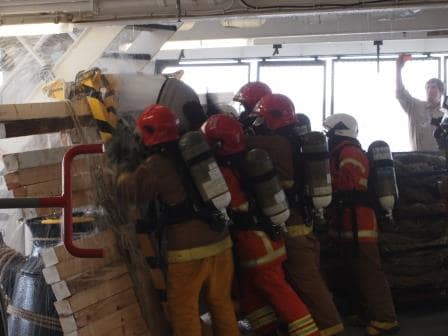
Two firefighting teams attacked and once the area was declared safe from any danger,

on the atack

On the attack

apart from the water, the hole was plugged with a special gadget that we have for these sorts of things.

Plugging the hole

Plugging the hole

It is a half sphere with an angle bar on a threaded shaft, which can then be tightened up with a wing nut.  The angle bar is stuck through the hole and pulled tight against the hull and then the half sphere can be tightened against the inside of the hull and thus close off the hole and thus stop the ingress of water.

Job done

Job done

It took quite a bit of man power to hold the half sphere in position against the force of the water but eventually everything was in position.

The good ship Rotterdam was in the meantime still heading towards Santa Cruz de Tenerife.  Heading on a North Easterly course in the general direction of the African continent. Heading towards the north means that the temperatures kept dropping and today we lost another 2 degrees, with another two expected tomorrow.

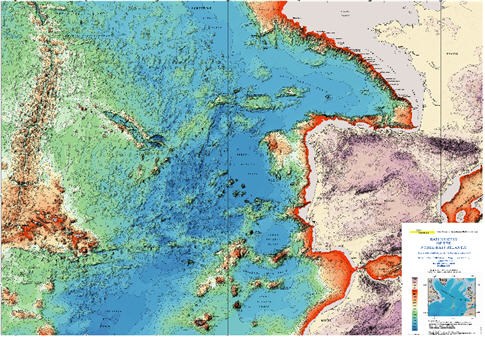
Relief drawing of the sea bottom

Relief drawing of the sea bottom

What is of interest is what is below water in this area, although it is not visible because of all the water. But if the ocean was pumped empty in this region, we would see two large flat areas surrounded by mountain ranges.  One area north of the Canary’s running up to the Azores, and one area south of the Canaries, running down to the Cape Verdes. Most of those mountains stay well below water but here and there they surface. The east side is the African Continent, all caused by volcanic action either a long time ago or more recent as was shown by the outbreak in the Cape Verdes on the Island of Fogo.

These mountain ridges are cracks in the tectonic plates that cover the earth. The larger plates that come above water are what we know as continents. Where the plates touch there is a crack and that gives the chance for volcano’s to appear. Some continents do not have many volcanos, such as Australia where the volcanos are mostly active just to the North in the Indonesian Archipelago but sometimes the crack on in the continent. A good example is North America. There are several volcanos in Nicaragua; running through the USA we have the St. Andreas Fault and bit further to the North we had in 1980 the sudden explosion of Mount St. Helens.  On both sides of the volcano’s and the fault line is land, and that land forms part of the continent.

Thus also the mountain peaks of Tenerife are the tops of volcanos. The Canary Islands indicate the middle of these rims which encircle a sort of deep flattish valley under the sea. The area is really a little tectonic plate in itself. The area is still active and on occasion the inhabitants of the Canary’s are woken up to a good shake up. Thus far the earthquakes have not been devastating but living on volcanos can have its exciting moments.

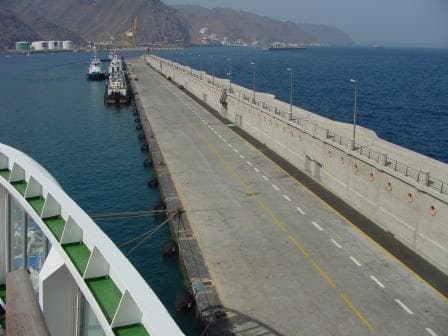
For the ship there was not much excitement and it arrived in good order near sunrise at the pilot station of Santa Cruz de Tenerife.  The port of Santa Cruz is basically constructed of a very long breakwater wall of which the inside also acts as a pier. That is where the cruise ships dock. Then further in are smaller docks for the local Ferries and a Marina. On the south side is another finger pier at which are currently parked two large oil platforms.

Santa Cruz Breakwater Pier

Santa Cruz Breakwater Pier

We are staying here until 10.30 pm and then sail on to Las Palmas. Today was also the final day of our training class and tomorrow they will leave the Rotterdam. Some will go directly to their first ship, some will go some for a short vacation before flying out and some will go to some training courses before they will join their assigned ships.  Two of the Trainers will also go home but I will stay for another 8 days to carry out a few more projects.


05 Dec. 2014; At Sea.

It almost looked like as if a curtain descended over the ship, the moment we left the Cape Verdes. Today was basically an overcast day, it was windy and as predicted yesterday the temperatures started to dip. That will continue tomorrow as well by another 2 degrees or so.  Luckily there is enough to do inside the ship to not to be detained by the weather very much and there are also a lot of area’s were everybody can sit outside the wind as well.  Life just goes on.

For the remainder of the cruise, which ends in Rotterdam on the 21st. of December, we will be calling at Santa Cruz, Las Palmas and Arrecife in the Canary Islands. Then Agadir, Casablanca and Tangiers in Morocco, followed by Cadiz in Spain and Lisbon in Portugal. Here I will leave the ship while the Rotterdam continues its cruise with calls at Vigo and Southampton. By that time it will have completely circumvented Africa.  An unhappy part of the cruise was that due to Ebola a number of ports had to be cancelled and no other ports could be substituted are there were simply no other safe ports in the area. But that is always the challenge that one gets when going on an adventure.

Today the class was focusing on Damage Control and Security. That meant in the morning that yours truly spent some time going through the theoretical part of what we have to do if there would be a hole in the ship under the water line and what equipment we have available for that.  A ship is equipped with watertight doors which sub-divide the ship in 10 or 12 compartments. The Rotterdam is a two compartment ship which means that if the two biggest areas in the ship, between watertight doors, would flood, the ship would still stay afloat. If smaller compartments would flood then probably 3 or 4 could be flooded without endangering the ship.  A Navy ship could probably have 10 compartments flooded and still stay afloat but then those ships are designed to expect holes, if being shot at.

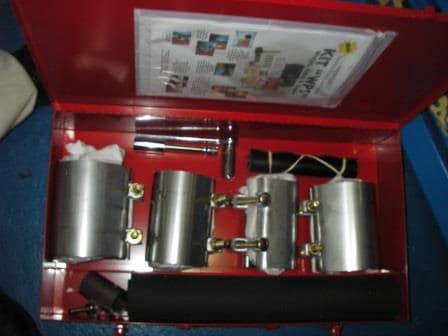
We have a lot of equipment onboard to close off a hole if we would get one. Varying from small plugs to close off small cracks; to shoring equipment to put big plates in place to cover larger holes. All that material is located in a damage control locker, well above the water line. In case the ship would start to flood we should be able to get at this equipment easily.  I know this is not really sexy, but some items are simply not that exciting, but very necessary.


Sleeves for pipe punctures

Sleeves for pipe punctures

supports for shoring up bulkheads

Supports for shoring up bulkheads

As is the case with everything that Holland America does, it has to be trained and exercised to reach a high degree of proficiency. Varying from discussing on how to tackle a problem by means of a table top discussion, to executing a real drill.  The latter is a bit of an issue, as we cannot make a hole in the ship to make it look real. We have to simulate. Thus this afternoon I spent some time with the sailors to build on the mooring deck aft, part of a ship’s hull. Made of strong wood and with a hole near the top. Tomorrow we will do the drill and then a lot of water will be pumped through that hole. As it is on the mooring deck aft the water will not damage the ship and as the water is pure sea water it can flow overboard again without damaging the environment.


The challenge will be to plug the hole (8 x 4 inches) while 5 fire hoses pump an enormous amount of water through the hole. With the pressure that we use we can pump approx. 10.000 gallons through the hole in an hour, which approximates the same ingress of water if that hole would be 18 feet under water. As the Rotterdam draws 28 feet, this is not un-realistic.

Whatever happens during this drill, one thing is certain, a lot of people will get very wet.

04 Dec. 2014; Mindelo, Cape Verdes.

Today we had our 2nd day in Mindelo. The weather started out the same as yesterday but in the course of the day the wind increased and it started to become more overcast. Maybe the islands are in for a rain shower tonight. I think that would please the locals as there is a constant scarcity of water on the islands. Most areas are really arid and thus do not hold any water and that prevents a cycle of moisture going up and coming down again. And if it would be going up, it would probably come down over water again as there is the constant trade wind blowing. Ashore in Praia I saw that on the lee side of the island where most of the rain falls, that the tree’s, up on the plateau were all bending towards the west, in the same way as you see on the Caribbean Islands such as Curacao, Bonaire and Aruba.

Today we had another cruise ship in the port. Although it was more built as a yacht. The Variety Voyager with a capacity for 36 guests and 31 crew. This ship belongs to a company which has a number of these little ships and focusses on what I would call Eco-tourism, visiting areas off the beaten path.  Behind it was a normal yacht, well normal, it was longer than the Variety Voyager but it was a privately owned vessel and it listened to the name of Papi – Papi.  Hopefully it means something special, otherwise the only thing I can think about is that the owner must have been inspired by the endearments of his little boy or girl.

Another amazing thing for which I do not have an explanation either is the fact that there are no church spires in Mindelo. The whole island is Roman Catholic; the Portuguese were present for a long time, but not a single church spire in sight. I scanned the whole town twice, asked the navigators to verify and indeed no church spires. Very peculiar.

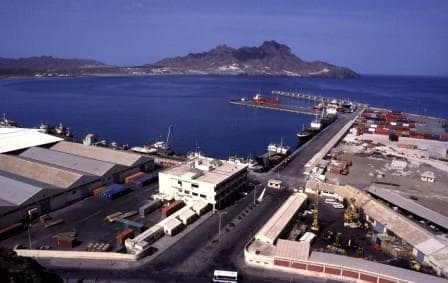
Porto Grande as seen from Mindelo. (Stock photo from Internet

Porto Grande as seen from Mindelo. (Stock photo from Internet

Mindelo is the name of the village or town which we see when looking out from the ship. However where the ship is, is not Mindelo. It is called the Porto Grande or grand harbor and that is more or less correct. The large bay has good anchoring ground which means that even during very windy days, the anchor seldom drags.  So technically our brochure should not have said Mindelo, but Porto Grande. There are more ports that have the same confusion. Look at Florida, our ships dock in Port Everglades but nearly everybody talks about Fort Lauderdale.

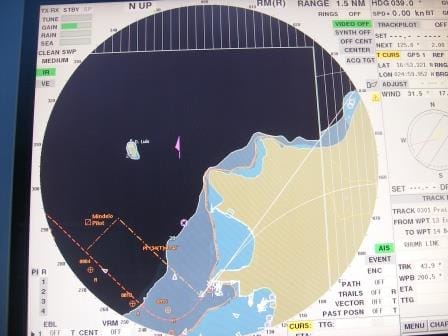
The Radar/chart screen, showing the way we came in. Going out, we sailed between the yellow part of the main island and the small rock of Dom Luis.

The Radar/chart screen, showing the way we came in. Going out, we sailed between the yellow part of the main island and the small rock of Dom Luis.

We left right on time with the last guest hopping onboard 5 minutes before the All On Board Time and then it was a matter of giving a bit of astern power, backing out of the pier and heading for open sea. All without the help of the local pilot who was already on the ship coming in, which took our spot as soon as we were gone.  Then we sailed North West as we are now on the way to the Canary Islands.  Mindelo is located on the island of Santo Vicente, which we kept to our right and the island of Santo Antao which we kept to our left. The channel is 6 miles wide and thus plenty of room to sail safely in the middle.  The channel is called Canal de San Vicente and that keeps it all nice and simple. There is only one rock in the middle called Dom Luis with a cross and a monastery (?) on the top. Clearly visible so easy to avoid.

We will now spend two days at sea and then arrive on the 7th. of December in Santa Cruz. We will call at two ports while in the Canary Islands and the next day we will be in Las Palmas.  To get to the Canary islands we will be sailing on a North Easterly course as the Canaries are located right off the coast of Morocco. Due to historical happenings, the islands belong to Spain and not to Morocco. No doubt that will be of great interest to our guests once they start preparing for their next land outing in the coming days.

One thing will be certain, the outside temperatures will drop. We keep heading away from the sun and moving towards Europe and thus the temperatures will plunge. Today it was still 24oC / 75oF tomorrow there will already be a dip of 2 degrees and more to come.


03 Dec. 2014; Mindelo, Cape Verdes.

We did not see anything of the volcano on Fogo. Latest news is that its activity has reduced considerably in the last few days and without big fireworks we were too far away to see anything.

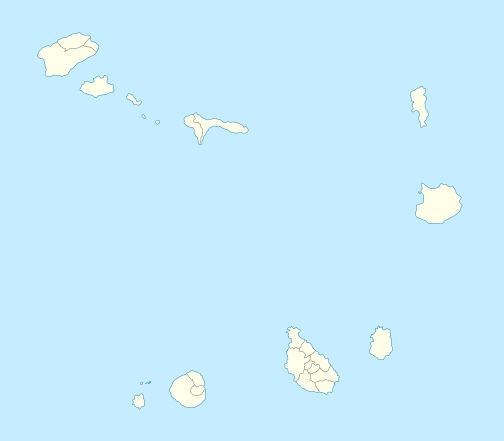
Mindelo is the smaller island just under the big one at the top left corner

Mindelo is located on the smaller island just under the big one at the top left corner

Mindelo is located on the northern side of the Cape Verdes island group and thus we spent the night trundling with a speed of 13 knots through the islands.  By 07.00 the ship made her final approach and by 08.00 we were safely docked.  Mindelo has a large anchorage area and also an extensive dock area but there are basically only two deep sea berths.  The inner – smaller one – was occupied by the Azamara Journey and we docked at the inside of the outer breakwater. 


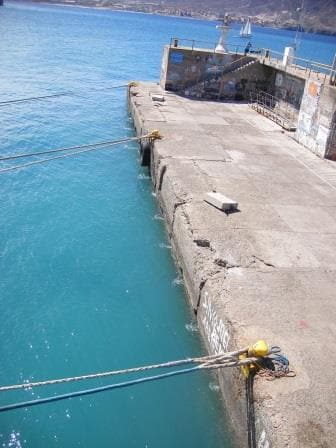
This can make a Staff Captain really happy. All the ropes on different bollards.

This can make a Staff Captain really happy. All the ropes on different bollards.

We fitted in with about 25 meters at the stern and the bow which made for a happy Staff Captain as he had a lot of spare bollards to put his mooring ropes on.  We are staying here overnight and thus a few more ropes were paid out. Not that it is really necessary as the weather is not supposed to change but it is company policy as in other parts of the world an overnight squall can create un-expected havoc with a ship.

From the ship the distance to town did not look that far but Mindelo is really spread out in an arc against a high mountain range. That gives a false perspective in distances and quite a few guests who thought they were going for a nice walk into town, soon found out that “town” was a considerable distance away.

As the weather forecast turned into reality we had the chance to do something that we all liked. Messing around with boats.  The group was split up in 2 of four with a captain and down we went with a lifeboat each.  I do not have to teach these people how to operate a lifeboat. They are already qualified navigators, but they need to be familiarized with the equipment and to learn how we teach the crew in operating a lifeboat. So for nearly 3 hours, we sailed in an out of the harbor, inspected the inventory, made approaches in returning to the ship with the focus on stopping right under the fall blocks which lower and hoist the lifeboat and to sit still under it regardless of wind and current, so the blocks can be hooked in safely by the boat riggers.

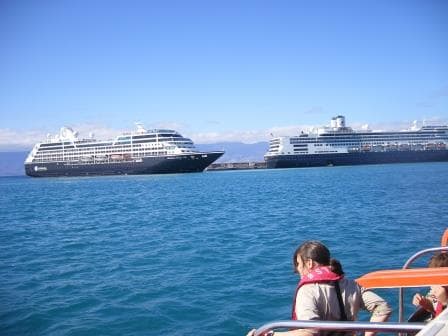
A lot of blue. What a pity that they are from different company's.

A lot of blue. What a pity that they are from different company’s.

In the mean time we had to stay out of the way of the Azamara Journey who was departing at 14.00 hrs.  So we stayed at a safe distance while the ship moved to open waters.

In Mindelo there are always a lot of small ships at anchor and it is not always clear if they are waiting for cargo, have been impounded, abandoned or are in the process of being sold. We happily sailed around them all and while passing one, I saw the most disgruntled Chinese person I have ever seen.  He looked absolutely unhappy being there, on a small ship at this anchorage and with a 6 foot long sulk on his face he hung over the railing glaring at us from above.

Last time I was here with the Prinsendam we were told that Mindelo nightlife was less than exciting unless one went around the mountain to a sea-side resort.   This time some of the more focused crew had done their research and this morning there were a lot of discussions going on about Disco, versus Restaurants, versus Taxi’s and how much to pack into the evening for as little money as possible. Well the “rich captain” paid for the taxi & all yesterday but my Disco days are over, so today I was not going ashore. Too much to do. I need the time to prepare for the coming lessons for the Trainee’s.  We have 4 more days to go and then they are finished and my colleague and I have to ensure that we have covered everything.

Tomorrow is the 2nd day in Mindelo and we should have the same weather as today. Partly cloudy skies, a temperature of 24oC / 75oF with a humidity of only 50%. …………………………………..And breath taking scenery all around us.

« Older posts Newer posts »