From our last point of “mayhem” last night it was a quiet run through the Kattegat. That body of water where Sweden and Denmark are starting to come closer and closer. Here the traffic routes ensure that nearly all the traffic is following the same pattern and that makes navigating easy. I had planned to be passing “Hamlets” castle around 9 am, and then to be at the pilot station at 10.30, followed by a docking at 11.30 with the official arrival scheduled for noon time. Thus we were nicely on time and shortly after 9am we rounded the land tongue on which the castle stands. The best time to come by here is in the morning as the sun shines on it from the East. In the afternoon it is often caught in a glare when the sun is setting behind it. It is of course not Hamlet’s castle, but a later version on the same location, but it is very pretty to look at and the Shakespeare link makes for a good story. Continue reading
Author: Captain Albert (page 172 of 238)
The weather forecast was partly right. It was a nice day but the predicted poor visibility due to low hanging haze, never materialized. A good thing as well, as the whole day we had to dodge traffic. Especially the fishing boats were a curse. I think there is a Fish quota opening going on at the moment as they were all over the place and most fish seemed to be exactly there were all the ships were sailing. That meant that we had to dodge them on a regular basis and that brought us then on a collision course again with other traffic. That danger corrected and, yes, there was the next fishing boat. After a while our course track in the chart looked like a drunken sailor on a late Friday night. Still we kept going in the general direction of Copenhagen and that was the aim anyway. At least it kept us all on our toes. Continue reading
There was a spot of bad weather somewhere over the United States and that got our Air/Sea ticketing department all excited. Even to such an extent that they were asking me if I could delay the departure time, if necessary. That decision involves looking at a large number of things. The most important ones: One; How long can I stay and still make the next port on time, while running a safe speed all the time? I have to cross the North Sea and there are areas where the traffic is so dense that racing through them at full sea speed it is not always good seamanship. Two: How will this affect my fuel consumption, in relation to the number of people affected? It does not make much sense to spend $20,000 extra on fuel if one or two guests have to be flown to the next port and it would cost only $ 500. Three: Are these people flying on HAL tickets or are they on own arrangements? E.G lays the responsibility of a timely arrival at the ship with themselves or with the company. Four: even if they land on time, will they make it quickly to the ship? Traffic Jams could delay their arrival by yet another hour. Five: If I delay the ship and I would not make the next port on time, would this be fair to the guests already onboard? This is a consideration that comes into play when we are talking higher numbers. Normally if the next port call can be extended then is not such a big issue but if it can’t then it takes a good bit of consideration. Continue reading
After a good nights sleep, and an undisturbed nights sleep on top of that; I woke up to a beautiful wind still morning. For once I was the one who could stay in bed while others, who normally have a regular working day, had to get up in the middle of the night. As today was change over day, housekeeping started collecting luggage at 10.30 pm last night. This lasted until well into the early morning when the last guests had finally put out their suitcases. Everything was directly off loaded and stored in a secure area in the terminal, ready for when the guests would start to disembark. For some guests that was really early, due to the fact that you now have to be at the airport at least two hours before the flight and from the ship it is also a 45 minute ride to the airport as well. Continue reading
The approach to the estuary of the river Thames is something that would give a computer a headache. Ships are coming and going to and from every direction and they all descend on a little area called NE Spit pilot station, to either embark or disembark the pilot. Then there are numerous ships, such as regular ferries and ro-ro boats who have pilot dispensation and come racing by without having to stop at all. That makes the approach an interesting puzzle and one that needs concentration and focus on collision avoidance. Hence I am normally on the bridge before we enter this area to give a helping hand to the navigator or to take over when it becomes particularly hair raising. (The latter I tried to avoid at all cost, as I do not have that much hair left to start with) Continue reading
Mother Nature behaved it’self and it was not until 0700 in the morning, that a certain haziness descended over the North Sea and the world became decidedly limited in its outlook. At least the guests had had a good night before I started pulling the ships whistle. The North Sea leads to the busiest waterway in the world; Dover Channel and is thus full of shipping that goes North/South but also cris-crosses the sea from all other angles and directions. Hence collision avoidance is the main focus of a North Sea crossing. Throw in a good amount of fishing boats that, due to the very nature of their occupation, can be very erratic in their movement and you have a nice mix for some extended excitement during a watch. Thus when we loose a very important part of safe negation:, “keeping a good look-out” due to the fog, then it is time for the captain to be and remain on the bridge. Continue reading
We approached Bergen from the north and that meant a 0500 pilot for a 0800 docking. As it had been sunny in Bergen yesterday, it was very hazy near the pilot station, but visibility was still good enough to see more than 3 miles and thus we did not have to use the whistle to give fog signals. As expected it was busy at the pilot station. Cruise ships most of the time have the same arrival time as it coincides with the departure times of the tours. Ahead of us was the Princess Daphne, picking up the pilot and then proceeding to Flam. Behind us was the Aida Luna and in the mix was also a cargo ship, a tanker with the name of Bro Enterprise, if I remember correctly. So we all trundled with about 12 knots to the pilot station where one after the other received their pilot. Continue reading
Today we saw the arrival of summer, at least according to the calendar. As far as our cruise was concerned, Alesund turned out to be the best day of this cruise, apart from the Kieler Kanal. It was clear, dry and not too cold. Further south, in Bergen, they have had a few days of sunshine but it is supposed to be gone by the time that we will get there. However you treasure every moment that is given to you and thus we savored the good day in Alesund. Alesund is one of my favorite ports in Norway for calling at. It is nestled in the lee of the hills, we dock right in the down town area and it has this flavor of a small Norwegian market town. Continue reading
The Approach to the pilot station of Trondheim goes through the Krak-Vag Fjorden. This is a very wide fjord with deep water and thus the Norwegian authorities do not deem it necessary to cover that part of the fjord system by Pilotage. No doubt the pilots like this as well, as now they can board in a nice sheltered area instead of having to bounce around in a small boat in inclement weather. Along the shores, there were several reminders of World War II activity by the Germans in the form of old fortifications and bunkers. Later on when coming closer to Trondheim we will see more of those. Trondheim harbour is located at the edge of a big bay and thus the docks are not really sheltered from the elements, especially the Northwesterly winds which blow through the Trondheimfjorden can make it very windy and choppy in the harbour. To make sure that I would not have any un-pleasant surprises when going in, I checked the local weather forecast for the day and they reported 4 m/s, which is roughly 8 knots and a gentle breeze. Very nice indeed. Continue reading
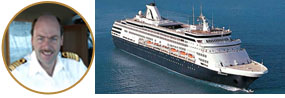
It was another windy day today but as we had following winds, the Prinsendam happily “surfed” ahead of wind and waves and was lying as steady as a rock on the water. As our speed matched the wind, it was nearly wind still on the decks so the guests could walk around un-impaired. One advantage of the wind was that it blew away a lot of the clouds and thus the sun could peak through, giving the impression that it was also summer in Norway. On the portside the islands and mountains of the Vesteraalens were visible and they were replaced in the afternoon by the Lofoten range. We kept a fair distance from the shore as around the islands there are a lot of rocky patches and shallow areas which would definitely hinder our steady progress if we would hit one of them. Tomorrow we will spend all morning in the fjords while going to Trondheim and thus we will get our next sightseeing “fix”. Continue reading
Captain Albert
© 2026 – Captain Albert's Website and Blog –
Theme by Anders Noren — Up ↑