- Captain Albert's Website and Blog -

Ocean Liner History and Stories from the Sea, Past and Present. With an In Depth focus on Holland America Line

Page 78 of 241

22 July 2016; At Sea, East of Nova Scotia.

Today a few words about the places we are going to visit in the coming days as this Voyage of the Vikings is not a seven day bus trip with all the familiar ports. Some are quite of the beaten track and to such an extent that the Hal ships only go there on maybe once every few years.
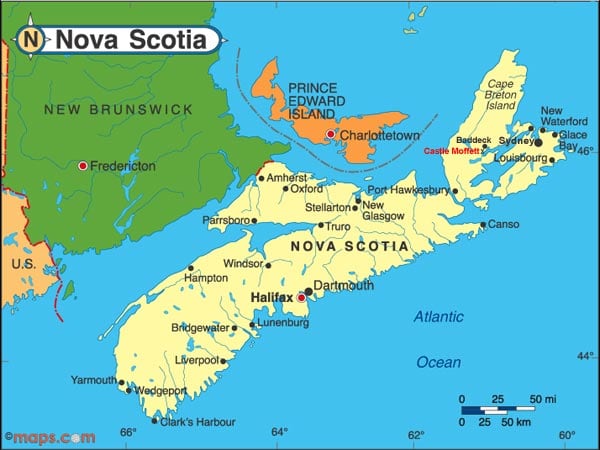
The route we follow is normally part of the Canadian Foliage in the autumn. Halifax - Sydney - Charlotte Town and then up to Quebec.

The route we follow is normally part of the Canadian Foliage in the autumn. Halifax – Sydney – Charlotte Town and then up to Quebec. Chart courtesy maps.com.

Currently we are sailing off Nova Scotia, the top part which is called Cape Breton. It has nothing to do with a Cape; the north point of the island is called Cap Nord. Cape Breton is a large part of the province of Canada called Nova Scotia. The whole area here was discovered by the French and thus they gave French names to the area. Even when the English took over and renamed the whole area Nova Scotia (New Scotland),  CapBreton or Cape Breton kept the same name. It is most likely named after Bretagne in the North West of France.
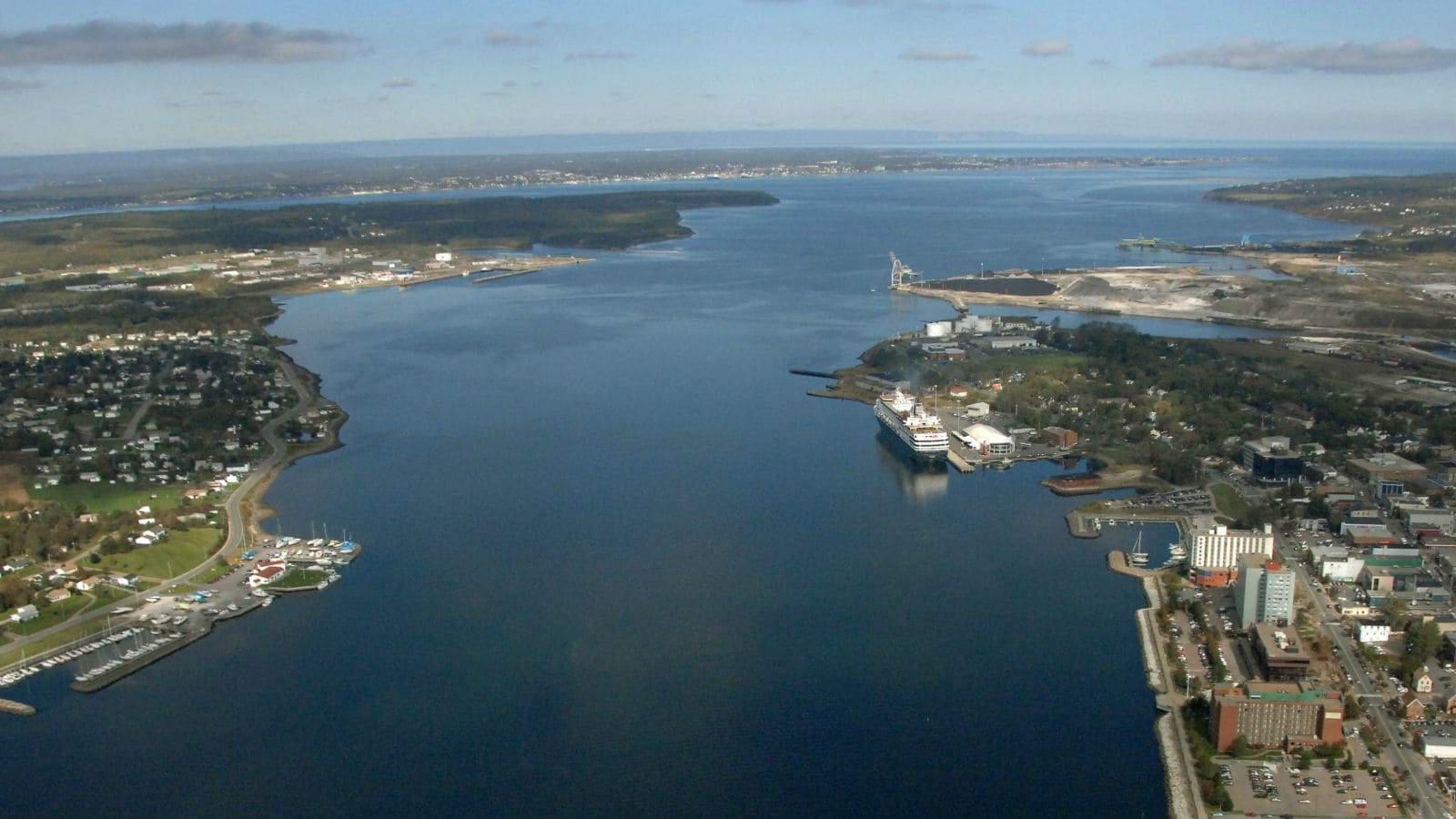
It is fjord or a bay, but as it is wide open, there is no shelter from the wind anywhere.

It is fjord or a bay, but as it is wide open, there is no shelter from the wind anywhere.

Sydney is located on the Northside of the Cape Breton area and we have to go around the North East point to get there. It is tucked away deep into a fjord and it will take us about 1.5 hrs. from pilot station to the dock.  If the weather is beautiful it is a very nice place but if the wind starts blowing it can be very nasty. Thus we always have a plan B up our sleeve and that is to drop the hook and to tender into the port. Something we really do not like to do as it is a long tender distance. Then there is plan C and that is to sail out again. I have had to do that several times in the past as the wind was too bad to stay at the anchorage and the tender ride would have been very bouncy and cold. Docking was completely out of the question. The weather forecast for tomorrow is breezy but not to the extent that it would affects us docking. So we are keeping our fingers crossed.

The Sydney area came to prominence due to the coal mining there and nowadays they run tours to the mines so you can see how they did it. Also when you sail in you can see the Academy for the Canadian Coastguard on the shore side. It must be lonely for the cadets there in the winter time. As it is also quite a distance away from Sydney itself. My Maritime Academy was in Amsterdam, just behind the center of the city and much more fun when having time off.
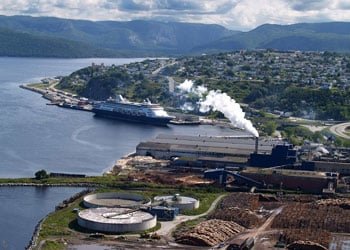
A Holland America S class ship alongside.

A Holland America S class ship alongside at the Cornerbrook dock.

From there we sail to Corner Brook in Newfoundland. That is a new port for me as the one time I was supposed to go there, I got the advice from the pilot to stay away it is horrible here. For our call it looks good and hopefully it will not change. Corner Brook has 22,000 inhabitants so it is not too small and not too big. There are some nice tours to make to a National park and indeed the main attraction is the wonderful scenery.

Next stop is Red Bay also in Newfoundland. Here things are getting more exciting as we are now in and out the ice limits and Labrador. This is not exactly going to be a visit to a metropolis so to speak. Red Bay gained prominence when Basque (from North West Spain) whalers came here for the hunt and much of the subsequent processing   was done in Red Bay. With the decline of the whale population, Red Bay faded away and as a result it is one of the best preserved whale towns in the world. And now an UNESCO world heritage site.
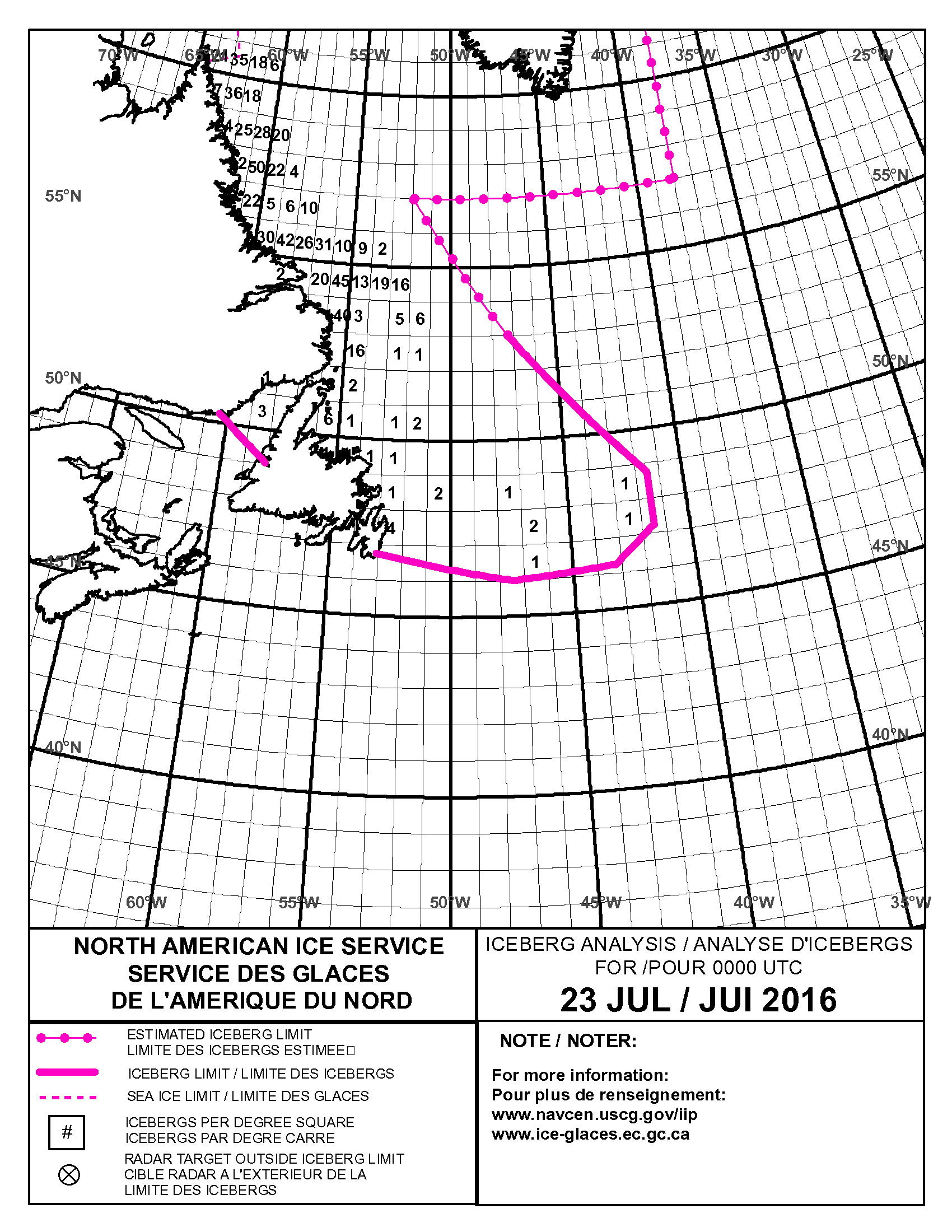
The ice chart for the area for 23 July 2016. Courtesy Canadian Coastguard.

The ice chart for the area for 23 July 2016. Courtesy Canadian Coastguard.

While we are sailing in this area we have to report to a monitoring system called NORDREG which keeps an eye on all the traffic. Then we get daily ice charts from the Canadian Coastguard which gives a count of the number of Ice bergs in the area. These come drifting down in the summer months from the Labrador area. We are still too far south for having to deal with Sea ice, so we will only see the big boys, if they happen to be close to our course line.

From Red Bay we start crossing the North Atlantic towards Greenland. So it going to quite an interesting few days for everybody as long as you have an interest in Nature and all related. If your focus is on shopping, then I am afraid there will be some disappointment. Although no doubt there will be T shirts, Key chains and post cards at any location.

Tomorrow is our call at Sydney, with warm but overcast weather expected and a bit of a breezy day, at least in open waters.
21 July 2016; Bar Harbor, USA.

At 09.30 am we dropped anchor in the South Bay of Bar Harbor and at 10.00 we commenced our tender service after the ship had been cleared. As we were coming from Boston, USA, clearance was easy and not need for long lines at emigration. Rumors have it that they want to build a cruise ship dock here in Bar Harbor but thus far nothing has happened and thus we anchor and run a tender service.

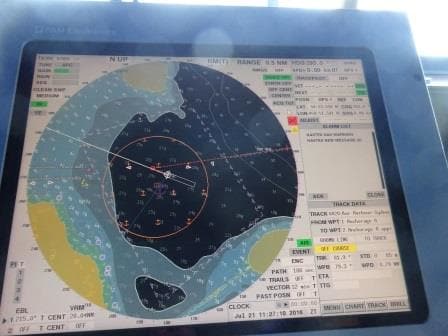
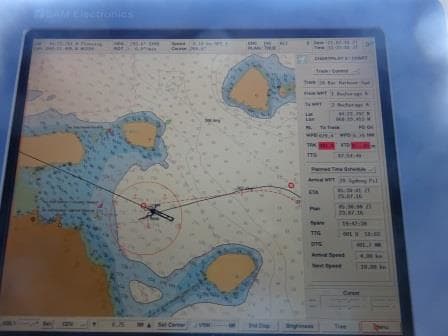
The larger anchorage area is north of the small island in the blue just of the main land.

The larger anchorage area is north of the small island in the blue just of the main land.

There are two anchorages, North and South. The North one is further out but wider and the South one is nearer to the port but hampered in swinging size due to the large numbers of lobster pots in the area. Today we were the only ship and as the Rotterdam is not that long, it could anchor at the South anchorage.  Among the captains there is always a sort of discussion going on about which anchorage is the best.

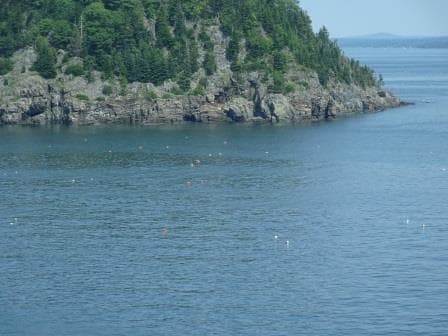
Hundreds or lobsterpot buoys all attached to lobsterpots on the bottom. Those ropes are not nice to get in the propellors.

Hundreds or lobsterpot buoys all attached to lobsterpots on the bottom. Those ropes are not nice to get in the propellors.

It depends mainly on the wind. The holding ground (which grips the anchor and the anchor chain) is not so good at the South anchorage. The composition/mixture of the mud and shells tends to cause the anchor to start sliding if the wind brings more force onto the ship and thus onto the anchor and then you can get set towards the shore (and all those lobsterpots) very fast. The ever present current helps the ship to drift even more quickly.

The little white triangles are the AIS transponders on the ships tenders.

The little white triangles are the AIS transponders on the ships tenders.

The North anchorage has the better holding ground and there is much more room. But it is a longer tender distance and a small island obscures the bridge from seeing the dock and the tender route. Thus the ship cannot follow each tender when it sails to and fro. Although the tender drivers are very capable and have Radar and AIS on board, there are a lot of pleasure craft messing around during the day and that results sometimes in very original applications of the Rules of the Road. So everybody has to be very vigilant.

Even more so when we get restricted visibility and a dense white cloud descends over Bar Harbor. Cruise ships normally do not stop tendering but we add an officer to each tender who acts as a sort of Captain and monitors the route and the traffic, while the Quartermaster (Coxswain for the British) concentrates on the driving. Also we add then an extra officer to the bridge complement (Most of the time the Captain or the Staff Captain) so one officer can fully concentrate on following the route of the tenders by monitoring the AIS signal (AIS = Automatic Identification System transponds/ gives a signal which can be seen on the ships radar. It is only compulsory for ships larger than 300 tons but all the HAL tenders have them as well)

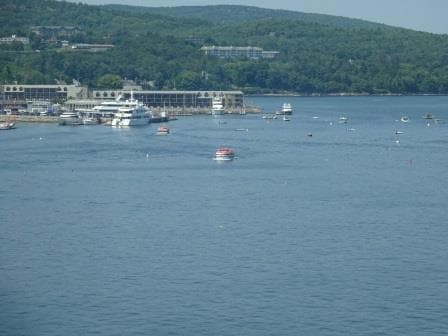
Tenders going to and from Bar Harbor.

Tenders going to and from Bar Harbor.

Bar Harbor can be quite a complicated harbor when there is no visibility, especially as right in front of the entrance there is an obstruction, which for some unknown reason always manages to get into the way when you cannot see anything. Many a sailor only realized that this obstruction is really there after bumping into when sailing into the small white world. It is marked by a big yellow/black buoy which gets hit quite regularly as well.

Today we are having gorgeous weather. Outside the sea was just warm enough to not let the air condensate and thus the Captain did not have to honk the horn. Tomorrow we are at sea and coming into colder water, while nearing Sydney Nova Scotia, and things might change again.

I am now on board the Ms Rotterdam in full swing with carrying out a full ship inspection for the Captain as we will have a major Carnival Head Office audit coming up in August. Thus I am going through all the lockers, public spaces, work area’s etc. etc. to see if we conform with all the Company and Corporate regulations. (And Corporate has created a lot more than just what the law requires us to do!!!!) Sometimes it looks as if you can not see the trees for the Forest anymore and vice versa. As I grew up with the forest so to speak I look at trees and can see if they need a little TLC.

Today I was quite intrigued by the escape alarms in Club HAL.

As with every public space, our children center Club HAL, has emergency exits. These are normally closed by a tumbler lock which you can open by just turning a little wheel. Toddlers, tweens and teens can do that as well. The Ladies from Club HAL cannot see all these exists when they are supervising the chaos of what a children’s club is and thus we have put alarms on the doors. That is not required by law but is a company policy. It is not a good idea if suddenly one or more of them decide to disappear without giving notice. Parents tend to panic if Little Johnny is not where they left him.

So I spend some time letting the alarms go off all over the Club HAL much to the excitement of the kids present. Even in port today we had a few on board as for some of them Bar Harbor did not offer any competition in relation to the ships Pizza and Ice Cream.

Thus tomorrow we are at sea; sailing around Cape Breton and then it is time for Sydney Nova Scotia, where they have the largest violin in the world standing on the dock side.

20 July 2016; Boston, USA.

Through the years Boston has become a more and more important cruise port and I think the only reason it’s is not even more important are the limits to the cruise terminal. They have only one long pier and which can handle about 3 medium size cruise ships or two very big ones.  Also as a Port of Call it is a great location as the Falcon Cruise Terminal is fairly close to the city and public transport is not bad at all. So also the crew can get there without losing an arm and a leg in transport costs. Today we were blessed with a sunny and warm day, although less warm than advertised on the weather forecast. A gentle breeze from the sea kept things just pleasant.  

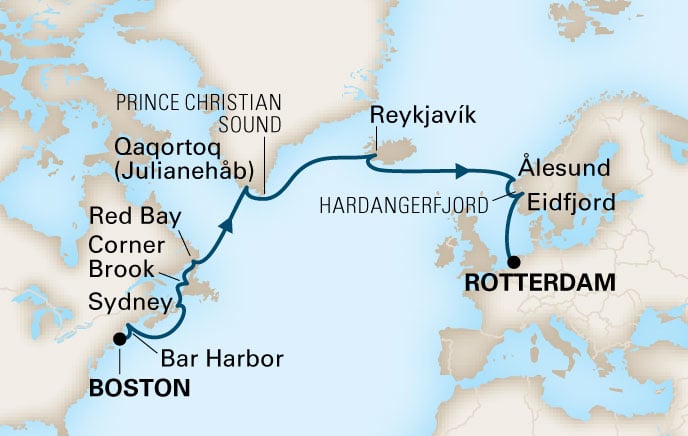
Voyage of the Vikings. !8 days from the USA, Canada via Greenland, Iceland and Norway to Rotterdam.

Voyage of the Vikings. 18 days from the USA, Canada via Greenland, Iceland and Norway to Rotterdam.

We are on the Voyage of the Vikings, which is split in two parts, for those who do not want to do the whole loop cruise. We have ran this cruise from Boston to Rotterdam and back to Boston in the past but this time the Rotterdam is doing it from Rotterdam to Boston and back. Thus we had a large number of Guests leaving us today but approx. 100 guests, mainly Dutch and German are doing the whole round trip. Main excuse is that they cannot fly easily (think sticks, Rollators, scooters etc.) or they do not want to fly in principle. With the latter one I can agree as flying it not fun anymore. But for the majority it was a disembarkation day today.

And it was a very hectic one. Boston was the first American port of call for the ms Rotterdam and then we have a lot of regulations to deal with. First USA call means all the Guests and all the crew have to go through a face to face immigration inspection. The crew does this between 06.30 and 07.30 (all 650) and then the guests are going through between 08.00 to whenever it is finished. My good self is currently on the Guest list as I travel on an L visa and thus I had to follow the last guests going of the ship to help achieving the famous “zero count”. This is when the gangway security count is down to 0% off on board people who are not crew. That was achieved by 10.30.

In the meantime the crew tries to achieve the turnover of the ship. Cleaning all the cabins, provisions, etc. etc. But because the ms Rotterdam has not been to the USA for the last six months, the USCG came on board for a full safety inspection which takes all day. And thus there is Fire drill, Boat drill and a lot of safety checks to be carried out and shown to the Inspectors.  For life on board I am counted as a crewmember and thus I was on deck with all the other crew at 11.00 to be inspected and interviewed by one of the USCG officers.  This was done by 11.40 and then Cabin Stewards, Dining room Stewards and Bar Lounge and Deck had to rush back to work and try to get the last cabins ready for noon time embarkation.

While waiting for the USCG on deck, I was the prime target for the lifeboat crew of Boat 3 for a last minute refresher and the Lady Commander did a very good job with some last minute priming. Then the interesting question was brought forward: Why do they not like Tea in Boston?  One of the crew had seen a documentary about the area but a few things had been lost in the translation. Thus the waiting time was killed with explaining the British Empire, Boston Tea party, the American Revolution and why the Americans almost had Dutch as their national language and not English.

The USCG inspection lasted the whole day as it simply takes that long for them to get through their whole checklist. The larger the ship, the more inspectors they will bring on board to speed up the process. But still it takes time. There are always a few rookies in the team, who then benefit from the experience of an older Chief Warrant Officer about how to carry out an inspection. For a new USCG officer can be a bit bewildering to step on board a larger cruise ship for the first time as they are mainly used to cargo ships and their own size Coast Guard cutters.

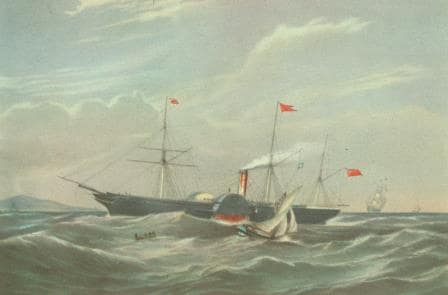
This is the Cunarder Asia from 1851. A paddle steamer for the North Atlantic service. Now it would fit in the show lounge of one of the larger cruise ships.

This is the Cunarder Asia from 1851. A paddle steamer for the North Atlantic service. Now it would fit in the show lounge of one of the larger cruise ships.

Boston has a great place in Ocean Liner history as this is the port where Samuel Cunard sent his new steamships to, sailing from England.  He did not pick a bad place as the port is deep inland and thus fairly sheltered and it had and has good connections with the hinterland.  I wonder if in those days (1842 and onwards) sailing in and out was as interesting as it is nowadays.


Tomorrow we are in Bar Harbor, which is an anchor port. It is going to be another nice day with temperatures around 76oF /24oC.  So we might hear the captain honking the horn again as Bar Harbor can have a lot of restricted visibility. But at least it will ensure that the guests will have a nice day.


19 July 2016; At Sea.

Today we are sailing south of Nova Scotia and on towards Boston were we are aiming for a 04.00 pilot station. That is very early but Boston harbor and its approaches are not very deep in certain spots and thus the Rotterdam has to be there before low water to get in on time.  We did not see much until about midday as we had Restricted Visibility.  Very Restricted. Normal practice for this area where as soon as the weather gets a bit warmer, it heats up the air, air over cold water, and bingo a dense white wall starts to form and can last for days. Only when the ship gets further south, where the water is a bit warmer, or we touch the Gulf Stream then it normally clears. In my whole career I think I have never seen the coast of Nova Scotia with my own eyes. Only the contours on the Radar Screen.  As is required by law, the captain then has to sound the ships whistle, once every two minutes to alert other ships to our presence. Radars are very good and can pick up nearly everything but the danger is always in the NEARLY everything. So we honk the horn and offer our apologies to the guests in the suites right under the Radar Mast and or the Funnel.

Having a suite with a balcony high up on the ship with a great view, is wonderful until you get into foggy areas. Then you find out exactly when the captain is working. Thus when I am now rotating over the ships, I do not mind to have an inside cabin or an outside cabin as long as it is tucked away on the lower decks far from where my colleague lets the whole world know that he is hard at work. But that is part of cruising. You have to take the rough with the smooth, the honking of the horn with spectacular scenery which you will get once the veil has lifted.

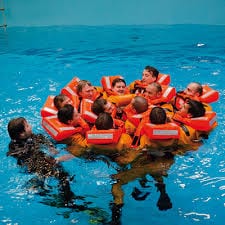
I was going to explain a bit more about the Safety training which is now compulsory every five years to comply with the international safety regulations. As is always the case, the law sets a minimum standard which gives you the required certificate. Then it is up to the company’s to over and beyond to ensure that the training of the ship’s crew is up to the company standards as well. So when we went on this last training, which is called BST or Basic Safety Training it was just to comply with the regulations and to be re-certified. Proper use of extinguishers, proper use of hoses, maneuvering with lifeboats, swimming and survival in the water.

Survival at Sea. If you are thrown in the water, then you try to get in a group and stay together for easier recognition. This is called a huddle.

Survival at Sea. If you are thrown in the water, then you try to get in a group and stay together for easier recognition. This is called a huddle.

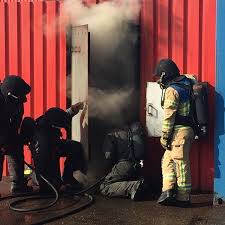
Then attached to this were two days of advanced firefighting and that is when the fun came in. Advanced means you have to plan, supervise and control two teams who go into a real fire and have them extinguish it fast, safe and by following the correct procedures.  Two teams of four firefighters, two on the bridge as Command and Control and one who acts as the first response medic for first aid in case the teams find a casualty.

A container simulates a cabin fire very well. And entering has to be done in a very careful way.

A container simulates a cabin fire very well. And entering has to be done in a very careful way.

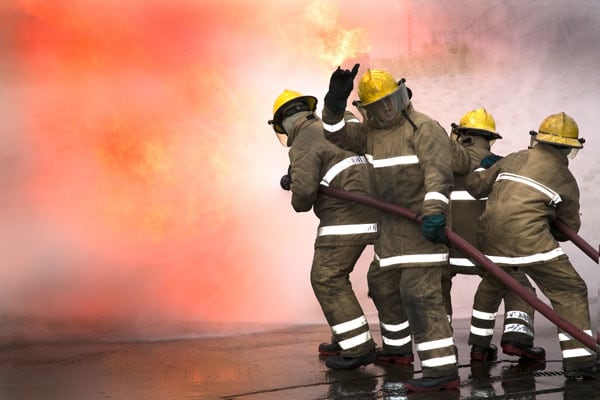
On the ships we can only simulate fires and then it is hard to keep focus and you have to a certain extent imagination to visualize what would be going on during a real fire. We use stage smoke and special effects on the ship but it is still a simulation. But now it is real. Black smoke, Heat, unfamiliar layout of the area you are being send into, it all sets the adrenaline going and you can spray water all over the place without having to be afraid that the Hotel Director starts to cry over his wet carpets.  What is the use of this for us as Captains? First of all, to refresh our techniques again and secondly having instructors present who can critique us and give hints of where we can do better. You are never too old to learn something new, or too high in rank that you do not do anything wrong.  It all helps to make the ships safer and that is always the top focus for all of us.

And this you can not do on a ship. Making a real big fire and then extinguish it.

And this you can not do on a ship. Making a real big fire and then extinguish it.

Tomorrow we are in Boston and it is going to be a warm and sunny day 83oF / 28oC. With not much wind so I would not be amazed if the Captain starts telling everybody again that he is working.

All photos courtesy of Falck Firefighting in Rotterdam, the Netherlands.


18 July 2016; Halifax, Nova Scotia, Canada.

After a leave of 8 weeks of which I lost 2 to trainings, I faced the real world again and joined the ms Rotterdam, flagship of the company, for a three week period which will end in Rotterdam, the Netherlands. From there I will join the ms Koningsdam for the next three weeks. I am on the Rotterdam for a regular visit under what the company calls the On Board Team Support Program which is basically being on board and help out where needed. Be it with extra training, or with organizing some large drills or as is in this case help the ship prepare with an internal audit coming up.

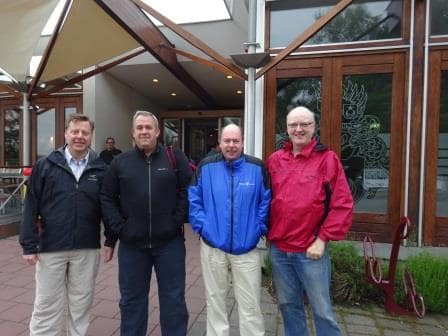
But for those of you who wonder, what does a captain do when on leave? The answer is he goes on training courses. And I was not the only one, see the photo below.  I have blogged in the past about the various regulations under which the ships operations are governed. There is Solas (Safe ships) there is Marpol (No oil over board) there is SCTW (Standards for Training and Certification of Watch keepers) and there is MLC 2006 (Standards for crew)

Four Captains on Training Course

Four Captains on Training Course. From Left to Right: Emiel de Vries, Master ms Koningsdam, Chris Norman Master on loan to P&O Australia, Albert Schoonderbeek Travelling Master, Hans Mateboer, Master ms Rotterdam. None of us looks very spiffy but wearing a three piece suit to a firefighting course is not recommended at any time.

SCTW has been with us for a long time already (1978 was the year to be exact) and based on experience gained through the last 20 years, an amendment came out in 2010 after a conference in Manila.  As all these rules and amendments have to be absorbed into National Flag State legislation, there are always a number of grace years before the latest rules kick in.  01 Jan. 2017 is the deadline for a large number of new rules under the Manila Amendments to take effect.  The most important ones, at least for captains, is that a number of grandfather clauses (Read experience is enough) will no longer be valid.  As we were firefighting on the ship every week, it was not found necessary until this time that we had this re-certified. Now we have to have a piece of paper which says, that we really can do what we were doing all along.

Thus all officers have to get their licenses recertified by 01 Jan. 2017. If not done, then you are not allowed to sail until the certificate has been renewed.  This deadline left the company and everybody else in a bit of a conundrum. There has to be recertification every 5 years, so everybody tries to go for training as close to the deadline as possible to make the 5 years after 2017 last as long as possible. (I will now last until summer 2021 and might be retired by then) The training facilities around the world can of course not cope with everybody showing up at the last minute and hence some have to go earlier. Thus all the officers whose certificates are expiring or who had Grandfather clauses under which their old certificates remained valid use a period during their leaves in 2016 to get re-certified.

For most captains this meant two things. Getting their Medical Care license (a sort of very extensive First Aid training) renewed and then their SCTW Basic safety training re-certified.  (Messing around with hoses, extinguishers and lifeboats). The last part was Advanced Firefighting and that was for all of us the most interesting part.  Medical Care is a 5 day course which consists out of basic First Aid, having the skill to give injections and know how to set IV drips; and interview patients to come to a correct diagnosis. Not really necessary for somebody who sails on a cruise ship but the law is the law and its makes not exception for Holland America Officers. For learning to make diagnoses, they do not use real patients but they use LOTUS people. These are amateur actors who simulate a disease, or a wound (with some very lifelike special effects) and who then answer your questions and queries. Once an assessment has been made, you have to figure out the correct medication or the right bandage and plan the correct follow up plan. (As at sea it is not so easy to call an ambulance)

Tomorrow a bit more about the firefighting.

The good ship ms Rotterdam under the command of Capt. Marco Carsjens,  is on the last two days of the first left of a loop North Atlantic Cruise Which started in Rotterdam and ends on the 20th. of July in Boston. There we get new guests on board (but we also have a number who do the whole round trip) and then the ship sails back to Rotterdam, arrival 06 Aug. Tomorrow is a sea day to cover the 342 miles between Halifax and Boston.


20 May 2016; Koningsdam, Rotterdam, the Netherlands.

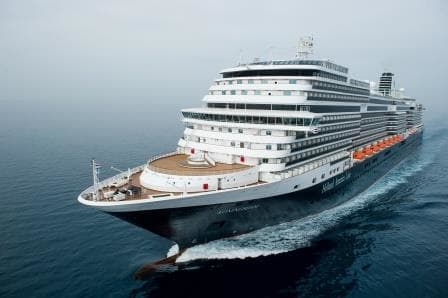
Then the Great Day arrived, the dedication of the ms Koningsdam. Yours truly under the able supervision of his lord and master arrived yesterday on the Koningsdam to be present for the dedication of the newest ship of the Holland America Line fleet. The ship arrived yesterday afternoon at 14.00 hrs.  in Rotterdam.


The Koningsdam at sea. Photos of her arrival can be found on the main page of the Hollandamericablog.

The Koningsdam at sea. Photos of her arrival can be found on the main page of the Hollandamericablog.

Due to its length, she swung around in the Waalhaven about a mile downstream and then went astern to the dock.  The days that the ships could easily swing off the WilhelminaKade are long gone as anything over 700 feet is a challenge. It would be a challenge some captains would not mind to take on but it would be a squeeze for a ship of just under a 1000 feet. Thus the longer ships swing on arrival or on departure and then have to go astern to the berth or from the berth. We had the chance to watch the Koningsdam while standing on the stern of the ss Rotterdam docked just south of the Cruise terminal. 

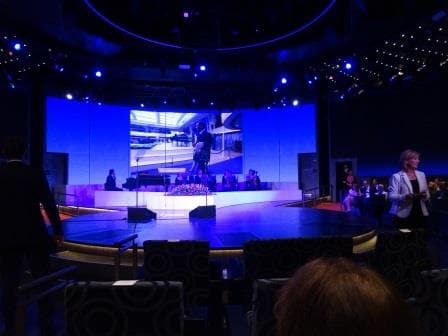
The dedication of the ms Koningsdam was all concentrated on this morning with first poring of a glass of Holland America Champagne over the ships bell followed by the real dedication in the show lounge. Although the World Stage can take 600 guests it was not big enough to have all the invitees there, all the guests, and a fair number of crew as well. Luckily the Lido deck of the Koningsdam is two stories high so you can have a lot of people in there. What was not live to see for the various groups could be followed on screens and that worked very well. The whole operation was meticulously organized and flawlessly executed.

Queen Maxima arrives in the Lido. partly obscured by the Captain. which is correct as a gentleman always walk at the left side of a Lady.

Queen Maxima arrives in the Lido. partly obscured by the Captain. which is correct as a gentleman always walk at the left side of a Lady.

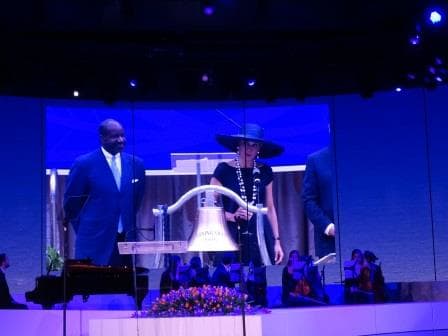
Her Majesty Queen Maxima of the Netherlands arrived at 10.30 and first went to the Lido Deck for the Bell & Champagne part of the dedication.

Queen Maxima, about to pour the champagne over the ships bell.

Queen Maxima, about to pour the champagne over the ships bell.

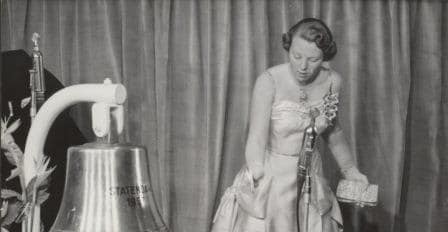
This is not the first time we have done this on a HAL ship. The Statendam of 1957 was christened/dedicated in the same way by then time Crown Princess Beatrix. The mother of the current King. This was done as the Statendam V was built in a dry dock and thus a traditional launching was not possible.  Not a bad reason to keep this link with the past, as it flowed over into the current day. Not only for the bell but also for the old Statendam name.

A link with the past. Crown Princess poring champagne on the bell of the Statendam IV.

A link with the past. Crown Princess poring champagne on the bell of the Statendam IV.

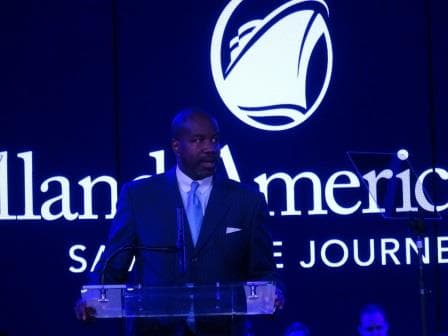
Orlando Ashford our president announced during his speech in the World Stage that the new name of the sister ship of the Koningsdam would be the Nieuw Statendam. The idea and logic behind this was to continue a traditional company name while at the same time indicating the future of the cruise business.

Holland America Lines president Mr. Orlando Ashford announcing the name of the sistership.

Holland America Lines president Mr. Orlando Ashford announcing the name of the sistership.

Hence Nieuw Statendam.  I do like this, as the name can be pronounced by everybody without having to deal with a Dutch tongue twister and still give a modern twist to it.

While in the Lido the Queen was also asked to sign the “Wall of Fame” which should eventually have the signatures of everybody who was on board today. As a result there were long lines later in the day which lasted until late in the afternoon. The panels will eventually be placed in the ship and remain there. Again a link back to the past as the same was done when the Nieuw Amsterdam (IV) came into service in 2010.

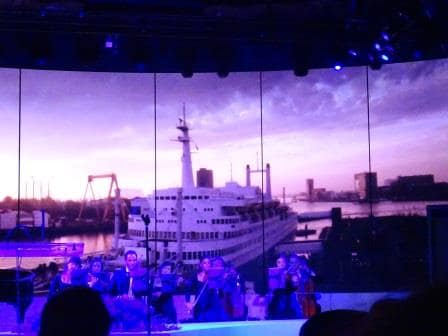
A short movie about the port of Rotterdam which also included a shot of the ss Rotterdam V.

A short movie about the port of Rotterdam which also included a shot of the ss Rotterdam V.

From the Lido the Queen was escorted to the World stage for the official ceremony. For reasons unknown to me, I had about the best seat in the house and an almost straight view onto the centre stage hence I can now put my own photos on line. A small orchestra played an intro while on the back screen a short movie played about the city of Rotterdam. This was followed by the National anthems of the Netherlands and the USA in a classical orchestration.

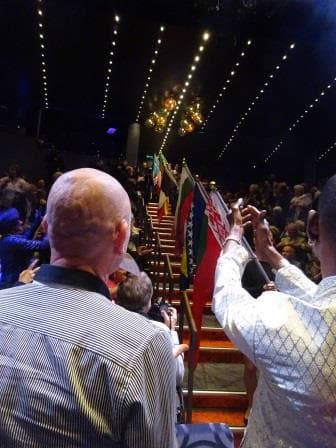
44 crew with their nations flag coming down the stairs.

44 crew with their nations flag coming down the stairs.

With the limited space available not too many crew could be present but this was solved by having 44 crew marching in (and out) each with the national flag depicting his or her own nationality. Currently we have 44 nationalities on board although of some of them there is only one representative on board and thus that one person “was volunteered” to represent his or her country. But…………. Who would even think about refusing even if the rehearsing went on until the deep of last night. The final two flags were from the Netherlands and the USA both carried by a Lady crewmember.

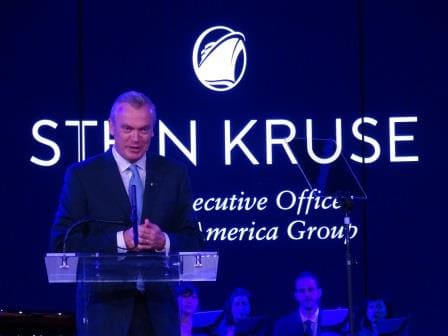
Mr. Stein Kruse with a few words of welcome to the Queen and all others present.

Mr. Stein Kruse with a few words of welcome to the Queen and all others present.

Then speeches of course by Stein Kruse, Orlando Ashford and Captain Emiel de Vries. As Stein is now the big man of the whole Holland American Line group his direct role with Holland America is less and thus the main speech was given by Orlando Ashford as President of Holland America. He impressed everybody greatly by giving a great and fluently flowing speech without having any notes whatsoever.

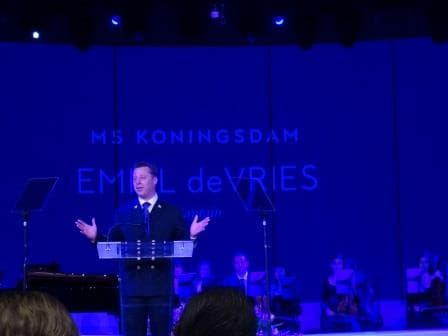
Captain Emiel de Vries with his appreciation for the day.

Captain Emiel de Vries with his appreciation for the day.

Captain Emiel de Vries expressed his appreciation of having everybody present and having the honor to be on the ship from building to Rotterdam and now up to Norway and following. This was followed by a Dutch harpist who provided an intermezzo. She was some years ago the winner of a contest in the Netherlands and showed that a combination of being a good singer and a good harpist is a very viable possibility.

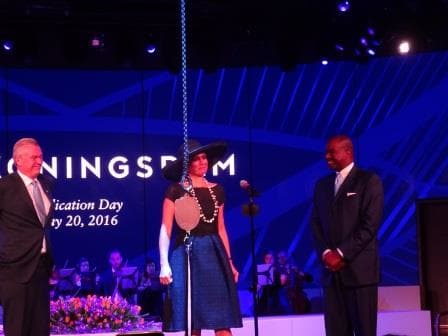
Her Majesty the Queen about to pull the cord which releases the champagne bottle outside the ship.

Her Majesty the Queen about to pull the cord which releases the champagne bottle outside the ship.

Then came the highlight with the official dedication/christening. As the Queen was in the lounge, the issue of releasing the bottle was solved by pulling a rope in the lounge which gave a signal to a release mechanism outside and then the bottle smashed in accordance with the requirements exactly at the right moment against the hull and broke. This could then be seen again on the big screen in the show lounge and also in the rest of the ship and even on the dockside

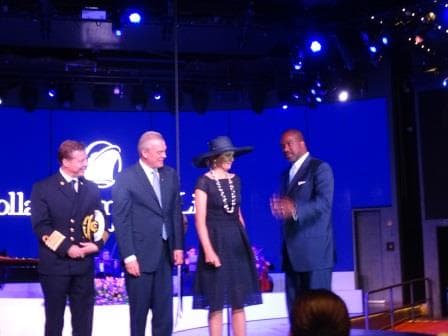
The Four Main Players of the day: Queen Maxima of the Netherlands. CEO Stein Kruse, President Orlando Ashford and Captain Emiel de Vries.

The Four Main Players of the day: Queen Maxima of the Netherlands. CEO Stein Kruse, President Orlando Ashford and Captain Emiel de Vries.

By 11.30 the official ceremony was over and Queen Maxima left the ship shortly after being given a farewell on the ships whistle.  All on board where offered champagne and were left to carry on enjoying the day on board or ashore.

Tonight the ship will sail at 20.00 hrs. stop briefly at Hook of Holland to watch the fireworks and then continue to Amsterdam where we will dock tomorrow morning. For those of you, who would like to see the whole ceremony, please go to the HAL website.

My apologies for the blue colors in the photos, it has something to do with the lighting of the stage.

13 May 2016; At Sea, heading to Kiel.

Today we have a relaxing sea day, sailing almost straight south towards Kiel and the “Kieler Bucht” as the Germans call it, the curve in the land in which Kiel is located. Just south is the entrance to the Kieler Canal which is also an interesting area. (See my old blogs in the archives) It is still chilly out here and that makes for clear skies and very good visibility. At 07.00 when I was on the bridge, I could see the mainland of Sweden on the Starboard side and the island of Gotland on the port side. This is the island with as its capital Visby which I referred to after we left Warnemunde.  Gotland or Gotaland is part of a province on the mainland which is also called Gotland or Gotaland. That can make it confusing but this also happens in other places well such Washington State and Washing DC. Which gets a lot of Europeans in a good muddle.

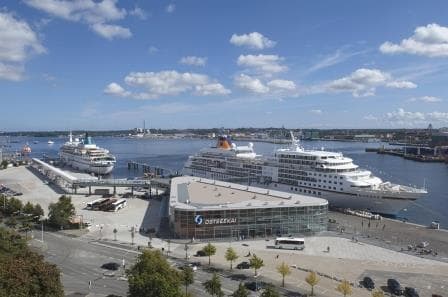
Kiel cruise terminals on a sunny day which we expect as well and close to downtown.

Kiel cruise terminals on a sunny day which we expect as well and close to downtown.

By the time we reach Kiel we will have made a full circle of the Baltic Sea. We will cross our entry course (Warnemunde to Tallinn) in the very early hours of tomorrow morning. After calling at Kiel the ship will retrace its steps and call at Gothenburg and  Helsingborg before heading back to Copenhagen.  We will have then sailed through an area full of history and our 12 day cruise was really too short to do it justice. If you could pump out part of the Baltic and clean the mud away, you would walk through a complete museum of artifacts and left overs from more than 2000 years of habitation and trade. The largest deposit of artifacts come from the 2nd world war. Russian scientists made a count in 2005 and found over 5000 wrecks and war relics on the bottom. The worst one is the Wilhelm Gustloff. This was a German cruise ship which was used in the last stages of the war to return to Germany with as many refugees as possible, running away from the advancing Russians. No exact count is known but the numbers vary from 6000 to close to 9000 casualties.  I have a small article about it on my blog under the header “of days gone by”. The First Mass market cruise ship”. I keep it to a number of 6600 casualties as most WWII experts seem to agree on that but there might have been many more.

The last few days I have been out and about for measuring and inspecting “Workplace Safety” on board. This is the safe working of the crew when serving guests, when carrying out maintenance and repairs and when doing drills. This can be as simple as: how to hold a fire hose.  Ever opened a garden hose and saw it starting to play around as the nozzle was left open? A garden hose does not do any harm and is not very dangerous. A 2 inch fire hose with a 10 pound nozzle on the end and 9 bars of water pressure can create havoc and thus it is important for the crew to be trained, drilled and retrained in the basics of hose handling.  And anything else as well.

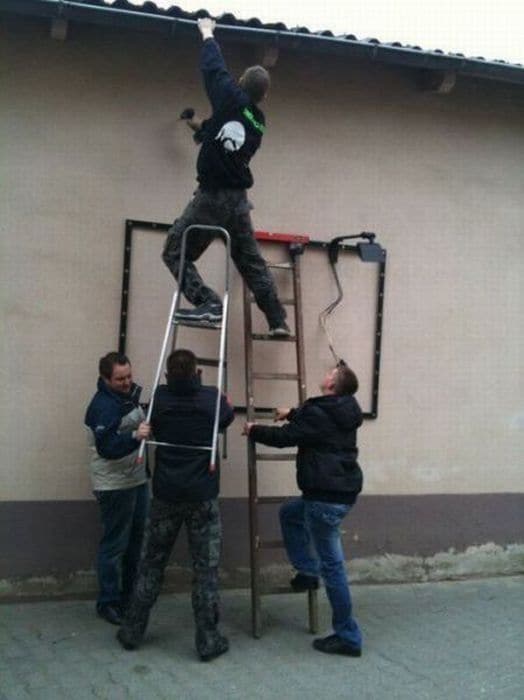
This is not on the ship.... I have been given to understand that this was some sort of creative thinking by workers in the east of Europe.

This is not on the ship…. I have been given to understand that this was some sort of creative thinking by workers in the East of Europe.

Another item is working above head level. This causes quite a few accidents in the industry as grabbing a stool, turning over a trash can or standing on a box is much faster and easier than first collecting the correct ladder. The crew needs to understand as well, when you can use a small ladder (never stand on the top step), when to use a large ladder, and when working over 2 meters above the deck a safety harness has to be worn. Officers and Supervisors train the crew and themselves and there are trainers who train the trainers. Then there is me to see if it is all been done, measure effectiveness and provide advice to the captain of where more focus is needed.

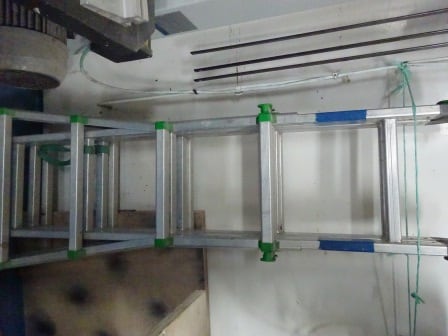
All Ladders are tested and then marked with the color of the year, such as blue in this case.

All Ladders are tested and then marked with the color of the year, such as blue in this case. When not in use they are tied to the bulkhead so they cannot fall over when the ships moves and thus not cause accidents.

We even have a yearly ladder testing program, so we can weed out the old and the broken ones. With roughly 200 ladders on board in various sizes and shapes not an unnecessary routine. As we have over 800 very inventive humans on board of which roughly 600 will have to reach for something which is higher than they are, it is an area where constant focus is needed.  So the program is train, observe & correct, verify, retrain and audit. All to ensure we will not have any crew accidents. The crew of the Zuiderdam does quite well with the accident count and that is good for all of us, not for the least the medical department as it remains quiet then in the medical Centre.

I am nearing the end of my short stay on board as tomorrow we are in Kiel and at 08.30 the agent will pick me up and get me to Hamburg airport. From there it is back to England and back to scaffolding and roof top maintenance…………. And there is also My Lord & Master with a honey do list which gets bigger and bigger ………. and so little time.   My blog might pop up again in a few days because if everything goes well, I will be for a few days on the Koningsdam for a quick review here and there to verify what I did there in the last two months was good and to see the christening at the same time. After that I have to attend a 4 day medical course followed by a 4 day fire fighting course to keep my Master license valid and then I should have a sort of vacation………… I hope.  What happens afterwards will depend on the needs of the Koningsdam and other ships so I will announce my schedule in due course.

12 May 2016; Stockholm, Sweden.

Well there was some good news today, the good ship Zuiderdam could dock after all. Somehow the cruise ship dock at down town was available and there we went. We did so with a delay, a not unusual delay, as there was a ferry in the way. The downtown dock Stadsgarten is next to two Ferry terminals for the Viking Line. And yes they have a departure at 08.00, or around that time, depending on the fact if loading is finished, and then they have preference. Ferries are like train services, their customers expect a regular schedule. Thus with 30 minutes delay we docked as near as is possible to down town. For good walkers it meant a 20 minute walk, a very scenic walk, along the harbor and for the non-walkers a 5 minute taxi ride or using the local bus. The captain made the delay up to everybody by also staying 30 minutes longer and thus shore time remained the same.

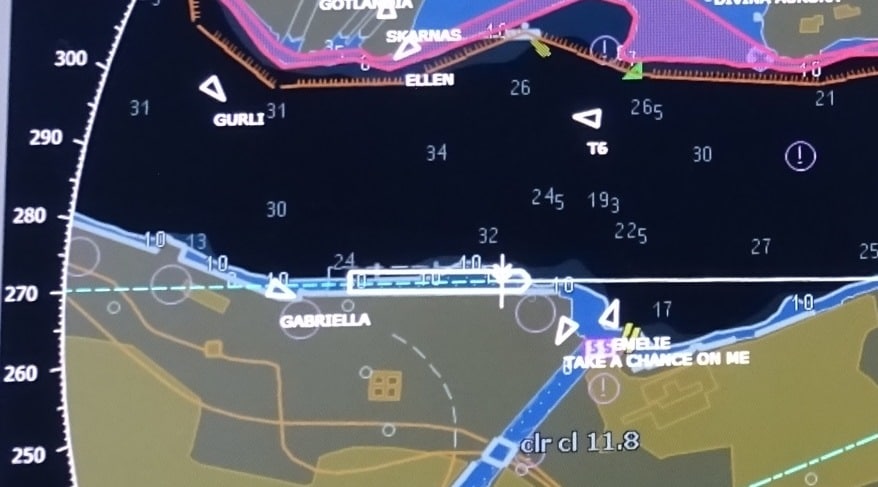
This is a photo of the Eelctronic chart. Hopefully you can read the name "Take a Chance on Me" docked with another boat the Emily under our bow.

This is a photo of the Eelctronic chart. Hopefully you can read the name “Take a Chance on Me” docked with another boat the Emilie under our bow.

What is also possible here is to take the local hop on hop off bus which stops very close to the ship. I do not khow many of my readers are currently on board, as I have been plugging these busses considerably through the years, but the Big Red Bus was very popular today; the local tourists might have had a hard time trying to get on as the Zuiderdam Guests were out in force. Another option unique to this dock is the sightseeing boat which docks right under the nose of the Zuiderdam. They are identical in size and layout as those in Amsterdam and that makes sense as Stockholm has the same sort of infrastructure as Amsterdam with canals and low bridges.  The boats have names derived from the songs of Sweden’s’ most popular export article: ABBA. And thus we could see “Take a Chance on me” docking under the bow and the “Dancing Queen” sailing by on the way to downtown. I wonder what sort of reaction the skipper gets when he makes a security call for a safe passage and announces “Take a Chance on Me”.  I supposed the whole port is used to it but I would be tempted to come back with a ………… not so serious answer.

The sail into Stockholm is a long one and a very scenic one. If you need to be motivated to get out of Bed early, then this is a good motivation. A lot of guests had followed the Cruise Directors advice and they were out in force. So much that I had a hard time finding a table for my breakfast at 06.30 this morning. This evening we do the reverse route and the weather is perfect today for some very good and extensive sightseeing. The great thing about Stockholm is, you sail inbound from East to West and outbound from West to East. Thus you always have the sun behind you. Shining perfectly over the sights ashore and avoiding all the glare which can otherwise spoil your photos.

One of the Ferries going through one of the narrow passages.

One of the Ferries going through one of the narrow passages.

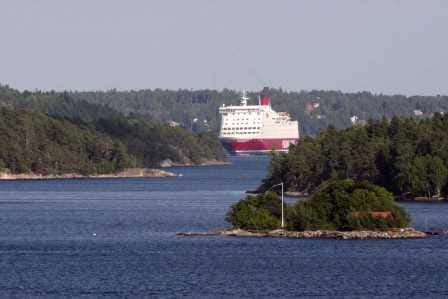
Because some of the passages are quite narrow (more of those nasty bumps in the way, nearly identical as yesterday in Helsinki, the whole area is covered by radar and by a Vessel Traffic System. This VTS advises the local traffic and ensures the ships are observing the local maximum speeds. A few points in the route are one way only and then the pilots arrange for the right meeting points. Again we have on occasion a ferry which gets in the way and if so, then we have to wait, as that ferry is on a “railroad schedule”.   The most prominent company is Viking Line with their red hulled boats and today we passed several of them. I wonder if the Ferry captains still enjoy the spectacular scenery as much as we do or if they got used to it in the same way I got used to Ketchikan after seeing it 200+ times (and mostly in the rain).

This is my artist impression and thus not very good. But it roughly indicates the difference between going North and going South.

This is my artist impression and thus not very good. But it roughly indicates the difference between going North and going South.

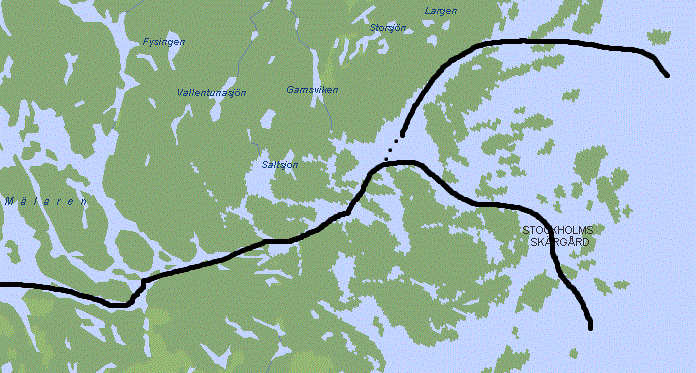
To get in and out of Stockholm there are two major routes. South and North. South is shorter and North is easier. The south has a 90 degree turn shortly after the pilot station. As a result they have put a length restriction on the ships which are allowed to make this turn. With the older HAL ships we always used the south route, now with the larger ships we are stuck with the north route which adds a considerable amount of time to the next journey going south to Kiel. The north route takes you quite far north and once in open water you have to sail the whole stretch back again, until you come by the south exit.

Tomorrow we have a sea day, giving everybody the chance to relax and take a deep breath before we end up in Kiel which we use as a gate-way for Hamburg. Although there is nothing wrong to stay in a Kiel as well. Plenty of things to do. The weather is holding and if it does so for a few more days then we will have had a magnificent spring cruise in the Baltic.


11 May 2016; Helsinki, Finland.

We picked up the pilot at the bright and early time of 06.00 in order to make it to the dock by 07.30. Helsinki is hiding behind a lot of reefs and rocks and it takes about 90 minutes to sail through the channel and then swing at the dock before going alongside.


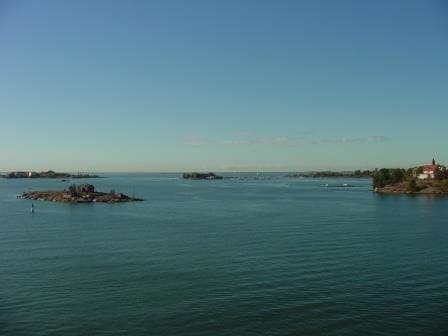
Lots of nasty bumps. Varying from small to quite large.

Lots of nasty bumps. Varying from small to quite large.

The reefs are not really reefs as in Coral Reefs but as in rock pinnacles which are sticking out to just above the water. Sometimes barely visible, sometimes in the form of smaller or larger islands. In between the water is deep and thus you can sail safely past them. But on occasion that passage is quite close to very close.


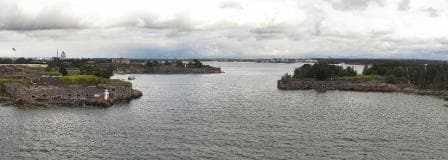
The Hole for down town Helsinki. It looks quite wide but it is not and there is a turn in the final approach.

The Hole for down town Helsinki. It looks quite wide but it is not and there is a turn in the final approach.

If you go to downtown Helsinki, you have to go through “the hole” which is a very narrow passage between two very large rocks/islands protruding out from the water. They form a natural gate to the city and thus it has fortresses on the top to keep the nasty neighbors out from long time ago. Going through the hole is not for the faint hearted, if you have never done it before and the larger the ship is (not just wider) the “more interesting” it gets. The length of the ship also plays a role as you have to change course close to lining up. So the longer the ship is, the more difficult it is to get the sail through course right.

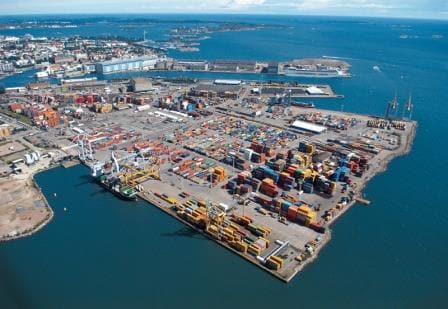
Overview of Helsinki. The cruise ships docks are on the far side of the container terminal. Down town is in the far upper left.

Overview of Helsinki. The cruise ships docks are on the far side of the container terminal. Down town is in the far upper left.

As a result they keep down town for the smaller ships. I docked there with the Prinsendam and the Veendam but the Zuiderdam is so much bigger again that it was a better idea to go to the new port on the west side. Most captains do not mind this location at all as it is so much easier to dock here. As I said The Hole for down town is not for the faint hearted. Also the piers here are better and newer but it is considerably further out from town. But as the invention of shuttle busses has also reached Helsinki it is not too much of an issue.

We had a bright sunny day again but a very chilly one. There was a cold wind blowing from the North West, from the Bothnic area and it felt as if this wind had been funneling over the ice of the last season as it had a very icy smell. Beautiful day to go ashore but wearing two pairs of socks while doing so.

In the meantime I kept the crew focused with a major drill experience. The whole ship has been catching up on drill experience as not much practical was possible with all the sea days during the crossing. Today all the efforts culminated in a combined drill with a lot of aspects touched upon at the same time. All 800 crew had to run around to support the big effort with their (small) part. The safety operation of a cruise ship is the same as an analogue watch. Hundreds or little parts ticking away with the only purpose in making the two hands on the dial go round and round.

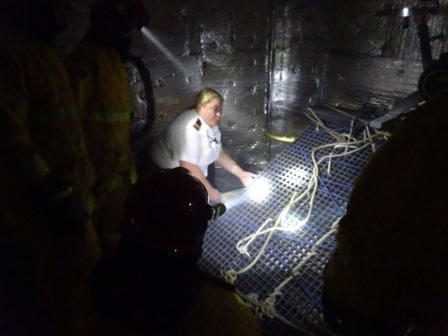
The ships Medical Officer assessing the casualty under the collapsed bulkhead before an effort is made to raise it.

The ships Medical Officer assessing the casualty under the collapsed bulkhead before an effort is made to raise it. A fireman is providing light with his helmet torch.

Today the complete three alarm cycle (Fire, Assembly, and Abandoning ship) had all the elements to make everybody very happy. We had a fire in a large space in the crew area and we had a collapsed bulkhead in the same area pinning down a (dummy) crewmember. This meant that after the fire was out, the Damage Control Team had to come out and jack-up the bulkhead before this casualty could be retrieved……………. and then we had to get everybody safely off the ship. To make the latter interesting we had six cadets in the ship who were simulating: confused guest, guest refusing to leave the cabin, wandering child, Guest slipped in the crow’s nest, and two crew fallen down the stairs. The whole sequence took from 09.30 to 11.00 hrs. while each evolution was carefully documented for further review and lessons learned. Anybody who has even remotely been involved with ships will understand that doing a combined Fire, Damage control, triage, assembly and abandoning ship drill is a major challenge to undertake. I presented the challenge and the Zuiderdam crew rose to the challenge and did very well. The fire was extinguished; the casualty safely retrieved after the collapsed bulkhead was jacked up, medical treated four casualties very quickly and had them dispatched correctly to the correct lifeboats. Which went down in the water as required. My compliments for a well done job.

We will sail at 17.00 hrs. tonight for a quick crossing of the Gulf of Bothnia and then a long, but very scenic sail into Stockholm for an 08.00 arrival. We will have to anchor as the port is full. Which is extra work for the crew but the guests are tendered directly into Stockholm center and that is quite handy. We are expecting more nice weather and if the wind dies down from blowing over all the ice cubes further north, then we should have a very nice spring day.

10 May 2016; St. Petersburg, Russia.

We are here during a Russian Holiday; of the 9th of May, День Победы Den Pobedy, which translates in to English as Victory or Liberation Day.  As there were gun salutes, fireworks (and it was nice weather) downtown St. Petersburg was heaving and the crew who could went ashore and had a great time. Some only came back very late in the night or early in the morning.

In the port it was very quiet. Whatever you say about Russia, they are good at security and The Marine Façade Cruise terminals are devoid of anything which does not belong. Apart from the Russian military using the beach nearby for a pre lining up for the parade, we did not notice much on the ships of what took place in downtown. This holiday is by far the most important one for the country as Russia still remembers the 2nd world war very vividly; as they were most likely the country that suffered the most as far as human sacrifices are concerned. So with even WWII so far in the past, it is still a very big thing.

I promised to explain why St. Petersburg pilots speak Dutch, sort off. It has all to do with Czar Peter the Great. He wanted to turn Russia into an international power and for that you needed a fleet in the 16th. and 17th. Century. Thus he himself went to Holland to study ship building and carpentry. Dutch was also the world language at that time and thus all he learned with his group of people was learned in Dutch. All these nautical terms he took back to St. Petersburg and the terminology was eventually absorbed into the Russian Language.  Through the decades some words got a Russian twist but in general a lot is still recognizable. If you talk to the skipper or captain of a Russian sailing ship you will find out that all the names of the ropes and sails have a Dutch origin.

Thus also the origin of the St. Petersburg Pilots. As mentioned yesterday we had to sail through a long and narrow channel to get to the city. It was already long and narrow (and very shallow) in the days of Czar Peter. Thus the need for good pilots was clear. Also here the Dutch got involved and the history lingers.  The local pilot is called a Lootsenman, Loots (nowadays spelled as Loods) is the Dutch name for a pilot. The pilot man or Lootsenman is the old version.  Also the Dutch nautical sailing terms came to St. Petersburg.  Starboard which is nowadays Stuurboord in Dutch, was Starrebord in those days and here it still is. Port which is Bakboord in Dutch lives on here as Bakkebord in the local pilot’s language. And so on and so on. If a Russian pilot speaks slowly in his VHF, then you can quite well follow the conversation as long as it is nautical. I never knew this, until I came to St.Petersburg as captain of the old Noordam in 2001 and the pilot introduced himself as the “lootsenman”.

Today the pilots were a little bit busier than yesterday as instead of only one other ship in the port there were two. The Marco Polo had left and was replaced this morning by the Aida Mar and a Costa ship. That still leaves room for three more ships and thus the cruise port did not look full at all. This will change in the coming weeks when the cruise season goes into full swing. Some cruise ships are still on their “migration” cruises on the way over from North America or coming up from down under.

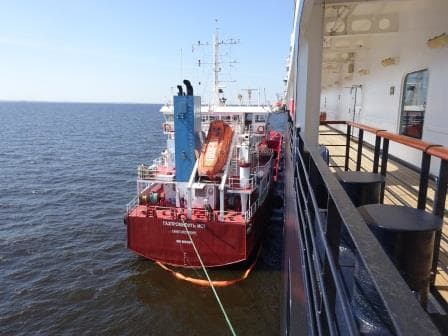
The fuel tanker Gazpromnef East. It has one of the modern enclosed lifeboats at the stern which are launched onto the water instead of lowered.

The fuel tanker Gazpromnef East. It has one of the modern enclosed lifeboats at the stern which are launched onto the water instead of lowered.

While we were docked yesterday we refueled the ship by means of a bunker barge. While in North America they use mainly Barges, in Europe the preference is a small ship. Sometimes large river boats as in Holland but sometimes sea going coasters which can be quite big. We had alongside one of the biggest bunker ships I have seen thus far. Listening to the beautiful name of Gazpromnef East, it brought sufficient fuel to last us for our next round trip. It had a capacity of much more than we needed and what we could ever hold in our tanks. The ship arrived at 10 am in the morning and departed again at 8 pm. in the evening. Which is quite a long stay but our experience is for Russian bunker boats not to have the pump capacity of what is standard on American barges. And if you can only pump just over 100 tons an hour, while we are used to the American standard of over 400 tons, then you get a prolonged stay. But as we had an overnight stay, who cares…………………..

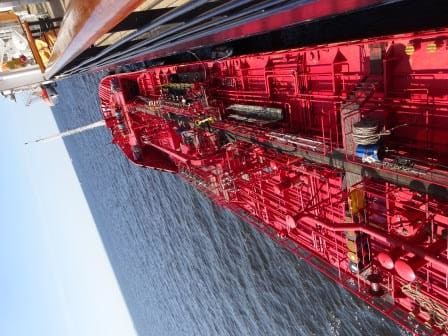
Lots of Tanks and pipes with in the middle a manifold which guides the bunker hose into the ship.

Lots of Tanks and pipes with in the middle a manifold which guides the bunker hose into the ship.

We will sail tonight at 18.00 hrs. and should have a sunny sail by the navy base of Kronstadt about 15 miles away from the city. Here we also have the flood barrier which was built not too long ago and which protects St. Petersburg from flooding during the winter storms.

Tomorrow we are in Helsinki and we should keep the same weather as we have today. Very nice weather, sunny and not too warm.

« Older posts Newer posts »