- Captain Albert's Website and Blog -

Ocean Liner History and Stories from the Sea, Past and Present. With an In Depth focus on Holland America Line

Page 56 of 242

26 October 2017; Civitavecchia, Italy.

In all the cruise brochures it gives the port call as Rome but this is not really the case. Rome is landlocked and never had a harbor. In roman times they had a port called Ostia and now in modern times it is Civitavecchia. The place has been around for a long time as the old harbor is protected by a Fortress designed by Michelangelo back in the 1500’s.

Fort Michelangelo. To the right we can just see one of the cruise terminals of the port.

Rome itself, at least the airport, is 90 kilometers away about an 80 minutes’ drive. How long it would take to get to downtown Rome would be any bodies guess as it would depend on the traffic at the time of the day and the day of the week. Saturdays and Sunday tend to be marginally less busy as there is hardly any lorry traffic then. Those 90 kilometers take 80 minutes although I have seen Mini Bus drivers do it a lot faster. Especially if they are driving crew who seem to be expendable in the mind of the drivers. They have a handy help when they are attempting to break the record of the fastest transfer to the ship and that is by keeping the white line in the middle of the road, exactly between the two front wheels. If from the opposing side somebody is doing the same thing, then that problem is solved by a last minute jerk to the right and then immediately getting back onto the white line again. The system does work……….. I am still alive and so are my new officers who arrived on board today .

Captain Mark Rowden.

The good ship ms Westerdam under the able command of Captain Mark Rowden is starting a 14 day Trans-Atlantic Cruise today which will conclude in Fort Lauderdale on the 8th. of November. We will visit three ports in Spain, Cartagena, Malaga and Cadiz and then have 7 glorious sea days. The weather for the coming days looks good; we just have to keep our fingers crossed for the crossing. But the ship will be taking the southerly route and that normally means that we avoid most of the bumps in the road. Wind is a lesser concern; everybody can hide behind the glass wind breakers when outside.

I had a school class, although the official title is Nautical Excellence Course, in April of this year going East with the Westerdam over the Atlantic and now we are doing the same thing again going west. Since then the ship has sailed in the Mediterranean it also received a face lift to update some of the Public Rooms, to install the Music Walk and receive lots and lots of carpet. I will share some photos in the coming days. The 6 new navigators will receive a mixture of theoretical and practical training to help to prepare them for their first real assignment as a licensed HAL officer. They can do it without this NEC period but it is always easier to climb a hill when you know the path and know why there is something coming at you when you turn the next corner.

That all started to day with them and the rest of the crew streaming on board with their luggage at 08.30. In the old days the crew at once disappeared into the bowels of the ship not to surface until a few days later when they were tuned in to the running of the ship. Not any longer; now we all have to go through Safety Indoctrination in which we are immersed into in two sessions. Today all the basic things we have to know before we are allowed to start working, tomorrow the rest and that is mainly what we are not allowed to do wrong. Which means watching a safety video, a video regarding proper conduct on board, filling out a whole pile of forms to comply with this and it all culminates with a visit to the Tailor shop. A good officer cannot start his/her life without a pair of safety shoes, a coverall and some khaki’s. The regular blue uniforms will come later, as the tailor is not in a hurry as long as the crew member does not know when and where he or she will be going.

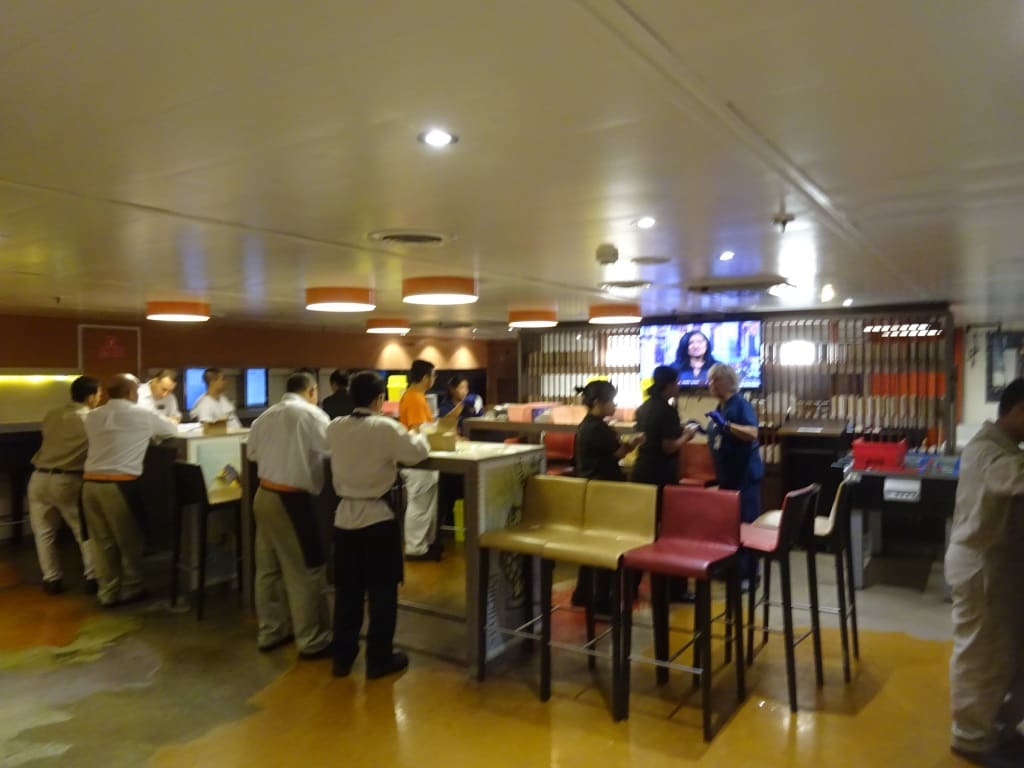
All those things take a whole morning to accomplish. The next highlight was then to explain where to get food and how the Lido layout works. I am sure that is one item I do not have to repeat a second time to get the message across.

The afternoon was filled with explaining who is who in the Head office and the in-depth reasons about why we do the Guest Lifeboat drill the way we do it. Tomorrow we are making a start of how to dock the ship safely, and then we will progress into how to sink the ship and then how to set it on fire. At least in theory.

We will be sailing south of Sardinia tomorrow on the way to Cartagena and the weather looks very nice with temperatures in the area of 19oC or 68oF. Not bad for autumn.

23 – 25 October 2017; Naples, Italy.

Because the ms Westerdam is island hopping in Greece, it was not really possible to join her any earlier. Flying to Santorini or Mykonos is a challenge enough under normal circumstances but when the Etesian winds are blowing (and you never know when the blow) then the flights to the islands get easily cancelled. The Etesian winds are a wind that comes from the north, from the Hungarian/ Bulgarian area where on a regular basis a high pressure system forms which generates very strong wind, up to wind force 7 to 8 is not unusual. And that comes “blowing down a gale” straight over the Greek Islands.

The Castel Nuovo dominates the down town area and is the first thing you see when coming off the ship.

So the best option for me was to park myself for two days in Naples, get over my jet leg, prepare for the coming school class and see a bit of Naples at the same time. The flight took me from Miami via Charles de Gaulle (CDG) in Paris to Naples and the whole happening lasted well over 24 hours, mainly because a Naples connection is not a main route and thus the flight connections do no tend to have a good flow through.  8 hr. wait in CDG airport as a result.  This is a most peculiar airport as everything is focused on getting you out when you arrive. There is no signage or information to direct you to another terminal if you continue your flight into the European Interior.  So even for this experienced traveler it took a while to figure out how everything worked. The main failure is that there is no signage between the International bit and the domestic bit (which includes the whole of Europe) you just have  to follow the exit signs; when you get to immigration there is some tentative information about where the next terminal might be. Strange thing is that apart from immigration (understandable, you are entering Europe) you also have to go through another security check again. They do not seem to trust anybody who comes from anywhere, and this happens while you have not left the secure area yet, when you are in transit. The airport has been renewed completely recently but I cannot understand how the French with their creativity and culture can create something so stark and depressing.  Nearly everything is grey and dark with on occasion an explosion of Orange. (= toilets). Taking the bus into Paris for a few hours was not really an option as it was Sunday and there was a reduced service.  I know from experience that this makes it difficult to get back on time.

Another thing right across from the terminal but a bit hidden from view an old fashion style shopping mall.

Naples turned out to be better; the agent parked me in a Hotel about 500 yards from the cruise terminal and that is also downtown at the same time. The basic street plan of Naples is a sort of half round with the port as its center and if you are in it you only have to walk up the hill or sideways to see it all.

This is normal for Naples. And not even close to rush hour. Note the mopeds driving over the white line. I think they are convinced that this white line was especially drawn there for them.

Best way to get the feeling for a city, especially for something so chaotic as Naples, is to take a city tour. Welcome Big Red Bus. Easily to find; outside Castel Nuovo next to the Cruise Terminal. For 22 euro’s you are happily driven around Naples via two routes. Due to the small streets of Naples, buses and even bigger cars cannot go everywhere, so the hop on hop off route is split in two. One follows the coast line to the west and the other does part of the old city, via the main thoroughfares. My compliments to the Drivers. Taking a Coach around Naples is not for the faint hearted. It is called a hop on hop off but hardly anybody is hopping as it is better to do the whole route and then walk to where you want to go. Also in mid afternoon it is not certain at all that you can hop back on again as the Bus might be full and you are not allowed to stand in the bus until there is space. Not allowed to stand makes sense as the driver has to break often and most of the time very sudden, to avoid motor cycles, scooters and small cars whose owners all think they are training for the Grand Prix and traffic rules are not for them but for the rest of the world.  It makes crossing the road an interesting experience. If you wait you never get across so you observe the flow and if there is a small gap, you just walk. As far as I can see, Naples invented the traffic Jam, although it is a fast flowing one. Also a constantly honking traffic Jam where each hole is filled with scooters and motor bikes. Neapolitan’s are friendly and outgoing, until they step on or in something motorized, then “an aggressive full speed ahead” seems to be the only goal in life.

Something I have found in more countries is that they built a copy of the St. Peters of Rome Church. This one is on the top of the hill at San Gennaro catacombs  and is a complete miniature version of the big one in Rome. There is one in Holland as well. I believe also one in England somewhere.

Do I like Naples ? Let’s say I found it fascinating. It is an old city; choc-a-bloc of old stuff going back to the Romans and before, but it is also full of noise and pollution. Neapolitan’s are very friendly people but do think that the whole surrounding world has to be an audience to their conversations, either face to face or via the phone; so do not expect to sit in a restaurant or small coffee shop for a bit of piece and quiet. For that you have to go further out of the center where there is a more space. In the old town it is just wall to wall noise and you have to be constantly on the lookout for all those mopeds coming by.

The whole of the center of Naples is one big labyrinth of small streets where the regular people live. That is why most traffic consists of mopeds, scooters and very small cars.

What is nice to do, if you have the guts for it, is to walk just one street up from the main street. The whole of Naples is just one big apartment building and behind the main thoroughfares you have the very small streets with all the small shops on the ground floor and the apartments above (still going 5 or 6 floors high) and where the regular people live. Those shops are very small but there is no other option as everything is built on top of each other so there is no room to build a bigger shop or expand upwards. Square cobble stones and big basalt blocks make up the pavement, so you need good shoes but it makes for a fascinating walk.  Is Naples dangerous? Yes if you walk around with your Rolex, expensive Camera, jewelry or a Gucci bag, then you invite a “fly by / rip off of your bag by a scooter but if you dress normal and behave normally, then there is no problem in all the main areas of the City.

This is a wide street as a bus fits through. This is typical for most of downtown Naples, apartments go six or seven high. I wonder if they all have lifts.

Whichever town or place I visit, I try to make it a point to find Real Estate agents. House prices combined with interior photos of normal houses and apartments give good idea about what the whole area is about and how people live. As downtown Naples is all built up, the only way to recognize a nice building from not such a nice one is the upkeep on the outside, as most of the architecture is similar even if it varies in style from Romantic, to Regency to Neo-Classical. So looking for good paint work and no TV wires on the outside is the first step and then if the pavement in front of the building is clean. Naples is a bit of a dirty town, so if it looks less dirty around the entrance than the rest of the street, you know that the price is going up and the inside will look good. In downtown, the price is roughly a 100,000 euro’s per room and depending on the quality it hovers for a 4 to 5 bedroom in the region of 500.000 to 700.000 euro’s. More bathrooms and a nice view and it tops the 1 million; if you want good inside parking, 1.2 million. Noise and chaos come free of charge and as there is a church within 300 yards anywhere it comes included with a free wake up service at 07.30 every morning.

Tomorrow I will board the Westerdam at the cruise terminal located just around the corner. I had a look this morning to see how to get there, if there would be no agent to pick me up. Naples is building a new Metro /Underground Line and the whole area in front of the Statione Marittima is one big building site. Everybody has to walk around this building site so I thought I had better do to a bit of Voyage Planning before I roll my suitcase out of the door. In 2007 or so, I had a private tour of the terminal which was built in the 1930’s when Mussolini forced the individual shipping companies to merge into one national company. 10 years ago, you could still see the 1st,2nd and 3rd class waiting rooms where people assembled before they boarded the ship. The place looked a little bit dilapidated then when I looked in the various rooms. That has all changed now and the large luggage and holding areas have been converted into meeting and conference rooms. Pity about the historic stuff but at least the building can now also be used outside the Tourist season. At the moment there are everyday at least 3 or 4 cruise ships in but that will get less in November. Yesterday we had MSC, Pullmantur, Costa and Albatross and today there was an Apartment of the Seas, and a Viking ship. If the schedule is right, then the Westerdam should be all by herself tomorrow.

The Westerdam is about to end her last Mediterranean cruise and will stop at Civitavecchia for Rome as the turn over port. Here my 7 eager and new Navigation Officers will board and then we will commence our Trans-Atlantic crossing to Fort Lauderdale. 3 ports and then 8 glorious days at sea.

I will leave you with a Napolitan puzzle: what are they trying to achieve here at the Bus stop:

A whole confusing collection of traffic signs.                                                                                                                                                                   1  A speed sign to drive maximum 20 kilometers. 
2.Then lorries are not allowed and the road gets smaller.
3. The 3rd sign indicates, nothing is allowed.             
4. Warning sign of traffic coming both ways and under it, no parking at any time.
Our Bus stopped here for a photo shot of Vesuvius and downtown, and nobody took any notice of any of the signs, and yes behind the bus was a lorry parked with the driver having lunch. Maybe in Naples stopping for lunch at a sidewalk café is not considered parking.


20 October 2017; At Sea 2nd day.

Late yesterday afternoon we sailed through the Windward Passage and the Trade wind fell away. The ridge of islands here, Cuba, Hispaniola and Puerto Rico further to the East all have mountain ranges and they ensure that there is a significant difference in wind; rain and other meteorological phenomenon between the areas on either side of the Windward Passage. Once completely clear, the wind has the tendency to return to the East or South East, similar to the Trade Winds but it is not constant. Regular depressions coming in from the North Atlantic, especially in the winter months can disturb this pattern with great frequency.

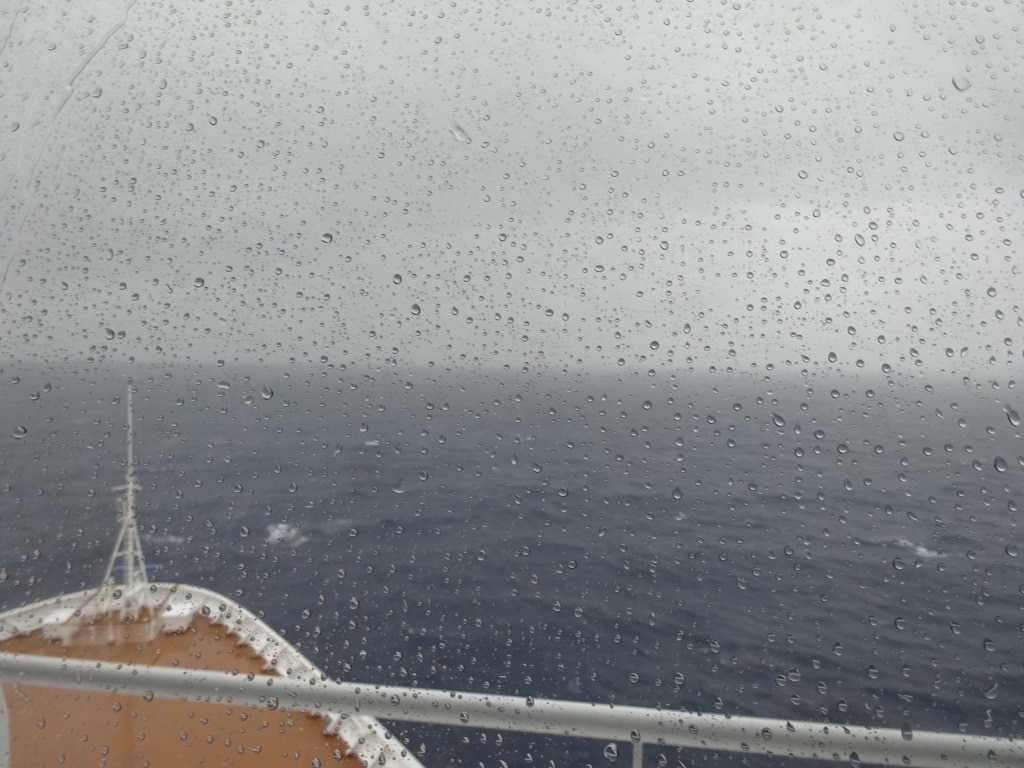
And we were not disappointed, a frontal ridge, a small depression was lying off the Windward area and while on the south side in the passage we had no wind at all, and once out it turned to the North East. By the next morning while sailing North of Cuba the frontal ridge came over and dumped a fair amount of rain water on the ship. Not appreciated by the guests but it made our Bo ‘sun very happy as it washed all the salt off the ship which had accumulated yesterday due to the strong trade winds. Once we were through the showers, the winds changed to the North West and later on veered back to the North East. And that is what we are supposed to keep all the way to Fort Lauderdale.

The Windward Passage, Gateway to the Caribbean.

There is a lot of traffic going through the Windward Passage and together with the Mona Passage further to the East it is the best connection to get in and out of the Caribbean so we see a lot of Container ships and Tankers coming and going from the Panama Canal. To regulate all these ships that are converging from six sides into the one passage there is a Vessel Traffic Separation scheme in effect, to keep those going north separate from those going south. Once north of the passage and heading up to Florida the same is repeated above Cuba in the Old Bahama Channel. For the Nieuw Amsterdam it adds about 20 miles to the journey as following the prescribed route means staying much more to the East and much more to the North of Cuba, than if we would sail a straight line. But it is now a lot safer than in the past as then it was a free for all and ships would do the strangest things; mostly to reduce the miles to make to the absolute minimum. So going through the passage we now hugged the Haitian side and once out, we hugged the Bahama side of the waters.

I used the day to wrap up my business here on board as tomorrow I will transfer to the Westerdam. This ship is about to end its European season and return to the USA for the winter. My regular readers might remember that I went to Europe with the ship in April to conduct a school class on board with new Navigators. Well we are going to do the same thing again, now sailing the other way. Holland America has found once again 7 eager navigators whose dream in life it is to join the company and we are not going to disappoint them. So I will fly from Miami to Paris and from there to Naples to join the Westerdam in that port, sail with her to Civitavecchia where the new officers will join for 14 days of immersion in the ways, routines and traditions of Holland America.  As there is a gap of three days, I will have time to prepare for the classes, get rid of my jet lag and explore the city as there seems to be a Hop on hop off Bus with three different routes.

On arrival in Ft. Lauderdale we will be together with the Harmony of the Seas and the Caribbean Princess who sailed ahead of us from Aruba two days ago. Then it is time for me to go to the airport. So tomorrow and the day after there will be no blog, but I hope to be able to share some experiences while visiting the city of Naples.

19 October 2017; At Sea.

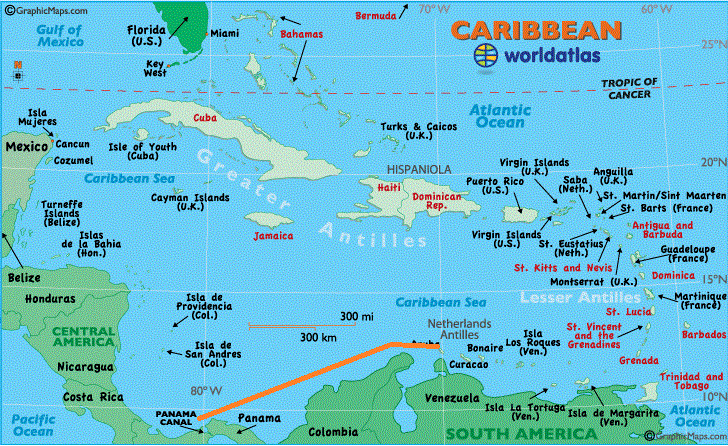
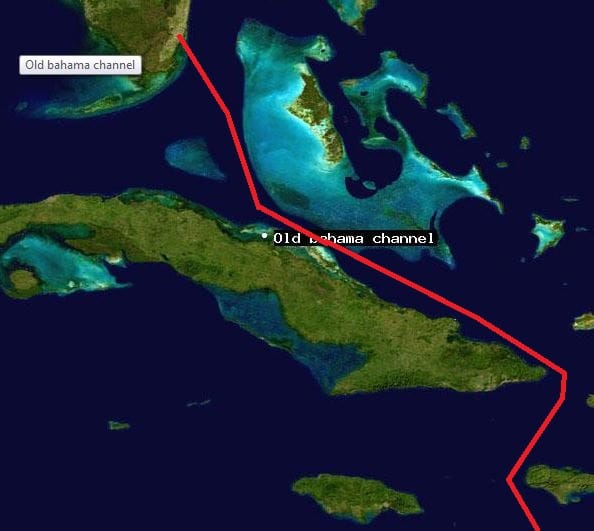
Even with going full out, it takes two days to sail from Aruba in the lower South West Caribbean to Fort Lauderdale. Of course we take the shortest route possible and that route takes us through the Windward Passage West of Haiti into the Old Bahama Passage North of Cuba. As long as there is no canal cutting through Cuba, we have to sail around it and that means either going West or East of this Island. For us the East side is the shorter route although if there are Hurricanes pending, then the ships have to sail around the West side of Cuba; but it means a late arrival in the home port. We want to arrive even earlier than normal to ensure that the Guests can disembark as per expected routine. We want to avoid any delays that might be caused by the full Crew Inspection which the CPB will conduct in Ft. Lauderdale.

Our route to Fort Lauderdale. Between 4 and 7 pm. we were in the Windward passage and then turned North West.

Every 90 days, every crew of every cruise ship has to attend such an inspection and that means that all crew goes ashore in groups to have their passports inspected and to get their I -95’s (crew landing permits) endorsed. With 900 crew that takes some time and the speed of the processing depends on how many officers the CBP can make available. Normally the ship ensures to be alongside at 07.00 hrs. which is the moment the longshoremen start working to take off the luggage. Now we want to be alongside by 06.00 hrs. so we have an hour to get the crew processed and thus we can ensure that the disembarkation of the guests is not affected. Most guests would like to have breakfast and that would be rather difficult if all cooks and stewards would be in the terminal reporting to the CBP. So we go pedal to the metal to makes this possible.

The day started full of rain showers as was predicted in the weather forecast but later in the morning the skies cleared but we had a sunny if windy day. Luckily there are enough locations on board to remain out of the wind and then decide if you want to soak up the sun, or stay in the shade. In my opinion it is a very nice way to end a cruise with two sea days, as it gives all the guests at least one full day to enjoy the ship without having to worry about packing and getting ready to go home. That can be left until tomorrow and for the fast packers until tomorrow evening.  Those who have the worry of how to pack the contents of three suitcases into two, due to all the shopping in the various ports, will have two days to come up for a solution to that challenge.

I had two main things on my mind today; conducting a fire drill with a full debriefing for the ship in the morning and secondly holding my Holland America History Lecture in the afternoon. The afternoon bit was the easiest and I was happy to keep a sold out show lounge attentive for 80 minutes with facts and stories about our fascinating company history. Fire drill takes much more time, as the challenge is always to create a drill with sufficient learning moments so that it is educational and will add something to the routine and skills of the crew involved. So today I put the Bo ‘sun store on fire which is a large area in the bow of the ship and its main challenge is to search for the source of the fire and save any casualties if found.

Within 8 minutes from out of bed, in full gear and ready to enter the Hot zone looking for the fire. I was quite happy with that time span.

The Bo ‘sun store is U shaped and by the time I had pumped it full of white stage smoke, visibility was below 2 feet. For teams the only way to find their way out again is to follow their hose and the same goes if there is a relieve team going in. Grab the charged hose and follow it blindly to where the nozzle is. Then do a hand over with the team going out (not easy as everybody wears breathing apparatus) and take over the job at hand.  For a simple fire drill we have at least 40 crew involved; deck, engine and medical officers, petty officers who are in the fire teams and crew who make up the various support groups. If we have a major drill it goes up to 80 or a 100 crew involved. And all these crew have to be in position within 10 minutes of the alarm having been sounded and to be ready to start the attack. Crew rotates, go on leave and come back again and this means that training and exercising is a never ending story. When I get on board there is then the nice chance to have an “outsider” organize something totally un-expected to have everybody hone their skills to an even higher level.

Hurrah for the invention of smoke machines, it makes it so much more realistic.

At 18.00 hrs. we sailed through the Windward Passage and from now on we will head westwards above Cuba. The moment we came in the shelter of Haiti, the Trade wind disappeared and it is expected that we will have a nice and quiet day tomorrow while sailing through the Old Bahama Channel towards Florida.

18 October 2017; Oranjestad, Aruba.

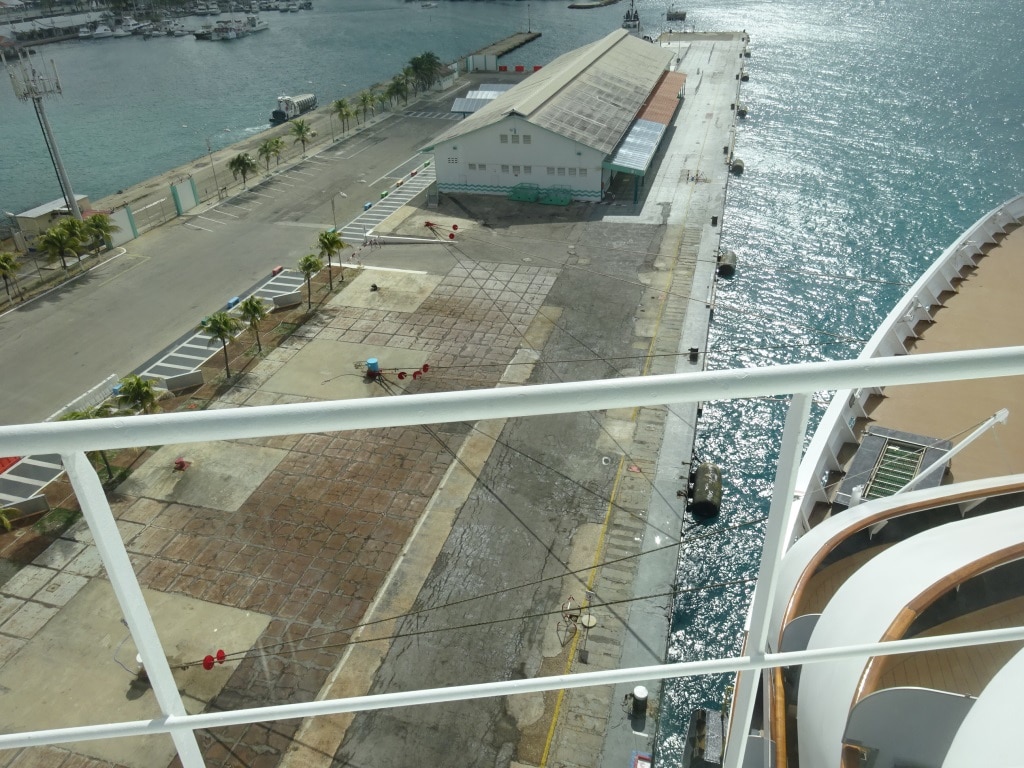
We knew it was going to be a windy day and we were not disappointed. There was a very strong wind blowing and during our stay it reached gusts of between 35 and 40 knots. That is Gale Force, except there was no storm. It was just very windy, a sort of Turbo Trade Wind blowing. On top of that we did not have the most ideal dock. The two big boys, Adventure of the Seas and the Caribbean Princess where at the regular cruise terminal, which makes sense because then you direct the largest flow of visitors over the shortest distance to downtown; and the Zenith that had an overnight stay was in the side dock, which is too short for the Nieuw Amsterdam. The Freewinds, the cruise ship of the Scientology Church, was in the next side dock and thus we had to content ourselves with being at the old container terminal. Aruba has now a new container terminal, close to the airport and the old one is currently used for the cruise ship overflow. They have big plans to develop this dock as another large cruise ship dock but that has not happened yet. Thus the bollards and mooring arrangements are still laid out as for cargo ships. Not for apartment buildings that catch an awful lot of wind……. As we had today.

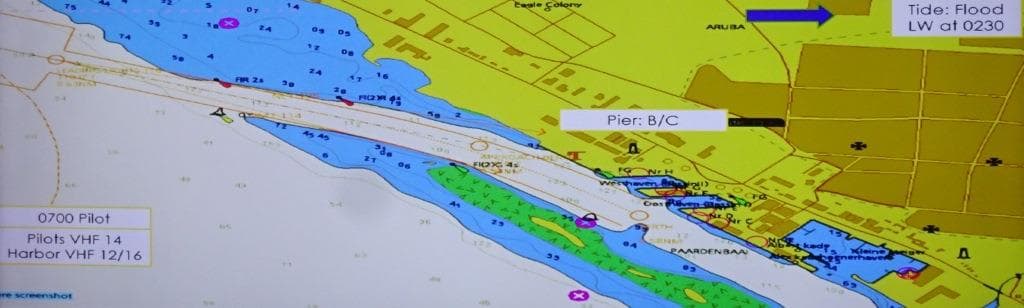
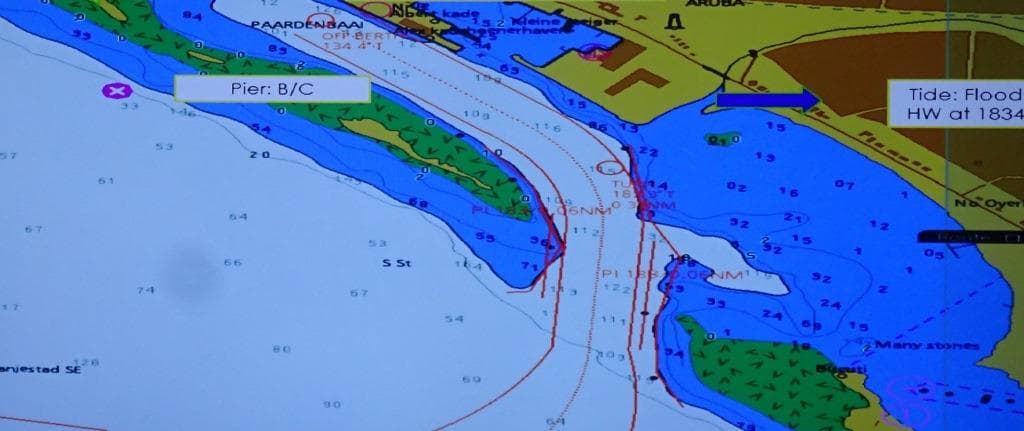
The Caribbean P on A, Adventure o/t S on B, Fairwinds on C, Zenith on D and Nieuw A. on E. This chartlet shows the new street car / tram line they have going now for a few years. When they finish the new terminal it will no doubt be extended. (Diagram courtesy Aruba.com / Mr. Allen Morrison)

At the other docks we have extra bollards, more inland which can take lines exactly perpendicular to the average direction of the wind but not here, so things were not ideal. Also we had bunkering today so for most of the day a large bunker barge/ship docked alongside us. The idea of blowing of the dock with a barrel of oil alongside you and then to be blown onto the reef on the other side of the harbor is something not to be contemplated so the Captain had ordered a tugboat on standby in case the wind would pick up even more. The harbor of Oranjestad, officially called Paarden Baai (Bay of Horses) is protected by a reef which runs along the whole length of the port. Great for breaking any strong swell coming in, not so great if you blow off the dock and otherwise could have drifted to sea safely.

Spaghetti Junction with the ropes of the Zenith and the Nieuw Amsterdam sharing bollards. We would have loved to have had some more bollards inland, there where the two people are standing or even beyond.

The name Paarden Baai dates from the Spanish and Dutch Colonial days when this corner of the island, the most sheltered from the ocean swells, was the landing point where horses were brought ashore for use on the islands. A practice long time gone but the name stayed. As far as I can figure out, the Zenith docked at the location where this original landing spot once was.  All the docks including the new container terminal and the airport are all at the south side of the island taking whatever shelter there is from the prevailing winds and from the leeside the island offers protection against the swell. Same at Curacao and same at Bonaire, the other two larger Dutch islands just to the east of Aruba.

The large empty space of the former cargo docks. Plans are in motion to extend the dock where now water is seen and then build another cruise terminal on this location,

Although Aruba is nominally still part of the Kingdom of the Netherlands its focus is much more towards the USA where the majority of the tourists are coming from and to Venezuela were the oil is coming from that was originally brought to Aruba, Bonaire and Curacao by The Royal Dutch Shell tankers from lake Maracaibo. The Shell tankers are long gone, the oil is still coming but the refineries are less prominent than they used to be and the main focus is now on tourism. And with over 11000 guests coming from the cruise ships they did not have much to complain about to day.

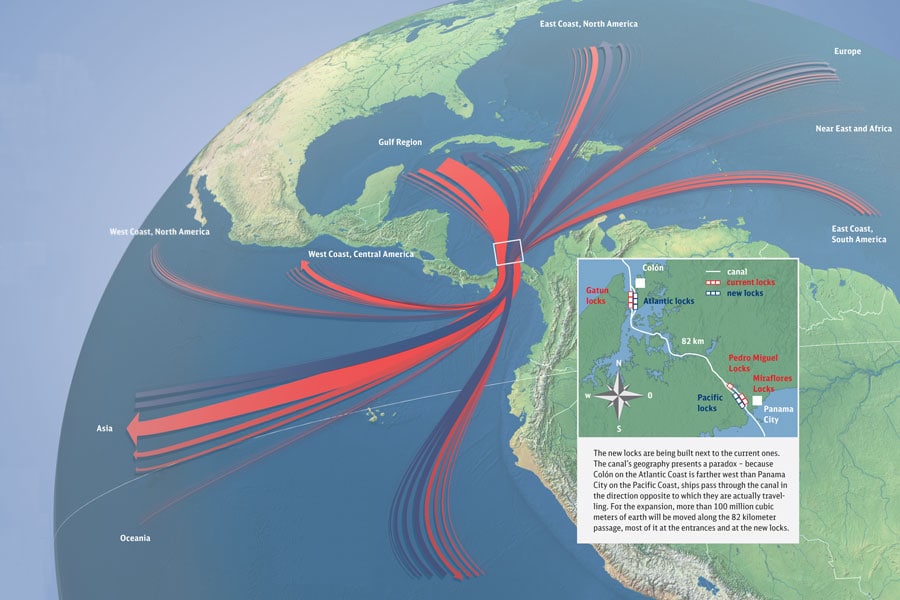
Because the refinery is so close by this is an ideal location to load fuel for the ship and the chief engineer’s fuel bill today went well over a $100,000. Still it was cheaper than the $433,000 the captain had to pay to get his ship through the Panama Canal. We had today a fairly long stay, departure was a 20.00 hrs. and once the last tired shopper was back on board we set sail for our last port of call, Ft. Lauderdale. We will have two days at sea and the first day is expected to be windy and rainy, with some dense showers coming over.

17 October 2017; Caribbean Sea.

A sort of communal sigh of contentment settled over the ship today after a long and hard day of sightseeing all the way through the Canal. On top of that we had an hour forward last night to get ourselves in tune with Aruba time and thus today is was a quiet day on board with a lot of guests taking it very easy. As a result the Greenhouse Spa with its wellness and pampering programs was doing very well and everywhere guests where enjoying comfortable seats and were having a hard time getting past page one of a new book, without  deep and profound contemplation setting in.

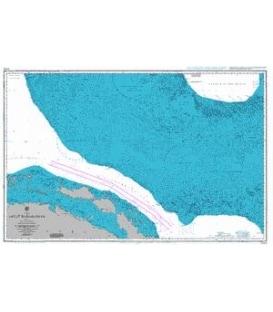
Sailing in the lower southwest part of the Carib. The Trade Winds have been blowing freely all the way from the eastern rim and have built up quite a nice swell by the time it comes to Barranquila

The ship is sailing today north of Colombia and is going against the Trade Wind and the accompanying seas. Thus on occasion there is a shudder going through the ship, when the bow collides with a wave under the wrong angle. All normal routine but it takes getting used to as it sounds as if the ship is hitting a block of concrete once in a while but not moving for the rest.

I am gearing up for one of the more complicated drills that I conduct when on board. In my blogging history you will find exercises where we put the whole show lounge on fire, rescued multiple injured persons from collisions and setup three or four hospitals (triage areas) to deal with larger numbers of casualties. We also have another challenge with cruise ships and that is if a ship rolls severely in bad weather. That has happened in the past in the cruise industry and even while guests are warned, some severe rolling can still result in a large number of small or medium severe injuries which all need attention at the same time. Ships infirmaries cannot cope with such an instant influx and thus triage is needed to establish a picking order of importance.  Read: selecting the most serious injuries first.  We mark those from Green to Yellow to Red to Black. With green being walking wounded and Black being the end of it all. For the medical staff, the yellow and the red, those who need immediate attention and those will not survive unless instant action is taken, will cause the biggest challenges.

A number of years ago, an Australian Cruise ship, called the Pacific Sun got caught in synchronized rolling. There is a clip of it somewhere on You Tube. This can happen if the speed and the direction of the ship is such that ocean swell can catch the ship under the exact right angle and cause that ship to roll with the same frequency as the wave that is pushing it. The only way to stop that is to change course and/or speed. But before the bridge has carried this corrective action, a few nasty rolls can have occurred already. Resulting in all sorts of injuries, and lots of people descending on the ships hospital all at once. Then suddenly 5 medical staff have to attend to 60 or 70 people who need (and demand) instant attention.

So tomorrow we are going to do an exercise to see if our protocols work as expected and to get more experience in this evolution. Today I spend a lot of time discussing everything with the major stake holders. Medical, the various groups in the Hotel Department and the Heads of Departments. Deck and engine are only involved on the edge of things as their primary focus is on keeping the ship safe if something happens. So tomorrow a large group of volunteers will descend on the ships hospital and one Medical Officer has to do Cabin calls for those who cannot get to the hospital. So our guests might see a lot of housekeeping running around with stretchers collecting various hapless volunteers who are simulating broken legs or worse. An important part will be the correct administration of all the casualties so at a certain point the Captain will have to alert the outside world and get boats or helicopters in or divert to the nearest port for the final disposition of those who need further shore side treatment. As we are working with a lot of people it should be interesting as we never know what one or two individuals will do when they get creative.

Tomorrow there will also be a lot of people. We will be in Aruba with 5 cruise ships. Caribbean Princess, Adventure of the Seas, Zenith, Nieuw Amsterdam and Freewinds. Originally it was not supposed to have been so busy but cruise companies were forced to replace Puerto Rico, St. Maarten, St Thomas and the BVI with other ports until the hurricane repairs have been completed. Roughly 11000 guests will invade Oranjestad during the day, not counting the crew. I think the local infrastructure can handle this but it is going to be busy in Front street. I do not think that the shop keepers will be offering many bargains tomorrow. The crew will want to go to the big supermarkets and hopefully they will be able to get taxis.

Weather for tomorrow: Sunny and hot 87oF / 31oC and very windy.

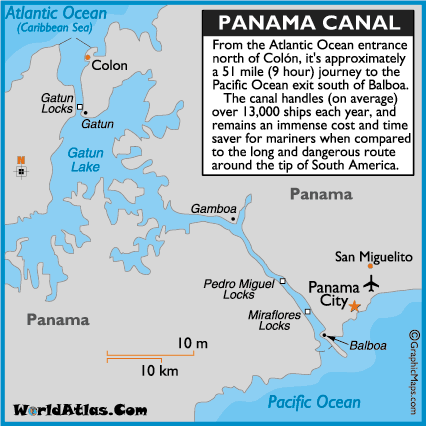
16 October 2017; Panama Canal, Panama.

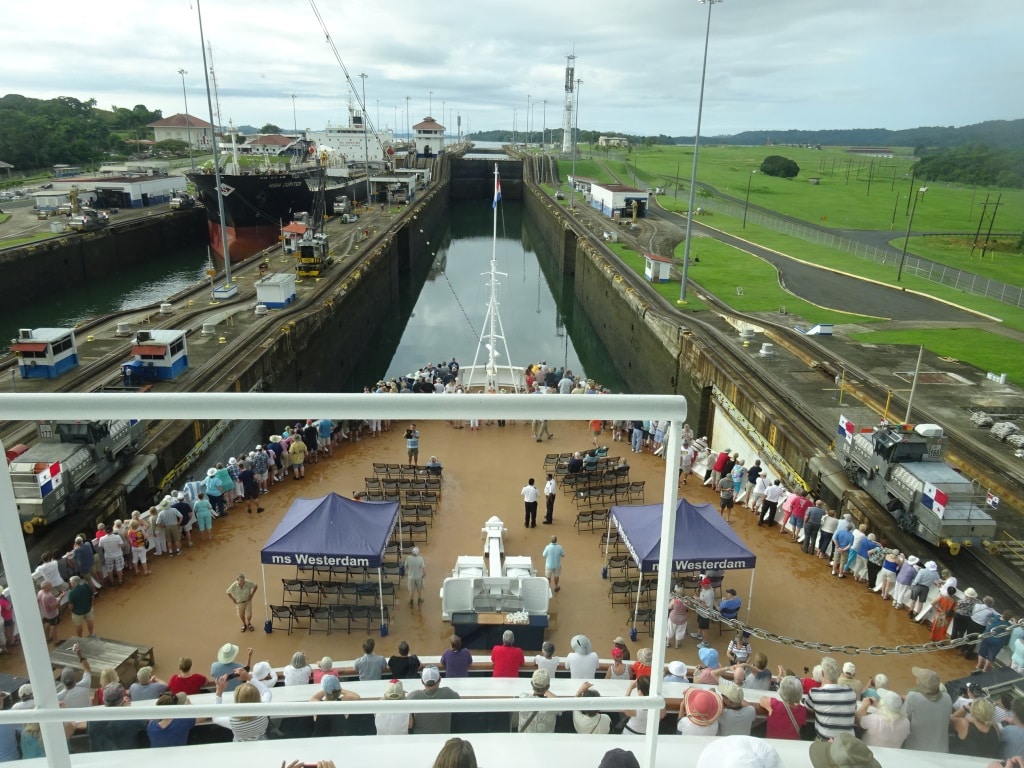
With a little bit of time to spare the Nieuw Amsterdam arrived at the convoy assembly area, to line up for the Transit. The canal still runs in convoys as the area at the Culebra Cut is still not wide enough for ships to pass each other. That might happen in the future but it will take a lot of dynamite before that day arrives.

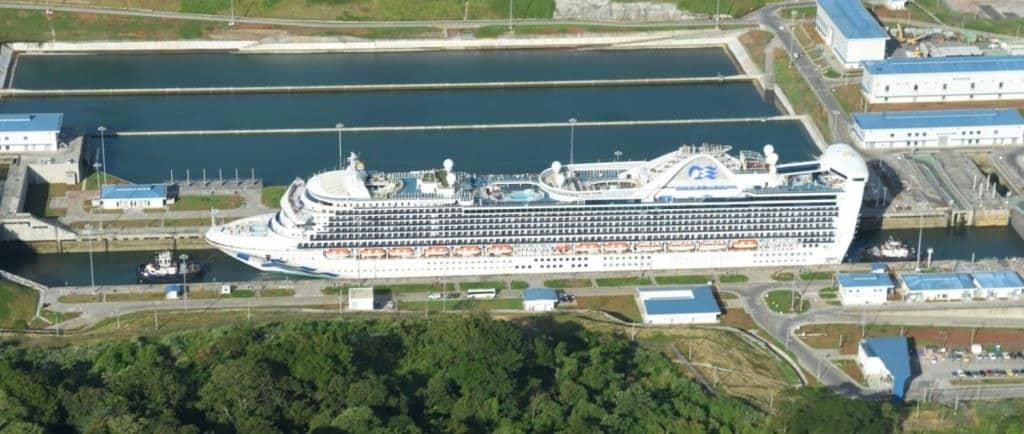
The new locks are now also in operation. This is the Atlantic side, but still used sparingly. There has been some good rain fall lately but conserving water is still very important.

Once the ship is drifting off the sea buoy, there is a whole flotilla of boats that attend to the ship. The agent arrives to deal with anything needed and to bring the Panama Canal narrator. The Boarding Officer arrives to clear the ship. The Canal Technician arrives to see if all the required equipment is working, such as the steering light, the window wipers, the whistle etc. etc. Then the first pilot arrives who will take the ship towards the first locks. They all come with their own boat, although the Canal Technician often comes together with the Boarding Officer. Once everybody is happy the pilot gets the green light from the Boarding officer and then slots the ship in, in between the rest depending on the number assigned. Today we had a whole cruise fleet going through. Ahead of us was the Norwegian Sun and behind us we had the Norwegian Pearl.  White hull, blue hull, white hull.

View from the Bridge of the Nieuw Amsterdam while in the Culebra Cut. It is much wider than in the old days, but not wide enough yet for opposing traffic. The white square in the distance is the Norwegian Sun.

Once the ship comes closer to the locks, the 2nd and 3rd pilot comes on board, followed by the Panama Canal crew which will handle the wires of the locomotives when they make fast to the ship. All ships have a 2nd pilot and two pilots work as a team on the bridge each on a bridge wing when going through the locks. One pilot takes the lead, the other assists with distances at the opposite side of the bridge. Once the ship is sailing through the Canal they take shifts in conning the vessel. Ships which have overhanging lifeboats, making it impossible for the pilot on the bridge wing to what the aft locomotives are doing, have a 3rd pilot who will stand at the stern when going through the locks.  A transit for a cruise ship normally takes between 8 to 10 hours from sea buoy to sea buoy although it can be shorter or longer. I have done it once in 6 hours but I also had a colleague who was stuck behind a tanker (which was really stuck in a lock) and it took 16 hours to get back to open sea.

The all important locomotives or mules which keep the ship in the center while going through the locks.

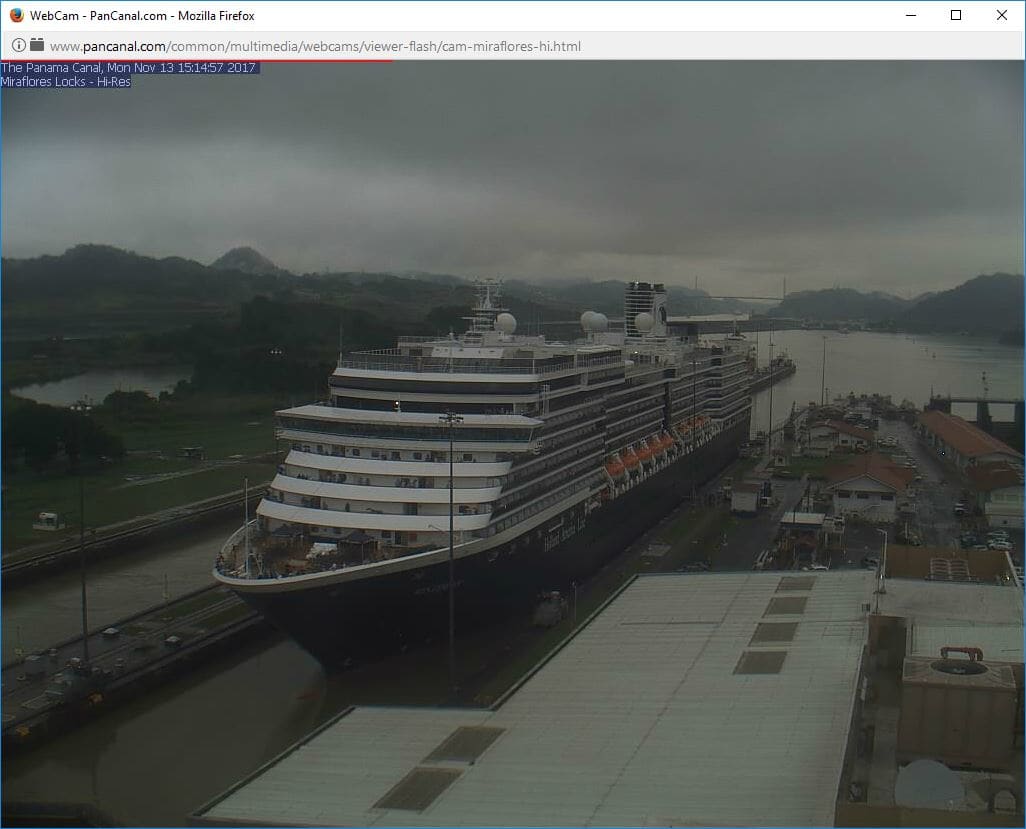
In my 37 years of going through the Canal on a regular basis, I have never found it dull. There is always something new to see, as the Canal is continuously expanding or evolving and there is always something to think about; why are they doing it that way. Also today, there was something of special interest going on. While going into the first locks (Miraflores) they were a locomotive short and somebody had to run to the waiting area to wake up the driver. No big deal but with an operation that works on the minute to get as many ships through as possible, any delay becomes at once a significant delay. Then in the next locks a locomotive got stuck, we think the engine seized up, so the ship had to put the brakes on otherwise the locomotive would have been pulled off the tracks. This happened sometime in the past with a bulk carrier whose bow swung the wrong way and the locomotive nicely plunged into the Canal. Getting a 40 ton locomotive out of the water is not that easy, although the canal has procedures in place for all these sort of happenings.

Overview of the largest lock system on the Atlantic side. At the Pacific side it is split in a one chamber and a two chamber set up.

The weather remained quite good for the day and although it was tropically warm, it was mostly overcast which make it quite enjoyable to stay out for longer periods. We were at the sea buoy on the Pacific Side at 05.00 hrs. and we were at the sea buoy on the Atlantic Side at 17.00 hrs. so this was a transit of about 12 hrs. from the very beginning to the very end and that is about average. Start of first lock to end of last lock was from 07.30 hrs. to 16.00 hrs. and that is a regular day for guest sightseeing.

Tomorrow we are at sea, heading North West towards Aruba and I am expecting a bit of a bumpy ride as the ship has to go against strong N.E winds and waves.

One from the good old days, the Statendam and Ryndam together in the Panama Canal.

15 October 2017; Pacific Ocean.

Most of the day was over cast with a lot of rain clouds in the vicinity both at sea as well as over the land. Although not the ideal situation for a cruise, it is good for the region as the tropical forest needs it and also the Panama Canal needs it; as it operates on rain water collected in the Lake. Recently the Panama Canal authority has been very cautious with using the new big locks == only for those ships that really need it == as those big lock chambers use a lot of water and there has not been enough of it. It has been raining less recently than in previous periods. So we will see tomorrow what the situation is although we will be only using the old locks.

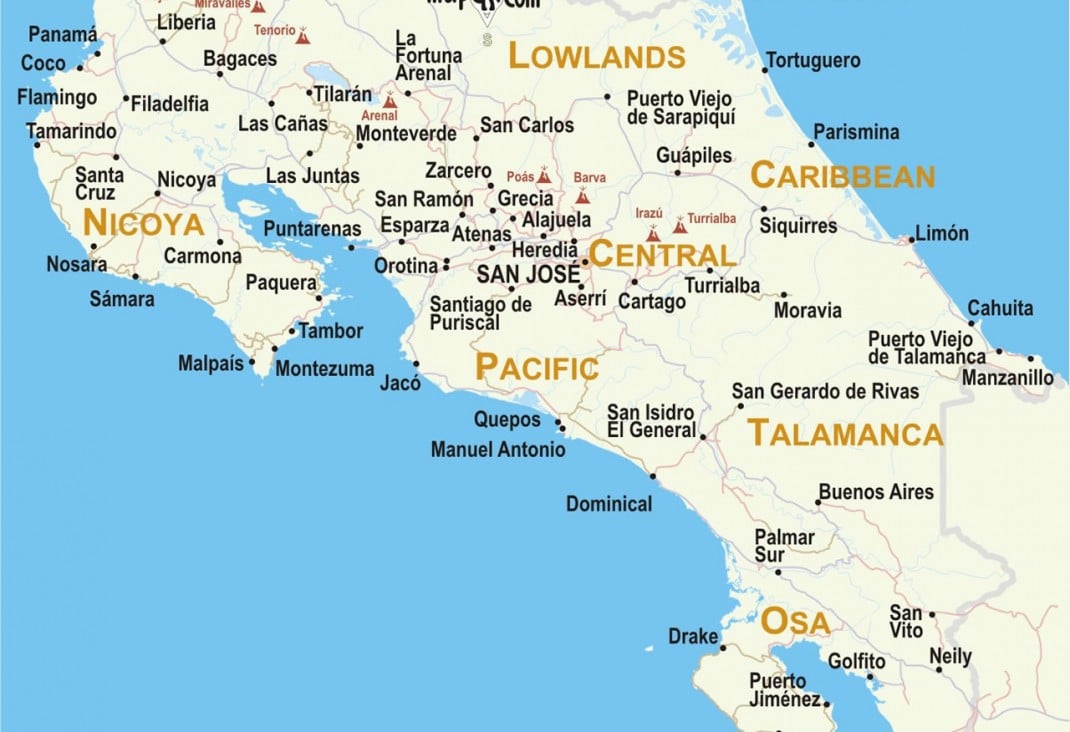
The distance between Costa Rica and Panama does not look that big but there is that nick at the border and we have to sail around it towards Balboa.

Today we sailed along the coast of Costa Rica and Panama. With the pedal to the metal as we left 4 hours late from Punta Arenas due to the late return of the tours.  As mentioned, the last guest stepped back on board at 10 pm. last night and then we left at once. Some of those on the tours were nearly delayed by six hours in returning to due slow traffic and (at least) one fatal accident.  On board the Lido was kept open until the last tour had returned and for those who did not have the energy to go there, Room Service was on full battle stations as well.

Maybe because of this the morning on board was very slow. I was almost the only one in the Lido Restaurant at 06.30, while normally it is buzzing with early risers and a lot of traffic of gentlemen who have been sent out by their better half to get coffee and rolls. We have the friends of Bill W. on board, and meetings of Service Clubs, maybe there should also be a meeting of “those who suffer from the early morning Roll and Coffee run” it could be quite popular. But only later it got busy with guests trying to get breakfast in before they started to participate in all the activities of the Daily Program.

The crew of the Nieuw Amsterdam was preparing for the Canal Transit and those who would have to make long hours tomorrow were taking it quiet today. I blogged about it in the past that we have nowadays the MLC 2006 labor regulations which govern the working hours of all sailors worldwide. And that means that over a 7 day period there is a maximum. Tomorrow especially the Deck department and the Bar Lounge and Deck stewards will go over those maximum hours and those hours = too many= have to be compensated either before or after. Hence a quiet Sunday at sea for quite a few.

Navigational wise the preparation is about letting the Canal know that we are coming. Which means 72, 48, 24 and 12 hour notifications so that we as a cruise ship we can fit straight into the convoy when we arrive. As a passenger ship we have preference, as long as we arrive on time. If we miss our slot we will be added as the last one in the convoy and then we will always be behind the last slow tanker going through. If we make the time agreed upon between Captain and Panama Canal Authority then it is possible that we end up behind the fast boys (Container ships) and will have a speedy transit.

Just above the N of North, we have to slow down to 12 knots and then sail with that sedate speed towards the Balboa sea buoy. Slow speed gives more time to avoid dangerous situations.

Thus the captain is keeping the pedal to the metal, to be on time and also to have surplus time as the last 25 miles we have to do with a speed of 12 knots. Panama has instigated this on the Pacific side to make things a little bit safer. In the past cargo ships would give full ahead at the sea buoy and race towards the Pacific, sometimes with leaving only a very junior officer on the bridge. The rest were tired and thus left it to Jason to sort things out. At the same time there was all this traffic coming towards the sea-buoy and it resulted sometimes in very scary situations.  With our ships we used to go extra wide to avoid these fast johnnies who were going full speed while not keeping a sufficient look out, and cutting corners wherever they could. Now they all have to behave with a regulated slow speed and the world is the better for it.

We expect to be at the sea buoy tomorrow at 05.30 and then enter the first locks, the Miraflores Locks around 07.30. Expected Weather: Hot and Humid with a fair chance of a big shower. Good news; it is supposed to be overcast all day, which reduces the chance of sunburn.

14 October. 2017; Punta Arenas, Costa Rica.

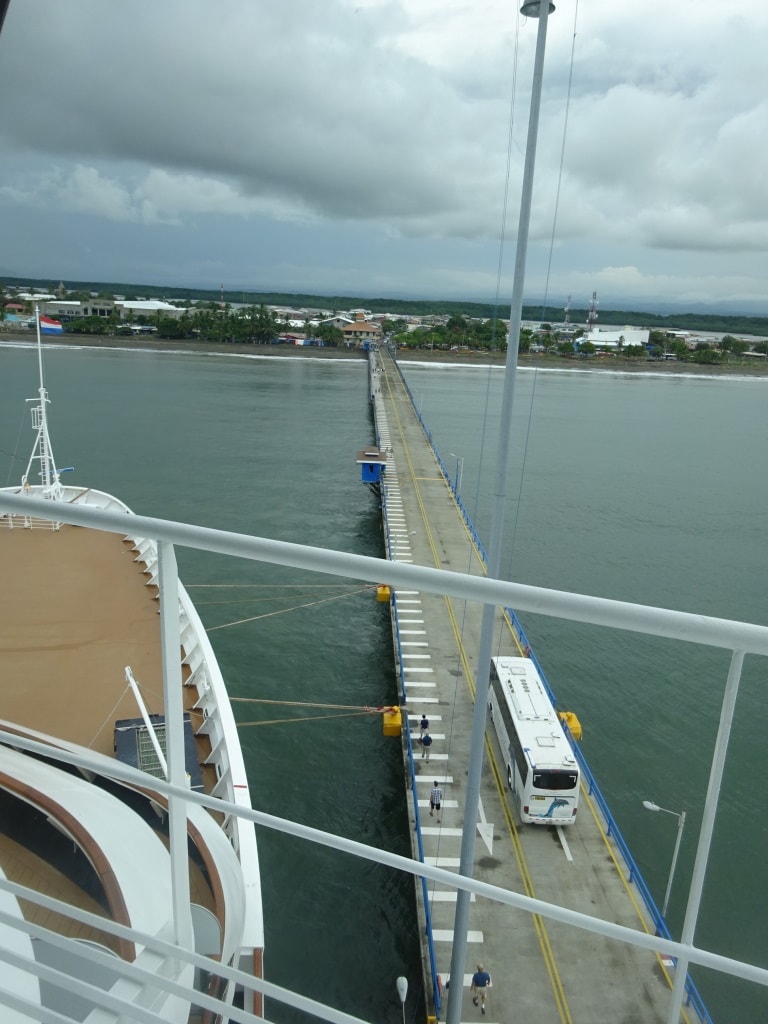
When you come to this area of Costa Rica, Puerto Caldera is the main cargo port here. A long time ago, in the late 1980’s Holland America started to call at Caldera and docked at a new cargo pier which was nicely protected by a breakwater meant to keep the sometimes very unpleasant swell out. Then cruise ship tourism expanded greatly and it caused in spring and autumn such a congestion with cruise ships that there was hardly any chance for a cargo ship to dock; as every day there was a cruise ship coming in. So the local authorities decided to build a cruise terminal, a pier which runs straight into the main street of Punta Arenas. Puerto Caldera is just a cargo port and there is not much of anything else there. Now the guests could walk straight into the local town.

This was a great idea but they forgot or ignored the concerns of the professionals at sea and did not built a breakwater to protect this dock from the swell that comes in at times. and took for granted the current which comes in at an angle of 90o onto the pier and can run up to four knots. Thus the ships now have to arrive near slack tide when the current drops under two knots otherwise the ship either gets slammed against the dock or cannot get alongside. All depending whether it is flooding or ebbing and at which side of the pier you are at.  Then they made the pier so small that there is hardly any room for the buses to come in and go out. They have to back in or back out of over distance of half a mile and when loading needs to take place, it is getting very cluttered. As the dock is located at the end of the Golfo di Nacoya, it forms an estuary tidal situation where the sea water is pushed up to considerable height and that means that there are long gangways/ramps and platforms and all sorts of other clutter on the dock.

An un ending stream of “invaders” marching into Punta Arenas.

So it is always with a certain trepidation that a cruise ship captain calls here. Yes we want to go as the guests really like the tours but operationally it gives quite a headache. Today was no different. The tide today was slightly different than the predictions and we had to postpone docking by half an hour and when we finally could it took all the ships power and the aid of a tugboat to dock against the still remaining current. We were joined by the Norwegian Pearl which was docking after us and also struggling with the remainder of the current, and she had to put all the brakes on to make a soft landing against the dock. By the time both ships where safely docked and the gangways were out and platforms in place, we were an hour late and nothing we could do about it. Thus from both ships all the tours left an hour late, making the tour dispatch a bit challenging as well. 10 am. means that all guests had had their breakfast and now wanted to go ashore all at the same time. So for about an hour 2000 people streamed from each ship and thus a total of 4000+ guests marched into town or invaded the country side by tour bus.

On the bridge they had their own challenges, as the swell was running in which caused the ship to slowly move up and down and with the waves once in a while creating a shudder in the ship when one slammed under the stern. When a ship is moving along the dock a little bit it means that the deck department has to continuously adjust the mooring ropes so that all 12 of them take the same tension when the ship moves. For us, when it was ebbing it was easy, yes the ship moved but the ebb pushed the ship back against the dock. When the flood came through, it started to push the ship away from the dock so the captain put on the thrusters and the Azipods and kept the ship alongside that way. A very safe operation but it meant the bridge was on battle stations all day.

As the dock is very tidal, the port provides long ramps and platforms. Ramps ensure that rollators, scooters and those who have difficulty going up and downs steps can still get ashore. To the right the Norwegian Pearl who docked the other way around.

Ashore they had their own fun and games with the return of the tours. Unbeknown to all involved there had been mudslides on the new highway to San Jose, the capital of Costa Rica way up in the mountains. Thus all traffic had been diverted back to the old road and things were slowed down to single lane traffic. Then there was a fatal accident somewhere down that road and as a result all traffic came to a grinding halt. As a result the last tour group stepped back on board by 10 pm. As ships crew you feel really helpless then, as against nature there is nothing you can do while you still feel responsible as it is your company’s tour.

We had one final piece of luck, because it was 10 pm. we just fitted in the tidal window of being able to sail and were not more delayed because of the tide being too strong. We have some leeway in the schedule so by going up to wrap speed we can still make the Panama Canal pilot station by 05.00 hrs. the day after tomorrow. But now we have of course a very unhappy chief engineer as his fuel budget is going to take a hit. Tonight we are going an hour forward to get in sync with Panama time and tomorrow we should have an overcast day with some rain clouds. For the guests there should be things to see, as wildlife will now be playing around the ship.

But we are ending the day with a smile………………. from the kitchen department.

13 October 2017; Corinto, Nicaragua.

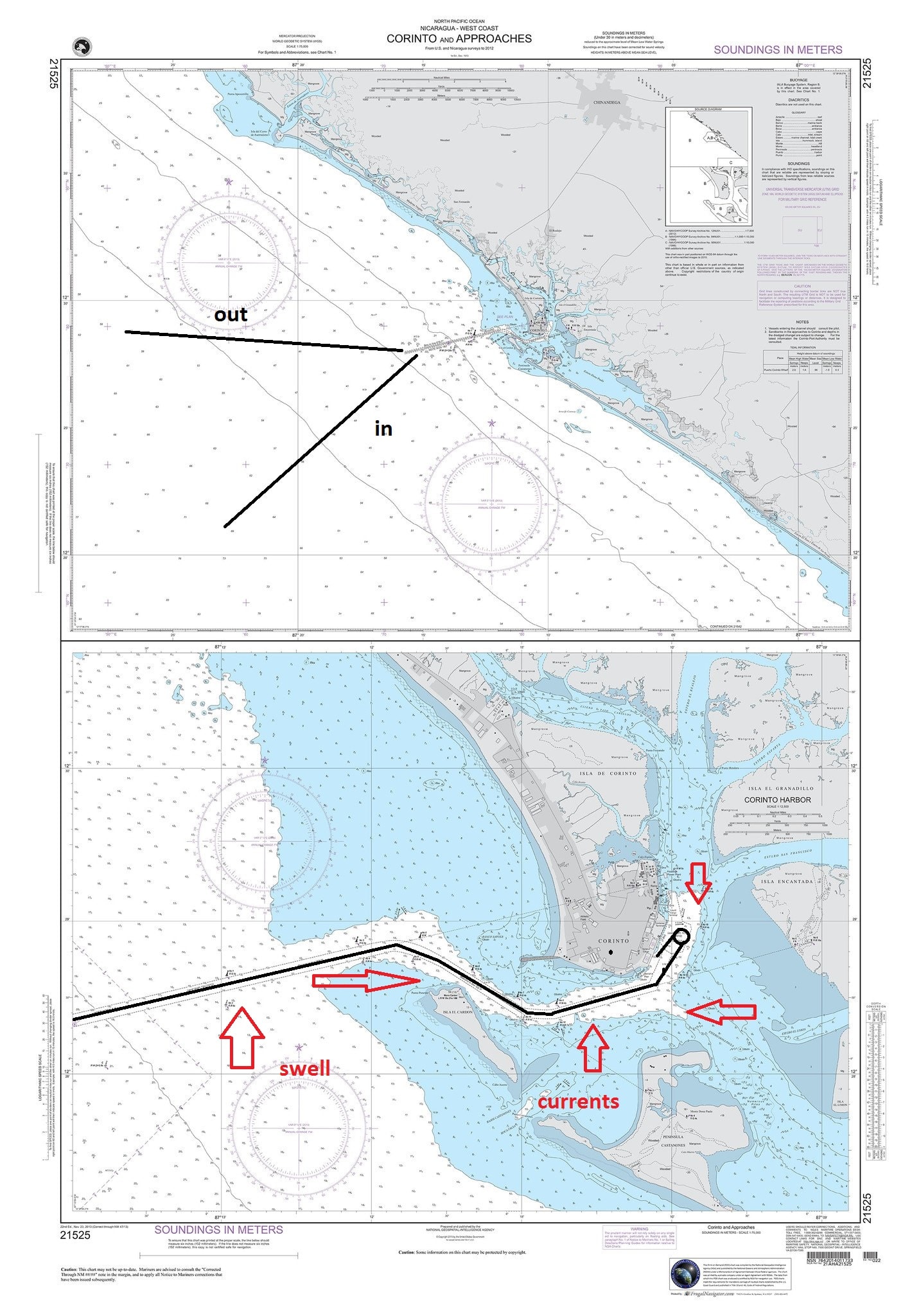
Our guests have been indicating that they enjoy Corinto and thus Holland America is now having more ships calling here during Trans Canal cruises and re positioning cruises to and from Alaska. My first time here was in 1979 when I was cadet on a container ship just after the revolution and things where rather hairy. I was there with a container ship which sailed for a company that was once the cargo part of Holland America until it was split off on 1 January 1973. The management of the remaining passenger ship part of Holland America wanted to concentrate on cruising. These were most interesting calls as the ship was very advanced for that time and the local longshoremen could not handle the equipment (Or those who could had run away during the political changer over, I never found that out) and thus it fell upon us, cadets, to run either the ships cranes or the large shore crane which had been installed a few years before.

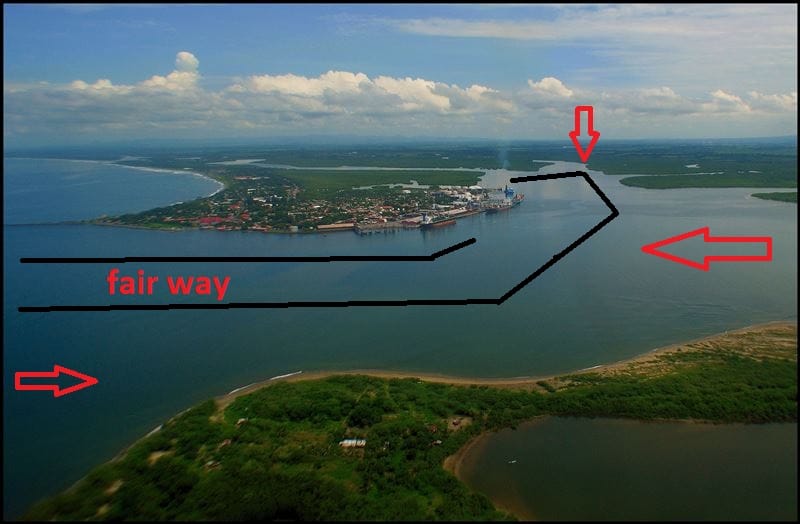
The Dock at Corinto. This is an air photo of the port from 2 years ago and also then the crane was already out of order. Currently they are tearing down the two sheds on the dock.

Routine was then that the Engineers would check over all the shore equipment including the large fork lifts before the deck officers would and could get the show on the road. And so there was little me, sitting there in the crane, with a sleeping longshoreman beside me who was supposed to do the job but could not, and at times a gun toting Sandinista behind me, ensuring that the whole unloading procedure was carried out in a sufficiently revolutionary way. The crane is still there, albeit a long time out of order; but every time I see it I have to remember my activities as a budding crane driver. During subsequent calls we used our ships cranes as that worked a bit faster as long there were sufficient trucks to drive the goods away.

Sailing into Corinto can be unpleasant due to the swell running across the entrance channel and yes we rolled a bit but it was not too bad. I was having breakfast in the Lido and being incognito it is fun to listen to all the experts around me, explaining and complaining about why we were “tipping sideways”. As usual very few people had listened to the Captains announcement about this, so the most wonderful theories and nautical expressions (mostly out of context) were bandied around. Now I have learned that when a ship goes into port, it does not roll; it can only list because the stabilizers are not out; moreover it can list to both sides at the same time. Who says that breakfast in the Lido cannot be educational?

This is the forward tricing pendant from a tender on the Koningsdam with a rigger in action. It holds the lifeboat to the ship to make embarkation possible and then it has to be disconnected before the lifeboat can be lowered.

While on education, I promised yesterday to explain about Closed Loop Communication. I have a whole series of training going on at the moment, to educate the lifeboat crews in using this technique as it reduces misunderstandings. We have it in use on the bridge for a few years now and it works very well as soon as you start using it routinely. Closed Loop Communication is simply a repeat and confirm exchange which eliminates assumptions and half understood orders or announcements. It is great for situations where the sender and receiver are a certain distance away from each other, or cannot see each other. Even more so, when they belong to different nationalities and they have to work together for safety routines. Such as in a lifeboat where the crew member in the bow and in the stern is completely hidden from the view of the commander if there are 150 people sitting in the boat.

It goes like this:

Commander: Release tricing pendant forward (that is a line that keeps the lifeboat bow to the ship)

Boat rigger forward: Releasing tricing pendant?

Commander: Yes

The commander now knows that the boat rigger has understood the message and is ready. The boat rigger (the person in the bow or stern of the lifeboat) knows the commander has understood he/she is ready as the repeat of the command is acknowledged.

Tricing pendant is released. (Something the commander cannot see)

Boat rigger: tricing pendant released

Boat commander: tricing pendant released?

Boat rigger: Yes.

It is very simple and it reduces mistakes. It can and should sometimes be used in civilian life as well. How many people forget to put the trash can out at night and the other half, most of the time the better half, just assumes it has been done………….. because it always gets done. That is an assumption and a form of complacency and a little closed loop would sort that one out.

Tomorrow we are in Punta Arenas Costa Rica. We are there with two NCL ships so it will be busy and it will be as warm and as sunny as it was today.

« Older posts Newer posts »