- Captain Albert's Website and Blog -

Ocean Liner History and Stories from the Sea, Past and Present. With an In Depth focus on Holland America Line

Page 55 of 242

05 November 2017; At Sea, day 6.

We have a saying in the Dutch language, after rain you will get sunshine. And that is what we got. Glorious sunshine and no wind at all. The Westerdam was making her own wind with 19 knots of speed and that was just pleasant for the guests on board. We did notice the passing of the weather front from yesterday. Where there is wind there are waves and when the wind is gone those waves become swell. Thus we had a swell running from behind and that made the Westerdam move on occasion. Not a regular roll but a “list at times” just as if the ship could not make up her mind. Normal; because the swell was hitting the ship on the quarter and then you can get that strange cork screw motion that is neither rolling nor pitching. Not much and not all the time but occasionally we were reminded that we were on a ship and not in a hotel ashore.

This was a day at sea full of highlights, see the daily program, or maybe without high lights as it was a regular Holland America Line day at sea where we provide the guests with what they expect and what is there to enjoy. I was able to help a little bit in that regards as I held my Holland America Line History Lecture in a full show lounge (now called the World Stage) and hopefully I provided some insights about what a great company we are.


The Northern Lights was a very nice space, especially with the lights on, but not that busy.

So I can happily continue with my round, around the ship. As mentioned yesterday we also changed and refitted the Old Disco, called the Northern Lights. A very nice place but underutilized as it was only heaving & busy during charters and during Thanks Giving or the New Year’s cruise when we have a much younger crowd on board. And a Disco you cannot really setup as a multi-purpose room so it was a bit of a lonely corner in the ship. Then somebody had the bright idea to add a public room/ sitting area in this space. Plus two TV screens which replace the Sports Bar which was removed to make room for the Billboard with the two dueling pianos. There is a lot of interest in sport among our guests but not to the extent that a Sports Bar is filled to capacity so this works very well. Welcome the concept of The Gallery. The old Disco Bar remained and was taken into the concept of the Gallery so called because the decorations consists  of floor to ceiling pictures in various sizes and scenes.  (In nautical speak, from Deck to Under Decks)

The same corner now as the Gallery. Where once the DJ booth was is now the Whisky tasting corner,

To get to the Gallery, you have to walk, coming from the stern, through a passage which curves around the back of the Queens Lounge (BB King Music in the evenings and America’s Test Kitchen during the day). In that passage there were portraits of Marlyn Monroe. Same Photo in different colors of touch up paint. Those have been removed and now hang in the Lido Restaurant and it looks as if the area was designed for it. I had to check my files to see if those pictures had not been there from the beginning. The Gallery Bar provides draft beer and is thus my firm favorite when I am out and about to entertain. Which is not much at the moment as the new Navigator’s Class takes up much of my time.

Marlynn got promotion as all her photo/paintings went up from Deck 2 to Deck 9.

With this reconstruction of this center part of the ship, the Westerdam now also has the Music Walk as was introduced on the Koningsdam. Billboard at the old night club/ sb casino/sports Bar location, BB King in the Queens Lounge and Lincoln Art Centre (Classical) in the Explorers Lounge. The last lounge only had to be reconfigured a little bit to get more people in as the lounge already gave a very classical ambiance. That leaves for tomorrow’s blog the crow’s nest to discuss; and which has been changed into a ”Destination Center” fully focused on the places we visit and how to learn about them.
Weather for tomorrow, if I have to believe the weather forecast and I will gladly do so then it will be as glorious as today. Those who are not careful will arrive with a (not so) glorious sunburn in Fort. Lauderdale.

Even the Bars are into tablets. This is a gadget to help you select the whisky or whiskey that fits your palate the best way. This must be an Irish gadget due to the spelling of the word “Whiskey”

04 November 2017; At Sea Day 04.

We have now passed the half way mark with some 2000 miles behind us and some 2000 miles to go. If it all works out then we will arrive around 05.00 in the morning of the 8th. of November. Part of it will depend on what time we will fit into the pilot’s port entry schedule but most of the time that is not an issue. Frontal systems are normally not small systems and the one we are under now is no different. It will take about 24 hours before we haves sailed past all of it. But the weather forecast does indicate that sunny skies will return.  Today the guests had to keep themselves happy with indoor activities or go for a bracing walk around the deck. No much of a problem as the ship was heaving with lectures, get togethers and other activities. The ship is running at 19 knots and we are having a gentle push in the back by the northern edge of the West Equatorial Current. The wind has gusts of occasionally 45 knots but on average it is about 30 knots. We had some rain, but not enough to really satisfy the Bo ‘sun with his salt on deck challenge.

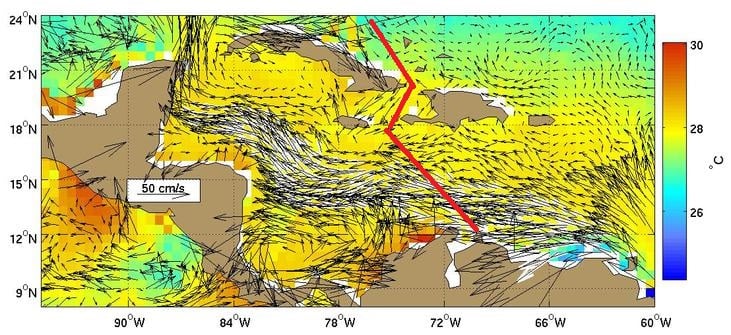
I flipped Satellites today as we now nearing the Caribbean Basin. For the remainder of the cruise and the beginning of the next cruise that is where our challenges might come from. We are now busy with getting rid of the weather front. (Photo Courtesy, the Weather Channel, Caribbean Sea)

I was on about the new Atrium yesterday as that was the largest refit on the ship. And it is a considerable change from the old warm and fuzzy interior to a modern sleek and focused interior. Focused on the message that we want to give; enjoy the Rijksmuseum Experience. To create the largest space possible, one flight of the Atrium stairs have been removed so the Area in front of the Front Desk is now wide open and uncluttered. With the removal of the stairs also the Atrium Bar was removed.  This makes sense as this bar was never very popular; the original idea was to have a sort of walk by and stop off bar where you could just have a quick one when coming from the shore or when in between activities. Most of our guests, if they go for a drink, make it a bit more of a ritual than just a walk in and thus the concept lived not up to expectations. In the end the Bar was only used for cocktail tasting events organized by the Bar Department. That was very successful (and very rowdy at times) but this can be done at another bar as well. And thus the whole area has now focused on the “Rijksmuseum Experience”.

This is the old Starry night ceiling centre piece.

I am always interested to find out if a new concept works as with these sorts of things you do not know what the guests will think and do until it is there. And I do see quite a few guests nosing through the books or going over the big coffee table picture books. If this was planned or not, I do not know but it has also become a waiting and reception area for the Front Desk and I see on occasion Front desk Ladies and Event Staff having little meetings in the alcoves or in the seating areas in the middle. The antiques we had here in the various corners have been relocated to other areas in the ship and I am currently chasing those and documenting them. Only the large glass center piece of the Atrium has been removed to shore side and will hopefully be used somewhere else.

And this is the new Day sky Ceiling

On the upper Atrium levels, deck 2 and deck 3, everything has remained the same. The Pinnacle Grill and the Pinnacle Bar are still on deck 2 and the Ocean Bar and Ocean Bar sitting area are still on deck 3. Happy Hour is still there and is now from 1600 to 1700 hrs. What has changed as well is the Bar menu setup. Each bar now has its own specialties and not every bar serves everything. As an example if you want to sample Cognac Louis XIII ($ 99 a shot) then the only place to do that is in the Pinnacle Bar. I have to agree this is the bar with the best setting for such an indulgence.

A corner of the lower Atrium, seen from the Front Desk. On the wall the large painting projections which rotates 24 hrs. a day.

Further on, on deck 2, there are two changes. The Music Walk has been introduced and the Northern Lights Disco has been changed into the Gallery Bar. First of all to compensate for losing the Sports Bar (now taken up by Billboard) and secondly as the Disco was really underutilized. The Bar behind the former disco has been kept and now also serves Draft Beer and not just the regular lagers. Blue Moon and Newcastle Ale have a bit more taste and depth than an average lager.

Tomorrow we are on our 5th. day at sea and Florida is coming closer very rapidly and it should start to feel quite like Florida weather.

03 November 2017; At Sea, Day 4.

I made the statement yesterday that things were looking good and that is tempting fate as today we started to approach a frontal system which is laying over the whole of the Mid North Atlantic. But it is not a bad one. It will bring more wind and it will bring rain but it is not a storm or anything else nasty.  So we can live with it, although it will annoy the sun-bathers who were out in force today. It will please the Bo ‘sun though as a good shower will get rid of the salt on the decks. His sailors are trying to keep up with washing down the decks at 05.00 in the morning but they cannot get everywhere before the early risers get in the way. It will take about a day’s sailing to get through it all and then we just have to see if the – small- disturbances located further to the West will affect us.

Our position at the arrow takes us through a weather front.

While we will have rain above us, we have mountains below us. Today we passed over the Mid North Atlantic Ridge. Which is located in the middle of the North Atlantic and that means that we are also in the middle of our crossing. Although we do not see it, it is a very important boundary as it indicates the geological border between Europe and North America. A German gentleman called Mr. Wegener predicted that the whole world, read the continents, were sitting on their own “saucer” and were surfing along over the globe on top of fluid inside of the earth. Those saucers are called plates and we can see where they meet as there is a gap in between them and that is where we normally find volcanos.

The mid North Atlantic ridge follows exactly the contours of the Continents and can thus we consider it the real border of a continent even if it sits underwater.

Wegener was not believed in the beginning as most people found his idea ridiculous because you could not see the movement; but in 1850 the Atlantic Ridge was officially discovered and in 1872 further confirmation came when a route was plotted for the first North Atlantic Telegraph cable. In Iceland the ridge comes above water and runs over the island and you can even walk through it. The plates move by about 2 inches a year and their movement is often noticeable by small or larger earthquakes. The plate is in a way a sort of conveyor belt with North America on the top and this plate is rising right here from the depth and is then disappearing again in a pacific ridge. Not much for us to worry about as it took about 180 million years for North America to drift this far way from Europe so it does not go that fast. But every time the plate takes a hop, there is a fair chance that San Francisco might notice it.

I promised a few blogs ago photos from the interior changes of the Westerdam made in the April 2017 dry dock. The Atrium was rebuilt and also the Crow’s nest. And for the rest a lot of carpet, wall paneling and soft furnishings were done. Let’s start with the carpet. It has now been brought in line with the new and lighter house style of the company which was started with the Koningsdam. So the corridors have a greyish touch with an abstract pattern to it. Very functional.

The art work on the outside of the midship staircase central elevators. Note the leaf curve.

But what I really like is what they have done in the staircase landings. The pattern in the center part of the landing and lobby now reflects the decoration of the Elevator doors. Maybe not all the guests might make that connection or may not care but I have a weak spot for Art Deco and I think it is magnificent. We have an interior designer / interior Director who looks after all the ships and I think I can clearly see her hand here.

The same motive in the new carpet in front of the elevators. Note the leaf pattern.

The conversion of the Atrium and the Crows nest are part of the new philosophy of the company to offer our guests more in-depth enrichment while travelling. Hence the decision to combine the Atrium / Meeting area with a location where you can learn something. Thus the decorations on the walls are now in relation to the Rijksmuseum in Amsterdam; well-known from all the Rembrandt paintings. They have decorated the walls with a timeline in years and paintings, giving in this way everybody an idea how painting developed through the centuries. On the forward wall is a led screen on which – as a sort power point show – famous paintings are projected. Guests can sit on comfortable chairs and immerse themselves in Dutch culture. On the starboard side are book shelves with a number of reference books which provide more background information.  The front Office remained but the Shore excursion information and sales counter has moved to the Crows nest. Photos will follow tomorrow.

So tomorrow we will find out how wide and how intense the depression will be and afterwards it does not look like there will be much rain at all anymore.

02 Nov. 2017: At Sea, Day 3.

I am starting to believe that this might be a very good crossing with not too many “ups and downs” as far as the ships movement is concerned. Today was a sunny day with a bit more wind but not of the kind that affects shipboard life. Either outside the ship or inside the ship. The ship is on a steady course and getting closer to the middle of the North Atlantic. There is not much to report about what is going on, as there is not much going on, other than the regular routine of a sea day.

Except one thing; the guests might have noticed that the ship on occasion was listing to one side and then to the other side. Not much, no more than 2 degrees but unusual as the Navigators are very conscientious in keeping the ship upright. So why the list, well we are cleaning water tanks or better said sea water ballast tanks. And we do that every time we cross the Atlantic. The reason is that we want to do this as a company policy, but also because we have to comply with Ballast Water Treatment regulations which is an international law exercised under the control of the IMO or International Maritime Organisation.

Officially it is called the: International Convention for the Control and Management of Ships’ Ballast Water and Sediments or (BWM). We on the ships we just call it the Ballast Water Management. It was agreed upon in 2004 but is now in September 2017 coming into force worldwide. Why the 13 year delay? Well some countries did not want to participate in the beginning and there has to be a minimum number to get the BWM in force worldwide but also it can take a long time before countries have entered it into their on National Legislation. It has quite an impact on the shipping industry as it requires that no creepy crawlies and other little animals are exported from one part of the world, to another part where they do not belong.

A cargo ship discharging ballast water in a port prior to commencing loading.

What happened in the past was that ships would take in ballast water in one port after discharging cargo, especially bulk carriers and would then sail empty across the ocean to another place for loading. To be stable enough, as the cargo was gone they needed weight and did this by the way of taking on board local water. Once on the other side, when the loading started, that water was pumped out again. But it was not just water it was full of smaller and sometimes not so small animals. Nobody paid much attention in the beginning but when in certain area’s the local fauna and flora started to disappear or a foreign species managed to get the upper hand, alarm bells started to ring.

There are a lot of little and larger animals that are not wanted in other areas of the world but 10 of them have been recognized as the most unwanted and the most invasive.

Once a problem has been recognized, it might still take a long time to get all the stake holders together and agreeing to what needs to be done and how to do it. Hence the 13 years between getting the matter on paper and its worldwide implementation. Holland America has already been taking part in this BWM for a long time and although it only now becomes compulsory worldwide we have had Ballast Water Management since at least 20 years in one form or the other. We do not need much ballast water to keep a cruise ship in a safe stability condition. Its design together with the weight of oil and drinking water is normally enough. But sometimes we get ballast water on board if we have to ballast against a heavy list, caused by strong winds on one side of the ship. To make sure that we do not carry anything unwanted we can flush tank after tank to get any hitch hikers from the old world out before we reach the new world. (And the other way around during our Spring East bound Trans-Atlantic) For Bulk carriers and tankers it is a different story; if they would empty a tank to clean it, their stability might go under the required norm. Those ships will now install treatment equipment which filters or burn (Ozone treatment) anything out of the ballast water.

There are regulations which advise where we can clean tanks by flushing seawater through and the main one is that you have to be at least 200 miles from the nearest land. So if we have an unwanted traveler with us, then it will not reach another shore and start invading the local biotope.

The main regulations in the new treaty that is now been universally adopted.

We have a lot of tanks and thus the process takes a lot of time. Normally 48 hours or so, before all the tanks have been done and are considered clean again. It does keep the watch keeping engineers busy. The deck officers normally calculate the best sequence for the tanks and then record the results in the Ballast Water Management Book. A book which is carefully scrutinized during each Flag or Port State Inspection that we have.

01 November 2017; At Sea, Day 2.

With an hour back a lot of guests were up and about very early. I normally have my breakfast around 06.30 in comparative solitude while only continental breakfast is being served; but this morning it was well before 0700, when full breakfast is available, that large groups were already marching into the Lido. So maybe we have another phenomenon in the making here, guests take a long cruise with sea days, solely to get up early in the morning. Of course our guests are welcome to do whatever they want, and we have coffee available to help any early riser problem, but there is not that much to do this early. Apart from observing me having breakfast. (Cornflakes and orange juice)

If you look at the daily program of today, highlight of the early morning was a 02.00 hrs. setting the clocks one hour back but as that ritual takes place on the bridge it is a restricted-access affair so not much of interest to the guests. Next is at 06.00 the Fitness is open for guests (counting six early risers on the torture machines) and then next thing is Fitness class at 07.00 hrs. Then, apart from Breakfast, there are no activities until 08.00 when Mass is celebrated in the Main Show lounge. Thus the ship does not give much reason to raise that early but still a few hundred people were there. As bright and shiny as can be and not willing to wait for the Dining room to open at 08.00 hrs. (Unless they went for a 2nd breakfast, that is)

One of these early risers cornered me after having recognized me as being “somebody from the ship, and asked rather indignantly why there were only foreign newspapers available. On the stand where the British, Dutch, and German newspapers (Spanish and others are available by request) but no American or Canadian. I had to think for a moment and then it dawned on me that this also has to do with time differences. Our company has a newspaper subscription and the papers covered are released when the real, local newspaper, goes to print. So the ships version is also as actual as possible. Hence the printer receives them early morning and they are available at around 06.30 hrs. New York is still four hours behind us, and the New York Times version has not been released yet then. It will only be available around 09.00 or 10.00 hrs. Ship’s time, when it is around 05.00 hrs. in New York. The closer we come to Eastern Standard Time, the earlier the Canadian and American newspapers will appear. I explained this to the guest but looking at his facial expression I got the impression that he did not believe one word of it.

When we sail in Alaska it is the other way around at Breakfast time (4 hrs. earlier than New York) the two North American papers are available but Europe is so far behind, that we start running a day behind in the newspaper business; e.g. getting old news compared with the New York Times. Still we get the news and in the morning, and there is a steady stream of guests passing by the Front Desk to pick up the morning (foreign) copy and then closer to lunch time there is another stream passing by the pick up North American papers.

The weather today was the same day as yesterday, mainly overcast but quiet and with a nice gentle temperature on the outside deck. Not T shirt weather, but not sweater weather either. Tomorrow the sun is supposed to break through with a slight increase in wind but not anymore swell.

31 Oct. 2017: First Sea day.

Since we left Italy for this Trans-Atlantic cruise all eyes have been on the North Atlantic weather. Although the hurricane season is tapering off, it is by no means over and if one of those big boys starts coming over, even reduced to a tropical depression, it could affect us. We have to go to Ft. Lauderdale and that means once we are south of Bermuda we could be in the track of one of them. But even during our time on the mid North Atlantic while we are well south of any storm track, the swell produced by the strong winds can easily roll down our way and cause a bumpy ride. Thus the weather reports which we receive nearly constantly, as our ships are connected to a simulation program through which a weather bureau continuously provides updates, are intensely scrutinized. We even have two of those programs that the company subscribes to, just to make sure that we can interpret the opinions and projections of two independent groups of meteorologists.

If there is going to be bad weather then we might have to face it, as very simply, we  have to go to Florida. But if we can avoid it to a certain extent then we will certainly do so. And that means the captain has to make a major decision. Follow the shortest route which will save him time and or fuel but it will bring the ship closer to the bad weather areas, or take the longer route and sail more south, but have to cover more miles. This is all caused by the fact that the earth is a globe (there are those who disagree see: https://www.tfes.org/) which results in a straight line on a globe, when putting it on a flat piece of paper (a sea chart), being shorter than when a straight line drawn on a flat piece of paper and then projected on a globe.

Each stretch of the voyage is reviewed and approved by the Captain. Then one of the officers will conduct the departure briefing before the ship sails. This is 3rd officer Max, one of several  7 feet tall navigations officers we have in the company, conducting the pre departure briefing in Cadiz for the whole team.

In nautical speak, such a “globe line” is called a Great Circle Line and a straight line on a chart is called a Rhumb Line. Over our 8 day crossing it makes a difference of about 42 Nautical Miles about 2.5 hours of sailing. This is a lot for a short cruise between to two ports, but not that much on 8 day crossing. Going on Rhumb Line looks on the chart as if we are sailing directly for the Bahamas and by doing that we stay about a 100 miles more to the south than otherwise would be the case. We are also staying about a 100 miles south of the average storm track.  And that is the big plus point. And that is what the captain decided upon, the least wobbly route we can sail on, based on the current predictions which are fairly reliable for about 5 days in advance.  The Great Circle Line would have taken us north of the Azores, and very close to Bermuda, where they know everything about hurricanes and other bad weather.

Welcome to the Dinngroom on Halloween night. Note the guy with the mask behind the tombstone. The first devil I have seen wearing a name tag.  Maybe something for the “Living Dead” to take over.

Inside the ship everything is about Halloween today, I do not know what the craze is about, as it really an American tradition but the crew is getting into it as well. All Nationalities. Maybe it is the chance to deviate from the uniform rules or to just make a mess of the working area, I do not know. But all sorts of things are going on, culminating in a long and big party this evening. How wild the guests will be I do not know but the crew will have a party on the top deck, well away from all the guests so they can make plenty of noise and dance to their hearts content. Some guests got into the spirit of the whole happening as well: I saw some somebody coming by in a wheelchair decorated (better said rebuilt) as a tombstone. ….why do I always forget my camera………… as it was a real good one.

We have a 50 feet long serving counter in the hot section of the galley and here at 18.20 hrs. it is one long line of stewards coming in to pick up their orders. The Training And Development team is in the background watching it all with a certain disbelief. 

I took the class this evening to the Main Galley to see Controlled Mayhem executed at a very high level of professionalism. Around 18.15 hrs. first sitting plus the start of As You Wish Dining have all advanced to their main course and then in 30 minutes the Executive Chef and his team has to churn out about 500 main courses, that is 17 servings of a hot dish per minute.  All perfectly presented and all arriving hot at the table. It is something you have to have seen once to believe and none of my previous students will now dream of calling the kitchen around that time for something trivial.

The weather is supposed to hold for at least two more days, thus we will have overcast skies little wind and a low swell running from various directions which lets the ship move just a little.


30 October 2017; Cadiz, Spain.

This is a wonderful port as long as the wind does not blow. Because it is on the coast of the North Atlantic Ocean and because the area is flat; there are no mountains ranges to protect it. The churches are the highest buildings in the area, and the same as at home, they seem to attract wind. So both the westerly and easterly winds blow freely over the whole port. If that is the case, then getting the ship into port and parked where it has to go can be quite challenging and not the most favorite pastime of the captain. Today there was not such worry. The wind was about 15 to 20 knots but from the south east and that meant the moment you are in the port, behind the breakwater you are sheltered for at least 50% and you can dock the ship without much of a headache.

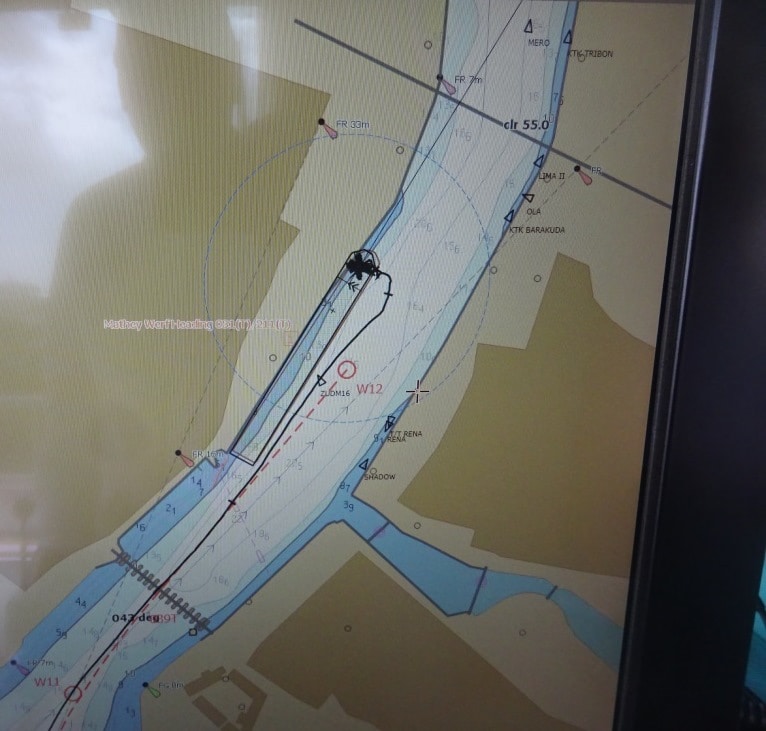
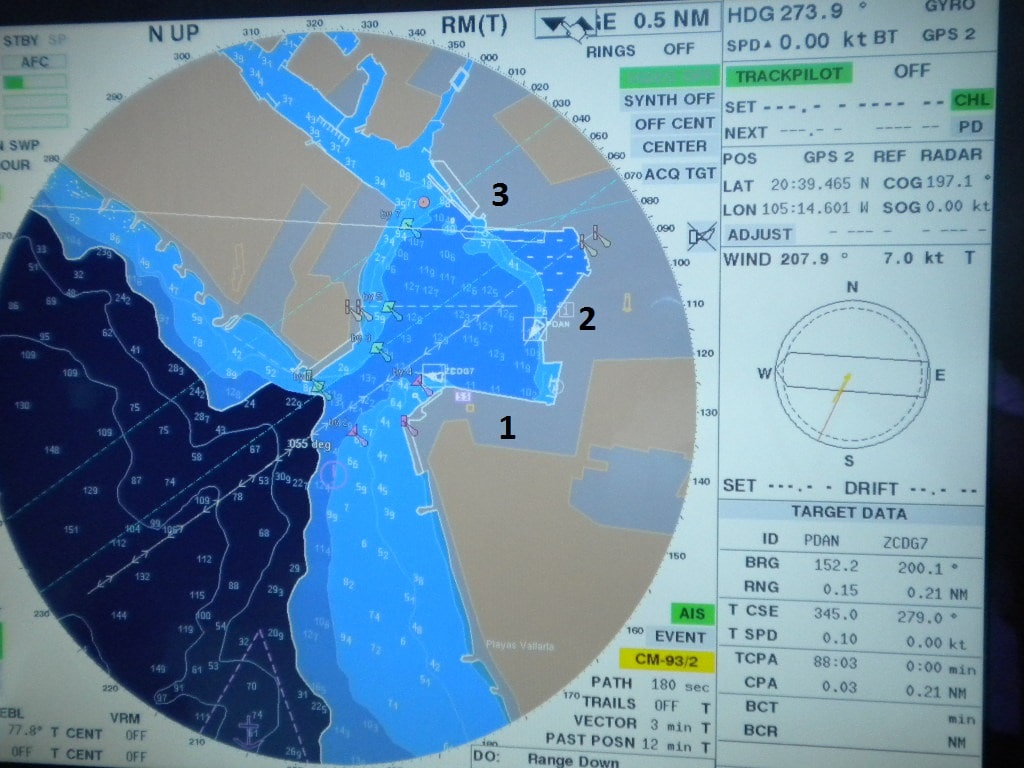
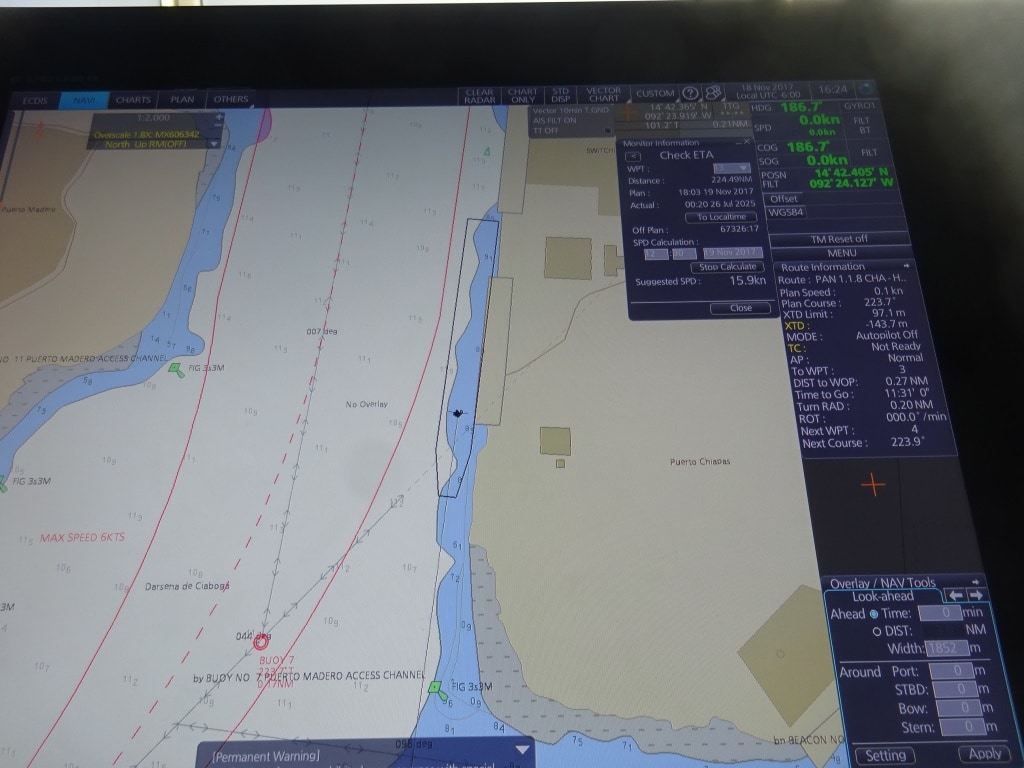
Cadiz Harbor as per electronic chart. A curved faiway leads into the port located behind Cadiz town which sits on a peninsula.

Cadiz is located at the end of an estuary and the port is sitting in the inside of a curve of land upon which also the town of Cadiz has been built. This gives a sheltered port from the ocean swell but on occasion a sailor still has to cope with Ocean Storms or strong winds coming from the South East overland. We had a beautiful day with no wind and a lot of sunshine, which meant that even on arrival and departure we did not have to wear coats while standing at stations.  Standing stations for officers mean: leading the sailor teams at the bow and the stern when giving out the ropes to dock the ship or when taking the ropes in again.

This is the 3rd port where the school class has been either forward or aft to observe and participate in the art of connecting the ship to the port or going the other way again.  There is a whole science behind mooring a ship and although it is basically the same for any ship in any company, the procedure of how it is done varies greatly from one company to another. Especially the way the orders are received by the officer, relayed to Bo ‘sun and the sailors and then confirmed with the Bridge.  To get the ropes ashore, we are using a messenger line which in HAL speak is called a Heaving Line because the way it is thrown or heaved ashore.

This line is caught by the linesmen ashore and then they start pulling at this thin line to get the larger mooring rope ashore. Depending on the expected weather (read wind) it is decided before arrival how many headlines and spring lines (the lines running aft from the bow and forward from the stern station) will be used. Our winches are equipped with mooring drums and so we can have 4 +2: four headlines and two spring lines, on those drums and for normal weather that is sufficient according to the shipyards calculation. If more wind is expected you can give out more ropes, we call those “extra’s”, to provide extra docking security. We can then go to 6+2, or 5+3, or 7+2, or to whatever the captain decides and is comfortable with. I once docked 11+ 7 when a hurricane was expected.

The more bollards you have on the dock, the more evenly you can spread the ropes. The longer the ropes, the better the holding power. I was very happy with this setup.

When the process starts we always give out a spring line first, both forward and aft. On a cruise ship the focus is always on the gangway and the spring lines are needed to bring the ship exactly in the best position for the landing of the gangway and to keep it there. Once those lines are taut and the ships position is correct, then the headlines can go ashore and once on the shore side bollards they can be winched tight as well. Eventually the final configuration is then achieved. Biggest challenge is the communication. The stations fore and aft letting the bridge know the status of the paying out and the coming taut of the ropes,  and the bridge side letting the mooring stations know what is needed, if there are changes and to also take into account the remarks and concerns of the mooring stations if the original plan is not achievable. The latter is often the case, as the ship does quite often comes to a standstill at not the planned location because there is a shore side bollard in front of the gangway or in front of the provision area or an expected shore side bollard is simply not there.

Today in Cadiz it went exactly according to plan. Apart from a Silversea cruise ship, which was at another dock, we were by ourselves and could park wherever we wanted within the limitations set by the harbor master. And thus we had the ropes paid out over several bollards (that is called a nice spread) and the ship was safely moored for the day.

It was a beautiful day and a great conclusion of our first part of the cruise. At 18.00 we sailed for open sea and we started our crossing across the North Atlantic. The captain has chosen the southerly route to get the best weather possible and the first three days look indeed very good with little winds, sunny weather and only a gentle ocean swell to contend with. How we decide on that sort of thing, more about that tomorrow.

29 October 2017; Malaga, Spain.

As I was somehow expecting, there were more cruise ships in than listed on the port website. The fact that we had to make do with the inside of the outer breakwater and were not at the Passenger terminal indicated that something was afoot. And indeed, apart from Mein Schiff 5, we also had the Horizon in from Pullmantur and the Thomson Celebration from TUI cruises in port. The latter was a meeting of “sweet memories” as she is the old Noordam from Holland America Line and I was her captain from 2000 to 2002. I also was part of the team who supervised her construction in 1983- 1984 in France. She was laid up in the far corner of the outer Breakwater as she was planning for a dry dock and had no passengers on board. Apart from being white instead of being blue, she had not changed at all from her Holland America Line days. I did not get the chance to visit her as at the moment the school class takes up all the time. I am trying to cram the work for five port calls into three as on this cruise we are only calling at three ports before we start the crossing. And this is the second port already. But there will be a next time for a nose around.

The old ms Noordam (III) basking in the autumn sun in Malaga. The crane near the bow was in use to lift materials for the dry dock on board.

The ms Westerdam docked at the inner berth of the outer breakwater and was happily docked by 07.30. It turned out to be a beautiful day in Malaga with clear blue skies and hardly any wind, while it was not too warm. Did it matter that we were not docked at the passenger terminal? No, I think it worked out to our advantage. The passenger terminals (there are two of them) are very nice and have some nice shops but it is a very long walk from the ship through an elevated corridor extended from to the Jet way which connects to the ship.  From our berth you have to take a shuttle bus to the gate of terminal one but at least when you come off the ship you do not have to walk that long way. At the main gate you either have to take a taxi or purchase a shuttle ticket to down town, a 4 euro shuttle organized by the port authorities as the cruise docks are about a 20 minute walk from the down town area. Today it was a beautiful walk to make but the shuttle was there as if a plan B was preferred.

We had today a gathering of ALL the crew in the show lounge to attend a short seminar about cockroaches. Or better said about not to have them. We can prize ourselves lucky that we do not have them on board but it is a hard battle to achieve that goal and keep that goal. They can come on board with the stores and provisions, they can come on board with luggage, they (at least the males) can fly on board and as they are always busy to produce future generations, a ship can soon be infested if you are not alert. So we want all 900 crew to be alert and report if a creeping crawly is seen. Thus we have an outside contractor & specialist who travels around the fleet to train all of us in general and those in culinary and housekeeping in particular.

I think we had about 90% of the crew in the show lounge, the remainder at work to keep the ship in operation and the guests happy.

But because we can see insects everywhere while walking around, it is important to recognize the difference between a friendly beetle and a not so friendly piece of vermin. And thus we go for our yearly refresher, so all of us can recognize something we do not want on board. We have on board a very proactive system in place which monitors all the spaces in the ship for any sign of infestation. This is done by Bait Traps and they are regularly inspected by our Pest Coordinator; a petty officer from the Housekeeping department. If anything is found in a trap, then it is analyzed to see what it is (and it can be anything) and if it is something we do not like then this gentleman goes to war. He has a whole range of non-poisonous (at least not for us) chemicals and cleaning materials at his disposal to ensure that Papa and Mama cockroach are not going to show the world how many babies they can make. I can faithfully declare I have not seen a cockroach on board since about 1990.

We sailed on time and after going astern out of the port we swung around and set course for the Straits of Gibraltar. We will pass through here at around 22.00 hrs. and then turn to the North to be at the Cadiz pilot station at 0630 tomorrow morning. Tomorrow’s weather promises to be a carbon copy day of today with very little wind, which is amazing as Cadiz is exposed to the North Atlantic and it can be very windy here.

It is much easier to go astern out of the port and swing around in the wide open sea, than to do it in an enclosed space with all sorts of small craft in the way.

28 October 2017; Cartagena, Spain.

We were the only cruise ship scheduled for today and thus we could arrive when we wanted and we could dock at any location at the cruise terminal. Cartagena is a very large port. The navy has a large presence here with patrol boats, cruisers, submarines and destroyers and then there is the rest of the port with tankers, container ships, Gas carriers and various off shore installations. The cruise business is fairly new, Holland America went here for the first time in 2002 with Yours Truly in command of the old Noordam and if I had to believe the agent then we were the first large cruise ship calling there. I still do not know if he wanted to make me feel important or if it really was the case. Fact was the cruise terminal was the old ferry terminal with a small pier for a ferry boat.

That first call was quite successful apart from the fact that some of our guests found it hard to visit a REAL Spanish city which shut down from lunch between 13.00 hrs. and 15.00 hrs. But after my visit the port was more frequented and then the authorities built a new pier of 560 meters long so now it can have one big and one small cruise ship, or two medium sized ships. Today we were alone and the authorities allowed a salvage vessel / tugboat to dock at the end of the pier. It did not bother as us we could park the ship right in the middle with the gangway right opposite the now greatly enhanced old ferry building terminal.

Getting into the port is quite interesting, as you have to make an S turn between two breakwaters which nicely keeps the swell out of the port. The pilot boards about a mile south of the entrance and then the ship first makes a turn to port, shortly after a turn to starboard, then goes deep into the turning basin and then turns to port again to dock starboard side alongside. Starboard side is not necessary but it is handy to do, as it takes less time on departure to get out again, as you do not have to swing the ship completely around.

This is our way of Grand Prix racing; around the chicane, then a major turn and then putting the brakes on. This is a photo of when it was still a Ferry Terminal, the pier is now twice as long and acts at the same time as a natural barrier for the Marina.

And so we did this, this morning and the whole maneuver took roughly 70 minutes from pilot on board to gangway out and first guest walking ashore. You pick up the pilot with a speed of six knots and then continue with that speed when making the turns. When a ship turns it is losing a lot of speed. If a ship would commence an 180o turn with six knots, then by the time the ship is facing exactly the other way the speed is almost down to zero due to the friction it gets from the water in the turn. So if you want to stop a ship, then you can give astern on the engines but a few good course changes (or making large zig-zags), if you have the space also helps to reduce the speed very fast.  Thus this morning, the Staff Captain who did the maneuvering today only had to reduce the settings on the Azipods from slow ahead to dead slow ahead and the two course changes brought the speed down very quickly and by the time we were in the turning basin the speed was down to three knots, exactly what was wanted to commence the turn to the dock.

The Westerdam enjoying a sunny day in Cartagena. Photo from the lifeboat as the class had lifeboat maneuvering today.

And then you have to find the perfect spot to park yourself. Today we had one of those mystifying Spanish moments, none of the lights on the shore side worked. The port authority with great foresight had put a car with its lights on at the ideal location for the gangway and the ship approached accordingly. With still about a 150 meters to go, the driver of the car had enough of it and decided to go somewhere else, leaving us a little bit abandoned. Luckily the early part of sun rise started (nautical twilight) so we were able to see the gate in the Cruise terminal building and we could still line up at the perfect position. But if the driver had waited about 4 minutes it would have been a lot easier to use the head lights to judge how far we still had to go…………………

It turned out to be a very nice and sunny day with one big rain cloud hovering over the port for most of the day but it must have forgotten its purpose in life as not a single drop came down on the ship and the port. No doubt somewhere there must be a very unhappy Spanish farmer who had hoped for a bit of rain on its crops. We stayed until 18.00 hrs. and then set sail for Malaga, just around the corner. According to the schedule we are supposed to be in port with one more cruise ship, Mein Schiff 3, but you never know who else might pop up. It should be another warm day with no wind and temperatures of 74oF / or 23oC.

27 October 2017; At Sea.

We sailed late from the port. But then we always sail late from Civitavecchia. Somehow it is impossible to get our guests back in time from the Rome Tour. Partly it is traffic on the motorway, partly it is that the guests come back to the coach at the very last minute, partly it is because the tour just runs late with all the traffic in Rome. So the bridge officers went into the same mental state of resignation as they do that every cruise ship bridge team has done before, just sit down and wait. And thus we waited and eventually the bus was back, and we were not that late, not so late as we had already mentally resigned ourselves to.

It was important to sail on time, or even earlier if possible as it is a high speed run to get to Cartagena on time. So once we were out of the harbor it was the pedal to the metal and a race with 19 knots on a South Westerly course down to the Iberian Peninsula. Our main concern is the weather as by late October it can be very spooky here. But we are doing well apart from a brisk westerly wind; the sun was shining today and is supposed to shine tomorrow.

When going to Cartagena from Italy you have two islands that are in the way. Corse and Sardinia. So you have to go above, under or in between. In between is Strait Bonifacio which is a very scenic stretch of sailing, however in our case we had to go through a 01.00 in the morning to keep the schedule. Nice thing is for the navigators at all the little ferry boats that dart in between the two islands are sleeping and there is no traffic. No pilot either, so the ship goes through with the Captain on the bridge and that is it.

Our Route from Italy to Spain. (Courtesy Her Majesty’s Geographic Office chart 301)

By noon time we had passed the Balearic Islands, coming quite close to Menorca with the cruise port of Mahon. A very nice port to visit but only suitable for ships of the ms Prinsendam size as it is very tight to make the one turn to get inside, followed by swinging around in the inside harbor. Cartagena has a much wider entrance and much larger port, hence we are going there. Most guests do not directly equate the Mediterranean Sea with bad weather. Postcards and photos always give sunny beaches and ripple free blue water but the opposite can be the case. Because it is surrounded by land on all sides (not counting the small hole called the Straits of Gibraltar) there can be land wind from all sides and low and high pressure regions on all sides. Strong sand filled winds coming from the Sahara, cold Etesian wind from the north in the Greece area and Mistral winds coming from the North in the French area. During the summer and winter months when the high and low pressure areas around the Med are quite stable, the storms are fairly predictable but in spring and autumn this is less the case.  And that is of course exactly the period that the cruise ships move in or out of the Med. So cruise ship captains are extra alert when they are transiting this area to ensure that the ship is ready in case the winds suddenly pick up. Today we had not much of a bother. Around noon time it peaked up to 25 knots and then it died down again gradually.

We will keep that pattern as during the night this westerly wind will breeze up again, going up to 25 or 30knots and then remain that way. But Cartagena is sheltered at three sides by mountains so when we go into port then it should be nearly wind still. Weather expected 64oC / 18oC with partly cloudy skies. Should be a very nice day for which is still a very Spanish port.

« Older posts Newer posts »