- Captain Albert's Website and Blog -

Ocean Liner History and Stories from the Sea, Past and Present. With an In Depth focus on Holland America Line

Page 54 of 242

15 November 2017; Punta Arenas, Costa Rica.

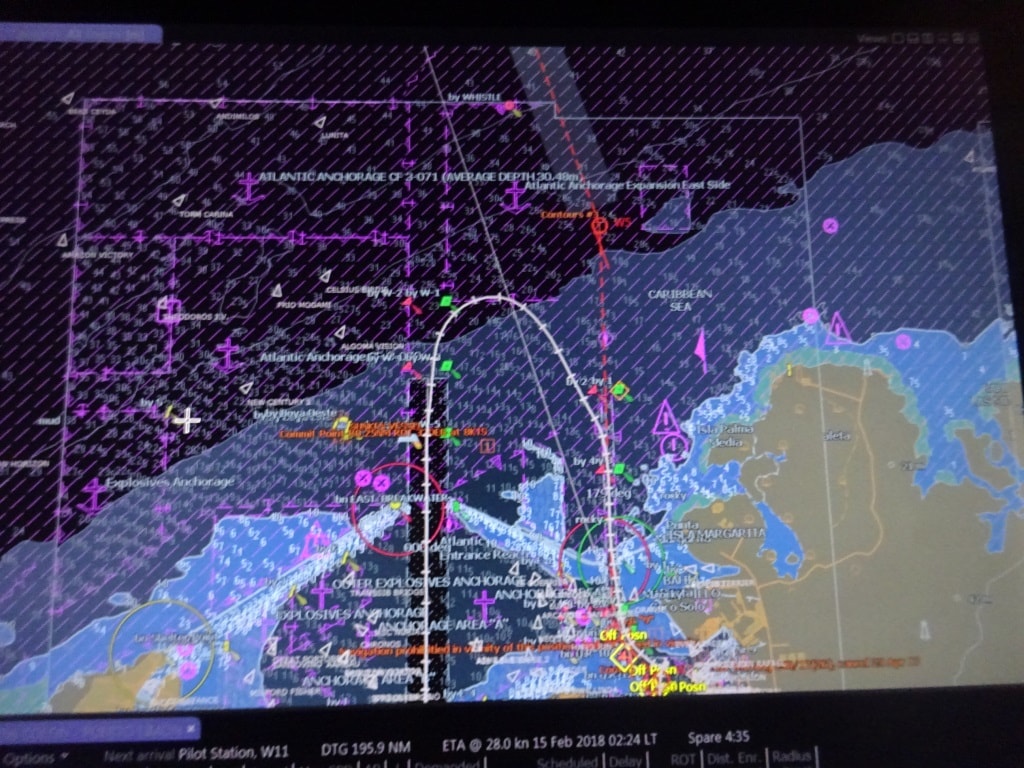
As you can see Puntarenas or Punta Arenas is half way up the Golfo the Nicoya. The current comes in and most of it will follow the east shore. But when it comes to the islands in the middle, the flow is distorted and calculations are of little use. So we look at the buoys and watch the drift.

Slack tide for docking in Punta Arenas was calculated for around 05.30 hrs. and thus the Westerdam was there at the precise moment making sure that as soon as the current fell away, she could go alongside. And then the current did not fall away, it diminished somewhat and thus a safe docking could be made but it needed all the power of the thrusters and the Azipods and the help of a tugboat to accomplish this. One hour later and the flood current was still running.  And that is what fills captains with dread every time they have to go here; you cannot rely on the predictions, not even the ones made by the most experienced pilot.  Get the timing or the estimation of the flow wrong and you have a dent or even worse. Due to the flow of water passing by and going further up the inlet and the option for the water to circle around further up the inlet, the currents are not straight forward in and out as with regular tides.

The water is shallow here so a long pier had to be built. It causes the water / current to flow freely under the pier and that is not nice for docking.

Luckily today we had very little swell and that saved the day. On occasion we could hear a bump under the stern when a low wave got caught under the transom but apart from a gentle sway along the dock, it was a nice and quiet day. It being the time of the season, we were blessed with the occasional rain shower but the positive side of this was that it brought down the temperatures. As with a sunny day it can be very HOT here as there is then normally no wind while the humidity remains high.

Punta Arenas is a small town so for the guests who do not go on an excursion, there is something to look at and maybe pick up a small souvenir. But most of our guests go on shore excursions here and quite a few of them on tours up to the capital of Costa Rica, San Jose, two hours’ drive up the mountain. I was there long time ago and visited the National Museum. I found it most interesting as it was a museum with bits of everything.  Including a six feet KNSM (Dutch company called Royal Boat in English) model of a small passenger ship called the Cottica in an original show case. To my horror they had it standing on a covered Verandah but not in a temperature controlled environment. I wonder if it is still there and survived the tropics. The maritime museum in Amsterdam would have drooled over it.

Another thing going on bellows decks. Medical were doing flu shots today. The company strongly encourages all crew to get their yearly shot, so the medical officers are holding several clinics during the cruise to get all 800 crew through.

While the guests were exploring Costa Rica, on board life continued. For those who remained behind were treated to the occasional announcement for testing the P.A system. An unpleasant intrusion but for safety we have to test all the speakers on the outside deck once a year in case we need them during an emergency. We use as many people as possible, by parking each one of them under a speaker so we can keep the number of announcements down but we had to “ding dong” a few times during the day as there are a lot of them. We always find one that has stopped working due to water ingress and then we repair and then have to test again.

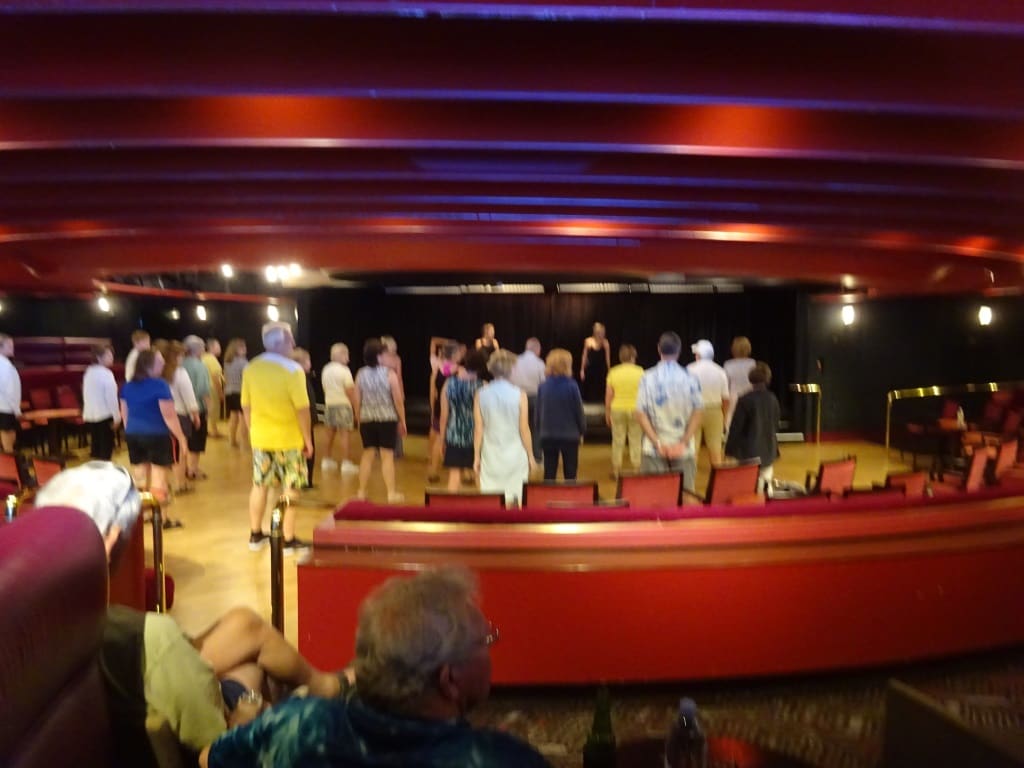
Another activity I see every morning when I go for breakfast, yearly morning yoga. Now the question is, why are there only two guys participating and so many Ladies ??

Then there were more announcements at 10.15 hrs. as Yours Truly was running a Fire drill. This time only the captain was aware of it, as once a month we have to stage an un-expected one as the law makers have recognized that too much routine for the crew is not good. We are human and if we can prepare for a drill, mentally (thinking about a fire scenario in advance) and physically (already on standby for the time scheduled) then you lose your edge. Thus once a month there is an un-expected one and if I am on board then it is really un-expected as nobody knows what I might come up with.

Leaving Punta Arenas was easy to day, the tide was again off schedule but very weak and thus we could just push the ship off the dock and sail out of the bay. Tomorrow we are in Corinto Nicaragua, where we are scheduled to arrive at 10.00 hrs.

Weather for Corinto sunny in the morning rain in the late afternoon. No wind and temperatures around

83oF or 28oC with high humidity.

14 November 2017: At Sea.

Today was a peaceful day at sea in the Pacific Ocean, which was also peaceful to a certain extent. Meaning that we did not have a storm.  Whoever decided to call this big ocean Pacific probably did not sail it very much because it not always quiet here. Today we were in a medium state of peacefulness. The wind came out at times with gusts of up to wind force seven but was most of the time content with a wind force 4 and blowing a lot of rain our way.  With the wind came the swell and on occasion we could feel that the Westerdam was a ship and not a hotel.  Even the brown boobies and the starlings that like to drift on the bow wind where having a difficult time of it and were continuously blown off course. They could not find much of a balance between wind and wind uptake and were forever “wobbling” while trying to stay at the bow. It also made it impossible for them to land on the deck and that pleased the Bo ‘sun as on this side of the Panama Canal the sailors are forever cleaning the “memories” of the sit down visits of the birds.

We are on a fairly high speed run to Punta Arenas as our docking has to coincide with slack tide. I have explained before that some deep thinkers built a cruise pier here, perpendicular on the current and with no protection to the surf that rolls in from the ocean. We always have to pray here for a day with little swell so the gangway will not move as the ship is not moving along the dock, caused by being lifted up by the swell. We used to go to Puerta Caldera which is only a cargo terminal but at least you could dock there without swell worries as that port has break water. But we are in the tourist business and thus we go where the T shirts are.

The route we take is simply following the coast at a distance of 12 miles. In the old days we used to sail much closer but now the main traffic zones have been moved off the coast to make it safer and also easier as we are now really looking at highways at sea. Nobody likes a tanker collision near their beaches and certainly not if it is caused by navigators looking for short cuts.  So today we saw land only from a considerable distance but we did see a lot of shipping traffic going to and from the Panama Canal. Not many people realize this but 95% of all freight and cargo that goes around the world goes by ship. Inland there might be some train and truck transport ….. and add to it some air transport, but most of it is by ship.  Because you do not see the ships anymore, the container and tanker ports have been moved away from the down town areas to industrial sites far away, not many people realize how crucial seafarers are to keep the world economy going. It has been calculated that if all seafarers would go on strike at the same time Walmart would not be able to stock 85% of their products within two months’ time.

The traffic flow through the Canal. Most ships are on the Trans Pacific run which includes the large container ships. (Photo courtesy unknown, there was nothing in the google)

Thus a Panama Canal cruise is really an optimum way to see how the world’s commerce operates and how ships are involved in this. It makes the Panama Canal and the Suez Canal two very important strategic locations and if anybody would be able to close one of those canals (as they did with the Suez Canal in the 1960’s) then the whole world will be impacted by it. We go through the Canal as a sightseeing excursion and for the company to get their ships up to and from Alaska but most ships have to go through to maintain their schedule and deliver the products that they carry on time. And that goes by clock work.  Now it is possible that from the moment a TV is being assembled in China to the moment it stands in a sitting room in a house in Finland, the period of time in between is not more than six weeks.

Tomorrow we are in Punta Arenas, where the weather is expected to be very Costa Rican, a bit of everything with quite a bit of rain in between. Luckily not too much wind is expected, unless we get a thunder storm, so it will be damp, muggy, warm and very likely wet.

13 November 2017; Panama Canal day.

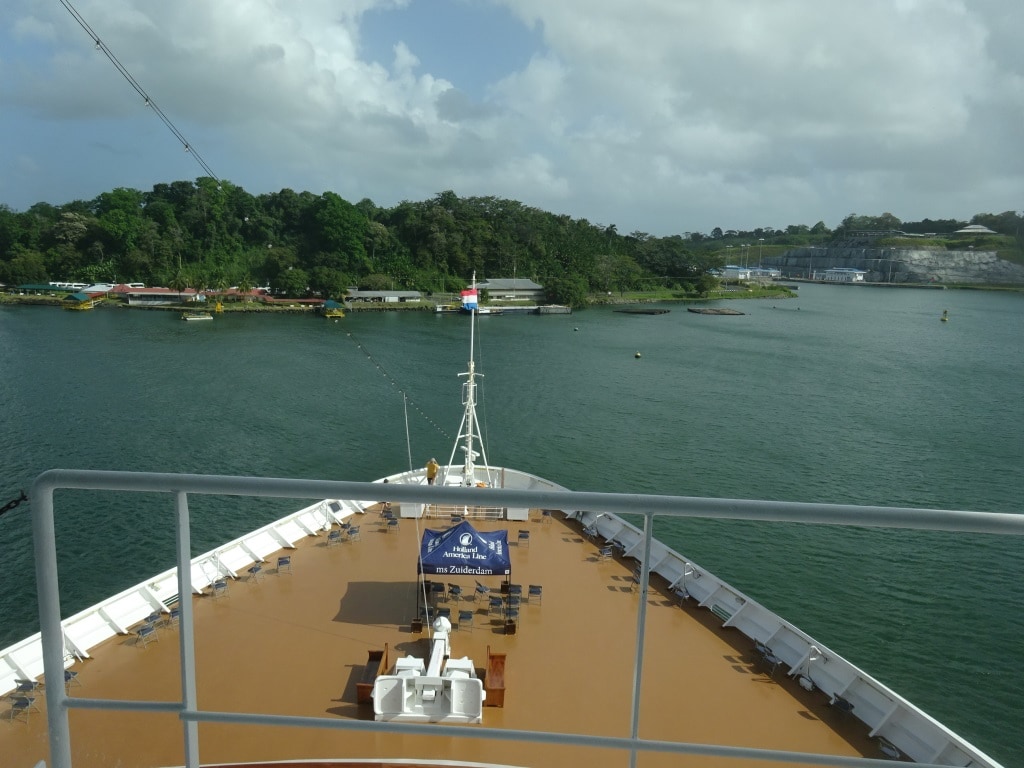
In accordance with the scheduling of the Panama Canal Authority we arrived early at the Sea buoy to take up our place in the convoy and go through the canal. We were ready for the Canal at 05.00 hrs……….., it was just that the Canal was not ready for us. Overnight fog had developed on the Pacific Side which caused a delay in the start of the Pacific Side convoy. The Canal routine has always been that the Pacific side goes through first. The Atlantic side can wait as they are in the wider part of the Canal. Until Gamboa, half way, the canal is wide enough to have ships pass each other, then coming close to the Continental Divide, it becomes one way traffic. At least until now. In the future they want to make the whole Canal two – way but that is still dreams for the future.  So we had to wait and drift. It was more than an hour later before we slowly were allowed to creep in.

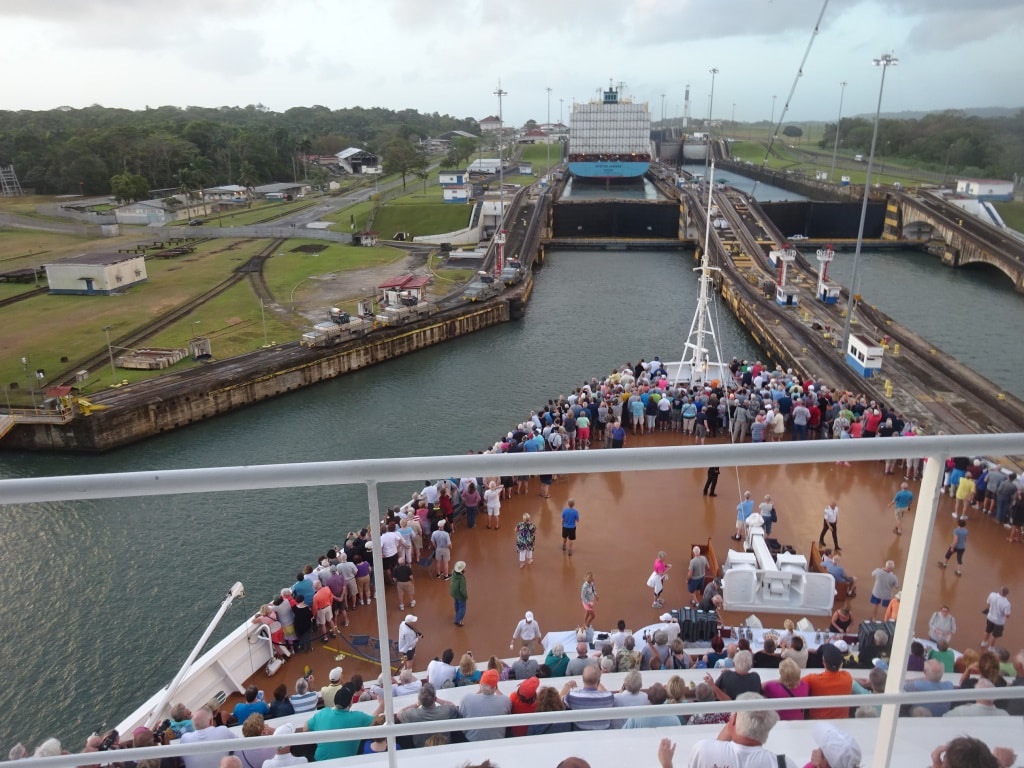
Approaching the Gatun Locks. They have been adding to the locks again and now there is a large Cell Phone tower on the East side, right above the white light house tower / leading light.

At least it was overcast so the guests were not waiting under a scorching sun while we were drifting. But there is nothing you can do about fog or the scheduling of the canal, so we just had to wait and take it slowly. Once out of the first locks, we had to drift again as the Pacific Convoy cannot go faster than the slowest ship. Most of the slow movement is not due to the speed of a ship, most ships can do 10 to 13 knots, but due to the time it takes to get a very wide and deep ship through the locks. Transit speed of a lock depends on how fast the water can flow around the hull of a ship when it goes into the locks or out again.

Gamboa is approx. in the middle of the Canal. There where the lake ends and the actual canal begins. (Courtesy Worldatlas.com)

And thus the Atlantic convoy has to wait until the last ship of that slow moving convoy is past Gamboa and then the two convoys can pass each other and the Atlantic convoy can move into the narrow part. Now there could be a plan B if it was allowed and that would be to divert part of the convoy into the new locks. But that would cost a lot of extra water and the Canal authority tries to preserve as much as possible. Rain fall has not been too good in the past year and while there is enough water, there is no abundance of it and so we wait.  A few days ago the first cruise ship of our HAL Group went through the new locks. (The first cruise ship ever was the Disney Wonder, but she was not a Post Panamax; she just paid a lot more for the privilege) The Caribbean Princess from our sister Company Princess Cruises is a Post Panamax Ship which means it does not fit in the old locks.  And thus on 09 November the Caribbean Princess went through. The new locks have no mules (the little locomotives) to keep the ship in position and they use a tugboat forward and aft, although a cruise ship really does not need that.  But the Canal has always relied on its own people and its own equipment to get the ships through and they are not going to change now.

The Caribbean Princess in the new locks. Note the water reservoirs behind the ship.

In the end we passed Gamboa one hour and 45 minutes later than expected and that put our Pacific side Sea buoy time well past 17.00 hrs. Nothing of a problem for the guests but for the crew involved in the transit it was going to be a long day. And a wet day. By the time we were past Gamboa dark clouds started to gather over the Continental Divide and while sailing towards it, the rain slowly increased from a little drip first to a torrential downpour not much later.  Enough to keep the Canal well supplied for another day. It looked that a lot of guests had planned for this possibility as suddenly I saw rain coats and poncho’s appearing everywhere.  Nobody was going deprive themselves from seeing the second and third set of locks.

The Westerdam entering the last sets of locks. (Photo courtesy: Lesley Schoonderbeek, taken from the Panama Canal Webcam on the Miraflores Locks)

We were at the sea buoy well after 17.00 hrs. But before sunset so the guests could see everything in good daylight. From the sea buoy the ship had to sail slow for 24 miles until it is well out of the busy shipping zone. Tomorrow will be a day at sea and we will spend a day at our next port Punta Arenas.  For those who are tired, the ship has arranged for the clock to go one hour back.

And this is what caused the rain in the afternoon.

12 November 2017; At Sea.

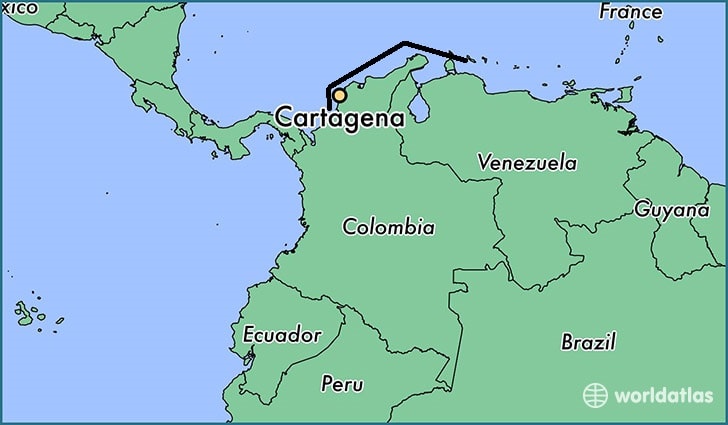
Today we sailed the stretch of water above Colombia to get from Aruba to Panama. This is technically still the Caribbean Sea but somehow it does not feel like it as we are away from the Caribbean Islands and now more surrounded by countries which we consider to be part of Middle and South America. The course line is quite simple, we first follow the coast of Venezuela and then make a turn to the South west once above Colombia. Here we pass the main cities Barranquilla, quite close by, and further to the south, Cartagena which is a favorite stop on most eastbound Trans canals. Cruise ships seldom go to Barranquilla although it is a large port but it is a cargo port. I doubt there is much culture to enjoy around there otherwise a large cruise terminal would have been established long time ago. So for Colombia the focus remains on Cartagena.


The run from Aruba to Panama. We are now completely away from all the Caribbean Islands and that begs the question, is this area still really the Caribbean Sea.

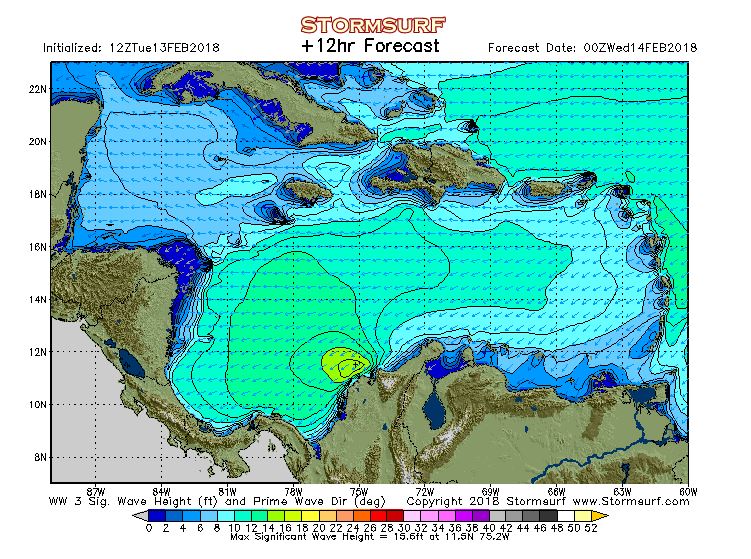
Although it is in my opinion not really a part of the Caribbean Sea, the Trade winds do not pay much attention to that and it was blowing quite nicely during the day. Wind force 6 to 7 for most of the time, although we did not notice it very much as we were sailing with the wind. We could see it but not really feel it; large white caps on the waves but because the ship was sailing the same direction with about 16 knots, the relative wind on deck was reduced to about 12 knots. That is a nice gentle breeze which brings some cooler air onto the decks. (Danger is then of course that guests forget that the burning sun is still there and that can cause a few unpleasant side effects.)

Once we made the course change to south west, the swell went from straight in the stern to ¾ on the quarter and then we got the corkscrew roll once in a while. Luckily not too much, to become an inconvenience. As explained in the past, this corkscrew motion is caused by a swell which is not a really swell on the beam and not really a real swell on the stern. So the ship does not know if it should pitch or roll and have the stabilizers take care of it. The stabilizers can do most of the job but occasionally the angle shifts just a little bit from roll to pitch and then this cork screw motion sets in. If the angle then shifts back the stabilizers can handle it again.


The Ac Stations are in the center of the ship. Forward and aft of the funnel uptakes. Most of them run up from deck 4 to deck 7

Today I was on parade in the ship with 2 quartermasters in tow. Due to a new regulation, all storage rooms and lockers need a sign indicating what sort of structural fire protection it has, what it is allowed to be used for, how to store materials in it and list a few examples of what is allowed and what is not. I am combining that with my ship inspection and thus can supervise the QM’s at the same time while they install the signs/ stickers. While on parade I was stopped by a guest asking me why in some locations there are inside cabins and then suddenly there are none and are only blank walls. She had figured out where the funnel uptakes were running and thus the big question was what is behind the rest of the blank walls.

You might think that this is a lot of wasted space but the AC ducts cannot be smaller as they have to serve so many cabins and with always enough flow.

So I opened a door for her and she could look into a sort of factory going up 4 decks high. Behind the bulkheads are the Fan Rooms which take care of the A.C and the ventilation. These are not small rooms but large area’s 60 to 80 feet long 20 feet wide and open for 3 and four decks up and down. From large intakes on Deck 10 the fans suck in the outside air, send it through a cooling – A.C system, and then circulate it through the cabins. As a minimum requirement at least 75% of all air needs to be exchanged each hour (at home in your house it will not be more than 10% or maybe 25% with the garden doors open) and thus the fans work 24 hours a day, 7 days a week. And they better do as in the tropics it gets warm very quickly if you are sailing inside a tin can with no cooling.
Tomorrow we are in the Panama Canal. Schedule calls for a 05.00 hrs. arrival at the sea buoy and if all goes well then we should be past the sea buoy at the Pacific side before the 17.00 hrs. Most likely a bit earlier. Weather Mainly overcast and dry until we come to Gamboa and then there is a fair chance of showers and maybe something even more intense once past the Continental Divide.

11 November 2017; Oranjestad Aruba.

This is what we call ” a nice spread”. The ropes are on several bollards and also set in land giving a nice angle and good length to the rope.

By 07.00 hrs. in the morning we were at the Oranjestad pilot station and Aruba lay in front of us, covered in an early morning glare as we looked against the sun and as there was still a lot of moisture in the air so the light was a bit diffuse. The Freewinds was indeed in port but the Norwegian Dawn had cancelled its call and thus we were the only real cruise ship in port. (The Freewinds is run by the Scientology Church for its members only and is thus more a sort of a floating club) At the old container terminal, which is destined to become another cruise terminal, they had parked a ship specialized for the off shore industry, so we had to sail around it.  But we were the only ship and thus we had the whole cruise terminal to ourselves and could park right in the middle. And that is what we like as we can then set our mooring ropes the best way possible.

Today the winds were hovering around 20 knots but I have seen days here when it gusted up to 40 knots and that is not much fun. If the ropes break, you are very quickly at the other side of the fairway and onto the reef. Maybe a good location for a new hotel but it would be doubtful if we would get permanent planning permission from the local authorities. Thus a lot of consideration is given to how many ropes we will send ashore and in what configuration they will go onto the bollards.  The port is geared up to deal with this sort of wind and thus they have a number of heavy bollards set deeper inland so the ships can set breast lines (90o degree perpendicular on the ship) which offer optimum holding power against the Trade Wind which blows often full on the beam of the ship, and straight into the balconies. Not many people realize that balconies catch more wind than a flat wall. Better phrased a flat wall deflects and bounces away wind so the sustained impact is less. When wind blows into the ships balconies it blows into a lot of small boxes and there is no possibility to form a deviating current or air flow. The pressure stays or has to go out the same way as it came in.  Some-where there will be a wind specialist who can explain it better and can probably even calculate it. But when we maneuver we have to deal with this “grip” that the wind holds on the balconies.

But today there were no such issues, although the navigators and quartermasters kept a close eye on the passing dark clouds, as there can always be wind gusts in them. I suppose the only happy camper about the weather yesterday was the Bo ‘sun as it washed all the salt off the decks, including in the corners where it is hard for his sailors to rinse the ship down with fresh water. So today he took the opportunity to paint the now salt free surface of the ship’s hull.

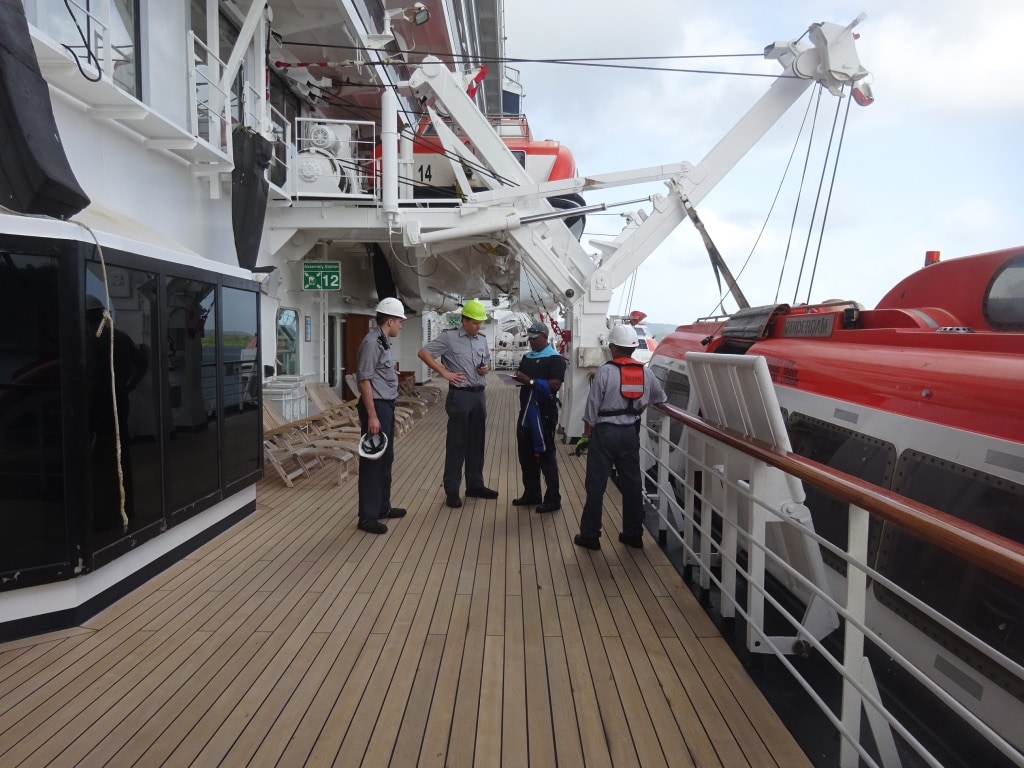
In the old days we used Bo ‘sun chairs for that, which were lowered down the side of the hull with ropes. Now we use cherry pickers because it is faster and also much safer. Those cherry pickers are operated by the sailors and rented locally at a cost between 500 and 1000 dollars a day. Before we let the sailors play with them, they receive training and for that purpose we have a traveling trainer in the company. There is more than one, they are called Fleet Safety Trainers, and they rotate through the fleet for various detailed and in-depth training’s. The gentleman currently on board is giving cherry picker training, fork lift driving, proper safety harness wearing techniques, Genie Lifts (a sort portable small lift to replace ceiling lamps and do cleaning in high spaces) and how to work safely in enclosed spaces. The sailors receive theoretical and practical training which is then completed with a multiple choice exam.

We left Aruba behind us by 17.00 hrs. after all the tired shoppers had returned, most of them sun burned and exhausted as it was very warm today and set sail for the Panama Canal. We have to get there by 05.00 hrs. to fit in the convoy.

While uploading the tentative Panama Canal schedule came in:

0500 Pilot on at Sea buoy

0700 Entering Gatun Locks

0900 Exiting Gatun Locks

1200 – 1230 Passing Gamboa (pending opposing traffic)

13.30 Entering P.Miguel Locks

14.15 Exit P.Miguel Locks

15.00 Entering Miraflores locks

16.00 Exit.

1700 Pilot off at Sea buoy

All subject to EXTREMELY much change.

10 November 2017; At Sea, Day 2.

This morning between 0400 and 0700 hrs. we zig-zagged through the Windward Passage and into the Caribbean Sea. To do this we first hugged the East coast of Cuba, staying close to the Light house of Cabo Maisi and once out of the Vessel Traffic Separation Scheme we came closer to the West coast of Hispaniola.  Hispaniola is the name of the whole island to the right of Cuba and it is split in two halves. One is Haiti the other is the Dominican Republic.  Thus we saw the sun rise over the mountain range of Haiti on our port side. A bit of a watery sunrise as there were only a few rays and then it clouded in again.  From then on the clouds got thicker and thicker and by 10 am. we had a few torrential rain showers coming over the ship.  By noon that had tapered off to the occasional drop of rain but it took the remainder of the day to leave the weather front behind. Or better said the weather front to drift away from our course line as we are on a south south easterly course towards Aruba.

A rainy grey morning in the Caribbean Sea.

Although most of the navigators have been to Oranjestad many a time, there is still a very in depth voyage and arrival meeting the day before. Being Dutch we do this at Coffee time at 10 am. in the morning. This time the affair was enriched by Dutch Cookies which had been brought over from Holland by a new joiner. We have all sorts of cookies on board but not always the brand that is considered best by the experts. (That’s us) The whole officer team assembles including the Security Officer (in charge of the gangway setup) and then the arrival is simulated on a big TV screen step by step. Docking plans are discussed – where the ropes go- and the navigation officer has made  a cheat sheet for forward and aft mooring stations with photos from last time, so we can achieve the optimum mooring line configuration.

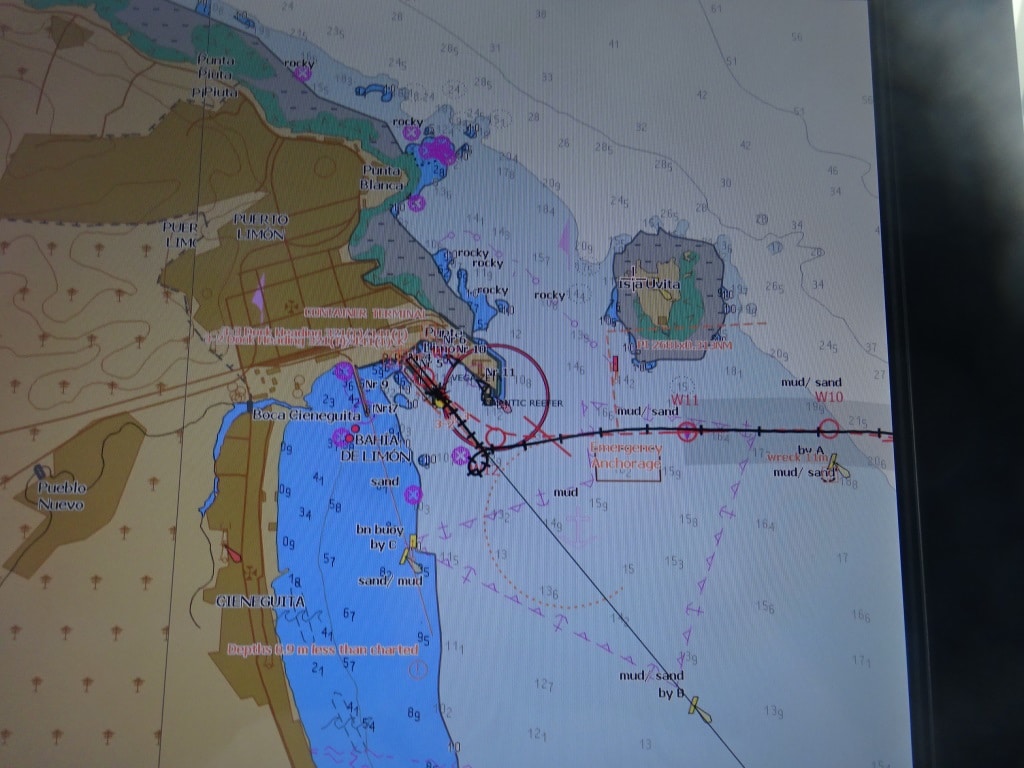
The approach into Oranjestads harbor, the “Paardenbaai”. As long as we stay between the red lines and do not hit the blue bump, we are in good shape.

Then the most important part is the approach to the dock, with the focus on what if. If you drive a car into a garage, you focus on that. We worry about the fact if the garage door might come down while we are driving in and what do we need to do to have –positive confirmation –so that will not happen. Maybe cynical but it saves paint scratches on the cars and lives on ships.   Thus “Plan B” is very important. For Aruba there are two challenges: One, when you sail in, you cannot stop anymore or drop anchor. It is too narrow. B. There is always a lot of wind which pushes you away from the dock.  Luckily the port has a natural plan B. There is an exit at the end of the harbor, so if the ship comes in and if you do not like the situation you just sail out again. I have done that once in my career, 14 years ago, when a sightseeing catamaran decided to sail westward between the pier and the ship, while I was coming in and was executing a maneuver to reduce the wind influence which was gusting up to 30 knots.    I could not slow down, the ship would have been set towards to reef to the south and I could not turn around so I just gave full ahead, sailed out, turned back to the West entrance and made a new approach.  It was quite enlightening to listen to the pilot who questioned the legitimacy of the boat skippers heritage, and that of his immediate family, fluently in three different languages. (English, Dutch and Local) After docking successfully the second time, I explained to the guests what had happened and asked those who were going on that tour boat to voice my displeasure. Which they did with great gusto. The tour boat skipper never made that mistake again.

The exit of the “Paardenbaai” giving the option to sail out if you do not like the situation. (Both photos are screen captures of the actual ships voyage plan.)

Tomorrow should be an average day according to our prognoses; winds of up to 20 knots, sunny but with a chance of showers, so the ship will put out a few extra lines to deal with wind gusts which might be hidden inside the showers. According to the agent we are the only ship in port but according to the Aruba port authority there are two more. The Norwegian Dawn and the Freewinds. Tomorrow we will find out who was correct.

09 November 2017; At Sea.

After all our trials and tribulations of yesterday, today we have a routine day at sea. The focus of the crew is back on pure guest satisfaction and everything else is on the back burner as most of them made too many hours yesterday according to the legal requirements. If this happens, then those extra hours have to be compensated with extra rest the next day. And so we did. This is not something that the guests will notice but any work planned for today behind the scenes was put on the back burner for another day.  I helped out today where I could and then started my own project of carrying out a full safety sweep of the ship on behalf of the Captain.  I do not expect to find much but history has taught us that small things can change into big issues and it needs an experienced eye to connect a small issue to a much larger challenge sometimes in the future.

When there are inspections going on like yesterday I cannot be involved as……… A. I am not officially a crew member and B. Legally I am in a bit of a vague position as what I say would carry authority but could encroach on the position of the Master and that is of course a No No. Plus halfway in the morning I get kicked off the ship to present myself to the CBP to show my Visa and dutifully declare that I am still not a danger to the safety and security of the USA. And you never know how long that might take; and yesterday it took a long time.

Wouldn’t it be nice if Cuba had a sort of North – South Panama Canal in the middle. I wonder if it would be profitable.

But the cruise has started and we are now happily on the way to our first port of call Oranjestad Aruba. Yesterday evening we sailed south towards the Old Bahama Channel and there we spend all of today. Tomorrow morning between 04.00 and 07.00 hrs. we will pass through the Windward Passage and then we are in the Caribbean Sea. Because we called at Ft. Lauderdale on a Thursday there was only the Koningsdam and the Crown Princess in port, plus a small intra-coastal cruise ship of American Cruise Lines. All went their different ways and thus we are sailing all by ourselves at the moment, not counting cargo traffic of course.

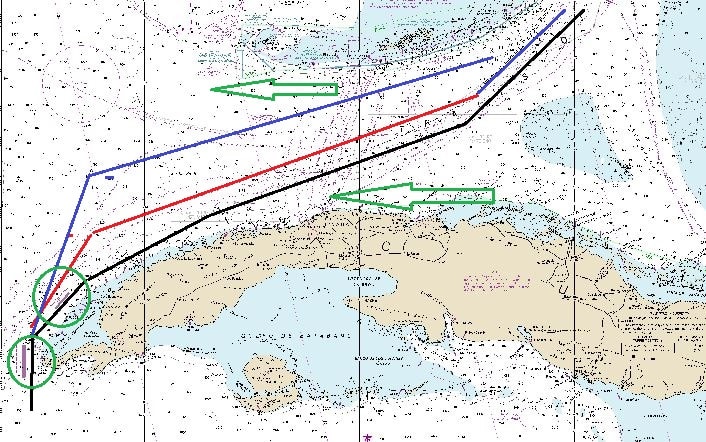
The Old Bahama Channel is the preferred route for going to the South and East Caribbean Sea. If you go all the way to the East, then going north of the Bahamas is shorter (= saves fuel) but you are completely exposed to the vagaries of the North Atlantic Ocean. Sailing the Old Bahama Channel offers protection by the Bahamas to the North and Cuba to the South. You might still get a strong, opposing, easterly wind, but you do not get the swell of the North Atlantic. Thus every cruise ship captain, who is concerned about his guests comfort, will look for an excuse to take this route as it will call for a more comfortable ride.When you go to the South Carib, then it is the only way to go, as going West around Cuba adds at least 80 miles to the route and you have to sail against the Gulf Stream until you pass Cabo San Antonio. That we only do when there are hurricanes in the way. But the hurricane season is more or less out of the way and thus we take the regular route. As it is so popular with everybody, the channel has been divided into traffic zones to keep opposing traffic nicely separated.  So going South/East bound we are hugging the Cuban side at a distance of between 3 to 12 miles, depending on how the Cuban coast is following our route.

The weather is, what it promised to be. We are still out of the rainy area as the frontal system is now occupying the middle of the Caribbean Sea. But we can expect some heavy showers when are south of Haiti.

I expect that we will meet the tail end of the system and get some showers in the morning and miss most of it.

08 November 2017; Fort Lauderdale, USA.

It was the end of the cruise today and welcome to Florida and welcome to Mayhem. Controlled mayhem but the ship had a very heavy day. We knew what to expect and we were prepared to have all go as smoothly as possible. But with so many things going on, and with so many outside influences, the only approach from ship side can be to very minutely plan the operation and then hope that all the other stakeholders do their part of the job. And this time it did not work out completely.

As the ship had been away from the States from more than six months, we knew that we would have to go through a full crew inspection of the CPB and we knew that we had to do a Full year CVE (Control Verification Exam) by the USCG. So we were ready. We knew we might get an inspection by the USPH ( we are always ready for that) but we were hoping that they would come in the next USA port  as providing labor for that while the USCG drills were going on would be tight. And in the mean time we had to do the cruise turnover. On top of that we had a crew change of about 70 and while the old crew could not help anymore; they had to see immigration and then go to the airport, the new crew could not help either as they first have to complete the mandatory safety indoctrination before they are allowed to start working. This was all expected, we had planned for it and had all it organized.

Then we found out the CBP could only make 4 officers available at the start of disembarkation. This slowed down the full crew inspection but it also slowed down the Guest disembarkation. Nothing we could do about it, nothing they could do about it as the CBP is really strapped for manpower at the moment. I heard from the ground staff in the terminal that some of them were already on the job for 14 hours that day; then were supposed to take a few hours off and then go at it again for a full night shift.  And although they were trying to be as efficient as possible, it delayed the end of the disembarkation by more than an hour.

This had a knock on effect on the USCG inspection as the USCG officers like to wait with the drills until the guests are off the ship so it does not interfere with the disembarkation procedures. But now the guests were late and thus the drills were late and rolled over into noon time. That had a knock on effect on the boarding of the new guests as the crew was still in the drills. Cabins had to be completed, food for lunch had to be cooked, meet and greet setup etc. etc. So embarkation did not start until 13.30 hrs. and nothing we could do about it. While all this was going on, the USPH officers boarded for an inspection and that drew labor away from other tasks as now various Hotel supervisors had to be at their areas of responsibility while the inspections took place. In between we had to fully provision the ship, bunker oil, load water and had a large number of service technicians on board to service all the equipment. I observed coffee machine experts, a radar technician, an expert on water measurements, a juice machine repair man, and at least another 20 or so experts in one thing or the other. They all disappeared into the bowels of the ship, to ensure that everything would be in good working order while we make our cruise.

Based on all of this rolling forward, the Captain could not do anything else than to postpone sailing by an hour to get everything completed in a proper way. As always it all worked out. USCG returned happy to Miami and we got our CVE certificate. USPH declared our ship healthy and the CPB inspected all the crew and the guests going off and gave us the sailing clearance. Nothing stopped us from starting our Panama Canal cruise, with our first port of call Aruba, two days from now. Complements to all for a job well done as this turn over day was not for the faint hearted.

I am now staying on the Westerdam to help out with some projects for the Captain until Puerta Vallarta on 21 November, and then fly home for first a training course and then my vacation. I came Eastwards through the canal with the Nieuw Amsterdam 3 weeks ago and now will go Westwards with the Westerdam. I will have to sit down one day and calculate how many times I have done the Panama Canal since 1981. I know I am closer to or over a 100 of them so maybe I can apply for a discount as a frequent Canaler.

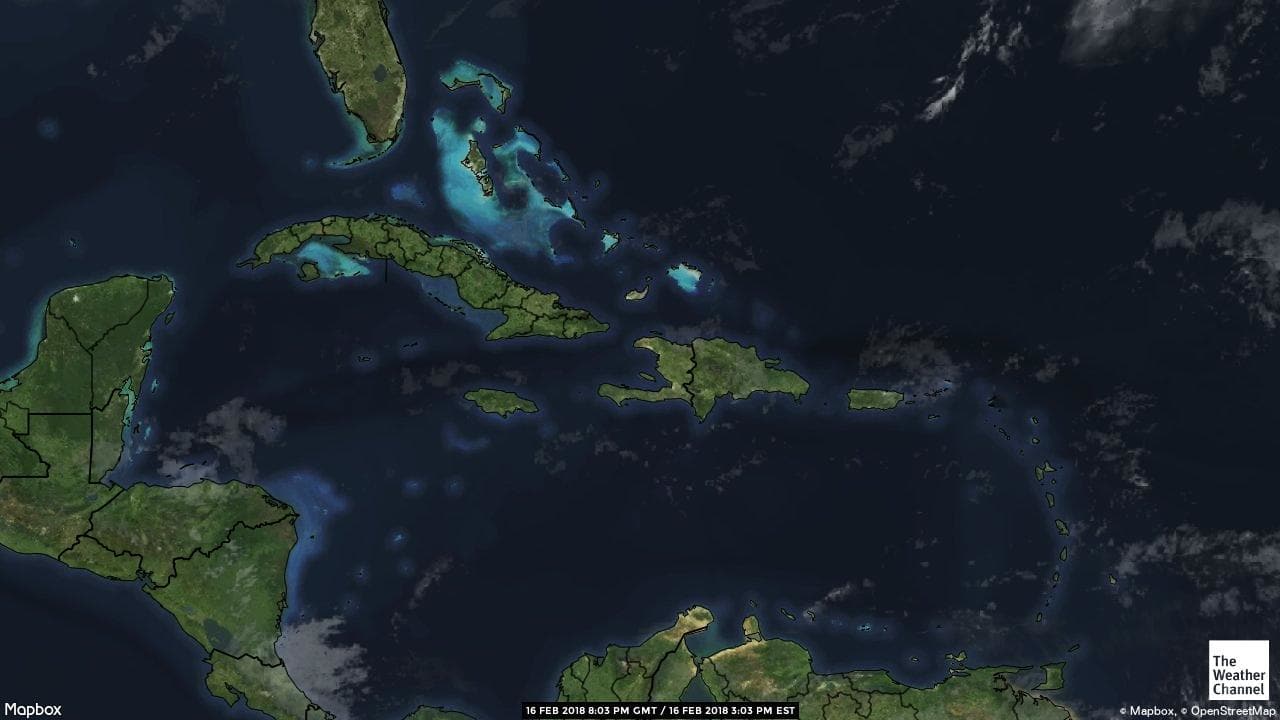
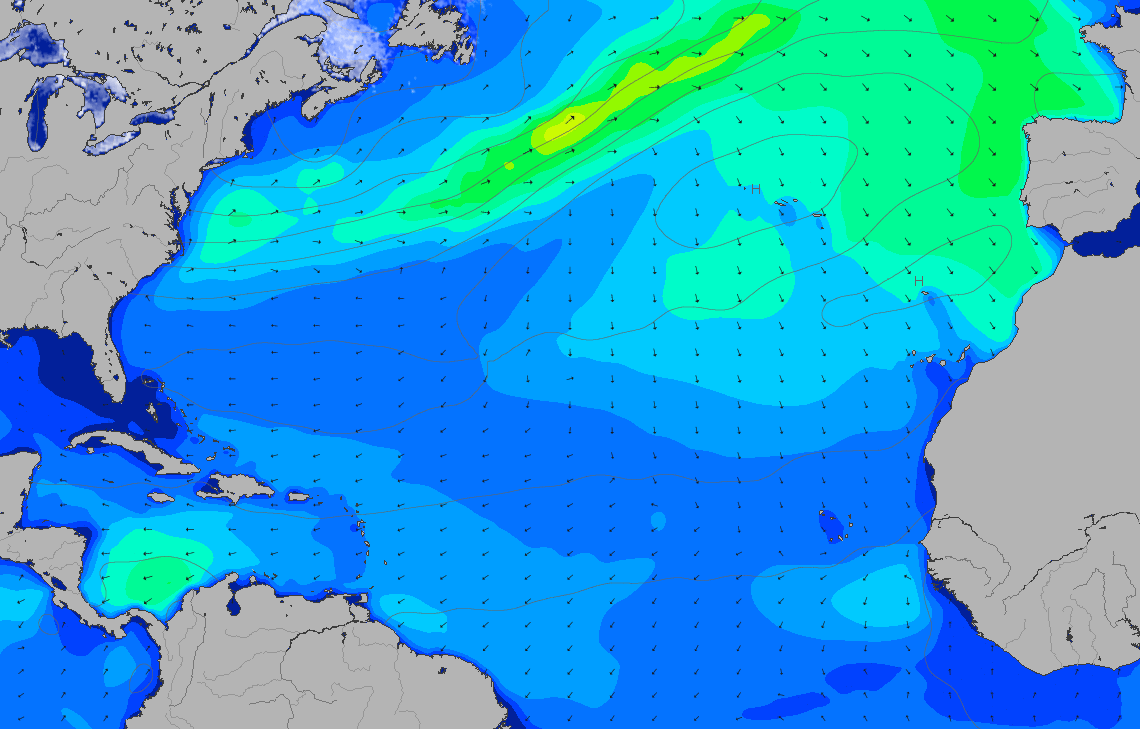
Heavy rain clouds coming over from the East Carib. (Courtesy The Weather Channel)

The weather for the coming days is a bit uncertain. There lays a large weather front over the East Carib and the North part of the South America and that is moving slowly westwards. If I read the chart correctly, we should get through the frontal system while on our 2nd sea day and then it should be gone by the time we dock in Aruba.  But that will depend on the speed it moves to the West.  Wait and see, the frontal system is too wide to sail around it so we will take the showers when we get them.

07 November 2017; At Sea, Day 07.

Before I roll into the current day, we had an interesting event by means of a visitor or a stowaway. Sitting on top of the Magrodome with an attitude as if it owned the ship was a big bird. A very bird. I thought it was a Heron but in England Herons are blue and this was definitely a brown one and a scruffy one as well. According to guests:  he/she had been observed by somebody flying around the ship and catching fish and then, shortly after a dive over the Lido Deck, he or she landed in the middle of the top curve of the Magrodome and stayed put.  I do not know anything about birds, so readers please, is there any ornithologist available to tell me what sort of bird this is.  One guest considered the bird to be a terrorist as it dive bombed. Exactly where this guest was standing and the dive bomb was accompanied by a white release………….   Pending corrections on my thinking, this does not look like a deep sea bird and thus was most likely blown off course, hence his/her scruffy appearance. Last night we were about 400 miles from the edge of the Bahamas and two days ago we were 400 miles south of Bermuda, so it might be a bird with a British or Bahamian Passport. He/She spent most of the time preening and getting everything in order for a future take off. This morning the bird was gone, maybe for good or to return later and catch a ride to Florida.

Our Hitch-hiker in total control of the Magrodome.

With the bird no longer overseeing the Lido Deck from its lofty perch, Housekeeping moved in, in the late evening. I have not seen this on any other Holland America Line ship yet, but they managed to turn the whole area round the pool into a menagerie with every animal variation (and a few more) that normally covers our beds every evening.  Sometimes the creation of the cabin steward is a bit hard to decipher but normally it is very clear as to what it is. For what you get in the cabin, you can buy a small booklet with how to do it at home.  But here creativity was taken to a much higher level. Mr. Hobben our Executive Housekeeper and his team really went to town. Crocodiles, centipedes you never hope to see, Orang Utans larger than in real life plus smaller creations which are not in the booklet and are thus most likely dreamt up by the Housekeeping Attendants themselves. Indonesians are in general very artistic and elaborating on an old idea with a few extra towels is not beyond their capabilities.

Towel animals everywhere. all the way around the pool. I assume all 100 housekeeping attendants were in attendance. Luckily we always carry enough towels on board, as each cabin had an animal as well.

Most guests saw it at breakfast and the ohh’s and ahh’s were heard all around the deck. They had even made a guardian to look over them during the night by means of a stuffed Hotel Directors uniform, so the wellbeing of the whole zoo was in the capable hands of the most senior hotel person.  Compliments to Housekeeping, this was really impressive and listening to the noise produced, the guests really enjoyed it, all the time and effort well spent. Impressive.

These ones we do not get on the bed, as they are too big.

Outside the ship there is still not much going on. The sun is shining; the seas are calm with only a very small swell running, and the guests have to make the difficult decision of lazing for the day or to start packing. This evening around 19.00 hrs. we will enter the Bahama Islands. Then we will sail between Abaco Island and Eleuthera Island. This area is called north –East Providence Channel, followed by North West Providence Channel. Then early tomorrow morning we will cross the Straits of Florida to aim for Port Everglades pilot station around 05.00 hrs. If all goes well then we will be docked by 05.45 hrs. at our regular location Hal Terminal 26.  Then the changeover circus will start an even a bigger circus than normal as this is our first call after a whole summer in Europe, so we will have all the inspections. More about that tomorrow.

My school class found the bird back later in the day ; it is now sitting outside the Officers Bar on Deck 4, probably waiting for somebody to buy him/her a drink. We will have check tomorrow to see if it has become a Floridian. The Nautical Excellence Class finished today with 5 very happy campers who in 14 days’ time were indoctrinated in most Holland America Line procedures. Some known, some secret but all of them very important. Tonight we will have a final dinner in the dining room and then real life will start for them. But my final lesson will be: how to properly open a wine bottle, check it, taste it and then share it.

The weather looks very nice for Ft. Lauderdale and thus the guests will have had a VERY GOOD Trans -Atlantic crossing with only one overcast/rainy day.


06 November 2017; At sea, day 06.

Another beautiful day at sea. Last night it was so clear that we were even hoping for a Green Flash at sunset. But a cloud spoiled the happening and dashed all the expectations. But today is a similar day and maybe we are lucky now.  So what is all the excitement about so that we even announce it to all the guests.  First of all it is a fairly rare happening and secondly you can only see it over sea as you need an on-unobstructed horizon.  This because it is an optical phenomena which occurs at sunset and sometimes at sunrise. But I have never seen the latter one myself.  The moment the sun touches the horizon the atmosphere can cause the various colors in a sun ray to split with green color dominating. If the air is then a little bit hazy (but not cloudy) this green discolorisation might rise higher and we can then see a Green flash of about 2 or 3 seconds. That rather unusual happening is what we are hoping for.  If the weather stays the same we might have another chance,

But if all fails, then there is always Bingo to solve all the frustrations………………………………………………….. Although most guests are busy with other things. This morning I observed a first in my career. At 07.00 in the morning, the Passenger Gym on deck 9 inside the Greenhouse Spa was sold out. Not in the way of costing money, as it is free, but it was full with no room to spare and none of the machines were free.  Normally we have a daily rotation with 25 to 30% of all equipment in use and at the same time exercises are going on in the center area of the Gym but this morning everything was in use at the same time. Causing a few guests to turn away a bit disgruntled. I suggested to one Lady “why not take a run or walk a few laps around the deck, as things would certainly quiet down closer to breakfast time”. It was the wrong thing to say I think as I got one of those glares that can curdle milk. ……………. She wanted a particular machine that she had used all cruise at the same time each day, and now somebody had taken it. No doubt the Hotel Director will get a nasty Let-us-Know card about that one.  Maybe we have do the same as they did in old days with the steamer chairs on deck, you reserve one with the deck steward, so nobody could pinch it……………….

The crownest bar which now incooperates the Coffee Bar.

Continuing on our refurbishment tour, we now come to the Crow’s nest. This has now been giving over completely to the EXC, our Explorations Center and enrichment philosophy. Welcome Explorations Central. The Java Café / Coffee bar on the Starboard side has been merged with the Crow’s-nest Bar on the portside which has remained in place. The open space has been filled by the Shore excursion desk.   Starboard aft a more private office has been created for the Future Cruise Consultant and going to starboard forward there is now modified library shelving set up with books pertaining to travel.  Two puzzle tables have been retained and are always in full use.  Port Aft, where we had the Captains Corner, is now a meeting/ lecture area called EXC encounters, featuring the EXC team with travel stories, narrated movies and slides show about far flung places to visit.

Center Forward area with a view towards the Starboard side.

This is a new concept for the company and it was the question if it would catch on. But looking at the number of guests who are present during most of the (sea) day, I think it does, all areas are well frequented and when done exploring the Bar nearby gives the option to come to rest and relax with a good glass of something nice. Because the chairs, although comfortable, are smaller, a lot of space has been created for everybody to have room to mill around.   This will help the congestion issue we always have during a Panama Canal Transit. If needed, there will be room for a lot of folding chairs for those who want a good view but stay indoors.

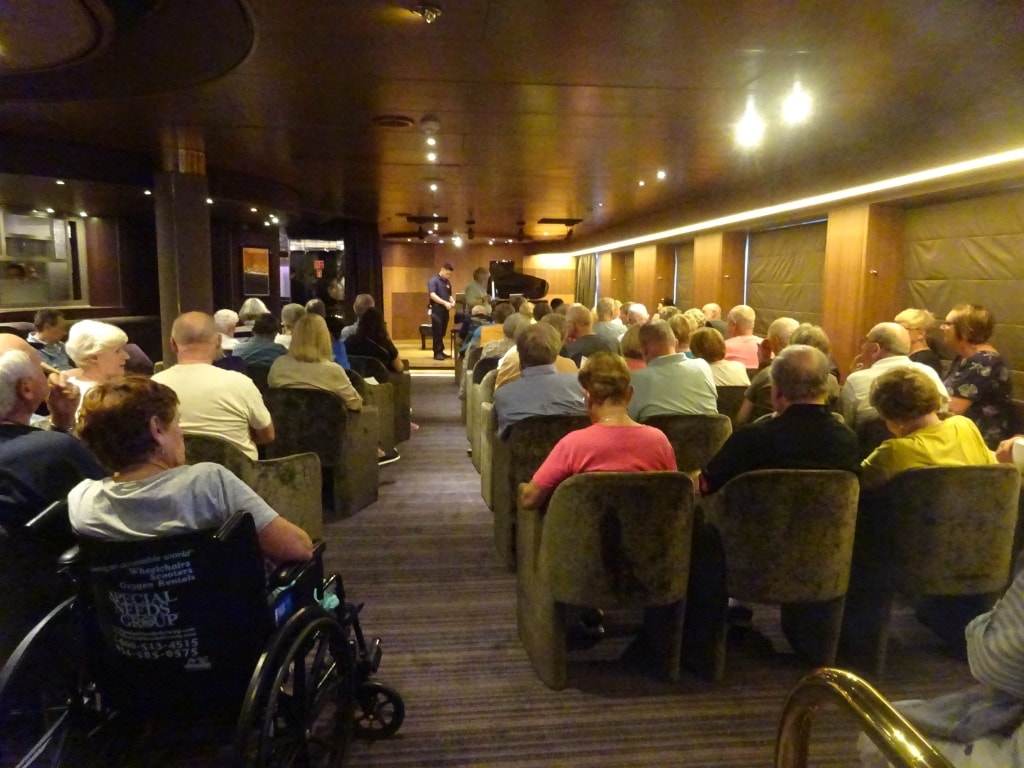
The old Captains corner now transformed into an enrichment /small lecture area. Now there are more chairs otherwise we can not get everybody in. It is very popular.

We have one more full sea day to go and then a final night, sailing between the Bahamian Islands before we reach Fort Lauderdale. Weather is supposed to remain as is and thus it should be sunny all the way to Fort. Lauderdale.


« Older posts Newer posts »