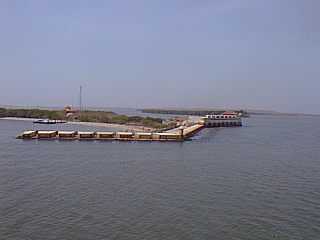
- Captain Albert's Website and Blog -

Ocean Liner History and Stories from the Sea, Past and Present. With an In Depth focus on Holland America Line

Page 107 of 241

04 Nov. 2014; At Sea.

Today we spend the day at sea as it is a long distance from Huatalco to Puerto Vallarta. Although it looks dwarfed by the USA when seeing it on the map, Mexico is a large country which stretches several hundred miles from South to North and as Huatalco is near the south border and Puerto Vallarta about 2/3 up the coast we have to spend a day at sea to get there.
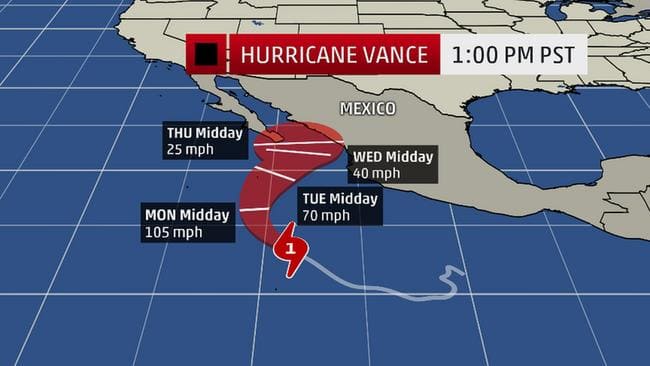
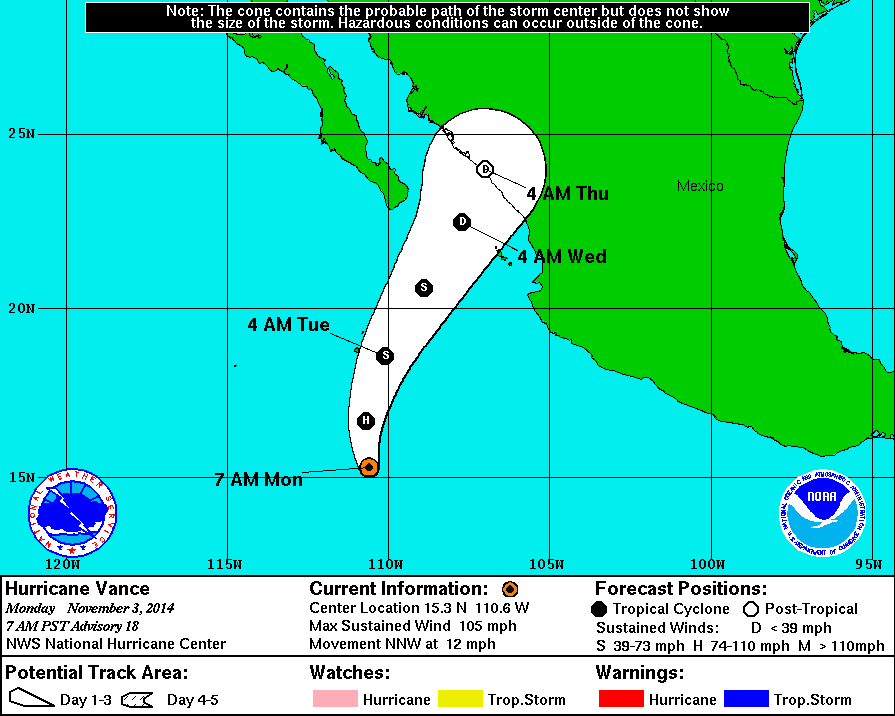
vance 1300 hrs pstThe most important question of the day was: What was Vance doing or what was he going to do. (I suppose that a hurricane is a he, if it has a male name and a she if it has a female name) Well Vance had finally made up his mind and was slowly moving towards the coast of Mexico. The most likely trajectory is now that he will make land fall somewhere north of the Bahia de Banderas in which Puerto Vallarta is located.  That would be bad news, if it was not for the fact that Vance is weakening and is expected to come down to a tropical storm or less.  On our way to Puerto Vallarta we will remain at least a 150 miles away from the stormy area and by the time we leave P.V again, the winds should be down to about 20 knots in the area of Cabo San Lucas, where we will then finally pass its path. We will notice the swell though as that always coves a larger area than the wind.

If Vance would have maintained his strength and then would have started to move; then the situation would have been different. With a full blown hurricane in the vicinity you do not go into a bay with the chance that the hurricane might block the entrance, or worse, follow you inside. If Vance would have moved as predicted, North East, then the Veendam would have moved North West and sailed around it at a safe distance. That would have cost us the Port Call of Puerto Vallarta but you do not take chances with a hurricane. But Vance is a good boy and is giving up the fight so we can continue our cruise as planned. We might get a bit more rain fall that we would have expected for this time of the year but the people in the Bahia de California won’t mind that I think.

I spent my day on teaching Crowd Control again. We have a lot of special teams on board who all have a special task to fulfill during an emergency and most of them have to deal with people while executing those tasks. One of those teams is the Evacuation Team under the leadership of the Security Officer. During an emergency they are responsible for evacuating cabins near the Restricted Zone (where the emergency is) and then act as Guardians to keep everybody out of the area. (As everybody now walks around with a Smart Phone, that has become a very busy job, as everybody wants to take a photo of the emergency)

This team is made up from Housekeeping crew, those who you see vacuuming the staircases, carrying tables etc. General Purpose Attendant, Housekeeping. It is the first step on the ladder of a career in the housekeeping department. The biggest challenge is to instill in them enough confidence to be forceful against other crew members and or guests. Partly as it is all new to them and partly as we are a service orientated business, where you are friendly and not brusque. Still in an emergency only the results count and that means sending people away from the danger zone and also stopping crew, even if in higher rank.

It gives a lot of satisfaction to see after an hour that a timid and friendly Indonesian is turning into a roaring lion of a guardian as soon as he or she realizes what you can do with just a few small tools and attitude, and they love it. Finally the chance to throw one’s weight around, while serving a good cause.

During the next fire drill, I will play – a difficult passenger – and then they can yell at me and order me away. And I think they will do it as well.

So the good ship Veendam will arrive in Puerto Vallarta at 0800 tomorrow morning, without having being bothered by Vance the dissipating hurricane. (Unless he changes his mind again during the coming night) I expect an overcast day and if Vance keeps moving as he currently does then he will be pushing a lot of rain showers ahead of him and over Puerto Vallarta. That will keep the temperature down and will make our Bo ‘sun happy as he has been complaining about all the salt on the ship. To make a ships Bo ‘sun happy, you have to give him a good downpour on the ship every morning at 0500 hrs. He might get it this time.


03 Nov.; 2014, Huatalco de Santa Cruz, Mexico.

The Tehantepeccer was present, very much so.  Around midnight it started to blow and by 2 am the ship was in the middle. As it is a funnel wind, it was quiet again by 4 am when the ship sailed out of the funnel.  The peculiar thing is that the wind whips up to 50, 60, 70 knots and the ship remains as steady as a rock as it is a land wind. As long as the ship is close to the shore, the waves cannot gather any momentum and it is just very stormy but without the motion that makes a storm so bad.   Although we have the weather forecasts, the big question always is where the vortex is and what the angle is. The more the angle is towards the South West, the bigger the chance that Huatalco can be affected. This time the wind stopped around 04.00 in the morning and with still 3 hours of steaming to go there was a fair chance that the waves would not curve into Huatalco bay.

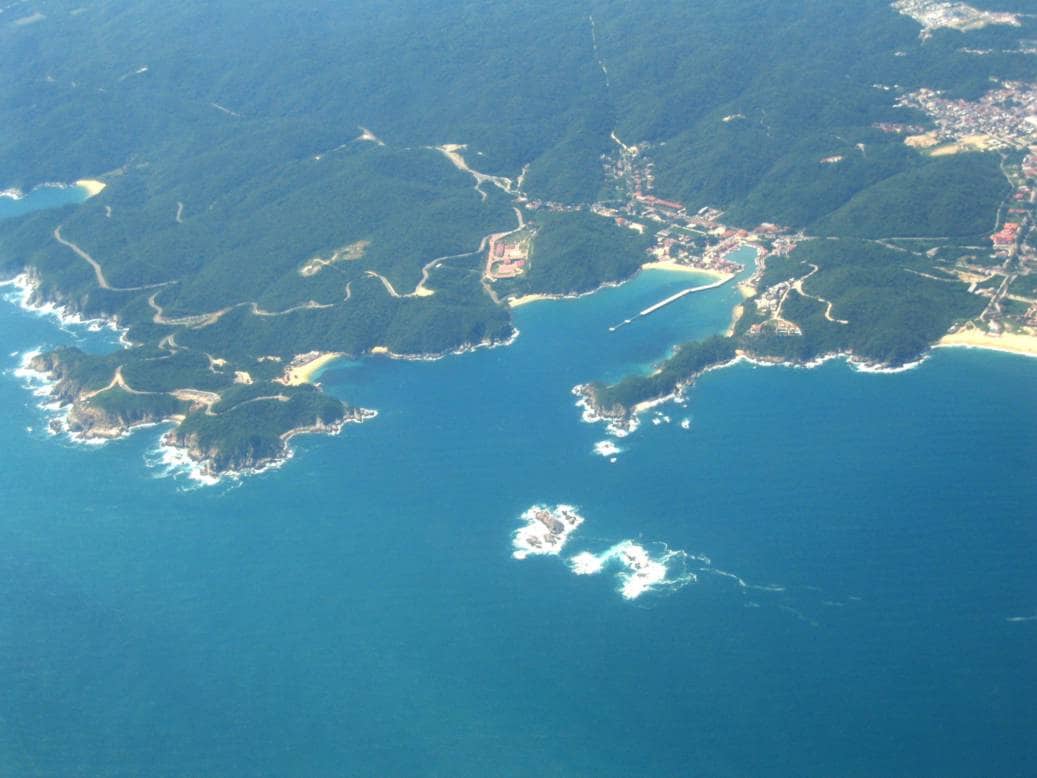
They did not. It was nice and calm. And thus the Veendam could happily dock at 08.00 hrs. in the bay. There is room for 2 ships at the pier but we were the only one and the guests had the whole little resort to themselves.  Since Acapulco is out of the question, this is my favorite resort on the West Coast of Mexico.  Acapulco was always wonderful but now it is suffering from the drug wars in Mexico and it is not really a safe place. Even downtown seems to be affected and thus the cruise ships stay away. It must cost the locals a lot of money and those who are losing out are most likely not the ones who profit from the drug trade.

A very nice and sheltered bay.

A very nice sheltered bay.

The only issue with Huatalco is that it is enclosed on three sides. Only sea wind can get in and if there is no sea wind then it is very warm in the bay. Very toasty so the speak.  And today was a very warm day. I felt sorry for the Mexican soldiers who were guarding the ship. While in Mexican ports there is always a navy boat around the ship and most of the time it is an open boat. Even when you are used to warm weather, sitting there in army fatigues with the sun belting down upon you cannot be much fun. At the same time you also get the reflection from the water, a double whammy so to speak, making it very warm.

By mid afternoon it was time to leave again and our next port of call is Puerto Vallarta. Now hurricane Vance is becoming more and more important. It is still sitting there out in the ocean and it is not moving very much. The predictions are that Vance should move to the mainland, somewhere between Cabo San Lucas and Puerto Vallarta. Those are the predictions, as that is what most storms do here. But Vance is not really moving and that means that there are other options.  It could move to open sea, it could just blow itself out, and it could move a bit north over colder water and loose intensity. Everything is possible. We just have to wait. The big question is……………….what is Vance going to do ??

Most likely, but by no means certain

The most likely path, based on previous patterns, but by no means certain


02 Nov. 2014; Puerto Chiapas, Mexico.

Puerto Chiapas is located just over the border from Guatemala and thus located in the extreme south west of Mexico.  The mountain ranges of what will eventually become the Rocky Mountains can be seen in the far distance but this area is what I would call flatlands. Rich soil which is cultivated extensively with Fruits and Vegetables. Even the pilot has a mango farm when he is not occupied with getting cruise ships in and out. A river that flows through this fertile land has given rise to the port of Puerto Chiapas. The good thing is that there was already an established estuary; the bad thing is that it is constantly silting up as the river brings a lot of brown soil towards the sea. As there is hardly any flow in the river, the soil has time to settle right in the entrance of the harbor.  Because of that there is a dredger permanently in residence to clear away any silt banks in the entrance which are constantly forming, especially after a few rainy days upstream.

puerto chiapas

Then there is one more challenge and that is a challenge that gives captains a real headache: Swell. The entrance of the port is NE/ SW and if the ocean swell is in the same direction then that swell builds up the moment it rolls over the silted areas. A wave goes up and goes down and that means that if the wave goes up, it adds to the room you have under the keel (What we call that UKC or Under Keel Clearance) but when the wave goes down, it reduces the available water depth with whatever height the wave has.

As we had some waves yesterday in Puerto Quetzal the big question was what is the direction of that swell at Puerto Chiapas? Well the direction was good. It ran across the port entrance instead of into it. Thus between the breakwaters there was no swell and thus there was the regular water depth of at least 10.5 meters under the keel. Take the draft of the Veendam of 7.8 meters and you have at least 2.7 meters left under extreme low water circumstances; so always much more during normal days.

That made the Veendam zip into port without any hindrance followed by a happy warm day alongside.  Navigation wise it was less of a happy day. The Tehuantepeccer is blowing and that means that tonight there will be a lot of wind around the ship. As it is a land based wind, it generates a lot less swell than a storm in the open sea. It can go up to hurricane force winds but normally it blows between 50 and 60 knots which is still a heavy storm but it does not feel like it as the ship hardly moves.

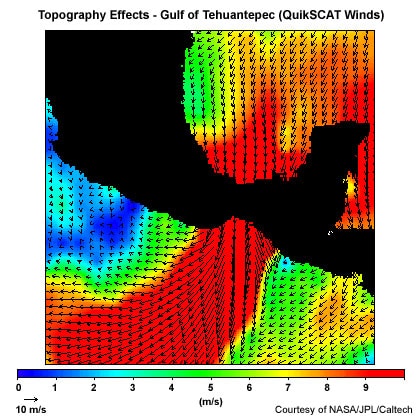
Red is the wind flow and black is land. The darker the red, the stronger the wind

Red is the wind flow and black is land. The darker the red, the stronger the wind

A Tehuantepeccer starts to blow when a high pressure system forms in the lower part of the Gulf of Mexico near the Yucatan Peninsula. Then if you have a low pressure situation in the Pacific an air flow starts to go west. Right between Puerto Chiapas and Huatalco there is a gap in the mountain ranges on top of the port of Salina Cruz. That gap creates a funnel wind and what has started out as a fresh breeze of 20 knots is suddenly being amplified into a severe storm.  The further into the Pacific Ocean, the more swell it generates. To avoid being affected by the swell, the ships creep closer under the coast and that is what the Veendam will do tonight. So watching the anemo meter if the wind force goes up and up, the captain will change course closer and closer to the coast so the ship will not be pushed over by the wind and be rocked about by the swell. Once past the vortex the ship can then angle away bringing the wind onto the stern and set a safe course for the next port.

We have a Tehuantepeccer so often that dealing with this phenomenon is pure routine and as long as the guests stay inside there will be no danger to them whatsoever.

Something more unusual is the fact that this wind is feeding the creation of hurricane Vance, that is churning off the coast further up. We are safely behind it but the question is where will the hurricane go?  The Bridge Team will be keeping a close eye on that one in the coming days.

Tomorrow we are in Huatalco de Santa Cruz. This port is normally not affected by the Tehantepec winds, but it can be affected by swell that bounces off the coast and then runs into this beautiful harbor.  We will see tomorrow morning. We are expecting another hot Mexican day and if the local wind is not from the sea, cooling things down, then it will be a very toasty day as well.


01 Nov. 2014; Puerto Quetzal, Guatemala.

We approached Puerto Quetzal by 09.00 in the morning and were docked shortly after. That shortly after was achieved by scooting straight in, instead of swinging around and docking nose out, something we normally do during early arrivals.  The call at Puerto Quetzal is built around the fly tour to the Maya ruins. The airfield that is used is day light only. The plane has to take off and land during day light hours as the airport has no night landing facilities.  Thus when we have an early arrival, the captain has plenty of time to swing around in the dark and still dock on time without endangering the timely take off of the plane.  Normally we have it that well organized that the guests are sitting in the plane and 5 minutes later there is Twi -light and as soon as the pilot can see the end of the run way, off he goes.  With a day light arrival, it makes sense to get the tour on the road & off the ground as quickly as possible, hence going straight in and turning on the departure.

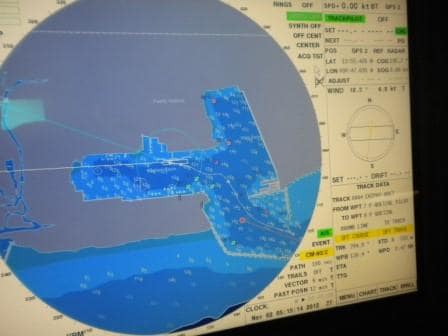
Radar captain showing the shape of the port and the breakwater entrance

Radar capture showing the shape of the port and the breakwater entrance

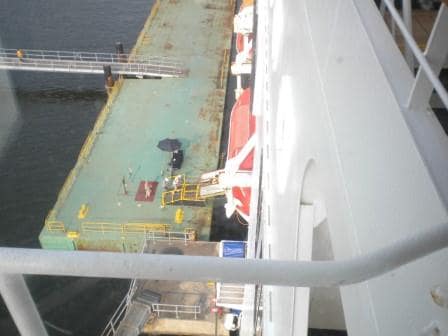
The port of Puerto Quetzal is in an L shape, where two rivers meet and have a joint exit to the sea. Through the years a complete port has been dug out and in one leg of the L is the container port and in the other leg a tanker port and a cruise terminal.  The port is protected from the ocean swell by two breakwaters and you sort of zig zag through. Not completely, you can with making a little curve, sail in a fairly straight line to the cruise terminal dock.  This is a floating pontoon, so it goes up and down with the tides and thus with the ship and the gangway is always in the best position.

The cruise terminal floating pontoon

The cruise terminal floating pontoon

As the breakwaters do not completely protect the port, at least not the area where the cruise terminal is located, there can at times be a low swell running in. Not a problem unless you want to lower lifeboats. And I was going down with the boats twice today to do the practical part of the lifeboat training class.

We managed one group and then I considered it too dangerous. The swell was building up to 2 feet and that means that the lifeboat, when coming back, is also going up and down under the blocks with amplitude of 2 feet.  Lifeboat systems are designed to release lifeboats as quickly and safely as possible. They are not designed to do that the other way around. Hooking in the Falls in which the lifeboat hangs is a hairy affair when there is swell and thus I prefer to do it safely, when the sea is calm. We will try again tomorrow in Puerto Chiapas.

While I am on board the ships, there is always the challenge to find an empty cabin for me. We have service staff cabins on board but they are always full, with one or the other technician coming for a repair, service or upgrade.  It means that I am parked somewhere in cabin that was not sold (seldom) or when there is a no- show (with the average age of our guests a common occurrence). So even when the ship is full, there is space for me somewhere. It means that I am becoming an expert in Holland America cabins and locations. From those in the depth of the dungeons to those at the lofty heights of the Suite Decks.

I personally prefer an inside cabin, as I can then sleep whenever I need to, there is no noise coming in from the outside and as there is no sunlight shining on the window/porthole it is easier to maintain a steady cabin temperature without having to fiddle all the time with the A.C. and then wake up freezing in the night, when the ship cools down. No, a good bed and a good shower and I am a happy camper but I am working.  Of cause when sailing with my wife on vacation that changes as she does like a window and a much larger cabin with a balcony or a suite.

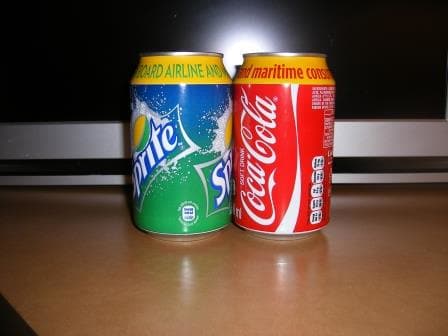
See the yellow rim on top of the cans

See the yellow rim on top of the cans

It is interesting to follow the cabin service and the hotel logic behind it. I have a vast array of soft drinks in the cabin and if I drink one, the next morning at 0900, a new one pops up to make the total the same again. One thing I would like to share with you; is that recently we have gotten Coca Cola cans on board with the label:  Only for Airline and Maritime Consumption.  I have never seen that before. Special Cola and Sprite for those who travel.  I wonder if they put something in it, which makes you less fast air sick or sea sick?

Tomorrow we are in Puerto Chiapas, Mexico, which is just over the border from Guatemala. The weather looks the same again Hot and sunny.  The hurricane that I wrote about a few days ago never materialized but now we are expecting the Tehuantepeccer wind to blow. How strongly is something we will find out tomorrow evening. And behind there is something else brewing…………………….

31 Oct 2014; Corinto, Nicaragua.

Due to the distance from Puntarenas to Corinto, it is not possible to arrive any earlier than 0900 at the pilot station. And so it was done accordingly. The captain kept the pedal to the metal and we nicely arrived on time. From there it is about an hour to the dock as it involves swinging on arrival. Whether that happens depends a little bit on the current, which can really surge though the estuary and river, which together make up the harbor of Corinto. Today everything was according to plan and the Veendam docked sb. side alongside, nose out and ready for departure.

While this was happening we had a major activity going on down stairs. Today was card change day as we are moving to the three alarm system. Some crew will be keeping the same duties but some will be assigned to something else. But everybody had to report in with their lifejacket to get a new instruction card. To prevent any old cards from floating around, the best way to do this is, is old for new, and to check at the same time if there is not another, an even older card left in the lifejacket pouch.  When dealing with large numbers of people you have to devise procedures that are fool proof, or at least as much as possible. Mr. Murphy is always on board and enjoys anything out of the ordinary.

The Veendam towering over the port of Corinto

The Veendam towering over the port of Corinto

It must have looked a bit strange for the pilot when he stepped on board as he had to walk straight through the lines of crew – with lifejackets – while going to the bridge. But all crew showed up during their allotted time slots and by 11.30am all 600+ crew had received their new instructions. Now we will have three days of drills, to get everybody marching to the same tune.  Everybody knows what to do, but we want it to go like clockwork and that needs a few rehearsals.

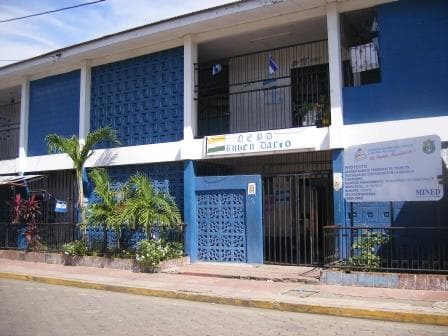
Probably the only school in the world, painted in Holland  America Blue

Probably the only school in the world, painted in Holland America Blue

When that was done, I had the chance to slip ashore to pay a quick visit to the school that I sponsored with the Crew of the Statendam in 2012 & 2013.  It is vacation time, as it is the warmest time of the year and thus the school is officially closed. With all the supplies that we landed a lot of work was done since autumn last year and what we landed in collected clothing etc. was sold to buy more teaching equipment. So reason to be very happy.  The wish list had not reduced of course; they still wanted small chairs, more school materials and cooling fans.

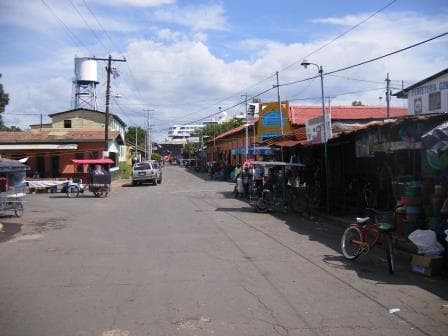
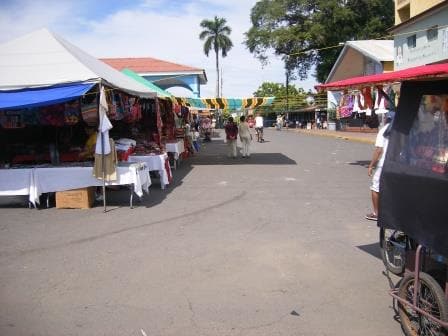
It was even too hot for the fleamarket to show any activity

It was even too hot for the fleamarket to show  much activity

Now I am not on one ship anymore it is somewhat harder to organize things but I will see if I can arrange something for December if I make it to the Statendam on my rounds at that time. I will contact the Purser there as I believe there is still some money in the kitty.

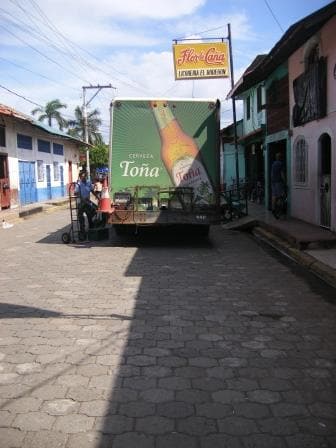
But the local brewery was doing well in sales

But the local brewery was doing well in sales

Tonight the Veendam will sail from Nicaragua to Guatemala to visit Puerto Quetzal with a 0900 hrs. arrival. In the morning we will train the Crew in the new three alarm system and in the afternoon I will have my lifeboat class pottering around the harbor trying to steer a lifeboat.

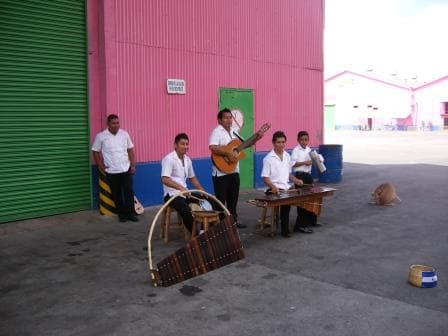
blog marimbaThe local authorities provided entertainment on arrival and for the remainder of the day they had a marimba band on the dock. As they were happily sitting in the shadow all day, they probably had the best job in town. Reasonably cool and the dollars were flowing in.

Today it was dry, no wind and very warm. Tomorrow it is expected to be dry and very warm, but maybe we will find a shower to cool things down.

30 October 2014; Puntarenas, Costa Rica.

Coming to Costa Rica, you have two options for docking. Going to Puerto Caldera or to Puntarenas which is about 2 miles to the west of P.C.  Until about 10 years ago Puerto Caldera was the only port. Built as a cargo port, it started to attract more and more passenger ships.  That we docked there did not matter for those on tour, as you could hop straight away on the Highway to San Jose, the country’s capital. But if you stayed on board, then it became a problem, as apart from an impromptu flea market, there was and is nothing there. You would have to take the taxi to Puntarenas the nearest town.

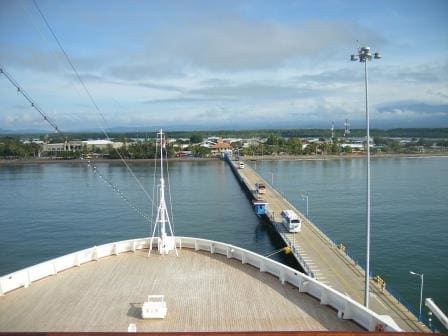
Thus the authorities decided to build a very long pier, reaching into deep water; they dredged around a bit and created a cruise terminal right in the middle of the town. A very nice and wide pier with a little shuttle train taking people to and from the gate, if you did not want to walk.

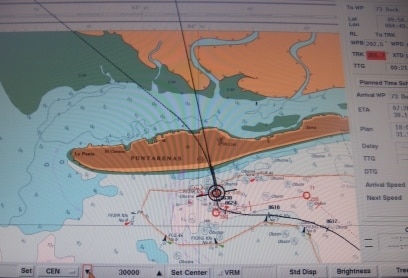
However this pier has two issues. While the dock of Puerto Caldera is protected by a breakwater against the incoming swell, the pier at Puntarenas is completely open. If there is a high ocean swell, then the ship will move on that swell alongside the dock. Sometimes the swell is so high the ship cannot give out a gangway, or accept a shore gangway.  Secondly  because of its location, it has a heavy current in the area and that makes it quite difficult for ships to dock and undock. Hence you have to adjust your arrival and departure times to nearly the slack tide times when the current is near zero.

blog puntaarenas pierThus both ports have its advantages and disadvantages. The authorities now have a nice pier and want the cruise ships to use it. The captains want to have a steady ship alongside and arrive and depart on the regular schedule and thus they want Puerto Caldera as a Plan B and sometimes as a plan A.  I had to make that decision a few times in the past and I always preferred Puerto Caldera. No so handy for the guests maybe, but at least we could always dock, and we could dock and undock at our regular times, without having to take the current in consideration.

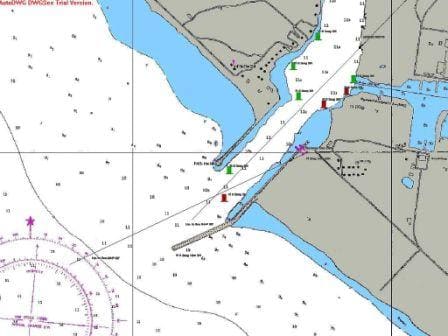
A view from the electronic chart. Puntarenas is located on a peninsula to the west of Puerto Caldera. This location causes a strong East/West current

A view from the electronic chart. Puntarenas is located on a peninsula to the west of Puerto Caldera. This location causes a strong East/West current

Luckily today there was no issue. Slack tide was around 06.00 and the next slack tide was around 18.00, both more or less in synch with the cruise brochure. Also the swell was only a foot or so. It made the gangway move but not to a dangerous extent. The only challenge was the heat. It was very warm today. So I did not mind to spend most of my day inside.

Today I facilitated a big drill, called a triage drill. This is a sort of emergency drill but with so many casualties that it is beyond the capabilities of our medical department. Still we have to cope and thus we have Triage scenarios.   Triage means assessing and then deciding on priorities. Who can we save, who can wait for treatment for later and which victims are hopeless cases. It was developed by the army to deal with large number of wounded soldiers but it is applicable in the same way to cruise ships with larger number of people in close quarters.

The focus on the drill is to have everybody support the triage officer (most often the lead nurse) during the initial triage assessment and then very quickly get the injured people to the various treatment area’s where the rest of the medical staff (2 doctors and one more nurse) can work in safer and better circumstances than at the scene of the emergency.

So 16 victims (volunteers from our entertainment and deck department) were in the show lounge where we simulated a collision. All had a  sticker on their breast with their problem (broken leg, unconscious, burns, leg missing etc. ) for quick assessment and then they were all taken out, one by one, on stretchers and in wheel chairs and transported to the various treatment areas. The coordination of it all is the biggest headache as it involves so many people in difficult circumstances.

It all went very well. Yesterday we had a pre briefing and all involved (about a 100 crew) had taken all the past experience to heart and used it during today’s drill as best as they could. Tomorrow we have a debriefing for lessons learned which we will then apply again next time, while I will try to make it company policy.

Tomorrow we are in Corinto. We are scheduled to arrive at 10 am during what looks like another sweltering day.


29 October 2014; At Sea.

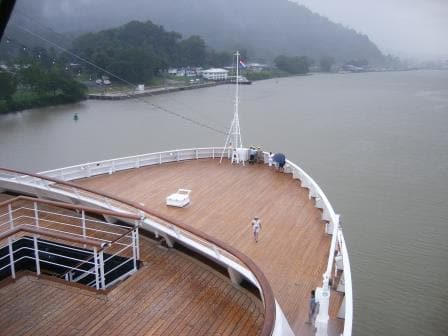
Today a peaceful and nearly wind still day at sea. The only movements that can be seen are other ships coming from or going to the Canal and Brown Boobies and Starlings hovering over the bow. The moving ship produces an upstream of air and the birds love it. Without any real wind there is no turbulence, so they can drift on the “bow wind” and land on the railing whenever they want.

On the very top of the bow mast is a small black box. Inside is the Panama Canal steering light......and a perfect landing pad for any self discerning sea bird

On the very top of the bow mast is a small black box. Inside is the Panama Canal steering light……and  it offers a perfect landing pad for any self discerning sea bird

As they like to sit high there is a constant tussle going on between them of who is allowed to sit on the highest point – the top of the Panama Canal steering light.  Nice to look at and some divertissement for the Navigators. The only person who will be distinctively unhappy will be the Bo’ sun as the birds tend to leave presents behind on the wooden deck, before they move on.

Yesterday we were in the Panama Canal and between a cruise ship and a cargo ship there is one big difference to observe; tugboats are seldom used.  As they are compulsory when entering and leaving the dock and anywhere else where the pilots deem it necessary, you see them hovering around the ship but a cruise ship they seldom touch.  All courtesy of the gadgets that make the cruise ships so maneuverable.

But even among the cruise ships there are differences. Sometimes in design and sometimes in power. The more modern the cruise ship the more powerful the propulsion tends to be and the same goes for the thrusters. I think that the designers realize that in the long run cancelling ports is less cost effective than spending a few dollars on equipment during the new build.  Thus all the cruise ships now have bow thrusters, stern thrusters, pitch propellers, double rudders or the combination of propeller & rudder & thruster into a pod.

Basically with having all that power it means that you carry your own tugboats with you, which will enable you to dock in ports where there are no tugs, or where the tugs are not strong enough. More power and you can dock during higher wind & current situations.  For the latest generation of cruise ships it is not unusual that they can maneuver against 40+ knots of wind and that is Gale force winds. Winds that almost make you bend over while walking in it. If the captain deems it safe to dock, it again reduces the chance of a cancellation.

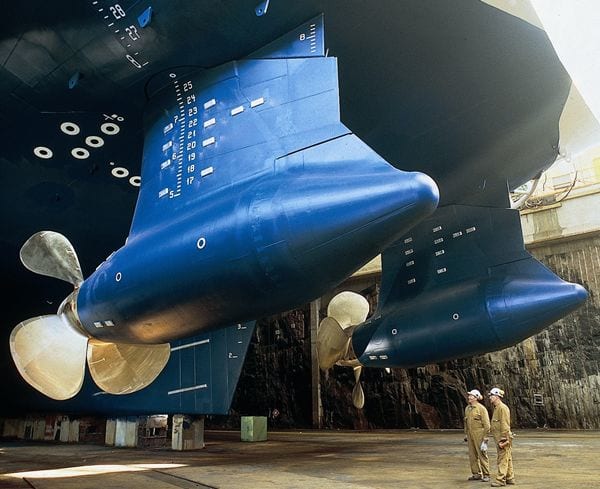
This is the pod setting for going forward. The is pulled forward instead of being pushed forward as is the case with a conventional propeller system

This is the pod setting for going forward. The ship is pulled forward instead of being pushed forward as is the case with a conventional propeller system

Since 2000 the addition to the ships of podded propulsion has become more and more standard. The great advantage is that it combines the stern thruster, the rudder and the propeller into one unit. Basically it acts as if you have an outboard motor hanging under the ship and the way you pull the handle is the way the ship goes.   For maneuvering a ship it does not make that much of a difference, whether everything is separate or combined into one unit, except for one issue: With rudders and stern thrusters you are limited to a certain amount of power that is available. With an Azi –pod or Mermaid – pod (Azi pod is name of the ABB Company, Mermaid is Rolls Royce) all the power that you use for going forward is now also available for going sideways.

Starting with the Amsterdam in 2000 all our ships, built since then, have podded propulsion.  Also our new ship will have it and as everybody is very happy with this concept, I will think we will keep it for a long time to come………….Until something new comes along.  The Pod was a bold innovation but no doubt there will be –out of the box – thinking going already again. It will be exciting to see what the next innovation will be.  I would not be amazed if some sort of sail assist would be the next step.

Most of the day we were still sailing off the Panamanian Coast but by 5 pm. we crossed the border between Panama and Costa Rica. Then by tomorrow morning 0500 hrs. we will approach the Golfo de Nicoya to dock at 0600 in Puntarenas.  Weather expected more of the same; warm, sunny and the occasional downpour.


28 Oct. 2014; Panama Canal, Panama.

And thus we approached the Panama Canal in the very early morning hours. However things do not always go as planned so by 0800 hrs. the ship was one hour behind the published schedule, courtesy of some slow movers coming the other way. That meant that the whole transit was going to be put back due to the natural bottle neck at Gamboa. This is the Panama Canal headquarters about half way in the Canal. Here the Canal goes from single lane to dual lane, e.g. ships can pass each other between the Atlantic side and Gamboa but not between the Pacific side and Gamboa. A slow convoy moving towards the Atlantic and the convoy towards the pacific is delayed. And yes we were delayed accordingly. If all goes well you can make Gamboa around 11.30 in the morning. Now it was going to be 12.30 and that also automatically meant that the Veendam would not be out in the open (Pacific) ocean again until 1700 hrs.

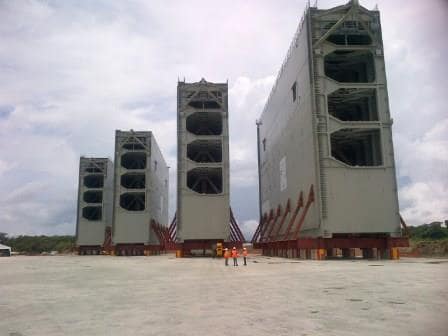
The new locks waiting to be installed. Photo from the internet

The new locks waiting to be installed. Photo from the internet

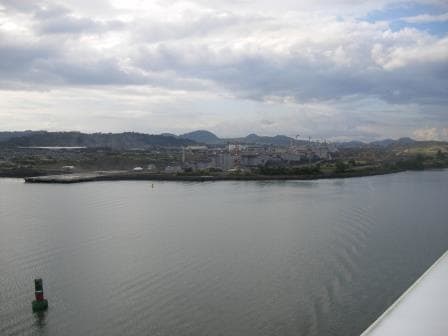
My main interest today was to see how they were getting on with the new Locks. On the Atlantic side there is hardly anything to see as a high hill between the old locks and the new ones block the view. But they had an attraction there: the new lock doors had arrived and were parked for the time being on the edge of the fairway to the first set of Locks, the Pedro Miguel Locks. They are big, really big, soo big that it was difficult to get a picture of them in such a way that it did justice to their size. So I googled one but it shows the same location and setup of what I could not get on my camera the right way. We had glorious weather today, sunshine all the way to the Continental Divide.

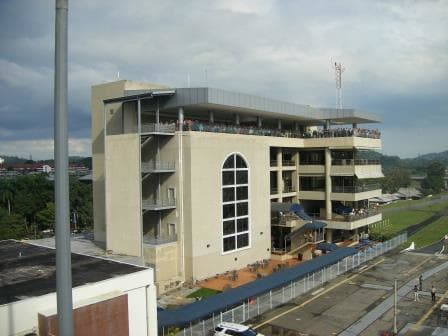
There it rained and thundered for 5 minutes while approaching the 2nd set of locks and then it was dry again for the remainder of the passage. So everybody should be really happy about that one. A very nice un-eventful crossing. The first set of locks are the most impressive ones, as they have the 3 step going up and going down. But at the last set of locks there is more to see, as one side are the new locks, clearly visible taking shape and the other side there is a large visitors centre which is normally, and was today, full of people watching the ships go by.

blog visitor centreA cruise ship of course attracts more attention than a cargo ship and so there was a lot of noise coming from the 1000 (?) or so viewers on the top floor. But the other side was the most interesting.

blog locksThe Canal had a setback a while ago when it became clear that the wrong concrete was used when they started with the lock chambers. The Panama Canal Authority and the (Spanish) contractor are blaming each other but what happened was that the concrete was used did not set/harden in the rain. Who ever made the mistake must have thought that it never rained in Panama. Well if it didn’t then there would be no Canal and then there would also be no reason to pour concrete for new locks in the first place. However that issue has now been sorted and the lock walls are going up very fast and the area is enormous, gigantic and really impressive.

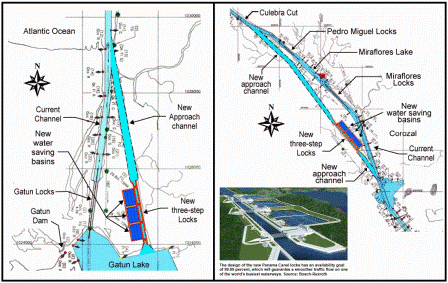
The new the new Locks fit into the old system

The new the new Locks fit into the old system

Although you can see it very well, it is still quite far away from where the ship now sails coming out of the old locks. When the locks are finished, the dam will be cut away and then there will be a Y pass created, giving the option to use the old or the new locks. For the cruise ships it would be interesting from a sightseeing point of view to go through both an old and a new lock. By 2016 we should know if the Panama Canal Authority is having the same thoughts. Tomorrow we will sail along the West coast of Panama and then later along the Costa Rican one on our way to Puntarenas. It is going to be interesting weather wise as there is the chance of a hurricane brewing further out in the Pacific. The weather gurus are a bit non-committal as to what is going to happen, so the only thing we can do is keep an eye on it and plots its development and movement.

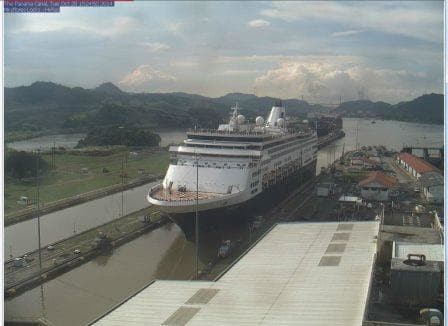
The Veendam on the Panama Canal Webcam.  (Courtesy of Lesley Schoonderbeek)

The Veendam in the Panama Canal Webcam. (Courtesy of Lesley Schoonderbeek)

27 Oct. 2014; Cartagena, Colombia.

The weather forecast called for rain in the afternoon but it turned out not to be the case. We had all the rain in the morning and it only dried up close to lunch time when all the guests were returning to the ship, as departure was scheduled for 1300 hrs.  It gave a very sunny sail away, but a rather wet port call. For those of you who are familiar with the area; when it rains, it does rain, better said, it pours. The rain might be warm but you still get soaking wet.  The ship was docked by 0700 hrs. in the morning to give everybody maximum time in port and most guests took indeed the opportunity to do just that. I normally have breakfast at 0700 hrs. in the morning but it was standing room only in the Lido and thus I awaited a better time. Never interfere with people ready to mount an invasion.

Cartagena is located partly along the coast of the Caribbean Sea, the lower West part. That is the Western side of the City but the port is located around a large inland bay, which for the city is laying at the East Side.  It is a very large bay and it is sheltered. It takes nearly an hour to get from the entrance to the cruise dock in the top of the harbor. As long as you can get through the entrance, you are in safe waters.

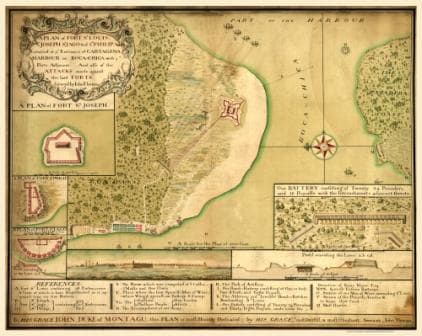
A view of the Boca Chica entrance from an ancient map

A view of the Boca Chica entrance from an ancient map

The entrance is narrow and is called Boca Chica. What is narrow can be easily controlled and defended and it is this combination of narrow with a very large bay, which made it a coveted place. Already in the 16th. Century  the world powers were quarreling over it. The British fought the Spanish here, the Dutch created mayhem here; basically everybody who was somebody in the good old days had a go at the area. However the Spanish influence has always been the greatest as can be seen nowadays from the fact that it is a Spanish speaking Country. Gun emplacements and Forts are located on either side of the entrance and date back to the days of the Spanish.

This is the fortification on the South Side

This is the fortification on the South Side

I have been coming here since 1982. The first call was with the old Statendam (III) which was then on her last voyage (Capt. Aad Hess) before being sold to Paquet cruises.  I had heard the stories but now I saw with my own eyes what a real Middle American (or a northerly located South American port) looked like. Cartagena had not yet made the transition to a container port, security was non existent and cleanliness was a word mainly found in a dictionary.  The docks were still covered by the old sheds from the days that all the goods were stored there until loaded by hand onto the ships. As nobody really cleaned up I saw the biggest rats I have ever seen.  But according to most crew on board it was a happy place.  Happy Shopping, Happy Prices, Happy Hour, plenty Happy Ladies……… and plenty Happy Rats. I was not impressed.  Although the city itself was very beautiful and interesting.

Things were not really that safe in the following years, due to the emerging drug cartels which used Cartagena as an export base, and for a while afterwards the cruise ships did not call anymore.  Then containerization came and with it the whole port was cleaned out. Now there are nice docks, good infrastructure and the ships started to come back. I think that most of the Happy stuff is still there as well but it is now far removed from the Container Port; which now doubles up as the Cruise Terminal.

As mentioned yesterday, we have to get to the canal on time and thus we sailed at 1300 hrs.  The schedule for the Transit has come in and tomorrow 28 Oct., is an early one.

0500: Breakwater at Cristobal

0630 – 0835  Gatun Locks

1335 – 1415  Pedro Miguel Locks

1430 – 1445  Miraflores locks

(Which means we could be back in open sea by 1600 hrs.)

The weather forecast gives a “chance of rain” and that is always a safe prediction. If we do not get rain on one side of the Continental Divide, then we will get it on the other side.  As Capt. Hess of the old Statendam would say; I have no idea what the weather is going to be, but I can promise you a Zero percentage of snow.

26 Oct. 2014; At Sea.

What was supposed to be the one day at sea became now the 2nd day at sea due to not being able to call at Grand Cayman yesterday.  And what a day it was today. Flat Calm of wind. Not even a ripple for most of the day. The only wind that was there was produced by the ship itself.  It made for what they call a “balmy” day. It made the sea surface look oily and anything that moved over or in it was easy visible. Thus the Quartermasters spotted “big fish” at 07.30 when I poked my nose onto the bridge.  As I have explained in the past, we are now all heavily trained in recognizing large marine mammals in the water and then to ensure that we do not sail over them.  Most species we easily recognize, such as Humpback, Minke, Right, Fin, Blue whales, etc. etc. Same goes for Dolphins although of those there are a larger number of variations out there and sometimes the differences are quite minimal.

This morning we saw something that looked like a small whale or a very big dolphin and all the experts on the bridge were puzzled.  Thus the book “with all the Marine Mammals in the world” came out and by studying the pictures we tried to come to a identification.  We really could not find it, as the dolphin that we saw looked like the Common Dolphin but it was just much bigger than the average dimensions given in the book.  Thus the Quartermasters were convinced that they had discovered a new sort of dolphin which is now officially named “very big common dolphin”. (In Latin: Dolphinus Giganticus Communales) Now we have to make sure that next time we take pictures when we see one so that we can prove our discovery.

While the ship is gearing up for the official change over to the 3 alarm system, I can only wait as all the preparation work has nearly been done. I will be in full swing again when the changeover takes place. So for the time being I try to induct 24 more crewmembers in the secrets of operating a lifeboat.  In the past only those who were in charge of the lifeboat needed to be certified; the rest had to be trained on a regular basis. Now legislation and also company requirements are getting more and more elaborate and that means that every crewmember now needs proof of their knowledge and their training. Certificates, stamps and other tokens that keep the auditors satisfied.  With the regular change over of crew and the rotation to other ships there is always need for more certified crew and I try to help the numbers swell.

Especially the new function of Communicator needs attention. This is a new addition to the life boat crew and this person is meant to narrate and announce to the guests in the lifeboat what is going to happen and how it happens. So when the lifeboat would wobble (and they all do when being moved away from the ship in the davits) then everybody is prepared and nobody will panic.  For that we need native English/American speakers and also those who can to a certain extent perform.  Hence the Entertainment department is now a prime target for me. Singers, Dancers, librarians, Travel Guides, Techsperts, Band leaders, whatever function we have out there, they are all a prime target.  The same is going on, on all the other ships, only there the deck officers have to find time to conduct these classes. Here on the Veendam, I will deal with it as long I am around for the three alarm system.

Thus today we had the scheduled sea day and a warm day it was. Relatively few guests were on the outside decks, many more sought their divertissement inside the ship. Ranging from the early morning Church service, to bridge, to the Lectures (about Sea Mammals !!!!) to the shop deck sale, the travel guide and the art auctioneer, and do not forget the bingo. There also came a lot of noise out of the Casino so it looks like they all had a very good time there.

Tomorrow we are in Cartagena. We are scheduled to dock at 07.00 hrs. and sail again at 13.00 hrs.  We are looking forward to real Cartagena weather; Very hot when the sun is shining and still hot when it is raining. We are expecting showers in the afternoon, so we should get it all.


« Older posts Newer posts »