- Captain Albert's Website and Blog -

Ocean Liner History and Stories from the Sea, Past and Present. With an In Depth focus on Holland America Line

Page 99 of 241

10 April 2015; At Sea.

We are on now on one of those stretches between ports which really do not fit in a proper cruise schedule. The distance between Malta and Crete is too far to cover in one night and for a full day at sea, you are really sailing on a slow-boat. So we are happily trundling along with a speed of 11 knots. A good thing as well, as during the evening and early morning there was a considerable amount of wind and thus quite a few bumps in the road. Had the Prinsendam been going full speed we would have noticed all those bumps in a very distinctly way. Now with a slower speed the bow rides the waves instead of bashing into them and it results in a much more comfortable ride.
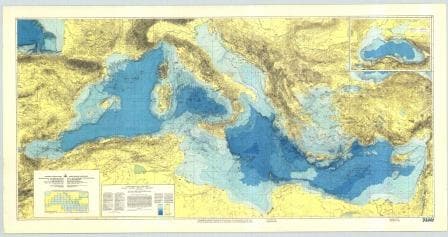
depth med chart for blogToday we are deep water. The Mediterranean Sea as a whole is not so deep.  In the long and distant past, when the Oceans were lower, this area was once land and only with the rising seas this land area was eventually broken into near Gibraltar and flooded. But East of Sicily and South of Greece there are quite some considerable depths which are more normal in the Oceans than in an inland sea.   As you can see from the Chart there is a deep blue triangle right in the middle of the Med. This area is called the Ionian Sea and the ocean floor dips down to over 5000 meters. (The deepest deep is the Calypso Deep with a depth of 5,267 meters or 17.280 feet)

There is another interesting issue with the Med. One that affects in a small way the seafarer.  As there is more salt water coming in, than fresh water, the Med is a little bit more salty than the oceans to which it is connected. How does affects the seafarer? Well, every ship has a draft and the draft depends on what water that ship is sitting in. Salt Water with its higher density creates more buoyancy then Fresh Water. Fresh water has a salt content of zero; we call that 1000.  Regular sea water has a salt content of 35 grams per 1000 grams water or 35 parts per thousand.  The Med can reach 37 to 38 parts per thousand. This means that the ships draft will reduce by the influence of those 3 extra parts per 1000 more than in the Ocean.
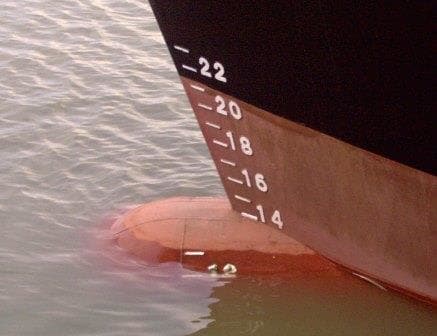
This is not the bow of the Prinsendam but an image plucked from Wikipedia. the Draft Marks are in Feet. Nowadays more and more ships are metric.

This is not the bow of the Prinsendam but an image plucked from Wikipedia. The Draft Marks are in Feet. Nowadays more and more ships are metric.

Although 3 parts extra is not that much, the total of 38 extra parts per thousand is considerable and it affects the ships stability. As a rule of thumb, the deeper a ship lies in the water, the more stable it is. Hence the great interest a navigation officer has in the draft. As a result a deck officer will check the draft in every port before finalizing the stability calculation for the coming voyage. In the old days we had to run around the ship, now we have digital read outs on the bridge. But as that is mechanical, it can go wrong and thus the deck officer still regularly verifies if those read outs are correct. We have those read outs (called draft marks) at the bow, the middle and at the stern. By combining all three, as the ship is not always at the same draft at the bow as at the stern, the navigator can figure out the exact displacement of the ship in the water. By checking the salinity, he/she can then exactly figure out what the weight of the ship is and thus calculate if the stability is good and if it is safe to sail.
plimsoll line

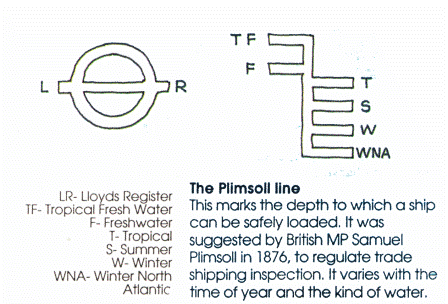
Related to this, is the existence of the Plimsoll Mark on the side of the hull. This harkens back a number of years. In the good old days, everybody just loaded the ships anyway they wanted and some unscrupulous ships owners wanted as much as possible and on a regular basis ships sank, capsized or cracked open. And there were lots of them. A gentleman called Mr. Hall invented a measuring system so you could see on the hull if the ship overloaded or not. How deep the ship could go depended on the salinity of the water and that was indicated as well. A British parliamentarian pushed for this system to be adopted into British Law and somehow he got his name attached to it as the Plimsoll Mark. Nowadays the whole world is using it. It is embedded in Maritime Law and each commercial ship is required to have it.

Tomorrow we are in Heraklion or Iraklion, Crete. We are expecting a chilly day; same as we had today as the winds keep blowing from the north. Only tomorrow even more so.  We will be docking at the passenger terminal as we are the only cruise ship expected. When we dock, there will be a lot of wind on the beam while lining up, so I expect that the captain has a few tugboats lined up. As far as I remember one tug is compulsory anyway. Courtesy of a harbor master who does not like dents in his piers from captains thinking they can do it without.  Noon temperature is supposed to reach 66oF/ 19oC. But my guess is that this is out of the wind and in the sun.
 

09 April 2015; Valletta, Malta.

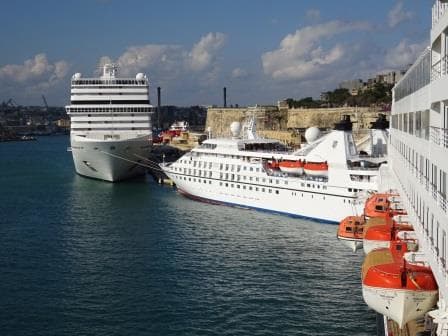
They call the port of Valletta the Grand Harbour and that is correct for more reasons than one. First of all it is a very large enclosed harbor which can handle any draft as long as the ships fit through the breakwater and it is surrounded by monumental buildings erected through the ages until the current day. Although nowadays not much new can be erected as the place is full and the locals are not planning to knock something old down to get a more modern creation in place. This has made sailing in and out always spectacular or just plainly enjoyable encase you are not overawed with what you see.  It is just an amazing place.

Busy day again in Valetta.

Busy day again in Valletta.

We were not the only ones who thought so as behind us was the MSC Magnifica which came in just before 08.00 hrs. and the Seabourn Spirit which was already there yesterday. This is one of the three smaller ships of Seabourn and she is on her last voyage as Seabourn is phasing out the smaller ships. All three have been sold to Windstar which once was also part of Holland America. Seabourn which is now a sister company to us, is replacing them with bigger ships, roughly the Prinsendam size and already has three of those in operation. The Seabourn Sojourn, Quest and Odyssey. Two more ships are under construction, the Seabourn Encore and the Seabourn Ovation. They will come into service in 2016 and 2018. The small Seabourn ships were nice and because of their size they could visit ports not open to larger ships but they lacked one thing and that was balconies. Some years ago the company tried to alleviate this problem by installing French Balconies in the suites above the lifeboats but it did not fully solve the issue.  Hence new ships and to get balconies on, you have to build them larger as well. You are no allowed to have Balconies under lifeboats and that means a redesign of the ship and that means you have to go larger. Still 40.000 tons is not that large.

Most of our guests went ashore and if not on tour, they could reach the city of Valetta easily as it was just across the street from the gangway. If you want to walk everywhere, or better said climb everywhere, you have to be a bit agile as it is all uphill when you leave the ship (although you go downhill when coming back) and that is quite an exercise. Hence the taxi’s and the Big Red Bus being very busy.

I created my first bit of “mayhem” today by throwing an un-expected fire drill today. The last two days I have been busy with paper work today I got the chance to get the crew going.  According to company policy we have to conduct and un-announced fire drill every three months to test the crew’s alertness for a real event; incase that would happen. Normally we have fire& training drills around 10.30 in the morning as this time does not upset the daily operation of the ship too much.  However if you do not occasionally do it at a different – at an unannounced time – then the human penchant for routine and tradition takes over.  Thus today I put the Officer Bar “on fire” and waited to see what was going to happen. Well at lot happened and in no time I had fully dressed firefighting teams barging into the Officer Bar and even crashing through doors in order to get to the fire as soon as possible. I am glad to say there is nothing wrong with the alertness of the crew of the Prinsendam and they followed the Company’s firefighting doctrine to the letter. It went very well.

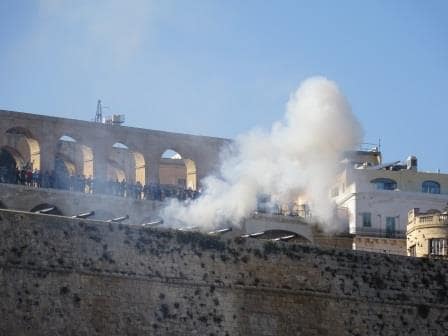
And I can assure you, they were blanks they fired.

And I can assure you, they were blanks they fired. This was shot nbr 5.

Sail away went well as well. While sailing out, the city of Valetta greeted the Prinsendam with a 7 shot Gun salute from high up the bulwarks of the City’s old defense works.  Nice to see and even nicer to hear.  Old guns can make a lot of noise.

Tomorrow we have a sea day, and it is expected to be a bit of a wobbly one and then we will be in Iraklion, Crete. To do so we have to get on Greek time and therefore the clocks will go forward one hour tonight. We are scheduled to be the only ship there, so we will have Crete to ourselves.  Wobbly weather caused by North Easterly winds and thus it will also be chilly for most of the day.

08 April 2015; Gozo, West of Malta.


It did not look good during the night. Around 3 am. a heavy rain squall hit the ship and a ferocious wind blew around it, but it passed and in the morning it was back to the normal – windy day- as yesterday. Now it would all depend on it if the lee was good enough as the wind did continue to blow from the right direction, straight over land providing the maximum lee possible.

It turned out it was enough. There was still 20 to 25 knots blowing but as the ship could anchor close enough to the shore the wind could not create enough waves and the swell which curved around the island was not that high. We were in business. It was going to be a windy day with a wobbly tender ride but we were there. In the past the Prinsendam had had to cancel calling at Gozo several times but this time we were lucky.  Everybody could go ashore to see Gozo while the sun was shining and temperatures hovered around the 16oC / 61oF. Not warm but perfect for sightseeing.

Because there is not much lee around Gozo it is very hard to call at Gozo with a cruise ship. Unless you fit inside the port but then you have to be the same size or smaller than the ferries and they are not very big to start with. The sides of the island are quite steep and the wind not only blows over the island, the steep cliffs can also guide that same wind around the island if it has enough momentum to start with. Today with a wind force 4 to 5 it was not too bad and we could stay. Otherwise the only solution is to go to Valetta and to run a tour from there and use those ferries. We could count ourselves very lucky.

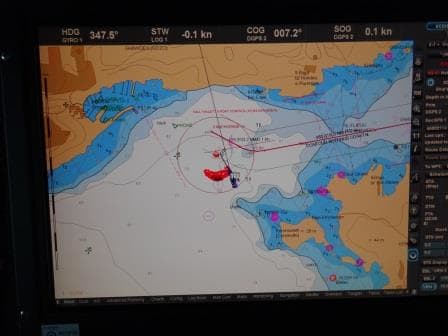
The red "bean" on the chart screen are all the positions plotted while the ship moved to and from behind the anchor chain. The blue is the projected location of the ship in the next three minutes.

The red “bean” on the chart screen are all the positions plotted during the day while the ship moved to and fro behind the anchor chain.

Because of the strong winds the Prinsendam behaved like a restless horse on a long tether. The captain had run out 8 lengths (out of a maximum of 11) of anchor chain and thus with over 200 meters of chain on the sea bottom we were safely at anchor. But while the weight prevented the anchor from dragging, it gave enough room for having the ship yawn behind it considerably. So for the duration of our call, both the cabins on the portside and those on the starboard side got a very good view of Gozo harbor while the Prinsendam swing like a pendulum behind the anchor chain.

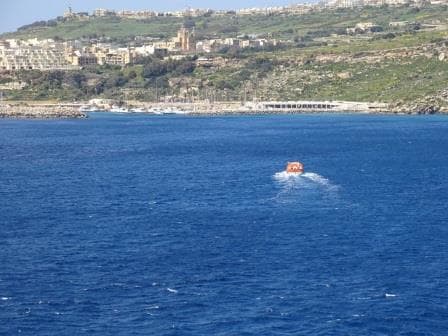
Churches are always handy. Here we have one which is positioned perfectly to guide the tender safely into the port.

Churches are always handy. Here we have one which is positioned perfectly to guide the tender safely into the port.

I did not go ashore as I had a ships articles review to do but what stands out in my mind from the last visit there was the number of churches for such a small island and the wild nature on the west side. Wikipedia just taught me that there are 46 of those churches scattered around the island and that for a population of 37,000 is quite a high per diem. Lots of things to see if you are into church buildings.

Most of our guests went on tour but several went for the hop on – hop off Bus that marvellous invention has also reached Gozo. I am a big fan of it and luckily they can be found in more and more ports and towns.  It works much better than haggling with a local cab driver and you have a much better view. There is talk about building a bridge between Gozo and Malta or maybe even a tunnel but it will be an expensive affair and there will be a big political battle to see if the money is worth it and if the Government can afford it. Malta is not that big, that is has surplus billions lying around to play with.

Because Gozo is so close to Valetta on Malta we are having two ports calls in one day. As soon as the last tender was back and the anchor was raised, we sailed between Gozo and the West point of Malta to the North East and then approached Valletta from the North. This port has been designated one of our overnight ports and that gives the option to do a barbeque on deck. Theme this time is Mongolian night.

We sailed into the port just before sunset. That is not the best time as the setting sun only lights up the buildings to the East near the dry-dock area. In the morning with the sun in the East, the ship sails with the sun and then the higher part of Valletta with all the fortifications form an impressive sight to behold.

Still sailing into Valetta still beats a large number of other ports, where there is simply………….. nothing to see. Thus we will be here until tomorrow evening and the weather looks good. Little change, in other words, perfect sightseeing weather.


07 April 2015; At Sea, South of Sardinia.

And thus the good ship Prinsendam sailed on a south easterly course from Barcelona towards Malta. In command is Captain Tim Roberts who was one of the captains who came over from Windstar Cruises when it was still a subsidiary of Holland America Line. He has remained with us ever since. Today the most puzzling part was the weather. It was wind still in Barcelona and then in the late evening it breezed up while we sailed north of the Balearic Islands. Once passed, the wind died down again but late this morning when coming in the vicinity of Sardinia it started to blow again. And not just a little bit, there is a stiff breeze blowing out there, which has whipped up the waves sufficiently for the ship to be moving about a bit. Not bad weather but wobbly and thus quite a few of our guests are not happy campers.  Tonight we will come in the lee of Sicily and hopefully the wind and waves will die down a little bit.   

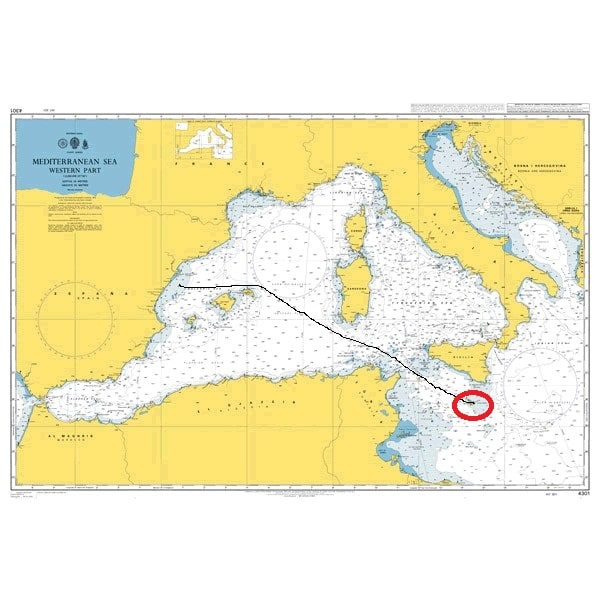
Our route from Barcelona to Gozo.

Our route from Barcelona to Gozo.

That is certainly hoped for as the anchorage at Mgarr on Gozo is not the most sheltered in the world. At the moment the wind is blowing from the right direction and that means that the island will act as a wind catcher and thus provide a good anchorage in its lee side. If that is the case then we have to see what the swell is doing at the anchorage. If it follows the wind completely then we are in good shape. If it decides to curve around the island than we might have some challenges. We just have to wait and see. Sailing on the Prinsendam is always a happening as the ship goes to places where other ships do not or cannot go. Gozo is a beautiful island with a rich history but it is not big enough to let 1000’s of cruise guests run around. The infrastructure is not ready for it and there is a distinctive lack of shops to keep the majority of those 1000’s happy. Gozo is all about culture. Even the souvenirs which you might want to buy (table cloths with lace fringes etc.) are more about buying culture than anything else.

As Malta & Gozo are very strategically placed between Africa and Europe it has always been in the middle of wars, invasions and all sorts of other mayhem which brought the local population a lot of grief but which also has resulted in a very rich cultural history. Romans, Arabs, Knight Templars, British Colonials, Invading Germans etc. etc. they all have been there and left their marks, good or bad, but definitely fascinating. So much that my wife and I went back there 2 years ago, for a week to see the islands properly and as you cannot do justice to it all with just a quick cruise ship visit. Plenty of museums to visit and I had only one complaint the island has a definite lack of 2nd hand book stores. It saved me money but I had hoped for better.

Navigation wise this is not such a busy area. There is a flow between the Straits of Gibraltar towards the Suez Canal but most of the shipping traffic veers north on the East side of Sicily and goes through the straits of Messina towards the Italian and French ports in the North West of the Med.  The only thing which can be a hindrance here are large numbers of fishing boats but with the strong wind blowing outside I do not think that the navigators will have an issue tonight. Any self-respecting fisherman, who wants to live to see his grandchildren, is staying in port tonight.

For the time being this is the closest which a HAL ship will come to Tunisia. The company has wisely decided not to call here anymore until it has reviewed the situation in regards to the safety of our guests. Although no acts of violence have been brought directly again cruise ship guests, the latest flare up at the Museum in Tunis did involve guests from two cruise ships and that is something we cannot have of course.  Hopefully we will be able to go back there one day as it is a great country with much to offer but we have to wait and see.

Thus tomorrow morning we will arrive at Mgarr roads on the East side of the island of Gozo and if the weather Gods favors us we can have a good day ashore here.  The weather forecasts calls for a sunny day with temperatures of 16oC or 61oF. Perfect for sightseeing. Now we just have to wait and see what the wind and waves are going to do.

05 April 2015; Barcelona, Spain.

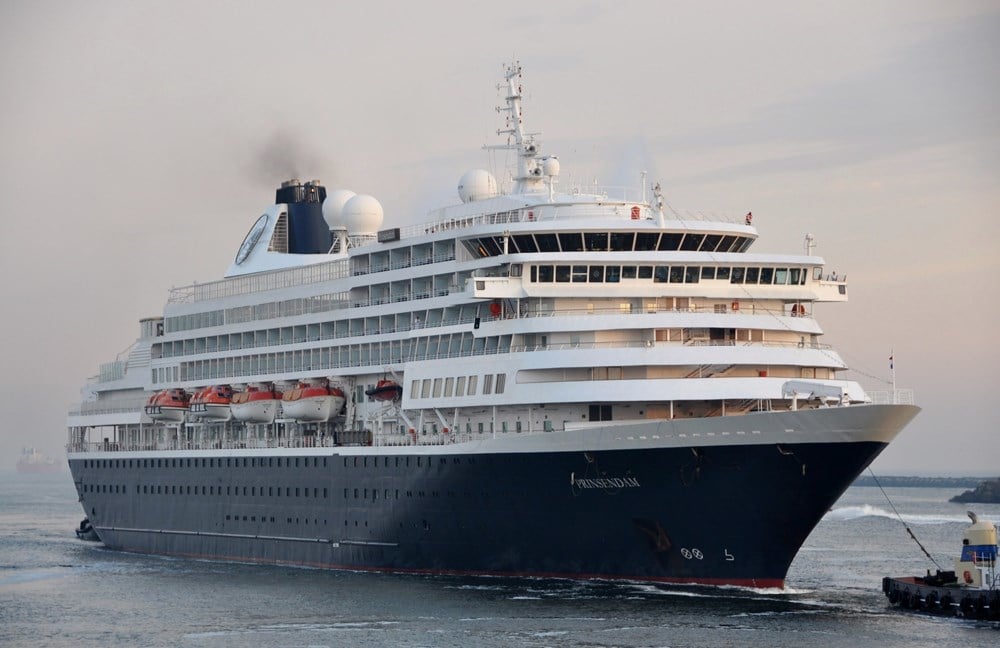
The Prinsendam in april 2014. (Courtesy an unknown but very good photographer)

The Prinsendam in April 2014. (Courtesy an unknown but very good photographer)


After a few rather unusual days I boarded the ms Prinsendam yesterday in Barcelona. It had been the plan to go home for 4 days when leaving the Noordam on the 30th. of March. However just before walking off the gangway I was asked by my colleague to stay on board, so he could go home to attend to a medical emergency in his family. Emergency’s always override personal plans so I suddenly found myself at the helm of the ms Noordam while the head office was phoning around to find a replacement. Luckily this turned out not to be so difficult and in the first port of call Philipsburg St. Maarten, three days later,  I could hand over and leave from there.  As a result I spent two nights and one day at home before flying out to the Prinsendam. Just home long enough to do the laundry and the ironing and with a disappointed wife (normally referred as Senior Management) who had hoped to have had my undivided attention for a few more days. Luckily she is an old salt as well and understands that helping out a colleague in an emergency overrides everything.  In the mean time I have heard that the emergency was not fatal so we can all be happy about that.

Now I start a 3 week period on the Prinsendam with trainings, reviews and other sorts of mayhem that accompanies me when I pop up somewhere. Senior Management is joining me for 10 days between Heraklion and Istanbul and hopefully I will be able to post some reports about the tours in the various ports.  Although Lesley has been at sea for a very long time, there are still places she has not been to or did not see properly.

The Prinsendam is on a 55 day Grand Voyage, and has just finished the crossing and is now commencing the “port hopping” part of the voyage. Barcelona is a change – over port for those who only booked a segment and thus the ship stays here on the 5th. and the 6th. It enabled me to go straight from the airport to the ship avoiding a stay in a hotel room somewhere.  Tomorrow we are a day at sea and then we will visit Mgarr on Gozo which is the smaller island West of Malta. The day after we will be in Malta itself with a visit to Valetta. Then another sea day, before arriving in Heraklion as the Dutch say or Iraklion which seems to be the more Greek spelling. From there it is to Israel and then to Turkey.

Israel is going to be interesting as we will be there during the Greek Orthodox Easter. The West has just finished this but the Orthodox Church is using another Calender which means it is Easter in Jerusalem twice. It might be rather busy and chaotic when the ship tours get there.

At the moment we are blessed with extremely good (sunny, cool and nearly wind still) weather in the area around Barcelona and that means that we should have a nice and quiet crossing to Malta. Although a lot of people do not realize it, the Med is a big sea and it can be very boisterous. Plus swell can build up over shallow waters and build up to very high waves. 30 feet and higher are observed on a regular basis during the winter season.

I spent the day today walking around the ship saying hello to a lot of officers and crew I sailed with in the past and re familiarize myself with the Prinsendam again. I was captain here from 2008 to 2012 so I know the ship inside out, but you forget things and also the company keeps tinkering with the ship.  In 2010 they built extra cabins, in 2013 they added a covered Lido deck and also inside they have been making small changes to make sure that the Prinsendam could follow modern trends as best as possible.

For a small and older ship not everything can be achieved but then that this not always necessary either. The ship is the “Elegant Explorer” and that can be achieved without having a rock climbing wall, 10 restaurants or a Jacuzzi around every corner.  (Although we do have a few of those ……….. on board)

Tomorrow real life will start again and I will be trying to find out how many new crew there are on board and how much they are familiar with all the company rules, regulations and operational procedures.

28 March 2015; Caribbean Sea.

Today we sailed on a slightly NNW course towards the Windward Passage the gap between Cuba and Haiti on Hispaniola. This means that during this course we sailed south along the East side of Hispaniola and then north on the West side. A sort of circumnavigation of the island with a very wide turn. The area under Hispaniola now looks again as it used to, very windy, but not too much swell as the angle of the Trade Wind is half over the island and that reduces the free wind surface needed  to whip up the waves in height.

This was a thing I used to my advantage during my first year as Captain on the old Noordam. Learning how to use this to my advantage. No open water around, no swell or waves rolling in. Being used to not being able to operate a tender service in ports when the winds were stronger than force 5 or 6 because of the generated swell causing too much chop at the tender platform. Then I came to Greece. Here the Etesian winds from the North can easily blow 35 to 45 knots at times and I found out if I anchored close enough to the shore then the wind might be ferocious but there was not enough distance for the waves to build up. At the same time that strong wind would keep the ship away from drifting onto the shore.

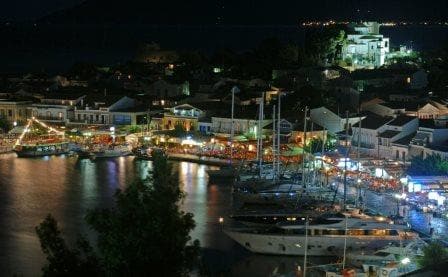
The harbour of Pythagorion by night. We parked our tenders right in the middle of the town.

The harbour of Pythagorion by night. We parked our tenders right in the middle of the town.

The best example was Pythagorion on the island of Samos. When I arrived it was blowing a severe gale but coming closer to the breakwater of the port the flatter the water went. In the end I dropped two anchors about half a ships length from the breakwater and ran a perfect tender service for the day. The tenders docked straight onto the little boulevard with rows and rows of Taverna’s right across the street. Tendering during a full gale and the guests really did not notice it. We stayed until 11 pm. and while normally Guests all return for dinner on board, that evening we had a really hard time of getting them out of those taverna’s and back on board. The little town was in the shade of the mountains and there was hardly any wind blowing through the town so everybody could sit comfortably ashore. Sitting in Greece under starry night with a good glass of wine looking at a fairy tale lighted ship was Paradise revisited and nobody wanted to return. If I remember rightly we had 3 tenders lined up at 22.30 in the evening to get everybody back on board at the same time.

Through all the years this was for some reason a call which I have never forgotten.  We only called there a few times and later not at all anymore. I wonder if it has changed much. Most cruise ships call at Kusidasi just around the corner which attracts more people due to the tours to Ephesus.

Greece is far away from the Caribe, although I will be there again in the very near future. The training class for new officers is coming to an end here on board the Noordam. For three weeks they have been listening to the HAL gospel as preached by me. They have been suffering under a assignment dreamed up by nasty me and been exposed to training drills they had never dreamt about by an even nastier me.  Tomorrow is the final day with presentations; handing out certificates and finishing off with a farewell dinner. Then some of them will fly home, waiting for their first assignment. Two of them already have their assignment, here on the Noordam and can simply stay on.

I will fly home for a few days, and on the 5th. of April join the Prinsendam for 3 weeks in the Mediterranean which will include several Greek ports.  As the Prinsendam normally does some unusual ports there will no doubt some items of interest to highlight. My blog will be silent until the 6th. when the Prinsendam leaves Barcelona for travelling into the Med. All the way up to Istanbul.

Tomorrow will be our last day at sea, travelling to the old Bahama channel towards Fort Lauderdale. The guests on board have had a really warm and sunny cruise, so they should be very happy.

Weather forecast: there is a frontal system descending onto Cuba from the American East coast and that will cause cloudiness and a considerable drop in temperature.  Time to put the sun tan lotion away.

I will be back in a week.

27 March 2015; Oranjestad, Aruba.

Guests do not always understand why we sail early from one port while the next one is just around the corner; and why we stay longer in another port while the next port is also nearby. Well it has to do with the design of a cruise. The company tries to create a multi experience event which the guests will appreciate and then come back for more. And thus we try to fit in on a longer cruise one evening in port for an on deck experience and the option to enjoy night life ashore. Willemstad on Curacao and Oranjestad on Aruba are such ports for the South West Caribbean and San Juan Puerto Rico is such a port for the East Caribbean. This port is most of the time followed by a call at St. Thomas which is just around the corner again.

Whatever time we leave the distance to the next port can be very short and then the ship just goes very slow to adjust for a scheduled arrival. Except this morning. We left at 11 pm. and shortly after the Captain was informed that a guest needed some special medication which was not on board. Then you can return but with Aruba just next door, you might as well speed up for a few hours and dock as soon as possible in your next port. It would take the same amount of time to return, then to continue, with the islands being so close together. Thus the Noordam docked this morning very early, while all the guests where still sleeping. The patient was taken care off in the proper way and the other guests were not inconvenienced by arriving late in the next port due to a medivac.

Our ships hospital is laid out as a regular small Emergency hospital and first aid unit as ashore. We have two doctors and two nurses on board and they can take care of all the incoming issues as would be the case at a regular A&E. On shore the patient who has a more complicated issue is then directly forwarded to a larger hospital where more specialized doctors are available. We cannot do that as easily on the ship and thus we have to carry out medical disembarks or Medi-vacs.   The medical team stabilizes the patient if the situation is serious and then the captain tries to find the nearest and most safe place to get the patient on the way to an appropriate hospital. Sometimes this is by helicopter, sometimes by boat and sometimes the ship sails into another port and simply docks there. Ambulance shows up, arranged by the local port agent, a ships side door opens and the patient is disembarked.

I took a few hours off yesterday as my trainees where busy with preparing a case study to present on their final day, this coming Sunday. They have been given a ships accident to investigate by producing a time line of the significant moments in the case and then point out where it went wrong, where it went right and if are there any lessons learned. Before that they had security training from our ships security officer and observed the gangway operation with the security guards.

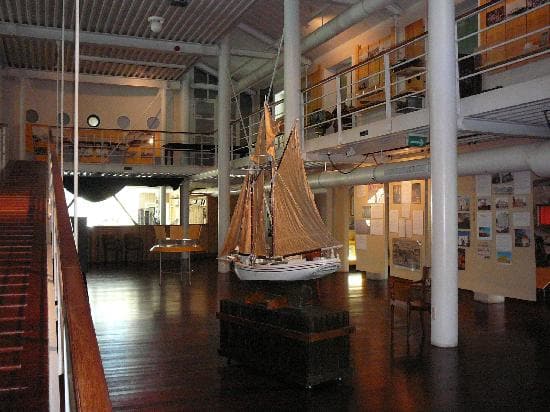
The museum has three levels. One and two depict the development of Curacao and the sea trade and on the 3rd floor is a Royal Dutch Navy exhibition depicting that part of the islands history.

The museum has three levels. One and two depict the development of Curacao and the sea trade and on the 3rd floor is a Royal Dutch Navy exhibition depicting that part of the islands history.

That gave me time to show around the people from the Maritime Museum in Willemstad. It is right opposite the fruit market I wrote about yesterday and very much worth while a visit.  I have asked the Curator if he could find out the answers to some questions which I have in relation to office presence of Holland America in Willemstad in the 2nd world war and if there were any photos from the olden days showing HAL ships docked in port.  So we will see what comes up.

Today we are staying until 5 pm. as we need the time to get back to Fort Lauderdale on time by Monday. This stretch is a 19 knot run and that does not leave much room in the schedule in case there is adverse wind, swell or other issues which might impede the timely arrival. Saving a few minutes here and there soon mounts up and if you can get out at 16.45 instead of 17.00 hrs. then that is a nice bonus.

During the night and tomorrow we will cross the Caribbean Sea, heading for the East Side of Cuba and then sail through the Windward Passage to arrive north of Cuba.

Weather:  Sunny, but very windy and that means a wobbly sea until we get in the lee of Haiti late tomorrow.


26 March 2015; Willemstad, Curacao.

Today we were the only cruise ship in port and thus we docked at the mega pier on the outside of the harbor of Willemstad. 

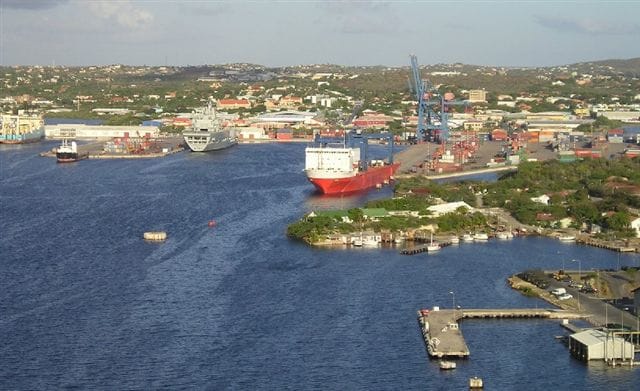
Part of the inner harbor of Willemstad. (Photo courtesy: Maduro Agents Curacao)

Part of the inner harbor of Willemstad. (Photo courtesy: Maduro Agents Curacao)

As previously explained Willemstad really consists out of two halves. Otrabanda to the West and Punta to the East of the fairway leading into the harbor in the middle. That middle part consists out of the Schottegat and leads to the St. Anna Baai a large and natural deep port inside Curacao around which a large port complex has been built. The nice thing is, it is really sheltered but the bad thing is it is a fairly small gap to sail into with a lot of cross current to deal with.  In this natural safe haven you can find a dry dock, tanker docks or the oil terminal, a container terminal and part of the Royal Navy base.

Because of the small gap and the cross current which can go up as high as 3 knots, cruise ship captains are on average very happy to dock at the Mega Pier, and there is the 3rd reason; the Trade Wind which blows from the same direction as the current flows. For cargo ships it is less of an issue but floating apartment buildings do catch a lot of wind.  Wind and current together give a nice drift and if you then have the possibility to avoid all these issues by going to the Mega pier then you go.

The mega Pier has the same wind and the same current issue, but when you dock here you get it on the nose and with the nose in the wind or in the current you do not drift. One kick ahead on the engines and the ship stays nicely in position while you go slowly alongside. Today was a very windy day with a very gusty Trade wind performance so it was a good day to be at the Mega Pier.


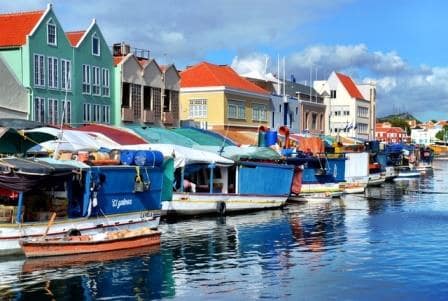
The floating market from the water side

The floating market from the water side.

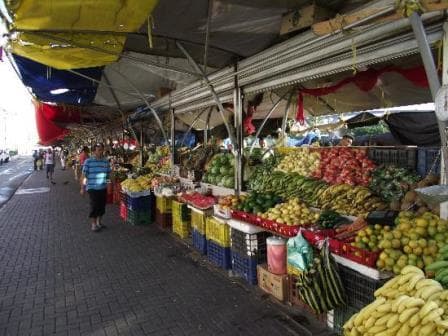
A special feature of interest is the floating market in Willemstad. Just inside the entrance there is a small side canal on the (East) Punta side. There fruit and vegetables are being sold directly from the small (that brought them in) boats to the public. These boats come across from the north coast of Venezuela which is as the crow flies not more than about 8 miles away. Curacao has a much more arid climate then Venezuela, hence the import of all things green and juicy. (And colorful)

The floating market from the shore side.

The floating market from the shore side.

It is very nice to see these little boats suddenly appearing out of nowhere in front of the entrance of Willemstad harbor, slip inside and have a roaring trade going 5 minutes later. Close near 5 pm. they all leave again to go home, just to repeat the whole performance again the next morning. I once asked if bad weather stopped them from coming and the boat/shop lady, after some thinking, replied that only real heavy hurricane could do that. A bit of storm did not keep the grocer away it just resulted in higher prices as not every skipper liked to get out in wobbly weather. Apart from fruit and vegetables there are also stalls (read boats) with fresh fish. Once I saw a boat unloading Venezuelan beer but that was a long time ago. I wonder how it goes with Customs import duties.

We have a long call here, as we stay until 11 pm. Main reason for this is the option to hold an outdoor barbecue and deck party. When sailing that is not so easy. The captain can create a relative wind still situation on deck by sailing with the wind and matching the wind speed but then you might go the wrong way for too long which hampers the schedule  and the Barbecue smoke will stay on the ship. Or you can have wind on deck and then everybody’s plate might fly away. So we do it in port with the option for guests as well to enjoy night life in Willemstad. If they do not go then the crew certainly will.

I will be on board to catch up work from this afternoon as I had the Curacao Maritime Museum people on board for a visit. More about that tomorrow.

Tomorrow we are in Aruba which is the next island to the west. To get there is only a hop and a skip and that is why we can leave so late.

Weather for tomorrow: Same as today; Sunny, Warm and Windy.


25 March 2015; Kralendijk, Bonaire.

In the early morning we rounded Bonaire from the West and then sailed south under the island heading for the town of Kralendijk. Looking towards the south, towards Venezuela it looked as if we were in for a rainy day. Dark clouds were laying overland and some extended to the ship.  But then the sun gathered in strength and it all disappeared and it became a hot Caribbean Day.  There was not that much wind blowing over the island and the Noordam easily docked at the North Pier.

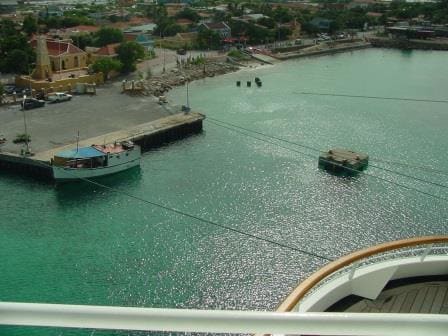
DSC00192Kralendijk has two docks, the old one on the North Dock right opposite down town and the South Dock which was constructed later and is further out of town. When there are two ships in, the biggest normally docks at the North Dock so the largest number of guests have to walk the shortest distance.

However today we were the only ship and thus we docked at the North Dock.

Top left, the mooring lines at the bow disappear under water.

Top left, the mooring lines at the bow disappear under water.

Docking here is rather peculiar as the dock is fairly short and thus only the spring lines are connected to the dock, the rest, the breast lines and the head lines, go out on a 90 degree to bollards on the shore side. Some of those bollards are nearly submerged on high tide and then it looks strange to see mooring ropes disappearing under water.  But the wind tends to breeze up during the day and then these breast lines (those lines perpendicular to the ship) are needed to keep the ship alongside. The regular Trade wind blows with 16 to 20 knots but on occasion it is not unusual for it to go up to 35 to 40 knots while it is not really bad weather.

Bonaire is the most Dutch of all the islands that belong to the Kingdom of the Netherlands. Dutch is still widely spoken here, although there are a lot of shops, commerce does not dictate  everything yet and you are still able to ashore and find unspoilt areas in the town centre. Most of the guests when going ashore will focus on the beach life. The water is clear here and the sand is coral based so very white and fine. Plus if you want to you can swim right in front of the ship. The area is completely pollution free and so is a Holland America ship with its zero overboard policy and thus………Why not?  And thus Yes, a lot of people where exactly doing that.

Bonaire is a little bit curved and in that curve Kralendijk is located . Right across from the berth is a small island called Klein Bonaire. (Klein = Small) It is un-inhabited and people can go there for the day.

Sailing away  is a very simple affair. The ship is being held alongside by the thrusters and the Azi-pods and the long lines are being pulled in. Then we just stop everything and apply the –blow away manoeuvre- which means we let the wind do the job of getting the ship away from the pier and into deep water. Then we can just sail away. That whole evolution takes only about 5 minutes and the bridge can go from Port mode to Sea mode.

Tonight we will sail slowly westwards towards Curacao as that island is not far away. As a matter of fact during the night you can see the lights against the horizon. We will dock there tomorrow morning around 0700 and we will be at the Mega Pier.

Weather: more of the same. Hot and Sunny.

24 March 2015; At Sea.

Today we had our sea day, crossing the Caribbean Sea on an almost southerly course (175o to be precise). From the Mona Passage, outside Samana, to the Westside of Bonaire. Our next stop Kralendijk on Bonaire is located at the south side and thus the Noordam will curve around the island and come north again to approach the pilot station.

We have the regular trade blowing but it is not very strong, only about 15 knots, which is the average Trade Wind standard but in the last few years the wind has been blowing a lot stronger than that average. So I was quite surprised. Today it might not have been such a bad idea to have a bit of a stronger wind. It would have brought a little bit more cool air onto the decks. Tomorrow the captain will be very happy if the wind is not as strong as the ship will have to move sideways towards the dock with the wind full on the port beam.  So a gentle breeze is hoped for.

With the wind on the port side it was not ideal for birds to hover around the ship but we did see a lot of flying fish coming out of the water. Our relative slow speed of 12 knots probably created the perfect bow wave to lift them out of the water and carry them for a considerable distance skimming over the ocean surface.

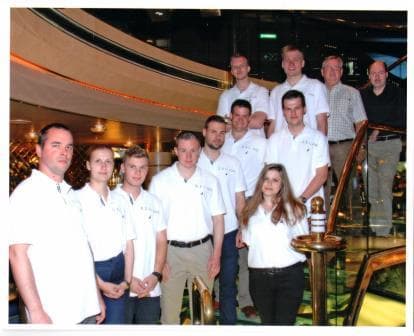
The Nautical and Engineering Excellence Classes together with Trainers. Looking after the Engineers is Mr. Willem Dullaert (Ch.Eng Ret.)

The Nautical and Engineering Excellence Classes together with Trainers. Looking after the Engineers is Mr. Willem Dullaert (Ch.Eng Ret.) 2 Ladies and 8 Gentlemen.

We are now entering the 3rd week of the training school we have going with six prospective deck officers and 4 prospective engineers and as we have slowly worked our way through all the theoretical material the focus is now shifting to practical. That practical stuff is done via Touch Drills.  This means that we act as if we are doing something but we do not push the buttons. We touch – not push. It is a very clever way to have new officers going through the movements which they have to make if a real emergency would occur. It would not be the first time for a new officer to freeze when the first emergency telephone call comes in. All the knowledge is in the head, all has been explained but now you have to do it. It is the same as driving a car all by yourself for the very first time without a driving instructor or family support. You are it, there is nobody else.

So we do touch drills. To give an example:  there is a fire somewhere in the ship and a crew member phones but the smoke detectors have not yet gone off on the bridge to indicate where this fire might be. The crew member is of course excited and says nothing else but Fire, Fire, lots of smoke.

Step 1:  Quickly question the crew member, who he/she is, where he/she is, what he/she says and what he/she still can do or has done already.  Then tell the crew member to secure the area and wait for help. If done successfully we should now know that the crew member is called Tony, his ID is 12345 and his location is on deck 6 amidships next to the sb. Elevator and he sees fire in the locker next to it.

Step 2: Company policy demands if an actual observation is phoned in, we ring the fire alarm. Thus we simulate touching the button.

Step 3: Make an announcement for the guests about the alarm; advise that we are investigating an occurrence and that the Emergency Teams are assembling.

Step 4: Send the first response officer to secure the area.

Step 5: If needed change course/ speed in case smoke is coming out of the ship.

Step 6: Close Fire screen doors and maybe also watertight doors

Step 7: Call the Master and be prepared to give an initial report with all info known as of yet.

Step 8:  Now get the check list to see if you have not forgotten anything and continue with the rest.

Time elapsed between step 1 and 7, approx. 45 seconds depending on how long the announcement lasted.

To accomplish all the steps quickly, the Trainees have to run all over the bridge and go through all the motions. If I can get that down to a routine, they will not freeze or be nervous when that first dreaded telephone comes……., as it will one day. We will continue to do these drills in the coming days as I have about 20 scenarios’s which we can play and I want to build up routine.

Weather forecast for tomorrow:  Mostly sunny, Temperature in the mid 80’s (30oC) and a nice Caribbean Breeze.  Bonaire is the most Dutch of all the islands in the south Caribe, so it will feel as if we are in Holland but with a heatwave.

« Older posts Newer posts »