- Captain Albert's Website and Blog -

Ocean Liner History and Stories from the Sea, Past and Present. With an In Depth focus on Holland America Line

Page 100 of 241

23 March 2015; Samana, Dominican Republic.

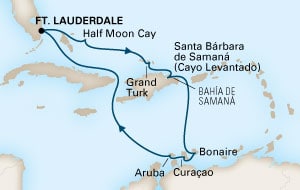
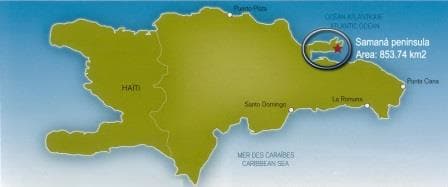
Blog chart SamanaThe route last night was a bit of a Zig Zag.  To leave Grand Turk safely, the ship first had to sail to the South west until approx. 18.00 hrs. to avoid yet more Bahama Sandbanks. Then it turned to the South East to head into the General direction of Samana and after following the coast line to then turn west to enter the Bay. Samana is located in a sheltered bay on the North East side of the Dominican Republic.  Holland America has been calling here for the last 10 years as it offers a great combination of beach, jungle and whale tours. The area is also well known for making cigars and that also attracts people.
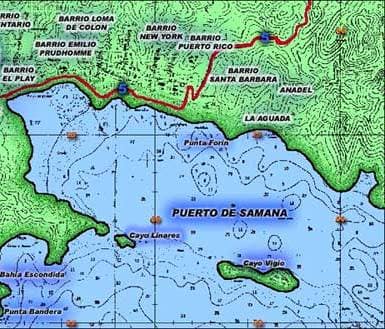
samana bayWe face the challenge that there is no dock and thus we have to tender. Also tender a fairly long distance and as well the far end of the bay is shallow. Even when the ship sails in, it is through a natural channel which is not so wide that a ship’s captain is really not happy about it. Before the cruise ships came here it was already a resort due to its beautiful beaches. With the arrival of the cruise ships the Shore Excursion industry has really taken off and that provides much needed extra income for an area that is not very well to do.

Between January and March the bay can be very well populated with Hump Back whales that arrive here to give birth to their young. Thus the chances to see Whales are excellent around this time but it will be glimpses as the new mothers will be busy with their calves. Too busy to start splashing around as we are used to seeing in Alaska in the late season.

We love whales and we love them especially if they do not come too close to the ship.  That does of course not always happen and then we have to insure that we stay out of their way and not disturb them.  Hence I was busy today with teaching my class how to avoid whales. Avoiding whales in Samana Bay but also for later in Alaska.    Holland America has very strong and clearly defined policies of how the Navigation Officers should deal with whales.  To be able to implement those policies you have to know a little bit about the various sorts of whales and their behaviour.
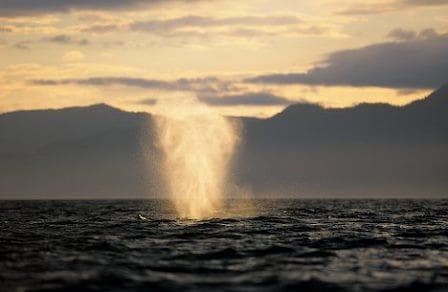
A humpback whale spout in the evening Alaska Sun. (courtesy Alaska pictures .com)

A humpback whale spout in the evening Alaska Sun. (courtesy Alaska pictures .com)

We focus on the ones which we most likely will see and which most likely could be an issue. This means mainly Humpbacks = very active, Right whales = not very active and Orca’s = travelling in groups.  Step 1 is to recognize the whales and then watch where they are going; Step 2 is to decide what action to take. For the humpback do they remain at the surface (tail fin does not come up) or do they dive?  If they continue moving, we slow down and try to go behind them, or just wait.  Right whales are not very active and do not pay much attention to anything (hence they are very scarce nowadays as it was so easy to catch them) and if we see them; we slow down and sail around them.  Orcas are very intelligent and very active. Not much chance to hit them but they can travel in large family groups or Pods. We do not want to sail in between such a Pod for the danger of separating them. Hence we slow down and carefully observe. The problem with them is that they are very inquisitive and will come over to have a look at that strange tin can full of people. That can result in having to float for a while until they move on.

This morning we saw a few whales at a mile away but they were hard to recognize as they did not come much above the water surface and in the sunlight it was difficult to see the shape of the spout, which is for some whales is very distinctive.

By 17.30 we were on our way again and are now heading East until we clear the East side of Hispaniola (which is made up of Haiti and the Dominican Republic). Then we head south through the Mona Passage with the island of Mona on our port side and venture into the Caribbean.

Tomorrow is a sea day and we are expecting partly cloudy skies, Temperatures of 27o C/   81oF and we will be sailing with the wind so it might be a touch warm on the outside decks.
22 March 2015; Grand Turk Island, Bahamas.

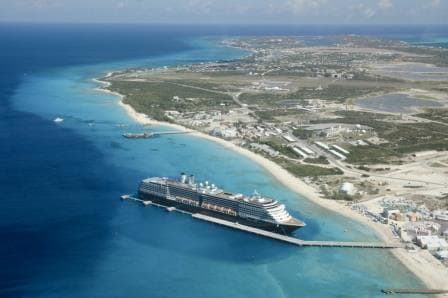
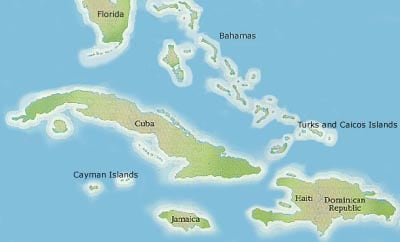
caribbeanmap1Today we were in port with the Carnival Sunshine. This used to be the Carnival Destiny but after a major make over and upgrade it was decided to rename her the Carnival Sunshine. The reason for seeing a Carnival ship here is the fact that the Pier was built with the assistance of Carnival. Before the pier it was virtually impossible to call at Grand Turk because of the ever present swell and the difficulty to anchor safely at the edge of the reef.

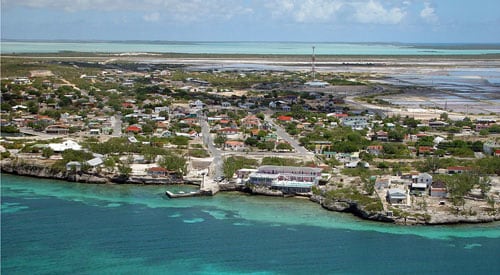
Neither was the tender pier very good. No cruise company is going to add a port of call to the schedule if they know that the Captains are cancelling 9 out of 10 calls. As there was one stretch of beach area where the shallow part of the reef was extensive enough, or better said long enough, to construct a cruise ship pier, Carnival invested. Not only a Pier but also in a little village near the pier. The town of Cockburn is a little bit further away for the more enthusiastic explorers but the beach is just next door.

Please note the small dark blue area around the Noordam. On a windy day there is not much room to drift. (Photo courtesy Holland America Stock photo)

Please note the small dark blue area around the Noordam. On a windy day there is not much room to drift. (Photo courtesy Holland America Stock photo)

Since the pier has been constructed the ships only cancel on average 1 out of 10 times as sometimes the wind is too strong to attempt docking. If the area around the pier was deeper, there would be more of a chance but the dredged area is just wide enough for a cruise ship to slide in and out but not to be able to blow away in case the ship loses the battle against the elements.

The town of Cockburn. In the centre the tender pier for ships to use.

The town of Cockburn. In the centre the tender pier for ships to use.

There was little chance of this happening today. There was a small and gentle breeze blowing but nothing that would even come close to a strong wind and at noon time the Noordam was docked for an afternoon call. Not a very long stay, only six hours, but for a beach call it is long enough as everything you want to do can be done in those hours. Apart from beach and water sport related shore excursions there is the option to fly over the Island and scenery by helicopter or go by Bus or Trolley Train around the historic spots on the island. Apart from the pier and the town, the cruise centre has a size of 14 acres with a large (sea) pool area to while away the afternoon.

Also here Columbus is present. Although they do not really claim that this is the spot where he landed for the first time, they have proof that he was here, as one of his ships the Nina was shipwrecked.  There is also an historic lighthouse but it arrived only 150 years ago so it would not have been of any help for Columbus. That lighthouse is a sort of a Ikea happening. It was constructed in the U.K, then disassembled and shipped to the Island and then put together again.  It is standing on the North point of the island guarding the gap between the Sand banks and Grand Turk Island. It was also the opening the Noordam used to come in from the North today and to get to the south of the Bahamas while stopping in between at Grand Turk. And of course as it was a British Island there is a 18th. Century prison as well. It seems somehow when an island is occupied, one of the first things being built is a prison. No self-appreciating Governor should be without one.

This evening we will continue our journey to the south East leaving all the big and small Bahamas behind and aim for the Dominican Republic. Tomorrow we will visit Samana which is located at the North/East side of the island. This means we first go SSW to get clear of the last cays and sand banks and then SE for Samana Bay.

It will be a tender call with a very long tender distance as well and that makes it difficult to get everybody off just after arrival. The captain already advised everybody on departure, that those who were not in a very big hurry could better wait until after lunch and leave the first two hours to those on tours and those who really cannot wait.  Those who stay on board might see whales’ frolicking around in the area as it is a location where whales are frequently spotted.

We will be there from 10 am to 5 pm  and it is going to be another warm day, although about two degrees less than today.


21 March 2015; Half Moon Cay, Bahamas.

Poor people today at least that is what I think. It was supposed to be in the high seventies. But when we arrived it was flat calm at the anchorage. The Eurodam and Noordam were floating on a mirror like sea which only moved gently on a very low residual swell from the winds of last few days. The sky was partly cloudy but much more sunny than cloudy. No wind, full sun, reflection from the white beach and the crystal clear sea……….. It was hot today. I suppose that is what you want from a beach call but directly coming from a relative cool Florida it was a bit of a shock. To make people realize this, the Cruise Director announced the more than beautiful weather; to use plenty sun block and to drink a lot of water. Hence the BLD steward at the gangway was doing a roaring trade in small size water bottles.

With the Eurodam at anchor the Noordam stayed on the engines. The day before yesterday we did so because of the wrong wind direction and today because the Eurodam had the better anchorage, it being the more frequent caller.  There is a 2nd anchorage as well but it gives even less space to range out the anchor and the chain than the premier anchorage and thus it is much easier just to remain drifting with the occasional adjustment when the ship got moved by the current.  As the wind had died down completely the current had also reduced in velocity and the ship did not drift that much at all. A quiet and easy day for the navigators.

With two ships in port, the tender service is a lot more hectic. Two days ago our ship was serviced completely by the two shore tenders. Now we had to share them with the Eurodam and that meant we had our own ships tenders running as well. A lot of extra traffic in the port of Half Moon Cay, requiring a lot of vigilance from the two security officers on the shore side. Apart from this there was the challenge of ensuring that the correct people went back to the correct –Dam- ship. That sounds easier than it is, as we have guests on board who after several days still do not know on which ship they are on and will happy stand in the wrong line, going to the wrong tender.

While this all was going on, I took my class through the mysteries of Fire Safety both passive and active. A cruise ship has an enormous amount of safety protective items on board, and in use, and a deck officer has to be familiar with all of them. Not an easy task and a task which takes a considerable time to complete.  It helps if there is a structured approach to this challenge, starting with a bit of history about the why this was added and why that became important and then eventually all the pieces of the puzzle come together and a complete picture arises.

Going back to the 1930’s; passenger ships did not have very much protection in the accommodation. Inside everything was made of wood and everybody relied on the vigilance of somebody to catch a fire on time and to attack it quickly with an extinguisher and a fire hose. Then the sprinkler came along. Every cabin and other area suddenly had these little shower heads in the ceiling and each shower head contained a glass bulb. If the temperature was going too high, the bulb would break, pressured water would come out as a shower and it would extinguish the fire. Wonderful system.

Hi-fog is  a water drenching system kept under high pressure by having the water under pressure in large cylinders. When the bulb breaks it pours out of the nozzle as a very fine mist. (Photo Courtesy www.Marioff.com

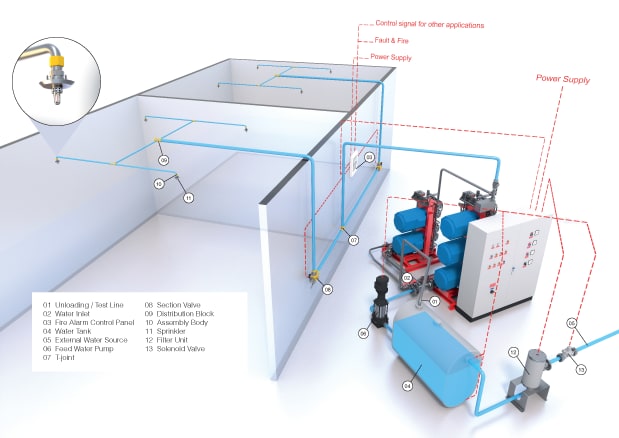
Hi-fog is a water drenching system kept under high pressure by having the water under pressure in large cylinders or tanks. When the bulb breaks it pours out of the nozzle as a very fine mist. (Photo Courtesy www.Marioff.com

Then science came along, a company called Marioff figured out that if you make water droplets as fine as mist, it increases the cooling & extinguishing capabilities multi-fold and a new system came on the market called Hi-Fog.  It can extinguish with a 500 litres (or less) the same fire which a conventional sprinkler system needs to do with 5000 litres. That gives a lot less damage.  Thus now all new cruise ships are being built with a Hi-Fog installation and the older ships are being retrofitted. The Vista class, which includes the Noordam, was the first class of HAL ships which were completely protected by Hi-Fog. Something so important that it merited at least a half a day of teaching to ensure that the principles, advantages and ways of operating the system are fully known.

We left Half Moon Cay nicely on time. It was not that hard to get everybody back on board timely as most guests longed for some cool A.C. after a few hours on the beach.  Now we will sail along the top rim of the Bahamian Islands until we arrive tomorrow at noon time at Grand Turk Island for an afternoon call, for more beach visits should one so desire to do so.

Weather Forecast:  More of the same.


20 March 2015; Fort Lauderdale, Florida USA.

From Half Moon Cay we sailed north and then followed the coast line of Eleuthera Island which guides in a sort of boomerang shape to where we have to go. Then it was a straight course sailing south of Freeport until we cleared the last cay in the Bahamas near the Great Isaac Lighthouse. A very important lighthouse as it guards the corner of the last reefs of the Bahama Banks. Keep Great Isaac in view and it is hard to run aground. From there it was a hop across the Straits of Florida and by 0600 hrs. we were at the pilot station of Ft. Lauderdale. It being a Friday it was not so busy and we were in port with only a RCI ship and one from Silver Seas.  

By 07.00 hrs.  the ship went into controlled mayhem mode which we call a change over day.  Luggage off, followed by guests off while down in the bowels of the ship provisioning started. This had an extra challenge today as it was heavy loading which means that nonperishable items are loaded in larger quantities. Also the ship started to load materials for the coming dry dock to ensure that we have everything before it goes into dry – dock in Freeport Bahamas.  We only managed to get it all in, just before sailing time.

Disembarkation took a bit longer than expected as there were only 2 CBP inspectors available until late in the morning and all the guests had to exercise a little bit of patience. The law is the law and if there are no more inspectors then it just takes a bit longer to get everybody processed.  This can happen on occasion and therefore a wise word to those who read this: Make sure that you do not book any flights until midafternoon. We had a couple onboard who had flights at 11.20, did not want to do self-disembarkation (e.g. carry all you luggage of yourself) and most likely missed their flights.  Then there can be traffic jams to the airport as it is not a weekend day, and if you happen to have a cruise with a bit of wobbly weather the ship might be in late. So mid-morning flights or very early afternoon flights are always a gamble.

20 march 10 day southern caribean seafarerToday we also had a captain’s changeover. Captain Robert Jan Kan went on a well-deserved leave and Captain Jeroen van Donselaar took over for the next 3 month period.

He will now take the ship on a 10 day cruise via the Bahamas to the Dutch Islands in the South Caribbean Sea.

Then there will be dry dock which is always a busy time for a Captain. Officially you have nothing to do; no sailing and the department heads have to do the work; but you are very very busy with trouble shooting and keeping oversight to ensure everything keeps marching to plan.

The Noordam docked at Pier 26 which is our normal home, laying along the Inter Coastal Water Way, which runs all the way up the East coast. Even on a Friday it can be very busy with small yachts and power boats, quite a few of them who can be defined as six – pack navigators. On the departure I saw twice that the Sheriff’s department (who escorted the Noordam with two boats) had to race over to avoid a certain disaster.  Once with an idiot planning to sail through the bow thruster wash and the 2nd time by somebody not much wiser stopping in front of the ship with the plan to take a self-fie. Yes, they are out there, you just have to find them as my father in law used to say. I do not know if the sheriff would fine them but if I had a say in it, I would confiscate the boat as it does endanger the lives, not only of the driver but also of those on board as passengers; quite often children.

But the Noordam managed to get all the provisions, stores and supplies onboard on time and without undue delay we sailed out of Port Everglades.  We will now retrace our route exactly the opposite way as when coming in, as tomorrow we are back in Half Moon Cay.

Only this time we are not going to be by ourselves but together with the Eurodam, which is the first ship of the Signature Class.

Weather for tomorrow:  Partly Cloudy and temperatures in the high seventies.

19 March 2015; Half Moon Cay, Bahama’s.

My apologies that there was no blog yesterday but my computer crashed and I lost my literary outburst for that day. Also not enough time to rewrite it as the hours are scarce while this training class goes on. But yesterday we were at sea sailing on a straight line from St. Thomas to the South side of Half Moon Cay, at least that is what we call it.

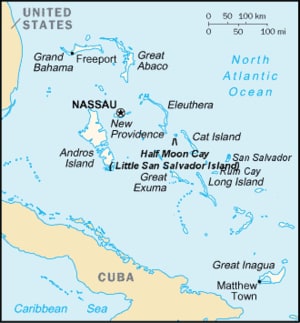
The official name of the island is Little San Salvador Island and it is located to the South West of San Salvador Island one of the larger islands among the thousands of islands, cays, banks and reefs of the Bahamas. San Salvador Island is most famous for the fact that it is claimed (one of the many places to do so) that Columbus made his first landfall here in 1492 and thus discovered the new world. Although he thought he was in India. Hence calling the locals Indians a name they got stuck with forever.  They built a statue on the North East point of the island which can be seen from the sea if you bring the ship to about a mile off the beach.

300px-Bf-map_with_Half_Moon_CayJust to the west there is a smaller island called Little San Salvador which has a size of approx. 32,000 acres and a lot of that acreage is taken up by a lake. Holland America has a very long term lease on 16,000 acres on the west side. Through the years it has been slowly developed as a private island for beach calls. Princess has one as well, so does NCL and so does Mickey Mouse. However we keep winning prizes for our island that it is the best of them all and that indicates that Holland America has done a pretty good job here.

They decided to call the place Half Moon Cay. If you look at our company logo, it shows a large two funnel ship and a smaller old sailing vessel in the front of it. The large ship is the Nieuw Amsterdam from 1936 and the sailing vessel is the Haelve Maen or the Half Moon in English. This was the ship which Englishman Henry Hudson used to explore the East Coast of the USA. He did this on behalf of the Dutch West Indian company and they were looking for new trading grounds. Henry Hudson sailed up a big river on the East Coast and that river is called the Hudson River nowadays. So everything is nicely linked into our Dutch History.

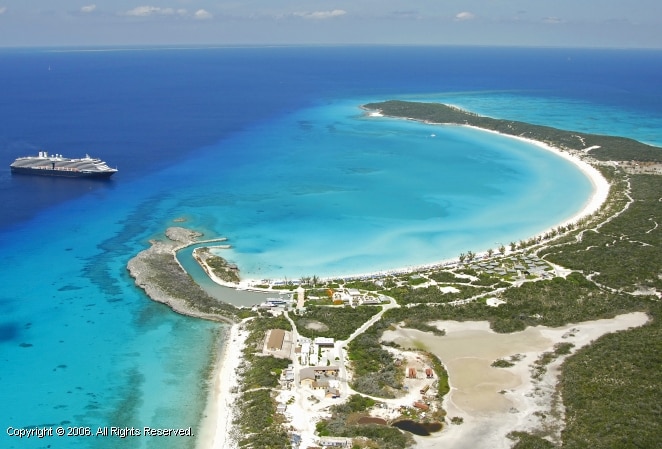
The tender port is to the left below the ship. (Photo courtesy of Holland America Line)

The tender port is to the left below the ship. (Photo courtesy of Holland America Line)

Holland America created an artificial tender port out of the rocks and thus we can land our guests safely and directly next to the beach and in front of the little village that was built here. The island can handle about 3,500 guests without feeling crowded and thus 2 HAL ships can call at the same time. Today we were by ourselves but the day after tomorrow we will be with the Eurodam.  Carnival Cruises do not have their own island and sometimes they call at Half Moon Cay but only when there is no HAL ship in.

Through the years the islands facilities have greatly expanded and I will tell some more about that the day after tomorrow.  Today we could not anchor as the wind (very little luckily) was from the south and it would have slowly pushed the Noordam towards the beach. Thus the captain decided to stay on the engines and drift at a safe distance from the entrance, while the shore tenders took the guests  to and from the ship.

Here at HMC the anchorage is on a ledge in very shallow waters in a similar way as at Grand Cayman. The sea bottom rises very steeply and while the anchor is on a ledge in 20 feet of water, the stern of the ship is laying over a 1000 feet of water.  Because it is so shallow, the ship cannot swing around the anchor but needs a constant North Easterly wind to keep it off the beach. Today there was no N.E. wind and thus the ship had to drift.

We were here from 0800 to 1500 hrs. today and then it was time to set sail for our home port Ft. Lauderdale/Port Everglades where we will end this 10 day cruise tomorrow.  Then we will start an 11 day cruise which will take us via HMC and Grand Turk towards the South West Caribbean.


17 March 2015; Charlotte Amalie, St Thomas, US Virgin Islands.

Sailing inside the East Caribbean rim of islands means that you are really sheltered. Except when you are sailing past the gaps between the various islands. Then the long rolling ocean swell comes through and catches the ship. This is what we experienced last night. Rocky steady ship followed by brief periods of the occasional wobble. Of course the ship had the stabilizers going but as they dampen only about 90% of the roll you will always notice the difference between no movement and a little bit of movement. While walking through the ship I was admonished by a lady to tell the captain that he should make up his mind and stop this on and off “lurching” of the boat.  A ship is a small place so even the guests find out eventually who I am and what that group of young people do who are with me on board. Plus the constant urge of the crew to chat to the guests and give them titbits of exciting information, means nothing is secret and thus the Lady thought I was the one with the most direct pipe line to “that guy on the bridge” and get things sorted out.

Well I know that no captain has yet been able to smooth the seas and thus the occasional wobble continued. Still it became less and less; it started yesterday morning when the wind died down and then eventually the seas also started to lessen. By the time we approached St. Thomas all the wind was gone and the seas where considerably reduced.

The Noordam docked at Crown Bay which was developed in a joint venture with Carnival Corporation after the US navy closed its submarine base there. Thus we do not dock at the WICO pier (West Indian Company) but on the other side of the bay. Both have a shopping center but Haven Sight at the Wico pier is much larger. It also has to deal with many more guests. When three mega liners dock at that pier it is easily possible to have 12,000 guests descending on the Haven Sight shopping area. To get to downtown from there you have to take taxi or one of the many shuttles busses/trucks all manned by very noisy drivers. This you have to do from Crown Bay as well, so there is not much difference.

Crown Bay is a little more sedate. Only two ships can be accommodated and normally the slightly smaller ships go there and thus there are seldom more than 5,000 ashore at the same time.  Today we were are all by ourselves here, so only 1,800 guests, with only one other ship in port, the Carnival Breeze, which docked at the WICO pier.

The very nice thing about Crown Bay is that a lot of beach, snorkel and party tours leave from right next to the ship and no transport is needed to the pickup point. We cannot have tour boats come alongside the ship for insurance and security reasons and so docking the ship next to the tour boat area is a very good solution.

In the days before 2001 we sometimes had tour boats coming alongside as long as our insurance guru’s in the head office had figured out how it worked insurance wise if somebody would fall between the ship and the tour boat. Who would be responsible? Cruise ship? Tour boat? The party who owned the gangway that was used for the transfer? The supervision on one or the other side of the gangway? Very difficult. I did it often in the past and I never liked it, mainly because the tour boat operators never wanted to listen to us but did their own thing and some of those “own things” were quite often very much “laissez faire”, while we would try to work with strict and safe protocols.

Today no such worries. The Noordam was safely docked and the guests only had to walk around the bow to get to the tour if they were going to take one. Those on other tours stepped on mostly open top busses, what they used to call share-a-banks in the past, to go wherever they had to go.

The Noordam now has to go to Half Moon Cay. Tomorrow we will be at sea and with the wind having subsided it should be a smooth ride. Then we will arrive at 08.00 hrs. at the anchorage of HMC for a call lasting to 3 pm.

Weather for tomorrow: Partly Cloudy with the temperatures coming down to the mid Seventies as we will have the cooler sea air blowing around the ship.

16 March 2015; St. Johns Antigua.

The weather decided to follow the weather forecast and the winds died  down nicely overnight. Under sunny skies we sailed into St. Johns Antigua. It is Monday so all the shops will be open and thus we will have a lot of happy campers.  

Today the trainees are being indoctrinated, trained and enlightened by the S.E.H. Officer.  The Safety Environmental and Health Officer. He (or sometimes she) is a one person department whose job is compliance. Making sure that we stay on the right path towards the perfect protection of the environment; ensuring happy authorities by following all the rules and preparing enough reports to keep our people in the office nice and busy.  Apart from that there is crew education, formally by classes and informally on the job.  Any place where there is a chemical used or stored the S.E.H officer will show up on a regular basis. One very important part concerns the correct off-loading of garbage, recyclables, chemicals, medical waste, sludge and anything else we have left over and cannot process ourselves. In the change over ports any offloading has to be authorized, overseen and tracked by this person.

Another important part of this extensive compliance work is keeping an eye on our SOPEP readiness.

SOPEP stands for: the Shipboard Oil Pollution Emergency plan.

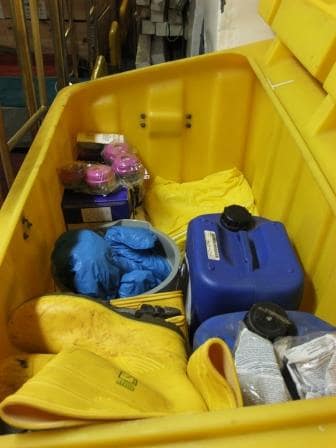
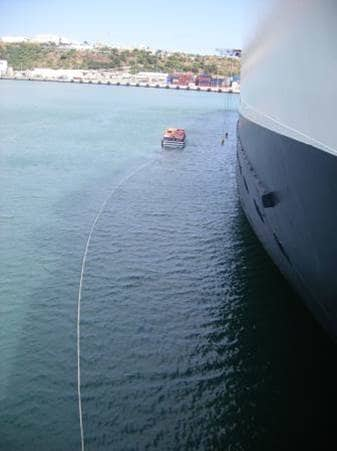
sopep boxIf we would have an oil or chemical spill then the equipment has to be ready to combat and clean up that spill ASAP and if possible so effectively that nothing reaches or remains in the environment. For this purpose we have Mop-up kits in the bunker breaks in case oil is being spilled. Special suits, absorbent pads and tools in a break-out box in the Provision break that can be taken to any part of the ship where something happened and a large oil spill boom which we can wrap around more than half the ship.


But it is much more than that. It is a complete – I would almost say Combat- plan with a chain of command, carefully defined functions, materials, reporting requirements, regularly updated addresses from authorities who can offer help and the trainings and drills for a lot of crew members.

By paying out the boom correctly, the tender made it to the far end of the ship. (Archive photo from boom exercise on board ms Rotterdam in Nov. 2014)

By paying out the boom correctly, the tender has made it to the far end of the ship. (Archive photo from boom exercise on board ms Rotterdam in Nov. 2014)

This time we cannot train it in reality but we can explain the procedure to the trainee’s ensuring a certain level of competence and knowledge if it would ever happen and we would not have a delay in boom deployment due to not understanding the maneuver required.

Tonight we will sail west of the Saba Bank towards St. Thomas. The Saba bank is a very shallow under water area and is the largest under water Marine Park (2200 sq. km) in the Western Hemisphere. It belongs to the Netherlands and it if would be considered regular territory, the Netherlands would suddenly increase in size by about 15%. I can hear our Prime Minister already asking for a pay raise.

Weather for tomorrow: more of the same. Warm sunny but rains clouds in the distance and maybe over Charlotte Amalie.

15 March 2015; Fort de France, Martinique.

To get from Barbados to Martinique there are basically two ways to go. One is the direct route staying out in the North Atlantic Ocean and making land fall at Fort de France itself or go back the way we came and sail north in the shelter of St. Lucia. Last night we took the straight route as the swell was not that high and the wind although brisk not much of an issue. Had there been storm or large ocean swells it would have been a different story,  but it was regular north Atlantic weather and no issues at all. And thus we arrived at 0700 hrs. at the pilot station and were docked by 8 am.

Fort de France has for some years now a new dock, right in down town where in the old days we used the tender. The older dock is used by cruise ships as well but is located in the cargo port and quite a walk away from downtown. So this new dock is really a great option. We were sticking our nose right into the town itself.  A very quiet down town as it was Sunday and everything was closed. True to French tradition, they might have gone to church but they certainly would have focused on having lunch with the whole family.

That made a lot of guests decide to either stay on board or go on tour. Company organized tours or by themselves. We even have a German tour group on board who had organized a beach party tour by ferry to the other side of the island. Luckily they came back just in time before the ship sailed because the captain is not required to wait for independent or private tours organized outside the company. The captain might wait and he will try to provide the service but there is no obligation and he would not endanger a timely arrival in the next port for it. Luckily that seldom happens.

In the meantime life goes on and thus also the induction of my trainee class. They are going step by step deeper into the”mysteries” of the Holland America’s way of doing things. One of the very important aspects is everything related to fire drill, fire safety and fire prevention. The first step is to observe how it works, next step to get familiar with the equipment and the third step is to start training and gain experience with our systems and routines.

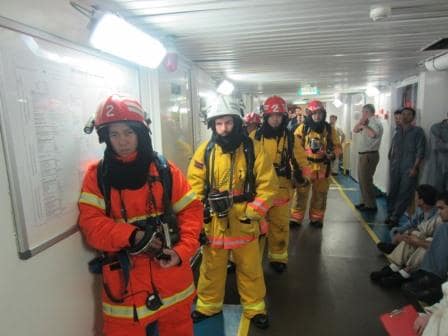
Team 2 of the deck department. They are not looking very happy but then no team is if they are forced to the standby team. Today was an Engine drill and then deck is the backup & support group.

Team 2 of the deck department. They are not looking very happy but then no team is if they are forced to be the standby team. Today was an Engine drill and then Deck is the backup & support group.

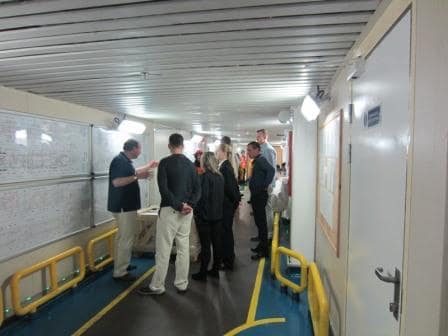
So the first step was observing a fire drill. Especially the gathering of the teams, the dressing up and getting ready. Raising a hose against a (simulated) fire will come later. First they have to understand the principles, the pitfalls and the dangers as ships fire fighting can be dangerous if not properly trained and not knowing the protocols. Thus step one is to look and see how the ship’s crew is doing it and then take it from there.

The trainer and team "on location.  (Both Photos courtesy by Security Officer ms Noordam "JP"  J.R Prins.)

The trainer and team “on location”. (Both Photos courtesy of Security Officer ms Noordam “JP” J.R Prins.)

Fire station inventory will be next to get to know what equipment we have; then dress up drill and finally we will open the fire hoses.

Since St. Maarten we have been island hopping with a different island each day. We will have two more to go before the guests get time to take a breather with a sea day. Tomorrow we are in Antigua and then in St. Thomas.  Antigua is just around the corner and after our departure at 5 pm we will have a slow ride and then arrive early in the morning at St. Johns. Today it was a windy day but for the dock in Fort de France that does not matter as it right on the edge of the open bay. St Johns is inside a bay which only has a small turning basin so we cannot have not too much wind otherwise we cannot swing around safely. Luckily the wind forecast is for lessening winds and so we should be good for tomorrow. For the rest it will all be the same. Warm, sunny and a chance of a shower.

14 March 2015; Bridgetown, Barbados.

Barbados is a peculiar island to call at, for several reasons. First of all the ships have to make an “extra” effort to get there as it is located outside the eastern rim of Caribbean Islands which form the boundary of the Caribbean Sea. The island is surrounded by North Atlantic Ocean on all sides. So is it really a Caribbean Island??? Secondly they are very independent but still very British. They used to close the shops on Saturday afternoon for the weekly cricket game. That happens less now as the booming Cruise Trade forced a rethink between tradition and style and raking in the dollars.  Thirdly it acts as a turn over port for cruise ships, far- far away from Miami and Fort Lauderdale.

Barbados has excellent airport facilities (the Concorde used to fly here) and can handle a larger number of airplanes and passengers at the same time. Thus British company’s such as P&O use Bridgetown as a changeover port. This is also done by smaller company’s / smaller ships which do not want to make cruises where one day or more is lost to get to and from the Caribbean and still stay on the 7 day circuit. Today being Saturday we had several ships in port doing so.

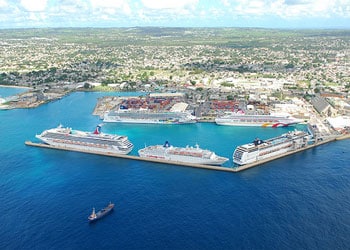
When the good ship Noordam pointed it’s nose into the harbor, it was the last cruise ship in. Docked were the Ventura, the Royal Clipper, the Seabourn Spirit and Windstar.  Apart from the Noordam they all used Bridgetown as a changeover port. That cannot be bad for the local economy at all.  The port of Bridgetown has a U-shaped main harbor and apart from a Geest Line Banana Boat the whole port was full of cruise ships. Everything else had to stay outside, at anchor, until they all sailed.  Understandable that we are not always very popular with the cargo ship captains who have to sit idle, losing money while the cruise ships take preference. But we book two years in advance and always show up on the minute to keep the schedule. Cargo ships cannot do that so what can we say?

Archive photos with all berths full of cruise ships. Going clockwise from top: Berth 2A,B,C, Sugar mill berth and  Breakwater South and North. The knuckle is the end of the Breakwater.

Archive photo with all berths full of cruise ships. Going clockwise from top: Berth 2 A,B,C, Sugar Mill berth and Breakwater South and North. The knuckle is the end of the Breakwater.

If a ship does a turnover in Barbados then it is assigned a berth as close as possible to the cruise terminal. That is berth nbr 2. South. Because the Ventura of P&O was doing exactly that, we had to dock at the Breakwater north. Not a bad dock from a Captains point of view but not ideal for the guests as they have to walk around the whole of the harbor. The port runs a shuttle service with small buses but you have to wait and they might be full from another ship already.

Also for the captain this is an interesting location to be at. Coming into the port you have to make a very sharp 90 degree turn to line up with the Breakwater inside the dock. To do this successfully most captains line up the ship completely parallel to the dock before they slide in and go alongside.  Bending around the knuckle is possible but with a strong Easterly wind blowing it is not ideal as it might set the ship onto the knuckle, then you get a dent and you get paperwork and upset the local authorities. All these things you try to avoid as a captain as your life is already complicated enough. So what you do is you line up first and then slide in. If the wind pushes you over then at least the ship will make a soft landing with a larger part of the hull on the flat of the pier.  To help with this the port has been dredged to give the very large ships the option to swing/and line up outside the confines of the harbor itself.

Today was a bit windy with occasional squalls coming over but as Barbados is lower than St. Lucia none of these squalls released much rain. They did cause the wind to pickup every time when one was coming by. This was also the most important lesson for my school class to day. When you play with an empty life boat – drifting like an egg shell on the water – the wind is the biggest factor in your assessment of the coming maneuver. Either you use the wind as your friend = let it do the work for you, or treat it as your enemy and you have to battle against it. After 90 minutes playing around, everybody understood that watching first how the wind affects the lifeboat and then using it your advantage, works better than deciding upon your boat handling without taking the wind into account and having a big battle on your hands.

Barbados is also the most southerly point of our cruise. Tonight we sail north again and tomorrow we are in Fort de France, Martinique. This is a regular part of France which means apart from speaking French and having French law they also have the Euro as the local currency. Although I do not believe that they are that french that they will not accept American Dollars.

Weather for tomorrow; more of the same. Warm, windy and a local shower.


13 March 2015; Castries and Soufriere, St. Lucia.

It can rain in the whole Caribbean but it seems that Castries gets more than its fair share. The high mountain range which separates the port from the Atlantic is high enough to slow down the rain clouds a little bit and that means they are pushed together enough to saturate them. Once coming over the mountain top, they release the rain. Although the rainy season is over a regular shower is still very much on the program for this port. And today we were not disappointed. It rained while the sun happily kept shining. A very local shower, right above the ship. Although the rain was not cold, it was still wet so a few dapper shoppers were caught out while traversing the distance between the ship and the shopping terminal. Same occurred in the afternoon when the ship called at Soufriere to re-embark the overland tour. All 340 of them and of course there was a shower right at the moment the coaches arrived near the tender pier.  Who says the life of a tourist is easy.

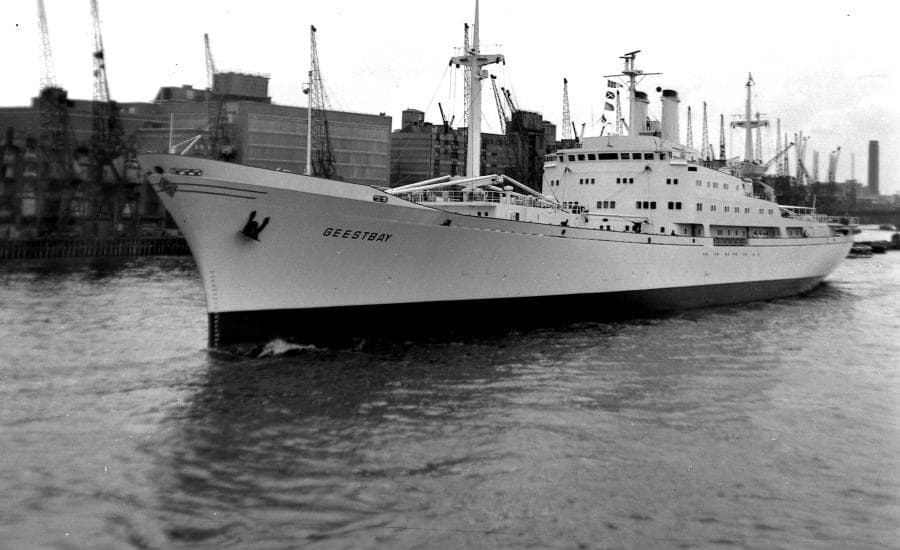
Today we were the only cruise ship in but, quite unusual we had two Dutch ships in. At the downtown pier, which is mostly used for cargo and containers we had a Banana/ container boat in from the Geest Line. This company has quite a nice history with the unusual angle of having originally been owned by a Dutch Family.  The Van Geest brothers were originally from the Netherlands but the family ended up in England during the period that thousands of Dutch laborers came over to turn the Fens, located in the west part of Norfolk, into farmable land. As the area was almost identical to Holland being mostly under water it made sense to use Dutch engineering skills and labor to accomplish it. As the area was almost the same as Holland many of them stayed and ended up in vegetable farming, in the same way as they were used to in the mother country. The Van Geest Brothers started a horticultural business in 1935 and in 1945 expanded into shipping. In 1953 they founded an export company in St Lucia and started exporting Bananas with chartered ships. Then it bought their own ships which all commenced with the prefix Geest (Geestbay, Geeststar, etc.) Until 2001 one could buy Bananas with the Geest name in the UK in the same way as Chiquita and Fyffes. In 1986 they went on the stock market and thus reduced the family influence but the name is still there. They normally flew the English flag so I was quite amazed to see that the ship in port today was flying the Dutch one.  I always admired the ships which they had in the 70’s. Stylish design, giving the impression of being very fast and always maintained in a very good condition. Now of course they are as square as the other ships as they have to carry containers.

Ship Lovers delight. A stytlish Banana Boat of the 1970's.

Ship Lovers delight. A stytlish Banana Boat of the 1970’s.

The Noordam left at 3 pm. and had to swing around on departure in about 25 knots of wind. Not pleasant as the swinging basin is not that large. No room to drift. But it is an Azipod ship and thus has lots of power at the stern.  The trick is then to come off the dock and push that stern against the wind and have the (weaker) bow follow. It worked well and we sailed happily out of the harbor.  The pilot left once we were out of the narrow entrance, under great applause from the guests hanging over the railing and the balconies above. The pilot transfer from ship to pilot boat was also carefully observed by my school class who were amazed about all the safety precautions we take for such a transfer. Most of them have a cargo ship background and there things are most of the time not so strongly regulated as with Holland America.

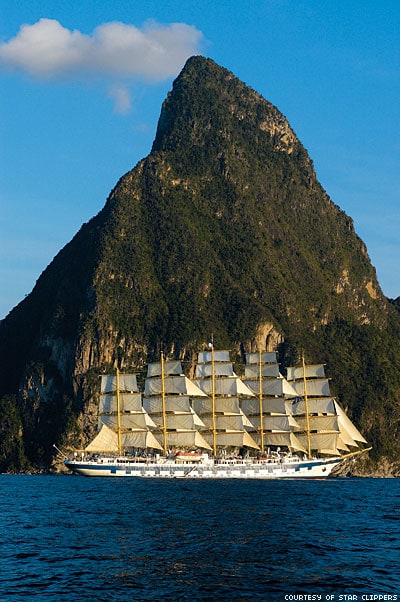
The Royal Clipper sailing past the Pietons. I could not take a own photos, so a stock photos. (Courtesy Clipper Cruises)

The Royal Clipper sailing past the Pietons. I could not take my own photo, so a stock photo. (Courtesy Star Clippers)

In Soufriere we were entertained by the departing Royal Clipper which is the largest Square rigger in the world but also a 5 star sailing- cruise ship. She made quite a magnificent impression when she left the anchorage and sailed to open waters past the Pietons.  We ran our tender service to get our guests back on board and then set sail for Bridgetown Barbados. This means sailing into the open North Atlantic as Barbados is located outside the eastern rim of Caribbean Islands.

Weather for tomorrow:  partly Cloudy 28oC / 82o F.


« Older posts Newer posts »