- Captain Albert's Website and Blog -

Ocean Liner History and Stories from the Sea, Past and Present. With an In Depth focus on Holland America Line

Page 101 of 241

12 March 2015; Philipsburg, St. Maarten.

According to plan and schedule we arrived at the pilot station of St. Maarten and then proceeded to the berth. Even with 90,000 ton and 1900 guests on board we were the smallest ship in town today. From left to right we had:  the Celebrity Summit outside of Pier 2. Freedom of the Seas inside Pier 2; Regal Princess inside of Pier 1, Celebrity Eclipse, outside of Pier 1, forward dock and us the Noordam, outside Pier 1, aft dock.
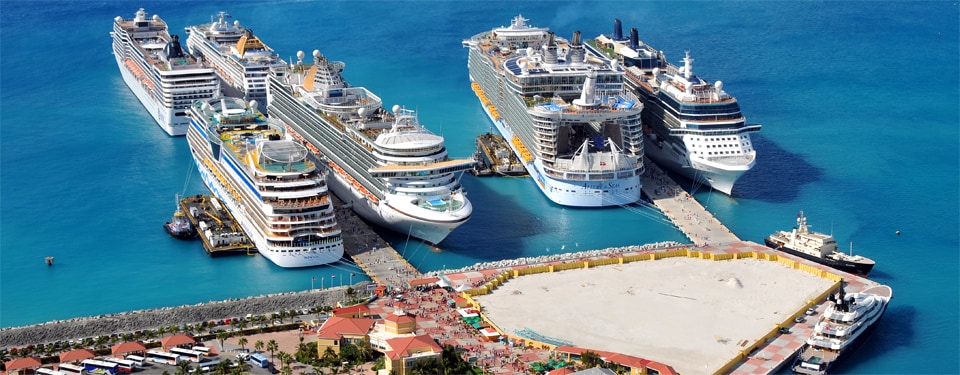
The two piers in St. Maarten. The Noordam does not have a helicopter on board and thus I could not take a shot of todays Pier situation from above.

The two piers in St. Maarten. The Noordam does not have a helicopter on board and thus I could not take a shot of todays Pier situation from above. (Photo courtesy, internet unkown source)

The next question is then, how do we dock apart from having been allocated a location to go to? Nose in or Nose out?  It is most of the time better for the guests to have the ship docked nose in as most ships have the gangway closer to the bow than to the stern. Going nose means that their walking distance to get by the ship and to town is reduced. For ships with the gangway in the amidships area it does not makes any difference of course.

However in St. Maarten there is a 2nd consideration to take into account. Swell which causes the ship to move while alongside.  Quite often the swell, coming from the North Atlantic Ocean to the East can really swerve around the East Cape of Groot Baai in which the docks are located. The ships can move considerably alongside the dock and breaking mooring ropes is not unusual.  To reduce that movement it is better to dock nose out. The sharp bow cuts the waves rolling in and a wave chopped in half has a lot less influence, while the square stern is lifted by the full wave.  The closer you can dock to the shore side the less influence this swell has.

According to this logic the ships were lined up accordingly. Both Regal Princess and Celebrity Eclipse were docked nose in, as they were deepest in the sheltered corner of the cruise terminal area, while the Celebrity Summit, Freedom of the Seas and the Noordam where docked nose out as they were more exposed to the swell.

Luckily the swell had greatly reduced overnight as the winds had abated last night from 35 knots to about 15 knots and with the sustaining wind gone the waves died down quite quickly as well. Also the wind had shifted more to the North East and thus it did not push the swell so much into the harbor as normally. Although all day long the ships did gently move on the still present swell but it was neither annoying nor dangerous.

Philipsburg St. Maarten had to cope with 14,000 shoppers today and if everyone spent $ 100,– then you cannot say that they had a bad day. I heard one couple complaining that it had been too busy in the jewelry store and they had left disappointed and empty handed. Luckily for them there will be more Caribbean ports and more jewelry stores coming.  At least everybody had very nice and sunny weather and the temperatures were pleasant with 80 – 82o F.

The Noordam sailed at 3 pm. as it has to make St. Lucia on time, located about half way down the eastern circle of the Caribbean Islands. The others stayed a bit longer as most of them were going to St. Thomas which is about 90 miles away and for that hop you can sail at midnight and still be early at the pilot station of Charlotte Amalie.

On our S.E. journey we will pass St. Eustatius and Saba on our portside. These are also two islands which together with St. Maarten are part of the Kingdom of the Netherlands.  Together with Aruba, Bonaire and Curacao they form the six Dutch islands in the Caribbean. Some of them, St. Eustatius, Saba and Bonaire are fully part of the Netherlands the others have a more associated status and are running a more independent governmental system.

Tomorrow we will visit St. Lucia and it is a split call. In the morning we are docked at Castries and in the afternoon we do scenic cruising at Soufriere and the Pietons while we re-embark the overland tour.

Weather forecast:  temperatures in the high 70’s with a chance of showers.
 

11 March 2015; At Sea.

The 2nd day at sea takes us right into the open North Atlantic while we travel that corner marked by Hispaniola and Puerto Rico to the south and the Bahamian Islands to the west. This area is on the edge of the Trade wind system and the regular North Atlantic weather.  Those two areas with their own significant weather patterns can sometimes enhance each other to create more wind or the opposite and calm the seas down. Today they worked together and the average wind was between 25 and 35 knots. With the ship going against it with nearly 20 knots it caused relative gale force to storm force winds on the outside decks. Luckily most of the open deck areas for the guests are screened off by glass walls or protected by the bow of the ship. You do not feel 50 knots on the decks, just occasionally a strong tug at your sleeve if the wind plays around the corner of a windscreen.

The ship has to push against the wind and has to use more energy/fuel to keep the same average speed going. With a full wind on the bow, it slows the ship down by about 0.75 knots or so and with having the stabilizers going in the choppy seas as well another 0.75 knots comes off. Thus the ship has to go 1.5 knots faster just to maintain the average speed to get on time to St. Maarten. Because of this we are barreling away through the ocean with a speed of 19.5 knots but in reality we are only eating up the distance with only 18 knots or so. The fact that we lost an hour yesterday at Half Moon Cay does not help of course to keep the average speed down.

The route takes us far North of Hispaniola and Puerto Rico and it is only in early morning of tomorrow that we will make a landfall near the West side of St. Martin / St Maarten and then approach Philipsburg on the south side, sailing east.  The Northside of the island is French and the Southside Dutch but there is not really a border as such. If you travel from south to north you suddenly come across more people speaking French and the restaurants being more French style. Legend has it that this border line was decided by having a French drunk and a Dutch drunk start at opposite sides of the island and meet in the middle. The result is a bit of a wobbly border line with the French side being bigger but the Dutch side being better as it has a deep harbor. That port is called Philipsburg while the French side has Marigot, but there it is very shallow necessitating a long tender ride in and it is exposed to the North Atlantic swell. Hence cruise ships hardly call there.

Philipsburg is in the lee of the island and its waters normally have no swell at all, unless the ocean manages to curve around the east side of the island. Nowadays there are two large docks, which can handle 8 large ships and during some days there are 8 mega liners in port with one or two more ships at anchor. Very good for the tourist industry and the French side is really losing out here.

The ship will enter the Caribbean Sea through the passage located between the British Virgin Islands to the West and Anguilla / St. Maarten to the East. Then by 07.00 hrs. we will be at the pilot station and then shortly after docked. A little bit always depends on if the other ships arrive on time because if two ships dock at the same pier on the same side, the ship which is leaving later has to dock first as it is not so easy to get out by sailing around the other ship.

Tomorrow we are expecting: Regal Princess, Freedom of the Seas, Celebrity Eclipse, the Celebrity summit and us. All ships with 2000 or more guests on board.  We are looking at a minimum of 14000 guests ashore and most of them will be marching up and down Main Street.

I will not be among them. My class is gearing up for the more serious stuff now and they are about to be initiated in the mysteries of lifeboat lowering.

Weather for tomorrow: Partly cloudy / Mostly sunny 81oF; with winds coming down to about 15 knots.


10 March 2015, At Sea.

The shortest route from Fort Lauderdale to St. Maarten is above the Bahamian Islands, or at least close to the top. We sail south of Freeport and north of Nassau into the Atlantic Ocean keeping most of the Bahamian Islands, reefs and sand banks to the south.  We use this route if the weather is nice, otherwise we can go south via the Old Bahama Channel north of Cuba which gives the guests at least one day of shelter against an North Atlantic storm. But the weather is good and thus we go the North. Apart from a gentle movement at times the ship is as steady as a rock.

We will have two sea days before the ship arrives in St. Maarten which looking at the schedule will be a full house with several big ships in. Although we left on an unusual day, Monday for the cruise ship cycle, we will be teaming up with other ships which have St. Maarten as their last port before returning to a home port in Florida.

We had some excitement this morning as the ship had to deviate slightly to do a medical disembarkation. One of our guests had fallen ill overnight and needed more medical treatment than the ship could provide. Thus the captain made arrangements for the Noordam to call at the nearest island with landing facilities for a small plane or helicopter and that place was Princess Cays. As we are now one big happy family and especially as Princess Cay is very close, and we share the same President, it is of course very easy to go there.

aprincess blogPrincess Cays is for Princess what Half Moon Cay is for Holland America. Each is similar to each other in setup;  each is different in what they offer on the island in facilities and entertainment.

Thus the Noordam deviated from course, stopped at the anchorage, lowered a tender and brought the patient ashore to be collected for further transport. I am happy to announce that the patient is doing well. The whole operation took about an hour and then the Noordam continued its voyage.  An operation with a minimum delay for the patient, and minimum delay for the guests who will arrive in St. Maarten on time.

Our officer school class is getting into the swing of things and this morning they went through their shipboard indoctrination. Yesterday about 60 new crewmembers joined. Some of them brand spanking new and some of them old HAL veterans, but they all have to be refreshed into the company’s safety procedures.   At the same time they are introduced to the Captain and the ships staff so everybody knows at once who is running the ship. It is a nice touch which I always have liked as you come a bit closer to the crew members and they do not have to wonder who that guy is with all those stripes.

Each ships staff member speaks a few words of wisdom, all related to their area of expertise and then the security officer tells everybody about his area of expertise – how to recognize a suspicious object, always wear your I.D., report strange things etc. —- and then the safety officer takes the really new crew around the ship to show them the most important features they have to know at once. How to call the bridge in an emergency: not to walk through a closing Watertight door: what is a Fire Screen door: etc. etc. More in-depth training will follow later but everybody needs to know the basics to start with. Or need refreshment about what the basics are.

The most important part of my training today was to explain who is who in the office and what they are doing exactly.  If you understand the office structure then it is becomes a lot easier to understand what the decision making process inside the company is and how it affects the ship.

Tomorrow we are at sea for our 2nd day and it supposed to remain sunny and breezy.


09 March 2015: Fort Lauderdale.

Although it is after Miami the largest cruise port in Florida it has never settled on a name and there will be forever the confusion if the cruise is leaving from Fort Lauderdale or Port Everglades. To make things even more complicated, the police cars and boats you see in the port are from Broward Country thus adding a 3rd entity to the equation. We officially dock in Port Everglades but as the name says, it is on the port. Fort Lauderdale is the larger town/city nearby with the airport. As people fly to Fort Lauderdale the name became synonymous with the place /port from where the ships were leaving.  The fact that we see Broward Country Police around shows again the fact that Port Everglades is too small to have its own police force and thus it relies on the County with its Sherriff.  Fort Lauderdale has its own police department but I have not seen their cars very often in the port area. The big boss is a sheriff, although I doubt that he will be riding on a horse.  The Everglades are full of swamps and those and horses do not go well together. Alligators like horses, horses do not alligators nor mud.

When we docked this morning, the whole ship had to chance to see the Sheriff’s department in action when they made way onto the pier for the emergency services. One of our guests needed a medical disembarkation, luckily not life threatening and the police were there to get them to the ship. Protocol demands that the fire brigade shows up as well as they have the first line Paramedics, followed by the Ambulance. As it was non-life threatening they boarded together and I could watch a nice parade of life saving professionals coming on board.  A guy with the emergency Bag, two guys with the stretcher, A guy with a laptop = the record keeper, and another gent and lady as support troops.

I saw it all first hand as I was at the gangway awaiting our school class. Together with Ch. Eng. Willem Dullaert (Ret.) we received them at the gangway, deviated them out of the throng of boarding crew, and parked them in our training room. After an initial introduction it turned out that Breakfast was very high on the Agenda and thus their first impression of a cruise ships was: piles of food. Something sounds familiar there. This was followed by the Safety Indoctrination for all new embarking crew which is done by the Human Resources Manager.

I lost them there as I had to present myself as “down liner” to CBP. This is something new which has thus far only surfaced in Fort Lauderdale. It pertains to Repair men, Travelling Trainers and everybody else who joins a cruise ship in a Non-American port, while the ship is on a round trip from and to an American port. With the Noordam on a 10 day loop from Fort Lauderdale and me having joined in Willemstad, I fitted the description perfectly. They call such a person a down liner and he has to be processed separately from the rest of the world. As this is a fairly new phenomena, the way a down liner is handled still varies a bit. First I had to get off the ship before everybody else, e.g. at 07.00 hrs.  and then wait for the ZERO count but it was changed to going off together with the CVG guests. Those are the guests who are in transit. They assemble near the end of the disembarkation process in the showroom at sea and then “march” in unison to the CBP stand in the terminal. Once all are processed, the ZERO count = empty ship should have been achieved, and then they can “march” in unison back on board again. This time it looked like a real invasion with scooters  speeding ahead as spearheading tanks, followed by a 2nd wave of wheel chairs and the regular infantry bringing up the rear. It is a very efficient and customer friendly way to do it, but it was quite funny to see a huddle of 200+ cruise guests scampering through the nearly empty customs hall by various modes of transport. But the 10.30 reporting time suited me very well, so hurrah for the CBP. 09 march 11 day southern caribbean wayfarerToday we will leave at 16.00 hrs. for an 11 day cruise to the South East Caribbean with a farthest point the island of Barbados. Weather for the coming days; Sunny but breezy.

08 March 2015; At Sea.

The interesting thing for me this time is that I have never worked on a Vista Class ship, and that means that I have to learn my way around. To find where everything is, where everybody is working and living and also the routines on board which are different to the smaller ships, simply because the ship is bigger.

As the HAL ships are progressions of each other, it is not so difficult to get a handle on the whole thing as the setup is very similar but with small twists.

When Holland America built the S class, the guests were very happy with the end result. Spacious and comfortable ships with all the gadgets which were up and coming and exciting in 2002. A space ratio of 43.8 was the highest in the cruise industry for the premium market and that is still more or less the case. There was basically only one complaint and it was the fact that there was such a large distance between the forward and aft elevators. As Holland America tends to listen very carefully to the comments that are brought forward it resulted in the R – class which did have a 3rd or middle staircase. The extra section also gave space for more cabins and that made the accountants happy. A larger engine room space meant room for bigger engines and thus longer cruises or more ports could be done during a same length cruise.

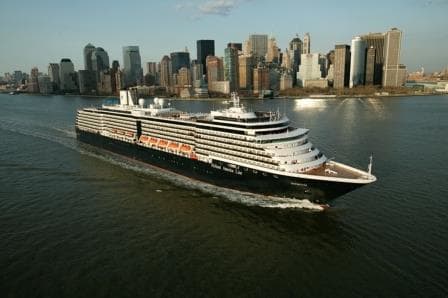
The ms Noordam III when she had just entered service.

The ms Noordam III when she had just entered service.

The next desire of the guests was: more balconies and the result was the Vista Class. Holland America went a little bit bigger because the competition went to Mega ships and being only slightly large meant we still could go through the Panama Canal. The next craze was more food outlets and thus with the Signature class the Tamarind restaurant made its entry.  We still do not have 10 restaurants on board as NCL does but with a Main Dining room, a Lido, a Pinnacle, a Canaletto and a Tamarind we are not doing that badly either. I believe the lower number of restaurants will be rectified with the Koningsdam.

If you keep this evolution in the back of your mind, then going from class to class of ship there is not so much of a difference. The biggest difference is at the bow, the 3 story theatre which means that the forward section is configured totally different internally, and the lower stern section as the ship has Azipods and not conventional propellor propulsion.

So today, having done all the administrative prep work and trying to chase up all the materials needed for the class, I went around to get into the “Vista Groove”. I think I walked about 10 miles and as I refuse to use an Elevator those 10 miles had quite a few vertical challenges to it as well.  One confusing thing is, compared with the S class, is the numbering of the decks. Soon after the S class came in service it became compulsory for the cabin numbers to correspond with the deck number. Thus cabin 1118 where I am living this week has to be on deck 1.  On the S class cabin 701 is on A deck or deck 4.

On the Vista class A deck is the highest crew deck, while the highest crew deck on the S class is B deck.  The Bridge on the S class is on deck 10, on the Vista class on deck 8 Etc. Etc.  As a captain you really know your ship by heart, inside out and then changing ships causes a few days of adjustment. This is the reason the company now has a system to ensure this is taken care of.  New captain on new class of ship, 14 days overlap. New Captain on a same class, 7 days overlap.  Same ship, same captain, 1 day hand over.

Today we were sailing in the Old Bahama channel, north of Cuba with a beautiful sunny day. Strong winds but they were following winds so it was very pleasant on deck. Tomorrow morning the ship will dock around 07.00 hrs.  and then I will have to present myself to Immigration. I have been promoted to a “downliner” which seems to be a person working on board who did not join in the USA port of departure. That is a new one to me so all will be revealed tomorrow.

The weather for tomorrow, sunny and warm. Florida seems to be heading for the summer already.

07 March 2014; Noordam Underway.

And so I arrived on the good ship ms Noordam. The final of the four Vista Class ships of the company. There was also a 5th. Vista class which was transferred to P&O cruises while being built and is now called the Arcadia. Then there are two modified Vista’s out there, which sail for Cunard as the Queen Elizabeth and the Queen Victoria. But those two differ considerably from the original Vista design as envisioned and executed by Holland America.

In command of the Noordam is Captain Robert Jan Kan, who will be the Master for the remainder of this cruise and the next one and then Captain Jeroen van Donselaar will take over. Captain Kan goes through life the same way as I do, being Dutch and living in England. Captain van Donselaar lives in the States. Although we might be captains in command and consider ourselves in charge of everything, there is always a higher entity to consider: “she who will be obeyed”; and as a result we all live where “she” wants us to live.

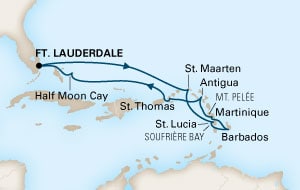
The Noordam is making 10 day cruises to the south Caribbean, with slightly different ports during each cruise. I am on board for 2.5 cruises. I hopped on in the middle of this one and then will have the school class on board for the next 20 days.  They will board on March 9 in Fort Lauderdale, which is the winter home port for the Noordam. She has spent the last years sailing in Europe in the summer but now she will go to Alaska and from there for the winter season 2015/2016 to Australia.

I joined in Willemstad after transferring from the Ryndam in Tampa and waiting for 2 days for the Noordam to come in. She docked at the Mega Pier (see my Ryndam blog from 10 days ago) and then hopped on to Bonaire and Aruba. From there it was homeward bound and today is the first day of the two sea days needed to get back to Fort Lauderdale.  We will be sailing north through the Caribbean Sea. Then through the Windward passage between Cuba and Hispaniola and then westwards above Cuba, ending up in Fort Lauderdale on the 9th.

There 12 trainee’s will board the ship, all coming from the company’s simulator training in Holland. They have all passed their exam and before you can join the fleet you are by law required to have completed a Bridge Management Resource Training and Digital Chart/Radar training. So that is where they are at the moment. To make their arrival on the ships a little bit more comfortable, they will receive 20 days of induction from two Facilitators. As there are six deck officer and six Engineers, there are two Facilitators.  The engineers will be looked after by Mr. Willem Dullaert who retired a number of years ago as active Chief Engineer but is since then passing on his vast knowledge and experience to new and sometimes also not so new Engineers. This year he has been at sea for 50 years so the word “vast knowledge and experience” are correct in his situation.  Compared to him, I am just starting out as I can only offer 35 years at sea, so the Deckies will just have to make do with that.

It will be a very mixed group. The days that the officers on Holland America Line were exclusively Dutch have long since gone and now we source officers who indicate their interest in cruising and Holland America and that means various nationalities. Thus 3 from the Netherlands, 3 from New Zealand, 3 from Romania, 2 from Croatia and the UK has sent one representative.   When I give training then I like them all to be from the same nationality or I like a good mix, I even prefer the latter, as the cultural exchange really helps to bring the best out of everybody.

So tomorrow will be the last sea day of this cruise and then our Holland America school will start while sailing the beautiful waters of the Caribbean. I wish they had had something like that when I started out back in 1981 as a 4th. Officer on the Statendam IV.

28 Feb. 2015, Sailing around Western Cuba.

Cuba forms a natural Northern boundary for most of the Caribbean Sea and as it consists of one island you either go around it on the west side; Cabo San Antonio or the east side at Cabo Maisi.  For us going to Tampa it means the west side, using the Yucatan channel and keeping Cabo San Antonio to the East.  As all ships have to do something similar it can be – sometimes hair raisingly – busy at the Cape and thus the Wise Men of the IMO have introduced a Vessel Separation System for this area. The IMO (International Maritime Organisation) is a sub organization of the United Nations and is tasked with regulating the shipping world. A task which gives headaches as each member of the UN wants something different and once something has been decided it  takes a minimum number of member states to ratify it before it can be implemented worldwide.

Approving new Vessel Separation Schemes is often one of the easier problems to tackle although also here the bickering can be intense about having the boundaries one inch to the East or one inch to the West so to say.  Still, most of the time it goes fairly smoothly as everybody see’s the logic in trying to prevent collisions. It saves lives, it saves headaches for the adjacent Country and it saves money for the ship owners.  Before the VSS was there, things would go “bump” on a regular basis with ships because when they came around the Cape they simply kept doing their own thing; which was not doing anything, and even then a very large body of water can suddenly be very small.

Thus the VSS are there now, how to deal & comply with them is stipulated in the Rules of the Road or Colregs  and since then the number of “bumps” or worse have been greatly reduced. More and more of these VSS areas are appearing around the world all with the aim to reduce collisions and the often secondary effect of Environmental Catastrofies.

When the Ryndam sailed through the VSS which is a Vertical North / South system west of Cabo San Antonio early this morning there wasn’t much of a chance of a “bump”. One lonely ship came south in the other lane and for the rest there was nothing to see. Just the sky, the sea and us. If you are on the extreme eastern edge of the VSS you can normally see Cuba but it being slightly hazy today, made sure that Cuba remained a mystery.

This is my last day on board, tomorrow I will be transferring to the Noordam. The plan was to fly to Samana in the Dominican Republic but that was not easy as it seemed and thus I join in Willemstad Curacao.

There will be plenty of work to do while waiting for the ship to come in, as on the Noordam I will be running the Induction class for new officers, similar to the ones I blogged about in November /December last year when on the Rotterdam.  This time we have 6 deck officers and 6 engineers who will be looked after by our Retired Chief Engineer Mr. Dullaert.

Also in Willemstad there is a Maritime Museum which I have not been able to visit yet and I hope that they have some information about Holland America when the ships called there in the 1930’s during the early days of cruising.

So in the coming days my blog entries might be a bit intermittent until I have settled in on board the ms Noordam.

27 Feb. 2015; Georgetown, Grand Cayman.

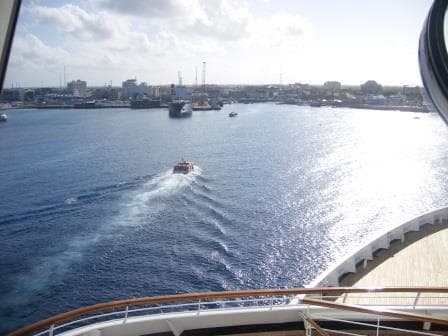
Grand Cayman was still as it was and the way I remembered it from a few years ago. When coming from the South you could see the Oil Tanks on the South West corner but not much else. Then slowly the houses come in view and finally when rounding the South West corner, you see Georgetown. Only when you come very close you can see that there is a sort of harbor there. Consisting of a small square with tender piers on both sides, two larger cargo docks capable of receiving small container ships which supply the island and next to it a larger cruise tender pier built about 10 years ago when the Mega Liners started to call in.

Approaching Grand Cayman from the South

Approaching Grand Cayman from the South

The weather looked really good with not too much wind and not many clouds around the island. The only thing that was indeed not very nice, and was going to be a challenge, was the wind.  Under ideal circumstances the wind is from the north east and blows over the island. Easterly winds are not very problematic either but south Easterly winds are not nice.  As long as they are not too strong they are not a danger to the ship but they do push swell and current around the S.W. corner of the island and that affects the tender operation.

Anchorage number 4 right opposite the port

Anchorage number 4 right opposite the port

We do not really want wind still weather at Grand Cayman; we want a regular steady trade wind from the NE or East.  The ships all anchor on the edge of the reef in about 30 to 50 feet water.  It is anchoring on a ledge. While the bow is above 30 feet of water, the rest of the ship is off the ledge and drifts above a 1000 feet of water. If the wind would stop, the ship could drift forward and then drift aground when it goes past where the anchor lays. It gets too shallow on the ledge very quickly. The constant trade wind prevents that. It pushes the ship away from the reef, while the anchor keeps it close to it.  There are four anchorages and we had 1, 2 and 4 in use today.  Carnival Splendor on 1, Carnival Pride on 2 and us on 4 which is the closest to the town. We anchored on a square area of about 100 square feet in order not to damage the rest of the reef.  To accomplish this, the pilot comes out in his boat, sits on the exact spot for the anchor, the captain brings the anchor above this boat…….literally on the foot…… boat moves away and anchor goes down.

A beautiful day when you can not see the swell and the current

A beautiful day. As you cannot see the swell and the current you would think it was a perfect day.


Today we had challenges with this S.E. wind as it pushed the swell over the anchorage areas. Which meant that we could only use our leeside (Portside) platform, as there was too much swell on the sb. side. Then the current came up around the ship as well making it necessary to tie each tender alongside the platform with two ropes to keep it from drifting away. Then the tender driver finds a balance on the engines and twist in such a way that there is no gap between platform and tender.  With only one platform available and the time it took each time to tie up safely, we had a slow tender operation. But safety comes first and thus not much we could do to speed the proceedings up. The captain had even hired a shore side tender to ensure that there was no lack of capacity. So the ship did its best but the battle against Mother Nature can be difficult even if she looks at her best.

By 3 pm. We had gotten over 1000 guests to the island and back again. The rest had been there, bought the T-shirt already and thus did not bother. Now it was time to set sail for Home port Tampa.  The two Carnival ships had arrived later and thus sailed sometime later as well. At least they were not in the way, as their tenders dock at the Whatley Pier which is a bit further away from town.

Tomorrow will be our last day of the cruise while we sail around the West Point of Cuba. The weather should be nice and warm and only getting chillier late tomorrow afternoon when we are past the Gulf Stream and enter the Gulf of Mexico.


26 Feb. 2015; At Sea.

Today we sailed from Aruba towards Grand Cayman,with the wind on the side and the swell three quarters on the stern. The latter can be a bit annoying as the ship tends to move then. Rolling a degree or so on occasion. We have the stabilizers going full out but they cannot cope with the elimination completely due to the angle.  For some reason all the ships with a square or semi square stern (and that is all the modern cruise ships) have this issue that if the swell catches the ship under this ¾ stern angle there is some rolling. The swell on occasion comes under the stern and as it not straight under the stern, it cannot make the ship pitch and as it is not full on the beam, the stabilizers cannot completely deal with it. But the swell lifts or pushes the ship up at just the wrong location. Only the Prinsendam in our fleet which has a very rounded stern does not suffer from it.   

If you have ships with a duck foot (that is a sort of spoiler on the water line at the stern), you get the strange movement that sometimes the ship seems “to hang & stay” on one side for a prolonged time before it comes back to straight up.  So modern ship design for all its improvements, has also introduced a few new quirky behaviors in the ships.

A duck foot is a flattened part sticking out from the stern over the water. It can be installed to improve stability. If you increase the width of a ship at the water line, you get a better margin to survive if the ship would take on water.  Or you can use it as a spoiler which presses the ship down on the water and thus reduces the fuel consumption as it optimizes the direction of the flow of propeller wash.

When you do practical drills on the ships it nearly always consists out of three parts.  1. The objectives for the drill: what do we want to achieve?  2. The execution of the drill according to the objectives.   3. A debrief: did we achieve our objectives during the drill? What went wrong, what went right, what can we do better next time.

The ships hull with two cracks

The ships hull with two cracks

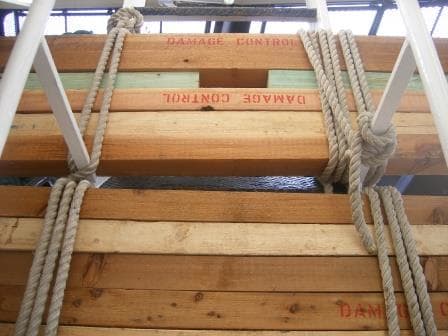
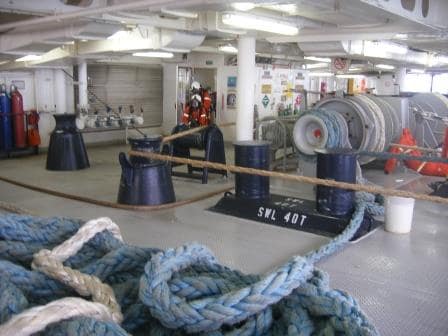
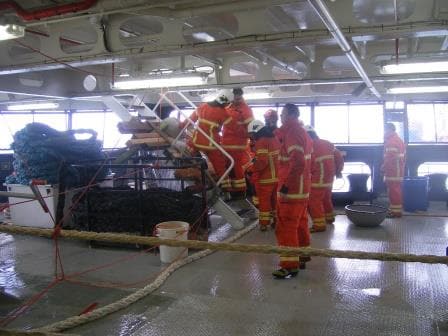
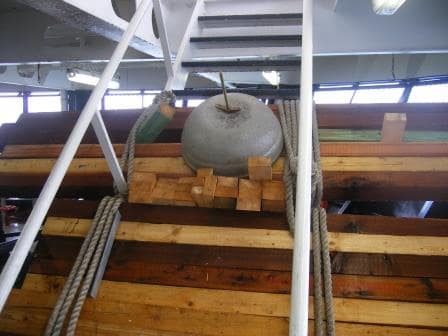
In Aruba we held a damage control drill, with the objective to close of two holes in the hull through which water was coming in.  The focus of the drill is to first make the area safe and then to have the teams brainstorm about what material to use and how to plug the holes to such an extent that if they cannot be closed completely, they can be sealed to such an extent that the pumps can easily deal with the still incoming water.

Initial attack = is the area safe

Initial attack = is the area safe

We exercised the drill accordingly, with the mockup I had built on the aft mooring deck and it all went well. The engineers showed great skill and insight in carpentry so if they ever decide to leave the ship…………. there will be a future.  When it comes to Damage Control it is the engineers who take the lead as there is steel – construction – involved and pipes and fluids. Plus most likely if we would have ingress of water, it would be in the Engine Spaces.

Area is safe, scuba gear comes off and we are hammering away

Area is safe, scuba gear comes off and we are hammering away

When it is above decks, outside the technical spaces when it mostly involves guests areas, the deck teams take charge as the needed routines might be closely linked to moving guests around and other disciplines which might be guest related. However when an Emergency is called, all the teams are in the same attack mode together, until it is fully clear under which expertise the issue can be resolved the best.

20 minutes later all the holes are properly closed off. the ship is safe.

20 minutes later all the holes are properly closed off. The ship is safe.

Tomorrow we are in Grand Cayman and that is a tender port. To prepare for that evolution the Life Saving Officer calls the whole deck department together for a Tender Briefing. This is a gathering in the Bo ‘sun store where by means of a Power Point, the tender route is described, where the tender will dock, Navigational issues, Traffic that might be encountered, Weather, etc. etc.  This ensures a proper operation of the shuttle service and then the only thing that can really go wrong is either mechanical or weather related.

We should be arriving at 08.00 in the morning and then have the shuttle service going shortly after. The weather should be typical for the day, breezy with showers in the area. The only thing is, the wind might be S.E. instead of North East and could mean more swell at the anchorage.

For those who do not know what to do: Grand Cayman has over 600 banks who are registered there and thus have an official brass plate on one or the other official door and that is already worthwhile to have a walk around the town for.


25 Feb. 2015; Oranjestad Aruba.

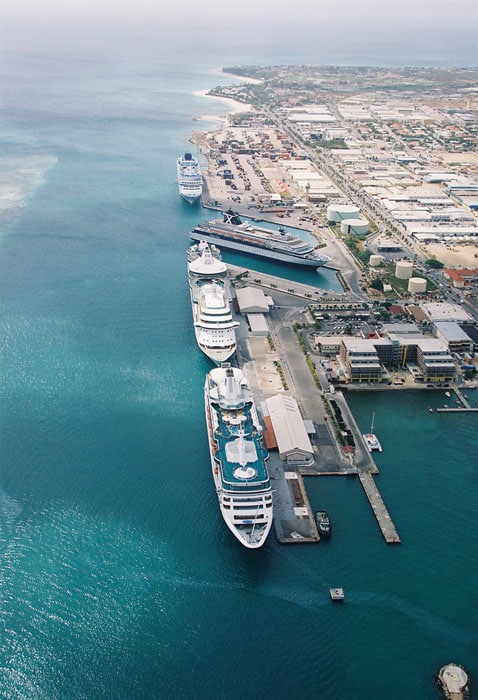
The port of Oranjestad is really more a sort of coastal rim or beach which was eventually built up, than a properly constructed port, as its existence is fully due to the natural protection from a reef that lays in front of it. That together creates a natural harbor where the reef protects the port from the worst of the ocean swell.  This protected rim of the island has been changed into docks and they form a barrier between the water and the town itself. There is a Container / Cargo Dock, then several docks which are multi-purpose and then the docks A, B, C and F which are mainly dedicated to the cruise business. Dock C and F are the closest in walking distance to the town as for A & B people have to double back to get to town as they cannot walk straight off the Pier at location A/B as there is water in between.

Full house in Oranjestad. Terminal C is where the 2nd large ship is docked.

Full house in Oranjestad. Terminal C is where the 2nd large ship is docked.

We were the only cruise ship today and dock C was reserved for us. If there are more ships, then the berth assignment depends on size and arrival and departure time. Smaller ships can fit in Berth D,E and F, as long as they do not stick out but the bigger boys have to go on A,B, or C and sometimes even have to overhang using the bow ropes going onto the dolphins.  I never like to be at Berth A, as it is a long walk back to the Gate for the guests but also because on departure it is very short distance from the dock to the exit of the harbor and you have to make speed quickly to make the turn. With the S class ships it is not such a problem as they have Becker Rudders which steer extremely well as long as there is flow over the blades.

However in the past when I came here with the old Noordam, Nieuw Amsterdam and Rotterdam berth A was not so nice as those ships needed to build up speed before sufficient flow would go over the rudder blade to steer and a safe turn could be made. If I had half the chance I would let the N ships drift back halfway down Dock B and then charge forward. With the Old Rotterdam we would normally hook up a tugboat for this turn as a steam turbine ship needs time to gather momentum.  The old Lady liked to Waltz, she did not like to Jive very much.

Oranjestad has the same current flowing past the entrance as Willemstad and when the ship sails in from the North West, there is a leading light to help steering against the current and to stay exactly on track. Once inside it is a matter of slowing down at the right moment and finding a good course to avoid the ship being caught by the strong Trade Winds which blow almost unhindered over the low island. They have a mountain called the Hooiberg (Hay stack) which rises steeply out of the landscape but for the rest the island is flat. (Or is it a hill ??, as I saw a movie once which claimed that a hill has to be a 1000 ft. high before it can be called a mountain ?)

ms Freewinds ex Boheme

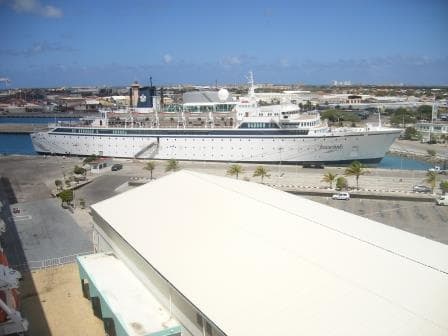
ms Freewinds ex Boheme. Note the sloped flat stern which was once the Garage Door for the Cars.

Next to us in Berth F was the Freewinds. Nowadays owned by the Scientology Church and it potters around a bit in this area. We see it sometimes in Bonaire and sometimes here. I do not know whether it is a cruise ship for that church or a training center or maybe both. What I do know is that we are looking at a piece of Cruise History. This ship, then called the Boheme for Wallinius Lines, can be credited with starting the modern cruise business from Miami. The original concept was to run vacation – take your car cruises – to the Bahamas. That was not that successful so they welded up the car deck and it became a regular cruise ship and then it all started rolling. NCL showed up, followed by RCI, followed by Carnival and the rest is history. All back in the good old days of the late 1960’s. She is now 47 years and has been owned by Scientology since 1986. From the outside she looked in very good condition, so if the inside is the same, she might last for a long long time to come.

We had a long stay yesterday in Curacao; today was only a half day call, as we have a long distance to travel to make Grand Cayman on time. Tomorrow will be a sea day and Georgetown will be our final port of call on the day after.

Guests can now start worrying about how they are going to get all this stuff that they bought in the suitcases they brought on board which were already too small when they packed them. But the weather is going to be very nice. Sunny with following winds, creating a gentle breeze on the decks.

My day will be filled with debriefings from the various drills I threw at the ship and the sailor trainee’s will be excited as they will have their theoretical examination.


« Older posts Newer posts »