- Captain Albert's Website and Blog -

Ocean Liner History and Stories from the Sea, Past and Present. With an In Depth focus on Holland America Line

Page 102 of 241

24 Feb. 2015; Willemstad, Curacao.

Willemstad is blessed with what I think is the best port in the South Caribbean. It is also the largest one, with a big sheltered internal harbor, created by the combination of the “Schottegat “and the”St Anna Baai”.
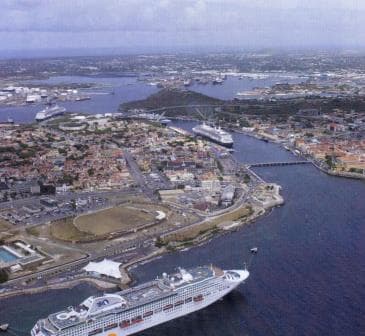
Almost All the cruise ship berths occupied. Two Holland America Line ships inside the harbour and an RCI ship at the Mega Pier outside.

Almost All the cruise ship berths occupied. Two Holland America Line ships inside the harbour a Celebrity ship tucked away under the bridge and an RCI ship at the Mega Pier outside.

Because of this natural advantage the island is also economically further developed than the other islands. Apart from the Refinery which you also find on Aruba and Bonaire, the other two Dutch islands nearby, there is a shipyard and a lot more industry. It does not have to survive on oil and tourism alone, courtesy of having a deep and large harbor where many ships can dock at the same time. Sailing in, then swinging around inside either during arrival or departure and then sailing out again is a nice thing to do. Especially if it is an evening departure when you sail through the lit up houses on either side …… very close to those houses as well, as the fairway is not that wide.  
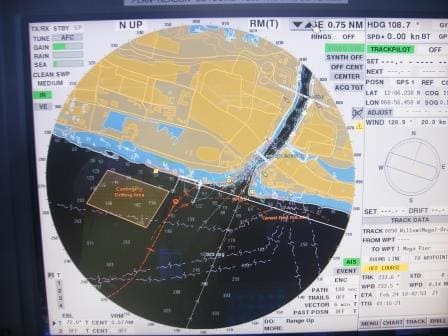
As you can see the entrance is quite narrow and a challenge for a high-out-of-the-water cruise ship on a very windy day,

As you can see the entrance is quite narrow and a challenge for a high-out-of-the-water cruise ship on a very windy day,

But this was not the case today. We were the only ship and thus we docked at what they call the Mega Pier. It is not so Mega big but large enough to accommodate all the large cruise ships which do not easily fit inside the harbor. It would be nice to go inside but it is time consuming and the mega pier is a much better dock to moor at.  Today it was very windy and I would have been quite reluctant to have gone into the entrance, certainly in the early morning.  For the approach it is not such a big problem as the current is against the wind but about 300 feet from the entrance the current becomes a counter current, in the same direction as the wind and then it is less pleasant if there is lot of wind, like today. Especially if they want you to dock at the berth right inside the entrance. Then you have to put the brakes on as soon as you come in and that is a rather unpleasant maneuver. Luckily Captain Ryan did not have to make that decision; we were going to the Mega Pier.

Because the 3 Dutch ABC islands (Aruba, Bonaire, Curacao) are so close together, we always stay a late night in one of them. Going to the next one is barely 5 hours sailing, with a sedate speed, and thus we can have a late night stay. For this cruise it is Willemstad but I have stayed late in Oranjestad (Aruba) and Kralendijk (Bonaire) as well. Because of the late stay we see more guests taking longer tours, as there is still time to explore the town, or to shop, even if it is a full day tour. There are no full day tours on Curacao, it is simply too small but we see quite a few guests doing a morning and an afternoon tour and then on return wandering into town or have themselves dropped off in town on the way back.
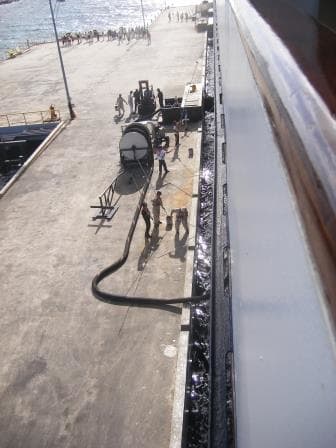
Regular cruise ship day. Bunkering fuel and the sailors touches up the hull

Regular cruise ship day. Bunkering fuel and the sailors touching up the hull

For the ship it was just another port day, except that we were refueling as well. Willemstad has a Refinery and that lowers the price of oil. There is not any cruise ship company who will let a bargain slip by. With the refinery close by, there is no need for a Barge or Tank trucks; the pier is connected directly to the pipe lines system and the ship can simply hook up.  The oil is pumped with sufficient pressure at source and thus there is no need for a noisy pump on the dock and it results in a very quiet bunkering evolution.  Good for the guests on the dockside and even better for the guests in the nearby cabins.

My afternoon was spent with rigging up one of my elaborate drills. Building a small section of a ship’s hull from wood with two big holes in it. Simulating a breached ship’s hull with the option of lots of water coming in. That “lots of water” being supplied with three fire hoses on the other side of the wall. Tomorrow morning, there will be the challenge for the Emergency Response Teams to plug off a broken gas pipe which threatens to create a gas explosion, to save two casualties with gas inhalation and then to plug the holes with wooden beams, steel covers, plugs, wedges or whatever they deem suitable as we have it all in our Damage Control Inventory.

Tomorrow we will be in Oranjestad (Orange City), Aruba, and will dock in the port which listens to the name of Paardenbaai (Bay of Horses) although I have never ever seen a horse there.  We will be the only regular cruise ship in port apart from the Freewinds but that is a private undertaking of the Scientology Church.

The weather will be the same as today: how could it be different as Aruba is barely a stones throw away? Warm and Windy.
 

23 Feb. 2015; At Sea.

After several days of Island hopping we had a quiet sea day today. Although quiet is relative when looking at the daily program. If you would want to partake in everything you would basically have to split yourself in 3 parts and then have a fourth part available to go to the Bar, as the Ocean Bar opens its doors at 10 am. in the morning.

Still 1200 people had to be kept occupied and that means activities, either in active form or passive form. There are always a number of guests who are happy to enjoy the peace fullness of a deck chair with a good book or music but a larger number on board want to be entertained. Then there are many choices and you cannot do it all at the same time.  Today I was thrown in the mix by holding my HAL History Lecture which took about 500 people out of the equation. By careful planning I managed to finish the moment the Mariners Luncheon started. As nearly all guests this cruise are Mariners it was quite a nice parade from the bow of the ship all the way to the stern of the ship. A good way to build up some appetite. A few guests left the lecture early to get a head start as of course you never know if the ship runs out of food, so better be early than late.

Sometimes we have days where there are little gaps in the daily program but today one could have gone all day nonstop:

0630 – 0700 Continental Breakfast.  0700 – 0800 early morning stretch. 0800 – 0900 Church (two flavors available) 0900 – 1000 Photo Editing.  1000 – 1100 Hal history lecture. 1115 – 1230 Mariners lunch. 1230 // 1300 Poker class / Cooking Class/ Bingo/Art Action / Health. 1400 – 1500 Dancing under the Stars. 1500 Trivia // Cocktail mixing // Tea time.  1530 Movie time (the hundred foot journey) 1630 Computer classes.  1700 Cocktail hour/ social gatherings/ music in the ship. 1800 Dinner. 2000 Main Show (Livewire playing Celtic Music) 2100 Classical live music 2215 Live music dancing.  2300 Disco // Late night buffet.

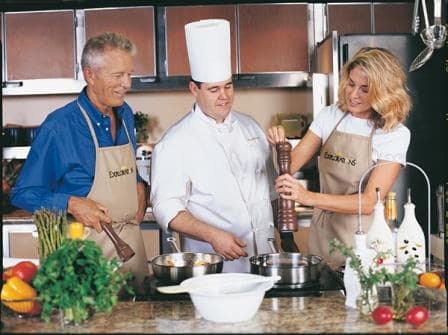
And I forgot to mention we had three of these as well today.

And I forgot to mention we had three of these as well today. (Photo courtesy; Holland America Stock Photo)

And that is only for one of the three parts as I have not even mentioned the marvelous invention of happy hour. Available to kill time between activities or to fill a larger gap in the daily activities for half price.


Compared to the longer and more unusual cruises there is less port lecturing than on a European Cruise. This has mainly to do with the fact that everybody has already been there before.  Shorex and the Port Shopping Ambassador hold their talks but it is more to refresh the people’s minds and maybe point out something new but most of our guests are very well versed in the ports to come. Some do even know the difference between dock A, B and C in Oranjestad Aruba. Those will be happy to know that we will dock at Dock C, which has the shortest distance to walk to the gate and thus to town.

We are going to Willemstad on Curacao first and we should be there around sunrise which has been scheduled by the Navigator to occur at 06.43 tomorrow morning. We will be docking at the Mega Pier, which is the pier in the open ocean. This is a mixed blessing. The ship can nearly always dock there as wind and current do not hamper the ship sailing into the narrow entrance of Anna Baai but it is further from the main town of Punda. Luckily this side of Willemstad, Otrabanda (or “the other side”) has been renovated so much in the last few years that people can spend a few good hours there as well. There is a small restaurant on the corner which serves excellent Sate, – with spicy peanut sauce – the way the Dutch like it and as are there until 11 pm a few of the Dutch officers might make a pilgrimage in that direction.

Weather forecast for tomorrow; Warm and very windy. Dangerous for getting a sun burn as with the wind you do not feel the sun that much.

22 Feb. 2015; Castries St. Lucia.

We are now in the middle of the process of what we call “Island hopping”; everyday a new Island and everyday a new experience. Although the Caribbean islands have a large number of similarities there are also striking differences. Most of them are caused by the colonialisation in the old days that brought traditions and routines which are still observed today. Barbados closes it shops on Saturday afternoon because of the weekly cricket game; people retained the language from the last or most influential occupier or developed their own uniqueness among the other islands of the Caribbean rim.

St. Lucia is one of those islands as well. Although Tourism & Cruise Industry is a very important of the economy it seems that it has never taken over or dominated the island. Even at the cruise ship terminals, where most of the souvenir shops are concentrated it is not as over powering as in St. Thomas or in St. Maarten.  A slower pace still persists and that brings a certain charm to St. Lucia which other islands sometimes miss. It might help that only ships which make 10 day or longer cruises can call here, as it is just too far south to be part of a 7 day itinerary from Miami or Ft. Lauderdale and that cuts out most of the mega liners.

I have been calling here with Holland America since 1986, when we had to anchor outside due to the shallow harbor.  Cruise Tourism was still in its infancy here and we tendered into downtown and the local market. It was quite a long tender ride. Passengers were unloaded straight into the fish shop of a Mrs. Black, whose skin lived up to her name but she had off-set that with the most vibrant  colored dresses and head scarfs I have ever seen. She was a very large and friendly lady and equipped with a voice like a fog horn, so nobody could miss her when she sold her fresh fish. She was a great ambassador for St. Lucia all by itself. When landing with the tender it was the first impression you got about Castries and it was a good one.

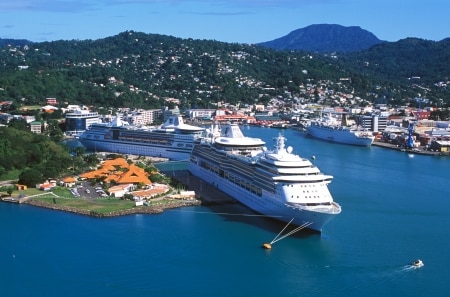
Castries Bay full with cruise ships. (Stock Photo from some years ago)

Castries Bay full with cruise ships. (Stock Photo from some years ago)

Then the port developed two cruise terminals on the other side of the Bay. Seraphine I and Seraphine II. The harbor was dredged deeper and cruise ships could come in. The downtown dock was then mostly used by cargo ships.  Nowadays, on busy days, and or when smaller ships are in, the downtown berth is now also used again by cruise ships.


So today we saw the Braemar docking there who had followed us from Antigua.  St. Lucia is a very fertile island which can be seen by the lush green scenery all around the port and up into the mountains.


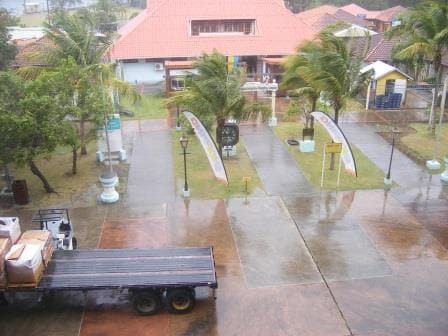
Downpoor at the Shopping Centre. Still life is slowly paced. Even the advertising clock for the local Jewellers was 5 minutes slow.

Downpoor at the Shopping Centre. Still life is slowly paced. Even the advertising clock for the local Jewellers was 5 minutes slow.

Occasionally you are reminded about how it is possible that it remains so lush and green when there is a sudden downpour. We were able to witness one this morning when just before noon time the heavens opened for a short moment and the torrential rain shower came down in the bay. Luckily they normally do not last very long and this one did not last very long either.

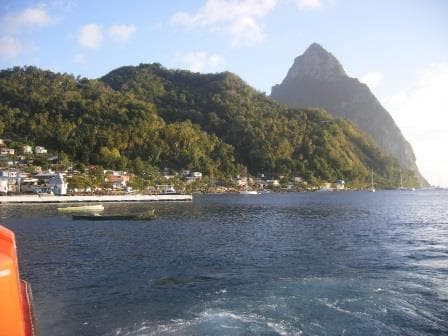
Gros Pieton dominating the bay of Sourfriere. As seen from the Tender Pier

Gros Piton dominating the bay of Sourfriere. As seen from the Tender Pier.

Also as long as I have come here, we make this a two port call. We spend the morning and early afternoon in Castries and then sail along the coast towards Soufriere, near the south end of the island to retrieve our overland tour and at the same time look at the magnificent Pitons. Soufriere Bay is sheltered from all sides except the South West.  As there is seldom bad weather coming from the south west, it is a very popular place for yachts to spend a few days before heading out to sea again. The east side of the bay is normally full with them. The most dominant feature are the two boulders rising up to well over 2000 ft. The largest one is the Gros Piton (777 meters or 2548 ft.) and the smaller one is Petit Piton (743 meters or 2266 ft.)

They are not really boulders of course but cone shaped mountains. They are cores of two lava domed volcano pipes and most likely a left over from a larger Volcano. The sides of these Volcano Pipes eroded and collapsed away and the cores, made of harder material remained.  As the Volcanos have been dormant for the last 20,000 years, the Pitons and surrounding area is completely covered in dense Tropical Jungle and home to a large variation in wildlife, including Iguanas. Under that majestic view, we sent the tenders ashore to retrieve 197 guests who had explored St. Lucia by means of an overland trip and had thus seen most of the island.  Our tenders arrived at 5 pm. and the guests showed up at 5.05 pm.  So it was all working like clockwork.

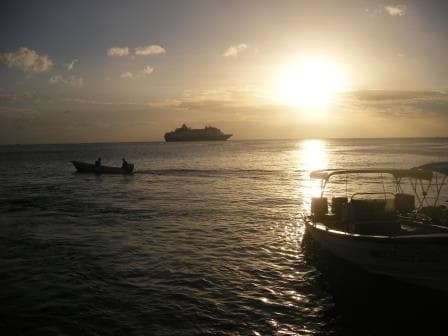
The sun setting over the ms Ryndam

The sun setting over the ms Ryndam.

The Ryndam remained floating in the bay as it is much too deep to anchor here.  I took the chance to get my Tender Operator school class involved and had them do the work on the tenders and observe the operation. They will have their exam in Grand Cayman so they had better be on the ball.

By 6 pm. we were on our way again. The Ryndam headed on a south westerly course and will now spend the next 38 hours or so crossing the south western part of the Caribbean, arriving the day after tomorrow at Willemstad  Curacao.

Forecast weather, hot and balmy due to the following wind with chance of showers in the early morning.


21 Feb. 2015; St John’s. Antigua.

Same as St. Thomas (Bluebeards Castle,) the island of Antigua was for a long time a Pirates strong hold. Also blessed with a deep and sheltered Bay it was a safe haven for many of them until the worlds powers had enough of it and cleaned them all out. Then the bays, inlands and other sheltered areas were taken over by the Worlds Navy’s who controlled their strategic assets. Dutch, French, and English they all had a few islands under control and those served as a springboard to assert their claims in the area. A name such as Nelson’s dockyard still reminds us of those days. Nelson and the dockyard are long time gone and now the rich, super rich and sometimes not so rich can park their yachts in that sheltered corner of the island. The size of their bank accounts identified by the lengths of their yachts.


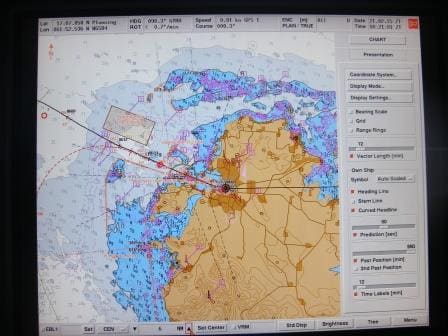
A scan of the Chart on the Radar. A long and narrow channel leads into a very shallow Bay.

A scan of the Chart on the Radar. A long and narrow channel leads into a very shallow Bay.

The main bay with St. Johns as the capital of Antigua is located on the North West side of the island, completely sheltered from the Trade Winds. There is only trouble here if a frontal system comes in from the other – North West or West – side. Today the wind was regular and the Ryndam could sail in without any hindrance. The Braemar (Fred Olsen Lines) was already in. We docked at the Northside of the Heritage Pier and were later joined by the Costa Mediterannea who docked at the other side. The Heritage Pier is the pier that is closest to the down town area and the Ryndam basically docked in the middle of the town.

Same as is the case with San Juan, St Johns harbor is prone to silting up and when coming in we saw a dredger busily removing silt from the area which is called Rat Island. This used to be cruise terminal in the old days before the down town piers were developed and the bay dredged out. Now this is the main cargo/ container terminal. The dredger was called the Shoreway and is owned/operated by Royal Bos Kalis which is a Dutch company but the dredger was flying the Cyprus flag and that was a bit of a disappointment.  But the off- shore and dredging industry is really cut-throat and thus having subsidiaries all over the world does make sense.

A group of people on board which really fascinates me are the ships photographers or the Image Creators as they are called nowadays. If you talk about a group of people who have to constantly self-motivate and re-motivate themselves, then that is the groups. Seldom a compliment from the guests but a lot of indifference; and sometimes worse.   People do not want their photo taken, and if they don’t get one then it is not good either. If they like the photo then the prices are too high. Etc. Etc. It does take a very positive attitude to get through all that.  They only feature which is really liked is the Black and White studio which clever photo shooting can turn everybody into a fashion model.

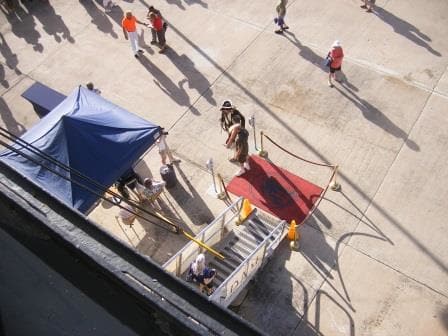
DSCF4633One of the standard features in the photographers’ life is the Gangway Shoot.  Every port a different theme, sailor boy, pirate, Spanish lady, something done in relation to the port.  Today it was a Pirate theme and thus a photographer was standing at the gangway all dressed up in the hot weather. Again not something for the faint hearted. Cursed by Security as they are blocking the gangway flow, pushed aside by the guests who are in a hurry to get to their tours or to the shops. You wonder if it is all worthwhile to do it. But it must be, as every ship has a photo department and when looking to the new ships, the area allocated to them only seems to grow.

Leaving St. Johns is also an interesting feat as it just fits. The turning basin has to be constantly dredged as well and it is not very large. For the Ryndam there is sufficient room but for the larger ships such as the Costa M. next door it is a very tight maneuver with only a few feet to spare.

Once outside the ship set sail for Castries St. Lucia. An almost straight southerly course. We will be there tomorrow arriving around 0700 hrs. and we will be followed by the Braemar. Tomorrow will be a two port call as in the afternoon the ship will proceed to Soufriere Bay to pick up the overland tour which leaves from Castries in the morning. Additional benefit is the scenic cruising that it involves around the Pietons.

The weather is looking good, although there is a chance of one or two torrential downpours courtesy of a weather front that lingers over the N.E Caribbean and SW Atlantic.

20 Feb. 2015: Charlotte Amalie, St. Thomas, US Virgin Islands.

From San Juan to Charlotte Amalie is only a short hop. The islands of Puerto Rico and St. Thomas are neighbors. Only San Juan is located at the north side of Puerto Rico and Charlotte Amalie is located at the south side of the Island. Thus during the night the ship sailed East North of P.R, then dives through the hole and continues sailing east south of St. Thomas.  We can be always on time; the question is just what time do we arrive? Although the Captain can indicate when he wants to arrive, the exact time is decided by the Port Authorities, with the eye on avoiding Traffic Jams. St. Thomas is so popular with cruise ships that the docks are nearly full everyday (except Sunday’s) and all the cruise ships want to arrive at nearly the same time.

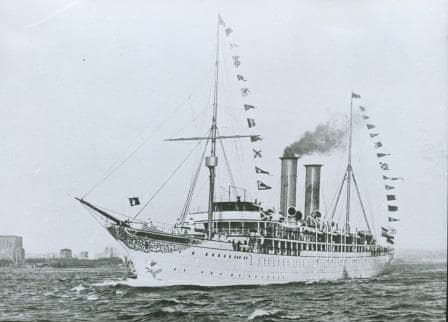
Since the mists of time; cruise ships have come to Charlotte Amalie. First as an excursion to a quaint island in the Caribbean, but has it had a sheltered bay so good for the cruise ships they kept coming.  The Germans already had a dedicated little cruise ship calling there, the Prinzessin Victoria Luise coming here in 1900. Holland America showed up for the first time in 1934 with the Rotterdam (IV).  One of captains from those days; Captain Barendse, was so love with the island that he bought a piece of land there. Including a servant whose duty it was to raise the – HAL – flag each time his ship would come to port.

One of the earliest  ships built as a cruise only vessel. The Prinzessin Victoria Luise from 1899

One of the earliest ships built as a cruise only vessel. The Prinzessin Victoria Luise from 1899


The West Indian Dock Company built a dock in the bay on the sheltered side and the rest is history. The Ocean Liners of the North Atlantic went cruising in the 60’s and 70’s and were then replaced step by step by dedicated cruise ships, and then the increase in size came. I remember that around Christmas 1981 (I was 4th. officer on the Statendam IV) we were with 11 cruise ships in Charlotte Amalie, putting ashore about 5500 guests. Four ships alongside the berth. Two in the inner harbor, one on the engines and 4 outside the entrance.

In 2002 I was there again with the Maasdam (V) and now we had 5 cruise ships in port, putting ashore close to 12000 guests. Three ships at the dock, one in the inner harbor and one at the outer anchorage. Of course it did not stop here: the days of the mega liner arrived. The dock could barely hold of two ships and was even extended to make that possible.

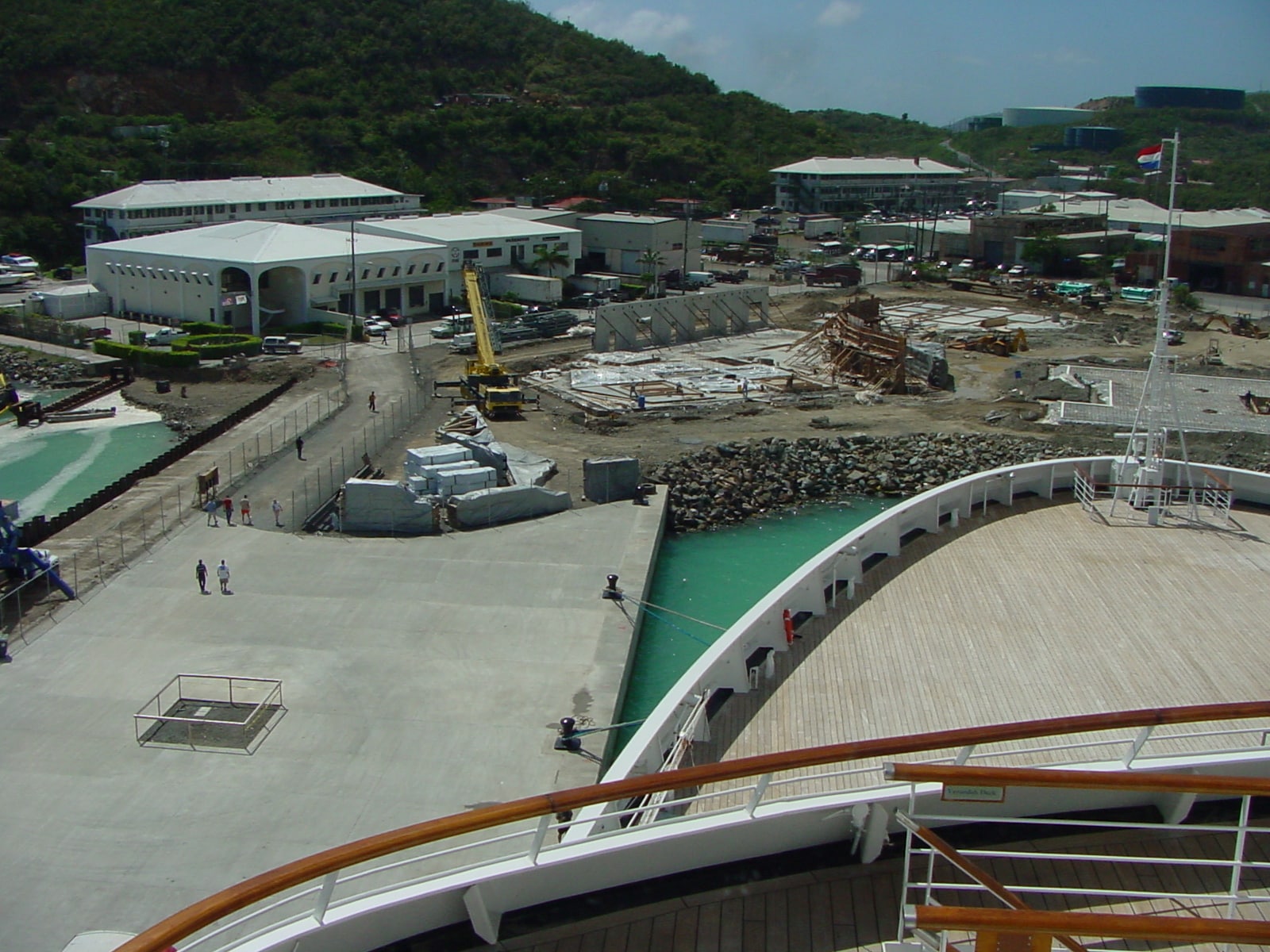
To deal with this overflow the Submarine Base in Crown Bay was developed. In the 90’s the Navy closed the base and the dock was modified and extended with a shopping village built at the entrance.  So those with the money but not the stamina to go to down town could still spend and support the economy.  Holland America was one of the companies who opted for Crown Bay, having to make the decision between a quieter cruise experience or maximum shopping exposure. There is still shopping galore in Crown Bay, but it is not as hectic as in downtown or at Havensight.

From the bridge of the Maasdam in 2002. Crown Bay cruise centre under construction.

From the bridge of the Maasdam in 2002. Crown Bay cruise centre under construction.

And thus that is where the Ryndam headed this morning; into Crown Bay, which is really more of a natural channel around an island. But the channel has three names: West Gregory, the entrance/exit to the West; and East Gregory the entrance exit to the East.


Both come together in Crown Bay. The routine is when docking nose in, you normally come in through East Gregory as you can aim straight for the dock. Then you leave via West Gregory. If you want to dock stern in, you come in via West Gregory, aim the bow towards East Gregory and then go astern into position.  You can do it the other way as well but it means a lot more of maneuvering and fighting wind and current.

So today we docked nose in on the north side of the dock and thus entered via East Gregory. Next to us was the Royal Princess who was docked nose out. At the Havensight dock there were two other mega liners and together we sent approx. 10,000 happy shoppers ashore.

I remember the good days when the town was already a shopper’s paradise but with a lot of diversification and interspersed with lots of restaurants and liquor stores. Now the very large majority of the stores are Jewelry stores.

But it was very nice weather and everybody should have had a grand day. Whether they bought jewelry or not. By 5 pm. It was time to sail and we followed the Royal Princess out and headed towards Antigua. We will be docking around 7 am. Tomorrow morning.  And will be in good company with the Braemar and the Costa Mediterranea…………………. and more jewelry stores of course.


19 Feb. 2015: San Juan, Puerto Rico.

San Juan is one of most impressive ports to sail in from the whole Caribbean. Morro Castle is towering high over the entrance and the ships sail fairly close to the shore, all the way to docks.  It can also be a challenging port to get into.


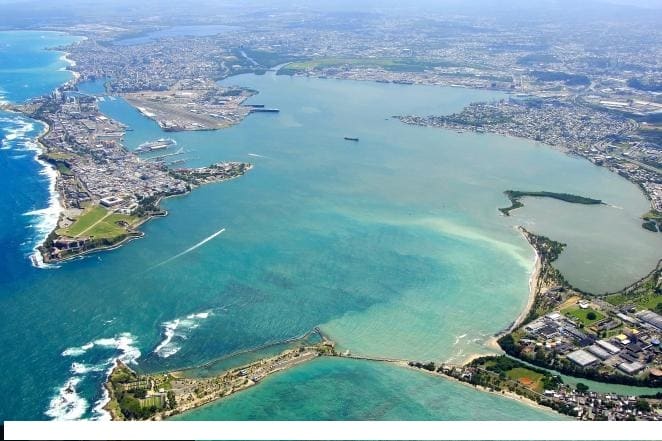
From the air entrance looks quite wide. It is very shallow with only a dredged channel providing sufficient depth. Luckily for the guests this channel runs quite close to Morro Castle.

From the air the entrance looks quite wide. It is very shallow with only a dredged channel providing sufficient depth. Luckily for the guests this channel runs quite close to Morro Castle.

The entrance to the West of Morro Castle is almost perpendicular onto the Easterly Trade winds; running almost north – south. The more wind, the more drift you will have while entering the channel and the channel is not that wide.   You can reduce the drift by going faster and that is what most cruise ships are doing under windy circumstances. When it is windy the pilot stays inside as the chop (read waves and swell hitting the shallow water area) near the sea buoy can make it very dangerous for the pilot when transferring from the pilot boat to the ship.

Then the captain can sail in by keeping speed and only has to start slowing down once he is in the lee of Morro Castle. Just inside, the channel makes a sharp turn to the right and that is where the pilot boards in wobbly weather. There also ends the wind & drift issue as the wind is now coming onto the nose and is reduced as well due to the lee of the land.

It only becomes an issue again once the docking procedure starts. Once again the wind becomes perpendicular onto the ships course as the docks are all lined up south to north. Thus with a lot of wind you can either drift too fast onto the dock on the windward side or drift away from the dock on the leeward side of the dock.  If there is too much wind for the thrusters, then there are tugboats. There is a plan b.

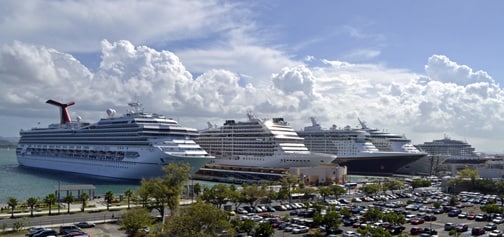
San Juan is a very popular cruise port and on mid week days all docks can be occupied with mega liners

San Juan is a very popular cruise port and on mid week days all docks can be occupied with mega liners


For us, today, there was not so much wind but we also had a perfect windbreaker in case there had been. The Carnival Splendor was towering high above us, located on Dock Four East and created a very nice lee which was appreciated by all.  I do not particularly like very large ships, but they come in handy sometimes. The Ryndam could nestle happily alongside dock Four West.

And thus we arrived and were happily alongside by noon time. The weather front was there but only its tail. It had lifted away from a forecasted track over Puerto Rico and now most of it was angled towards the Dominican Republic and San Juan saw only a few showers in the distance and strangely fluctuating winds in the harbor. Going from east to south and then to north in a bit of an irregular pattern. Only by 16.00 hrs. was the wind standard direction: East again.

Apart from trainings in the morning, I took the sailors down into the water to learn the basics of tender driving. Today they discovered the delights of maneuvering a Tender which lays high on the water and is pushed all over the place by the wind. Thus the most important lesson today was where is the wind coming from and where will it try to push my tender to.  For that purpose I train in steps.

Step 1: before you move the tender, check the wind direction.

Step 2:  when the tender is let loose from the fall blocks or from the gangway rope, watch how the tender starts to move by itself. Where does it drift to?

Step 3: Whichever way the wind/ current is pushing the tender, is the way you are going. If you enhance that movement is goes a lot better than when you fight it.  So if the stern gets pushed off by the wind use the correct engine to increase that momentum. Does the bow gets pushed off, then do the same with the other engine to increase that momentum.

And that makes it possible that suddenly you can maneuver a two engine tender; ……. with one engine.

Our nice lee side, the Carnival Splendor, left at 16.00 hrs. amid much thrusting to get the ship off the dock against the strong winds. The Ryndam had to put her thrusters on line and stop all gangway traffic to counteract all that power of the Splendor and to keep the gangway safe.

The Ryndam sailed in the late evening, giving the crew a chance to go ashore for a few hours as well. By that time the wind had died down completely which is normal for San Juan as the Trade Wind is mainly caused by differentiations in air pressure caused by the warming up of water areas. The sun gone, the water cools down slowly, reduces the imbalance in air pressure and eventually the wind dies down as well. 20 knots on arrival reduced to 6 knots on departure.

Tomorrow we are in St. Thomas and will be docking at the Crown Bay dock. Weather should be nice and not too breezy.

18 Feb. 2016; At Sea 2nd Day.

We entered the North Atlantic today leaving the shelter of the Bahama Banks behind. However the weather is very good with very little swell resulting in no ships movement at all. It remained windy though with an average of 27 knots on the bow, creating a relative wind on the bow of 43 knots. Not pleasant to lean into but the Lower Prom – walk around – deck is enclosed at the front and thus still not a problem to walk around in.


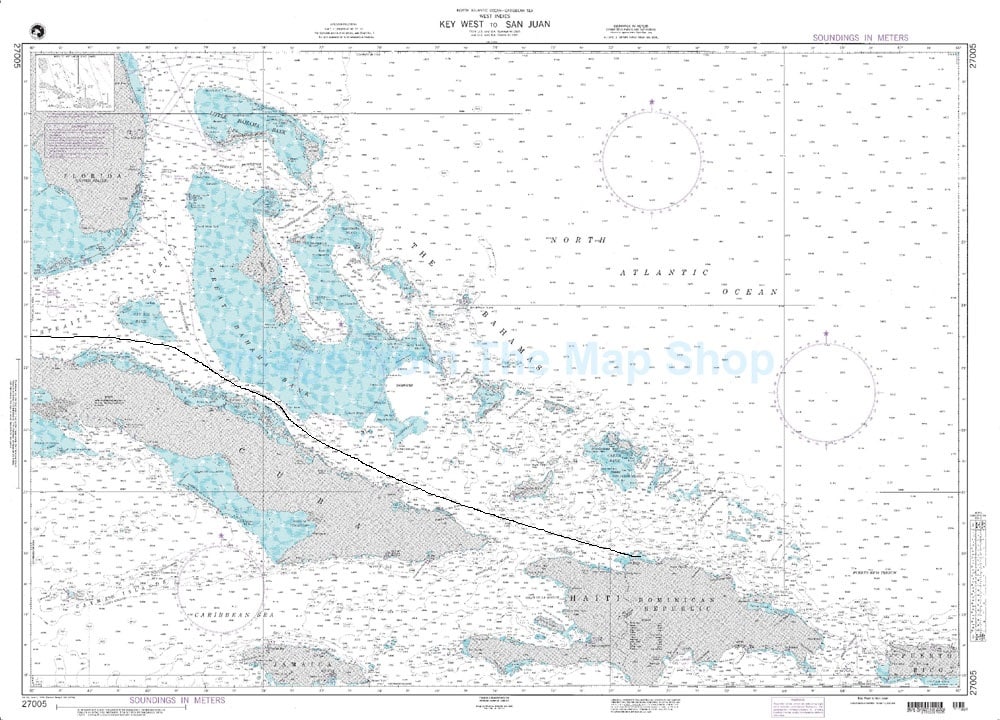
Map of the area we sail in. my apologies for the crude course line. Paint Shop is not my forte.

Map of the area we sail in. my apologies for the crude course line. Paint Shop is not my forte.

When the ship clears Cuba it crosses the Windward Passage, which is located between the East point of Cuba, Cabo Maisi and the west side of Haiti. It is a gap through which a lot of traffic enters or leaves the Caribbean Sea. When inside the passage the traffic is regulated by a Traffic Separation scheme. Once through it is a free for all and the ships scatter to all directions. That makes it very interesting for the navigators as the behavior of the ships is not predictable anymore.


To keep track of what those ships are doing and whether they are of concern to us there are a number of support systems available. First of all there is the bottom line: keep a good look out, by looking out of the bridge windows. Secondly keep a good eye on the Radar as it can pick up targets much farther way than the naked eye can see.  Within a range of 24 miles every blip on the screen is plotted (checked for its movement: e.g. direction and speed) and that gives a good idea what could become a problem or not.

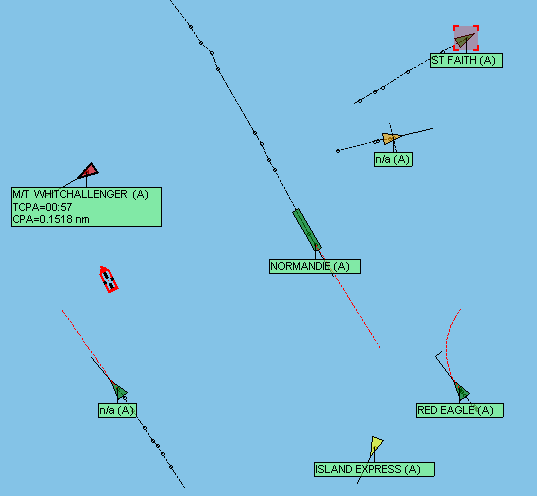
ais_display_sample_hr


The information seen on the Radar screen when clicking on the vessels icon. A read out on the side of the Radar screen with some the pertinent information needed for the Navigator.


Then there is a more recent invention which is another Aid to help make up the Navigators mind whether something is of concern or not. It is an Aid, as it is not fail safe and thus you cannot rely on it. It is Called A.I.S Automatic Identification System. It sends out ships specific information which is beamed up to satellites and then beamed down again to other ships. Every ship which has a receiver can display this information either on the AIS receiver itself or on the Radar Screen.  If the display says that the ship is going to New York, the navigator will get a pretty good idea which course it will follow once coming out of the Windward Passage and going north.  But the information is entered by humans, thus we come across ships who think it is funny to have strange messages transmitted. I remember a small ship on the Thames in England who displayed its destination as: From Here to Infinity.

Still, keeping a good look out, using the radar properly and using the AIS as well gives the Navigator a very good idea about what is going on. And then it is just monitoring if the ships keeps doing what they were doing and apply the Collision Regulations properly, so we do not get a collision. To run a bridge watch there is a team of 4 while in open Sea. Two Navigators and two Quartermasters. One navigator is the senior and is officially in charge of a watch, the other is the assistant. If both have the same seniority then the captain decides who is in charge. The two quartermasters rotate on a 30 minute cycle between keeping a look out and steering, or being on standby for steering.

Once the traffic gets more hectic, this bridge team is augmented with an extra officer who holds a master License. If the ship in a very hectic area or entering or leaving port, the Master is on the bridge as well.  Normally the team then counts at least 4 officers and two quartermasters. What they are doing during such an evolution can vary in tasks. Something nice to blog about on another sea day.

The weather front I mentioned yesterday is delayed a little bit. Initial forecasts indicated that it would hit Puerto Rico during our stay, during the day; now it looks that it will come over during the night or the next day when we are in St. Thomas. So we will wait and see, there is not much we can do about it and as we have to visit the ports on our schedule, we cannot sail around it.

Tomorrow we should be at the pilot station around 11 am. And be alongside by noon time. We will dock at Pier 4 west and have the Carnival Splendor on our Starboard side and the Independence of the Seas on our Port Side.


17 Feb. 2015; At Sea.

Today is the first of two days at sea. Our route will take us through the Straits of Florida and then into the old Bahama Channel located between the South end of the Bahamian islands chain and Cuba. Eventually by tomorrow morning we enter the North Atlantic Ocean after passing Great Inagua Island heading towards Puerto Rica.  Then it is sailing above the island of Hispaniola (Haiti & the Dominican Republic) until we make our landfall at Puerto Rico around 10 am.

The first part is going through the Florida Straits. Here we have the Gulf Stream that pushes us forward and if the Navigator manages to find the Axis it can help with up to 3 miles in the hour. Finding the axis is true statement as the strongest flow of the Gulf Stream is not always in the same location. Sometimes closer to the Florida Coast; sometimes further away. However that won’t last very long as the ship then has to head into the Nicholas Channel, followed by the Old Bahama Channel. Once it is there it comes under the influence of the Easterly Trade Winds. That is a steady wind which results in a steady push on the waves towards the West and it results in a Westerly current. So here we will lose what we gained with the Gulf Stream. The steady – opposing- trade wind varying between 15 and 25 knots costs us about 0.5 knot of speed. The opposing current is on average 0.5 knots as well and that means that the ship has to go a knot faster each hour than the average speed to maintain. That does not make the Chief Engineer very happy as it costs extra fuel to keep the schedule. Normally we make up for it again by the time we sail west from St. Lucia and later NW from Aruba to Grand Cayman and back to Tampa.

What is of more interest to the Guests is there something to see while we are sailing on this route. Yes there was this morning. While in the Gulf Stream we are too far from away to see the low laying land of the Florida Keys. Cuba is a different matter. It has a very high mountain range running along the island and on our courses we are sailing close to the Northern Cuban shore, just outside the territorial waters. We cannot go much further out anyway as the Old Bahama Channel is quite narrow at certain places (under water that is) and we have a Traffic Separation System in place with keeps the SE and NW traffic separate. To the north we have the 1000’s of reefs and small islands which form The Bahama’s and we do not see those either. Same as with the Florida Keys, most of them only stick a few feet above water and are not visible with the naked eye from a distance.

So, once we are clear of Cuba we will not see anything until we make our land fall at Puerto Rico. That is land we will not see. There is always abundant wild life out there, especially when land is not too far away. So we had all sorts in the morning. Sea Gulls, Brown Boobies, flying fish and guests reported seeing small dolphins, most likely porpoises. I think that it will diminish later on as there is more wind expected than blows normally. The Trade winds are normally good for 15 to 20 knots but 25 to 30 are expected tomorrow, courtesy of a Cold Front looming in the distance which might reach us after arrival in San Juan. (If so, that would mean a rainy day in that port.)

Cold Fronts are very common here in the winter. Florida normally has one every 3 days, big or small and that plays on into the Caribbean. On the one side it makes the temperatures a bit more pleasant while cruising the Caribe, on the other hand it increases the amount of rain and the wind…………………. It can be very windy on occasion in San Juan and as the docks are perpendicular to the prevailing wind, it can make docking an interesting experience.

Sailing here in the winter time can be very interesting as the area is caught in between the steady weather of the Tropics and the variable weather of the north. A good snowstorm cannot only upset the whole of the USA but it has direct implications for the weather further south.

Tomorrow we will find out how the weather is developing and how it will look for the coming days.

16 Feb. 2015; Key West, Florida.

It was quite windy when the Ryndam approached the pilot station and that always gives to think about what you will get when you get in there. Luckily the Pilot boat sails by the docks when coming out and its report gives some indication. The 2nd thing is the rule – of – thumb; call it past experience, and it has taught us that the wind at the dock is about 10 knots less than the wind at the sea buoy. Although low laying Key West is not that sheltered, there is still a high enough concentration of obstacles to dampen the wind velocity. That meant that for the day the winds inside would not be more than about 15 to 20 knots and that velocity is not really an issue.

So by noon time the ship had been cleared and everybody streamed ashore to inspect the local scenery. A few guests came back later rather shocked as the local scenery had been a bit more revealing than they had expected.  While that was going on, I took the Tender trainee’s down into the water to get the basics of ship maneuvering under control. Key West is a great port to do that, as it is always very busy with Sunday sailors and there is always wind and there is always current. Three ingredients which make a tender driver sometimes question his sanity; about if he really wants to be a tender driver or not.

The traffic in Key West is a mixture of Professionals (the large sightseeing schooners, ferries and catamarans), a group of those who study to become old-sea salts- but have not made it yet.  And the largest group, which are the six pack navigators who are let loose with a speed boat or a jet ski after 5 minutes of training.  Tender drivers have to learn the Rules of the Road, especially nbrs 1 to 20 and act accordingly. With the training course we teach the trainees to always err on the safe side and to find a common denominator that works the best. As an example; a sailing vessel has most of the time right of way. Not always but most of the time. To make it easier, we teach the tender drivers to give right of way to sailing boats all the time. Why, because a tender is much more maneuverable than a sailing yacht and getting out of the way early and staying out of the way is much quicker for the tender than for a ship that has to tack and relies on the wind.

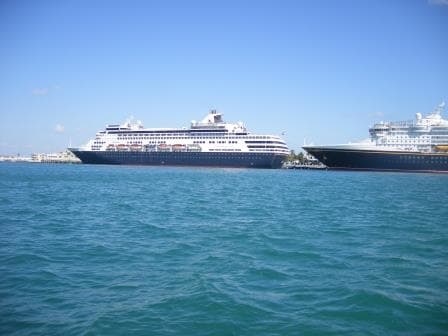
The Ryndam as seen from the tender. Behind her the bow of the Disney Magic.

The Ryndam as seen from the tender. Behind her the bow of the Disney Magic.

Today, just staying out of the way, was already hard work. It was breezy but not so much that small craft stayed in and everything that sailed, or somehow gave the impression that it sailed, was out there.


One that gave a lot of discussion was a guy on a sail board who was stopped in the fairway (or drifted into it) and sat on the sailboard fishing with the sail up.  So was it a fishing boat, was it a sail boat, what was it according to the Rules?  And was he doing in the fairway? As he was just floating, he might even consider himself Not –Under- Command, who knows?  After a lot of discussion the Golden Rule was accepted: If you do not know what the other party is going to do, and you can safely do so, stay out of the way.  So we did. Then the discussion came up if this guy knew what he was doing?? So I said why don’t you sound the Danger Signal (5 shorts blasts) and see what happens. We did and the reaction was: looking up from his fishing rod, giving a friendly wave and returning to fishing. He did not get the hint at all. So we stayed away. It must give the USCG a real headache when dealing with these sort of people.

Later on in the evening we had to deal with USCG, albeit in a very positive way.  Shortly after departure one our guests suffered a stroke and had to be disembarked. When that happens the fastest way to get help is to the USCG. If the USCG doctor at the location SAR Base agrees with the ships physician that it is urgent and help is needed at once; they will dispatch a helicopter. However being that close to Key West a helicopter did not make much sense so Capt. Colm Ryan simply turned the ship around, sailed back to the sea buoy and the patient was off-loaded onto a small USCG cutter. I am happy to report that the patient is doing well in the local hospital.

The hospitals on cruise ships are equipped to deal with regular walk in patients and with controlling an emergency. They are not equipped with supplies to solve the emergency. E.G. If there is a heart attack the medical team will stabilize the patient and keep him or her alive but they cannot take the cause of the heart attack away. That needs specialist help on the shore side. So if there is an emergency on board, the ship’s doctor discusses the situation with the shore doctor to see if a medi-vac is needed or that it can wait to the next port. You do not want to use resources unnecessarily. If it is needed, then the USCG is there very fast.  I wonder how many lives have been saved by all these USCG stations around the coast in the course of the years. I have never seen any statistics on it.

Tonight we have an hour forward and then we will spend two days at sea. Sailing north of Cuba through the Old Bahama Channel and then into the North Atlantic. We are expecting sunny skies and the regular trade wind breeze, so it should be beautiful.

15 Feb. 2015; Tampa, Florida.

It all ran as explained yesterday and the Ryndam safely docked at Terminal 6 in Tampa. Then the whole merry-go-around started with the disembarkation, refueling, provisioning and luggage in and luggage out. I observed the immigrations procedures by the CBP from the guest side this time.

When I sail as a crewmember I have a C1/D1 visa.   C1 = crew coming into the country, D1 means crew sailing on a ship in/out of the country. (Then there is a very popular D2 which you become appointed to when you go on vacation and leave the USA. Lots of crew are really looking forward to being D-two-ed……………) Now as a Travelling Master I hop off/on in USA ports and work between USA ports and that means I am on a L Visa which covers foreign labor working on USA territory. That Visa is there to make sure no Foreigners take over American jobs. So when I applied for this Visa the company had to prove that the job could only be filled by me.  Which makes sense and hence the special application. Requirements – long time sailing company employee – Command Status – Fluent Dutch Speaker – intimate knowledge and experience of HAL ships, crew and procedures. Maybe not so easy to find inside the USA…………  So of course my Visa was granted but that puts me on board as a passenger in the eyes of the CBP and thus I had to go through immigration; wait for the zero count of the ship and then return back on board.

Well, I was really impressed. There were about 150 in transit guests on board, neither of whom wanted to go ashore to see the sights and to keep the procedures a simple as possible we were all marched off the ship once all the disembarked guests were gone; Saw immigration and then waited in the holding area for 10 minutes until CBP had observed the Zero count === all guests REALLY off= == and then we were let back on board again. Painless, easy and all within the rules. Kudo’s to CBP. Very well organized.

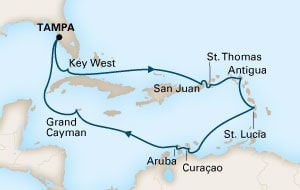
CS514WWe are now going on a 14 day circular Caribbean cruise. Tampa – Key West – San Juan – St. Thomas – Antigua – St. Lucia – Curacao – Aruba – Grand Cayman.  All docking ports, except Grand Cayman which still does not have a dock. Also in St. Lucia we will tender but only to collect the overland tour which comes back in Soufriere. While we wait for those people the rest of the ship can have a look at the Pietons, those strange Mountains that loom over the bay.

Key West is normally not part of an Eastern or all around Caribbean Cruise but has been put in to avoid spending 3 days at sea. Trying to race to San Juan P.R. is a bit tight in two days and by making it 3 days  you can put a Key West afternoon call in.  Last cruise we called at Key West as well and we were all by ourselves.  Tomorrow we will be in port with Mickey Mouse, Disney Magic who will arrive just after us and will dock at Pier B. We will be back at Mallory.

I spent the afternoon upgrading my Port Database. Since the time that digital cameras were available for a decent price (approx. around the year 2000) I have been taking photos of each port that I visit. Dock, mooring lines, navigational marks etc. etc. Anything that might be useful as a memory hint for the next call. Through the years the ports catalogued have increased and for a number of years now it has been a very useful tool for navigation.  I was not the only one doing this and as a result there is a lot of information floating around on various ships. Now while I am travelling around, it gives me the opportunity to merge everything and leave an updated database behind on each ship. Eventually each ship in the fleet will benefit.  Also the Ryndam had a lot of material accumulated and it took me all afternoon to merge it and to update the newest ports.

The good ship Ryndam sailed on time following Carnival and NCL out to open sea. By 20.30 we were back in open waters and then we overtook the Carnival Glory who was going to Cozumel, and with a sea day to get there, only needed 14 knots of speed.

We are aiming for a 10.30 pilot tomorrow morning and should be docked at about 11.30. Weather forecast Sunny, not too warm and breezy.


« Older posts Newer posts »