- Captain Albert's Website and Blog -

Ocean Liner History and Stories from the Sea, Past and Present. With an In Depth focus on Holland America Line

Page 73 of 241

28 Oct. 2016; Punta Arenas, Costa Rica.

This is a most peculiar place to visit as you have two options. In the good old days, we could only go to Puerto Caldera, which is the cargo port in the province of Punta Arenas. The provincial head town had a small pier as well but not suitable for our activities. So when we docked we had buses and taxis for those who wanted to go to Punta Arenas about 15 minutes down the road. Most guests go on tour in Costa Rica but for those who did not want to go on tour and for those who did not want to go to Punta Arenas there was a big flee market setup in the cargo sheds. Puerto Caldera dock is located behind a nice breakwater and protected from the sea swell for most of the calls and thus very much liked by captains. Happy Taxi drivers, happy vendors, happy captains as the ship lays stable against the dock.
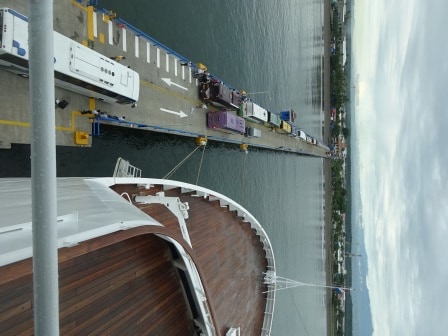
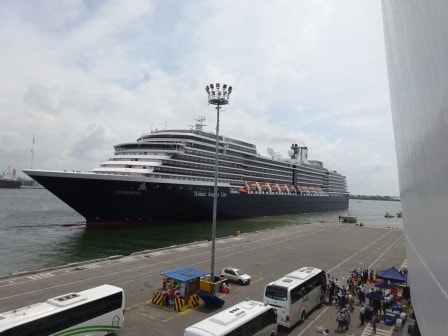
The Veendam docked at Punta Arenas. The tour buses back down all the way from the beginning of the pier as there is no room to turn.

The Veendam docked at Punta Arenas. The tour buses back down all the way from the beginning of the pier as there is no room to turn.

Then a new pier was built so we could dock with our nose straight into Punta Arenas downtown. That created for very happy shops and very unhappy taxi drivers. For the tours it did not matter, all the buses still parked outside the ship. For the captains it was less straight forward. Offering the best location for your guests is something you want to achieve but the new pier had some challenges.
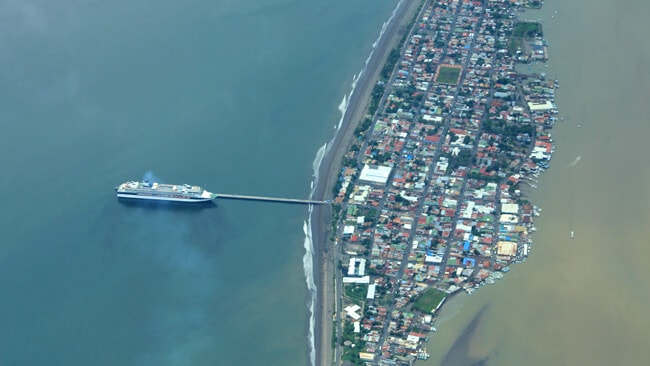
The new pier sticking right into the open waters.

The new pier sticking right into the open waters.

It was not sitting behind a breakwater so the swell ran in freely. This can make the ship bounce and surge along the pier if there is a long ocean swell running; and a moving ship creates problems with the gangway.  The other thing is the current. The pier is right in open waters and up to four knots of current can freely run under it. Four knots of current is not something you can control with your thrusters. Thus you have to synchronize your arrival and departure with the time that the current turns, slack tide. Which is not always at the same time and thus absolutely not in synch with the cruise brochure. Thus sometimes the Captain has to get the ship in much earlier (sail a lot faster than planned, burn a lot more fuel) or come in late and that affects the departure time as the tours still go with the duration.)

Today we were lucky. The turning of the tide was around 06.30 and for a 07.00 hrs. arrival it was just perfect. Departure was less of a problem as the current was going to push the ship away from the dock anyway. And it had been quiet in the Pacific and thus there was only a very low swell rolling in and the ship hardly moved. On top of that it was overcast and it hardly rained; all things came together today.
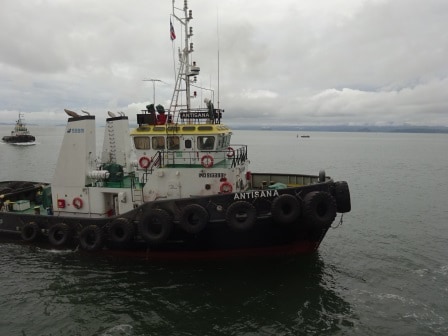
There are two strong tugboats to protect the pier incase the tide is misjudged. Looking over the bow you can see the pilot boat on the buoys observing the current.

There are two strong tugboats on location to protect the pier in case the tide is misjudged. Looking over the bow you can see the pilot boat on the buoys observing the current.

What we do when we get there, and to make it alongside; the pilot parks his pilot boat on the nearest buoy and that provides him with information about the moment the current goes down to zero, a bit further out in open waters. The ship is in position about 300 feet from the dock where the current is already so slow it can be kept in position with the thrusters; and the moment the pilot boat gives a cry, the ship starts moving and then  it has a good window of opportunity before the current starts running again.
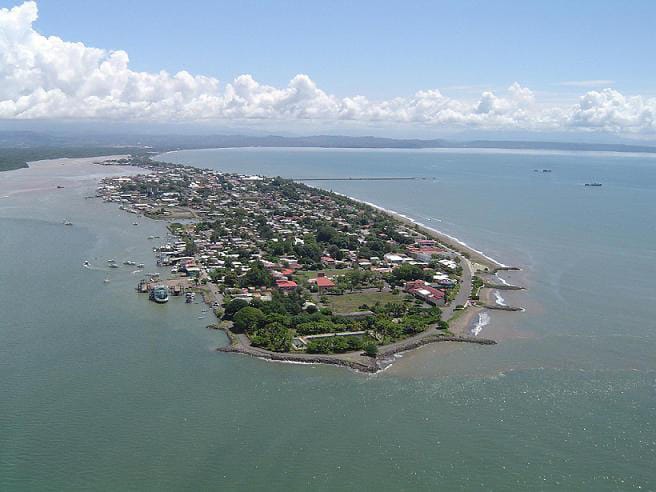
Punta Arenas. (Courtesy a from somewhere on the internet)

Punta Arenas. (Courtesy  from somewhere on the internet)

Punta Arenas itself is located on a sort of long and narrow peninsula running along the coast of the main land. Which is one of the reasons there is such a strong current, as the water finds its way around the peninsula to the North side.  In the last few years, no doubt because of all the cruise ship money coming in, the place has been considerably spruced up and a large part of “happy town” from the old days is gone and replaced with an open air theatre.  To my regret the little shop which sold postcards ………… old ones……….. was gone as well and replaced with a T shirt shop. I was a very happy camper a few years ago when I went by taxi to town and found this little place which sold antiques (sort of……………. Let’s say old stuff) but had a lot of old postcards from Panama and San Jose (Capital of Costa Rica). I have never seen an antique shop like that anywhere else in Middle America. But there it was and I made the owner very happy by ensuring a major donation went into his retirement fund. (Maybe that is why the shop is gone)
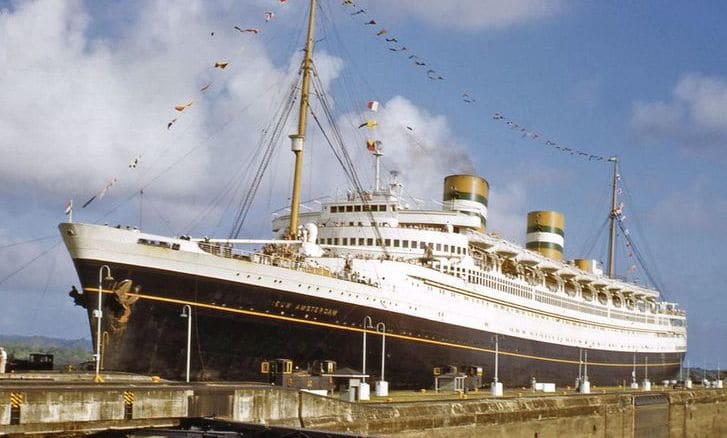
A postcard which made me very happy. The Nieuw Amsterdam of 1937 in the Panama Canal anytime before 1951.

A postcard which made me very happy. The Nieuw Amsterdam of 1937 in the Panama Canal anytime before 1951.

Tomorrow we are in Corinto, Nicaragua. I hope to visit the school which we sponsored when I was Captain on the Statendam. Last time when I went for a look, they were closed for vacation but the school looked good from the outside. We had left some pails of paint behind and the parents had followed up by turning the school into a wondrous picture of Holland America white and blue.

Weather for tomorrow; As Corinto has less tropical forest than Panama and Costa Rica it is a lot drier. So tomorrow we are back to sunny skies and temperatures around 84oF / 209C. with hardly any wind. It is going to be challenging for some of our guests.
27 October 2016; At Sea.

It remained slow going after we left the last locks and by the time we made it to open seas, it remained slow going. It is the time of the year that the Right Whales are in the area. I explained on 16th or 27 October that we had to be very careful with the Right Whales and because they are spotted in the area of Panama Bay around this time of the year, a slow zone has been ordered. Important to do, and the right thing to do, but being already well delayed it made it even harder to get to Gulfo Dulce on time. I wrote yesterday that by 17.00 hrs. we were back on schedule; yes we were back on the Panama Canal schedule, not on our own planning and sailing schedule.

To make it easily to Gulfo Dulce we need to be at the Panama Canal Sea buoy at around 17.30 and then we have a little bit of leeway in our schedule to take care of the Right Whales. By the time we now made it past the right whales we were running about 3.5 hrs. late. And that meant no call at Golf Dulce. We normally made this an afternoon call and sail in the bay between 2 and 5 pm. Now we would have made it there by 5 pm and the sun was going to set at 18.14. An hour there does not make sense, thus the captain could only decide to forgo Golf Dulce.

For today it did not really matter as the rain was so abundant over the coastline that we most likely would not have seen anything at all. So we stayed at sea and sailed on to Puerto Caldera / Punta Arenas in Costa Rica.  The captain announced the news at 09.45 and then at 10.00 I started with my HAL lecture in the show lounge. So one captain had to bring some bad tidings and the next captain was able to bring some happy tidings and good stories about all the “Dam Ships” from past, present and future. Maybe I made up for missing Golf Dulce.

Our course line will now basically follow the Pacific Coast while we hop from port to port. In the coming days it will be busy for our guests, as day after day we will visit Costa Rica Punta Arenas , Nicaragua Corinto, Puerto Quetzal in Guatemala and then Puerto Chiapas in Mexico. Only then we will get two days at sea to recover before we come to our final port of Cabo San Lucas at the southern tip of the Californian Peninsula.

Our first port, Punta Arenas in Costa Rica is located deep in a bay, the Golf de Nicoya. So it will take a considerable time to get there, while the ship has to sail through the local fishing fleet. Then Corinto is located on the banks of a river and also that takes extra time to get there. Only Puerto Quetzal has a short distance between the pilot station and the dock. But there we still arrive early to facilitate the shorex flights to Tikal by plan, and that plane takes off at sunrise, so we have to be docked before.

Early days are coming not only for the Captain and the Ships officers but also for the guests.  Who said cruising was relaxing???????????.  Thus today having a full quiet day at sea, might not have turned out that badly.  Looking at the rain from behind a ships window is a great way to relax and several locations of gentle snoring were prevalent on the outside decks and in the lounges. So guests were exactly doing that.

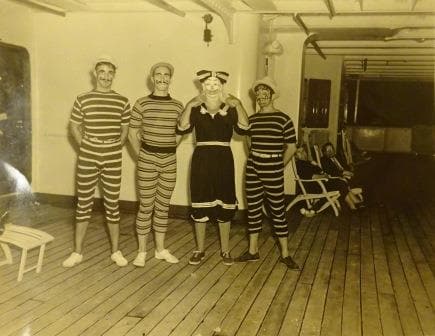
The day was Sept. 7 1939 and the ss Nieuw Amsterdam was on its way from NY. to Europe. The occasion is not known.

The day was Sept. 7 1939 and the ss Nieuw Amsterdam was on its way from NY. to Europe. The occasion is not known.

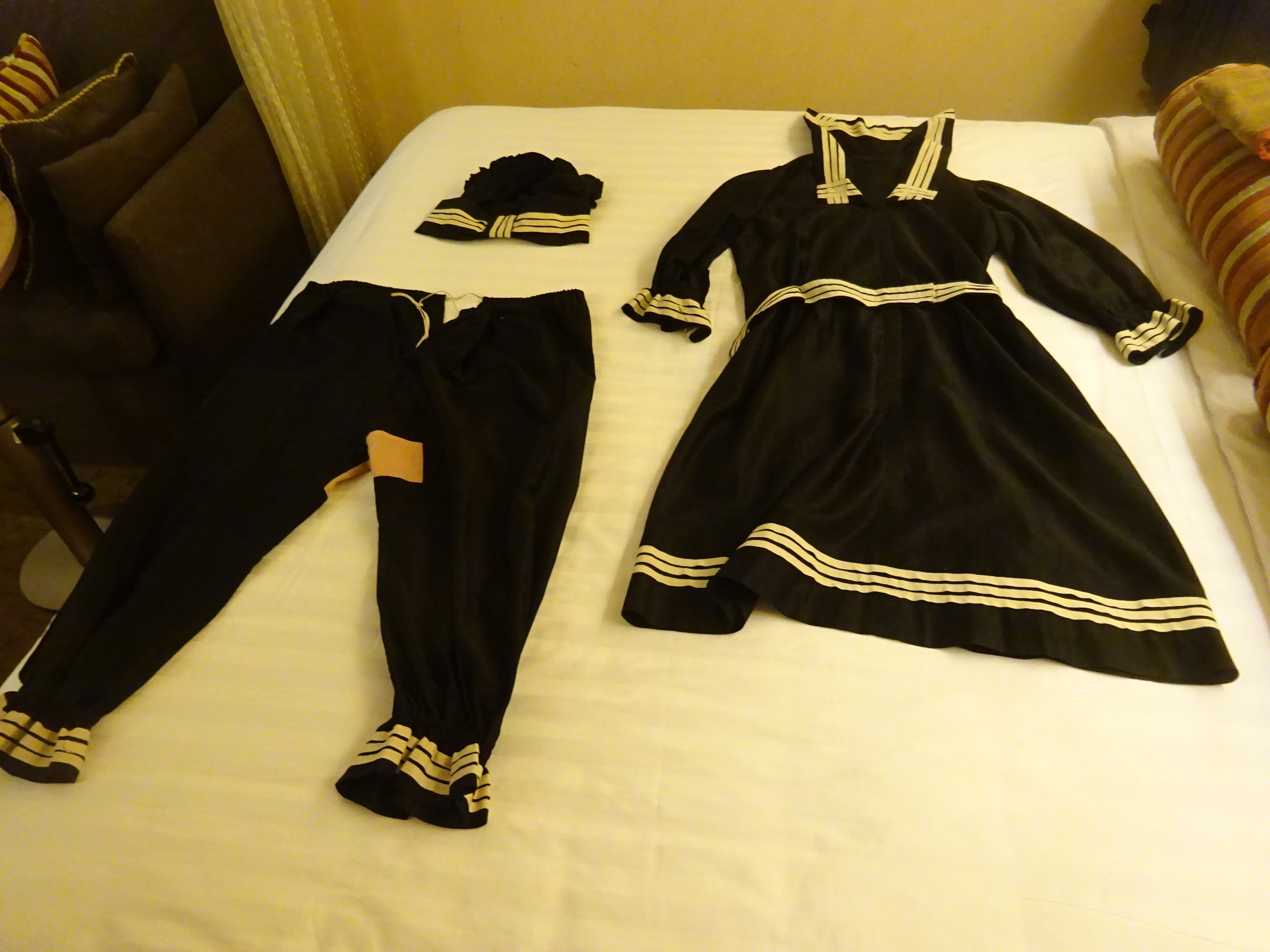
One thing I would like to share today are a few photos which were given to me by a Lady whose father in law worked on the ss Nieuw Amsterdam in 1939. Also in those days the crew knew how to enjoy themselves with a good fancy dress party. What is special this time, the lady still had the 1920’s bath costume including head dress in her possession and brought it on board to show it. She certainly found in me a very interested audience.


The most amazing thing after 77 years the costume was still in the family and in good quality.

The most amazing thing after 77 years the costume was still in the family and in good quality. Although I think the costume is much older, most likely from the 1920’s. Which would make it nearly a 100 years old.

Tomorrow we are in Punta Arenas, at least for the moment this port is on the schedule according to the Captain. We have to arrive there by slack tide which this time is at the very convenient time of 06.30 in the morning.  Weather?:  maybe rain, maybe sunshine, it will all depend on which way the wind is blowing the clouds.

26 October 2016; Panama Canal.

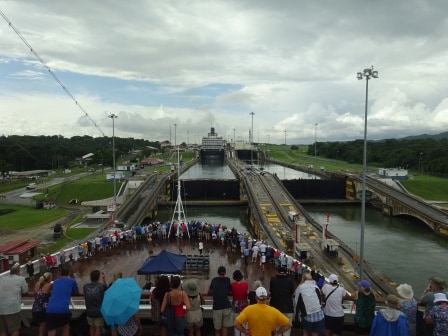
And thus we arrived at the breakwaters of Cristobal at 05.00 hrs. and then nothing happened. Same for the Zuiderdam; they had arrived even earlier and nothing happened for them either. For some reason the planned convoy scheduling had gone awry and the cruise ships kept being put back.

The ms Zuiderdam one lock ahead of us. She was going into Gatun lake and then back for a call at Cristobal/colon

The ms Zuiderdam one lock ahead of us. She was going into Gatun lake and then back for a call at Cristobal/colon

Thus it was not until 07.30 before we got some action and could follow the Zuiderdam in. Both of us were going through the old locks as it was now clear that the Panama Canal Authority was going to keep the regular ships separate from the Post-Panama max ships; those who can only go through the new locks.  We were all thinking it was going to be a long day, but later on we managed to catch up a bit and by the time we came to the Miraflores locks we were back on the original – published –schedule. How long a transit takes, depends on the slowest ship in the convoy and today we were unlucky as we had some real slow boats (deep laden tankers) ahead of us. I did the transit once in just over 6 hours and faster has happened as well. But today we had a regular day, with a lot of starting and even more stopping.

The weather was wet, with a constant drizzle or stronger all during the day. Negative is that you get wet, but the positive things outweigh it; the rain is not very cold, you do not get too hot and you do not get a sunburn.

My interest went out to the new part of the canal and unfortunately you can only see a few things of it. Now all the construction is gone and everything is flat there is not much to see unless you go through those locks.

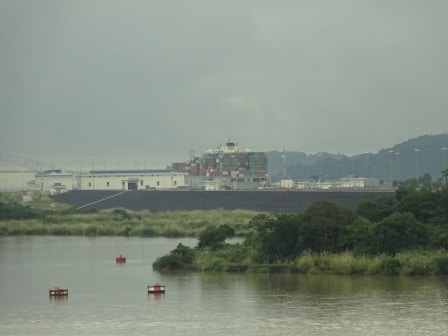
A Post Panamax Container ship going through the new lock at the Pacific side.

A Post Panamax Container ship going through the new lock at the Pacific side.

Because there are no trains “the so called Mules” used in the new locks, it all looks basically as a series of basins with water in it and in some of those basins a very big ship floating.

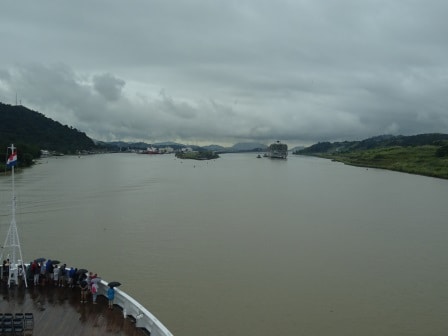
Split in the Canal to the left the Pedro Miguel Locks to the right the new Canal port continues

Split in the Canal to the left the Pedro Miguel Locks to the right the new Canal part continues

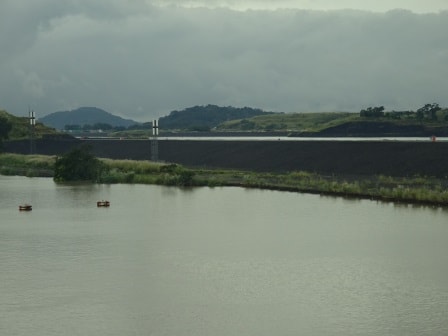
Now all construction materials and ships are gone, the separating dykes are gone and the water ways to the new locks are open, you can see very well how they have done it.  Once you have sailed past Cristobal you come to a Y fork in the road, with the left arm being wider than the right arm. Left is the way to the new locks.  Same thing happens again when you come to the Pedro Miguel locks where the Pacific locks are located and again a Y with now the left arm for the old route and the right arm for the new route.  From then on it looks a bit strange.  The new Pacific locks are near the last set of old locks, the Miraflores locks but the ships following the old system are already descending with one step at the Pedro Miguel. So we have a big dyke which keeps the right arm of the Panama Canal from draining into what is now the lower part of the Canal.

The big dyke which keeps the waters separate. Note the little tugboat in the photo.

The big dyke which keeps the waters separate. Note the little tugboat in the photo. You can hardly see it, so big scale is everything.

You are used to those dykes in Holland where you can see a ship sailing by about 20 feet above a car in the road. But to see it in Panama which is basically flat apart from the Continental divide is a bit unusual. Luckily all the dredging for this area was done by the Dutch so I have full faith in the dyke being capable to hold the water, regardless the size ship that sails through it.

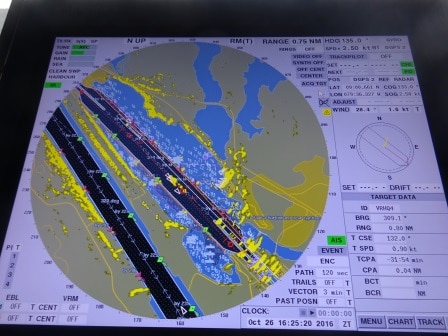
This is what it looks like on the Radar screen. the new part is as straight as an arrow. While the old part retains much more of he original features from 1914.

This is what it looks like on the Radar screen. the new part is as straight as an arrow. While the old part retains much more of he original features from 1914.

For the guests it was also a long day as many were up and about just after 5 am. Luckily we know that this happens and thus the Hotel Director had ensured that the Lido Restaurant was also open at 5 am. so the lack of Panama Canal to see could be compensated with food. Always a good alternative. For the same reason the Bars were very busy in the afternoon. What is better than to have Happy Hour in the Panama Canal?

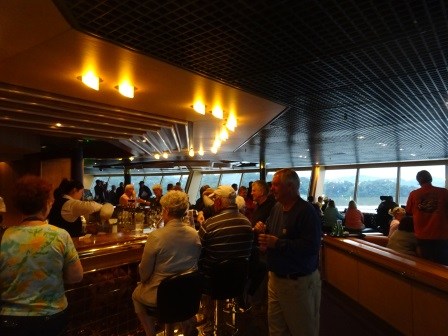
This is Happy Hour in the Crowsnest.

This is Happy Hour in the Crowsnest.

While I am writing this we are about to leave the last locks of the Miraflores and then it will be another hour to open sea. From there onwards we follow the Coast of Panama until we come to Costa Rica. Tomorrow afternoon we will be sightseeing in Golfo Duce and then the next day visit Punta Arenas or Puerto Caldera in Costa Rica. These two ports are next to each other and are interchangeable, so we will see where we end up. The weather will not be much different if it rains in Panama it also rains in Costa Rica. Maybe the weather will run out of water for a few hours and we have good visibility.


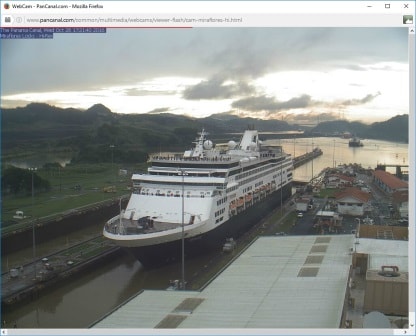
17.00 hrs. the ms Veendam in the Miraflores Locks. (Photo courtesy of my Lord & Master Lesley who followed the webcams)

17.00 hrs. the ms Veendam in the Miraflores Locks. (Photo courtesy of my Lord & Master Lesley who very patiently  followed the webcams and tracked our progress)

25 Oct. 2016; Cartagena, Colombia.

I was running around by 05.30 in the morning as I had supervision and support of the new junior officers on my schedule. So I had the enjoyment of seeing sunrise over Cartagena and the pilot boarding. Before twilight started there was a nice light show in the clouds of big electric discharges but with day light approaching that all disappeared. Also the rain disappeared and thus we had a nice dry day, but it was very sunny and very warm. The Zuiderdam was just ahead of us by about 15 minutes, giving just enough time for the linesmen in the port, to tie up first the one ship and then the other one. No other cruise ships in port today so it was a Holland America only show.

Sailing into Cartagena takes about an hour as the entrance to the Bay is in the South West and then you have to sail north to get to the cargo docks. For the docks where we are going, the old cargo docks, now all container, it would be so easy to cut through a canal in the west side and get us in and out in about 30 minutes. But it is the expensive part of town with all sorts of high rises (every year there seem to be more) being built and it would not help the rest of the port.  The whole of the east part of the bay, which is mostly known as the Boca Chica, is full of oil terminals, tanker docks and a lot of related industry. They all use the same entrance and they would continue to use the entrance we used this morning. So no preferential treatment for the cruise ships.

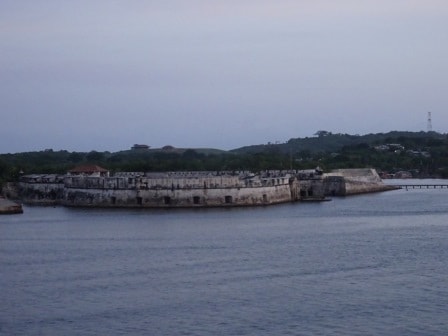
Fort on the northside as seen from the Forward mooring deck of the Veendam

Fort on the northside as seen from the Forward mooring deck of the Veendam

Because of its natural and large sheltered harbor the area has always been a hot spot for countries that were convinced that they had to rule the world. As there were many countries who thought so, the one who was there first (or who had just kicked somebody else out) built defense structures to make sure they themselves were not going to get kicked out later. Until today those defense works are still there and the space for us to sail in, located between two forts, still has the same width as it had 500 years ago. Luckily they already thought big in those days and thus our current big ships still fit through the channel.

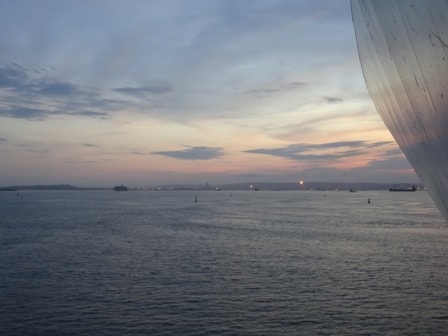
The light spots are the flame off towers of the Raffinaries in Cartagena.

The light spots are the flame off towers of the Refineries  in Cartagena. To the left the Zuiderdam going ahead of us.

But it is one way traffic, so once the Zuiderdam had slipped through, we had to wait until a small cargo vessel came out and then we could go in. There is a leading light which can help you to stay in the middle of the channel but it is hardly visible due to “light” pollution by the refinery located behind the leading light beacons. They are burning off gasses which come free with the production of oil. When the oil price was still high, they caught the gas and it was sold for export. Now with the oil prices being fairly low, it does not seem to pay any more to do so and thus they burn it off. Using it for local heating is not an option either as Cartagena is already hot & warm enough by itself. But a leading light is not so much of a necessity here. As long as you are clever enough to stay between the buoys you are in good shape.

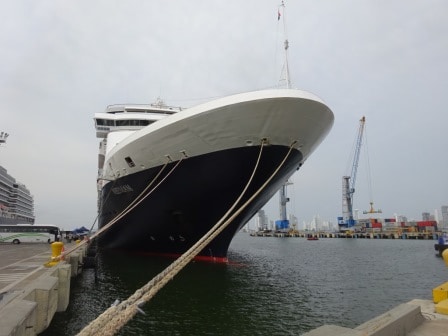
Veendam safely docked at Pier 3 in Cartagena.

Veendam safely docked at Pier 3 in Cartagena.

Where we now dock used to be water. The old cargo docks were much deeper inland.  I still have docked there with the old Statendam in 1981 but then a few years later, the old cargo sheds were ripped down (and approx. 2 million or so rats were made homeless) and the dock foundations were filled over to provide space for container parks. New piers were then built further into the inner harbor and that is where we dock today. Once you could walk to “downtown”, well a sort of downtown, the sort of downtown sailors liked, so it was really THE downtown but now you need a tour bus or a shuttle to get in or out of the port. The “downtown” I am referring to is long gone as well as crew hardly has time to go ashore and with the increase in ships size, and same crew complement, the number of visiting crew had dwindled considerably. So now “downtown” is near the business district and we are stuck and can only look at containers. Or at the Zuiderdam being docked next to us.

The Zuiderdam departing. She came in first and she went out first.

The Zuiderdam departing. She came in first and she went out first.

As mentioned yesterday both ships had a short stay, as both ships have to be at the Cristobal breakwater entrance for the canal at 05.00 hrs. So we sailed out at 1 pm. and put the pedal to the metal once we were outside. We have to make the Panama Canal slot to fit in the convoy as the Canal does not wait for anybody.

Our schedule………………… subject to extremely much change:

05.00 Break water

06.00 Inside waiting for clearance.

08.00 Gatun locks

13.00 Miguel locks

17.00 Mira Flores locks

18.30 Pacific Ocean.

As you can see, no new locks, but maybe we will see the Zuiderdam using them.

24 Oct. 2016; At Sea, 2nd day.

We caught the tail end of the frontal system in the morning and it gave us the occasional shower on the deck until lunch time and then we were past it. Now we are slowly starting to come under the influence of the land mass of South America where much is covered by Jungle and that makes for a totally different situation. Hot and Humid with lots of electricity in the air and thus we can expect thunderstorms tomorrow. Hopefully it will happen before and after our arrival and departure in Cartagena but that is something we cannot plan for. We will only be a short while there, from 07.00 until 13.00 hrs. as we have a tight schedule afterwards to make it to the Panama Canal on time. We will meet up again with the Zuiderdam which will sail with us to the Panama Canal as she is doing the sail in – Gatun Lake – sail out routine and then goes to Colon/Cristobal for a late afternoon stay. We of course go straight through as we are on our way to San Diego.

This will be my first time going through with the new locks in operation and I harbor a small hope that we might do one of each, an old and a new one, but it is a very tiny bit of hope and a lot of wishful thinking. Thus far the Panama Canal Authority has not much been in favor of letting a cruise ship do both but “hoop doet leven” as we say in Dutch or “Hope keeps you alive”. Tomorrow during the day we will receive the transit schedule of what the Canal is planning to do with us ——— subject to extremely much change———— and then we will know more.

The planning for the Canal takes some doing and it already starts when the ship is built. As the Canal has different measurement criteria for a ship, the ship is measured at the end of its new building and then it gets a Panama Canal Tonnage Certificate. During its first ever transit; it is quite customary to get officials on board, who sail with the ship during the transit, to verify if that initial certificate is valid. They always seem to be very interested in pools and Engine sky lights as there the rules seem to vary greatly from the regular register tonnage certificate to what Panama wants. And then they return when needed.  I can understand this quite well, as cruise lines keep tinkering with their ships and here the Veendam is a good example. In 2006 we had the Club Hal added to the aft top deck, creating a lot of extra volume and then in 2008 extra cabins were added. At that time we lost a deep swimming pool but we gained a wider shallow pool and extra Jacuzzi’s. Enough changes to keep a tonnage verification officer in bonus for quite some time.  Last time I spoke to one of them (who came to check the new cabins on the aft deck of the Prinsendam) he was musing about how the new slides on the Mega Liners would fit into the equation. On the earlier ships slides had been open on the top. Now on the larger ships the higher up parts of them are enclosed, so you water-slide through a tunnel. But the big question of course was for him would an enclosed water slide bring in more money for the Panama Canal Authority. I never found out the answer but it was an intriguing thought.

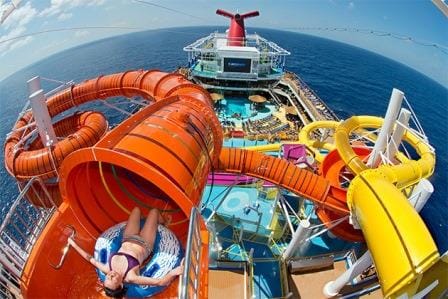
This is the water slide from the Carnival Vista. Partly enclosed, partly open; What would Panama think?

This is the water slide from the Carnival Vista. Partly enclosed, partly open; What would Panama think?

For the normal routine of the ship and the transit, you have to start sending your ETA’s already 3 days before. This is something really meant for cargo ships as they are not as reliable in their scheduling as a cruise ship but the rules are the same for everybody. Then about 48 hrs. before we have to call them. This is an Oil Pollution Prevention exercise. By calling in, the Canal Authority knows that we have read the regulations and thus know what is expected of us by them in case something happens.

Getting into Cartagena takes more than an hour as we have to sail through the inside lake towards the very sheltered port of Cartagena. So tomorrow morning we will be at the pilot station of Boca Chica at 05.30 am and then sail in either before or after the Zuiderdam but that depends on what the pilots want for their docking sequence.

For the weather, it will be hot and humid and it will be everybody’s guess how much fireworks we will get out of the rain clouds.


sdsds

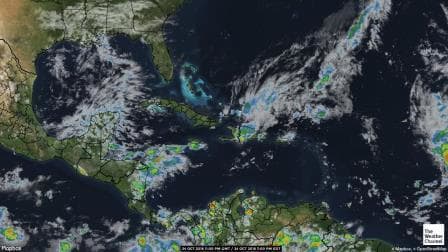
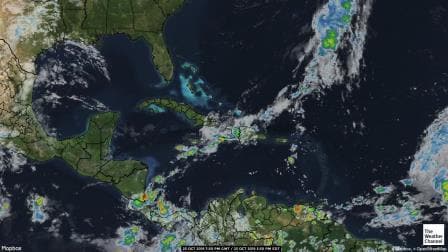
You can see the yellow/red spots over Colombia and that means dense rain clouds. (Courtesy www.weatherchannel.com)

23 Oct. 2016; At Sea, First Day.

We are now on our way to Cartagena and with the speed we are making, we nicely “out marched” the rain. Although the clouds were in the area but that is not so bad as clouds keep the temperature down and that makes being on deck very pleasant. And you can still sun bathe, even when it is a bit cloudy as there are still rays coming through that will produce a tan.  Although quite a few guests shied away from the sun today as they got more than their fair amount yesterday.

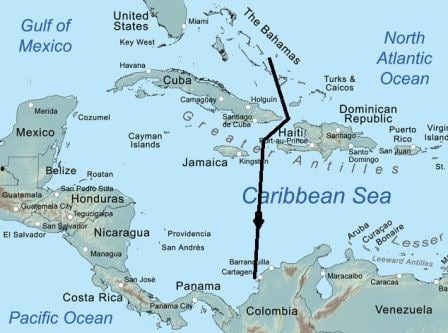
For most of the evening we sailed between the Bahamian Islands towards the south and then during the night we crossed the end of the old Bahama Channel, to reach the Windward Passage, located between Cuba and Haiti.  We passed Cabo Maisi (the end point of Cuba) in the early morning and by the end of this afternoon we will be out of the Windward Passage and in the Caribbean Sea. This area is called the Jamaican Channel but we will not see Jamaica as we are too far to the East of it.

Our route for the two sea days.

Our route for the two sea days.

By that time we will be coming under the full influence of the Trade Winds and that should give us about 20 knots from the East. So windy on our Port Side and nice and gentle on our starboard side.

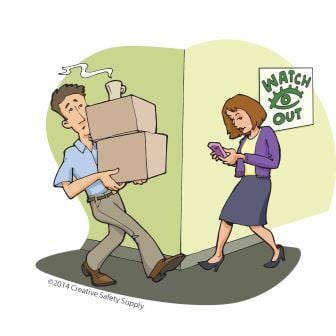
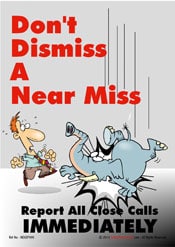
An accident on the rise in our modern world.

An accident on the rise in our modern world. (Courtesy Creative Safety Supply)

Continuing with my safety story of the last two days, the last thing is to explain are near misses in safety. As I do not want to create a panic on the internet; in safety we qualify a near miss as something that could have result in an accident but it did not.  A bucket of paint started to slide but you caught it in time; somebody wants to stand on a box to change a lightbulb but somebody else saw it and got a step ladder. An electric socket had come loose but the danger was seen before somebody plugged a cable into it. etc. etc.

The challenge is to get everybody talking and provide examples of what they have seen or were involved in. We call these “learning events”. Something has happened, something did not go 100% right or something had the intrinsic potential to go wrong, but it was recognized and the situation was mitigated.  To make it work, it has to start at the Top, with the leaders, and thus it has become an established feature on our ships to have each officer come forward, starting with the captain, to explain what in his/her work situation could have gone better. As the ships are a small world onto themselves, the word soon spreads around the crew and then the rest will follow.

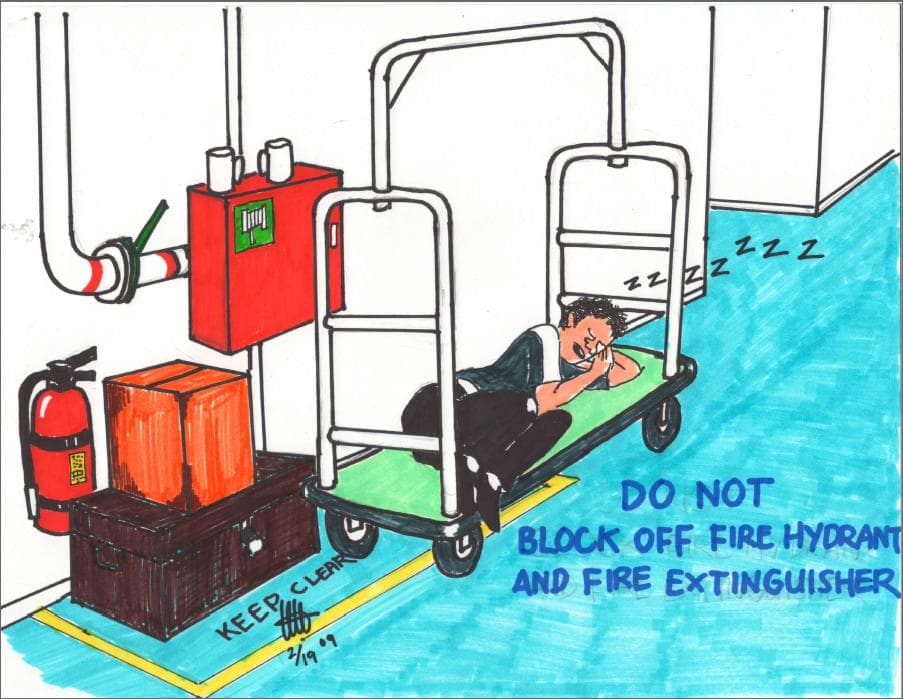
One way to get the crew interested is to run a safety poster competition with cash prizes.

One way to get the crew interested is to run a safety poster competition with cash prizes.

The company is really encouraging everybody to do this and is asking each ship to provide every month 3 examples of near misses that they found, discussed, solved or learned a lesson from for the future. These are then shared fleet wide and slowly but steadily we see a reduction in the return of the same mistakes. One of the direct results is, that our accident free days are going up. We define anything that needs more than a plaster to be an accident, (that is about the only thing the crew doctor does not write a report about) and thus is it is not easy to stay on zero. But ships with 800 crew or more are now reaching 300+ days without anything happening at all. Safe work with a moving ship and so many cooks with knives and so many engineers in machinery environments it is not as easy as on the shore side and so we are really pleased with the results. But everybody is keeping focused; as our friend Murphy has a nephew on every ship and they simply hate good safety records and mistake free environments. So the safety training, the safe work planning, the safe work execution and the “learning experiences” continues and will do so in the future.

I am honored to play a little role in this all, apart from the inspecting, by training and teaching. Due to my unique position as Travelling Master I can compare the ships while I rotate around and can pick up and pass along good practices and little changes which can make a large difference in a chain of events.

So tomorrow we are at sea again, and looking at the weather chart we might lose the cloudiness later in the day but could get an isolated shower during the night or early morning.

With the frontal system passing over, we should run out of the clouds tomorrow.

With the frontal system passing over, we should run out of the clouds tomorrow.

22 Oct.2016; Half Moon Cay; Little San Salvador Island, Bahamas.

By 07.30 we arrived at the anchorage area together with the ms Nieuw Amsterdam. Half Moon Cay is large enough to handle two mega liners at the same time, we do not have mega liners in our fleet, and thus the 3400 that came ashore had ample space to enjoy themselves. We did not see any lines anywhere except at the barbeque station around 1 pm. but that had more to do with the fact that everybody tends to go for lunch at the same time. Hence my personal Golden Rule on sea days, I go at 11.30 to the Lido as it normally noon time when the wave comes rolling in and that wave keeps rolling in until 13.30 hrs. and then suddenly it is all quiet again. (Except at the ice cream parlor)

The Nieuw Amsterdam off HMC. alongside the provision cutter Half Moon Clipper and Henry Hudson guest tender.

The Nieuw Amsterdam off HMC.  Alongside the provision cutter Half Moon Clipper and Henry Hudson guest tender.

The wind was from the wrong direction for anchoring and thus both ships remained on the engines and floated. For an operational perfect Half Moon Cay day you need the wind from the north east, blowing over the island. Then the wind can make no swell, as there is no open sea to blow over, and the wind will push the ship away from the island so it can lay perfectly behind a stretched anchor chain. Today the wind was coming from the North West and then you are pushed towards the island and eventually end up on the beach. The island is rising so sharply out of the deep, that there is not enough room to swing around with the anchor down without hitting sand and rock somewhere. Thus we stayed on the engines and drifting in position. There was very little wind today and that made it very easy to stay in position and not to drift all over the place.

The Nieuw Amsterdam was on the shorter stay with a last tender scheduled for 14.30 as they had to make Ft. Lauderdale on time; it being the end of the cruise, and thus they were given the use of the large shore tenders. We were here all day and thus we provided our own transport during a very nice but very warm day.  It got warmer and warmer while the day progressed as the wind decided to almost die down completely. So it was a very tropical day, but then we are on a warm weather cruise so we are delivering according schedule.

Back to Yesterday and safe working on board.

The list of five points yesterday indicated the way the company has setup its safety philosophy. First train the crew and then review with the crew involved what the challenge of the work is. As most of us are over 25 we forget things and then we make sure we also review and complete check list so that nothing is forgotten. Then we carry out the work while the supervisor is required to check in to see if all goes well. The frequency of checking really depends on the sort of work. If a sailor is painting, the Bo ‘sun maybe checks once a day, if it is working aloft, it might be once an hour but if the work pertains to a tank entry, then there is the requirement to have constant supervision present. Sitting in an enclosed steel tank is a lot more dangerous than happily sitting on a chair painting in the outside air. When a more complicated job has been carried out, then there is a review  to see if any lessons can be learned to implement next time and then do an even better job.

Things go seldom wrong, but often there is the potential for something to go wrong and from that we can learn.

Things go seldom wrong, but often there is the potential for something to go wrong and from that we can learn.

For that review, we also check if there were any “near misses”.  You should NOT see that in the context of “the ship almost sank” but in the context of “I forgot to tie up the paint bucket and it almost tipped off the shelf”. Those things can bring up very valuable insights as the persons who carry out the work normally know better what is going on than the supervisor. To make sure that mistakes are also being reported and discussed, you have to create a no-blame culture. And that is probably the hardest part of the whole safety process, as in general the world always looks for somebody to blame when something goes wrong and then demands instant punishment; mostly without having checked the facts and details of what exactly happened. Holland America is quite far advanced with creating a very open safety culture and more about that tomorrow.

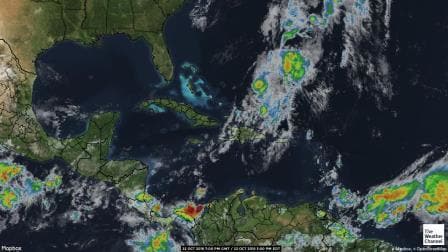
Today at 5 pm. we will start our journey to Cartagena, which will take us two days. First we sail through the Grand Bahama Bank, then into the Caribbean Sea on a south westerly course until we curve around the North West point of Columbia and then we approach Cartagena from the West.  Weather for the Caribbean Sea:  Same weather as today, with a chance of cloudiness. If you look at the weather photo you see there is a frontal system approaching but if it does not move too fast, we might be able to outrun it and then the sunshine continues all the way to Cartagena. If not we get some rain. That might not please the guests but it will please the ships Bo’sun as it will get the salt off the ship.


The frontal system is just coming over Hispaniola. We a bit of luck we might out run it.

The frontal system is just coming over Hispaniola. We a bit of luck we might out run it if it moves slowly. (Photo courtesy, 22 Oct. 2016 The Weather Channel)


21 Oct. 2016; Fort Lauderdale, USA.

We had a warm day today and we did arrive as we wished, just before 07.00 at the regular Holland America dock, Pier 26. So everything worked out as planned. Always nice as a turn over port creates a very hectic day, with stores and provisions being loaded for the whole trans canal, contractors and service people, bunkering of fuel and a myriad of other items which can only take place in a end of cruise port. Mainly because there are no guests in the way and all service is reduced to a bare minimum. At least from 08.00 until noon time after which the ship gears up again with embarkation.  So this morning I saw technicians crawling under coffee machines, others looking concerned with blue boxes which are supposed to measure something and did not, and service people bringing on board spare parts where in some cases brought a big smile to an engineer’s face. Plus a whole conga line of others, of which nobody really knows what they do, but of whom you soon find out that they were not in attendance, when something does not work, or something was not brought on board.

I had my regular end of cruise visit with my friends of the Customs and Border Protection again. I am not a complete crew member and I am not a guest either; and to solve this vague position the deep thinkers in the immigration business have come up with the beautiful designation of the “Non-Revenue- Passenger”.  What that exactly it means is anybody’s guess but the end result is that at the end of each cruise I have to march off with the In Transit Guests, show my face to receive a friendly nod and then march back on board again, as soon as the CBP is convinced everybody except the real crew is off the ship. That has the magical name of “the zero count”. This cruise we had 254 in transit guests on board (that is including me) so there was quite a bit of marching (or in some cases scootering and rollating) going on before the supervisor of the CBP was satisfied and officially cleared the ship.

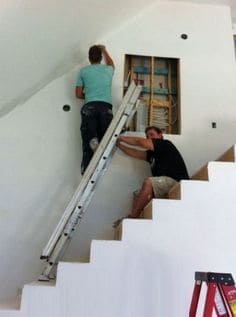
Very creative but not exactly safe.

Very creative but not exactly safe.

As mentioned in an earlier blog, part of what I am doing this time is going through all the work practices on board to see if we all comply with the Company Rules (which includes all the legal stuff of course) and if all safe working practices are being followed – at all times -. We have roughly 50 different nationalities on board and each group has a different understanding of what “safe” is and what precautions should be taken. A crewmember can  have a moral culture shock going around in his/her head if a company practice of safe operations is considered silly or stupid or over the top back at home. So there is a constant push from ships management to engrain everybody with the mantra: You arrive with 10 fingers and you go home with 10 fingers.

The challenge is that if you see the same ship, do the same work, have the same procedures to follow and deal with the same crew every day, then in the end you do not see the Tree’s for the Forest anymore. (And the other way around as well I suppose) thus a pair of fresh eyes, with the experience of where crew tries to slack off, bypass or ignore procedures (yes crew are human as well, just like everybody on the shore side)and then raise the spotlight on those items.

Safety Meeting before every job, however small the job might be,

Safety Meeting before every job, however small the job might be,

Apart from law enforced required safety training, we also have a lot of company safety rules and they get hammered into a crew member by several methods.

  1. The 15 minute safety trainer. Each supervisor has to conduct those and discuss, in a cycle, issues as hard hats, safety googles, bending, lifting, and chemicals etc.etc.
  2. The Risk management procedure. Before each work challenge is carried out, there is a (brief) meeting about the way the work will be carried out, what the dangers are and what is needed to mitigate these dangers. Including what PPE is needed.
  3. Checklists to fill out, commonly known as PTW’s or Permit to Work
  4. Supervision and correction on the job
  5. Reporting of missed chances, from which we all can learn again.


To be continued tomorrow.

We sailed just after 16.00 hrs. and shot straight across the Straits of Florida towards the Great Isaac Lighthouse where we will enter the Bahamian Islands. As tomorrow we will be at Half Moon Cay, our private island. We are to be ready to commence tender service at 08.00 hrs. and we will be joined by the Nieuw Amsterdam for the day.  Weather for tomorrow:  84oF / 29oC, with very little wind. It is going to be a very tropical day.

20 Oct. 2016 ; At Sea.

Today we have our final day at sea and are sailing along the East coast of Florida towards Fort Lauderdale, and once again we are battling the Gulf Stream.  I can even feel it. The wind is from the North East and thus partly against the general flow of the water and that gives a strange movement to the ship.  On the waves caused by the wind, it should either move or not, but now it moves on occasion and that is caused by  the wind moving against the swell at times. Sometimes damping them out, sometimes enhancing them, then you get this moment of will she roll or will she not and you cannot really predict it. In the course of the evening we should get a bit of wave left over from Hurricane Nicole who created havoc near Bermuda a few days ago and whose wave field is not completely gone yet. It won’t be bad weather but some clever guests were already packing in the early afternoon.

To get as little opposite Gulf Stream as possible we on a SSW heading trying to get under the coast as soon as we can. At noon time we passed Jacksonville and now we are roughly abeam of Orlando passing a village called Palm Bay which brings us in sight of the shore line. Not much to see and not very easy to see what might be there, as Florida is fairly flat. By tomorrow we are in Fort Lauderdale and that will be the end of the cruise. To send everybody home with at least a bit of education, the Cruise Director had me scheduled for my Holland America History talk and now all who attended know where the Veendam came from.  And thus I have done my good deed for the day.

We are coming today from the north, which is a more unusual route for a cruise ship. Most ships that go to Fort Lauderdale are coming from the East out of the North Providence channel (under Freeport and above Nassau) or out of the Straits of Florida from the south. Cruise ships tend to all converge at nearly the same time at the pilot station of Port Everglades as we all want to be docked by 07.00 when the regular work day starts in the port. Especially around Christmas is can be very congested at the pilot station as a lot of cruise lines change their regular cruise schedule to offer a Christmas or holiday cruise, with the happy day at least falling after departure.  8 to 10 ships in port together have happened.

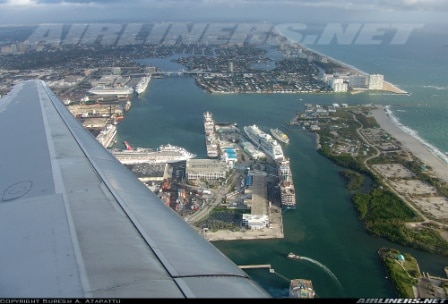
One of those busy days in port, sometime in the past.

One of those busy days in port, sometime in the past. Eight large ships alongside and one small one sailing down the intracoastal. (Photo courtesy: www.airliners.net.)


On such an occasion the Harbor Master creates a very tight schedule for pilotage and docking, normally 15 minutes between each ship and simply orders a ship to be there at the given time. If not, then it can wait until the rest has gone in. Tomorrow we will not have that challenge as we are supposed to be the only one in port, at least according to the schedule published by the port. Which means we can arrive when we want and dock at the most opportune time. As long as work can start at exactly 07.00 hrs.

Sailing into Port Everglades is almost right on the 270o. but ofcourse they had to make it a little bit harder and thus we have to steer 267o

Sailing into Port Everglades is almost right on the 270o. But of course they had to make it a little bit harder and thus we have to steer 267o

For the captain the challenge will be to line up into the leading lights before going in. Normally what we do, when coming from the East of South, is to steer a bit to the south of the lights and then let the Gulf Stream push us into it. That makes it very easy to adjust the course little by little until we have found the perfect balance. Now coming from the north we have to “push” into the Gulf Stream and find the perfect angle or steer south and let us be pushed back again. The maneuver of the day will really depend on what other ships or small craft are in the area. The drift angle we need can be quite considerable, depending on how close the Gulf Stream is flowing near the sea buoy. I have been coming in on a course of 242o while the Leading lights want 267o and it was only getting slowly less by the time we passed the sea buoy. I do not think it will be that extreme tomorrow, but it is going to be an interesting arrival as always.

Weather for tomorrow: A hot and sunny day with no clouds predicted and noon temperatures of around 86oF or 30oC.  Not that great for travelling or for sightseeing.


19 Oct. 2016; Charleston, South Carolina, USA.

Charleston is a port that captains really like; main reason the cruise ship terminal is very close to open sea so you do not have to get out of bed so early. Get to the bridge by 07.00 hrs. and you are docked at 07.45 hrs. Charleston is a port which the crew likes very much as you almost dock into downtown. Once you have walked past the Customs house you are there. I think a lot of captains in the past must have liked Charleston because looking at the size of the Customs house there must have been a lot of trade here.  And thus a lot of import fees and it looks like that a Customs officer in the mists of time invested some of those fees in a Tax – Temple which would have made the old Greeks very jealous.

Now this is a Customs house to make any bank manager really jealous.

Now this is a Customs house to make any bank manager really jealous.

I know Charleston fairly well as I once spent 8 weeks here  with the Nieuw Amsterdam in lay-up. In 2000 we sold the Nieuw Amsterdam (III) to the freshly resurrected United States Lines and it became the Patriot. The ship was meant for Hawaii cruises and was to serve as the “training & test ship” for two new builds which were under construction at Pascagoula. Normally this would not have been possible as the American law requires for coastal trade ships built in the USA, but an exemption was given as there were no home-built modern cruise ships available, and this was the way to kick start an American Flag cruise ship company.  We handed the ship over in autumn 2000 and I stayed for a while to train the American Officers who had no experience with the modern technique of a cruise ship. After six weeks my little team of Deck, Engine and Hotel went home and the Patriot started cruising around the Hawaiian Islands.

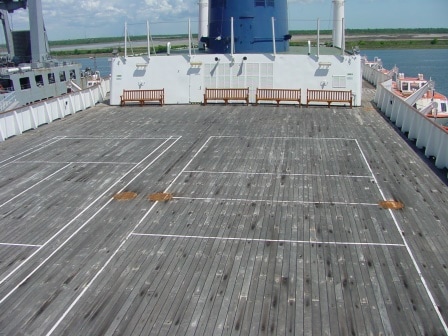
This is what happens after 9 months of un-attended teak wood decks.

This is what happens after 9 months of un-attended teak wood decks.

After nine months I was sent back to the ship as the company had gone bankrupt. I think that the management of the USL had not correctly calculated how difficult it would be to start a modern cruise venture from nothing.   It is not so easy to run a cruise company and it is even more complicated if it is with a new concept and with several new builds on the way at the same time. So the Nieuw Amsterdam came back from Hawaii and ended up in Charleston. While the office was thinking about what to do with the ship, I had a group of about 80 crew to keep the ship going, try to get it back to working order again and spruce it up. A few months in layup in a humid climate without air-conditioning are not good for a ship.

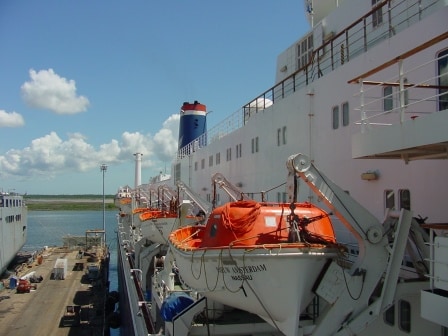
A nice organisational muddle. Dutch name, Nassau Flag and the American eagle still on the funnel.

A nice organisational muddle. Dutch name, Nassau Flag and the American eagle still on the funnel.

As a captain you do not have much to do when a ship does not sail, when it has no guests, when it really is not a ship as such. Our official safety routine was…………. “Run off the ship” if something goes wrong, as we did not have enough manpower to raise complete fire teams. We were only a skeleton crew and the ship was considered to be in unmanned lay-up. So my volunteered job was to drive the shuttle bus. Going shopping for the Bo ‘sun and Carpenters (The manager of Home Depot declared me a Saint after a few visits at $ 1000 a call) take crew to hospital and do all sorts of other things needed to keep our little enterprise going. Plan A was to get docking rights in Hamilton Bermuda and start New York, Bermuda cruises. That was a good idea as the N ships of 1983/84 had especially been designed for that purpose but never used as such because Alaska cruising really took off around that time.

Then came the option to charter (and later sell) the ship off to a Greek company who sub- chartered the ship out to Thomson Cruises which is a package holiday operator in England. They must have liked what they got as later the Noordam and the Westerdam went that way as well (Thomson Spirit, Thomson Celebration and Thomson Dream).

Today was the first time that I have been back to Charleston since 2001 and luckily it was not as warm as 15 years ago when it was the deep of summer. Today the guests had a beautiful day and it looks for tomorrow, a sea day, our luck will be holding as well.


« Older posts Newer posts »