- Captain Albert's Website and Blog -

Ocean Liner History and Stories from the Sea, Past and Present. With an In Depth focus on Holland America Line

Page 74 of 241

18 October 2016; Sailing South.

The small heatwave caused by the balance of high and low pressure areas is creating beautiful weather today. There are only some clouds in the sky, there is a gentle breeze which makes it pleasant on deck and the temperatures  reached a balmy 20oC / 68oF at noon time and that is not bad at all for this time of the year.  We have no hurricane to worry about yet and thus we can happily sail towards Charleston South Carolina where we will arrive tomorrow morning.

As I mentioned an upset Chief engineer yesterday, it is now time to explain what we do to keep him as happy as possible. When we go up the coast from anywhere north of Cabo San Antonio on the West side of Cuba, we try to find the center of the Gulf Stream and then let it push us forward. If we can find the exact center or Axis then we can get up to four knots of current. Especially in the section between Key West and Fort Lauderdale. Before and after that area the Gulf Stream is not so concentrated. If a ship has 16 knots to maintain and it gets 4 knots of bonus speed from the current, then the engines only have to produce 12 knots, which saves a lot of fuel and that makes a Chief engineer very happy.
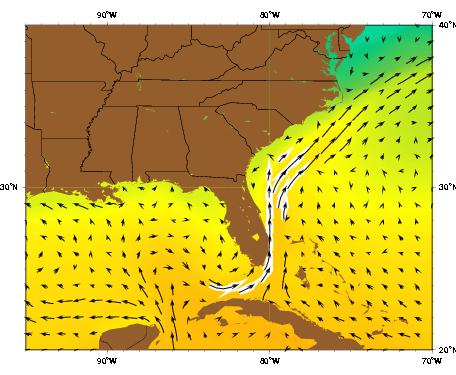
The is the average direction of the Gulf Stream. Coming down from New York you have to sail through at least part of it.

This is the average direction of the Gulf Stream. Coming down from New York you have to sail through at least part of it.

When going south towards Fort Lauderdale or into the Straits of Florida we try to avoid this center of the Gulf Stream by either sailing on the Grand Bahama Banks side when going to the East Caribbean when coming north of Cuba, or staying close to the Florida coast when going to Florida ports or down to the Gulf of Mexico or the West Caribbean.

That is what we are doing today; creeping closer and closer towards the East Coast of the Carolinas and later of Florida. In that way we hope to reduce the opposing current to less than 2 knots and if we are lucky we might even get a counter current. I use the word “lucky” as it is not all science here. We get chartlets made by NOAA which indicate the average location of the current and we have chartlets with the general pattern of the current. But one good hurricane coming through and the Gulf Stream can be completely different or even gone. Hurricanes can push water in a different direction or “suck” water away from a location somewhere else and then the current will go that way to restore the balance.

I sailed once from Norfolk to Half Moon Cay, right after a Hurricane had come through, and there was no Gulf Stream at all; instead I had two knots of current with me all the way down until I sailed between the Bahamian islands. It took two full days before the Gulf Stream came back to its regular flow.  As you can understand I had a very happy Chief Engineer at that moment.

Even when the Gulf Stream is flowing normally, we still do not always know the correct location as the Axis of the Gulf Stream can vary quite quickly from being close to Florida to moving all the way over to the East and being close to the Grand Bahama Bank. To get it exactly right is sometimes as much as throwing a dart at the chart, as conducting a deep study of all the information available. What still works the best is to make a plan and then when there, to let the ship “feel” where the current is by going a bit off track to starboard or to port and observe what happens.
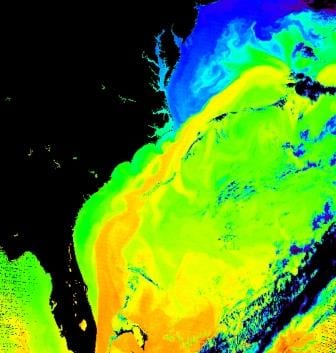
This is the Gulf Stream as indicated by its temperature. The more we can stay in the green part or on the edge of the orange part, the less adverse current we have.

This is the Gulf Stream as indicated by its temperature. The more we can stay in the green part or on the edge of the orange part, the less adverse current we have.

When we are coming closer to Charlestown it is not so much of an issue as the Gulf Stream is still very wide and thus close to the coast we will feel not much more than 0.5 of a knot. But at lunch time we were in the middle of it with two knots and that gave the navigators a good idea of where the Axis should be when we sail back into open waters tomorrow evening. Then the trick will be to stay out of the thick of it.

Weather for tomorrow: Nice and warm but not too warm. Clear skies with noon temperatures of 24oC / 75oF and a gentle breeze.
17 Oct. 2017; New York, USA.

Well the weather forecast of a sunny but chilly day did not exactly happen. It was sunny but New York experienced a small heat wave today and the temperature rose to 79oF, hardly cold autumn weather. But it was all to the advantage of the guests and that is the only thing which really matters.

I stayed on the ship as I am doing a complete sweep of the Veendam for the captain. Deck by deck, locker by locker, space by space, and that takes up a lot of time. Looking at maintenance status, safety routines and compliance and anything that might need attention and which has not received the focus as the crew as they are busy with other priorities. A fresh pair of eyes can be very valuable, especially as I know this ship inside out, having been captain on it from 2004 to 2008. So I did today the outside decks from the top all the way down to the lower promenade deck. Taking advantage of the sunny weather and being able to walk around in a T shirt instead of a winter coat.

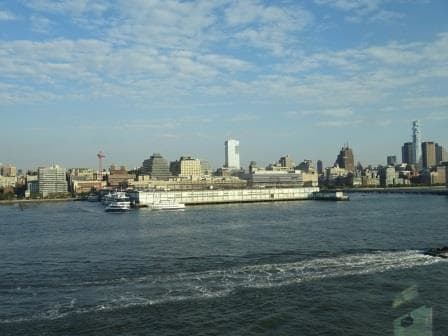
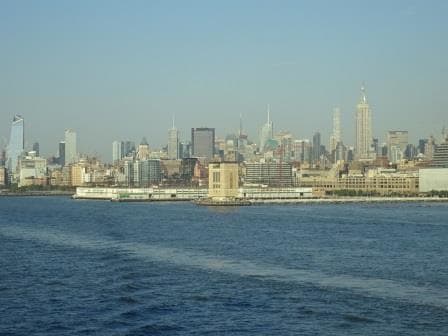
New York Skyline with the Empire State Building and the ventilation towers of the Holland Tunnel in the foreground

New York Skyline with the Empire State Building and the ventilation towers of the Holland Tunnel in the foreground

The nice sunny weather also created one of the best sail – aways from New York I have ever seen. With only a gentle breeze blowing it was very pleasant outside and with the setting sun shining on Manhattan, the scenery was nothing short of spectacular.

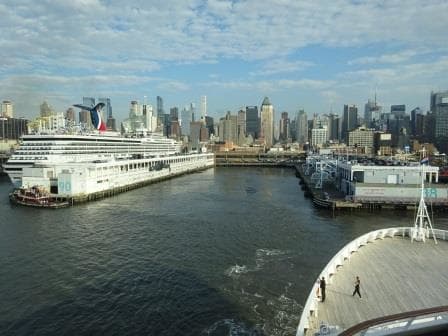
This is what 2 knots of current does. Barely out of the pier and instead of being in the middle we have already drifted south and are half way past our dock.

This is what 2 knots of current does. Barely out of the pier and instead of being in the middle we have already drifted south and are half way past our dock.

This morning the Veendam docked with slack tide which means there was no current running in front of the piers. So the ship could just shoot in without any danger of bumping into pier 90 on the portside or pier 88 on the starboard side. On departure we had a few knots of ebb running and that made it a bit more complicated to get out. The moment the stern comes outside the pier, it will push the stern back against the dock as we were starboard side alongside. Thus the trick was to angle the stern almost against the opposite pier, then go astern, and use the current to bring the ship back in line up with the pier and then just keep going astern until clear.

The old Holland America Line Pier. In 1964 the most modern passenger and cargo terminal in the world.

The old Holland America Line Pier. In 1964 the most modern passenger and cargo terminal in the world.

And then we sailed down the river. Apart from seeing the Empire State building from several angles, I was mostly interested in seeing the old Holland America Line Pier, Pier 40 at middle Manhattan. The pier is now is in use for various activities which have nothing to do with the sea anymore. A quick look at Wikipedia told me, that it is now being used as a parking garage and a sports facility. It is home to the New York Knights of the American National Rugby League but has a lot of other sports going as well.

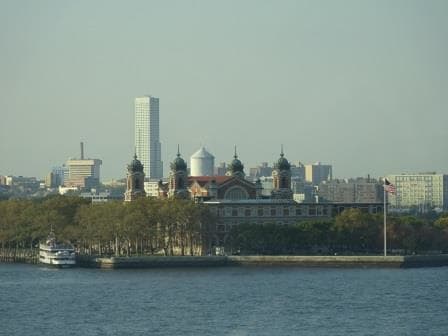
Ellis Island until 1954 the main entry for emigrants by sea into the New World.

Ellis Island until 1954 the main entry for emigrants by sea into the New World.

On the other side is of course Ellis Island where Holland America landed thousands of emigrants. The ships would stop off the island, the emigrants would go off and the ships would continue with the First and Second or Tourist class passengers to Hoboken docks where the company piers were situated until it finally moved over to Pier 40 at the Manhattan side. By that time Ellis Island was long closed.  Next to it is Liberty Island with the Statue of Liberty which was the main attraction for our crew on the forward deck. They all knew about it but as Holland America seldom calls at New York anymore, very few of the newer crew had ever seen it.

We have for New York, two pilots on board. One is the docking pilot, who does only the docking/undocking of the ship and is especially on board in case tugboats are needed. Today he had an easy day as they ship did it by itself with the thrusters. As soon as the ship was safely lined up, this pilot left and the River pilot of Sandy Hook pilot took over to guide the ship to open sea. That will take approximately three hours and thus we should be near Ambrose Lighthouse around 19.30 hrs.

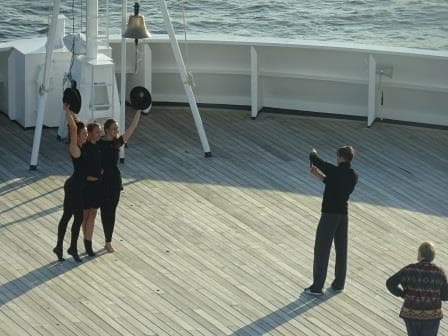
A lot of excited crew on board and as usual our entertainers are the most excitable among them. These three could not resist to stage a photo shoot.

A lot of excited crew on deck and as usual our entertainers are the most excitable among them. These three could not resist to stage a photo shoot with Manhattan in the background.

From there we go south and today the chief engineer was lamenting the fact that the ship will go against the Gulf Stream. First there will only be a weak influence but the closer we come to Fort Lauderdale the stronger the resistance will get. And thus he ran to run an extra engine to maintain the average speed needed and that costs fuel and that makes a Chief Engineer very unhappy. Tomorrow we are at sea for the whole day and then we visit Charleston, South Carolina.  Weather is supposed to be very good again and that should bring a very nice day on board.


16 October 2016; At Sea.

Today we spent a quiet day at sea, with very nice weather although it felt a bit windy at times. But that is more or less caused by the relative wind on deck. The ship is only making about 10 knots of speed and the wind is only blowing at about 10 knots of wind velocity but they are at times opposite to each other and then the combined relative wind on deck is 20 knots. That is considered a Fresh Breeze in sailors jargon and it feels real ”fresh”  as it is a cold and nippy wind, winter is definitely on its way. Hence we are getting away from the area.

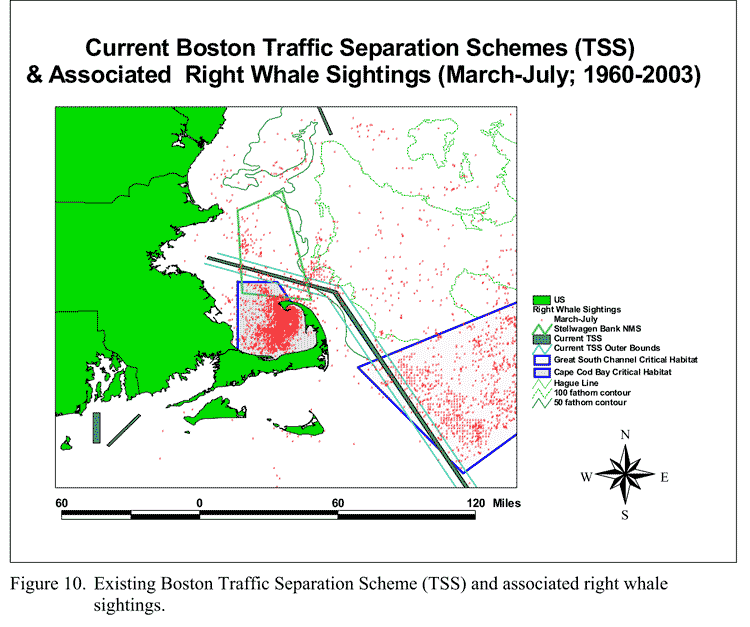
NOAA information with plotted sightings until 2003. Not much has changed since then. Diagram courtesy NOAA

Information with plotted sightings until 2003. Not much has changed since then. The green angled line to the lower right hand side is the vessel traffic separation scheme, which all ships have to follow when going south from Boston. Diagram courtesy NOAA

Making only 10 knots of speed has two reasons, first if we go full speed, we arrive in New York in the middle of the night and then we are alongside until dawn with hardly anybody going ashore. (Except some crew of course) The 2nd and much more important reason are the Right Whales. All the way from Boston, to Nantucket Island and then partly towards New York, we are sailing through their habitat. With a fair chance of hitting one of them if we go too fast.

The Right whale is one of the more peculiar ones among all the whale species out there. They tend to be completely oblivious of what is going on around them. The Humpback whale, which we encounter very frequently, reacts to engine sounds and vibration and will dive. So as long as we keep a good look out and change course on time, we do not have any issues with them and they not with us.

The Right whale does not do that, it just sits, floats and plays around regardless what happens around it. According to scientists, the mating rituals are different to other whales as well as they seem to engage in group sex; and people (with experience) say that when you are involved with that nobody seems to pay any attention to anything else anymore.  Because they do not take any notice of the outside world, they were a very easy prey for the Whalers in the old days and as a result there are only about 400 left. And with all the protection in place the population is not growing very much.

Apart from that we do not want to lose any of them, we cannot afford to lose any of them as they are very close to extinction, whatever their mating rituals might be. So the ships have to keep a very good look out and go slow to have time to see them when they are floating around, as they are far less active than a Humpback which tends to put up a show whenever they can. To see the Right Whales you need time and thus we go slow.

To help with this we all have speed rules in the conservation area’s and the USCG maintains a listening, reporting and advise station outside the Boston area where they collect all the data and make announcements of where the last sightings have been. And there is a Vessel Traffic Separation scheme which insures that all ships follow the same “highway at sea” and thus reduce the chances of an close encounter.

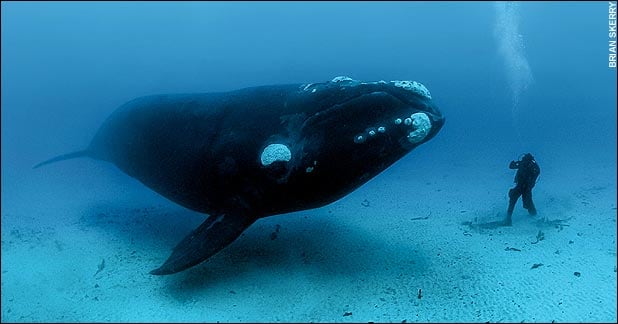
If you see them, then they are easily recognizable with the white callo on the nose.

If you see them, then they are easily recognizable with the white callosities on the head area. Photo by Brian Skerry. Courtesy of www.whaleman.org

Because they move so little and there are so few we seldom see them and thus each sighting is important. We keep the ship on hand steering where needed so we can change course without delay and at all times one officer and one quartermaster keep a sharp lookout while the 2nd quartermaster is behind the wheel and the other officer looks after the navigation. When sightings come in we even bump up the number of officers by adding a Sr. Officer to the team for oversight.

We do not have to go slow everywhere but it is of course much easier to schedule the ship for a slow run between two ports instead of putting the Captain under pressure of having to make up speed as soon as the ship is outside whale waters.

With that speed of 10 knots we will arrive at 04.00 hrs. tomorrow morning at the Sandy Hook pilot station and from there sail up the Hudson. At 05.30 we will pass under the Verrazano Bridge and will dock around 06.30 at Pier 88 in New York. There we will stay until 16.00 hrs. Weather is looking good, with partly cloudy skies and temperatures in the high fifties. We will be in port with the Carnival Sunshine which has New York as a turn over port for making her last Canada & New England cruise.

15 October 2016; Boston, USA.

Today I returned to the high seas and this time it was the Veendam. The Lords of Change had decided that no change was needed to my schedule and I could stick to my planned schedule. So Veendam it is.  If the schedule will remain unchanged is anybody’s question.   The port of Boston was full today with the Veendam, the Zuiderdam and the Grandeur of the Seas in port together. These three took up the whole of the long berth of the Falcon Cruise terminal and gave my taxi driver a headache because of trying to find out which Gate was the right one to drop me off. The building of the Terminal is so high that from the street you cannot see what ship is on the other side, let alone where the stern stops and the bow starts.  But with the help of a friendly policeman, the ships agent was found and I was taken behind the security gates.

It was good to see my old ship back again; I was captain on her from 2004 to 2008 and had since then only visited sporadically. So now we are back for three weeks, for training, auditing, creating a bit of mayhem with drills and offering words of wisdom (when asked………………). As the winter is coming to the East Coast, the Veendam is on a cruise from Montreal down to Fort Lauderdale and will then start a Tran’s canal cruise to San Diego. When we arrive there on November 5th. it will also be the end of my period on board, unless things change.  It is a short of snowbird migration that is going on, as the Zuiderdam, on a 12 day cruise from Quebec is doing the same thing. She also will end up in Fort Lauderdale to commence her winter season.

After Boston, we will visit New York on the 17th. Charleston on the 19th. and then Fort Lauderdale on the 21st. As Boston is a handy port for flights, we had a small crew change over today and that will take some of the pressure away in Fort Lauderdale when the regular crew large change over takes place. The more we can spread out those crew changes the better it is for the continuity on board and the least the guests will notice the change.

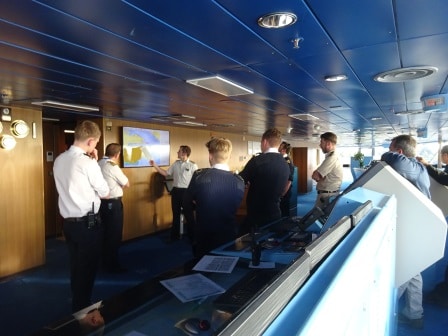
Staff Captain Andrew Barker briefing the team for departure. The Captain is the 2nd one on the left, the local pilot is on the far right.

Staff Captain Andrew Barker briefing the team for departure. The Captain is the 2nd one on the left, the local pilot is on the far right, leaning on the radar console.

The good ship Veendam is under the command of Capt. Noel Driscoll who has been around since 1999 and his first ship was the Veendam as well, so he has come full circle so to speak. He originates from Ireland and he is one of a few of the Irish Officers we took on in the mists of time who stayed the course and settled down at Holland America.

The rest of the Deck officers are roughly of the 50 – 50 percent mix between British and Dutch. Through the years the company has figured out that the two groups together enhance each other and push the mutual quality of the whole group up to a higher level. As one of my colleagues once said, we teach the Dutch how to speak proper English and they teach us common sense. (Or was it the other way around???)

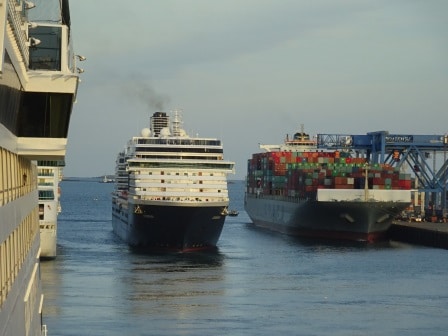
The Zuiderdam going astern with a container ship on the portside and the Grandeur of the Seas on the starboard side.

The Zuiderdam going astern with a container ship on the portside and the Grandeur of the Seas on the starboard side.

The Falcon cruise terminal has an excellent location, being close to downtown and not too far away from the Airport; but has one set back and that its fairway to get in and out is rather small. If there are three cruise ships in line and a container ship at the berth at the other side, then there is not much room left, especially if it blows from the wrong direction. Today we had very little wind but still the Veendam had to wait for 30 minutes until the Zuiderdam had pulled out and gone astern before she could follow.  We needed a little bit of the Zuiderdams docking space before we also could go sideways and into the middle of the channel. Boston has approval for a $300 million port dredging plan and the money has been allocated on federal and state level but they have to wait until the person has been found who will really write the cheque. Last night I heard a Lady on the local TV saying that this might be within the next two years.  So until that time, the mud will decide other departure sequence.

Tomorrow we are at sea, sailing at a slow speed to the Port of New York where we will arrive on the 17th. The weather is getting chillier but is supposed to remain good, and a bit of a chill in the air will reduce the chance of “very low hanging clouds” and that is a definite bonus.


27 Aug. 2016; At Sea.

The good ship Koningsdam is weaving its way southbound again back to Amsterdam after a 14 day “flat circle” cruise curving around Scotland to Iceland and then back via Norway.  Today the word “weaving” is correct as we are on far from a straight course. Going between the various Oil Rigs you can easily do on a safe and straight course but what you meet on the way can make a difference. Between the Oil Rigs you can come across Fishermen as they are convinced that fish will hide as close to a rig as is possible and you also come across watch ships which are there to protect the oil rigs. Fishermen will claim that we are going where they need to be, that the uncomprehending outside world build Oil Rigs, windmill parks and other structures on their exclusive fishing grounds and that the rest of the floating world (including us) is just a nuisance in principle. They are not always wrong nor are they always right but the rules which cause these structures to be there come out of a democratic consulting system where every stakeholder had the chance to give input somewhere during the decision process. And the final decision making policies resulted in what we have now.

The space between oil rigs is free to everybody as long as you do not endanger the rigs or its working capacity. And this means that fishermen are in between. Nothing against that, probably very good fishing, but when they move towards you from out of the rig area and they are still fishing then the navigational situation can become a bit complicated. We have the Rules of the Road which clearly define how to deal with fishing boats when fishing. However the rules have no allowances for: if a whole slew of oil rigs make it impossible to change course. What do you do then? Such a situation is then covered under a general rule, stop the ship or at least slow down. And slowing down if you really do not have to is some- thing we try to avoid as it costs time and fuel. So we always hope that the fisherman recognizes its own and the others situation timely, so a small action from one or both sides can prevent a major course or speed change.

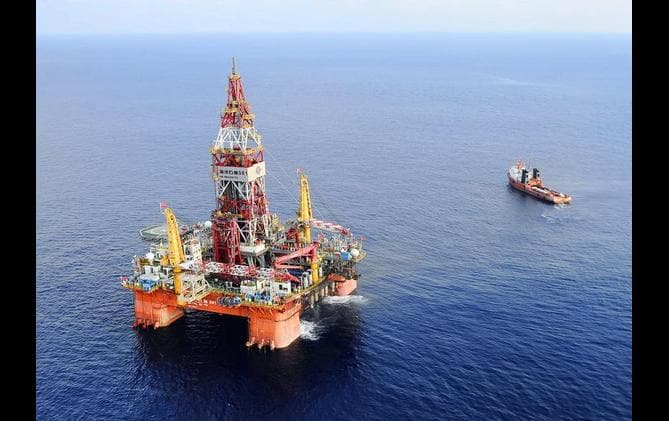
A Supply boat keeps watch over an oil rig. In this case a drilling platform, making a new well.

A Supply boat keeps watch over an oil rig. In this case a drilling platform, making a new well. (Photo Courtesy, somewhere off the Internet)

Then there are the watch ships around the oil rigs. A number of years ago it was decided to put watch ships on station near the oil rigs after a calamity during which a cargo ship ploughed into a Rig. And thus we see everywhere converted Fisherman Trawlers, Supply Vessels or other craft sitting a short distance from a rig with the duty to call & challenge anybody who comes too close; and if it is because of a power failure to tow the vessel to safety and away from the oil rig. Many an ignorant sailing boat has had the scare of its life when suddenly one of these station ships bore down on them. We have normally little dealing with them as they know we stick to the steamer tracks but sometimes we get a call with the advice about something or the other which might be going on or near our route.

Today we had something like this, where an Oceanic Survey Vessel (most likely looking for more oil) asked us to give it a wide berth. A wide berth of several miles around itself. It was accompanied by 4 watch ships sitting in quadrant around the ship and moving in formation, while going very slow. Sometimes they ask for a wide berth because they are towing a sonar probe but often it is that coming closer will affect the readings they are taking. We always try to comply but going 3 to 4 miles out of the way might bring you close to an oil rig and that upsets the watch ships again. Today the Navigation Team could solve the issue by veering off the course and by crossing at a large distance in front of this little convoy.

Tomorrow we will be back in our home port Amsterdam and getting ready for the next cruise. The weather will be a bit uncertain; warm 75oF /24oC but with a chance of showers and drizzle in the early morning and maybe during the day.

I will be going home as my time on the Koningsdam has come to an end. Now I will have a short leave and then will return to sea for the next series of ship visits.  I will keep my plans updated on: http://www.hollandamerica.com/blog/my-sailing-schedule/

As it is never certain where I will end up next. If nothing changes my next ship will be the Veendam starting on 15 October.  Thank you for reading my blog and I will continue with updating my history part of the blog. I managed a number of captain’s bio’s last time and that will now continue.


26 Aug. 2016; Bergen, Norway.

In Norway people say, “There is Norway and then There is Bergen”. As the people from Bergen seem to consider themselves sort of outside Norway or think that Norway is part of Bergen and not the other way around. The real deep meaning behind it was once explained to be by a Norwegian in a pub in Amsterdam and after several beers it made great sense but the next morning it was hard to remember the exact context. So I cannot explain why Bergen is different it just seems to be so. But I wonder if the weather in Bergen is also different than the rest of Norway. And with that I mean, the way it rains here.

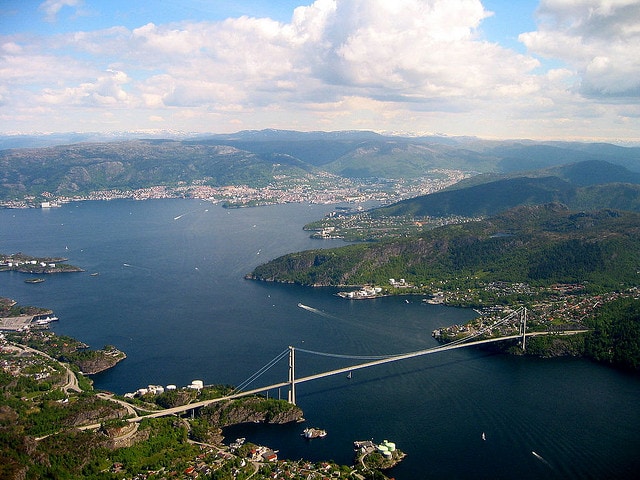
Bergen is nestled nicely in a protective valley but rain clouds get caugth in the Horse shoeshape. (Courtesy of Favi Images on Flickr)

Bergen is nestled nicely in a protective valley but rain clouds get caught in the Horse shoe shape. The bridge in the photo is high enough for all ships to pass under. But around the corner to the right is an older and much lower bridge. (Courtesy of Favi Images on Flickr)

It rains of course everywhere in Norway but Bergen sits in a valley surrounded on three sides by mountains. When the rain clouds roll in from the sea and bounce against the mountain ridge on the East side, there is a fair chance that it will rain here. But this morning I seem to observe that the clouds bounced from one side of the town & mountain ridge to the other side and it just kept raining. The cloud swirl looked very peculiar when seen from the ship. It moved towards the East and then it moved towards the North. It kept raining for most of the day with intermittent spells (I think the clouds were on their way to bounce to the other side) of dryness. We had the Aida Luna in as well and thus approx. 6000 guests had to enjoy a rainy day in Bergen. Luckily the town has a lot of offer even on a rainy day and thus “the damage done was limited”.

We were docked at the smallest dock in the town, the Bontelabo dock which I mentioned last time as well. The AidaLuna was at the other dock which is longer and also closer to town. Bergen’s port management does what most ports do: assign the best dock to the most frequent caller. If there is no seniority issue then the dock normally goes to the largest ship (in guest capacity) and if there is no difference there then it is normally the ship that stays the longest in port. We have a regular call today from 08.00 hrs. in the morning to 17.00 hrs. and thus there is nothing for Bergen Port to consider us special and hence we were at the smallest dock.

As most Norwegain towns Bergen is tucked away in a Fjord which means sailing in for a considerable difference.

As most Norwegian towns Bergen is tucked away in a Fjord which means sailing in for a considerable difference.

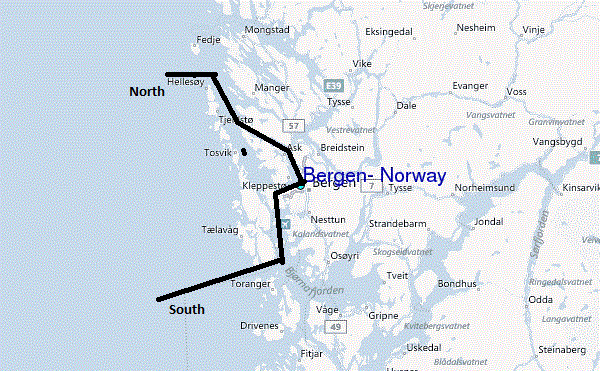
Bergen has two major ways of getting in and getting out. A north Entrance/Exit and a South Entrance/Exit. Smaller ships such as the Prinsendam can use both routes. Both routes require going under a bridge and the bridge of the southern route is lower and that blocks the Koningsdam from going this way. We are coming from Aalesund to the North so coming in from the north makes sense. Our final port is Amsterdam, down south and thus the Bergen south entrance would make more sense. But because of this bridge we have to go north again to open waters and then sail south. A deviation of a few hours and nothing we can do about it. Even lowering the Radar mast or flipping over the funnel as some ships can do would not make a difference in this case. We are looking at a considerable height difference here. A pity but the Koningsdam will have to make the extra miles.

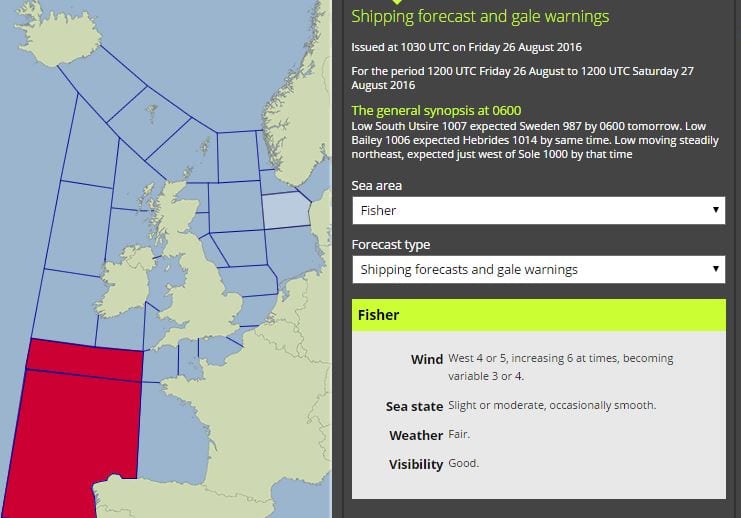
We will be in the light blue area tomorrow morning. the nasty stuff is all the way to the south.

We will be in the light blue area tomorrow morning. the nasty stuff is all the way to the south.

After departure we will sail North West again until we are back in open sea. That should take us about 2 hours counted from departure. And then it is due south until we will come to Amsterdam pilot station on Sunday morning. When going south the issue of low visibility will pop up again. Thus far there seems to be very little chance. The Shipping forecast indicates a moderate breeze off the Danish coast and good visibility. At the moment it is better to be here than West of the Gulf of Biscay as there is a nice storm blowing of the Portuguese Coast. Our guests have one more day to enjoy on the ship and then most of them will go home, unless they are adding the seven day Norway cruise to this cruise, making it a three week cruise in total.

25 Aug. 2016; Aalesund, Norway.

We were lucky people during last night and today as the Restricted Visibility did not return. The wind shifted slightly and that was enough to change the temperature balance between water and air. And coming closer and closer to the Norwegian coast also helped with the sea water temperature as the water is not so cold here than when  in the open sea. So reason enough for everybody to be happy. This morning we also passed the Queen Mary II which was on her way to Flam in Norway, where the Koningsdam will call next cruise. Normally the Queen Mary II should pass us as she is capable of a higher speed but we were going at a fast clip while she was leisurely cruising along. Courtesy of a different cruise schedule.

Today I caused considerable stress among the sailors as it was Theoretical Exam day for the aspiring Tender Drivers which I have been helping along in between other things. To become a proficient tender driver with Holland America Line a sailor has to do a considerable amount of work. First he has to be a Sailor AB. (= Able Bodied) which means he (we do not have female sailors yet) has to have enough experience to do all the work on board which the Bo ‘sun assigns. Then he has to follow the class which is given by a senior officer on board or in this case by me because I just happened to be here. That class has 6 or 7 hours of theoretical lessons, covering the construction and inventory of the Tender (as it is a lifeboat) Rules of the Road, Emergencies on board, use of all instruments and a Basic understanding of the engines.

Then there are two courses to follow on our computer system. We call this system HAL- University and it has all the training courses listed which any crew member might need to properly and safely do a job. Those two courses are Tender Driving where with animations several scenarios are played out and questions need to be answered and a special course about the Release Gear of the lifeboat.

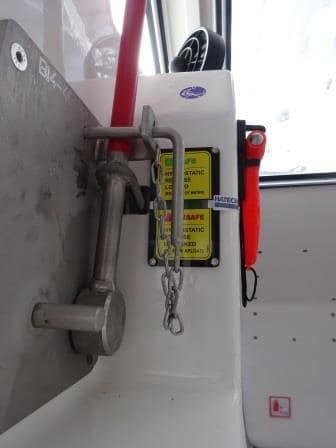
The magic handle to release a lifeboat and tender

The magic handle to release a lifeboat and tender

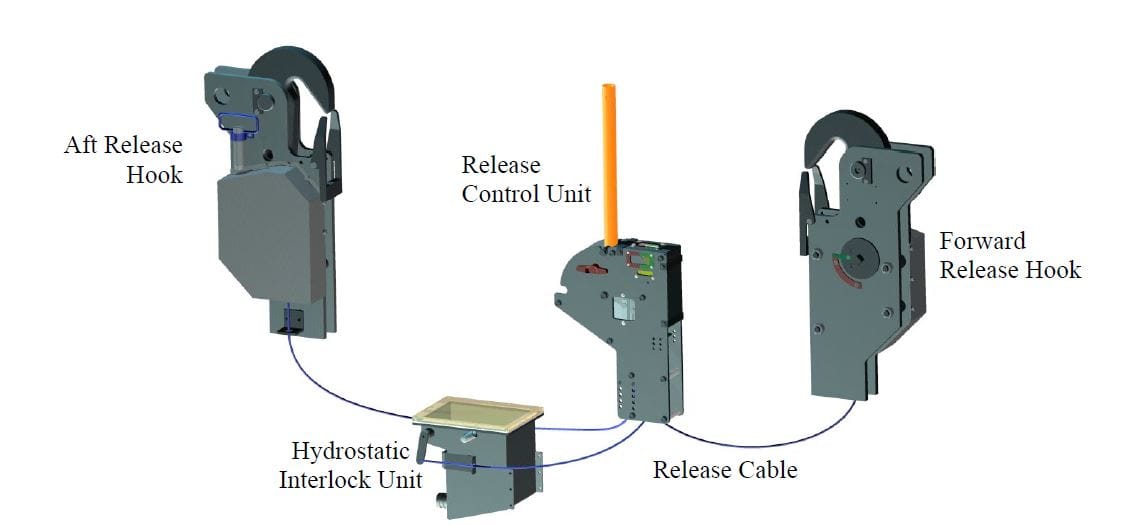
Everybody who has been in a tender to go ashore will have seen close to the driver’s position a long handle in orange, red or yellow. When this handle is pushed down, it releases the fall wires in which the lifeboat/tender hangs when it is out of the water.

Schematic of how it works. (Diagram courtesy of Rock Lok who supplies the system)

Schematic of how it works. The water pushes the plunger up and that releases the safety catch on the handle. (Diagram courtesy of Rock Lok who supplies the system)

This releasing is only possible if the boat is in the water. In the bottom of the boat is a small hole which lets water into a compartment in which rests a plunger. When the boat is in the water, the sea water comes in, pushes up the plunger and this releases a safety catch. With the catch gone it is possible to pull the handle and this opens the hooks to let those fall wires slip away. The principle is very simple but you have to understand the logic behind it and for that we have a special course.The whole evolution of safely getting away from a sinking ship depends on using this handle properly, so it is a very critical part of the lifeboat/tender.

Then there are a number of practical lessons. We exercise the regular maneuvering with the tender for docking and undocking, running on one engine, using wind and current to your advantage and emergency steering when the regular steering wheel does not work anymore.  Once that is all completed the Theoretical Exam is held. In 25 questions everything is covered —— well at the least the most pertinent points———— and 80% has to be scored to pass. Often the answers are not the issue for the sailor; they normally know their stuff very well. What spooks them the most is reading the questions properly as their English is often quite basic. Good enough to work safely, not always good enough to understand the Queen’s English. Today the stumbling block was the word choking. Which requires the answer: I will use the Heimlich maneuver. They all knew what to do but the word puzzled them. But all 10 passed without difficulty.

We arrived nicely on schedule in Aalesund and docked at the Cruise terminal. We are the only ship to enjoy the town today. It is a bit gloomy but it is dry. T

At 20.00 hrs. we will sail for Bergen where we should be docked by 08.00 hrs. Seeing the same overcast weather.

24 Aug. 2016, At Sea.

Once we were clear of the coast and the sun disappeared for the night, a white blanket descended over the Norwegian Sea. Thus the Navigators went to Reduced Visibility Navigation (Which means a senior officer is added to the team and if that is not the captain, then he remains nearby on short notice) and started sounding the whistle every two minutes. That is what the law requires and thus that is what we do, even if the guests with balconies right under the whistle are not very happy about it.  Unfortunately when you select a cruise which involves Greenland or Iceland or the North West side of Norway (including Spitzbergen) then there is a fair chance of losing all visibility around you. It is either that or bad weather.  

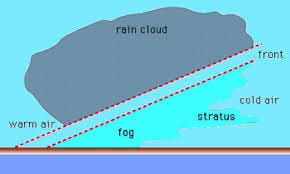
What happens in the sky. Borderlin between water vapor and no water vapor.

What happens in the sky. Borderline between water vapor and no water vapor.

Why are all those white clouds coming here and insist in coming all the down to the water line and why are they not staying up high in the sky and bother airplanes and not us?  Our fog is similar to clouds high up. Clouds are made up from condensed water droplets which are the result of the air being cooled to the point (what we call the dew point) where it cannot longer hold all of the water vapor it contains. Clouds form when rising air cools from expansion.  Secondary factors such as pressure and turbulence cause the shape of the clouds.

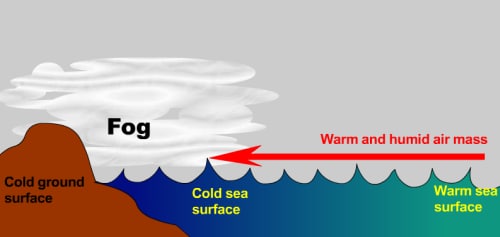
That is what we had today.

That is what we had today. Although the difference between warm and cold was not that great.

In our case we are dealing with clouds which form above the water. And also that has to do with temperature differences causing air to cool.  But because the water temperature is not always constant and the air temperature over it neither, it is not easy to predict when fog will exactly happen and when not.  In our case today, it is caused by a gentle easterly breeze. Not much but just enough. It brings warmer air towards this region where the water is colder. The Gulf Stream splits in two halves under Iceland, one arm doubles back to go west under the Icelandic coast and one arm continues over the North Atlantic towards Europe. That 2nd arm is causing the problem. Here the warmer water has warmed up the air, the sun has been helping a little bit as well and then a gently Easterly Breeze carries it towards the Norwegian Sea.

As soon as it meets colder seawater the air cools down, cannot contain all the water vapor anymore and starts to condense.  The temperature difference does not need to be much; a few degrees difference is enough. If the temperature difference is only a few degrees then a strong breeze can upset the balance and fog will not happen.  Hence there is seldom dense fog here if there is a good storm blowing.

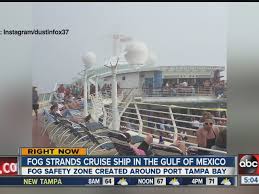
The port of Tampa is notorious for reduced visibility in the winter. And when you can not see, the port closes down. (Courtesy ABC Action news)

The port of Tampa is notorious for reduced visibility in the winter. And when you cannot see, the port closes down. (Courtesy ABC Action news)

If there is fog, then the sun can help. It is by no means certain that the sun “will burn the fog away” but if the temperature range is close enough, it will. That is what we saw in Isafjordur. Thick fog but no wind to start with and then when the sun started to warm up the land and the sea surface the warmer air caused a different dew point, the water droplets evaporated again and visibility was restored.

Today there is not much wind and the sun has to warm up a large area of water, which is much slower to warm up than bare rock, and thus visibility is struggling. It took today nearly to 1 pm. before visibility became more than three miles. The magic number was we are allowed to stop blowing the whistle.  We are not expecting much wind to happen in the next 12 hours and thus the “low cloud” situation could return in the evening. Unless of course we come to a warmer patch of water which will affect the air cooling down. This makes it also very difficult to exactly predict when fog will happen.

So we will continue our voyage towards Norway. At noon time we were 170 miles north of the Faroer Islands and about half way.  By mid-morning tomorrow we will approach the pilot station of Aalesund and dock about an hour later. If the water temperature remains the same then I expect that the weather situation will remain the same and the whistle will continue to blow every 2 minutes, until we come close to Aalesund.

23 Aug. 2016; Akueyri, Iceland.

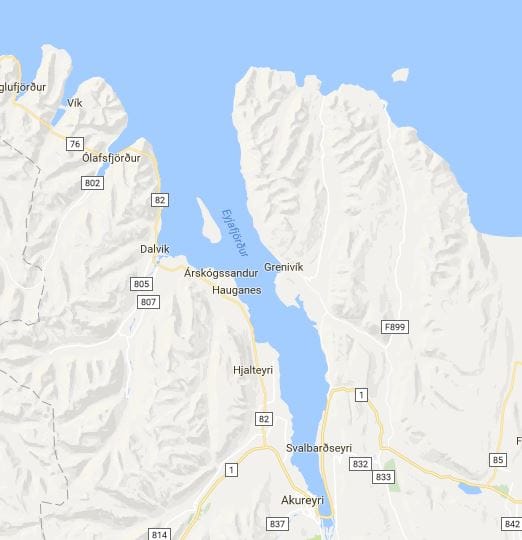
Akueyri is just a hop and a skip away from our last port of call and thus our schedule called for an early arrival. We had to be docked before 7 am so the invasion of the town could commence on time.

Thank you Google Maps.

Thank you Google Maps.

Akueyri is located fairly deep in a fjord and thus it takes a while to sail into it. The cruise terminal is located at the south side of the town and then the fjord ends in a sort of big and deep pond where ships can safely anchor as well. The fjord itself continues with what I would call a river coming from the inland but you cannot sail on it. Even if you wanted to try, you could not, as the locals have built a bridge over it to get around the fjord /bay.


The town and area is very well liked by Icelanders and many have a 2nd home here. If you pretend to be somebody in Reykjavik then you have to prove that by having a 2nd home in Akueyri somewhere on the mountain slopes.

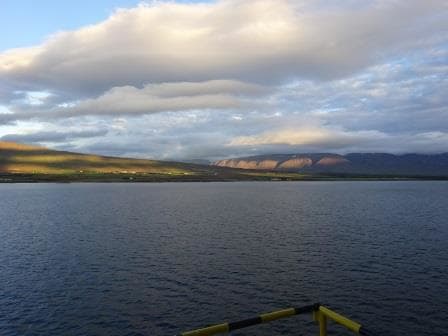
All the white dots are not farms but 2nd homes, for summer and christmas.

All the white dots are not farms but 2nd homes, for summer and christmas.

According to one of the linesmen (those are the gentlemen who pull the mooring lines ashore) I talked to today it does not work the other way around. If you are an Akueyrian and you would you have a 2nd house in Reykjavik it would not make you more important locally. People would just say, what is he/she wasting his/her money on.

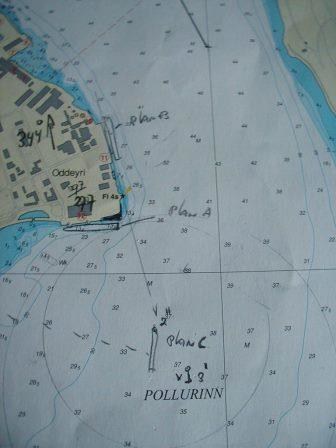
Sp for the weather there are three plans. If too much wind at Plan A, we shift to Plan B and docked nose or stern into the wind and if that does not work we go to Plan C; anchor.

For the weather there are three plans. If too much wind at Plan A, we shift to Plan B and docked nose or stern into the wind and if that does not work we go to Plan C; anchor.

The only challenge this port has for cruise ship sailors is, that the wind is often blowing through the fjord in an almost North / South direction. The cruise ship dock is in an East /West direction and docking with a northerly wind means fighting against it to come along side. From the south it helps you with docking but then you have to hope that you can get off the dock again on departure. Today the weather was fully in synch with our cruise schedule. On arrival the wind pushed us to the dock. At mid morning and early afternoon it was sunny and wind still and by 3 pm the wind had turned to the North and pushed us off the dock again. How lucky can we be?

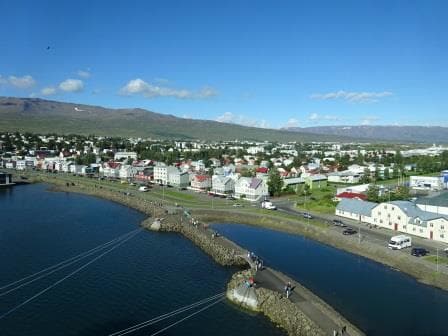
The Koningsdam bridge view, high above the town. May guests walked the streets and even climbed all the stairs to the church.

The Koningsdam bridge view, high above the town. Many guests walked the streets and even climbed all the stairs to the church.

Having nice weather is always a bitter sweet experience for a captain if you depart early. Today the sun shone and the temperatures were very pleasant and thus a lot of guests came back at the very last moment.  They then still have to be processed by security and that takes time and thus we could not completely adhere to our 15.00 hrs. departure time. So sometimes we pray if the schedule is tight, can we please have a short shower about an hour before departure? It really helps with getting everybody back on board in time. But once we could go, we could employ the blow-away maneuver which always makes life easier.

Akuyeri was blessed today with two cruise ships. In the late morning a little one came in called the Ocean Majesty. 16000 tons and a maximum of 700 guests. I think this year she sails charters for a German company. I know her well, in the past my wife worked on it as a tour escort and I tagged along twice to see ports where even the Prinsendam could not get into. It is in the blogs somewhere in summer of 2009 when I broke the golden rule of only blogging about HAL and blogged the Greenland cruise this little ship made. It was then chartered by an English company and the whole cruise on 3 star level was a real happening. Basically the way we used the sail in the 70’s and 80’s. Not too many rules and regulations and slight touch of dis-organization thrown in, to keep everybody sharp. It is nice to see that she is still going strong.

Now we start crossing the Norwegian Sea on our way to Aalesund in Norway. The weather looks very good with hardly any wind. So hopefully that will not result in a lack of visibility. Iceland is two hours behind the continent and thus we have to go two hours forward to get into tune with Norwegian Life. The first one will be tonight.

22 Aug. 2016; Isafjordur, Iceland.

It was a very small world this morning when we arrived. The good thing was, it was nice weather, the bad thing was, we could not see it.

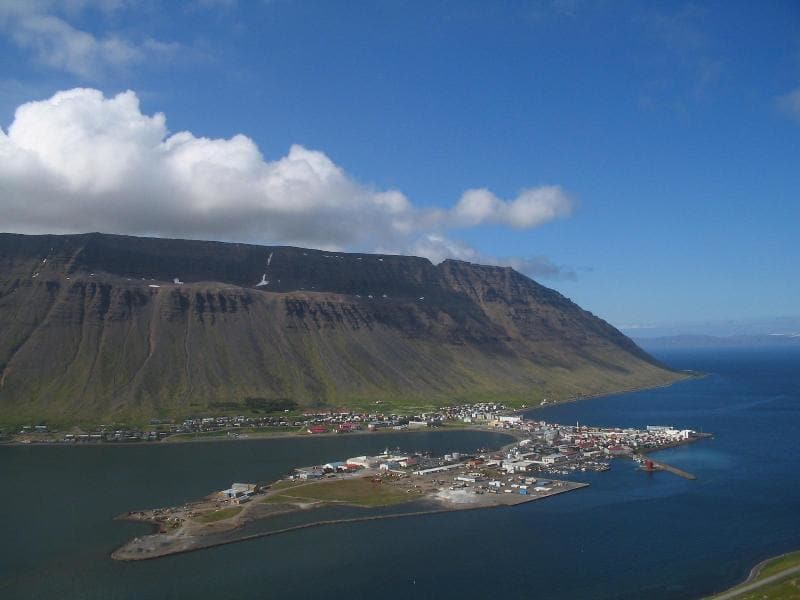
This what we should have seen arrival. (Courtesy, somebody who donated to Wikipedia)

This what we should have seen on arrival.  The dock is in the foreground and we tendered to where the red tower is located. The ships anchorage is to the right just off the photo. (Courtesy, somebody who donated to Wikipedia)

And thus the deck department of the Koningsdam went to battle stations. We have qualified tender drivers on our tenders who are trained and before they receive a certificate of competency have to do a practical and theoretical exam. However when we cannot see anything then the company requires Officers on the tenders who have full nautical licenses. I was this morning on deck early to see if my students…. Tender operators in training……. were doing what they had been told; everything according to the rules and regulations.  Which includes safe working practices; executed in the correct sequence and it all with good communication.  In a few days’ time they will have their exam and I do not like anyone of them to fail. So we train from early morning to the end of the working day on the job, if we get the chance.

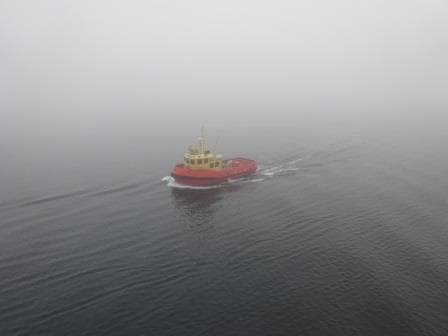
That is as far as visibility went. The pilot boat at 15 meters away and it was worse on the anchorage.

That is as far as visibility went. The pilot boat at 15 meters away and it was worse on the anchorage.

The Koningsdam has six tenders and we were expecting that the guests would be very eager to go ashore as soon as the ship was cleared by the authorities. Thus the staff captain decided to put six tenders into operation at once. And then I was drafted in to help so one of the regular navigators could have a bit more rest before starting.  We did not get visibility until 11.30 and thus I had the chance to play around with a tender for most of the morning. Always fun to do……………… boys with toys……… you know what it is. It also made it possible to continue training 2 of the sailors, who were on the tender and who had to report in after each run and explain what I exactly did with the engines and the rudder for docking and undocking. Thinking about your maneuver is the first step to safely executing it. The guests who used tender 20 had the experience of having the most expensive tender driver of Holland America Line taking them to the shore and back.

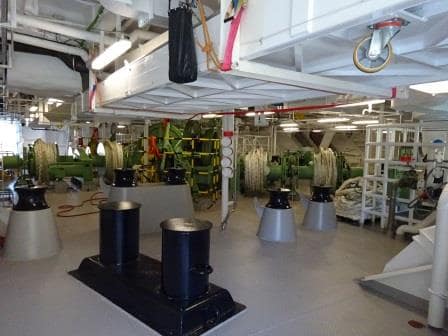
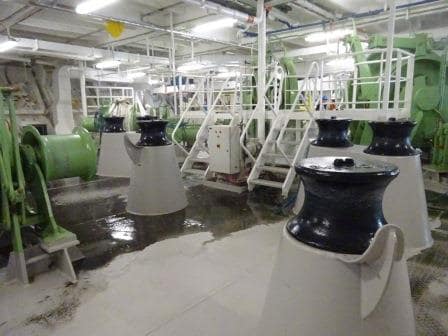
The koningsdam mooring deck with the starboard anchor winch, note the clean deck.

The Koningsdam mooring deck with the starboard anchor winch, note the clean deck.

We have to anchor in Isafjordur as the dock is too short for the Koningsdam and we cannot overhang here as there is no deep water beyond the end of the dock. I asked the Harbour Master if there were plans for an extension and he said they were talking about it already for three years. I suppose Icelandic winter months are long and thus they take their time and are not in a hurry, but it would help their business. There are companies with large ships who will not anchor and thus simply will not call at a port without a dock.  Extend the dock by 50 meters and you get thousands of more eager shoppers to come in.

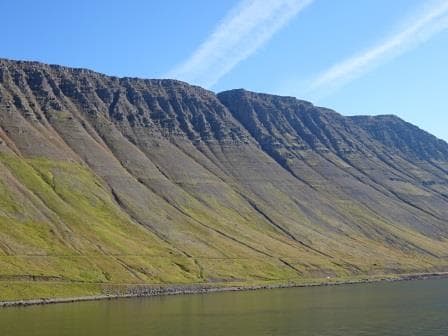
This is what we finally saw after 11.30 in the morning.

This is what we finally saw after 11.30 in the morning.

The fjord where we anchored is nice and sheltered from easterly and westerly winds. That was also the reason why it took so long for the visibility to return. First the sun had to peak over the mountain tops and then it had to warm up the land and the air to get the water saturation out of the air. But for safe anchoring it was a great day today. No wind at all. If there is a strong (and very cold) northerly wind blowing or a Northwesterly then it blows straight in and then it is sometimes impossible to be here. Today it was good and we anchored in about 30 meters of water and put about 150 meters of chain behind the anchor.

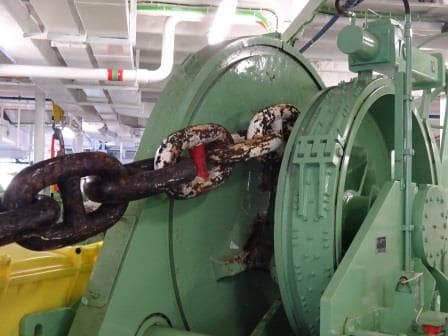
The anchor chain coming in. Each length of 15 fathoms is marked by white chain with a red stripe, so we can count them easily when coming out of the water.

The anchor chain coming in. Each length of 15 fathoms is marked by white chain with a red stripe so we can count them more easily when coming out of the water.

A lot of people think that it is the anchor which is holding the ship in position. That is not the case. The anchor is just the hook which sits at the end of the chain. The chain lays over the sea bottom and its weight and friction with the sea bottom provides the force to keep the ship where it is. The anchor is only a tool to stop the anchor chain from slipping. The holding ground in Isafjordur is very good. Extremely heavy mud which really sucks the chain in. Thus on the departure we had quite a job in getting the chain up and eventually the anchor. Heaving slowly on the winch, not just to get the chain up, but also to give the sailors time to clean the anchor before it went into the chain locker under the winch. It created a very nice muddy mess on the deck and the Bo ‘sun was not a happy camper.

Using the fire hoses to get the mud of the chain made a nice mess on the deck.

Using the fire hoses to get the mud off the chain made a nice mess on the deck.

Tomorrow we are in Akuyeri and here we dock. They have three docks and one is officially assigned as the Cruise ship dock but we can use any of the three if needed as long as there are no fishing boats in the way. We will have basically the same weather as today; 18oC / 64oF and sunny skies so we might have to find the dock without seeing very much if it goes the same way as today.

« Older posts Newer posts »