Today was the first of the two sea days that we have between Akureyri and Longyearbyen on Spitsbergen. This area of the North Atlantic is partly called the Greenland Sea towards the Greenland side and the Norwegian Sea towards the Norwegian side, and I have never been able to figure out exactly where the one ends and the other starts. The area is well sheltered from the North Atlantic weather that comes from the south by Iceland and as long as there is no wind from the North, the seas are smooth here. However there can be a lot of wind from the North and therefore we are very lucky with the weather. Nothing but a gentle breeze, temperatures in the mid 40’s (10 oC) and low hanging clouds. May it last for another few days. The only issue with low hanging clouds is that it obscured the top of the island of Jan Mayen, the Beerenberg Volcano. Continue reading
Page 171 of 241
By 03.30 we started to enter the fjord. Rather early but I had set up the route from Isafjordur to Akureyri to run on average speed, to achieve optimum fuel consumption and that meant a speed of just over 12 knots. As the fjord is 26 miles deep it would take nearly three hours to get to the pilot station near the port itself. Still it is advisable here to go slow. There is the occasional fishing boat, and the occupants are not always awake plus there can be whales swimming about. As explained in one of my previous blogs, the company has protocols to avoid collisions with whales. One of those options is to change course to head the ship away from them. In a fjord that is not so easy with limited space to go, so slow speed or stopping has to do the trick. Thus the idea of charging into the fjord at full sea speed is not a good one. If then you suddenly have to put the breaks on there is a fair chance that you get a highly excited Chief engineer on the phone. The Whale experts have figured out that if the ships speed is around 10 knots the chance of hitting a whale is quite small. It seems to give them time to realize that there is a ship nearby and it also gives us time to quickly stop the ship. Continue reading
Today and tomorrow we will be visiting ports that are tucked away deep at the end of a fjord. That gives the meaning of “approach” a whole different dimension as the arrival of the port is preceded by some very scenic cruising towards the dock. For the early morning arrival, there are normally not that many guests out and about, except for a few diehards that I see every morning but on departure the outside decks will be full when we retrace our steps again to open sea. The weather forecast predicted a gloomy day but when we started to make our approach we could see the sun already trying to peep through so once again the prediction was wrong, whoever it was wrong to our benefit. The town of Isafjordur is located on a shelf of land that sticks out into the fjord. Behind it is a large and deep bay with several docks all dedicated to the fishing industry.
The entrance channel towards these docks is only 60 meters wide and thus there is great reluctance by the port authorities to let us go there. They have asked for a government grant to widen the channel and then larger ships can call at Isafjordur. Until that time the largest size ship is dictated by the length of the dock located at the entrance of the port, or by its willingness to go to anchor. Continue reading
Once again the weather surprised us. In the planning were overcast skies with a little bit of rain but instead we had sunny skies and temperatures that reached the high sixties. Not that we were complaining, it ensured a perfect day during our first stop in Iceland. We had a whole parade of cruise ships or ships that could be construed as such coming in. There was us, followed by the Albatros, two small expedition ships the Akademik Shokalskiy and the Polar Stern and much later on the private yacht Octopus of Paul Allen, The latter being big enough to be a small cruise ship albeit catering for one person. By design or by good luck, I do not know but we had pride of place by docking in front of the visitors centre. We docked early, even earlier than anticipated, as the pilot boat came eagerly racing out to board us. So by 7 am we were docked for an official arrival of 0800 hrs. The first person ashore was the ships plumber as Iceland’s water is one of the best quality natural water that there is, and the quicker the hose was attached, the more we would be able to load. In the end we loaded over 1100 tons, which could sustain us for 3 full days if needed. However we will also load in the coming ports, so that the ships evaporators will only be needed when we start to approach Spitsbergen. Continue reading
Today we crossed that part of the North Atlantic located under Iceland. Although the ship was pitching while going against the North Atlantic swell, the weather forecast for the rest was supposed to have been reasonably decent. Light winds and overcast skies. To my utter amazement I saw during the day the wind freshening up to North East 7 on occasion which is near gale. As it was from the North East it was a following wind and that meant that it did nor really affect the ship. However it made me go back to all my weather sites on the internet to figure out where all this wind was coming from. If it would continue into tomorrow morning than it might affect our call at Reykjavik as going into port with wind force 7 is not a bright idea. However the North Atlantic weather forecast did not show much of the wind that I was seeing outside. So it had to be very local and that meant that it would disappear during the night as only a larger system can sustain this sort of wind for a prolonged period. Continue reading
This was a maiden call for the Prinsendam and subsequently for Holland America. The normal call is at Torshavn but that was out of the question today. It was a national holiday and that is celebrated with a sailing regatta and other water fun. So the whole port was reserved for them. Hence the “Albatros” and the “Mein Schiff”, calling at Torshavn, had to anchor and ferry their guests ashore. Runavik is located ”one fjord north” of Torshavn, in a fairly sheltered bay. It has a small dock and that meant we were sticking out about 50 meters on each side but it has good fendering so you can really pull the ship tightly alongside. Strong bollards are located on the mainland and they keep the ship very well in position. All reasons for me to be happy. The only confusing bit was how to find the pilot. Pilotage is not compulsory in Runavik but if you have never been there, it is better to have one for the first time to find out about the local way of doing things. Also in the age of the cell phone, the pilot can talk to all the locals on the dock assigned to pull the mooring ropes ashore and that reduces delays. As pilotage is therefore a bit of a voluntary affair, we found several different locations in our nautical paperwork of where the pilot boarding area was supposedly located. . When we called the pilot on the VHF, he gave yet another location. It turned out that it depends a bit how early the pilot boat makes its way out to the ship. Where the meeting point of the day is, is where the pilot station is located. Near the entrance of the bay was only one (fishing) boat floating around so that should then be the pilot and it was. With that issue out of the way, we happily progressed to the dock. Continue reading
I was on the bridge by 05.00 to be present while going through the Pentland Firth. This passage is located between the Scottish Mainland and the Orkneys, with Scapa Flow just being to the North of it. As it is a fairly narrow passage, the flood and ebb is really pushed through it at great velocity. There is a note in the chart saying that in one particular island passage the current can reach a momentum of up to 16 knots. That means that if your ships speed is 16 knots, which is not unusual for tankers going through, then the ship is basically standing still until the currents gets less. With the current against you, you loose speed and that might make you arrive late. That does not work for a cruise ship with tours leaving shortly after arrival and thus you have to plan for it. In our case the current was going to be with us anyway and that only helped with being early. The issue that made me be present on the bridge was that the current pushed the ship off the intended track even while it was a following current. You normally correct for this but then the ship is lined up in a different direction than it is moving over the ground in reality. The “aspect” of the ship is different in relation to the real movement over the ground as we call it. That means that when looking at a ship you might think, it is heading in a certain direction, so it will go clear of me. The angle shows the ship heading away, showing the right aspect but the current is setting that ship right into your direction. If you have two ships under different angles and under current influence and you could end up having a collision. Continue reading
With a 05.00 pilot time, I poked my nose through the bridge door at 4 am and saw that the weather looked very good. As the Firth of Forth basically runs West to East, it can be a big blow hole that funnels the wind up to a high Beaufort rate, which makes it a very unpleasant place. In the archives you can find a blog describing the cancellation of Leith due to wind force 11 in September 2009 and with those winds the Firth is not a good place to be. However today looked good and we happily progressed towards the pilot station. Edinburgh does not have a port itself but there are three options: Leith to the East where you dock, South Queensferry in the middle where you have to anchor and Rosyth to the West where you dock as well. We were destined for Rosyth, West of the bridges. Leith is closer to town but it is tide dependent, as you need high water to get over the bar in front of the locks. Rosyth is an all day port; the only hurdle is the clearance under the bridges when going there. It means that you can arrive and leave whenever the cruise schedule says it is best, instead of arriving at an awkward time and having to leave at an even more in-convenient time, dictated by the tides. Nothing of that today we went straight for the dock. Continue reading
During the January 2010 dry dock, the ms Prinsendam received a new GMDSS system (emergency telecommunication system for the bridge) and a new steering system, gyro compass and auto pilot. Normally, the old systems are recycled for scrap. As the Prinsendam would be calling at Vlissingen, the Netherlands, during the summer season, the idea came up to donate these items to the local Maritime Academy.
During the next six months the bridge team collected and kept all the old charts, nautical books and other related items that would be of use for nautical students. On 20 July 2010, the ms Prinsendam visited Vlissingen and all that was collected was handed over to the lecturers of the Maritime Academy.
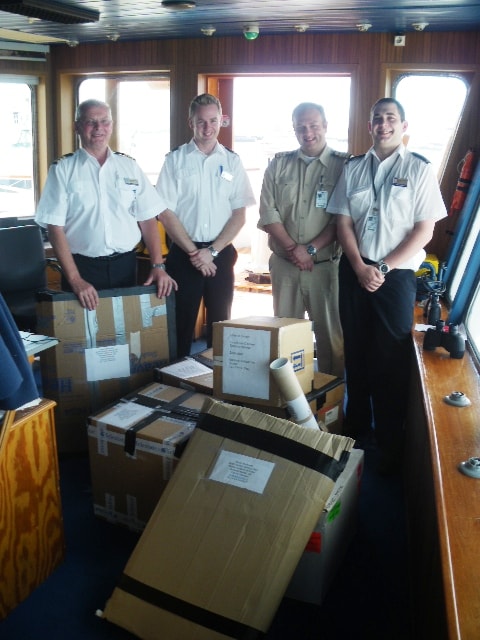
Recycle team, from left: S.E.H. Officer Willem van Woerkom, for environmental and compliance; 2nd Officer Navigation Simon Allcock; 1st Officer Joris Poriau, a graduate from the Maritime Academy Michiel de Ruyter of Vlissingen, and 4th Officer Adam Gardner, assistant navigation officer.
Today we really started our voyage heading north; by following the East coast of England. We are not going that fast as explained yesterday, and with very calm weather in the North Sea it was perfect cruising. Not much sunshine but that was good, at least for me, as it keeps that hazy stuff away. We had good visibility and thus the oil and gas platforms were clearly visible as our route went straight through the area. The platforms are grouped in clusters and you have to stay away from those but there are open shipping lanes in between for ships to criss cross the North Sea. I assume that the oil company’s would like to put a few platforms there was well but the chance of collisions would become too great, as commercial traffic also needs to use the sea. When ships do come too close to platforms, there is normally a Guard ship on duty that comes racing out to tell the perpetrator to change course. That sometimes results in loud arguments over the VHF, as not all ships agree with that policy. Continue reading
Captain Albert
© 2026 – Captain Albert's Website and Blog –
Theme by Anders Noren — Up ↑