Another peaceful day at sea, while we cover the 700 miles between Puerto Vallarta and Huatalco de Santa Cruz. For most of the day we can see land on the portside as we are sailing roughly between 10 and 14 miles from shore. The only thing is that the weather has been so nice in the last few days without any wind, and that creates very hazy skies and thus the shore line is not very clear. Only the outline of the inland mountain ranges shows up in a sort of darkish blue. We passed Acapulco around 1900 hrs. today and even its lights were only just visible. Still we cannot complain and if we can keep this weather for a while longer than I will take the haziness in my stride. Because it was so wind still, it was fairly windy on deck. Now the real wind did not blow, everybody could feel the wind created by the ship. As we were travelling with a speed of 17 knots, it meant that we had a wind force 5 blowing over the decks and that keep the outside temperatures quite pleasant. Noon temperatures rose to 29oC or 84oF and that is nice and cool compared to tomorrow when we are docked in the sheltered bay of Huatalco when it all will go up to the low 90’s. Continue reading
Page 151 of 241
During the past weekend, most of North America went to winter time and so did parts of Mexico. That included the province in which Puerto Vallarta is located. As a result we arrived this time in daylight at the pilot station instead of in the dark as was the case during our previous call four weeks ago. In a way that is a bit peculiar because you expect when you coming closer to winter that the sun will rise later and not earlier. The hour back changed that of course and as a result the sun rose earlier, according to ships time, than the call before. The pilot boat was waiting for us at the sea buoy and without further ado we sailed into port. Although drifting in, is a better word. The distance from the pilot station to the dock is less than a mile and that means while you are just entering the fairway into the basin you have to start taking the speed out already. Especially with dock nbr2. which is in the corner of the port. If you overshoot here, you end up against the concrete wall on the north side and that is a thing you want to avoid at all times. Continue reading
Today we had our 2nd day at sea and that meant that we saw the outside temperatures slowly climbing. As can be seen on the chartlets posted yesterday, the California Current is moving away here from the coast and replaced with warmer water flowing along the Mexican coast. That has an immediate effect on the temperatures. From noon yesterday to noon today the outside temperature jumped by 10 degrees from 72o Fahrenheit to up to 84oF. It will continue to rise to about 88o F. when we are docked in Puerto Vallarta tomorrow. In combination with little wind on deck, it made today for a very nice and warm day. I am not expecting much change in the coming days, so those who think that it is too hot, are better off taking a cruise around New England, as I believe the first snow has just fallen in North Hampshire. Continue reading
The frontal system that made it such a wobbly day in Cabo San Lucas was still sustaining a wind from the North West and that gave us a little push in the back. Much appreciated as on this stretch of our cruise we have the current against us, lopping nearly a knot of our regular cruising speed. It also caused for a nearly wind still situation on the deck, as the Statendam was sailing along with nearly the same speed as the wind velocity causing a relative wind of nearly zero. Always a pleasant way to start the cruise. On top of that the dolphins were out in great numbers so for those guests who were not engrossed in the daily activities on board, there was something to look at outside as well. Apart from dolphins and birds there is not that much wildlife yet. Most of the whales are only now starting their migration south and we only see occasionally a spout here or there. By the middle of December most of the resident whales should have returned to the Cabo Area and then we most likely have a whale in sight all the time. Continue reading
With completely wind still weather we arrived at the pilot station, while the first signs of dawn could be seen in the East over the city. The pilot was waiting for us and with no other traffic around we sailed into the bay. Arriving at 0530 at the pilot station is a very good time as there is then seldom any Navy traffic around. The entrance channel is not that wide so if you can avoid traffic while going in , it makes life a lot easier. To sail into the bay, you are guided by a set of very strong green leading lights. They very accurately indicate if you are in the centre of the fairway our away from it. There is often a strong current running caused by ebb or flood, so the leading lights help you to recognize the drift. By 06.55 we were docked with the gangway out and officials stepping on board, for a scheduled arrival time of 0700. hrs. More perfectly I could not do it. Continue reading
The weather forecast was, for once, right and in the early morning the wind abated from a wind force 7 to a wind force 4. That meant that the swells are not building up as high as I feared that they might do, and thus we will be able to maintain our required speed. Apart from unforeseen circumstances, we will be on time in San Diego tomorrow. There was some swell out there and on occasion we saw the ship pitching about two to 3 feet but as that is not enough to make the ship’s bow slam on the waves, the influence on the shipboard operation was negliable. So we happily sailed along; along the coast of the Californian peninsula for the whole day. Sometimes with a view but in the afternoon further away from the coast as we are sailing on a straight line and the coast was curving away at times. During the night, we were overtaken by the Celebrity Infinity who can maintain a higher speed and she came blasting by with over 22 knots. I am quite happy that I do not have to pay their fuel bill. The Infinity is arriving about 1.5 hrs. ahead of us at the cruise terminal as she needs all the extra time to disembark double the amount of luggage as we have. Although on a shorter cruise, so in principle less luggage but with 2500+ people on board the total is still much more than we have. On departure they have the same issue with more loading and although they always try to get out at 1600 hrs., they normally never make it and still leave after us, while our departure time is 1700 hrs. and we normally can adhere to it.
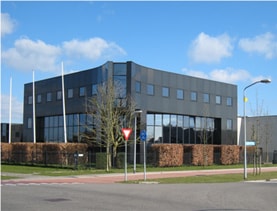 Today we had something else of interest on the bridge. Our Carnival Corporation Head Office operates a bridge simulator in Almere in the Netherlands. It was first pioneered by Princess Cruises but is now used by all the Carnival Brands on rotation. That makes sense of course; such a simulator is very expensive to build and to maintain and becomes much more efficient if it is being used by over a 100 teams of deck officers than just by one company. By next year they should also have an engine simulator up and running and then we can do training together with the engineers. That will be of great benefit because at the moment we cannot really train for black outs and other technical mayhem, but once their simulator is up and running we can do so.
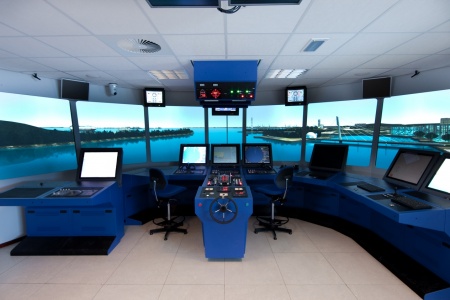 The S-class model, to which the Statendam belongs, is an ideal ship size to maneuver with, as it has all the gadgets you can think of, including the Becker rudders. These are great to use, but at the same time very powerful so you also have to learn how to optimize them. That S-class computer model has now been in use for awhile as the simulator was opened about two years ago. Now working with it, the operators are finding out that the Ship model is not prefect. A captain knows exactly how his ship reacts and if it does not feel the same while in the simulator then he will voice his displeasure very loudly. (We are very good at that…………..) In the end the technicians get back to you of course with requests to do more measurements so that the model can be refined.
And that was what was happened today. We received a request from our Director Nautical operations if for the coming month we could measure the turning of the ship with the thrusters, without the thrusters, on the rudders, check the stopping time, speed while going astern, etc etc. That will take us the better part of the month to do so. So for the coming ports, I will have an officer with a clipboard standing behind me, writing down it each setting that I make and then also noting down the result of that setting.
I do not like clipboard huggers very much but if it is all for a good cause than we will go for it. It will be interesting for the pilots to see this going on……………….
In the mean time it was a nice and sunny day. Now we were around the corner of the south point of Bahia de California which we call the cold cape for good reason; the temperature has dropped about 20 degrees from the mid to high 80’s to the low seventies. Tomorrow on arrival San Diego it should be in the high fifties but by 10 am. back up to the mid to high seventies. Also we are expecting no wind on arrival and that is always a nice way to start the day.
For those of you who would like to know more about the simulator, here is the link: http://www.csmartalmere.com/TourCsmart.aspx
As it was a crystal clear night, we could see the bay of San Lucan already from far away. Ahead of us was the Celebrity Infinity which was going slower so we started to overtake her. The Statendam was assigned anchorage number three, which is the most outlying one and a real bad one if it is a windy day as this wind is pushing the ocean swell into the bay. Also it is a very long tender ride into the harbor. I could not really understand the decision of the harbor master to assign the ship that was staying the shortest period in the port to the most outside anchorage, thus giving those guests the least amount of time to spend ashore but that was what it was, so be it. I had however arranged with the agent that I could stay on the engines on arrival, right on top of the harbor entrance and thus reduce the tender distance considerably. That would at least mean that we could get the guests ashore in a very rapid way. There is not much space to float around there as it is in the proximity of anchorage one, but on a wind still day the ship does not drift, so by gently maneuvering it is safe to do. So I did. The authorities came on board timely and by 0715 we had our show on the road as they call it. Continue reading
Today we left the Mexican coast behind and started crossing the Gulf of California. This is the body of water that forms the entrance to the Sea of Cortez located between the Californian Peninsula and the Mexican mainland. At noon time we had the Bahia de Banderas (entrance bay to Puerto Vallarta) on our starboard side and from then onwards we will not see any land anymore until we make our land fall at Cabo San Lucas around 0600 tomorrow morning. The weather continues to be the same, partly cloudy skies and hardly any wind. For tomorrow the weather forecast has changed a little bit, predicting a bit more wind from the NW, which will be good as it will keep the ship nicely behind the anchor and away from the beach. On our starboard side, although it is too far away to see, is an island group called the Tres Maria’s. They belong to Mexico and are far enough from the shore to be called remote. As a result the Mexican government has established a penal colony on the largest island and has issued a notice to shipping, advising all ships to stay away. Now it is never a good idea to get close to prisons in the first place but with a warning like that in the chart there is good reason to stay even further way. So definitely no sightseeing there. Continue reading
Today we had our first of two sea days which, based on the current weather forecast, should be two very nice days. Apart from the seasonal hurricanes this area of the Pacific Ocean can be very “pacified”. It is located right in between the area’s where the major weather systems are blowing and there are no cold and hot water currents meeting that could make things more interesting. When the sailors of old were talking about the various regions of the oceans, they would give the area’s generic names, based on the latitudes and the winds. Thus they spoke of the “roaring” forties and the “screaming” fifties. For the area’s where there was less or no wind, there was also a specific description. They called it the “Doldrums” and the sailing masters of the past hated it. A ship could be becalmed for weeks on end, if the wind failed to pick up. With the modest supplies and provisions that the ships had on board in those days and the lack of general comfort it must not have been a pleasant situation to be in. Knowledge of how to avoid the areas was much sought after and of great interest to any maritime nation. Continue reading
The Tehuantepec wind was indeed blowing but we were prepared. We had all the ballast tanks on the starboard side ready and when we entered the windy area, we could pump sufficient water into those tanks to keep the ship completely upright. It is part of the human psyche that people only realize that there is something going on, if their normal living environment changes. It is the same on the ship. It can be wind force 10 blowing outside (severe storm) but if the ship does not list or rock, guests on board will not realize that there is a grave storm out there. However as soon as the ship moves, even if there is no wind at all but only swell from somewhere else, then people start talking about bad weather. So number one item on our checklist is, keep the ship upright. Number two; keep everybody inside for this windy period to avoid accidents. Thus in the early morning, when we went through the area, all was prepared for. The wind breezed up to a max. of 45 knots but as there is no swell to go with it; nobody was bothered by it in the slightest. The most amazing thing is always when you come to the edge of this funnel wind. Then within 30 minutes the wind goes down from 40 knots to complete zero and then returns to what is normal for the area. We have this wind normally each time we come through the area during this time of the year and it never fails to amaze me that this wind picks up and dies down as if somebody up there turns over a switch. Continue reading
Captain Albert
© 2026 – Captain Albert's Website and Blog –
Theme by Anders Noren — Up ↑