The wind did not veer as fast to the East as the weather forecast indicated and thus we had the wind blowing on our sb side instead of from behind. That also meant that the swells kept being sustained by this wind and did not abate as fast as I hoped for. That meant that I continued to lose .4 of a knot each hour and that is going to set my arrival time back by about 45 minutes. Nothing to really worry about as we have an overnight stay in Honolulu, so there will be ample time to see the sights and to eat pineapple. Up North it still does not look very look and the people on Vancouver Island have a few windy days coming at them. In the centre of the gale the waves are about 25 to 30 feet high giving room for another series of the “deadliest catch” if needed. We are in a way still lucky as we are only skirting the southern edge of the wave field with 10 to 12 feet high waves. Together with the waves created by the current wind, the total height is about 15 feet and that is just enough for the ship to move about a bit. Still I did not get any reports about guests being sea sick, so all must be well in the world. Continue reading
Category: CaptAlExport (page 92 of 203)
The bad weather up north intensified and created winds of up to 75 knots under the Aleutians and that meant that the “ripple effect” came further down than was hoped for. So we caught the tail of that whole weather system. It started in the morning with 25 knots of wind from the South West and thus blowing against us. We are still on our straight course of 254o heading directly for the big Oahu and that meant we had the wind fine on our port bow. Then by lunch we had the tail of the frontal passage coming over which brought some strong showers. It made my Staff Captain very happy, as it washed all the salt away, but he was about the only one who could smile about it. During the passage it breezed up to gale force winds of 35 knots, but it did not last long. By 2 pm. we had left the rain behind us and the wind started to veer to starboard.
Continue reading
We are now entering our 2nd full day at sea and thus far the weather has been very cooperative. It remains overcast courtesy of the bad weather up in Alaska, but the cloud cover also indicates that there is little wind; otherwise it would break the cloud cover open. And little wind is exactly what I like as it keeps the waves down. Late on the 27th I expect the wave height to go up from 1.5 meters to about 2.7 meters and that will reduce the speed a little bit, so along there is no wind, those waves will not be sustained and I can build up some plus, to ensure a constant average speed to Honolulu. The guests who are hoping for a sunny day were disappointed but on the other hand a nice a smooth run is also something to be appreciative about. Normally there is a long Pacific Ocean swell running here, which makes the bow rise and fall with the waves but the 3 day bad weather cycle up north is upsetting that pattern a little bit and that results in confused seas, which dampen out the regular wave pattern, much to our advantage. Continue reading
Note: you will see on the left that there are two entries on the same calender date and also one day with an entry missing. Due to satellite location, (right behind our funnel) we have been out of connection with the whole world for a day (nice and quiet to a certain extent) until we could patch in to the next satelite. We should now be back in business for the rest of the voyage.
So we started our long awaited 28 day cruise to Hawaii and the South Sea Islands. The crew was buzzing as it is always nice to have a change of scenery and that buzzing was enhanced by the excitement of a 100 new crew who joined us yesterday. They have a few busy days ahead of them, as apart from having to do their regular jobs; they also have to go through a myriad of trainings and indoctrinations to get back up to speed with the ever changing world of Holland America. When they come on board, the first thing that happens is that they have to attend a short safety briefing, followed by a boat & raft drill. Only then are they allowed to go to work. Then the next morning, today, there is an extended HESS (Health, Environmental, Safety and Security) indoctrination briefing which takes a good two hours. This meeting starts with the Captain and the ships staff introducing themselves so all the new crew knows “who is driving the boat”. Then that is followed by training and indoctrination in the various elements of HESS. Continue reading
During the night the ships motion got less and less and as a result I was able to make it timely to the pilot station. When I arrived on the bridge at 04.30 I was confronted with an unusual sight. Haze; reducing visibility to about 5 miles…………and getting less. The combination of warm days before and the cold and very windy weather up north, which created that wave field of yesterday, caused a nice mixture of Cold air and Warmer water. Ideal to create some condensation which we, as sailors, recognize as very low hanging clouds; obscuring the visibility. It made for a nice view though, the lights of the city glaring through the haze making it look as if the whole bay was on fire. By the time we arrived at the pilot station even that glare had gone and visibility was reduced to about a mile. So, time to honk the horn and to let the whole world know that the Statendam was arriving in San Diego. I do not know if the people living on the hill side of Point Loma appreciated it, as the sound really bounced back from there, but at least every boat operator was warned about our impending arrival. Continue reading
Today we spent the last of our day of the cruise at sea and it was a wobbly day. It has been horrible weather in the Gulf of Alaska and under Vancouver Island and the wave fields generated by this weather are rolling down the American coast as far down as Cabo San Lucas. The weather chart indicated that below San Diego the wave field would slightly curve away from the coast, making the waters through which we were to travel relatively smooth. However it did not work out that way, the wave field came and remained close to the coast and thus we had to bump our way through it. That means that I am in a sort catch 22. If I slow down then the ship has a smoother ride, but the pitching will still be there and slow us down below the average speed required, and if I keep the speed up it will result in a more uncomfortable ride but I will be on time in San Diego. Being on time in San Diego was the argument that won the day and I kept the speed up. If I come in too late guests might miss their flights and it will set back my departure time for the next cruise. So the ship pitched up and down against waves of 14 to 16 feet high with occasionally a higher or deeper one in between which would then cause the bow to slam into the waves and send a shiver through the ship. We kept that for the whole day although in the early evening it started to abate a little bit and thus final cocktail hours were not affected and suitcase packing could still be done in relative comfort. Continue reading
The weather forecast was calling for nearly wind still weather and smooth seas with a low swell from the West, which meant that there would be optimum tender conditions in the bay today. And that is what I needed as I was assigned to the 2nd best anchorage location. There are three official locations and a fourth one if needed but that last one is so far away that a captain either stays on the engines, closer to town, or decides to cancel altogether if assigned to that one. It is simply too far from the town necessitating a too long a tender distance. Even anchorage nbr. 3, is over a mile from the port but as it was assigned to the Sapphire Princess I did not have to worry about that. Nbr. one anchorage was taken up by the Carnival Splendor which does a two day call here, with an overnight stay at sea and thus gets the preference. We were on number 2 and by putting the anchor in the right position the Statendam was just inside the lee of the Cape itself protecting us from the open ocean. Continue reading
As the docking procedure in Puerto Vallarta takes such a short time, we normally arrive at the pilot station 1 hour before our official brochure time. Thus we were there waiting for the pilot at 07.00 hrs the good thing was, he was also waiting for us and that kept any delay to a minimum. At 07.01 he hopped on board and by 07.10 we entered the port, spun around in the harbor and came portside alongside berth nbr 2. Today portside docking was required as our 3rd officer lifesaving wanted to test his tender platforms for tomorrow when we are in Cabo San Lucas. As that is a short stop, we need both forward platforms in operation to run with four ships tenders and 2 shore tenders, to make it as smooth a service as possible. How smooth that will be depends on the amount of swell running into the bay. You never can tell what that will be, as the swell can curve around the Cape and enter the bay, even when outside it is coming from a totally different direction. So we need both sides of the ship to be in operation to have a lee side available for in case there is a swell. Hence the need to dock portside to check the platform out. Continue reading
After so much wind before, today came as a sort of anti climax. For most of the day we observed wind force 1. As a result the whole area was hazy from sunrise until sunset. We were sailing 12 miles from the shore, but we could not see anything. On a clear day, you can see from this distance the apartment buildings in Acapulco and Zihuatenego with the naked eye, but not today. This was nicely compensated by the fact that we now could see things in and on the water. What can normally be obscured by the rolling waves of the white crests and foam on the top of the waves, now had no place to hide. It made it possible that every guest who was willing to lean over the railing for half hour able to see turtles. Nice big (approx. 21.5 to 2 feet across) sea turtles. Happily paddling along with not a care in the world. The ship is no danger to them, as they float by and are pushed off by the pressure around the hull. We were sailing with about 18 knots of speed and thus anything that even came in the direction of the ship was bounced off by the water that was being displaced by the hull, courtesy of the bow pushing the sea apart. Continue reading
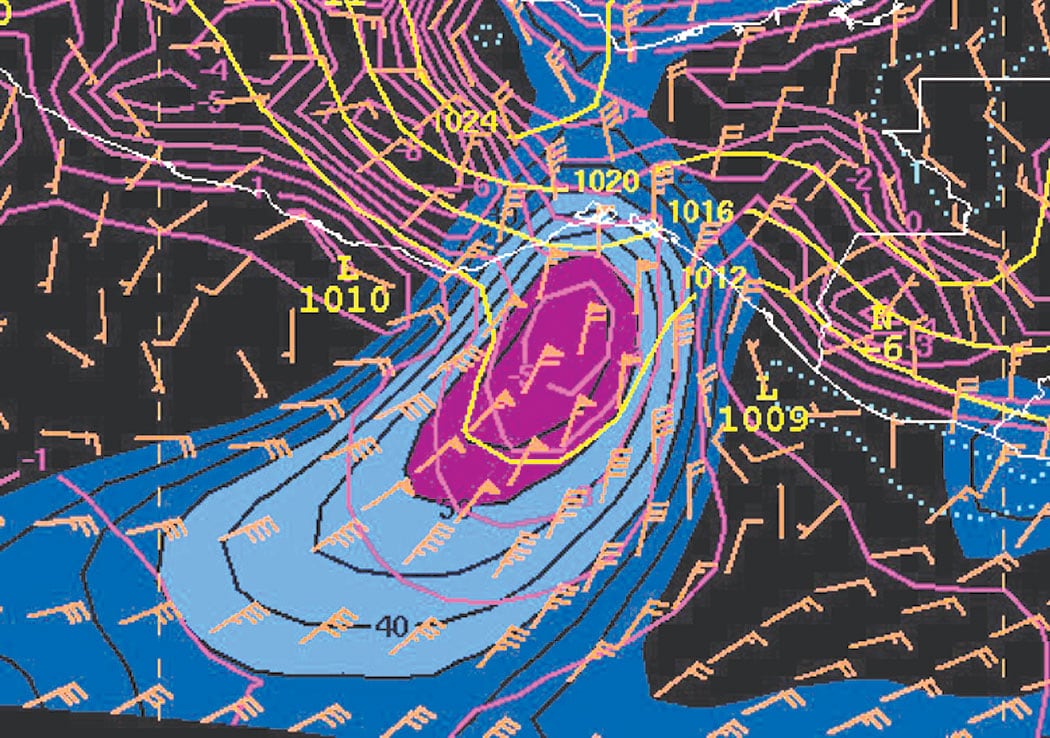
At 02.30 I was called by the bridge and informed that the wind velocity was slowly increasing. A sign that the Tehantepec “party” was about to start. The wind was hovering between 35 and 40 knots, right at the edge of the outflow boundary where we expected it to start. Then 45 minutes later it came down again to 30 knots and we all thought that the Tehantepec wind might be diminishing due to a change of wind direction in the Caribbean. Thus I returned to bed, only to be called again an hour later with the message that it had really started to blow. By the time I had came on the bridge it was blowing 50 knots and it just kept climbing. At 06.00 the anemo meter measured 59.5 knots of sustained wind (e.g. not just a wind gust); we kept that wind until 09.00 hrs when it slowly reduced again to zero by 10.00. It turned out that during the night, the axis of the Tehantepec wind had moved to the West and thus we had entered the centre of the outflow area later. As we were well prepared, there were no accidents, nor incidents or other negative outfalls from it. Housekeeping did not report any problems in the Starboard Balcony cabins either, so all the guests must have heeded my advice and kept their balcony doors closed. 55 knots blowing into your cabin can be a very interesting experience but you are better without it.
Continue reading
Captain Albert
© 2026 – Captain Albert's Website and Blog –
Theme by Anders Noren — Up ↑