After we disembarked the pilot at 03.30 in the morning, we were out of the Oslo fjord entrance by 4 am. Then we started crossing the Skagerrak which is the body of water between the top of Denmark and the lower end of Norway. I had plotted a course straight through the middle so that we would avoid all the traffic going towards Scandinavia and also the traffic rounding the top of Denmark going into the Kattegat and the Oresund. Only later we came close to the western shore of Denmark but then we were past most of the traffic. I never believe to look for traffic hotspots if you can avoid them. Today we did not have much traffic of concern, apart from one Chinese car carrier who progressed through the sea with erratic speed bursts. Must have been doing engine tests or something. It got my Officer in the 8 – 12 watch highly excited as it changed his CPA (closed point of approach) on the radar plot from 2.5 miles to 0.5 miles every so often. Continue reading
Category: CaptAlExport (page 155 of 203)
For the guests the cruise schedule for the day in Oslo was prefect. A mid morning arrival and a midnight departure. Thus no need to get up very early in the morning to see the Oslo fjord and also having the chance to see the same fjord by night. (Well, by dusk, as it never got really dark) Thus I approached the pilot station at the beginning of the Oslofjord at 0600 hrs. and then sailed with the sedate speed of 16 knots up the fjord towards Oslo. The first part are wide open waters and not that impressive and navigationally not that challenging. However the pilot was concerned about the ferries crossing the Fjord from East to West and vice versa and did not want to race through. Fine by me as long as I was docked on time, at 10 am. all would be well with the world. Continue reading
Copenhagen can be approached in two ways. From the North through The Sound (Oresund) and from the South through Drogden channel. However Drogden channel has a limitation of maximum 8 meters draft. Ships with more draft that want to go to Copenhagen or other ports in The Sound, have to sail through the Great Belt (Store Belt). First all the way up to the north point of Sjaelland, the island on which Copenhagen is located, cross the Kattegat and then down again into The Sound. When I sailed here with the old Noordam in 2001, the Drogden channel had a maximum allowed depth of 7.2 meters and we had to go every time around the island to get in and out of the Baltic. (The Noordam had a draft of 7.5 meters) That was not pleasant as it meant the whole night standby for me. Now with the increased depth of the channel, that issue is over for most ships and it saves a lot of time. Continue reading
On our arrival at Visby one thing stood out. The local Visby fog bank. About 3 miles long, 1 mile wide and located exactly where I was planning to drop my anchor. Not a single whiff of smoke was to be seen anywhere in the whole Baltic around us, except at the Visby anchorage. A really good way to start the day. However the sun was on my side and while I was lining up the Prinsendam, in the fog, for the pre selected anchor spot, the sunrays started to burn off the haze. By the time the hook was down we could see the breakwater and we had good visibility for the tenders. It would remain so for the rest of our stay. Continue reading
It was a beautiful day, it was a gorgeous day. I hope that the guests onboard realized how privileged they were with the weather today. Arriving in the morning and leaving in the afternoon has the advantage that the sun is always in the back and thus lighting up the landscape for the best viewing. Today everything that the Stockholm inside passage needed came together. Wind the day before, so the skies were clear and crisp. No wind today, so it was great on deck. No clouds, so the sun shone over the islands that make up the inside passage and a temperature that was not too warm to mar the day ashore. It was picture perfect. Continue reading
Whether is was by coincidence or by farsighted City elders, Tallinn is a really un-spoilt city that kept its original charm, old fashioned housing and lay out inside the city walls. New Tallinn, everything that was built after the 2nd world war, was built outside the gates and more to the East. Thus you can see high rises towering over the old city but not in it. Also the traffic to and from the harbor, which is located right in front of the old city, is nicely diverted around the city walls. Continue reading
I enjoy overnight stays as it gives me a chance to catch up with some sleep and to square away paper work and emails that somehow were left outstanding. When a cruise ship becomes a static hotel, it virtually runs by itself as there are no influences from sailing and variable time schedules involved. This was our port to fill up the ship for the next cruise and in the course of the day and evening we loaded 1400 tons of fuel. That will last us for the next 14 days and even longer if the average speeds are not that high. St. Petersburg fuel is about $ 50,— cheaper than some of the other ports, so all the ships that can, will fill up here. Continue reading
With the sun hardly setting, we approached the pilot station at 0400 hrs. more or less in the day light. Dusk and dawn faded into each other and real night never came. The pilot system in St. Petersburg is basically as it was in Holland for hundreds of years. A big mother ship for the pilot to stay on and a smaller boat for the transfer. It is not amazing that it is comparable to the Netherlands as it was probably copied from there a long time ago. In the 17th century Czar Peter the Great came to Holland to study shipbuilding as he wanted his Russia to have a large fleet that would dominate the Baltic. When he went back he took all the Dutch maritime knowledge with him. As a result the names for the sails and the rigging on the Russian training ships are basically the same as the Dutch ones. Also the pilot, in Dutch Loods is called Lootsenman, starboard is starrebord (after Dutch stuurboord) and portside is bakkebord (Dutch bakboord) and there are many more similarities. Continue reading
Helsinki has several cruise terminals spread over the city. Most of them are near the South harbour and used for the smaller ships. The larger ships are normally delegated to a terminal further out (West Harbour) where you need a shuttle service to get to town. So it pays off again to be a smaller ship as we were docking in the South Harbour together with the Regatta which is about the same size. The Norwegian Jewel and Seven Seas Voyager were at the West harbour. The rest of the South Harbour was taken up by ferries; at one moment four at the same time, that kept coming and going throughout the day. We arrived under glorious sunshine at cruise dock ERA and after the normal “discussions” with the linesmen about the location (this time there was at least 7 feet in the meter for positioning) we were parked happily for the day. Continue reading
It is a fair distance between Warnemunde and Helsinki as we basically have to sail almost the whole Baltic Sea from SW to NE to get there. Luckily we had sunny weather although it was a bit nippy due to the fact that there was an easterly wind blowing of a force 4 and the ship was generating a force 4 as well. Resulting in a combined wind of force 8 on the deck. However as it was the first real day at sea, most guests were occupied with enjoying what was happening in the inside of the ship. On the aft decks and the centre Lido area there was of course shelter enough to sit in the sun and out of the wind. Continue reading
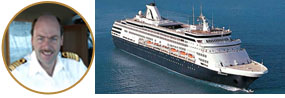
Captain Albert
© 2026 – Captain Albert's Website and Blog –
Theme by Anders Noren — Up ↑