- Captain Albert's Website and Blog -

Ocean Liner History and Stories from the Sea, Past and Present. With an In Depth focus on Holland America Line

Month: September 2015

30 Sept. 2015; Leixous, Portugal.

After coming around that corner guarded by our Roman built lighthouse, we followed the coast straight down to the Leixous pilot station.
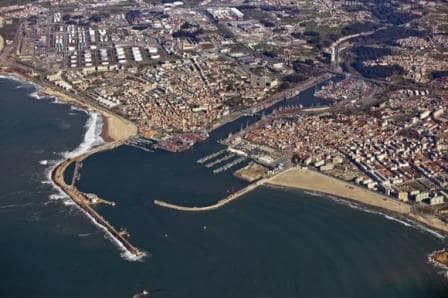
Leixous port without the new cruise pier.

Leixous port without the new cruise pier.

Leixous is an ancient port and although it now has a very modern cargo port, parts of the old breakwater are still in place.  That breakwater guards a larger inner basin with docks at either side but the real port is more land inwards. A port basically constructed by building docks on either side of the river which flows into the sea at Leixous. This river is called the Douro and further inland is the city of Porto or Oporto.  It creates sometimes the same confusion as we have in Florida. Is the ship docking in Fort Lauderdale or in Port Everglades? It is Port Everglades but as the larger city of Fort Lauderdale is next to it and has the airport, most people talk about taking a cruise from Fort Lauderdale. Here it is the same. Porto is the main attraction and the signs on the shore side even say Porto Cruise Terminal, but it is not correct, we are in Leixous.
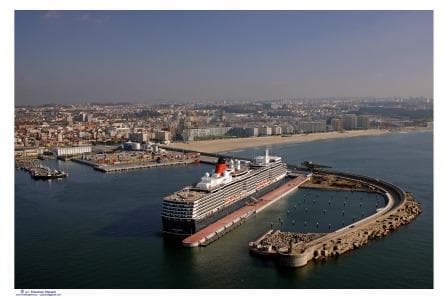
The new cruise pier with the Queen Victoria alongside. (Photo courtesy CruiseEurope.com)

The new cruise pier with the Queen Victoria alongside. (Photo courtesy CruiseEurope.com)

Fairly recently they built a cruise pier inside the south breakwater. Basically nothing but a straight pier sticking out from the shore which can handle 1000+ ft. cruise ships. This cruise pier was today occupied by one of the very big ships of P&O and thus we were relegated to a smaller berth up the river, where we just fitted in.  Because we docked on the river, there is no room to swing so the ship was turned on arrival and went astern upriver until it could go sideways to the berth. By the time we were docked there was not much room left between bow and stern, but we fitted in, and that is what counts. For the guests it was better, as here at least you could cross the street and be in local Leixous while at the cruise terminal there is nothing unless you take a very long walk.
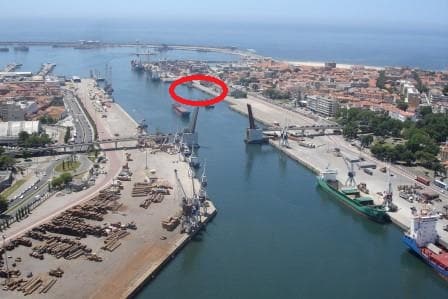
The ms Rotterdam docked exactly in the gap in the pier at the right hand side.

The ms Rotterdam docked exactly in the gap in the pier at the right hand side.

The challenge with the berth we docked at today is the tide. The sea pushes deep into the port and up the river and there is a tidal difference of about 12 feet maximum but today it was about 9 ft. (roughly 3 meters) and the water that brings that difference in height pushes straight along the ship, both when ebbing and flooding.  Thus when the ship enters the port and it has to swing around, it has all this tidal current moving around the ship and pushing in all sorts of directions. You need to adjust for that, while at the same time you go astern up a fairly narrow river with cargo ships at either side. The P&O captain was the lucky one today; ours had to work hard for it.

The current was also detrimental to me today, as I had the plan to lower a lifeboat into the water and to let the school class play. However with a strong tide running it is not really safe to come back under the blocks to be picked up again and thus I had to defer it to another day. We kept the boat on embarkation deck and explored the mysteries of the lifeboat inventory.  The trainees have studied this stuff at school but what they do not learn is how to train the crew of the lifeboat in these things and how to answer unusual questions.  As most of our hotel crew are not sailor’s per-se, you do get questions which a mariner does not expect as he/she is already trained.  A standard one is: where is the toilet…… ? Well there is no room for it as it is an emergency device but you have to be ready for these and other questions and that forms part of the training. (Another good one was from a lady working in the shops: do you have a power socket in the boat, so I can charge my cell phone ?……………)

Most guests went 10 miles upriver/ inland to see Porto which has a lot of history and a complete historic area (the Ribeiro) which is listed on the UNESCO world list.

With everybody on board we sailed at 5 pm. and now we are heading for Lisbon. Again straight down the coast following another Vessel Traffic Separation System which consists of an outer and an inner part. Because we are sailing from one Portuguese port to another, we are allowed to take in the inside / coastal route. Had we been coming from a foreign port, then we would have been forced to take the longer route. Why? Basically because the Portuguese only like vessels that have been cleared already by them in their territorial waters.

Weather for tomorrow, about the same as today. Partly Cloudy but clearing to blue skies in the afternoon. Temperatures should reach the low 70’s oF. or mid 20’s oC.
29 Sept. 2015; A Coruna, Spain.

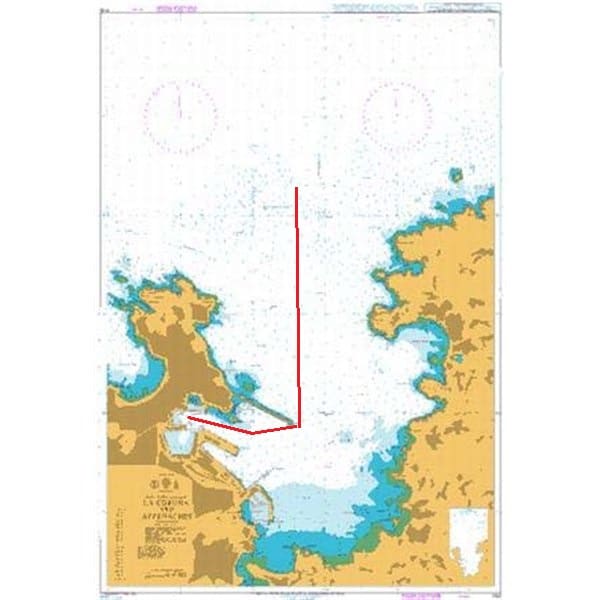
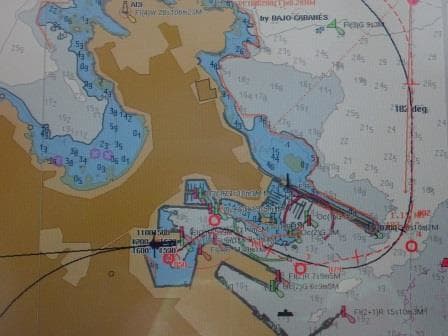
As predicted we had very nice weather today. So sailing in was over a nice and smooth sea with no nasty waves to make the ship go up and down like a jojo.  As shown yesterday in the chart sailing into La Coruna is quite simple as it mainly consists out of one 90o turn from a nearly southerly course to a nearly westerly course.

Docking in the inner basin of the harbour

Docking in the inner basin of the harbour.

The only item that made it a little bit more complicated was that the regular cruise berth was occupied by the Oriana of P&O and the Rotterdam was assigned the North dock in the old basin. That it was the old basin was easy to see as the Southside of this basin is where the fishing fleet docks.  Their warehouses look from a distance like a row of garages all with the same blue color. Today there was only one lonely fisherman at the dock so the rest of the fleet must have been at sea.

Thus our dock was a cargo dock but it did not matter that much as it was nice and clean and spacious enough to park all the tour busses just outside the gangway. A shuttle bus moved all the guests between the gangway and the Main Gate and that solved the location issue as well. The port is trying very hard to be a good cruise port but they are very reliant on the summer months due to the nastiness of the winter weather in the Bay of Biscay and the building up of these high swells outside the harbor entrance. (There are some spectacular clips on You Tube.)

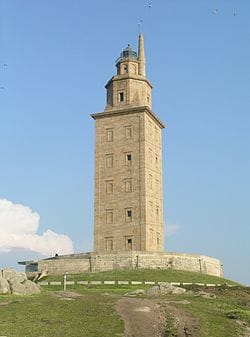
the Torre de Hercules. It is not exactly clear what Hercules had to do with this tower, but it is a nice name. (Photo courtesy Wikipedia)

The “Torre de Hercules”. It is not exactly clear what Hercules had to do with this tower but it is a nice name. (Photo courtesy Wikipedia)

Why do people go to La Coruna? A lot of guests want to go to Santiago de Compostela to see the Cathedral and the Pilgrims coming in and going out. If one stays in town, then there is the largest Shopping Centre in Spain to visit (which I suppose is on everybody’s bucket list) but the city also has some fine Museums and the seafood is not bad either. From a nautical point of view the most interesting item is the Torre de Hercules, the local lighthouse which was built by the Romans in the 2nd Century and which still stands.  It was built in the 2nd century so it is now 1900 years old and as it is still in use, it is the world oldest still operating lighthouse. Experts think that this lighthouse was built on top of an even older Phoenician one and thus this area had a lighthouse for a long long time. Understandable as the coast is very treacherous with strong currents and the bad weather winds all blowing in the direction of the land and rocks.

Just after 5 pm. we sailed and once outside, we sailed through the area which is guarded by this lighthouse. A wind force 6 to 7 from the north east greeted us and which kept the waves down but also those very low hanging clouds away that sailors do not like. Here we have warm air going over cold water and that creates fog on a regular basis. Cape Finisterre is not too far away and as was called Finis….. as the Romans thought that this point was the end of the world. Beyond it nothing but fog and bad weather. In the winter time you could believe it.

We will not have that problem tonight when we sail down the Portuguese coast on our way to Leixous. Although a Leixous is a town in its own right, a lot of people talk about Oporto or Porto as that is the major city nearby and a lot more famous.

We are scheduled to dock in the inner port which is nice for the guests as you can walk into town, just by crossing the street. It is not so nice for the Captain as it is a much more complicated maneuver to get to the dock compared to the cruise pier which is located right behind the breakwater. More about that tomorrow.

The weather should be good, partly cloudy skies with temperatures around 20oC or 66OF.

28 Sept. 2015; Bay of Biscay.

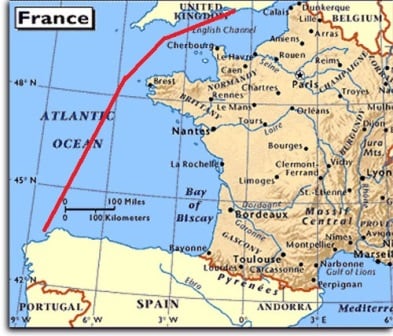
I said yesterday that it was more or less a straight line to our next port of call at La Coruna. For that one you have to put the emphasis very much on the less. A straight line would have been possible if the western part of France, consisting out of the Normandy and Bretagne, would not have been in the way.  But because it there, is the ship has to make a major course change once west of France and then it can sail on a straight line down to the North Coast of Spain.

Our route to Spain.

Our route to Spain.

This run between Southampton and La Coruna is for the Navigators very interesting as it goes partly through one of the densest Traffic Areas of the world. Once out of Southampton and clear the Isle of Wight, the ship joins the Vessel Traffic Separation Scheme VTSS)  for a while, following the South Westerly flow of ships coming from the Dover Channel. Then it has to cross this flow and join a new VTSS for a while, the one that curves around the west point of France. Also here a VTSS has been created to guide the flows of traffic coming and going from Portugal, Spain and the deeper Mediterranean?

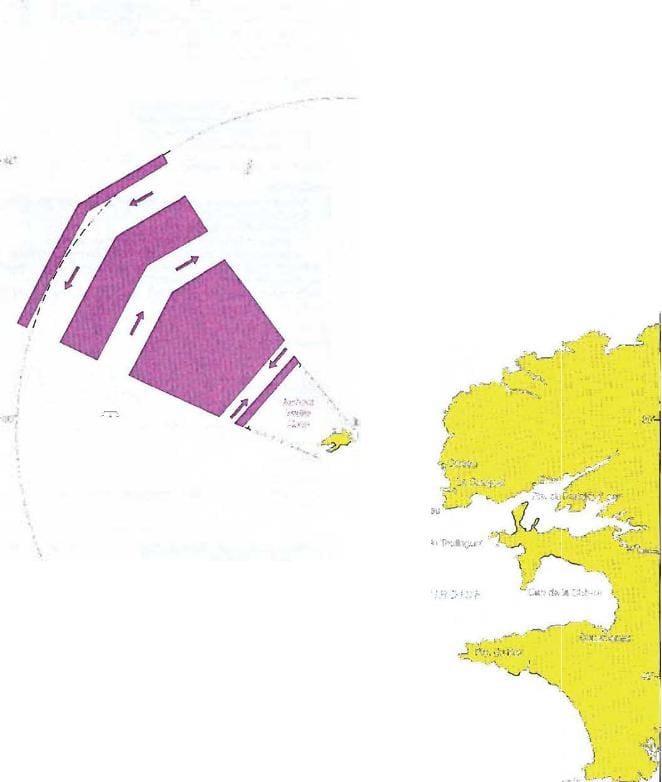
A Vessel Traffic Separation System keeps North going ships apart from south going ships and reduces dangerous situations and collisions.

The VTSS off NW France. A Vessel Traffic Separation System keeps North going ships apart from south going ships and reduces dangerous situations and collisions. There is an outer zone/lane system for transiting ships and an inner zone/lane system that can be used by Coastal  traffic.

This West point we passed at 11 am. this morning and then we arrived on our final straight course down to La Coruna across the Bay of Biscay. On this course we are not deep inside the Bay of Biscay but stay more to the North Atlantic Ocean side. So we will observe more of the regular weather for the North Atlantic than anything else.  That weather is today in our favor. The wind comes from the land side, so it blows against the waves and that keeps the ships movement down. Wind against wave’s means they cannot continue to build up as would be the case if wind and waves would go in the same direction. So the waves are relatively low and the wind force 6 from the continent side to keep them that way. As a result the ship only slightly moves and that is for sailing in the North Atlantic at this time of the year really good.

The water in this area is very deep, up to 2000 meters or so and that also helps with keeping the waves under control. Deeper into the Bay when coming closer to the land in the area of the French/Spanish border it becomes very shallow and then the waves can build up strongly and crash with a gigantic force onto the coast or onto a ship if it happens to be there during a severe storm.

Why do the storms get so particularly bad here?

First of all, most storms come from the west and they have a lot more open sea area to play with and to blow over than when crossing more to the North and hitting the British Isles. Secondly it sits in a near perfect area to have the maximum influence from the weather systems developing over the Azores and low pressure systems over Iceland. Then when a storm arrives it is slowed down to a certain extent by the landmass of France, so it has even more time to intensify.  Altogether it can turn the Bay of Biscay into a real cauldron of very nasty weather which has caused many ships to sink when a storm came in a bit un-expected. On shallow water the waves get higher and higher and that makes it even worse.  Reason for all sailors to be very respectful of this area and to stay in the North Atlantic if the ship does not have to go to any of the ports in the Bay of Biscay area.

We have to go to La Coruna which is fortunately located on the very western edge of the Bay of Biscay. Also with today’s wind opposing the sea, the waves remain a lot smaller than otherwise could have been the case.

The port lays deeply in a sheltered Bay and the Cruise Terminal almost in the City.

The port lays deeply in a sheltered Bay and the Cruise Terminal almost in the City.

We are supposed to be docked by 08.00 hrs. tomorrow morning and as La Coruna is located in a sort of Bay, which it has to sail through, the ship will make an early approach. Once inside it is a very nice and sheltered harbor, and the dock is located almost inside the city itself.

Weather for tomorrow, Partly Cloudy 75oF / 24oC with a gentle breeze from the North East, it should be a nice day tomorrow.

27 Sept. 2015; Southampton, England.

In order to facilitate a quick clearance of the ship, the ms Rotterdam arrived early at Southampton. The pilot came on board at 07.00 hrs. and then the ship followed the winding way up to the berth. There are a few almost 90o turns in the fairway with a lot of current running and that makes  sailing in and out of Southampton always an interesting affair.  Southampton is the major cruise port for the United Kingdom and that could be seen today as the Ventura from P&O and the Celebrity Eclipse were also in port.  They sail regular cruises from Southampton while for us it was just a stop on the way to give our 400 British guests the chance to board without having to fly.

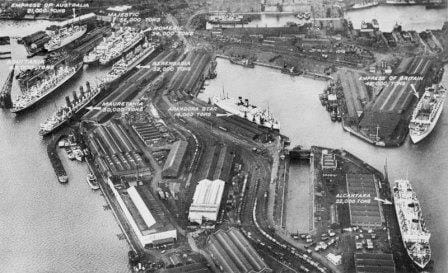
The heyday of Trans Atlantic Travel. The Southampton docks full of Passenger ships.

The heyday of Transatlantic Travel. The Southampton docks full of Passenger ships.

Southampton has been a port of call for Holland America Line ships since May 1923 when the company decided to change Plymouth for Southampton.  One of the reasons was the better train connection from this port.  By the mid-thirties of the 20th. Century it was THE port for the Big Transatlantic Liners to sail from.  Big names such as the Queen Mary, Queen Elizabeth, the Normandie and our own Nieuw Amsterdam called here after coming from and returning to their home ports, or in case of the Queens having their home port here.

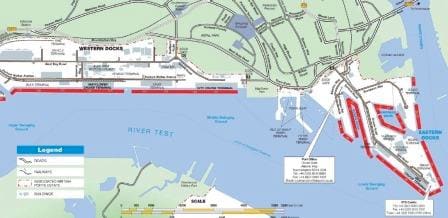
The layout of the docks now. Where the red lines go, Cruise ships can be found docking. (Map courtesy of ABP Ports of Southampton)

The layout of the docks now. Where the red lines go, Cruise ships can be found docking. (Map courtesy of ABP Ports of Southampton)

The arrival of the air plane changed all of this. Not only for the North Atlantic trade but also for all the other routes to and from outposts of the British Empire. Famous names such as Union Castle, P&O, British India, drastically reduced their Passenger Liner activities. Some made the change to cruising such as Cunard and P&O but some completely disappeared such as Union Castle and British India. Holland America stopped calling here when our Transatlantic service came to an end in 1971. It was not until we brought the ms Rotterdam to Europe that we eventually returned. Dover and Harwich were our regular change over ports but when the option came to call at Southampton as a secondary embarkation and disembarkation port for British Guests, we came back again.

We docked today at the Ocean Terminal. Quite often the ships of Cunard dock here, while  P&O and other cruise ships dock further into the port where there is a whole row of other cruise terminals. The Ocean Terminal was completely refurbished not too long ago and that must have given the guests a positive impression to start with today.

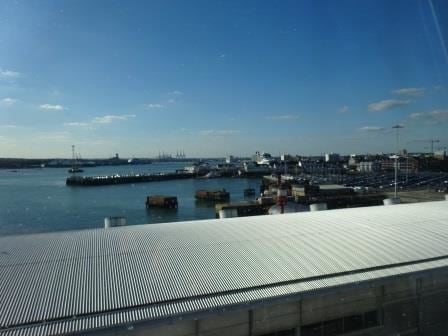
The cruise ships along the long dock further into the port. The tender Calshot can just be seen in the foreground.

The cruise ships along the long dock further into the port. The tender Calshot can just be seen in the foreground.

What was interesting for me was to see another (Ex) Holland America Ship docked next to us. The Ships Tender Calshot. Originally built to service the Ocean Liners which did not dock at Southampton but stopped for a quick service call and stayed at anchor between Southampton and the Isle of Wight. Being built in 1930 it remained sailing in Southampton waters until 1964. Then it was bought by Holland America for tender service at Galway in Ireland. She sailed for an Irish subsidiary but had the Holland America Line funnel colors and was called Galway Bay. With the continuing decline of the Transatlantic Trade, the tender service did not last very long and the Tender was sold on.  Eventually it returned to Southampton and is now step by step being restored to its former glory.

So our primary reason to be here was to embark our British Guests but as the Ocean Terminal is right on the door step of Southampton and the port, most guests took the opportunity to walk into town or take the short taxi ride.

I was on the gangway to get my trainee’s on board and after the compulsory Safety Indoctrination for all new embarking crew members, we started our classes. 20 days of digging deeply into the wonderful world of Holland America.

The good ship ms Rotterdam sailed at 17.00 hrs. after we got all the guests on board. We will now sail (almost) straight along the French coast down to Spain. The day after tomorrow we will visit La Coruna (as we Dutch spell it) or A Coruna as the Spanish call it. Weather still looks good with a bit of wind but not much swell to make life unpleasant.

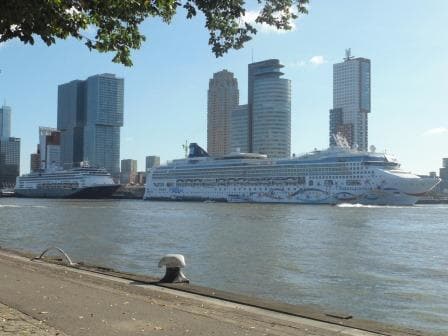
The sight I could not see as I was on board. ms Rotterdam and ms Norwegian Star both docked at the Rotterdam Cruise Terminal. (Photo courtesy B. Janssen)

The sight I could not see yesterday as I was on board ms Rotterdam and ms Norwegian Star both docked at the Rotterdam Cruise Terminal. (Photo courtesy B. Janssen)


26 September 2015; Rotterdam, The Netherlands.

As the crew has to be on board early to ensure a smooth handover with the crew who are going on vacation, it means getting up early.  Too early to take an early morning –same day- flight into Rotterdam.  Although I am not relieving anybody I go with the flow so I flew last night into Schiphol Amsterdam and spent the night in an airport hotel.  We left that hotel this morning at 07.00 with a coach full of crew for the one hour drive to Rotterdam.  Although things are cramped with the street lay-out (that has always been so since 1901) everything is very well organized and without much delay we could get to the ship.  As my school class is arriving tomorrow I had the day to go around to talk to everybody and figure out in general what the best approach is for this training period.  To give the students the best of everything hinges on finding synergies between the training schedule of the ship and what I can do, and what I am allowed to do, in the various ports.

In the meantime the ship was in change over mode and it was one of the less easy Rotterdam port days as there were two cruise ships in at the same time. At the main dock of the passenger terminal was the Norwegian Star which meant that the Rotterdam was at the dock further in. Nothing wrong with this dock but it makes it a bit more complicated with the gangway situation.  This meant some ingenuity had to be brought forth. Ship and port operations together had to come up with something that would work safely throughout the day.  An alternative set up was put in place and thus the passenger disembark and embark could take place without a glitch. Supplies and stores could go on; parts for repair and recyclables could go ashore.  Then there is always the larger number of visitors on board, not only from family, but also school visits as Holland America is continuously promoting careers at sea, for engine, deck and hotel.  If babies could read, then we would hand out free cots with the HAL logo on the baby pillows to get them focused as early as possible on a seafaring career.

By 4 pm. we left as the captain wants to be as early as possible in Southampton as the ship has to go through immigration there. The United Kingdom is not included in the Schengen protocol so they carry out a regular and full arrival and passport control policy. The ms Rotterdam is this cruise under the command of Captain Hans Mateboer who is the most senior HAL Captain. I have know him since 1983 so it was good to see him again.

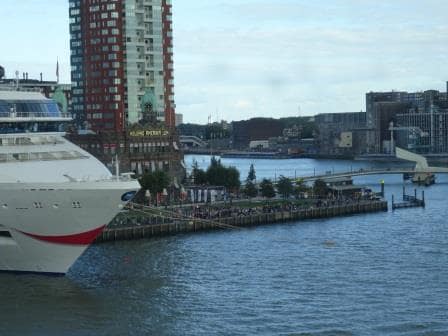
Our ancient Head Office with mainly well wishers trying to get a glimpse of the ms Rotterdam

Our ancient Head Office with many well wishers trying to get a glimpse of the ms Rotterdam coming from behind the Norwegian Star.

Sailing from the passenger terminal in Rotterdam is something quite special. First of all it has all the historic ties. Holland America has been docking here permanently since 1901 (Before that time the company used various locations around this area) and here at the Wilhelminakade was also our head office located until 1973. Then there was the move to the USA and only Human Resources (to deal with the Dutch crew) remained behind. That office then left Rotterdam but came back a number of years ago and has now a location in a sky scraper behind the old Head Office which is now a Hotel. With the company now also marketing in Europe, there is quite a large sales group in this office now as well.

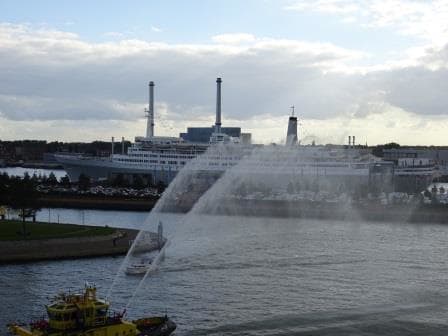
The ss Rotterdam V seen through the farewell salute of a Rotterdam Port Authority safety vessel.

The ss Rotterdam V seen through the farewell salute of a Rotterdam Port Authority safety vessel.

2ndly there is the old ss Rotterdam docked just around the corner. Once clear from the terminal she comes majestically into sight. Although now a museum, hotel and entertainment centre, she is still a ship and thus the ss Rotterdam V could exchange whistle salutes with the ms Rotterdam VI.  From then on it is almost 2 hours before the ship is completely in open sea and during that time the whistle will have sounded a few times more to greet local people gathering at various hot spots along the route.

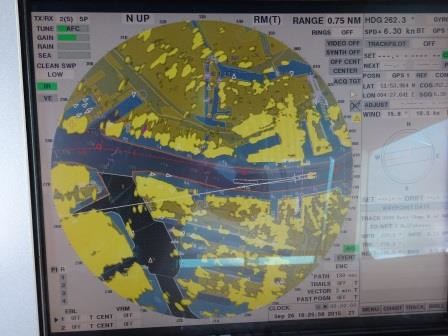
The Radar Screen clearly shows the winding river Maas, now called the Nieuwe Waterweg, through the City and Port of Rotterdam.

The Radar Screen clearly shows the winding river Maas, now called the Nieuwe Waterweg, through the City and Port of Rotterdam.

The Rotterdam is making a 14 day cruise to Barcelona. This 14 day cruise can also be seen as a segment and then the total cruise time can go up to 88 days if you connect the various cruises/segments. We have approx. 40 people on board who are going for that full length.

I am now getting myself ready for the school class, officially called the Nautical Excellence Class. We held the first one on this ship in December 2014 and as a larger number of the crew was there then and is here now again, it will make things go very smooth.  Tomorrow we will collect 400 British who will join the ship and then we head south towards the Mediterranean. The Gulf of Biscay is very quiet at the moment so we should have a smooth ride.


25 Sept. 2015; Schiphol Airport Hotel

Today my vacation came to an end and a busy one it has been with a lot of work done for the apartment building I live in, (as I mentioned before, I am an absolute expert on scaffolding now) two short cruises as a vacation (which I can not say anything about as they were with the competition) and a honey-do list a few yards long.

However all good things come to an end and real life starts again tomorrow.  I will be putting my teachers hat on as my coming ships visits will be part of our Nautical Excellence Class program for introducing our newly hired navigators to the wonderful world of Holland America.

If nothing changes…………… and it does most of the time……….. the plan is to sail with the ms Rotterdam between Sept. 26 and Oct. 26 then transfer to the Zuiderdam for the next class and then to the Westerdam for the 3rd and last class. However at the moment only the Rotterdam has been confirmed and all 7 trainee’s have been allocated a cabin.

Thus my blogging will start again tomorrow with a departure on the ms Rotterdam from Rotterdam. The ship then calls at Southampton where my trainee’s will board.

In the mean time  Public Relations has approved the addition of a new blog sub directory. I already had and am regularly working on the histories of the Captains of the Past, but now there is a new sub directory of Current Captains and their schedules. It is still empty but I will start adding items to it in the coming months. Always nice to know who is “driving the boat” before you board the ship.

To all my readers welcome back and hopefully you will enjoy my daily updates for the coming months.