We are now on our way to Al Aqabah which is a five day sea voyage up the Gulf of Aden and then into the Red Sea. Eventually I hope to report if the Red Sea is indeed red or if there is something different going on (Or was going on, when they came up with the name). But that will take a while as of lunch time today it was still 500 miles to the Bab El Mandab rock formation which forms the official entrance to the Red Sea coming from the south. We are sailing at a considerable distance away from the shore line, to stay in international waters but also to stay away from fishing boats and other mayhem which tends to congregate on the edge of the deep water to shallow water. That is where the fish tends to come to the surface and might swim straight into the nets. Continue reading
Category: Technical (page 9 of 12)
We are following the recommended deep sea route so we are quite far from the shore. This makes sense anyway as it keeps us clear all sorts of Sunday sailors and fishing boats who are normally hovering on the edge of the shallow and deep water line as that is where the fish tends to come up from the deep. We are in deep water, very deep water. In relative distance the depth of the sea increases quite rapidly from being shallow and below us we have about 4000 feet of water and that is not even the deepest part.
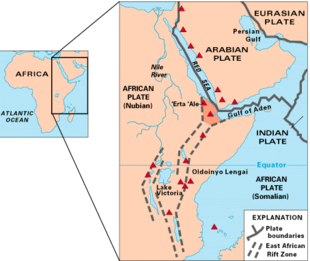
The tectonic plate movement in the area (Thank you wikipedia)
The cause is another continental divide. We are here at the eastern rim of the Arabian Tectonic Plate which is crushed against Europe by the African Plate. I have blogged about this before, explaining the Wegener theory (not a theory since a long time anymore) that the continents are a sort of parts of a large dinner plate (broken in to the continent pieces a long time ago) that mainly drift westwards but not always. Far down at the sea bottom the two plates meet and slowly but steadily the Somalian Plate pushes the African Plate to the North East. So the distance from South America is getting larger by a few centimeters every year. The Arabian plate has nowhere to go but follow and here the mountains are getting higher. (Wait a million years and you can see the difference) This is caused by the west moving Somalian plate which is pushing under the African plate and that gives these very deep canyons under water. And we are sailing right over the top at the moment. Continue reading
Well the amount of wind amounted was less than the weather guru’s had predicted and the good ship Volendam arrived without any hassle at 05.30 at the pilot station. Some ships have a dedicated pilot break but on cruise ships there are always several breaks (that is what we call the shell doors in the hull side that can be used as they are on the lowest deck). For the Volendam that is A deck as B deck is below the water line and Main deck is passenger accommodation. There we have the Tender break, the Water break, the Bunker break, the Marshalling area (2 doors), the Provision break, and another Water break. So plenty of choice but we normally use the Marshalling area, there were we load the suitcases and store the spare parts coming on board, as this break has the most space. And it is exactly amidships, so it has a flat hull and no bow wave playing around it. Continue reading
With the sedate speed of 15 knots are we sailing through the Caribbean Sea. The weather is following the weather forecast and that is appreciated by everybody. We expect that the Trade Wind will start to re-establish itself this evening and through out the night and with it the swell. But by tomorrow morning 05.30 we will be slipping inside the entrance of Boca Chica, the large inland water area where at the far North East the port of Cartagena is located. As explained in previous blogs, it takes about 90 minutes from pilot to gangway out and thus the captain is aiming to have the pilot on board at 05.30 hrs. The ships average speed has been set up for this as arriving earlier has not much use. If we put the pedal to the metal we could be there my midnight but what then. Continue reading
This current wind is our friend. It came from the north and was thus a following wind and then fell away (shielded by) when we entered the Windward Passage with Cuba to the West and Haiti on Hispaniola to the East. Then it turned to the north but only with a low velocity blowing against us. All due to that large frontal system that came through in the last few days and as a sort of Vacuum cleaner emptied the whole area out of wind. Well not emptied out, it balanced out the difference in High pressure and Low pressure here. Now the Trade Wind system has to re-establish itself and then we will be back to normal. The normal will be Easterly winds four 4 to 5 beaufort but here we still have this near wind still weather (which also means less whipped up waves) and that is something to enjoy and cherish while it lasts. Continue reading
Today we have our 2nd day at sea and we are sailing with a speed of 15 knots towards Half Moon Cay. We have outrun the bad weather and now we have just the regular Trade Winds blowing, although they are quite strong ones, reaching wind force six at times. Normally for a Trade Wind is a strong wind force 4 or a small 5. Still the sun is shining and that is what counts, the decks are open for the guests, much to the great relief of the Cruise Director. Because today was the “Walk for the Cause” and that is something you do not want to cancel. Thus far the company has raised over $ 6 million in funds for the Cancer Fund (and part of it goes to the Cancer funds in the home countries of our crew members) and a lot of good work can be done with that money. So by 11 am. we had about 40 quite excited guests getting ready to make the rounds on deck after having bought the T shirt. They had the additional benefit of seeing Cuba on the portside as we were just sailing into the Windward Passage. Continue reading
When I was on the Zuiderdam I blogged about the ships movement when going from Aruba to Cartagena and from Cartagena to Panama. The strong Trade Wind pushing in the back and the subsequent waves & swell caused a corkscrew motion of the ship. All with the stabilizers doing their best but limited in their success. On this run we are going the other way. So we do not have following seas which catch the square stern and lift it up; now the sea movement hits the pointy bow and lifts it up. The result in a similar movement but at the same time different. Continue reading
It does not happen very often but we made it all the way through the Canal at roughly the times we had on the published schedule. In the past it was sometimes earlier but often later. Often caused by things outside the control of the Panama Canal Authorities (PCA) as ships have a mind of their own and even if they are willing then the people around it might cause a change in the routine. But today we just sailed through as planned following nicely in the convoy that had gathered in the early morning. There were still lots of ships at anchor and those not on a preferential schedule (such as cargo ships) might have to wait up to 40 hrs. The Panama Canal is going through a dry period and thus the Canal is watching its water consumption carefully. Thus the convoy system is rigorously enforced and that means that no water is wasted by having ships go through without re-using the water for a ship right behind. Continue reading
When I was blogging from the Zuiderdam 14 days ago, we called at Puerto Limon Costa Rica; and now we call at the opposite side of the country at Punta Arenas, Costa Rica. Different port but for the rest it is nearly all the same. Costa Rica is not a large country, only 5 million or so inhabitants but it is a well-organized and a very stable country. What the Costa Ricans have realized at a very early stage is that Mother Nature gave them a very rich country and in return they are looking after it very well. Electricity comes from Hydro Power and Solar Panel farms and the carbon footprint has been greatly reduced by planting a large number of trees. Continue reading
We are always a little bit apprehensive when we approach Corinto with a ship. The port of Corinto is reached via a narrow channel about 3 miles long which leads towards the estuary of a river along which the docks are located. That shallow water poses a problem when there is swell. If a long rolling ocean swell comes in, the waves heighten when they come onto the shallow part. Waves have amplitude which is half under water and half above water, when looking at the mean height. When we see the down part of the wave it is really a hole that is normally filled with water. On very shallow depths, that hole cannot go down. It still has to as the waves roll on. So the whole wave system has to go up. As a result ocean waves rolling in over shallow coastal areas get higher until they crash on the beach. (This is the simple explanation, if I have to do it 100% correct, it will take me two pages) You have a similar phenomenon at rivers where there is a bar outside. Such as the Colombia River going to Astoria /Portland or the Garonne River leading to Bordeaux. Continue reading
Captain Albert
© 2026 – Captain Albert's Website and Blog –
Theme by Anders Noren — Up ↑