- Captain Albert's Website and Blog -

Ocean Liner History and Stories from the Sea, Past and Present. With an In Depth focus on Holland America Line

Category: Technical (page 10 of 11)

21 Feb 2019 Willemstad,Curacao.

After a very windy arrival yesterday we docked at Oranjestad Aruba. It was so windy that the captain had to abort the first approach as the wind was gusting up too much. So the ship made a full circle and lined up again. Then the wind dropped suddenly, giving the Zuiderdam the chance to sail in through the narrow western entrance and dock at the C terminal, which is the closest one to the Town. Aruba is always a windy affair as the island is tilted along the Venezuelan coast under a slight North West angle. This means that the Easterly Trade winds do not blow in line with the docks on the island. Wind under a large angle will push the ship towards the reef. A reef we really like as it creates a natural breakwater for the port and keeps the swell away. Continue reading

20 Feb. 2019; At Sea.

Well things did not go according to the plan we had hoped for. We knew there was a cold front approaching but it moved a lot faster than anticipated. As a result the road became quite bumpy last night and the ship shook and shuddered on occasion. This week my cabin is all the way in the bow of the ship, so I am sitting and sleeping on the first row for all the entertainment that the waves are bringing our way. Still with me in a cabin near the bow it means that a guest was moved and or upgraded to somewhere better. And that is the way it should be. Continue reading

19 Feb. 2019: At Sea

Yesterday I ended my blog with the remark that this cruise was not POSH. That does not just apply to this cruise, but basically to all cruises, unless you are on a world cruise which only travels one way.  POSH comes from the old days of the British Empire, when company’s such as P & O Lines maintained regular liner services to the colonies in the Far East. P & O still exists as  P & O Cruises but the British Empire is long gone.  In the heydays of this travel between the colonies there was no air conditioning on board and even worse, many of the ships had a black hull. Continue reading

16 Feb. 2019; 2nd Day at Sea.

With a brightly shining sun the ms Zuiderdam continued its return part of the voyage to Fort Lauderdale. We have already left the North western part of the Caribbean with the Yucatan Channel and by 16.00 hrs. we were abeam of Havana Cuba in the Straits of Florida.  In the Straits the navigators start searching for the most optimum speed by trying to find the center of the Gulf Stream. For this we are aided by current charts which we receive every day from the NOAA and from other Meteorological authorities who collect Satellite Data, then turn the data into charts and beam them on a daily basis to everybody who can receive them. Continue reading

13 February 2019; Panama Canal and Colon.

The Zuiderdam has been sailing on this service for quite a while and hence the Captain and his team have become experts in dipping into the Panama Canal and out again.  So today was pure routine, although it was a hot routine. Although it was somewhat cloudy at times, the sun burned down upon us all day and there was not much wind to help cool things down a little bit. That was a pity; but on the other hand it is also good as a cool breeze gives the impression that it is not so warm and then the next morning you find out that it was very warm and sunny when you start to imitate a well-cooked lobster. Continue reading

24 May 2017; Charlottetown, Prince Edward Island, Canada.

Just after midnight the water and air temperature got in balance and a white cloud descended over Northhumberland Strait. This is the stretch of water which separates Prince Edward Island or PEI from the rest of Canada and as the Maasdam was in the middle of that Strait we did not see anything anymore. And so it remained until arrival. Looking at the positive side it meant, no more rain but sunny periods during the day, even if it was chilly. Steam was coming off the aft swimming pool and that you only see when it is chilly, cold or freezing.
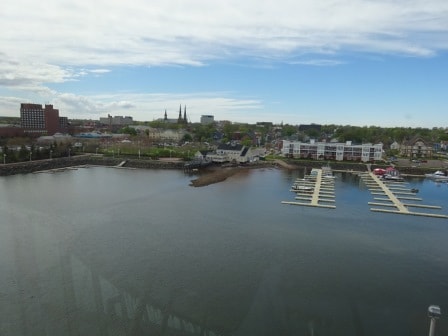
Charlotte Town from the sb bridge wing of the ms Maasdam.

Charlottetown is the largest town on the island and has grown around three rivers which all dump their water in the harbor area. It has a nice Cruise ship dock, long time ago inaugurated by yours truly with the Veendam when it was transformed from a small cargo dock into something which the locals can be proud about.  The town is named after a British Queen – Consort of King George III (Although she herself was German) and it has the claim to fame as being the birthplace of the Canadian Confederation. In 1864 the Charlottetown Conference was held here with the aim to unify the area which we now know as Canada.

Sailing into Charlottetown can be quite spectacular as the ship sails into a sort of lagoon with cliffs on both sides. These cliffs are of a red clay type material and give the area a very unique view. The port itself is located in the back and quite nicely sheltered. If there are more cruise ships in port then there is also an anchorage and that is less nice.  The three rivers converge here and there is the tide. In total four forces of current hitting the ship at anchor. At a normal anchorage the ship swings around on the tide and then settles with the bow into the flow.  Not here as the resulting influence of those four forces constantly changes and keeps pushing the ship one way or the other. It is constantly swinging around the anchor and it never settles.  I have been here at anchor only once (and that was more than enough) and during a four hour period (without a change from Ebb to Flood) the ship made three complete turns around the anchor. It only settled to some extent when the wind picked up; but we do not like that either as it means a choppy ride for the tenders. Luckily normally Holland America Line ships dock as we have been coming here as one of the first cruise companies and are very regular in our calls. In some ports seniority still counts for something.
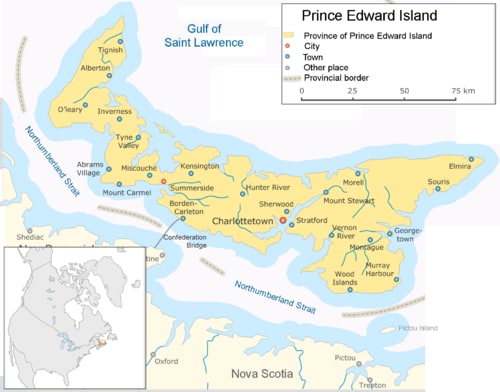
Prince Edward Island. The Confederation Bridge location can be seen on the lower left. (Courtesy Wikipedia)

On the island there are plenty of things to see and do and some of the tours also go off the island as there is a bridge connection with the mainland. The Maasdam will sail under it tonight and it takes about 3 hrs. from the dock to get there.  It saves quite a few miles to take this route as otherwise you have to back track and sail around the whole of the East side of PEI.

Sailing under the Confederation Bridge is a mixed blessing. It is very nice to do and quite spectacular as the old Westerdam just fitted under it but the area is full of lobster pots and as lobsters do not tend to pay much attention to steamer routes, the fishermen tend to have the same attitude and set the pots wherever the lobsters might be.  If one is in the channel then we can sail around it and then there is a chance the rope between the lobster pot and the indicator buoy at the surface might get in the propeller. To avoid damage we have little knife tips permanently attached to the inner edge of the propeller to cut the rope before it hits the seal. Especially plastic fishing lines can cut into the seals of the pitch propeller blades and can cause oil leaks. Although the hydraulic oil we use is environmental friendly and does not pollute the environment, we still do not want leaks.
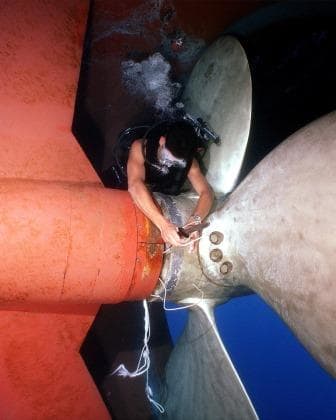
One way of getting the ropes out is by diver and we have to do that some times. We have little knife blades at the rim of the propeller end, exactly where the diver has his hands & knife. (Photo courtesy website osd.dtic.mil)

This evening we sail at 1800 and head to the St. Lawrence Pilot station and then tomorrow we will spend the day on the river, heading towards Quebec. Weather for tomorrow chance of rain and chilly, if it will bring haze, we will see.

13 March 2017; At Sea.

It is still very windy out there but we now have following wind; which means the relative wind on the deck is the real wind minus the ships speed. The ship is doing 12 knots; the apparent or relative wind is 18 knots, so it is still blowing 30 knots out at sea. And 30 knots is a big 6 or a small 7 on the Beaufort scale. Very windy. Sailors call that a Very Strong Breeze or a Near Gale. All caused by the regular Trade Wind being super charged by large weather systems North of Puerto Rico.  I think the word Near Gale comes from the observation of it being very windy but not yet that windy that it feels stormy. Still there is a lot more wind than there should be in this area.  Most of the Zuiderdam’s open deck spaces are screened off by large glass partitions so the guests can still sit out of the wind if they want to. Only the aft deck around the pool is open on three sides and that brings the danger that the cooler sea air does not make you feel that hot; and then you forget that you are baking in the Caribbean sun. Some guests forgot it today but will remember it tomorrow and the days after.

A bit more engine stuff today. Now outside the engine room, with the fascinating question, what happens if all the engines stop? Do all the lights go out?  The answer is no. In the unlikely case of a full black out, when all the engines have stopped or the two Main switchboards have a major hic-up, we still keep the lights on.

The Eme

The Emergency Diesel Generator, with next to it a small diesel engine in case we run out of starting air for the EDG.

When all the power would stop, the Emergency Diesel Generator (EDG) would come on line and provide sufficient power for the ship to stay in minimal operation. That happens by itself. The electric setup is so that when the main power goes down, within a maximum of 10 seconds the EDG has to come on line. In reality it goes much faster. But the 10 seconds are a requirement and when we have USCG inspection or Lloyd’s renewal of our certificates the EDG is always tested. Although we then do not make a real black out, we simulate by pulling fuses.  The EDG powers all the emergency lighting, all the bridge and Engine Control Room equipment, lights in the corridors etc.etc. It does not power air conditioning and toilets. For that we have another auxiliary engine. The EDG powers what is legally required. It does include elevators, one in every staircase. On every cruise ship you can recognize those as there are small green signs on every deck indicating which one it is.

The Emergency Switchboard. Two sides so it can bring power down to the Two main switchboards we have in the engine room.

The Emergency Switchboard. Two sides so it can bring power down to each of the Two main switchboards we have in the engine room. In the back the EDG.

The EDG is located near the top of the ship on deck 10, so if the ship would be sinking it could keep happily running until everybody had left the ship.

Now what would happen if the EDG would not start? It normally starts as a regular Diesel Engine with air which comes from an Air pressure vessel. If that tank or drum would be empty, then we have another smaller air compressor standing next to the EDG which would then fill up the Air tank again until it would have sufficient pressure to start the EDG again. The EDG has sufficient Gas oil to run for at least 24 hours. Ours can do at least 36 hours and if we can get more gas oil there (or mgo) then it can run indefinitely.

Now what if we would eventually run out of MGO or the EDG would break down? Then we still have batteries. A whole room full and they are capable of providing power for all the emergency lighting in the ship for at least 4 hours. Thus making it possible for everybody to safely disembark also during the night time. (Remember lifeboats do not need power to go down in the Davits as they are gravity operated)

All the

All the Elevators are connected to the EDG so the Ch. Engineer can decide which ones should run during an emergency, or if the power is sufficient keep even more of them on line.

Most guests only notice the existence of the EDG when they hear the announcement that we carry out the weekly test and we ask them to refrain from using the Elevators while this is going on. This is because we bring the EDG on line (Engineers called that “under full load”) and thus only four elevators need to continue to work. So the other ones might stop and then descend by themselves to deck 3 (lifeboat deck) and the open the doors. Not dangerous but a bit startling for a guest who was convinced that he or she was on the way to deck 9 for an early lunch.

Tomorrow we are in Cartagena and we expect to be at the pilot station around 05.30 am and to be docked an hour later.  Weather forecast:  Mainly overcast with a chance of showers. 31oC or 88oF. but very little wind inside the port.  Overcast is not a bad thing as most of our guests will be on tour. Hopefully we get our chance of showers after the early afternoon departure.


11 March 2017; Oranjestad, Aruba.

It was very windy. Almost on the edge. Although the Zuiderdam is very powerful almost all the power was needed to bring the ship alongside and to keep her there while the ropes were going out.  Definitely not a day for a good peace of mind situation for the captain. So when going into port, there is always the discussion and the planning for the “what if situation”. What can we do when plan A does not work? For entering the port of Oranjestad (called the Paardenbaai or Bay of Horses) we have three distinctive situations.

A. Going in or not going in. This would have been decided today by the wind or by the late departure of the Coral Princess who occupied our dock. If her guests were late, the Zuiderdam would have aborted the approach outside and made a neat circle until the coast would have been clear, or better said the dock. If the wind would have been too strong, it would have been here, 1.5 miles from the port where the captain would have said “bye bye Aruba”.

B. What if when going in, the Coral Princess suddenly stopped sailing out? Then plan B is docking at the container terminal. The crane there is broken so the container terminal is not in use at the moment but it has a very nice dock. Once there you review the situation and then you can always stay there or continue to the cruise terminal.

C. What if we come to the dock and the wind is too strong? We let ourselves blow away from the dock until clear of the Celebrity Equinox and then just continue back to open sea via the eastern exit. Once out, then you can review the situation and your options.

D. Then ensure that the pilot has a tugboat on short notice to help us to stay at point C   at the next time in.

the various options in case Plan C does not work. By the time we sail out, we can call a tugboat to help us for the enxt attempt.

The various options in case Plan C does not work. By the time we sail out, we can call a tugboat to help us with the next attempt.

Well we kept all of that in mind, and of course we docked without much issue although the wind was strong. For that we put extra lines out, 7 headlines instead of the normal 5 and that will keep us alongside until dusk, when the wind will die down considerably and then there is no issue anymore.

To continue with our engine room exploration: Most interest always goes to the stabilizers. Main engines are fine but our guests are normally happy when they know that they are big, powerful and there are enough of them to get everybody home on time. Water in the shower is also taken for granted and also were the water goes after the shower; but what really is a constant focus are the ship stabilizers. As soon as the ship starts to roll (or wobble or whatever phrase comes to mind) the first question is, are they working? And the second question is how do they work and where are they?


Yesterday when I mentioned the crystal clear water and the shallow depth: they were visible, about 20 feet below water and sticking out about 15 feet.

images (7)They work like an airplane wing, creating a lift under the flat of the stabilizer and directing it with the flap. If you use that lift opposite the movement of the vessel then it reduces about 90% of the rolling. It will never achieve a full 100% because the gyroscope needs the ‘push’ of the roll to react and thus there is always that little bit of movement left. Most of the time too little to be felt by the guests. The stabilizers are located in the AC or air conditioning room, which is as close to the amidships as is possible.


Most ships only have one set of stabilizers but some ships have two sets such as the Queen Mary 2. The logic behind it is that with the sheer bulk of this ship it might need a second set. I have spoken to officers who sailed on that ship and the combined wisdom was, nice to have two sets, always handy, but one set normally suffices.

The Zuiderdam sb stabilizer as seen during the newbuilt in 2001

The Zuiderdam sb stabilizer as seen during the newbuild in 2001

We are staying here in Aruba until 23.00 hrs. and then sail a short hop towards Willemstad Curacao. We are scheduled for the Mega Pier which is the outside cruise dock. A longer walk for the guests into town; but still better than not getting there at all as the wind is supposed to be even stronger than today. But with the Mega pier we can dock with the wind on the nose, so we will not drift.


An this is what it looks like inside. Nothing more than a hydraulic ram with a hydraulic power pack attached to it.

An this is what it looks like inside. Nothing more than a hydraulic ram with a hydraulic power pack attached to it.


10 March 2017: At sea.

And for those who paid attention you could feel (and see) us sailing through the various wind systems. After departing Half Moon Cay the ship had a bumpy ride as the North Atlantic waves found their way between the islands. Once clear and entering the end of Old Bahama channel this became even more pronounced.  I could feel it very well as I have a bow cabin this cruise. Nice view forward but also the weather on my door step.

Then early morning we entered the Windward Passage and a serene peace came over the ship as the island of Hispaniola now protected us from wind and swell. It takes about 12 hours to sail the whole stretch of sea which is protected by the Haitian mountains and around lunch time it was almost calm of wind. The last part of the Windward Passage near the Jamaican Channel is very shallow and as the sea had only its waves and no white caps you could see the white sandy bottom about 45 feet below us. In the distance were various fishing craft as the fish likes to  be at the edge of shallow and deep water due to the cold water welling up from the dee[, bringing all sorts of nutrients.

Cape Tiburon in the far distance. Most southwesterly point of Haiti on the island of Hispaniola.

Cape Tiburon in the far distance. Most southwesterly point of Haiti on the island of Hispaniola.

That lasted to just after 2 pm. and then we cleared the island and portside came full into the “view” of the Caribbean Trade Wind.  It came as quite a shock to all the guests sitting, relaxing or being “not there” in the deck chairs when the wind suddenly blew around Cape Tiburon, the southwest point of Haiti.

My travels through the ship took me today back in the Engine Room. We have two trainers on board who make a regular circle around the fleet giving basic trainings and do catch up work and thus can I concentrate myself on my ships review. Looking for the trees in the forest because when you work too long in the same environment you do not see the Forest for the trees anymore. (Or something like that)

The Engine room on the Vista Class runs the whole length of the ship on D deck and gets slowly smaller in size on the higher decks. On C, B &  A deck it is down to about 40% and then there is only the uptake to the funnel left which takes up about 10% of the ships space per deck.  The 5 engines of the ship (and a Gas turbine generator = which is not used anymore as it is too expensive with the current fuel prices) are divided over two separate engines rooms. 3 engines in the aft part and 2 engines (with the gas turbine) in the forward part. The idea is, if we would have a fire in one part, the other one would be able to take over and run un-affected.

For the rest the engines spaces are divided for dedicated purposes, all separated, section by section by watertight doors. Most of the engine room is under water and thus compartmentalization is required to ensure that when water would come in, it would stay in one location and not endanger the ship. We can have two of the largest engine compartments full of water and the ship will still stay afloat.

The Main engine rooms

The main engine rooms. To the aft left and right are the Purifier rooms for cleaning the fuel oil and forward in a separate space the evaporators for making potable water.

The Layout from stern to bow:

  1. Aft compressor Room with the cooling installation for all the Provision Rooms
  2. Auxiliary room. Here the Engine crew have some of their workshops
  3. Aft main engine room. Runs all the way to deck 13
  4. Forward engine room. Runs all the way to deck 13
  5. Evaporator Room, here we make fresh water from sea water using excess engine heat
  6. AC Room, where we have four big compressors to cool the whole ship down.
  7. Potable Water Room
  8. Treatment Room
  9. Pump Room
  10. Forward Sewage Room. (the aft one is combined with the aft compressor room)

More about tis tomorrow.

For the remainder of the day and night we will sail through the Caribbean Sea until we come to the Pilot station of Oranjestad Aruba. That should be around noon time or shortly after. We do not know exactly as we are hot berthing with the Coral Princess. And if she has a load of eager shoppers ashore then the Coral might not sail on time. And then we have to wait as Aruba has no anchoring option near downtown. The other part of the dock is taken up by the Celebrity Eclipse who was on an overnight stay.

Weather expected, almost overcast with a windy day and temperatures of 28oC / 82oF.

09 March 2017; Half Moon Cay, Bahamas.

When we arrived we thought for a moment, what is the weather going to do to us now………………….. As it rained and it looked grey and it looked murky. Not in the planning and not in the weather forecast. But the weather front edge had dipped down a little bit and had turned the prediction of ‘partly cloudy skies” into overcast with rain showers.  Luckily it was only a little dip and the murky arrival turned into a beautiful beach day. However the un-expected dip had put the captain on the alert and he decided not to anchor but to drift. If there one un-expected dip then their might be another one; and if the wind suddenly changes then you are pushed very quickly towards the beach. And as Holland America is not planning to open a permanent Hotel here at Half Moon Cay, the captain’s efforts in this direction would not have been appreciated.

And thus we had a wonderful – beachy day- in Half Moon Cay. We were the only ship and that made the island seem almost empty. Every guest had at least 5 beach chairs to him or herself plus one of the nicest beaches of the Caribbean at their feet. I did not see much of it as I was in the dungeons in the morning, reviewing engine room operations, followed by Communicator Training in the afternoon as we had a crew change of the entertainers yesterday. A bigger difference is hardly possible between an organized and highly methodical & technical procedures and High Drama and Hype which goes with acting and performing.

Thus the question arises what are communicators and why is entertainment involved.  With all the bad things of the Costa Concordia there were also a few good things — lessons learned —  Although there have been a lot of passenger liner sinking, foundering’s, stranding’s and other fatal or near fatal happenings, both in peace and war, there was never any reliable evidence about what went on in a lifeboat. But the Concordia did use her lifeboats and this was in the age of the Selfie and the Mobile phone with Video capabilities. And thus footage galore arrived on You Tube. And now we got an amazing insight in what went on in those lifeboats.

Cutting through all the drama and the embellishments, it boiled down to a few lessons learned:

  1. People follow orders as long as somebody gives them clearly and that somebody is recognizable.
  2. People only start to panic if something happens which they do not expect and do not understand
  3. People have a strong confidence in the routines explained and the equipment used.

Thus the decision was to add another crewmember to the lifeboat complement. A communicator.  A person who will narrate what is going to happen, when it will happen, how it will happen and explain if there is anything un-expected involved with it.  As an example: people do not expect a lifeboat to wobble when it moves away from the ships side before it is lowered. But it does. It is hooked into the lifeboat falls (those black wires) by two hooks which hold a ring. Thus the hooks can move a little in the ring.  But people do not know that as they do not know the lifesaving systems and thus expect the boat to move like a bus or a lift.  It does not and every lurch or wobble can set somebody off in panic or …….

150 people in a lifeboat calls for organization and with it the challenge to keep them calm.

150 people in a lifeboat calls for organization and with it the challenge to keep them calm. This was a test with crew only who know what to do and what to expect , so smiling faces…. they do not need a communicator.

If we now have a person in the lifeboat who will explain what can be expected and narrate everything throughout the evolution then people will not panic as they can mentally prepare for it. Why is entertainment involved? Because they are used to having an audience (that is the reason they stand on the stage, they want an audience) and they can give a performance.  They are not afraid to break the ice in a lifeboat and will simply start talking.  Once the boat is in the water they are then asked to try to help with keeping the moral up ven if it includes performing; singing, juggling, lecturing or whatever will help to pass the time.  Meet your neighbor, Grand Dads war stories, anything goes as long as everybody stays away from politics, because then we suddenly have a lifeboat split in two halves and a fight over who sits on the right or on the left side. We need and we hope for their creativity as this is very hard to train for or simulate.

Thus the day the entertainers join, the indoctrination starts to get them up to speed as quickly as possible and to reach the Holland America level which goes way beyond the legal requirements.

Tomorrow we are at sea, sailing full speed down to Aruba. For the remainder of the day we will sail between the Bahamian islands and then in the early morning hours cross the Old Bahama Channel and sail into the Caribbean Sea via the Wind ward passage. The weather looks good, although more wind is expected late tomorrow.

Older posts Newer posts