- Captain Albert's Website and Blog -

Ocean Liner History and Stories from the Sea, Past and Present. With an In Depth focus on Holland America Line

Page 85 of 241

23 Feb. 2016, Grand Turk Island.

The last cruise call at Grand Turk was a bit of a disappointment weather wise, at least for the operational side; too much wind, this week it was picture perfect.  Clear skies, gentle breeze and no swell. The only complaint we could make was, that we were not the only ship in port. Shortly after our arrival the Carnival Pride arrived. Luckily the Beach resort built together with the cruise ship pier is large enough to handle two or more big ships, thus there was no overcrowding to speak of. For a moment I was afraid that there would be three ships as the Regal Princess showed up and hovered off the dock, but they needed to land somebody and send a tender for the authorities.

Who was also very happy was the Staff Captain as he was able to lower lifeboats for training, which with the possible swell in this port is not always possible. This cruise can be very difficult in this respect, swell in Grand Turk, late arrival in San Juan, and swell in St.Maarten. It all leaves St. Thomas as the only reliable port where we seldom have issues.   Thus today the boats went down and we also drilled the life raft crew. This training was done by my school class who got their first official taste of un-aided work in front of a –very critical- audience.
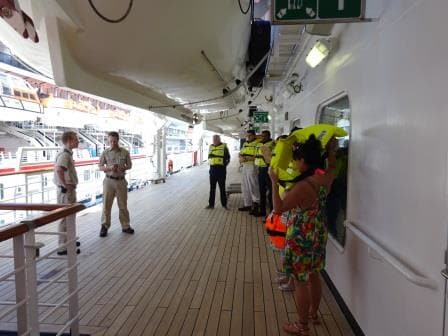
A quick check on the cheat sheet in order not to for get anything and then it is time to train the newly boarded crew who will get a special "welcome instruction"

A quick check on the cheat sheet in order not to forget anything and then it is time to train the newly boarded crew who will get a special “welcome instruction”

As we had worked, studied and trained for this for the last two days, it turned out not to be such a difficult thing and the regular ships officers were quite impressed. They had to learn it the hard way, as they joined Holland America before this program was in place. All went well, which was a great boost for the confidence of my trainees and at 1 pm. I had six smiling gentlemen sitting in front of me, who were quite pleased with themselves. Now it is a matter of gaining experiences and building on the initial experiences made. Hopefully they will not forget the wise lessons of this old captain who kept them busy for 14 days with all sorts of strange training and insights behind the scenes.
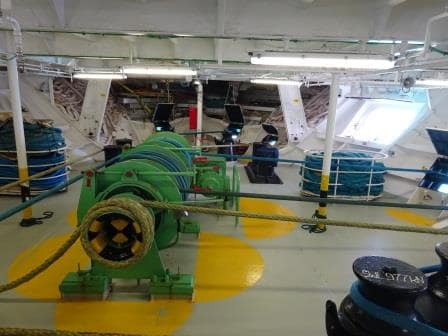
Spaghetti Junction. 8 ropes going ashore in Grand Turk to keep the ship alongside.

Spaghetti Junction. 8 ropes going ashore in Grand Turk to keep the ship alongside.

One of the most important insights to be gained takes place during the arrival and departure standbys on the mooring decks.  One of the regular duties of a 3rd officer is to be at “stations” during arrival and departure for supervising the mooring of the vessel. The only way to get a real good insight into what exactly goes on, how to handle ropes safely and how to create an efficient team on the mooring deck is to have done it yourself.  When looking at the sailors going about their duties, it looks easy enough but once you get involved yourself your find out it is not. Basically you need eyes in the back of your head to keep a good overview. Most people only have eyes on the front, but when you start gaining experience and start to build up routine, you get a feeling, a sort of sixth sense of what is going to happen and so you – see – the situation before it occurs and can then prevent it.
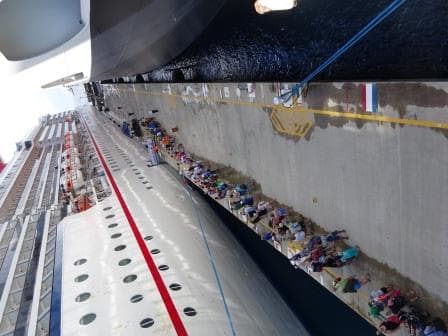
Carnival "Priders" returning home.

Carnival “Priders” returning home.

So my guys are doing each and every arrival and departure which means getting up early every day but then they have to get used to it anyway. On departure today it gave them the chance to observe the contrast between Carnival and Holland America. Carnival with long lines at the gangway as everybody returned from the beach at the same time which took time to clear; Holland America guests all  back early but with an ambulance at the gangway for a medivac which took up our time.

Tomorrow we are at sea, heading for San Juan were we should arrive around lunch time. It should be another nice but hot day. 86oF / 30oC with high humidity.
22 Feb. 2016, At Sea.

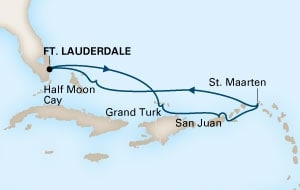
As mentioned yesterday, this cruise is calling at St.Maarten instead of St. Thomas.

As mentioned yesterday, this cruise is calling at St.Maarten instead of St. Thomas.

With extremely nice weather, both sun and sea, we are sailing north of the Bahamas towards Grand Turk Island. Because of the very nice seas we have a lot of cargo traffic around us, Cargo ships that have not opted this time for sailing through the Old Bahamas Channel. The old Bahama channel is a longer route as it goes south of the Bahamas and thus costs more fuel but it is also more sheltered and thus you can make more speed and that saves time. For a cargo captain a nice calculation to make and figure out what is the best for the ship. Our ships do the same if the weather gets very unpleasant in the North Atlantic, but it cannot get much better than this, e.g. what we have today.

In the meantime the training class has progressed to exploring the engine spaces. They are Navigation Officers and on a cruise ship it means that it is a completely different discipline than on cargo ships where a lot of functions are integrated. It simply comes with the fact that cruise ships are so complicated in construction and the functional needs in both disciplines so extensive. Our A.C. system is often bigger than an engine room on a fair sized container ship.

Although they do not directly work in the engine room for technical activities, deck officers are still very much involved. In case of fire they support and back up the Engine Fire fighting teams and most of the regular fire fighting equipment is maintained and tested by the Deck Department. For both reasons it is extremely important for deck officers to have a good knowledge of the layout of the machinery spaces, how to get to the correct location via the shortest route, and to understand the dangers which are always prevalent in these areas.

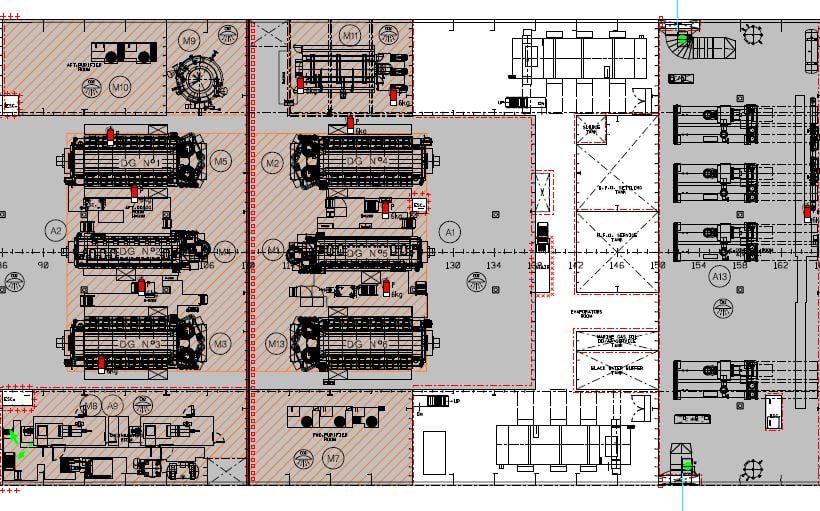
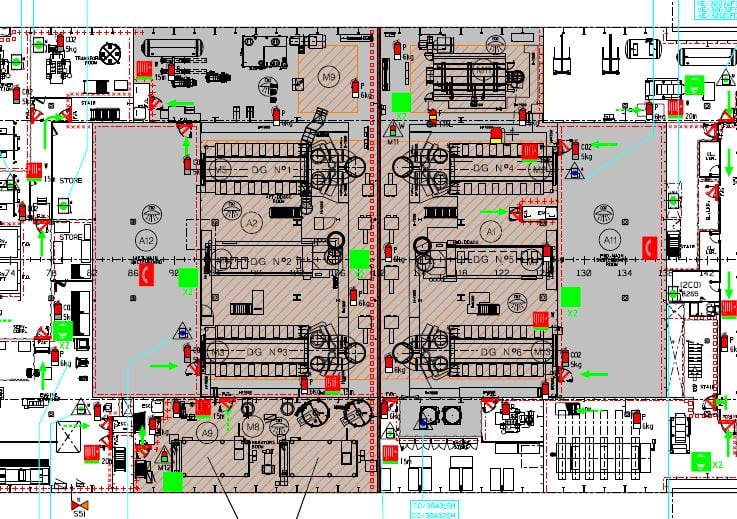
Thus it forms part of the training period. We start by looking at the Fire Control Plan. This gives a very good layout of the Engine Room and it lists in deep detail the location and layout of all the  fire prevention construction there is and all the systems which have been installed to protect the area’s in case of a fire. The challenge now comes, after studying the fire Control plans with all its diagrams, is to visualize it in reality. Not easy as with so many pumps, tanks, engines and other equipment around it is very difficult to relate to where you are exactly in the engine room.

The B deck level with the top layout of the six main engines. Top right is one of the boilers for steam production,

The B deck level with the top layout of the six main engines. Top right is one of the boilers for steam production,

Signs to help you are everywhere, all meant to help with a quick orientation in an emergency but as there is no clear “bow – stern” recognition in the lay out, you have to study and practice.  The main engine room is laid out over B, C and D deck and takes up about half the length of the ship.  On B & C deck there are crew cabins in the fwd. area but on D deck there are tanks, such as the potable water tanks.

The mid level of the six main engines and now aux. engine spaces are visible as well

The mid level of the six main engines and now aux. engine spaces are visible as well. The four rectangles to the right are the four A.C units of the ship.

Still this half part of the ship is complicated enough to get lost in and disorientated. Thus training is of the essence. Also getting in is not easy as the whole area is locked in and blocked off. If you do not have the key or know the door, it is hard to find. If you are a visitor, then you first have to report to the Engine Control Room and sign in the Visitor log. Then you get scrutinized by the Engineer on Duty to see if you are wearing Safety shoes (steel noses) and hearing protection and if you know what you are doing. Sometimes permission is played up all the way to the Chief Engineer.

Then you can go in and do whatever job you have to do. We spent a few hours down there, trying to get somewhere as fast as possible via the safest route, to get out as quickly as possible (every space has an emergency exit) and also realize in what section of the ship we exactly where.

Tomorrow we are in Grand Turk. According to the latest information we are sharing the berth with a Carnival ship and thus we have to make sure that we are not arriving at the same time.  The weather is looking a bit variable with some scattered showers in the area but it will be warm. 810F / 27oC.

21 Feb. 2016; Ft. Lauderdale, Florida; USA.

Today it was a very good day for being in Ft. Lauderdale, also as a turn over port. It was sunny but not too warm; there were plenty of cruise ships in but nothing on the road to slow down the procedures. For once the Nieuw Amsterdam only had to wait for the pilot to come on board on departure instead the pilot having to wait for last minute guests coming on board.  So today all was well in the world as far as turn- overs- were concerned.

My class was out and about today as I could not look after them in the morning due to having to go ashore again to be instrumental in obtaining the “zero count”. So I trundled off the ship at 10.30 with the last group and then trundled back on board again with the first group when embarkation started.   In the meantime the class went to observe chemical and recyclables off-loading with the Health and Sanitation Officer and afterwards reported to the First Officer to get involved in the noble activity of repairing Fire Dampers.

Together with Fire Screen Doors, the Fire Dampers are a major headache for each Safety Officer. Fire screen doors of which there are about 300 on board sometimes breakdown if they get hit by a trolley or a transport cart. The impact normally affects the closing mechanism and then the door does not fully close anymore. Thus the Safety Officer shows up with a hammer (for structural damage) and a screw driver for re-adjusting the closing speed. Fire screen doors you see everywhere in the Guest spaces especially around the staircases. They also are everywhere in the crew area’s and that is where there is the most repair work as the traffic (and the number of trolley’s) is the greatest here.

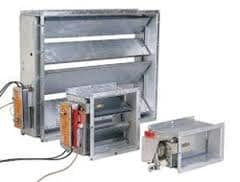
A few models of fire dampers we can find in the accommodation. Those for the engine room spaces can be up to 7 or 8 feet high.

A few models of fire dampers we can find in the accommodation. Those for the engine room spaces can be up to 7 or 8 feet high.

Fire Dampers are normally not seen by the guests. They can be felt by a guest, if suddenly the A.C does not work anymore. If there is no general stoppage of the main system, then normally there is a blockage in a fan duct and quite often that turns out to be a Fire Damper that decided to close by itself. We can not always see this as the indication might still give the all clear. Each damper has an indicator on the remote switch and if that is green, then we do not know until we get a complaint or when carrying out a bi-monthly in depth inspection. We cannot do a more frequent inspection as there are too many of them.   Thus we normally get the complaint first.

What do Fire dampers do?  Basically they are little doors or flaps which close a duct where air flows through. Circulating air will fan & feed a fire and thus they help stopping a fire by cutting this circulation off.  They can be found anywhere in the ship where there is some sort of air circulation going on. Most ships have hundreds of them. The majority can be found in and near A.C stations which are everywhere on board, or in the engine room, or in locations where ventilation ducting goes through a fire bulkhead or main vertical zone. However the latter you only see on older ships as it is not really allowed anymore.

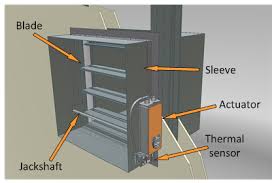
Everything orange indicates a name but also an item that can go wrong.

Every orange arrow indicates a name but also an item that can go wrong.

The smaller dampers are electrically operated and when activated seal off the ducts serving the accommodation areas. The damper itself might be one flap or several louvres which work in conjunction.  As there is cold or hot air flowing by and that air can still be tinged with salt, corrosion is an option and then they can get stuck. Also the little motor can burn out or the fuse can go.  Lots of small things which make damper maintenance a never ending enjoyment for the deck officers.

Thus today the Nieuw Amsterdam had six extra officers available to tinker with the dampers and to carry out a myriad of small repairs. Good for the ship and even better for them as these sort of repairs need a lot of experience and routine to do them fast and effective.

Tonight we go an hour forward and then tomorrow we are a full day at sea heading for Grand Turk Island. At the moment the weather looks good, so we hope that it will stay that way.

20 Feb. 2016; Half Moon Cay, Bahamas.

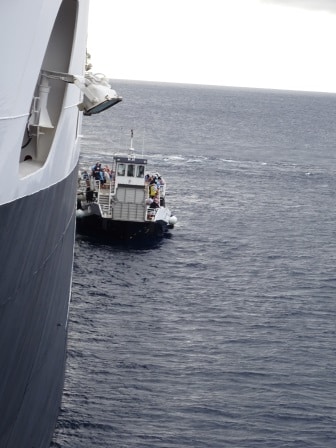
Today we were together with the Oosterdam and today was a little bit of a mixed blessing. For the guests the weather was great. Only after departure it started to cloud over and with a cool wind blowing it was nice on the island and not too warm even with the sun. The other side of the coin had more to do with the operational side. The cool wind, so nice for the guests was at times a wind force six in the open water where the two ships were. That meant that they could not be as close together as would have been convenient for the tender operation. So the Oosterdam settled down at the main anchorage closest to the port as it had to use its own tenders. The Nieuw Amsterdam went somewhat to the South, a slightly longer distance but then it had the benefit of the shore tenders.

The little Sting Ray disappearing under the bow of the Oosterdam

The little Sting Ray disappearing under the bow of the Oosterdam

The rule at Half Moon Cay is that the largest ship with the largest number of guests on board will get the shore tenders allocated. In principle there are two of them, the Henry Hudson and the Anne Bonney.  So those two came to the Nieuw Amsterdam. Then there is the Sting Ray which is about half size of the other two but can help out and she went to the Oosterdam to augment their own tenders.  If one of the ships runs into issues then tenders can always be mixed and matched of course but there is a system for the initial setup.  Then there is a final tender, the Half Moon Cay which is more of a work horse. Built for the bad weather up in N.E Canada with only a limited passenger accommodation. But it has a large loading platform at the back with a crane and thus it is used for ferrying supplies to the island from the ships.

The two ships together brought just fewer than 4000 guests to the island and it can easily handle that. With only one ship in, the beach looks a bit sparse but with 2 ships the beach fills up at bit more and the rest of the guests are normally spread out over the island at the numerous attractions and so avoiding over crowding.  I believe everything was in full swing today except the Para Glider but that might have been due to the strong winds.

I sent my school class ashore for a few hours as this might be one of the very few opportunities they will have to see the island. We cannot always make the call due to the weather and the tender service takes up a lot of man power as well, leaving few options to have a good look around.  Half Moon Cay is very beautiful and is one of the nicest beachy-island destinations  there is. I have seen Princess Cay and Castaway Cay (Mickey Mouse) and without being biased ours is better.

For the ships the operational challenge there is that all the food and drink comes from the ship and goes ashore to be prepared and served by our own crew. That is a logistical nightmare as there is always a delay in delivery if something is forgotten. So the Hotel department is in a constant frenzy to ensure that everything goes ashore and nothing is forgotten. Not a mean feat considering there will be 4000 hungry guests descending on the cook-out at lunch time. Not a good idea if you are then suddenly running short of napkins.  Normally the ships divide the burden between them with one ship providing the food and the other the beverages while both deliver 50% of the crew. So for some of the crew it is also a sort of reunion as they meet up with collegues from previous contracts.

The final island tender coming back to the Nieuw Amsterdam.

The final island tender coming back to the Nieuw Amsterdam.

For both ships it was 14.30 hrs. all back on board and both ships just managed to get ready to sail at 15.00 hrs. The Nieuw Amsterdam beat the Oosterdam to it as it had not anchored but had remained on the engines and drifting. The Oosterdam needed some extra time to get the anchor up but then she did have the advantage of having the better anchorage location.

Tomorrow we are back in Fort Lauderdale and a new cruise will start. Nearly the same as this one but with calling at St.Maarten instead of at St.Thomas. We will have the same ships in port and that will make for a crowded day again.


19 February 2016; At Sea.

Today we covered most of the distance from St. Thomas back to the Bahamas by sailing in the North Atlantic Ocean. It is a bit windy, which creates waves and those waves make the ship wobble on occasion. But not very much, just enough to remind you that it is a ship you are travelling on. For the guests this is the final day to enjoy “full shipboard life” with everything in full swing as tomorrow we are in Half Moon Cay and most of the last evening will be given up to packing.  As the sun is shining nicely, the outside decks are full with sun worshippers.  

What is something new to Holland America; and the Nieuw Amsterdam is the first ship where it has been installed, is TV on demand. What we are used to in the airline industry already for a while. You switch on your TV and you have 20 or 30 movies and TV programs to choose from; and start and stop whenever you want.  Thus far on our ships you had to check the program and then catch the movie at the right time if you wanted to see it from start to finish. This upgrade will be rolled out over the fleet in due course.  What is interesting is that I hear more TV’s going in the cabins than before. I spoke to a gentleman who was very happy as he could now catch up with the latest movies as his wife did not want to go to the cinema at home anymore and this was a good alternative for him.  We used to alleviate the movie issue with the option of offering free –rental DVD’s to our guests to watch whatever they wanted but this of course works much better.

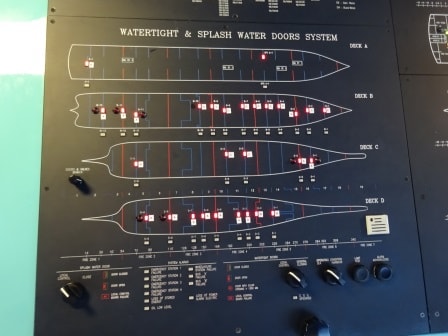
In the meantime my school class was hard at work and is starting to make themselves useful for the ship as well. Today it was watertight door testing with Central Closure.  Watertight doors are the most important defense we have against sinking. By sealing off the “holes” – passageways in the bulkheads, they ensure that water cannot flow through the ship but stays in one compartment. As long as no more than the two biggest compartments are flooded, the ship will stay afloat.  For everybody to do their work on the lower decks, we need those “holes” open most of the time. Thus there is the need for testing to ensure the doors still work. Every sea day there is a sort of test going on, to ensure good and correct operation. If ashore you might ask if “everyday” is needed; but for a ship it is. Basically a ship is exposed continuously to small earthquakes due to the movement while at sea and that has its influence on all the equipment. Much more so than on land. And thus we test.

The Watertight door panel on the bridge, showing all red. Means unsafe = doors are open.

The Watertight door panel on the bridge, showing all red. Means unsafe = doors are open.

We do the test by closing and opening locally on normal power. We do it locally with the hand pump. We do it local/remote = which means from an operating station above the “watertight deck” which is the highest deck under which watertight doors are installed and we do it with a General Closure from the bridge. (And if everything would fail, each door has a pressure bottle which ensures it open and closes 3 more times without any power at all)

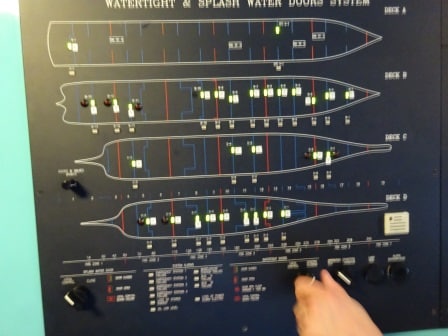
One flip of the switch and the panel goes green = is safe as all doors are closed.

One flip of the switch and the panel goes green. Means safe = all doors are closed.

For a General Closure in an emergency, the officer in charge will only have to walk a few steps and push or turn one button and all the doors close.  Checking this takes a lot of man power as we need guards near every door to prevent accidents. All crew are trained not to go through a open door when the bells are ringing but we are all human and sometimes in a big hurry. Accidents with Watertight Doors still happen in the industry and fatalities with these doors still occur as well. Even in the year 2016.

Thus the team was strategically parked in the various areas to control any straying crew and to see if the doors really closed. WTD’s normally close within 30 seconds after the alarm but some of them have to be opened up first as they are always kept closed and thus the whole operation takes at least half an hour to accomplish to ensure a successful test.  And thus we saved the other officers valuable time and learned another routine at the same time.

Tomorrow we are at Half Moon Cay. The ship will make its final approach at 07.30 to be in position for the tender service by 07.45 hrs.  We are expecting an overcast day with temperatures of around 73oF / 23oC and a strong breeze from the North East.


18 Feb. 2016; Charlotte Amalie, St.Thomas; U.S.Virgin Islands.

Today we docked at our regular Holland America Line spot in Crown Bay on the North side of the pier.  No neighbors today as Crown Bay normally only has a full dock with the Saturday ships from Fort Lauderdale or Miami.  As we are a Sunday ship we only see another cruise ship here when our schedule coincides (or collides) with a 10 or 11 day cruise ship. Or when a ship gets diverted from the Havensight Pier, at the West Indian Dock Company.

As explained before, Carnival Corporation was instrumental in constructing this pier at Crown Bay, which was the former US Navy submarine base. Then it allocated those piers to Holland America and Princess but also to other ships if there is no HAL or Princess ship calling.  Before those days we had to share the West Indian dock with everybody and/ or go to anchor.  And for Holland America that meant very often at anchor, because as soon as the cruise ship – size – expansion began, the big boys were given preference. So we anchored in the inner bay, which was not so bad, as we dropped the guests off right in downtown. And once we had explained to the guests that waiting for the tender saved them the taxi fare around the bay, most guests were quite happy with that.

Anchoring outside was not very nice as it resulted in a Tender ride of at least 20 minutes. In those days we often had the Norway at anchor outside as well. She did not fit in due to her draft. But she had two beautiful tenders/landing craft which could take about 400 guests. So 2 runs for each land craft and the Norway was empty. When they came charging by, the guests in our little tenders tended to get a bit agitated. So we always kept our fingers crossed for hopefully a cancellation of another ship or at least an anchor spot in the inner bay.

Holland America has been coming to St. Thomas for a long long time. My oldest record indicates a cruise from New York with the Statendam III in 1930. The captain at that time George Barendse fell so in love with the island, that together with two passengers he purchased a piece of land there overlooking the harbor. He built a house and when his ship would arrive; his house boy would raise the Dutch Flag while the ship sailed into the harbor. One day I will try to find out where that exactly was, as I also have the name of one of the passengers. This Lady wrote her memoirs and mentioned this strange fact of sharing a piece of land with this Captain. I have no idea how land is recorded in St. Thomas but I assume there must be somewhere records being kept.

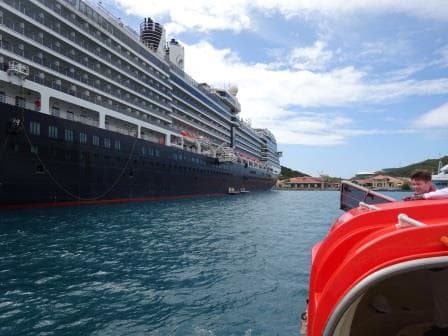
This is how the Nieuw Amsterdam looks like from the lifeboat. Balconies everywhere.

This is how the Nieuw Amsterdam looks like from the lifeboat. Balconies everywhere.

As it was a beautiful day today in port I got permission to go down with a lifeboat and have the team do lifeboat exercises. Important in my opinion as you can only instruct crew properly, if you can do it better yourself. As we were happily sailing to and from the ship we naturally got the attention from the USCG surveillance who was playing around with their Rigid Inflatable. But as we both applied the Collision Rules the correct way, no mayhem ensued and the USCG changed focus to a small speedboat which was not exactly operating safely. Nobody was wearing lifevests either.

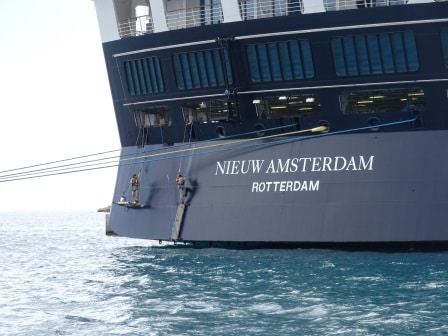
While in the water I took the below photo of the sailors painting the stern. You would think due to advancement of technology the whole ship  could be reached by some modern contraption, but no, new ship design still creates plenty of locations where only the old fashioned Bo ‘sun chair can do the job. And it is the only way on a Vista or Signature class ship to paint the stern as it has this strange angle. (The angle is there on purpose as this hull lay out gives a better water flow around the ship and helps to optimize the propulsion by the Azipods).

Bo'sun chairs on the stern of the ship. One is in use with a sailor painting, the 2nd one is in the process of being rigged up. Both sailors are wearing safety harnasses incase the Bo'sun chair would slip.

Bo’sun chairs on the stern of the ship. One is in use with a sailor painting, the 2nd one is in the process of being rigged up. Both sailors are wearing safety harnasses incase the Bo’sun chair would slip. And there is permanent supervision from above.

Tomorrow we are at sea and we are now retracing our steps. Same way back as the way we came but the day after tomorrow we will stop at Half Moon Cay.  If nothing changes we should be in port together with the Oosterdam.


17 Feb. 2016; San Juan, Puerto Rico.

During the night we sailed the final stretch of the North Atlantic route leading us to our first Caribbean Port of Call, San Juan.  By leaving Grand Turk at 15.00 hrs. we can just make San Juan by 13.00 hrs. Thus the guests do not get all full day here but an afternoon together with an evening. This then complies with the companies’ desire of having at least one evening stay during a cruise. It does not always work out that way for every cruise but whenever possible the company tries to make it work. For this Nieuw Amsterdam cruise it does work and the good ship will sail this evening no earlier than 22.00 hrs. 

That left us with being the last ship in port, as the MSC Davina and the Carnival Dream both pulled out at 17.00 hrs.  I was with the whole class on the bridge and it was interesting to hear the local pilot inquiring if the coffee machine on the MSC Davina had already been repaired as he missed his Cappuccino. I suppose it is a matter of getting your priorities right.

I was on the bridge as we did Touch Drill training. This means that we simulate an emergency and then go through the motions of taking all the correct steps to deal with this emergency. These are called Touch Drills, as it requires the officer to really go through the motions and Touch all the buttons but not really pushing them. Making the round from console to console and from safety station to safety station it is much more realistic than just taking about it.

When you talk about something you have time to think, when an emergency call comes in, you do not have much time to think. You should have a schedule in your head – mental checklist- which you can implement at once.   Then later on (after the first two minutes) you can grab the checklist and verify if you did not forget anything.  The urgency comes from the fact of having to alert so many people. A real fire on board involves at least 150 of a 600 strong crew and to get them going, every second counts and the need of providing the initial information for them to act on, however sparse it still might be, is crucial.

Thus during a touch drill, the officer is forced to think fast, try to build up a mental picture of the local situation and then activate the emergency teams in the correct way with the correct objectives. Not easy at all, because it means knowing your ship exactly; understanding the sort of people who might call and having intimate knowledge of what each emergency team is going to do and how they are supposed to it

This is how my guys felt by the end of the training session.

This is how my guys felt by the end of the training session.

This is partly different compared to the airline industry where the pilot can reach for a checklist for (nearly) every eventuality. In a way a little bit simpler, not easier as air planes are highly complex, as there are only two pilots, who deal with everything. All the guests are stuck in their seats and can be dealt with by announcements and actions of the stewardesses. On a cruise ship where all on board can be mobile all over the place and with a much more complex layout, not every initial action can be covered by a checklist system. We have too many variables when an initial evolution starts.

Tonight we sail at 22.00 hrs. and then tomorrow we are in St. Thomas where we will arrive at the pilot station at 07.00 hrs. We are expecting warm weather 27oC / 81oF with a strong breeze. And we are lucky, as the next 5 days are supposed to bring rainy weather over the Virgin Island.

16 Feb. 2016; Grand Turk Island, Turks & Caicos.

It did not look very nice early this morning when the ship approached the dock. Blustery winds and squalls to the south of the island. Luckily at 7 am when the ship made its approach there was a “window of opportunity” as they call it and the ship could slip in. Then Weather Gods decided that Grand Turk had had enough rain and the squalls disappeared, leaving a sunny but windy day. As the beaches are on the West side of the island close to the specially built resort that goes with the dock, this area was in the lee of the island and that made it very nice. As the island is very low, the ship does not have the advantage of that little bit of lee so the blustery wind kept playing around the ship. The bridge was extra vigilant today with an officer posted on the bridge wing permanently to monitor the situation in case the lines would break. But the swell did not become worse as the wind angle was just right and we could happily make our call.

Today the whole ship was on the march as it was time for our monthly General Emergency Drill. Every week 25% of the crew goes through regular safety training and then at the end of that cycle the whole crew goes through the three step General Alarm sequence. We have to do this as Solas requires for each crewmember to participate in a Fire Drill once a month. This regulation has been made mainly with cargo ships in mind where the whole crew should be proficient in fighting fires. Cruise ships with their much larger crews have specialist groups to do so; the fire teams. Thus for us the stipulation does not make much sense. The chance that a front office lady will put on a fire suit and run into a fire with a charged hose is zero. Still the stipulation is there and thus we do the full 3 step alarm cycle once a month.

The majority of the crew might not actually fight a fire but they will go through the assembly routine of where they would have to report, If there was a fire.

With a ship the size of the Nieuw Amsterdam and with nearly 900 crew on board, that is quite a happening. First there is A. First Stage Emergency alarm. The specialist teams are alerted to deal with the emergency. Crew not involved are now on high alert, waiting for orders. If the emergency (fire or flooding) is more difficult to control, the B. Crew Alert Alarm will be sounded and now all crew will get involved. If not having a special function to execute they will report to a safe assembly location so they are out of the way of the fire / emergency.

If then the situation still is still not under control, the C. General Emergency Alarm would be sounded and all crew would march to their life raft stations. Before this would happen, the Guests would have been taken care of first of course.

During the first alarm the Guests do not do anything and 99% of all issues on board a ship can be controlled/dealt with in this way. The 1% which cannot be controlled might necessitate the sounding of the Crew Alert Alarm. Guests are now requested (nice word for being ordered) to go to their cabin and to get ready to go to the lifeboats if needed.

If the emergency is not solved under this standby alarm, then the Guests will be directed to go to their lifeboat stations as soon as the 7 short and 1 long blast on the whistle have sounded.

This three step alarm has been initiated to give everybody sufficient time to prepare and the more time there is,  the less chance there is for panic to occur.

Thus we went through the whole cycle this morning, with only a few crew excused for operational reasons. I had my officers shadow the various teams to pick up as many clues as possible for future use, because as soon as their work assignment comes in, they will be doing it.

What amazes me the most is for the kitchen to be able to still open the Lido Restaurant on time (11.30 hrs.) while the majority of the cooks were out of the loop and in the drill from 10.30 to 11.25 hrs. With fluffy rice and crispy sweet and sour at the Far East Counter. They know something I do not and they keep it very quiet in how they do it.

We sailed at 15.00 hrs. and after leaving stern first from the dock, sailed around the north side of the island. Tonight and tomorrow morning we will be at sea and then by noon time we should be entering San Juan Harbor.

15 February 2016; At Sea.

Today we are sailing north of the Bahamas on our way to the Turks and Caicos Islands and it is a bit wobbly outside. Nice and sunny but the weather system which moved over us has quite a bit of wind in its tail, more than really was expected. It is not that bad, apart from the occasional movement of the ship you can hardly notice that there is a sort of gale blowing outside, mainly because you do not equate a gale with sunny weather. The ship is almost full to capacity, just a little bit less than last cruise when each bed and each sofa was filled up. But that was a real party cruise and now we are back to our regular clientele with a surprising number of younger families on board. I do not know if somewhere in the States the schools are on break but there must be something as I do not expect that all these children are home schooled.

My six new officers arrived yesterday and they all made it safely to the ship, including one from New Zealand who had been on the way for 30 hrs. The rest is from Holland and England and those are flights which are easier to deal with. All have sailed with Holland America before and thus I can to spend less time on the basics of how a cruise ship company operates and instead can dive directly in the deep end with safe working practices and my “use your brain” mantra. When you are a cadet, and it is the same for any cruise ship company, you observe and you are allowed to help out with regular maintenance, as long as the responsibility remains with a licensed officer. It simply has to do with insurance. Insurance companies want to see certificates with stamps and seals and of course a cadet does not have those. As a result there is very “little hands” on a cadet can do. Now they have a certificate and thus we can go for it.

Standing and observing is different than having to make decisions yourself. Making decisions yourself and the feeling of being held responsible in the end for the decisions that you made creates a totally different perspective. And with that we started today. Step one: know your ship, know where you are at all times and how to get to a location via the shortest route (if possible) but always the safest route.    So while we walked around, my constant question was, where are we now and how do you know that?

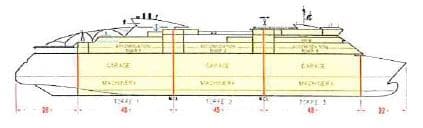
This is a diagram of a ferry with 4 main vertical fire zones. large cruise ships normally have 6, 7, or 8

This is a diagram of a ferry with 5 main vertical fire zones. large cruise ships normally have 6, 7, or 8

There is a basic division of a ship which all crew members have to know. Horizontally there are the deck numbers: for the Nieuw Amsterdam the crew decks C, B, A and then the passenger decks 1 to 14. Then vertically there are the Main Fire Zones which split up the ship in 8 sections. As a guest you can recognize those when you see the thick Fire screen doors recessed in the walls, most of them are located around the staircases. So each crew member should know exactly where he or she is if an announcement is made: Evacuate Deck 4 Zone 3. Without having to announce or to give specific names or cabin numbers; the section is enough. In this case it is the middle part of the ship where passenger cabins are located and at once Cabin Stewards can start evacuating guests from that area.

We have one trick to make it easier for the new crew: read the numbers on the Fire screen doors. Each door is labelled xx,yy,zzz    xx = deck,  yy is the zone, zzz is the door number. This is in our case 04. 03. 257. = Deck 4, zone 3, door 257. Because the ships now look very similar when going from deck to deck, this fire screen door numbering is a big help to immediately get your bearings when ending up somewhere you were not expecting. The group caught on very quickly and that helps them when reporting in their exact location if they are out there on a mission but also with quickly recognizing where they are when trying to ascertain their proximity to a danger area.

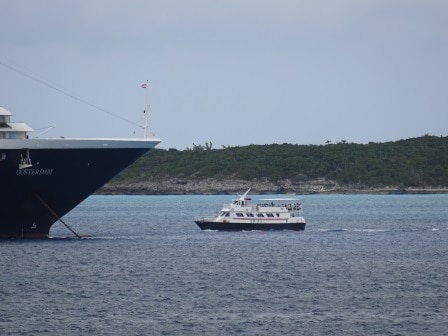
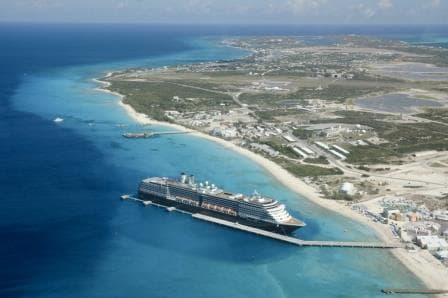
This is the Noordam at Grand Turk. Look around the bow and you can see how small the dark blue water area is.

This is the Noordam at Grand Turk. Look around the bow and you can see how small the dark blue water area is.

Tomorrow we will arrive around 07.00 hrs. and if all goes well we should be docked by 08.00 am. I hope that during the night the wind will abate a little bit as it is not much fun to dock with high winds there. The dock is fully exposed to winds as the land is very flat and the ship has no room to drift as the dredged out area around the dock is not very wide.

14 Feb. 2016; Fort Lauderdale, Florida , USA.

All the boys of the RSVP charter disembarked today and it took quite a while to accomplish this. With so many ships in port the CBP were hard stretched to cope with all those 1000’s of guests, but the few officers available coped admirably with what came rolling off the gangway. Embarkation could still start on time and thus all was well in the world. Even all our new guests made it to the ship as far as I know, at least those who were using a form of Holland America Line organized transport. We can keep track of those and thus we know if they are stuck somewhere and delayed. If operationally possible the Captain can then hold the ship while shore and port operations try to get them on board ASAP. If guests are travelling by their own arrangements it becomes much more difficult as we do not know what transport they are using, where they are staying or that they are even on the way. Some guests who run into delays contact our head office which in turn then contacts the ship and the terminal people but often we have so called “independents” missing and there is nothing we can do about it.

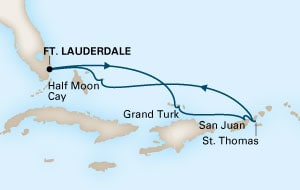
18 feb We are now starting a 7 day East Caribbean Cruise with calls at Grand Turk, San Juan, St Thomas and Half Moon Cay. Then next cruise we call at St.Maarten instead of at St. Thomas. The Nieuw Amsterdam will remain on these sorts of cruises until it starts the Transcanal and sails to the West Coast for the Alaska season. The place of the N.A for the Europe Season will be taken over by Koningsdam.  This seems to be a sort of established pattern ever since the construction of the Vista Class started. The newest ship sails Europe in the summer and once it becomes the 2nd newest ship it is assigned to Alaska. It will be interesting to see when the TBA –Dam comes out, if the Koningsdam will then go to Alaska as well. The only exception is the Eurodam which stays in Europe and that makes sense because of the name.

This brings me to the way the cruises are created/selected/ designed or better said decided upon. This is a whole extensive process which takes at least two years to complete. Because of this it is very difficult for HAL, or any company to quickly change a cruise. If political or health situations demand that certain countries are removed from the schedule, then cancelling is easy but redesigning the cruise is a pure headache.

What the guests suggest takes two to three years to work into the schedule for one of the ships. The biggest challenges are the port reservations. If you want to have a dock, especially in the smaller ports, then you have to be early and if there are more ships then the biggest one that fits, or the most senior ship on the run from last season will have preference.  So if you are in the seniority group then you try to keep that port in your cruise set-up for the next year or even the one after. Thus if we have to cancel somewhere, or pull out of the schedule for a prolonged time,  then the easiest alternative is to cruise to some larger ports where there will most likely be a dock available.

To give an example, if we would have to cancel Civitavecchia /Rome for a season then Livorno would always work as there is always ample dock space. Even if it would mean docking at a container dock.  If Livorno would not be in the proximity of Civitavecchia , then the nearest alternative would be Elba. That is an anchor port but with only two anchor spaces.  So if 5 ships had to omit Civitavecchia from the schedule who would get Elba??

The next important thing is the size of the ship:  Will it fit in? Therefore it is great to have a Prinsendam in the fleet, it fits nearly everywhere. Also it is one of the reasons Holland America does not want to go too big in their ships size as it severely limits the ports you can visit. Just compare the world cruise schedule for 2016 between the Queen Mary and our Amsterdam. Some ports are the same, some definitely not.

So tomorrow we are at sea and it will be interesting to watch the weather. A depression is coming over which will hit Florida tomorrow  and it is supposed to bring rain. For us it will be interesting to see what sort of weather it leaves behind while we sail for Grand Turk.

« Older posts Newer posts »