The Gulf Stream was indeed very strong and with an additional 3 knots in the back we were pushed towards the pilot station of Fort Lauderdale. The pilot station was all excited as the Zuiderdam scheduled for 0600 was behind us, instead of ahead of us. With both ships belonging to one company that does not make much difference so we switched pilot times around and sailed in ahead of them. This made much more sense anyway, as we had to swing in the inner basin while the Zuiderdam was swinging around in the Intra Coastal. They would have been blocking us, while we were not blocking them. It worked out very well and we were both docked at almost the same time. While sailing we could also solve the question of why we were not docked at berth 25, bow to bow with the Zuiderdam who was at the regular HAL berth of 26. There was a ship parked on Berth 25 which was loading a special cargo; yachts. Continue reading
Page 145 of 241
It has been very windy in the Caribbean Sea during the last few weeks and as a result the currents were much stronger than usual. That gave us a nice push in the back yesterday when we were mid Caribbean and last night a strong push against us when we were going through the Windward Passage. Normally the current & wind combination slow us down by about a knot or so but this time it was almost three knots. Once we were around the corner and sailing westward north of Cuba we had everything going with us again. We will keep that positive current all the way to Fort Lauderdale going with the flow of the Gulf Stream. As the Gulf Stream is an extension of the currents in the Caribbean it should also be stronger than normal. With favorable current comes less fuel consumption and I estimate that I can save on this stretch at least 10% compared to what is budgeted. That is not pure profit because when going the other way we will have to use more engine power as now these strong currents will be against us. My only hope is that above Cuba the wind is going to remain light and if so then the adverse current there should fall away. The Caribbean, especially the southern part, is to remain blustery and I will not be able to save much there. Continue reading
Today we had our first sea day after two hectic days and that gave the crew the chance to settle back into the normal routine of offering “HAL Life” on board. We have quite a few sea days on this cruise but it is always amazing the amount of items that are scheduled for the last two days. Nobody here on board complains about sea days, as a matter of fact is quite often the reason that guests choose this cruise, and all pay great attention to the numerous offerings listed in the daily program. This cruise we have over 900 Mariners on board again (those who have at least spent 21 days with us on cruises in the past) and indeed quite a few of them choose the Statendam for the Sea Days, including about 150 who will do the return trip as well. Thus we have guests on board who sail San Diego – Fort Lauderdale – San Diego and those who sail Fort Lauderdale – San Diego – Fort Lauderdale. For the latter there is always a fair number of Europeans who are doing this. Which makes good sense in a way. By the time you have paid for the flight from Europe to San Diego you already coughed up enough, so if you have the time why not add that additional 14 day return trip as well.
One of the responsibilities of a Captain is to ensure that a ship’s crew does not work too many hours in a week. For that there is Dutch legislation which coincides with the international labor laws under the ILO convention. Most seafaring countries are members of that convention and, ……..what is new……….; the captain has been made responsible to look after that. To ensure compliance the company has produced a computer program that makes it possible for each crewmember to log their daily hours. For that purpose we have terminals everywhere in the crew area’s and each morning the crew officer reviews if everybody has typed in their hours for the day before. Once a week, the Head of Department, enters a tentative schedule for the coming week and if the crewmember is only working during those hours then, he/she only has to confirm that. If there is a deviation then it is the responsibility of that crewmember to make sure that the variation is logged. The purpose of it all is to ensure that each crewmember gets at least 10 hours of rest each day. E.G Complete time off. For crew belonging to the deck and engine department, who run fixed watches, those 10 hours can be split in a 6 and a 4, but there have to be at least 10. For most hotel crew the split is 8 and 2 and some are lucky enough, such as the entertainment side who have much more than 10 hours free time a day. In emergencies and due to scheduled demands it is allowed to have less than 10 hours rest in a certain day, but then it has to be made up for the next day.
If this rule was not there, then a captain could not even work. There are (sea days) with good weather where he can get away with 7 hours a day but during a day such as the Panama Canal an 18 hour day is not unusual. So as long as the total work week is no longer than 91 hours and the 6 /4 rest rule is observed on a regular basis were are in compliance. A work week for a regular crewmember hovers somewhere between the 70 and 80 hours. That is quite a lot compared to a regular work ashore of 40 hours, but do not forget, when we go on leave we do not have anything to do for 2 or 3 months. (Except the Honey-DO list of course).
Compliance with these regulations is regularly verified by me and from the outside by Port State Inspections and the company itself by means of their internal audits. On occasion you read in the newspapers about reports where proof has been found that crew on ships were working too many hours and the resulting fatigue caused accidents or even shipping disasters. This is one of the reasons why the ILO rules are there and that is why it makes sense to live by them. There is hardly any reason to have a crewmember work so many hours. With good management, tasks can be redistributed and schedules optimized that even extra work can be absorbed into a normal the daily routine. And if we go over, then it is the duty of the captain to pick up the phone and call the office to ask for more crew to come on board. And that also works.
So today we a routine day at sea and I worked a little less to offset my Panama Canal Day. It still gave me the chance to do my Holland America Lecture in the afternoon, but I do not classify that as work, but as hobby. Tonight we sail through the Windward passage between Cuba and Haiti and tomorrow we will spend the whole day in the Old Bahama Channel, North of Cuba, sailing towards Florida. The weather looks good, sunny skies and following wind and thus the guests will have a great last day on board. A final day, unless you are of course one of the 150+ who also do the return trip.
Today everything worked like clockwork. Port Control and Pilots were in agreement about our arrival time and all other traffic was told to hold off until the good ship Statendam had duly entered Cartagena Bay. The pilot hopped on board exactly on time and 5 minutes later we were sailing through the Boca Chico entrance. From there it is roughly 45 minutes to approach the dock and that gave me the time I had hoped for, to swing around and dock stern in at the pier. The weather forecast was indicating very strong winds on departure and that would make it more difficult to swing around, to bring the stern up into the wind and then to make speed for lining up in the exit channel from the cargo port. On arrival it was wind still and thus perfect weather to swing around and be ready for a quick sail out. By 0845 we were happily docked for an official 0900 arrival. Continue reading
I am now going through the Canal for 32 years, as long as I have been at sea and it never ceases to amaze me. I am always impressed by the sheer significance of it all but also by the fact that it is never the same. There is always something happening, something that is not expected. Either good or bad. Those of you who have read my previous blogs about the Canal already know of the peculiar things that “happen” in the course of a transit and today was no different. As with each transit it starts the day before. We get the schedule that we duly publicize in the Daily Program or the Explorer as we call it nowadays. What then happens next are the modifications that the Canal Operations manages to make to it. Today the sting was in the tale and I almost managed to overtake the Zuiderdam which only spends a half day in the Canal, doing the Gatun Lake in/out cruise. Continue reading
Thus we spent our 2nd day at sea, sailing along the coast of Costa Rica and Panama. Because Panama is located in this curve of the continent it is a distance of 80 miles into the Bay of Panama from the moment you come around the SW corner of the country. We saw an increase in traffic on opposite courses and although not as much as I was expecting it meant that most of the ships exiting the Canal where either going South or West straight across the Pacific. This was confirmed when we came closer to the Canal and we could read their AIS transmissions. (Automatic Identification System) This is a gadget that each ship over 300 tons has on board and it continuously transmits ships specific information, such as name, position, heading speed, what sort of ship and where it is going. The ship appears as a little triangle on the radar and if you click on it with the curser, all the information is displayed. Thus we could see where they were going. One poor bulk ship had as final destination Geelong and was going to arrive there on the 27th of April. A voyage of a month of which much is sailing in Open Ocean and seeing very little. I wonder what they do on that ship to avoid boredom??? Continue reading
It is a distance of 879 nautical miles (0r 1011 land miles or 1628 km) to Amador from Puerto Quetzal. That makes a timely departure necessary and then all the way we have to keep up the speed to ensure that we arrive on time for the evening tours in Panama. On the way we have the current against for the last part of the voyage, plus we can have the wind when we sail of Nicaragua. When you look at the map you can see that Nicaragua is located in this recessed section of Middle America. We are sailing on a straight course and that means that we have a large open water area to the port of us until we reach Costa Rica. Nicaragua is a low lying country with a large lake in the middle so Caribbean Trade winds can easily blow through to the other side. It is never as bad as in Tehantepec where the gap in the mountains is much smaller, but still it can be very windy here. The problem is you never know from which side it will be blowing. This time we were lucky, the wind was with us and that might have even helped with the speed. But at least it did not slow us down. It is very peculiar to see this phenomenon, at 11.55 it is blowing a good wind force 7 and then 10 minutes later it is wind still when the ship has sailed passed the windy area. It looks indeed as if somebody just switched the wind off. It caught my fourth officer completely off guard. He is preparing my daily voice from the bridge and takes great pride in having the figures exactly right. Thus it was a bit startling for him when he gave me the paper, and then to turn around and see that wind force 7 had just changed in a wind force 0. Continue reading
It was an early morning and it looked like it that we were the only ones awake in the port. As a matter of fact we probably were, as we could not get any answer out of Port Control. So we called, yelled and screamed for over an hour on the various VHF channels but deadly silence remained. The only thing that really helps then is to park the ship squarely in front of the entrance so that nobody can get in or out. That always makes a lot of people nervous and nine out of ten times it results in very quick action from the other side. And so it was this time; with the Statendams well lit “bulk of superstructure” suddenly looming over the breakwater, the VHF spluttered into life and port control had an AHA Erlebnis as the Germans say. A lot of incomprehensible Spanish spouted forth and the pilot boat came racing out of the port. By the time a highly flustered pilot had made it to the bridge, I was already on the way in. Still the whole affair cost me half an hour, so I was very happy with myself that I had set the arrival time a bit on the early side. We have to be docked in Puerto Quetzal by 05.50 to get the flight tours off at 06.00 hrs. We just managed that. The gangway was pushed ashore by 05.51 and at 0600 the tours were streaming off the ship. I was not a happy camper of course with this delay and let the whole wide world know about it. But Puerto Quetzal is a cargo port and they have a hard time understanding the clockwork operation of a cruise ship. And what Port Control does during the night is everybody’s guess. Continue reading
The Golfo the Tehuantepec indeed behaved itself and we observed no more than 20 knots of wind, a nice and quiet day for that area. By the time were past it, the wind dropped down to nearly zero and we knew that the weather forecast had been right. Our pilot was on time and he was a very proud man, showing off his new pilot boat. It was even equipped with flashing lights so from a distance it looked like it as if it was an American police car, half submerged, going through the water. Sailing into Puerto Chiapas is always an event, it looks so simple; just keep the ship in the middle between the breakwaters and you are in good shape. But things are not that easy here. There is always a little bit of swell which makes it difficult for the Quartermaster to steer as it pushes the stern off the intended course. That means that you have to give rudder orders and anticipate where the ship will swing to. It is MUCH easier when there is a lot of swell, then you simply cancel the port as the swell reduces the depth at the entrance too much. Continue reading
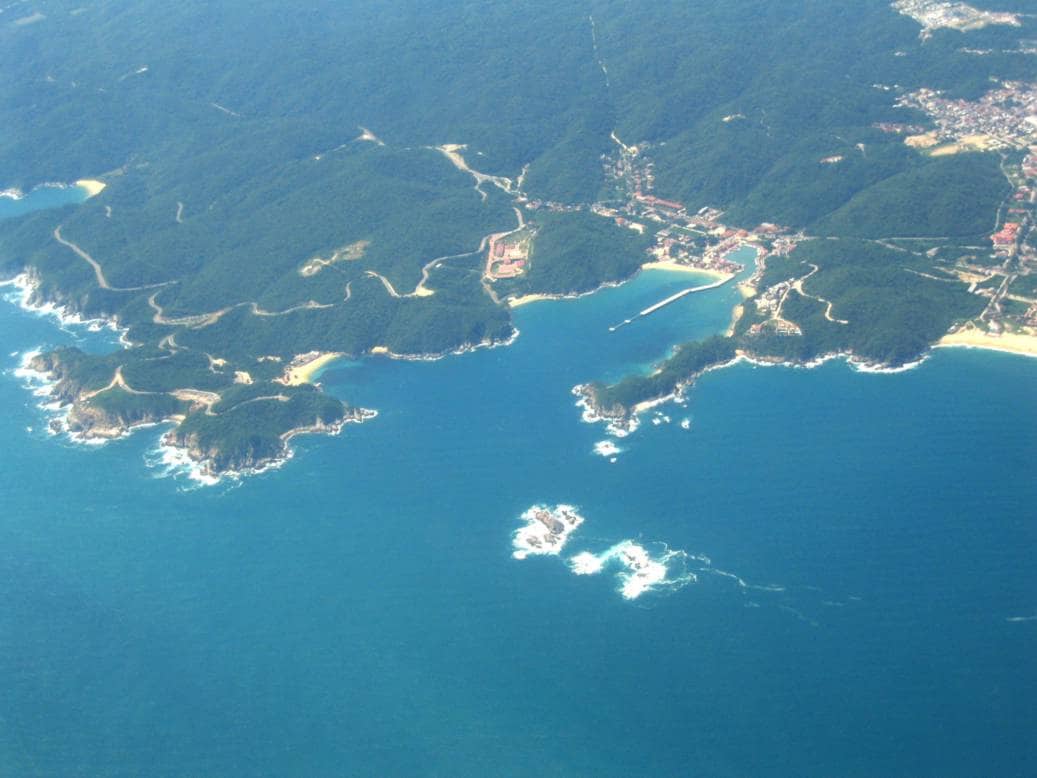
There was no sign of any earthquake damage when we arrived at Hualtalco so the information provided by the agent was correct and we could look forward to a very nice day in his port. A very nice day but also a very warm day. Huatalco is basically a small bay with a large cruise ship dock in it. It is a resort created especially for the cruise ship business. With high hills surrounding it on three sides it provides shelter from wind from all sides except the south west, as there is the entrance to get in and out. That is very nice for me but it also means that the cooler sea breeze cannot enter this bay easily. If the temperatures in open waters are around 75oF then in Huatalco you can easily add another 15oF to it, bring the noon time temperatures up to the low or mid 90’s. If there is a South Easterly wind coming in, then that is quite often accompanied by south easterly swell and then captains already start worrying about whether they can still make the call, as you cannot dock with too much swell running along the dock here. Continue reading
Captain Albert
© 2026 – Captain Albert's Website and Blog –
Theme by Anders Noren — Up ↑