- Captain Albert's Website and Blog -

Ocean Liner History and Stories from the Sea, Past and Present. With an In Depth focus on Holland America Line

Page 113 of 242

20July 2014; Seattle – USA.

Everything went as planned and by 0630, the ship was all fast under an overcast sky and with next to us the Grand Princess who is basically sailing the same cruise as we do and therefore never very far away.  In some ports they sail earlier than we do and in some ports they arrive later but in principle it is the same route that they follow. As both companies are now part of the HAL group (Consisting out of HAL, Princess, Seabourn and the Hal/Princess land tour part) it is basically one happy family that sails around in circles here. As with any change over port, the routine is the same as always, a very busy routine, which meant that apart from paperwork I was not in action today. I had my days outing courtesy of the CBP, as I had to oblige with the zero count = empty ship, required to ensure that everybody has gone through the CBP check and an hour later I was back on board.

The lack of adventure for today, gives me the chance to blog about something else. It has been announced a while ago already but it will come back time and time again until November 2015. And that is the transfer of the Statendam and the Ryndam. Two beloved ships but also part of the oldest class in the fleet.

A few years ago, our CEO Stein Kruse mentioned in a cruise magazine that he saw Holland America’s optimal size of fleet being 15 units. And now we have a 16th being readied, the Pinnacle-dam. (That is not the official name but the ship belongs to the new Pinnacle class). Based on that statement I was not so surprised for an announcement to be issued that one of the ships would have to go. I also was not surprised that it would be the Statendam as she is the oldest one. I had not expected two ships at the same time. Although the order of our new ship, also called for the option for a 2nd one, so maybe there is something there.

Now you can sell two very handy sized ships for a good price to a buyer but then they come back as direct competitors. Thus Carnival has instigated the policy to send smaller units to new markets. As a result the Statendam and Ryndam will go to P&O Australia. This company is also part of Carnival Corporation and Australia is very much an upcoming Cruise Market. The challenge is the size of the country, or better said the Continent. If you want to make cruising easy for newcomers, you do not want to have them fly for hours to something they do not know. But if you can get the ship to their doorstep, they might go for it, and once you have the cruise bug, you are hooked for life.

The way the ships might look like after the hand over. (Photo Courtesy; a creative soul on the internet, name unknown)

The way the ships might look like after the hand over. (Photo Courtesy; a creative soul on the internet, name unknown)

Thus down under is very much a target area for Carnival Corp and that means that you have the start with smaller ships. In the same way as they developed the Spanish market with Iberos Cruceros. Also here smaller ships haven been brought in already. P&O Australia has a number of ships that are smaller units of P&O/Princess.

The changeover will start in November 2015 when both ships will receive a makeover to get them ready for the Aussie & Kiwi market. I do not know what this make over will entail but I would be willing to bet a few dollars on it, that they will install another bar or two, as they do like a drink down there.

I will be sad to see the two ships go, as they were very beloved by our guests. I liked them as well, as they were very handy in maneuvering and had a lot of power for their size. However in order to keep the majority of our clientele happy, the company has to continue offering the latest in the industry and that means constant renewal.

Down under they are ready for them. The first thing they did was start a competition for new names and recently the two names chosen were announced.

new names s classThe ms Amsterdam sailed under its own name on time from Seattle, ready for the next round of Alaska, with a full house of excited guests. The weather for tomorrow gives for little change, so we have to see how it will develop in the coming days. I need wind still weather in Juneau, as my classes have to mess around with lifeboats again.

19 July 2014; At Sea.

This band of rainy weather is stretching down all the way from Ketchikan to Seattle and the normally very green island of Vancouver looked very grey and dull when the shore line came into view around 11 am, when the ship approaches Strait Juan de Fuca. Normally it comes into view as thin green line and when coming closer it turns out that the thin green line is a mountain range. Today it was mostly obscured by rain clouds.  Those clouds stayed nicely high up in the sky until around 14.30, by now the ship was well inside the Strait and here the temperature difference was still such that the clouds descended onto the water for about 2 hours. And that meant that the whistle was happily blowing again its 2 minute cycle. When we neared the Northern part of the Puget Sound, the world opened up again.

It was very windy, so the parade of Seattle ships had quite a challenge to get inside Victoria. The pecking order this time was NCL first, followed by, followed by us. The wind was almost due east, running a wind force 7, and that meant that docking was luckily still possible. The berths at Ogden Point are SS/NE in line up and thus the wind was mainly on the stern, making the drift of the ships controllable. But it all took more time than usual, so the gangway went out a little bit later than normal. Luckily Canadian Authorities are very quick in clearing ships if you have your paperwork in order, and 15 minutes after the gangway was out, most of the guests could stream ashore.

For some it was their first time in Canada and I overheard two rather startling observations. One that Canadians in Victoria spoke English, secondly that the road signs had funny words on it. Obviously the fact that the Canadian road signs are in two languages had not yet reached the depths of Kentucky. I assume the guests came from there, as they had one of these sewn-on signs on the handbag: I am proud to come from Kentucky. (American Flag to the left, text to the right). Well at least they learned something. Travelling does broaden the mind. If they were from somewhere else, then I apologize un-reservedly to all people from Kentucky.

We also have a group of Texans on board, who proudly walk around with large cowboy hats on their heads. They turned out to be quite handy in Ketchikan. At least the ones that  were made of solid material, and thus looked waterproof. One gentleman was wearing a straw version and that hat slowly started to wilt under the constant rain and drizzle of the Ketchikan weather. Obviously where he lived rain was not much of an issue.

Victoria harbour as seen from the air.

Victoria harbour as seen from the air.

Victoria is a nice city which I like very much, so it is a pity that this is only an evening call. For most of the crew it is of no use as they are all working in the evening. Plus as the city is curved around the port, it is not so easy to run into town for a few minutes. Something you can easily do in Vancouver.  So most crew come to Victoria with the ship but never see it. Only on occasion we have a full day call, when a ship is on a repositioning cruise. It is in a way a pity that Victoria gets most of its summer traffic in the form of evening calls by ships which have to comply with the Jones Act.

Having that done, the Amsterdam pulled out just before midnight for a quick dash south through the Puget sound to dock in Seattle at 06.30. Again the same parade of ships, with the NCL one heading for downtown and HAL and Princess to Pier 91, more to the North.

The weather for Seattle is forecast to be about the same as to day. Overcast with temperatures in the mid-fifties, chance of showers but not much of it, and that is not bad weather for travelling.


18 July 2014; Ketchikan, Alaska.

The whole ship woke up to a real Ketchikan day. Maybe not as advertised in the brochures, but in the way the locals know it. Wet, very wet. It rained, it drizzled and then it drizzled some more. As mentioned in my Ketchikan blog of last cruise, for the final port in the cruise it does not matter so much. At least not for the majority of the crowd. There are still many who are on a shore excursion but they see Ketchikan the way it really is, so how can they complain? For the rest it is the final opportunity to buy a keepsake to take home from the cruise. And the town was there to help. We were docked by 7 am and a number shops were already open by 7 am.

Today there were four ships in, two Holland America, two Princess and a NCL ship. Delivering just short of 9000 guests to Ketchikan.  Not to mention the crew, who get excited about Ketchikan, just for one reason: Wall Mart. When you live on board you have to keep your priorities in order and that means knowing where to shop. So the pecking order is here: Vancouver for noodles, chips and clothing. Juneau (Costco) for electronics and Ketchikan for everything else. A crewmember’s bane in life is always the fact that good shops are seldom near the cruise terminal. If they are there, then the prices are exorbitant. Understandably as the lease for a shop in a prominent location is probably exorbitant as well. A tube of toothpaste on Ketchikan Sea Front is often 75% dearer as when having the chance to go away from the tourist area. Thus paying for a taxi is worthwhile if you stock up for a longer period. Some taxi owners in Juneau have seen the logic in that and there is now a larger number of little vans or MPV’s that take 6 crew at the time to and from the shops in the valley. The taxi people still get their business and the fare for the crew remains reasonable as it can be split four or six ways.  I normally bring my stuff with me from home, as I am married to a very thrifty shopper, good price comparer and bargain hunter, and that is thus where the best prices are. Until now I have never been questioned by customs why I have 5 tubes of toothpaste in my suitcase. But today I ran out, so I had to dash across the street, and yes it was about 75% dearer.

Most of my time today was again spent with training for the roll out of the new Three Alarm System which greatest advantage is that its sequence creates more time for everybody to get ready. If there is an emergency, then everybody starts preparing at a much earlier stay, during the 2nd stage of the cycle, and is really ready in case the ultimate decision has to be made. The crew appreciates it as well, the time spent on drills might now take longer but everybody feels that it will work better. Although during an emergency a crewmember will turn into a barking sergeant major, to get everybody to their muster stations, the feeling will always persist that if you can do it in the most comfortable way, then we should do that. We are after all still people who work in the service industry.

Apart from the Lifeboat training for a group of 33 participants, my main focus is on getting the whole crew ready to get a handle on this new three step alarm system. That means that they will get an introduction of about 30 minutes and then a group specific training of 45 minutes. The challenge is to catch them when they can attend. For small groups we have a crew-training room on board but for larger groups I need a public room in the ship. Show lounge, Movie theatre, Card room, wing of the dining room, anything goes a long as there are enough seats and I can hook my computer up for a power point presentation. Those rooms are not always available, as on sea days the guests have their activities there and that results in some creative scheduling by the ships management to make it all possible. So I might give a training in the very early morning, or in the late evening.

The greatest chunk of all these presentations deal with Crowd Management. Since the booming of the Cruise Industry from the mid eighties onwards; a lot of research has been done into the behavorial patterns of larger numbers of people on a ship.  Studies about the best flow of public rooms, about the best flow from cabins to Muster Stations, but also how to communicate with large groups.

The latter point is the biggest challenge for all of us. When there is something going on; and an announcement is made: 60 out of a 100 do not react. 35 out of a 100, wants to do something but does not know necessarily what and the other 5 might push the panic button.  This means that more announcements have to be made and then the 60 will follow the example of the 35 and do as being told. This is not only in an emergency, but also during a simple procedure as the routine for going ashore with the tenders, when the ship first arrives. The Cruise Director explains it all, it is in the daily program, but still the Front office is bombarded with questions about what to do. Last Sitka I spent 45 minutes watching this at the Front Desk and that period 61 guests came over to ask the question: where do I get my tender ticket and from where does my Tour leave ? Not counting those who got hold of a crewmember before they reached the Front Desk. So out of the 800 who goes ashore, roughly a 100 still need to be told again what to do and where to go, on top of the announcements and the published information.


Based on that behavorial pattern, I try to provide the crew with some tools to get the message across and prevent the guests on board from reacting to rumours, as that causes a ripple of uncertainty in the ship and that leads to panic. Only 5 out of  a 100 might react that way, but if we can stop them in their tract, then we have a very safe and simple procedure we can follow.


17 July 2014; Sitka, Alaska.

It was a mainly dry but overcast day today, which is about Sitka standard. It is always nice to have a sunny day but it is by no means the norm. Ketchikan has 332 rainy days a year and if you catch a sunny day there, then it means it is something extra ordinary. For Sitka a dry day is not a bad thing either but as it is open to the North Pacific Ocean, the weather is more regulated by the sea. Ketchikan gets the rain drifting in from the sea and then more rain is released by clouds bouncing back from the mountains.

The Amsterdam was the only ship again and as it was a windless day, parked in the inner anchorage, reducing the tender distance to a minimal length. The Azipods kept the stern in position, the bow was held by anchor and there she sat happily for the rest of the day.

Since a number of years, the locals have been building out onto the islands around the anchorage area. I suppose the year by year influx of tourist money make it affordable to construct an island house or a chalet or cottage as it is not cheap. All the work has be done from a barge, and as some islands are nothing more than rocky outcroppings, pilings have to be installed to make a level floor possible. Most of these houses are for lease in the summer and very much in demand by people from down south who come fishing for a weekend or a week.

A number of years ago, one of the lighthouses which guarded the old approach to the harbor was converted in a luxury B&B and in the light chamber a Jacuzzi was installed. Very romantic of course but you have to climb all the steps up and then back down again. Also this B & B is currently for sale. It looks like that the generation that I knew from the 80 & 90’s are starting to retire and are cashing in on their assets.

Today my lifeboat classes were busy with learning about the inventory of the lifeboats. Basically everything is set up in such a way, that if you do not know what to do, or you have forgotten something, there are instructions for everything. It varies from how to start the engine, when to hand out food and water, to attracting attention when help is nearby. Some of the inventory is from days gone by, when the crew did not wear lifejackets and the boats were from wood. Thus having 2 axes in the lifeboat is of limited use as the lifeboat is now made of polyester. There is also the requirement to have a whistle in the boat. Nowadays every lifejacket has a whistle, which makes this one then number 151 to the total count available. But in the old days there were no lifejackets, hence the whistle requirement.

TPA or Thermal Protective Aid. The retail for about $ 15,-- and no boat should be without one.

TPA or Thermal Protective Aid. They retail for about $ 15,– and no boat should be without one.

Other items are of more use, such as TPA’s, or Thermal Protective Aids.  They are a sort of silver one-sie and you use them to warm up a under cooled person. They work extremely well as they reflect all the body heat that you lose straight back. I tried it once, and it made me feel like a Baked Potato in a microwave. So even persons with advanced hypothermia can be warmed up quite quickly.  It is a very good tool to save lives.

Eating the food rations is also always of interest. Today one of them hit the nail on the head. She said it tasted like Scottish Shortbread and it does. The ingredients are similar and shortbread was also developed by the Scots as travel rations when wandering over the highlands.  I wonder how close our current rations are to the original shortbread recipe, as I know that bakeries have been tinkering with it, to make it the worldwide cookie-success it now is.

The ship left right on time and put the pedal to the metal as it is a tight run to Ketchikan for a 0700 arrival. The ship will sail in outside waters until it re-enters the Inside Passage near Cape Decision and then goes via Sumner strait and Tongass Narrows to Ketchikan.

It will be a real Ketchikan day tomorrow, so liquid sunshine for most of the day and with 4 ships in, it will be busy in the shops.

16 July 2014; Juneau, Alaska.

Today we had weather that pleased everybody. It was dry and mainly overcast, hardly any wind and not too warm. A perfect day for sightseeing and shopping; and for the professionals not to be worried about getting low hanging clouds during the night. The Amsterdam was the first of a whole parade of ships coming in. During the day the Statendam arrived, followed by the Crown Princess and the Golden Princess. Together good enough for bringing over 7000 guests ashore. Life as a shopkeeper cannot be too bad in Juneau. Most of the shops in the downtown area, large and small, have been there as long as I remember. Some have grown in size but none have closed their doors. Except the Harley Davidson store near the Alaska Steamship Berth. That was something that did not amaze me at all. The road in Juneau only runs from the airport to just past the cruise terminals. I think the maximum length is 32 miles or so and that must lower the demand for a – King of the Road – touring motorcycle dramatically. Guests cannot take one on board and means that the only business would be merchandise. And how many motor HD enthusiasts would there be among 6000 guests coming ashore? In Ketchikan the HD sign is still on the front of one of the shop buildings but I do not know if they are still inside. Something to look at next time.

Today was lifeboat exercise day for the crew that needs to get the Lifeboat Assistant certificate for the new 3 alarm system. Juneau harbor is a perfect place for that, as most of the time Mount Roberts shelters the port from the wind and even if there is wind, then the free water surface area available is not enough to whip up waves. When lowering lifeboats with trainee’s inside you do not want waves as it makes the un-hooking of the boat more complicated and dangerous. Today all was quiet and team after team went down into the water, maneuvered and played with the boat and was then also instructed in the art of – safely coming back – to the ship.

All the crew are from the hotel department and vary from Entertainers (cast) to TV technicians, dining room stewards and even people from the Laundry.  Although this is pure routine for me to help out with something like this, it is still always interesting to see how amateurs from a totally different background take to the whole proceeding.

The topic that suddenly surfaced today was the lack of a toilet in a lifeboat. So how do you go, when you have to go…….?  Answer: bucket behind a curtain. Suddenly all interest was focused on where to get a curtain, what could you use as a curtain and how would you rig such a thing in a lifeboat. It is amazing what people can come up with – thinking outside the box – when necessity and urge grips them.  So from 2 oars and a sea anchor it was deemed possible to screen off an area for privacy. The fact that this contraption took over half the lifeboat and thus most likely would not work with 150 people in the boat was not considered relevant. And I did not feel to be the right person to shatter their dreams.

So I am happy to say, that after 33 years with the company, I still come across new things that I have not experienced before. A sort of wigwam/tepee inside a lifeboat. Original it was, but practical??

Tomorrow we are in Sitka and then the trainee’s will get lifeboat inventory lessons and the chance to taste some of the emergency rations. That is also always a source of good fun.

15 July 2014: Tracy Arm, Alaska.

Part of an Alaska cruise is looking at Glaciers, and there are several options. In the Gulf of Alaska it is popular to go to Hubbard Glacier, in the Inside Passage it is of course Glacier Bay, which is the most popular, but then there is the 3rd option and that is Tracy Arm. This is an inlet, a fjord located south of Juneau.  It is not so wide and deep as Glacier Bay but the mountains are very steep, raise very sharply out of the water and come very close to the where the ships sails.  It resembles the Norwegian Fjords very closely.

Where a ship goes to see ice depends on several factors. First for Glacier Bay you need to have a permit; a permit which is issued by the National Park of Glacier Bay. They only issue so many permits a year and also not more than 2 a day for the larger ships. If a cruise company does not get a permit, then the ships are not allowed in. Holland America is the most senior company visiting Glacier Bay and that gives a sort of preference. But also the ships & company are rated every year in how they work with Glacier Bay to offer the best Nature Experience. Running bingo while the ship is in front of the Glacier is not considered to be part of a good Nature experience. Holland America does it’s utmost to give the guests the best experience possible and works closely with the Park Rangers to make it better and better every year. As a result the company always gets sufficient permits.

Then there is the schedule to think of. Sailing from Seattle takes at least 6 hours longer, which is nearly a full port day, going up and going down. Glacier Bay is the most northerly point on an average Alaska cruise and from there the ship has to get back to Seattle on time. If you go to Glacier Bay, while on the Seattle run, it means one port less in a cruise compared with a Vancouver 7-day cruise.  Going down to a two port cruise is not much fun and thus for the schedule of the Amsterdam, calling at Tracy Arm works very well. It is on the way to Juneau, which means you do not have to go out of the way to get there, and a apart from calling at Juneau, you can still call at Sitka and Ketchikan. Do 3 ports and still make it on time to Seattle, with an evening call at Victoria thrown in, to comply with the Jones Act.

Other Companies who do not have Glacier Bay permits only have the Hubbard Glacier and the Tracy Arm option. Holland America can offer all three in its brochures. Lately we have not been offering Hubbard Glacier very much, as it is rather un-predictable. The Glaciers there are so wide and they calve off so much ice, that often the ships cannot get close enough to the Glacier wall as the fallen ice is completely packing up the bay. If you can get close, then the spectacle is much more impressive than Glacier Bay………. but you never know. Glacier Bay is a steady performer and we know that the guests will get what they pay for.  With Hubbard you might hit the jackpot but not if cannot get in, and you do not want to disappoint guests who have saved all year long for that one cruise to see a glacier.

Tracy Arm, a long bending fjord south of Juneau

Tracy Arm, a long bending fjord south of Juneau. At the end is south Sawyer Glacier where the ship stops.

So the Amsterdam calls at Tracy Arm and can still offer 3 Alaska ports during its cruise. The glaciers are normally quite active, so there is calving and you can get close enough to that glacier to be impressed by all its majesty. It does offer one thing which Glacier Bay does not have, very steep mountains on either side and a ship that sails by very close, while still in very deep water. This is an afternoon call, from 1400 hrs. to 20.00 hrs.  and while sailing out you get the additional bonus of a setting sun which colors the steep cliffs in a sort of golden hue.

Today was a very good day and the ship could sit near the glacier and see it all happening. By 5 pm we turned around and while it was leaving the basin in front of the glacier the Norwegian Jewel came around the corner. Everything perfectly organized. The sun sets at 21.53 hrs. and even then it stays light, so also for that ship plenty of time for sightseeing with plenty of time left to get outside again. The whole inlet or Arm is full of scattered ice cubes, large and small and thus you need daylight navigation in this area.

We were back in fully open waters by 9 pm.  and then aimed for a 0700 arrival tomorrow morning in Juneau.

14 July 2014; Sailing North.

I had some connectivity problems, so three posts in a row. This is number 3

When we pulled out of Seattle, the Puget Sound looked very nice with the sun shining and not much wind. A great view on departure. So I was getting worried, how long would it last. The ship was going the same way up North as it has come down, sailing around Vancouver Island. I was not disappointed or better said I was, as I had hoped to be wrong. The ship had barely entered the Strait of Juan de Fuca when the whistle started to blow again. As I had expected it, I had gone to bed early to catch at least a few hours of sleep.  I did not envy the captain and staff captain at all, as the very low hanging clouds persisted for almost 24 hours. From Yesterday, Seattle day 1900 hrs. until today, nearly at the same time.

Luckily as the ship has to take this route, there is not that much to see when the clouds are high in the sky and the guests did not miss that much. The whales that can be seen here in abundance in spring and autumn are now in Alaskan waters eating their belly’s full and we will see them later. As it is the first day of the cruise, the guests are milling around in full force trying to figure out of how the ships lay out works and where everything is. As it is high summer we have a large amount of children on board (at least “large” for HAL standards) but the 4 Club Hal Team members keep them safely “locked up” inside Club HAL. Most parents are quite happy to drop the kids off in the morning and collect them again in the evening again. Sometimes they are being picked up for lunch, but normally after the first day little Johnny prefers to stay at Club HAL and far away from his parents.

As with every HAL ship, the Amsterdam is full of antiques and memorabilia from the Dutch Empire days and some recent items as well. We have on display a woven tapestry made by one of the members of the Cobra group, Karel Appel, which was very famous in the 1960’s. I still have not figured out what the tapestry is supposed to symbolize, but maybe that is the purpose of it.

ms Amsterdam forward staircase deck 9

ms Amsterdam forward staircase deck 9

What I have figured out is a display of gold colored fairy’s hanging in the staircase on deck 9 just outside my cabin. I knew I had seen that before, on another ship, somewhere in the past. Yesterday I read the name plate that goes with it and then it clicked into place. Nieuw Amsterdam 1938, far before my time, but I had seen it on photos in my collection. So time to check the files and yes there is was.

ss Nieuw Amsterdam II First Class Lobby

ss Nieuw Amsterdam II First Class Lobby

The Four Seasons by the Dutch artist Leo Brom had originally hung in the First Class Lobby of the Nieuw Amsterdam II and now re-surfaced here on the Amsterdam III. As I have never seen the Nieuw Amsterdam II in real life, I was 15 when she went for scrap; it was a nice moment to recognize a real life piece of this ship. There is still quite a bit of items from the ship around. A lot was taken off before she went to Taiwan. Some is located in the Maritime Museum, some in an art museum and some is in the hands of collectors.  I have been told that some items are still for sale in Kaohsiung, near 40 years after the scrapping.  I will have to do some digging to find out how this piece survived all those years and how it ended up on board this ship. Holland America does not maintain a depot for its ship art so it must have come from somewhere else.

The ms Amsterdam will continue to run up the West coast of Vancouver Island, then pass the Queen Charlotte Islands and then early tomorrow morning, enter Chatham Strait to pick up the pilot at Kake, where the Alaska Inside Passage starts. Tomorrow afternoon the ship will be in Tracy Arm, looking at Glaciers as the Amsterdam is not visiting Glacier Bay. I mentioned in a previous blog that in the old days Holland America was always in port alone. That is no longer the case, 3 to 4 ships is the norm but even in Tracy Arm, off the beaten path, we will not be by ourselves as somewhere inside we will meet the Norwegian Jewel.

The weather forecast calls for overcast skies and chilly northerly winds and that will mean that the chance for very low hanging clouds it not that great. So maybe we can put the ships whistle to bed for a few days.

13 July 2014; Seattle, USA

I had some connectivity issues, so there are three posts in a row.

Since a number of years Holland America has used Seattle as a home port. This was not always the case. When the company came to Alaska back in the 1970’s it sailed from Vancouver. Partly because of the Jones Act and partly because the ships could not make the speed needed  to do a real 7 day Alaska adventure from Seattle. Plus there were not that many cruise ships going to Alaska anyway. Apart from Holland America there was the occasional Princess or Cunard and a few one off calls from other companies but that was it. When I came to Alaska for the first time in 1982, we were always the only ship in port, so sparse were the number of ships out there. Holland America dominated the market because it had the infrastructure of Westours with its hotels, coaches and hinterland experience.

Alaska grew quickly in popularity, HAL and Princess expanded and we saw more ships of Sitmar appearing. Then Crystal Cruises came, Cunard showed up and even a student ship called the Universe Explorer sailed for years and years in Alaska.   It was real boom town in its expansion, a sort of gold rush but with the gold in the bank to pay for the cruises. Vancouver benefitted greatly from all of this, and when Expo 86 came, they grabbed the chance to build a new cruise terminal at the same time as the Hotel(s) that were needed to cater for all the Expo Visitors.

Holland America offered in those days Gateway fares with the cruise. It meant that you could fly free as long it was inside the lower 48 States. Guests flew to Seattle and were then bussed to Vancouver. It was normally a smooth operation but on high days and holidays there could be long delays at the border. I once experienced such a delay and the ship missed the favorable Seymour Narrows tide and as a result arrived late in Ketchikan.

Seattle had a port, quite a big one, although they were not really set up for cruise ships with really nice terminals that came later.  But the cruise company’s started to play with the idea to have ships going from Seattle. First to reduce the congestion in Vancouver, 2ndly to reduce costs by having at least a number of guests going to the ship directly instead having to be bussed to Vancouver. The newer ships could make the higher speed needed to get around Alaska from Seattle in seven days and so Seattle became a viable option.

Since then Seattle has come a long way and there are now 2 cruise terminals capable of handling 2 ships each. The downtown berth, occupied by Celebrity and NCL and Pier 91 more to the North and in use by Holland America and Princess. The latter makes sense as HAL and Princess are now part of the HAL group within Carnival and closely cooperating anyway. I had a look at both piers and although, the downtown one looks more glamorous, being close to the city, the HAL pier has a lot more space and better infrastructure. The difference in Taxi fare is $ 3.50 and that won’t break the bank either.

The bunker barge with the hose going inside the ship. On average a barge like this can pump 400 tons of fuel an hour.

The bunker barge with the hose going inside the ship. On average a barge like this can pump 400 tons of fuel an hour.

So it was to this terminal that the Amsterdam came in the early morning, with the whistle working overtime as the low clouds only parted once the ship came closer to the dock.  The ship is on a 7 day cycle which means that fuel bunkering and provisioning takes place about every 14 days, and that was today. The bunker barge came alongside, stores and provisions came on board and another 1000 & 1 things needed attention. On a day like this every crewmember is busy, very busy, especially if the supervisor is also trying to give a few of his team a few hours off, which means I cannot do any trainings.

Therefore my focus was on 2 things. I had to go through immigration, which will be a weekly occurrence as the CBP wants an empty ship before embarkation starts ( I am part of that, as I am not an official crewmember at the moment ) and phoning my wife.  That took care of the morning and then administration called.  Plus I have to go to Guest Boatdrill as I am parked in a passenger cabin for this cruise.

12 July 2014; Victoria, British Columbia.

I had some connectivity issues, so there are three posts in a row

As expected the white clouds did decend on us as soon as the ship came closer to the Strait of Juan de Fuca. Here the combination of warm – sun heated – land and the cold water of the Northern Pacific being pushed into the Strait created an ideal temperature balance, or disbalance, depending on your point of view, to change the view around the ship into a small white world. Around sunrise the whistle started to blare and keep doing so until near mid day the sun finally burned the fog away.

As the Strait is a very busy area, serving the Whole Vancouver Area, but also the ports around the Puget Sound such as Seattle and Tacoma, there is constant stream of ships going both ways.  To make sure that they are all behaving themselves, The Traffic Management Stations were established. Further on the Strait has been divided in an outbound lane and an inbound lane. Outbound is on the Canadian Side and Inbound on the American side.  Since the 1970’s these systems have been introduced in all traffic hotspots and bottle necks in the world.

In the Strait they serve three important purposes;  A. creating some order in the way ships enter and exit the Strait near the Pacific. B. In the Strait set clear boundaries to keep fishermen away from the large ships, which sometimes can hardly see them C: create a system that makes it possible for Ships to safely split to various routes once approaching the Puget Sound. The latter resulted in several Round – and- about systems where ships are forced to follow a counter clockwise course and thus always safely pass behind another ship, instead of trying to cut across and run into a dangerous situation.

Ships like to sail in straight lines to save time and fuel and not every mariner is a “prudent” mariner as the law requires and hence the implementation of the VSS system, or Vessel Separation System.    This system forces ships to sail safe courses and you are only allowed to be a little bit creative in following the standard tracks, if there is absolutely no other traffic around.

This meant that the Amsterdam first sailed to the end of the Strait of Juan de Fuca and then made a 90 turn to the north. By that time the low clouds had been burned away and the guests had a beautiful sunny approach to Victoria.  This was by 16.30 in the afternoon and apart from seeing other cruise ships approaching (who also have to comply with the Jones Act before going to Seattle) wildlife gave quite a show as well.  A 100 feet from the ship a Humpback whale found the time to loudly applaud our presence with half jumps out of the water and beating the surface with its flipper.

There was a stiff breeze blowing to the North, and that meant that the ship had to go nearly broadside onto it to create a good lee for the pilot boat. With a strong ebbing tide running against the wind, the water looked a places as if a washing machine had gone wild, with white crested eddies.  Of course with the wind pushing against the Hull and the funnel and grabbing onto the balconies, it causes the ship to list, so if you do not know what is going one, it all looks very peculiar. The ships is turning away from the port and starts to heel.  But safetly first for the pilot and nice sailing second.

The ms Amsterdam docked this time where in this artist impression we can see the cargo ship.

The ms Amsterdam docked where in this artist impression we can see the cargo ship. Victoria – Ogden Point.

The harbor of Victoria is located NE to SW and laying in a sheltered curve. So a true southerly wind it not much of a problem for a safe docking. Victoria is issue if a wind is blowing from the SE, as that brings it perpendicular onto the ship.  Today while there was a strong wind outside, it was fairly calm near the dock.

I did not go ashore for the evening call although there is a very nice 2nd hand book shop in the main area of the town, but it has the tendency to close at 6 pm.  So I spent my time trying to figure out which Elevators on this ship are running on Emergency power. There is always one in each elevator bank, but which one varies from ship to ship.

Departure is set for midnight, with a 6 am arrival in Seattle. That means a quick dash through the Pudget Sound and with the sunny weather that we had all afternoon, I would not be amazed if the clouds come down again. So I will make it an early night and catch some sleep in case the whistle starts again.

11 July 2014, At Sea.

Because the ms Amsterdam does the Sitka to Seattle run it has the option to go either inside Vancouver Island or to sail around it and re-enter the Inside Passage via Strait Juan de Fuca. Going inside Vancouver Island is the route that we all know very well. Sailing through Johnstone Strait and Seymour Narrows and ending up in Vancouver. It is sheltered and provides great scenery. The only disadvantage is that it takes much longer. The ship has to slow down for Seymour Narrows, for picking up pilots and there are several speed restrictions on the way such when passing Campbell River and the stretch to Victoria south of Vancouver. Because the ship sails straight from Seattle to Alaska which are all American ports, it has to call at one foreign port during the voyage. This in order to comply with the Passenger Service Act of 1886; although most people are more familiar with a similar act which is also applicable, the Jones Act.

The latter comes into play when you try to transport and land passengers while travelling between two American ports. Ships sailing from Vancouver do not have this issue as they start and end their cruise in Canada and thus according to American law start and end the cruise in a foreign port. Hence that you go through American Customs and immigration in the Vancouver terminal to make it all a bit easier. With the Seattle run that does not work and to comply with the rules it means that you have to call at Victoria, which we will do tomorrow evening. Victoria is located at the South East point of Vancouver Island and that makes taking the outside route around Vancouver Island a real good alternative. It only brings the dilemma that as a cruise guest you have to make a decision between visiting Victoria or seeing more of the Inside Passage. This also changes the whole schedule for having pilots on board.

Running the outside route. Just before entering the Strait of Juan de Fuca

Running the outside route of Vancouver Island. Before entering the Strait of Juan de Fuca

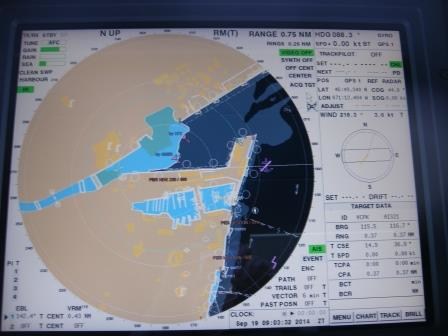
For this Seattle run it means that the American Pilot can be disembarked right outside Sitka, where pilotage water stops. Then the ship remains outside pilotage waters all the way to the Victoria – Sea buoy. Strait Juan de Fuca is wide enough to be considered open waters and that means for Canada that the inland water way pilotage starts at Victoria and for the USA at Port Angeles. To make sure that we as sailors do not do anything naughty, there is Radar and VHF coverage in the Strait to monitor all traffic moving in and out.

The border between Canada and the USA runs right through the middle of the Strait and thus this monitoring has also been nicely divided. Ships approaching or leaving Strait Juan de Fuca, report to Tofino traffic. This is a Radar/Radio Traffic monitoring station located on the northern – Canadian – shores of Strait Juan de Fuca and they keep an eye on who is coming in and going out. Once inside the Strait there is the moment that you switch you’re reporting over to Seattle Traffic. They keep an eye on all the traffic going all the way to the Seattle/Tacoma area or until you change course to the north and head for Canada. If you turn south, then you pick up a pilot at Port Angeles to visit any of the ports in the Puget Sound area. If you turn north towards Canada then you are transferred to Victoria Traffic and proceed to the pilot station there to obtain a pilot for any Canadian port, all the way up to Prince Rupert if needed.

When I first came on the coast here in 1979, I read an article in the National Geographic about how they checked & followed the traffic in Seattle. This was before good Radar coverage, AIS and real time satellite etc. The article showed photos of USCG men actually moving little models over a large size chart of the area. Intrigued about this, I managed to visit them during my cadet year and it was most interesting to see how it went and with the models how well they were able to predict if things were “hotting up” or not. Now that is all gone and the Control Station can see the whole area on radar screens and digital charts and follow the ships moving in real-time over the screens. That makes it even safer. The main challenge is now how to communicate developing situations to the crew on the bridge of the ships. Some crews, especially from China and Korea, speak highly original forms of English, and the well-meant advice from “Traffic” is not always understood or implemented the way it is intended.

So tomorrow evening we are in Victoria, which is, I think, the most British of all the City’s in Canada. The weather should be good, but as the sun shone in Ketchikan, it normally means that you have to pay for it. Thus the Captain might be looking for quite some time tomorrow at a very small world due to very low hanging clouds.

« Older posts Newer posts »