- Captain Albert's Website and Blog -

Ocean Liner History and Stories from the Sea, Past and Present. With an In Depth focus on Holland America Line

Page 112 of 242

09 September 2014; Charlotte Town, Prince Edward Island, Canada.

This is one of my favorite ports of call.  Partly because the people here are very friendly, partly because pilot and port authority will do everything to support our port calls, partly because town is nearby and partly because the approach to the dock, and sailing out again is so nice.

Charlottetown is not a very sheltered port and cancellations in the early and late season are not uncommon but today was a wonderful day. Nearly wind still and the sun shining brightly.   Prince Edward Island or PEI as it is mostly known is an oblong island with a semi round hole on the south side, nearly in the middle of the Island. Inside that hole, churned into a semi lake by 3 meeting rivers, Charlotte Town is located. The founding fathers must have recognized that this was the most sheltered area of the island.

The Maasdam arrived at 06.30 at the Pilot Station and the Pilot came on board. We always have the same pilot. As a matter of fact he is really the only pilot but there is a backup in case he is not available. His father in law drives the pilot boat and his children act as the linesmen who pull the ropes ashore when the ship docks. Ma runs the administration. Call it a family affair but we like these people; they are very, very professional….. and helpful and that makes it very nice to dock the ship here.  There is only one dock, so only one ship can go alongside.

Three Rivers. One lower left, One top left and One top right. The lower right, with the black course line is the way in and out.

Three Rivers. One lower left, One top left and One top right. The lower right with the black course line is the way in and out.

If more ships are coming then they have to go to anchor, which is less pleasant as the anchorage is located at the junction of the currents produced by those three meeting rivers.  Not dangerous but the ship is literally spinning around its anchor 360o all day. The moment it swings out of the influence of the first river, it gets caught by the 2nd river, etc. etc. etc. You are all day on full alert as you really do not know whether the anchor is holding or dragging as the reference points are changing all the time. So the captain is on the bridge all day, constantly watching the distances to the shore.

Not so today. The Maasdam is always the only ship on a Tuesday and thus it always dock.

The Brown Cliffs are slowly eroding and the houses on the top are not that far away.

The Brown Cliffs are slowly eroding and the houses on the top are not that far away.

The whole inland water is getting slowly bigger all the time, as the sides of the islands that are near the entrance are constantly eroding. It does not affect the approach channel too much as the water flow of the three rivers churns all the sediment to open sea. For the people who are living near the edge of the land it is a different story.

Quite a few houses, very nice houses, are coming closer and closer to the edge. According to local information, some home owners have already moved their house twice further inland but the sea keeps following. With the houses mainly made out of wood it seems to be fairly easy to jack them up and roll them a few 100 feet deeper into the back garden. One just has to hope that there is enough back garden to do so  ……. I suppose.

The ship always docks nose out here, apart from the fact that it makes the departure maneuver faster it is also handy in case the weather suddenly changes. If the ship would have to leave it would be a straight shot out and there would be less of a complication with the wind as would be the case if the ship would first have to swing around. Today there were no complications and the ship left in glorious sunlight. It was a perfect sail away.

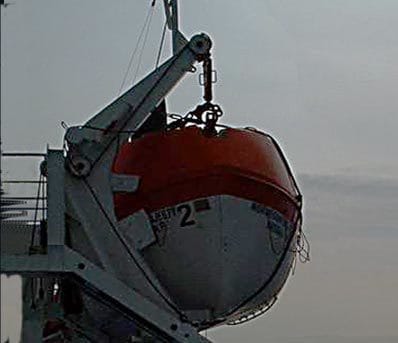
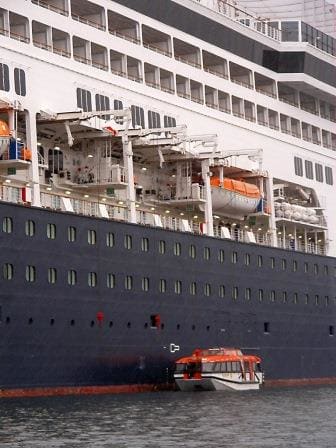
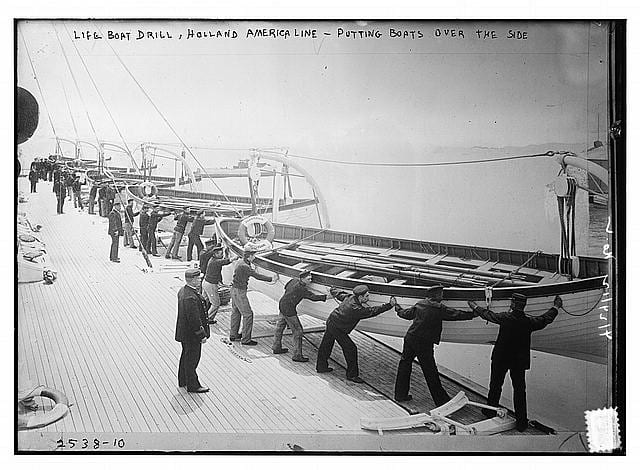
Tomorrow we are in Sydney, Nova Scotia and for the first time in four weeks it is supposed to be dry and sunny. Good for the Captain and Hotel Director as they have planned a Crew Barbeque ashore on the dock; and good for me as I will go down with the lifeboat with the Entertainers to train them for their new function of Lifeboat Communicator.

08 September 2014; St. Lawrence River, Canada.

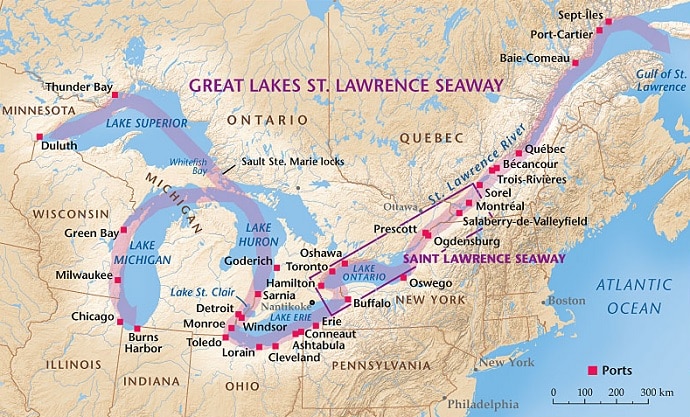
The St. Lawrence river is an estuary river and when looking at it on a chart it looks like a wide converging funnel with a thin rope at the end (A rope with a thin pole alongside it, called the St. Lawrence Seaway).  Thin is of course relative, the river is quite wide otherwise sea going cruise ships could not sail all the way to Montreal. From there the maximum size of a ship is dictated by the width of the Locks in the St. Lawrence Seaway. Holland America used to have ships that would go all the way up the Seaway and were built to fit in with the maximum lock dimensions.

The ms Katsedyk of 1961

The ms Katsedyk of 1961

There was one little passenger ship called the Prinses Margriet (*) and a series of cargo ships all starting with the letter K in the name. Katsedijk, Kloosterdijk, Kerkedijk etc.etc. With the start of containerisation, those ships quickly disappeared from the scene and were redeployed to the Gulf of Mexico.


The ms Ryndam II passing Quebec  on the way to Montreal.

The ms Ryndam II passing Quebec on the way to Montreal.

We also had regular passenger ships going up the river in the 1950’s, mainly for the emigrant trade. The large express liners had been calling at Canadian ports since the 1920’s but did not go any further than Halifax while enroute to New York.  But in the 1950’s there were two small Passenger ships called the Maasdam (III) and the Ryndam (II) who trundled up the river to Quebec and Montreal in high summer.  I say “trundle” as with a maximum speed of barely 16 knots it took them some time. Especially with an adverse tide. Still, quite a few Europeans reached the New World that way and became Canadians in due course.

The river has not changed that much since then. Due to its shape, you are already nearly sailing in it before you realize that you are on a river and not sailing between some distant islands at the horizon. And that is the impression for all of us on board here as well. On departure Quebec we had the city on both sides but then the scenery changed quickly to lush green meadow lands interspersed with small hamlets, each with a very distinctive church, serving the needs of the surrounding agricultural communities. The river only widens very slowly but when it happens it resembles suddenly more a wide bay than a river.

So during the night and today the ship sailed with an average speed of 18 knots through this ever widening mouth of the river until it ended up in the open Ocean. From there it set sail to Prince Edward Island. Part of the River is regulated by Vessel Traffic Separation Schemes which keep the outgoing and incoming ships apart. That makes it fairly easy for the navigator to stay out of trouble. More focus is needed to comply with the environmental rules. The Maasdam also has a Zenon system which turns waste water back into fresh water but there are area’s on the river where even that sort of water cannot be discharged. There are Marine Sanctuaries with zero tolerance, anything closer to land than 4 miles is a no – no;  except when the river has an outgoing tide, then the rules are a bit more lenient. The idea is that whatever goes overboard is quickly diluted by the water flowing towards the sea. We have nothing to dilute as the Zenon system produces clean water but the rules are the same for all. Under USPH rules and Can Pub health rules we are not allowed to re-use this water, so it has to go somewhere. It is a nice puzzle for the navigator to keep an eye on where that “somewhere” is.

In the old days we used to approach Charlotte Town from the West Side, going under the  Confederation Bridge. That is not allowed anymore due to the large numbers of Lobster pots near the fairway. Sometimes these pots are in the fairway.  But if a lobster pot gets its line tangled up in one of the propellers, it is the end for the lobster pot but the anchor rope could damage the seal in the propeller shaft that keeps the water out and the lubrication oil in. The ship does not want water leaking into the ship and the locals do not want oil leaking out although lubrication oil normally evaporates before it can do any harm.  So the ships now have to go the long way around and approach from the East, sailing North around Prince Edward Island as the entrance to Charlotte town is located on the south side,

The Maasdam will approach the pilot station at 06.30 tomorrow morning and will be docked about an hour later.  We are expecting glorious weather tomorrow. Windstill on arrival and a gentle breeze later on. Sunny skies all day long, but cool temperatures. Cool, as Autumn is quickly approaching.

The ms Prinses Margriet could carry just over a 100 passengers.

The ms Prinses Margriet could carry just over a 100 passengers.

(*) The Prinses Margriet never had a DAM name. She was bought from a company called the Oranje Line which names all its ships after members of the Royal Family (Which is from the House of “Oranje”) Prinses Margriet was and still is the God mother of the Dutch Merchant Navy and therefore Holland America decided not to rename the ship.

07 Sept. 2014; Quebec, Canada.

07 Sept. 2014; Quebec, Canada.

The pilots did not have any issues with the bridge time, the tides followed the predicted schedule and the Maasdam slipped under the Bridge without any challenges. Then she docked shortly after. This was very shortly after as the ship went straight alongside the downtown dock.

That is not always the case as it depends from which side the current is coming. Unless there is a very special situation, a ship on the St. Lawrence River will always dock with the nose into the current. This means that when it is ebbing (the current follows the flow of the river to the sea) the ship will dock with the bow stream up wards. When it is flooding (the tide of the sea is going against the flow of the river) the ship will dock with the nose into the flood. It will dock with the bow in the direction of the sea, where the flood is coming from.  Although the St. Lawrence River can flow very strongly, especially in the spring, the flow is normally weaker than the upcoming flood and thus the flood is the current to keep an eye on.

This is the normal sequence of docking. However there might be exemptions and I have been docking at times where the downward flow of the river was cancelled out by the upward flow of the tide and as a result there was no current near the docks. In the middle of the river there was a lot of turmoil with swirling currents, where the two water flows fought for supremacy but near the docks, where the current is normally a little bit less, there was nothing.  Then the pilots allow the ship to dock any side alongside and thus you try to dock with the bow in the direction of where you go next.

This time the Maasdam could dock quickly as it was flooding, so the ship already had the bow pointing the right way. It was also the direction of where we would go down river later and that would ensure a speedy departure. If it had been ebbing, then the ship would have had to turn in the river and then find its way back to the dock. That would have taken almost an hour longer.

Chateau Frontenac towering over the port of Quebec

Chateau Frontenac towering over the port of Quebec


But by 3 am it was all fast and all involved could go back to bed. Daylight was around 0600 and that meant that early birds could go ashore at that time. As it is Sunday today not much happened in the early morning, which is always a perfect time to explore the old city. Quebec is a wonderful town. On the Holland America rating of ports it scores year after year the highest of all the different ports that we visit in the world and that is over 300. Most people also take the chance to visit Chateau Frontenac, which is not really a Castle but a hotel. But it certainly looks like a castle. It was built in the days when the Railways were being laid through Canada and connections were being made with the Ocean Liners. No expense was spared and only the best was good enough. It is really wonderful to walk around in the down stairs area, where the old style charm of the place has been completely retained. I really wish that I would have the opportunity to walk that Castle/Chateau/Hotel from the top of the roof to the deepest dungeon, just to see what they put in such a building in those olden days.

It was a cool day with real nippy weather in the morning but when the sun came out it was a glorious day to be ashore. As it was Sunday, half the town was on parade in front of the ship in the afternoon, as the pier doubles up as a sort of small boulevard, cum Public Park.  It gave the Quebecois the chance to see a Holland America ship but also to see how the sailors were cleaning and painting the outside, as the Staff Captain had arranged for a cherry picker to be used for the duration of the call.

Tomorrow is a sea day and then the next port of call is Charlotte Town on Prince Edward Island. That is a tight run as the ship has to go the long route due to the lobster pot season but that is for the next blog when we get close to the next port of call.

The concrete dock walls of Quebec. Please note how the fender is pushed off the wall by the current that runs between the dock wall and the ship.

The concrete dock walls of Quebec. Please note how the fender is pushed off the wall by the current that runs between the dock wall and the ship.


Departure from Quebec is normally easy; the current tries to get between the ship and the dock, either from the stern (ebbing) or from the bow (flooding).

Whatever the direction of the current, it will push you off the dock mainly due to the fact that all the Dock walls in Quebec are from concrete and solid so any water that comes against it is bounced off again. And if the ship lets go of it mooring lines, then it will bounce off as well.

The weather forecast for tomorrow will be chilly but sunny, with strong winds while the ship is sailing down the St. Lawrence Estuary and then later a gentle breeze when it enters open waters.

06 Sept. 2014; Montreal, Canada.

And so we arrived on the good ship Maasdam in Montreal, Quebec, Canada on the 5th of Sept.  Canadian Customs were carrying out random in depth inspections and I was one of the lucky ones. Thus I had to wait for 90 minutes in the holding pen at the airport, then had a 2 minute conversation about who I was and what I was going to do, before I was deemed not to be danger to human society at large and Canada in particular. This is something that happens to every crewmember all the time when coming into the USA so it was nothing special. However as the Canadians do it randomly without making any exception to nationality (including their own) or race or religion, it was quite interesting to see how diverse the reactions were from people from various cultural backgrounds.  Varying from dignified resignation (India), to total confusion and mis-understanding (China, Korea), to highly indignant (Americans), to total bewilderment (Canadians). It was most interesting and made the time pass quickly. Montreal suffered from a very hot day, 32oC. and my hotel had AC in the rooms but not in the corridors as it was built around an indoor swimming pool, where the architect had tried to recreate a tropical paradise. Well today it was a real tropical journey to get from the room to the restaurant so the architect had more than succeeded in his/her ambitions. Continue reading

04 Sep 2014 Cromer, Norfolk, England.

Dear Readers,

Tomorrow I am flying to Montreal to join the ms Maasdam on 06 Sept. for 14 days to help them out with training. So my blog should start again on 7 Sept.

The Maasdam is making 7 day cruises  Montreal – Boston and back and around this time we should see the breath taking autumn scenery along the river banks.

I will be on the Maasdam until Sept 20 and then transfer to the Veendam.

The IT guru’s have been working on the blog and it should now be fully operational again. You should all have received a random ping, announcing my last blog on 25 July 2014 a few days ago.

The rest of my blog I will continue testing in the coming days and if is all back in order, which it looks like, then I will be uploading a lot of historical stuff in the coming weeks.

Best regards

Capt. Albert


25 July 2014; Ketchikan, Alaska.

The most famous shop in Ketchikan is Tongass. It is located right on the cruise ship berths. A prime spot as at least 2 full complements of cruise ship guests have to walk by there to get into town and back. The store has been there a long long time and once was a real “General Store” where you could buy everything you needed to survive in Alaska. That has now changed and all the down stairs has been taken over for selling souvenirs; except a small side corner where they have some drugstore items for sale. Why do I mention this store? Well it was raining today, real Ketchikan weather, and it looked like it that a full complement of at least one ship had marched straight into this store to stay dry, and they were of course shopping. The owner must be a rich man. It was almost too busy to sell anything. It confirmed my theory that it does not matter that much if it rains during the call at the last port of the cruise.  As long as the shops are open.

Tomorrow will be last day of this cruise, with an evening call at Victoria. The weather during the coming night does not look very good but once the ship has gotten past that, it should become sunny and warm. So although the cruise was -weather wise- not that exciting, it should have a favorable ending.

That brings me to the end of my blogging period and I would like to thank all the readers for keeping up with my musings and the humdrum of a travelling captain.

What is going to happen next?

I will have a month vacation first and she who shall be obeyed has booked a number of short holidays. We are taking a luxury train to the Tattoo in Edinburgh. I have been there before B&B style but now we are going the 5 star way. Secondly we will be making two short cruises. Just to be nosy to see how some other companies are doing.

Then, I should be back at sea by September 6. First visiting the Maasdam and then the Veendam. Both are doing 7 day cruises to Quebec and Montreal. The nice part of it is that it will be during Canadian Foliage season, e.g. autumn, so it might be magnificent.  Also on these two ships I will be helping out with the implementation of the 3-alarm system. Unless one of the trainers officially assigned for this job, obtains the proper US visa on time, so he can legally circumvent the Jones Act.

Maasdam 06 sep. – 20 sep.

Veendam 22 sep. – 06 oct.

After that I should start to gear up again for what I am supposed to do, support the ships with projects, train new captains and visit all the ships on a regular basis.

The IT Gurus have promised me that all the issues with the Blog will be resolved shortly and if that is the case there will be a stream of posts/upload coming with HAL history material. Hopefully they will also fix the email notification alert that the same time.

Thank you, and best regards

Captain Albert.


24 July 2014; Sitka, Alaska.

A little delay in posting this blog. Yesterday the Amsterdam was on a Southerly course and that means that the funnel blocks the sat dish.

We are not having much luck with the weather this cruise. Although on the second day it looked like as if the clouds would break, but it did not turn out that way. Today we had another real Alaska Day, with overcast skies and the occasional drop of rain coming down. Nothing to upset the proceedings of having a great cruise but it could have been better. For those guests who packed for a sunny – warm weather – cruise, and we have a few on board, it must be a disappointment. For the rest it does not really matter, they all brought their rain coats, back packs and boots and they all went off happily exploring Sitka.

Sitka is of course a bit of an anomaly compared to the other Alaskan Ports, cities and towns in as far as the history is more Russian than American. Although in the current way of life nothing feels Russian or International anymore but the history is still there in the buildings.

What amazes me most is the lack of Russian names among the local population. One would expect that given the presence of them for such a time, there would be some other traces left apart from the architecture. But in my dealings with the port of the last 30 years I have never have come across anybody who said that he/she was from a family from that period. It looks as if the Russians packed up lock stock and barrel after the handover of Alaska.

So what is left are the geographical names, the architecture and some cultural influences which the local population tries to keep alive. Many tours are available and one of them is the option to see Russian dances being performed. Another one, which has a Holland America connection, is a visit to the Raptor center. Here wounded birds of prey are nursed back to health. Holland America provided the grants that made the opening of the centre possible and has been sponsoring ever since. Either with more money or with trying to get as many tourists to visit the center.

Sitka is also a base for the United States Coast Guard who has stationed several helicopters there. Those are well known to us as we sometimes request their services to air lift patients from the ship, if somebody needs acute treatment that goes beyond the capabilities of the onboard Medical Department.

I visited the base long time ago, when I was sailing with a captain whose hobby this sort of thing was and one item I found there on display was the stern of one of the Prinsendam (I) tenders when the Prinsendam sank in 1980 in the Gulf of Alaska. Sitka airbase had been involved in that rescue due to proximity.  A rescue which I still consider a remarkable feat as in quite bad Gulf of Alaska weather they managed to launch all lifeboats, filled with rather mature citizens, without any injuries and they were all safely picked up by helicopters and a tanker.

The Amsterdam left on time as everybody had returned early. Every captain loves a bit of rain, an hour before departure. Tomorrow will be Ketchikan and we are expecting that the town will offer us one of those 332 days of the year that it rains.

23 July 2014; Juneau, Alaska.

The weather that was supposed to change for the better really did not. It remained overcast with dark clouds gathering at times but it remained dry. Which was fortunate for all the guests we had on board, and on the other ships.  Four ships in port, two HAL, two Princess, meant a full house and the weather was not much of an issue to upset a good day in port. The clouds stayed fairly high making it possible to have all the flight adventures take place as well. By Alaskan standards it was a good day, with regular Alaskan Weather. I was happy as well, as the wind stayed between a Gentle and a Moderate Breeze keeping the chop of the water down to small waves, so we could do our training classes.

For the rest it was a bit of a sad day, at least for all the Dutch on board. The Kingdom of the Netherlands is in official mourning, due to the airplane disaster in Ukraine where this Malaysian Airplane was downed, killing all on board. A large number of them were Dutch Nationals or people who lived in the Netherlands so it was a heavy blow to the country.

The Dutch are very peace loving in general and generally  go by the rule of live and let live, and this un expected and unnecessary act of violence shocked the Nation to its core.  Now the coffins are coming home, the country is marking that awful fact by stepping back in contemplation. TV programs have been adapted and a hush lies over the land, where the high summer with tropical temperatures normally assures much happiness.

As a cruise ship company, there is not much that you can do, but what was possible we did. All day long, on all Holland America Line ships, the National flags went Half Mast.  The Jack at the bow was not flown at all and the large Nation Flag at the stern was lowered as much as possible.  A small token from us to all of those innocent travelers who were killed in a random act of violence.


The flag of the ms Amsterdam at half mast

The flag of the ms Amsterdam at half mast

MAY THEY REST IN PEACE.

The flag of the ms Oosterdam at half mast

The flag of the ms Oosterdam at half mast

22 July 2014; Scenic Cruising, Tracy Arm Alaska.

In the morning the sunshine came through and at once the clouds came down and for about for 2 hours, it was a very small world again. The ships whistle announced it to the world accordingly. But as always when coming to any ice field or ice cap, the air and water temperature changes and thus when coming closer to Tracy Arm the world opened up again. A good thing as sailing into a Fjord full of ice cubes, while having no visibility is not something that is wise to do, but no challenges today. Visibility was good and there was little ice while sailing in and that meant that the whole sightseeing program could take place as planned.

So by 2 pm the ship sailed into Tracy Arm and slowly worked its way towards the glacier face. Tracy arm is open to everybody, it is not a National Park, and thus not regulated by the National Park authority. It also means that there are no Rangers around and thus the scenic narration on board is done by our own Travel Guide. Sawyer Glacier is quite nice and very similar to Marjorie Glacier in Glacier Bay, rising steeply up from the water to a height of about 300 feet. As mentioned last week, for me the attraction of Tracy Arm is the steepness of the Mountains on either side of the water. It reminds me very much of the Norwegian Fjords, even down to the coloring of the rocks in certain places, although the variation in rock composition is greater here than what I have seen in Lyse fjord and Sonde Fjord.

The Ship sails mid channel courses everywhere in Alaska, unless it has to go around a bump somewhere and it also does so in Tracy Arm. The safest way to go, although near some of the rock formations it would be safe to sail 2 or 3 feet away from them, as the rock face goes straight down in the water for another 100 to 200 feet. The pilots in Norway told me that in the old days, they did “broom stick” sailing. This meant bringing the bridge wing so close to the rock wall, that it could be touched with a broom stick from that bridge wing. That could be done as the rock wall went straight down under water for another few hundred feet. Navigational wise it was and would be quite a challenge as due to the size of everything, it is very difficult to correctly estimate distances.

When I was with the Prinsendam in Norway, we stopped opposite Pulpit Rock and all the officers were asked to guess the distance from the Ship to the rock wall. We were 2000 feet away but everybody thought we were much closer due to the height perspective. We had to use the Radar to measure the correct distance. So these local navigators must have had quite some experience and tricks up their sleeves to get the broom stick trick right. The Amsterdam left Tracy Arm around 8 pm, with all the broom sticks still safely in their lockers.

From there it is a slow run to Juneau for an early morning arrival. We will be in port together with the Oosterdam which is expected to pull in around 08.00 am. Weather forecast, overcast with passing showers and a gentle breeze. As long as that breeze stays gentle then it is fine by me, as the trainees are going down in the lifeboats again.

21 July 2014; At Sea, British Columbia.

Today two blogs in a row because when I tried to upload yesterday, the funnel was in the way, cutting out the Satellite signal. So we have the 20th and the 21st.

We are still under the influence of this small depression that caused all the rain in Ketchikan, wind in Victoria and gloomy weather in Seattle.  It should be gone by tomorrow but today we had the last of the rain and the grey skies. Also we had ships movement. The wind two days ago must have been strong enough in the Gulf of Alaska to create medium height waves that are just enough to make the ship pitch on occasion. Just gently. Just enough to give the kids on board a very good day, as the pool water was rolling along nicely. That creates a sort of wave pattern that no wave pool at home can re-produce. It was just nice to splash about in and not creating any dangerous situations that would warrant the pool to be drained. So a lot of small happy-campers today. Those who were not in the pool were busy with creating mayhem in Club HAL, supervised by 5 youth staff. I greatly admire them, as I would not be able to cope with this continuous mountain of sound coming at me, created by over a 160 kids, from 3 to 15.  But as long as they are there, it is quiet in the ship.

At least reasonably quiet as this week Trivia seem to have a rowdy attendance and the game is played with “the knife on the table” as we call it in Holland. When things are heating up, there is always a wise guy who knows better than the official answer on the Trivia card and then you have arguments. When passing by the crow’s nest I overheard something about Babe Ruth and his records. Luckily I do not know anything about Base Ball, so the finer points eluded me completely. I have heard about Babe Ruth, who hasn’t, and I also know that Marilyn Monroe may have married him briefly but there my knowledge stops. I tried to play American Trivia in the past and sometimes managed to win on points, as long as there was a lot of history, politics and Geography involved, but the moment it dealt with cartoons, American TV and American Sports, then a trivia team would wish I was not there.

Today I had an interesting challenge on my hands and that was the discussion with the Purser about how much space does $ 1 mln. Dollars take up in an overnight bag. Part of the new alarm system is the introduction of a group, led by the purser who is solely designated to take all passports, seaman’s books and all paper money ashore. This to make Identification and processing by the local authorities at the landing point of the lifeboats and life rafts easier.  All those documents will be carried ashore by the Purser and his/her team and we have 8 crew for that purpose = 16 bags, so the question was: is it enough?

In an emergency it is not expected that the Purser has time to carefully stack them up in a bag, but just throw them in, plus is then the weight still low enough to be carried. As we could not test it by a emptying the contents of the safe, we had to calculate. So $ 1 million in 20 dollar notes turned out to be quite a lot of weight and on international cruises; we also have foreign currencies on board. More weight, more bags. It will keep the Purser occupied for a few days, to figure out what is needed, or whether he has enough.

Thus I felt that I had done my good deed for the day. The good ship Amsterdam in the meantime plodded along nicely on the North Pacific Ocean. By early afternoon we passed the Queen Charlotte Islands and  that means by tomorrow morning we will enter Chatham Strait. Here, near Kake, we will collect the Alaskan Pilots and then head towards Tracy Arm for our afternoon Glacier Adventure.

Now we have to keep our fingers crossed that the Glaciers inside Tracy Arm have not been too active and produced too much ice. Especially in the beginning of the season it can clog up the whole fjord and make an entry into the fjord completely impossible. We are now midseason, so the chance is less, but it has happened before and the poor cruise ship was stuck outside.

With the weather system passing by, it should be a nice and dry day tomorrow, with hopefully not too much sunshine, otherwise we might get those very low hanging clouds again.

« Older posts Newer posts »