The pilot had been ordered for 0600 in the morning and we had to confirm our ETA (Estimated Time of Arrival) two hours before; so great was the surprise of the Officer of the dog shift to be called 4 hours before that time by the pilot of Fortaleza himself. We have never had such eager pilot station before on a cruise and certainly not in South America. However that is better than the other way around so the OOW happily confirmed our arrival time. We were there at 6 am. and so was the pilot. Then it was slow going as the entrance to the port is really shallow and with only 6 feet under the keel we crept into port. Going slow to avoid the squat and as a result the ship touching bottom. There we had a little surprise. I had expected the wind to be full on the beam while docking but the assigned space was between two ships and I was supposed to dock about 10 meters away from the ship behind me. Secondly there was a gap between two warehouses on the dock where the stern was going to be and that gap acted as a funnel and increased wind force 4 to about wind force 8. That would make it difficult for any ship to come in especially as with the little amount of water under the keel, the propellers would have a hard time pushing the water to where I wanted it to go. For that reason the port has a tug on standby in the port at all times and so I used it as I had to pay for it anyway. It nicely pushed the stern in against this funnel wind coming from between the warehouses. Continue reading
Category: CaptAlExport (page 141 of 203)
By 10 am we had changed course to the northwest and thus came an end to our mainly northerly courses (when in open waters) that we had been steering since we left Antarctica. We made this course change about 30 miles off the coast, as I had decided to stay away from the shallows, so we would not get entangled in fishing fleets and their nets. The sailing directions and notes in charts are warning about huge concentrations of fishing boats and they do not give that warning for nothing. All the information accumulated in the nautical sailing directions come from the seafarers themselves and thus a lot of them must have gotten themselves into a muddle with fishing boats while sailing close to the coast. So the Prinsendam remained in open waters and made a nice wide turn around the indicated areas. The chief engineer wanted a bit of steady and medium speed anyway as he had to make water because the loading capacity tomorrow in Fortaleza will be very meager. Thus a longer route worked well for him. The potable water pipe lines at the dock are at the end of the city’s pipe line system and the pressure is not very high as a result of it. If we are going to get 10 tons an hour it will be great. In other ports 50 tons an hour is normal) Continue reading
Recife has always been a cargo port which until recently was seldom visited by cruise ships. When I came here in the past the docks were always dirty from cargo handling and the authorities could not care less about cruise guests. My surprise was therefore great that when we arrived, I saw a very nice and clean dock to park at; everything ran as clockwork and the ship was cleared as soon as the gangway was out. The pilot mentioned that they have 50 cruise ship calls this year and they will build a cruise terminal during the coming summer (their winter) ready for next years season. Today was an extra busy day with two cruise ships in port. The port is still a bit limited if you are not going on tour as the city is very large and very spread out. Not unlike an American city with a business district and high rises and then suburbia around it. If you do not have a car and do not have local knowledge it is not so easy to find your way around and to see something of interest. Continue reading
Slowly we start to understand how large Brazil is. On the 26th of February we passed the border between Uruguay and Brazil and ever since that time we have been sailing along its coast. Between Rio and Salvador we sailed at full speed and now we are sailing along with the sedate speed of 14 knots; set to arrive at Recife at sunrise. After that we still have several days of steaming to go, interspersed with ports and the Amazon of course, before we will finally come to another country. However those countries, Guyana, Suriname etc. are still laying along the coast and form a rim around Brazil. It is indeed a very very big country. Thus today we sailed along another part of the coast of Brazil. That coast was about 60 miles to the West of us as we are following a straight course line and the Brazilian coast is curved inwards here. Only in the late evening tonight we will be coming closer again, making a landfall around 4 am in the morning. Continue reading
As the name says the city of Salvador is located on the rim of a large bay which is basically a combined estuary of several rivers. The bay is quite sheltered and thus there are always numerous ships at the anchorage. Today was nearly full moon and that meant that there was a lot of current running out of the bay as we were arriving half way between high and low tide. This was clearly visible as we saw the eddy’s swirling at the entrance of the bay which is relatively deep in the middle but very shallow at each side. For this reason the pilots also board inside the bay. It is not much fun to sit in a pilot boat with swirling waters around you and so they avoid it. I estimated that we had close to four knots of current running against us. Not a big problem but it does slow you down. Continue reading
From Rio to Salvador it is about 750 miles and that distance we have to cover in about 40 sea hours, which gives an average speed of just under 19 knots. However with the Brazil current against us, the speed that we really had to make was somewhere between 20 and 21 knots with the current being the unknown factor. Therefore we went full speed the moment we left the bay of Rio de Janeiro behind us. It turned out during today that the Brazil current was a little bit less strong than I had anticipated and so we made good speed all day long. It means that we will make our pilot time of 8 am in the morning and that also means that we should be docked by 9 am. which is arrival time. Continue reading
We stayed overnight in Rio de Janeiro while the other ships departed. The Delphin Voyager sailed at 11 pm in the evening and will work its way up the Brazilian coast before crossing over to Africa. The MSC Poesia and the Grand Mistral sailed earlier as for those two ships the port was a change over port and they commenced a new cruise here. The Grand Mistral is the old Mistral that was built for Festival cruises. Festival was a company that emerged very quickly from nowhere, riding the boom of the cruise business before 9/11 and then later ran into cash flow problems which caused the company to be broken up and its assets to be sold off. Festival Cruises focused on the Mediterranean public and as Grand Mistral the emphasis is now on Latin America. Its two sister’s ships, the European Stars and the European Vision were sold to MSC and are now sailing as the MSC Armonia and the MSC Sinfonia. The same company to which the MSC Poesia belongs; although the latter is a new build. Continue reading
I had decided to go for a 0600 pilot to be ahead of the other cruise ships. It takes about 1 hour to get from the pilot station to the dock and that normally means that captains go for 1.5 hours before their official arrival time. One hour for the transit and 30 minutes up the sleeve. That would mean 06.30 for the pilot station in Rio and that would mean that three cruise ships (Prinsendam, MSC Poesia and the Grand Mistral) would all arrive there at the same time. Also they would all dock at the same time and be most likely in each others way while doing so. Not a real safe situation if you think about it. Thus I went for 0600 and indeed the Poesia and the Grand Mistral went for 06.30 and while I was happily sailing in the port they were bickering with the pilot station about who was going first. Sometimes a theory does work out in reality. Continue reading
This was our second day at sea, to cover the distance of 1000 miles to get from Montevideo to Rio de Janeiro. The outside temperature is slowly climbing but it will not get very warm until we are passed Rio and are turning north along the coast again. At the eastern end of Brazil is Cabo Frio, or the cold Cape and here the temperature really goes up. Rio can be very warm but not necessarily so. Bahia de Salvador mostly is, due to being closer to the Equator and due to the fact that the colder water of the Brazil current does not reach here. Cabo Frio is not named Frio for nothing. Continue reading
After our wobbly evening in the entrance of the Rio de la Plata we turned north just after 1 am and from then on we had following seas. The Prinsendam made a knot more extra speed courtesy of the wind blowing in the stern and apart from the occasionally pitching movement the ship was riding the waves in a very steady way. Still the combined swell and wave heights were considerable and I had the opportunity to point that out to the guests today how much they can make a ship move. About three miles on our port side there was a car carrier coming south; the Franconia owned by K lines of Japan. As car carriers are extremely boxy they can come very close to a passenger ship in volume and with a similar draft. This ship was going the opposite way and it had to pound against the swell and wind. It resulted in some very heavy pitching with the bow coming fully out of the water and when the bow went down the propellers did the same. A sight you normally never see so it was worthwhile to have a look at and to understand that even a big ship is only a small toy in the big ocean. Continue reading
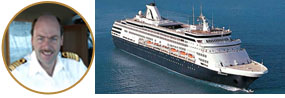
Captain Albert
© 2026 – Captain Albert's Website and Blog –
Theme by Anders Noren — Up ↑