When dawn came, it became clear that it was going to be a glorious day in Juneau. We were scheduled for a 10 am arrival in Juneau and that meant that the guests could see the approach through Stephens Passage and Gastineau Channel in bright and sunny daylight. As explained yesterday, our approaches and departures are regulated by the Voluntary Waterway Guide. So it also dictates our arrival speed going into Juneau. Hence the approach starts around 08.30 when entering Gastineau channel. That brings us by 0930 at the dock and then it takes about 15 to 20 minutes to get the lines ashore and the gangway out. Continue reading
Category: Captain’s Log (page 12 of 128)
Against my better knowledge I had promised our guests in Ketchikan a sunny day as that was in the weather forecast. However during the night, the (light) winds shifted a little bit to the South giving a rain system the chance to lay over Ketchikan. That made it a drizzling day all day long. Tonight the wind will shift again and that will mean that Juneau, where we are tomorrow, should be dry and at least partly sunny. At least the guests could see Ketchikan as it is for 332 days of the year. It is a typical pattern here in Alaska that when they predict bad or rainy weather they are always right but when it comes to good weather, the reliability goes down a little bit. Same as at home in England where the Met Office is also really good at predicting the weather that has happened already. When you wake up in the morning and you find snow on the grass, what do they say on TV: it snowed during the night. Well we had seen that already by looking out of the window. Continue reading
As we were going for a late tide at Seymour Narrows, the trip towards it was a slow one. With the sedate speed of 10 knots we trundled north following the coast of Vancouver Island, while staying more or less in the middle of Georgia Strait. The latter being the body of water that separates Vancouver Island from the mainland. Then the closer you come to Discovery Pass, in which the Seymour Narrows is located, the closer our course line comes to the Vancouver Island side. Finally we come to the point that is called Cape Mudge and that is where the start of the Narrow Passage begins. This is also the location, where I arrive on the bridge. Here the opposing traffic comes quite close to the ship and decisions that have to be made, in principle by the pilot as he is conning the ship that might go beyond the authority of the navigator to approve. There is normally quite a bit of traffic going either way, as every ship, boat or tug aims for the period that the currents in Seymour Narrows are at least below 4 knots. For the cruise ships, the pilots make arrangements before we come to Cape Mudge. Each cruise ship is on a different schedule and wants to maintain a different speed as soon as it is though the gap. Each captain discusses his needs with his pilot and then we normally come to a mutual arrangement. As we have a fairly slow average speed to maintain to get to Ketchikan, I prefer to go last and to get all the boys that are in a hurry ahead of me. That is easier for a second reason as well. Those that are ahead have to deal with all the traffic, while the Statendam following in the slipstream does not have a care in the world. In this case there were only two cruise ships, the Celebrity Century and us. The Century is in a hurry as it has to go to up to Alaska for her first call and thus she went ahead of us as soon as we cleared the Lions Gate Bridge in Vancouver harbor. Then it is just a matter of joining in the parade. Normally you stay about three miles away from each other, so there is room in case something happens. When you get closer to the Seymour Narrows, the line up becomes 5 minutes apart, which means that every 5 minutes a ship pops through the hole. In the Seymour Narrows there is the right of way for those who are on the following tide as it is much more difficult to stop or to hold position. When going northbound you have the round island – Maud Island- on the Starboard side. Here the current curves around the bend, which makes the approach so dangerous with strong currents. The tide will keep pushing you ahead, sometimes with five or six knots while you are on the approach. If you are bucking against the tide, it is much easier. You just put your bow into the current and maintain position on the engines. This time we had the tide with us, so everything north of the Narrows had to wait. In this case, log barges and fishing boats. We did not have any pleasure craft this time and that always makes life easier as not every yacht owner prepares for the voyage as good as they should and quite often do not have a clue what is going on. Becoming a danger to themselves and to others. At 03.20 we sailed through Seymour Narrows 20 minutes before slack tide with only 2.5 knots of current left. Then for the remainder of the night we sailed through Johnstone Strait, entering Queen charlotte Sound around 10 am. After a little haziness in the early morning it turned into a very nice day. A good day to start the Alaska cruise. Tomorrow we will be in Ketchikan and also there the weather forecast is calling for dry, even sunny weather, not too warm and very little wind.
So today I arrived back on the ship. After a direct flight from Europe and a nice early arrival at Vancouver; which gave plenty of time to catch up on lost sleep. Holland America has a contract this year with a hotel at the airport, The Fairmont, and that makes life really easy for all of us. Even if you now come in on a late flight, you do not loose sleeping time anymore by having to wait for a hotel shuttle or trying to find a taxi. All was well in the world. I will be doing a nearly 4 month contract this time, due to the fact that my time on board during my last tenure was shorter. Then I had cut the contract short, to avoid travelling to and from the Senior Management Conference for the Company in Rotterdam. Saved me, and my colleague, a lot of flying to and from the ship, and the company a considerable amount of money on flights. Continue reading
This is my last blog entry for the time being. Today I will leave the ship and then fly tomorrow to the Netherlands for the Senior Management conference which takes place on the old ss Rotterdam this year. After that I will go on leave until August 11. Then I will return to the Statendam, until December. See also the schedule on the blog under one of the other tabs.
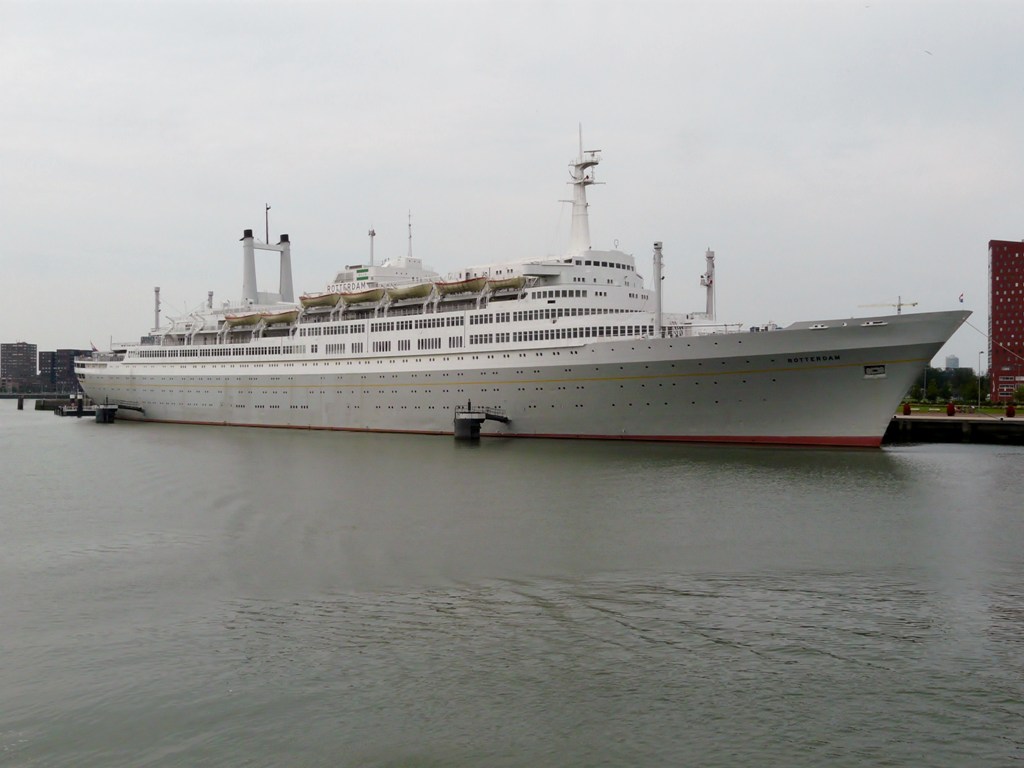

The Senior Management Conference or SMC takes place every 18 months so that the head office can touch base, face to face, with those on the ships. That is made possible because there are two meetings, each of three days. I will be going to the 2nd one, and my relief who is flying in to Ketchikan, went to the first one. Three days of meetings to bring us up to speed of what is new in the fast changing world of the cruise business. There will be in total of about a 100 people attending and some sessions will be for all of us and then there will be breakouts, separate meetings for each function. With 15 ships, there will be at least 15 of each rank present. Apart from that there are some evening functions and that is a nice chance to catch up with old colleagues. As everybody in my age group has now made captain, you do not see each other anymore so the SMC is really the only time you can catch up. On days that the ships meet in port, there is hardly any chance as there is so much going on each day. So this is an excellent opportunity.
Therefore it is time to say goodbye. Thank you for being my faithful readers who are willing to keep up with my daily ramblings. I hope that sometimes I was able to insert a small pearl of wisdom or tit bit of genuine interest in the daily blog.
I will be checking my blog regularly as I have to clean the spam out and approve postings that are coming in.
Thank you again for all the support.
Over the summer I hope to add a lot of material to the captain’s website. I have nearly all the information complete until 1937 and a lot of photo material is coming in, so that can now be uploaded.
I also hope to complete a manuscript for publication, and publisher willing, it might come out over the winter months. I do not think that I will have an idle summer, but first to Holland. My wife will be waiting at the airport and then together we will go to see my 98 year old mother who has not seen her only son since I left for sea on March 15th.
Thank you all, I will be back
The weather guru’s must have heard me moaning and groaning about Skagway as they did their best and this morning the weather was wonderful. Flat calm seas and far ranging vista’s showing the Fairweather mountain range in all its glory. In the upper bay we saw some low clouds hanging but it was a very good start to the day. Today we were expecting only three rangers, compared to the 10 we had on board last cruise as their training is over, the supervisors have verified their schedules and the season is settling down into routine. One Ranger stayed in the crowsnest, one ranger on the bridge for the commentary and the 3rd ranger was shadowing the 2nd one for the narration part. That narration is part set, and part own inspiration by the Ranger. There are fixed parts, pertaining to the route that has to be pointed out, pointers of where to start the narration and where to stop and pertinent information that should not be forgotten. But each ranger has a certain freedom in adding information depending on what route the ship is taking or what can be seen during the day. Then titbits can be added about their personal spheres of interest. I have heard rangers getting all excited about flowers, trees, or bears or whales. As long as it provides the audience with the real Glacier Bay experience it is all good to go. Continue reading
So the weather guru’s has promised me south winds 5 to 10 knots. And what did I see when I arrived on the bridge at 05.15; 25 knots gusting to 30 knots. At least they had the direction right. Which is not that difficult as it can only blow from two directions here. North or South. But it did not make me a very happy camper as the Broadway dock, where we are scheduled to go to, is fully exposed to that wind and you have to move against it. It gives no issues for the Railroad dock as it is protected by the mountain; it gives no issues for the Ore dock, as you just land with a controlled drift but it gives issues for Broadway dock. The wind pushes you away from that dock and then you drift directly onto the Ore dock on the other side. With only 200 feet of space between those two docks, that is not much, even if you have tugboats to help you. You’re only hope is, a. that the wind has the right angle and is more on the stern than on the side, b. that it is a consistent wind so you can find a balance with powering against the drift and c. that the wind is not too strong as you have to slow down as well, when entering the u-shaped berth area. The only way to find out is to go there and see what it looks like right on the spot. Continue reading

With the wind in the back we sailed up Chatham Strait heading for the Kake Pilot station at 0900 hrs. Ahead of us where the Norwegian Pearl, sailing for 1400 hrs. and the Century Celebration heading for Icy Strait. Behind us was the Oosterdam, going for an afternoon call at Tracy Arm. We are now seeing the first fishing boats of the season sailing up and down the coast. Among them there are always skippers who have a peculiar idea of how to apply the Rules of the Road or are completely ignorant of applying them at all. So we had one this morning, who was clearly heading for a collision and not doing anything. When 5 miles away we called him, with the question what was he planning to do, pass on the portside or pass on the starboard side. The answer was “I like to run a straight course” Well, don’t we all?? but if there is a big blue wall of steel in the way, that might not be the wisest course of action. To keep it simple, the big blue wall moved and our fishing boat could happily continue on his straight course. Which was not that straight at all as the wind pushed him quite nicely all over the place. Continue reading
With the tide at Seymour Narrows being as it is, it is a late night affair and nothing we can do about it. Slack water at the Narrows dictates our lives. Four ships lives to be precise. Thus after departing from Vancouver, the whole convoy trundled up Georgia Strait towards the magic moment of –near slack tide–. The Norwegian Pearl, followed by the Celebrity Century, followed by the Zaandam, followed by us. Everybody lining up in regards to the rush they were in and the speed they were planning to do after the Narrows. For us that meant that eventually we would overtake the Zaandam again as they would later run at a lower speed for a timely arrival in Ketchikan, which is closer than Juneau. This we did at 05.00 in the morning and then we left the Zaandam far behind as we were racing up the coast. The weather in the inside passage was really nice. Flat calm seas and a pitch dark night, showing all the ships lit up against the sky as if it was Carnival in Venice. Cruise ships, tug and tows, fishing boats, lighthouses and buoys all twinkling in the night. At times like this I do not find it too bad that I have to stay up all the night to sail the ship through. Continue reading
The season is now coming into full swing. This week the last cruise ship will arrive to make up the full complement of regulars for the summer. Today we had four ships in Vancouver and that will remain more or less the same in each port. 3 in Juneau, 4 in Skagway and 4 in Ketchikan. The Zaandam is starting the run up to Seward, which we will join next cruise as the alternating ship. So this evening she will sail to Ketchikan while we go to Juneau one more time as the first port of call. This week our buddy will be the Norwegian Pearl which we will see in Juneau, Skagway, Glacier Bay and Ketchikan. Then we will lose her as she is becoming a Seattle based ship. This means that by next week it will be quieter in Vancouver on a Sunday with only two ships in port, the Statendam and the Celebrity Century. Vancouver lost some ships to Seattle this summer and also there are now some ships calling on Friday and that distributes the load a little bit. I believe the shift to Seattle has more to do with the domestic flight arrangements that are available if you stay inside the US than with the attractiveness, or lack of it, of Vancouver. It remains a great city to visit and to sail from. Continue reading
Captain Albert
© 2026 – Captain Albert's Website and Blog –
Theme by Anders Noren — Up ↑