After all the nice weather in Alaska we had a windy and rainy day today in the Inside Passage. While sailing through Queen Charlotte Sound the wind breezed up to 35 knots and with it came the waves. Everything in line with the weather forecast, so we were not surprised and I was running the speed that was best for it. We kept the outside decks closed, mainly for the rainy spray that swirled along the ship and all was well in the world. Northbound we had the same weather, blowing from the north, now we had it again but blowing from the South. Adverse winds again. It is supposed to remain windy here for the coming days but from the same direction. That means that when we go north again, the day after tomorrow, it will be following winds. Pushing us in the right direction and making the weather less inclement on the ship. Every cloud can have a silver lining……………… Continue reading
Category: Captain’s Log (page 13 of 128)
Sailing from Glacier Bay to Ketchikan, you leave the Inside passage for a little while when nearing an area called Cape Decision. That gives the strange feeling of a moving ship while you are supposed to sail in the sheltered Inside Passage. It only lasts for about an hour or so while we move from one part of the Inside Passage towards the next one. This time the Pacific Ocean was nice and quiet and there was hardly any movement at all. But it can be different, especially near the end of the season when the Alaska storms are starting to pick up. Then I have to warn the guests about the –sudden- wobbly period that occurs in the middle of the night. That gives me a strange but challenging situation. E.G. making announcements. Most ports in Alaska do not like announcements to be made, either in port or when approaching or leaving. They like our money; they do not like our announcements. So I have to be careful otherwise the ships agent gets inundated with telephone calls. That makes it challenging on this cruise as most ports we are leaving late and I cannot make noise either when the show is going on so I am very limited. Another reason to hope that the weather stays nice. Continue reading
As we had done for the stretch from Juneau to Skagway, we did for the Skagway to Glacier Bay route. Sail around a mountain range again by going down the Lynn Canal and up into Glacier Bay. So that is what we did during the night. The Zaandam came racing by as she had a longer stretch of distance to cover because she had to go to Tracy Arm which is south of Juneau. We will see her again tomorrow. Once out of the Lynn Canal you turn into Icy Strait. Named so by Capt. Vancouver in 1793 when he sailed there, basically because there was a lot of ice around. Ice produced by the Glaciers that covered the whole of what we now know as Glacier Bay. With the retreating glaciers the ice disappeared and only the name remained. We entered the inlet at 06.30 to pick up the Rangers at 07.00 hrs. Although the pick up area is located only 5 miles inside the Bay, it took 30 minutes to get there as we had “Whale Waters”. Continue reading
If you could drive from Juneau to Skagway it would be about 40 miles as the crow flies. However nature planned, most inconveniently, a complete mountain range in the way and thus we have to sail around it. That means travelling all the way up the Lynn Canal at which end the town is located. The strange thing is, that with Juneau being the capital of Alaska, it is completely locked in and Skagway has access by road to the whole world as you can hop over the Canadian border and drive anywhere from there. For Juneau it is either the Ferry or the Airplane. Once again we followed the Zaandam at a safe distance of 3 miles and lined up for a first line arrival at 06.30. As the season is just starting, we are the only two ships in Skagway and thus we were parked together at the Alaskan Railroad dock for the day. Tomorrow we will split up as the Zaandam goes to Tracy Arm and we go to Glacier Bay. The day after tomorrow we will rejoin again in Ketchikan after which we sail together back to Vancouver. This is the first time in my career that I am sailing in tandem with another company ship for the whole week but it will stop next cruise, when the Zaandam will go up to Seward. We will wait another week before we do the same and then alternate with her. Continue reading
The wind kept blowing and blowing while we sailed back into the Inside Passage. Coming up via Cape Decision the Alaskan Inside passage runs north to south providing an excellent funnel for an already strong wind. The only positive part about it was that it provided clear and sunny skies, so we had a great view of the snow capped mountains all around us. We caught up with the Oosterdam who was on its way to Tracy Arm and thus ended up at the pilot station at the same time. It saved the pilot boat an extra run in and out of Kake, which is a little hamlet that is just conveniently located at the lower end of Stephens Passage. There is a little hotel there, where the pilot stays overnight after they have flown in by water plane. That makes it difficult sometimes to get the pilots there, if it is foggy or very windy. But not today, the wind made for clear skies and very long views with snow capped mountains all around. The moment we lined up for the pilot station, we left the “funnel” and it became wind still. I thought well we are in business, I will not be delayed that much. But later on the wind came back and with it the adverse current and that meant that we did not arrive in Juneau on our advertised time. Luckily for the rest of the cruise, the average speed to maintain is low enough, that we can deal with any adverse weather that might be thrown at us. Luckily none is expected for the next few days. Continue reading
Although we left Vancouver dock first, we were overtaken by the Zaandam while we were swinging off the berth and by the time we approached Discovery Pass, we were back to the regular line up. Century in the lead as she was going to Icy Strait, followed by the Zaandam for a mid day arrival in Juneau, followed by us for a mid afternoon arrival. Those two ships can go faster than the Statendam anyway, so it is better that they pass us before the narrow part of the Inside Passage starts. We cannot go through the Seymour Narrows at the same time and thus the arrangements are made depending on the speed you can maintain and how far you have to go on the other side. With the tide being so late, all three ships will have a hard time to keep their schedule anyway. Each cruise schedule has some leeway built into its timings but this time the Tide is very late and the weather further up north very inclement. We will be in the hands of the Weather Gods on how we fare while going through Queen Charlotte Sound. Continue reading
It is 89 miles from Victoria to Vancouver/Lions Gate Bridge and thus we all happily sailed along with a speed of 15 knots through the inland waters. Sometimes being in the USA and sometimes in Canada. The border is roughly following the regular route but it means that we are constantly crossing the border to stay on the track when going around the corner. Only by the time we pass Vancouver airport we are fully in Canadian waters. During the night the pilots were talking to each other to set up an arrival sequence. The Celebrity Century who had left Victoria at 1800 hrs. and thus gone at a very slow speed had strayed too far from the route to kill the time, so that she could not get back in the planned sequence and thus she went in at number 2, instead of number one. The Zaandam took the lead and we were number three, which is as it should be as we were docking at Canada Place North, which is the NW corner of the dock. That brought us under the bridge at 06.35 and from then on we just stayed a mile behind the Century until she was putting her nose into the East side. In the mean time the Zaandam was swinging around in the harbor to dock stern in. If there are two ships docking on the West side there is a shore side issue with the passenger flow if the gangways are too far apart and thus we dock nose to nose. Continue reading
The wind followed the weather forecast this time and by 2 am. The wind and seas started to abate. Abate to such an extent that by 10 am. it was almost windstill. The California current fell away as well, as it curves from the Gulf of Alaska to the South East and does not touch the corner we are heading for now. Strait San Juan de Fuca. That did not mean that I was home and dry, not at all. There would be a strong ebb current running out of the Strait when we would get there, made even worse by a strong wind from the East, in the same direction. So after playing with my calculator for a while, I estimated that we would be 30 to 45 minutes late. 30 minutes due to the bad weather and the adverse current in Strait Juan de Fuca and maybe 15 minutes on top for docking. Not bad taking into consideration the nasty 24 hours we just went through. Luckily as both the wind and the swell were on the bow, the guests on board did not realize that we were in a bad storm but the peak wind sustained was 43 knots in the afternoon and that is a force 9 on the beaufort scale. If we had had that on the side, with the swell, then a lot of people would have sought comfort with their pillow or worse. Continue reading
Today we were sailing off the coast of Oregon, having gone past Cape Mendicino. The weather chart had indicated that there was a rough patch of weather coming and indeed the wind started to blow around 5 am: exactly on schedule. I had anticipated for this as much as possible by going full out on the engines as I knew that I would lose some speed here. The 30 to 40 knots of wind does slow the ship down by half a mile and then the swell that comes with it 13 to 16 feet, will do the rest. The ride remained quite pleasant compared to what it could have been with this weather. As it was mainly a light pitching movement I did not get any reports about guests being inconvenienced. The highest wind we observed was around 2 pm in the afternoon when it breezed up to 43 knots. That is a wind force 9 on the Beaufort scale. In the evening it started to abate again and then by tomorrow morning we should be completely out of it. If that happens then I do not expect that it will affect us very much for our arrival time. Continue reading
This morning we left the area of the Catalina Islands by sailing South of St.Nicolas Island and entering the North Pacific Ocean. There was a long running swell but as I had hoped for it had lost most of its power already as the bad weather that had generated it had been weakening since the day before yesterday. So for today we were in business and the Statendam could nicely keep its speed. The wind had completely fallen away; down to a light air and sometimes a gentle breeze and that brought another challenge. Very low hanging clouds and so thick that our visibility was reduced to about 150 feet. In the old Atlantic days they would call that a “one funnel fog” as you were able to see only the first of the three or four funnels that a ship would have. That meant that the bridge of the Statendam went to battle stations. Double manning, all watertight doors closed and the whistle blowing every two minutes, so the whole world could hear that we were there and the captain was on the bridge. Today was an area mainly free of traffic, at least according to the radar but that does not mean that there is nothing out there, so the extra look-outs were in position and all radar stations manned. Continue reading
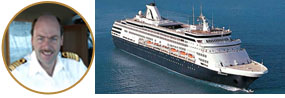
Captain Albert
© 2026 – Captain Albert's Website and Blog –
Theme by Anders Noren — Up ↑