Today is our sea day to get to the North Cape and Honnigsvag. The weather followed the weather forecast and it was nice, quiet and dry for most of the day. In the afternoon we got a bit of motion of the ocean courtesy to a weather front behind us which is creating some waves but the Prinsendam is a good surfer and thus the dis-comfort is very minimal. We are on average sailing a distance 12 miles from the shore. Partly because the dotted line between the pilot station of Trondheim and where we go around the corner of the North Cape makes it so, but also partly to stay out of coastal waters. There is the 3 mile zone (full territorial waters) and we try to stay out to avoid the local rules; and there is the , 12 mile zone, where we stay out of if possible as here the international regulations might vary from country to country. The latter can be quite complicated and brings headaches to every captain. IMO (International Maritime Organization) sets the standards that are approved by every member. But the regulations are allowed to be “amended by the local administration”. So a measure of a Liter of paint in Europe might be a Gallon of paint in North America, and a Jin in China. To avoid going mad and/ or making mistakes we try to plan our courses outside the 12 NM. Continue reading
Category: Shipboard Info (page 12 of 14)
Trondheim is located in Trondheim fjord which is the 3rd largest fjord in Norway. About 72 nautical miles long and the city named after the fjord is about 40 miles deep into this fjord when measured from the open sea. It is one of the most ancient cities in Norway so old that it takes at times priority over Oslo the capital city. When new Norwegian Royalty ascends to the throne, it happens here and not in Oslo and there are few more of these things. The city has a 2nd name Nidaros and for a brief period in 1930 it was the official name. Then almost a revolution took place and the government put the name back to Trondheim. This must have been a major issue as the attitude of the Norwegians does itself normally not link to revolutions. I have been told that this is still smoldering on but more peacefully as there is a split in opinion about whether the name should be spelled Trondhjem or Trondheim. So maybe one day when we come here during a cruise we will see the barricades up again, dividing the town in a hjem and a heim. Continue reading
Alesund is one of the better ports in Norway at least from a Navigators perspective. It is sheltered from most winds, it has nice docks, we dock with the gangway in downtown and downtown is worthwhile to visit. Most of it is constructed in German Jungendstil style or related to it after a big fire they had here a long time ago. There are some other good ports as far as shelter or docks or downtown distance is concerned but there are not that many Norwegian ports that have it all together. You might think about Oslo but this port is located at the end of Oslo fjord which is so wide that the wind can still blow the ship all over the place or keep it pinned to the dock. So Alesund is very highly rated on the list of ports that come closest to a Cruise Captains dream of having the best of all. And I fully agree as it even has a Big Red Bus for hop on hop off and for an initial exploration of a city it is one of the best ways to go. Holland America also recognizes that and nowadays you can buy the tickets on board. Continue reading
The weather turned out better than expected and under dry skies we picked up the pilot at 05.00 hrs. and docked just before 07.00 in Stavanger. Today it was a busy day in port with four cruise ships in. Our good selves, the Costa Favolosa, the Costa Mediterranea and The Viking Sky (*). Being the smallest ship meant we went to the smallest dock but in this port that does not matter that much. The downtown docks of Stavanger which are now mainly used for the cruise ships are surrounded by the town and that means that downtown is nearby at all sides. If we dock at the official cruise terminal, then we are opposite the Maritime Museum and while we now are docked here, we are across from the Pub so both docks have its advantages. Luckily downtown Stavanger with is large park behind it is fairly spacious so it could easily absorb the approx. 8000 guests going ashore (Not to mention the about 3000 crew members. (*)) Continue reading
Today we are at sea after leaving the Netherlands two hours late. Reason, the lock door of the Main Lock in Ijmuiden did not want to open. Amsterdam can only be reached by deep sea ships via Ijmuiden and then sail via the North Sea Canal to the various cargo berths of Amsterdam Port or all the way to downtown where the Passenger Terminal is located. Which is a great location as there are not many big ports where you dock a 5 minute walk from the downtown area. Also for joining and leaving the ship it is great as Central (Train) Station is also only 5 minutes away. And if there are a lot of Dutch guests on board you can see long lines of “cloggies” roiling their suitcase down the street from the train to the ship.
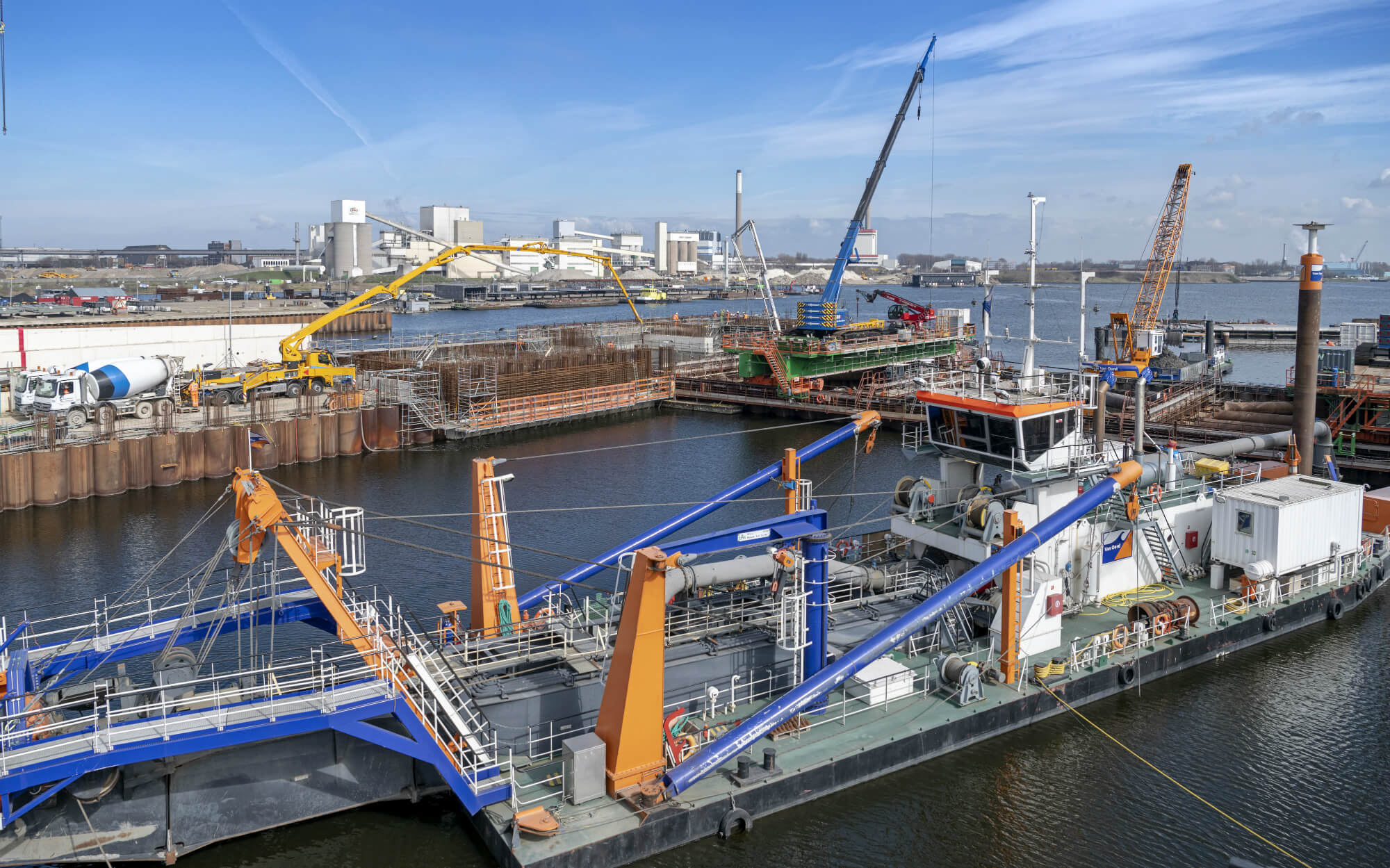
They have now built the walls of the new locks and have lifted a complete dredger into the lock pool to clear out all the mud inside. (Photo Courtesy: Dutch Government)
But the locks are another matter. They are expanding the locks to be the biggest in the world and it seems that the old one is a bit upset about that and starts giving sensor problems. And without electronic sensors nothing can work nowadays. Not even a set of locks that are already over a 100 years old (The first one is from 1876) and must have worked a long long time without any electric wizardly. The Prinsendam was delayed 2 hours inbound two weeks ago and now again two hours while outbound. If it has to happen then outbound is better, as inbound it might affect the dis-embarkation & flights of the guests going home. Outbound there is most of the time sufficient leeway in the schedule to catch up again. And in this schedule on the way to Stavanger we have plenty of time. Continue reading
With sunrise at 06.00 and a hazy sky we serenely sailed over a flat calm Mediterranean and then into Santorini. The hazy sky was courtesy of the lack of wind today but it all cleared up by 09.00 hrs. when the sun burned it off. The high pressure system over the Balkans which causes the winds in the Aegean Sea is not yet permanently in place (they also have cloudy days on the Pusta’s) and thus it was wind still, yesterday and today. The captain had opted to come in via the South West entrance and then sail north to our “floating area”. The Celestyal Spirit was already at anchor on the hump as she is larger than the Ovation in guest capacity and makes more calls but still small enough to leave plenty of space to come close to the town. Sailing into Santorini is always interesting as parts of the outer Crater wall loom overhead and the black core creates a sort of round-a-bout where the ships have to sail around to get wherever they want to go. Continue reading
Today we have a sea day as we are on our way to Santorini. The distance is 550 miles and that we cannot cover in one night so we are having a relaxing day at sea. And this time I can say this as the daily program does not feature any wild activities. One can be mentally and physically exercised if one wishes so but it is all spaced out and doable. The earliest activity was a remembrance service of ANZAC day this morning at sunrise and although the ship is small there was a good number of veterans on board to attend. As the crowd on board is very international it was amazing to see that the attendee’s also represented the whole scala of “Allied Forces” who were active in the wars and not just the Australians and New Zealanders for whom this remembrance days is specially meant. It was a real “Brother and Sister in Arms” gathering at sunrise. While this morning was the remembrance part this afternoon the ship will organize a get together for some reminiscing with a good glass of wine in hand. Continue reading
Although the ship was in port overnight and the gangway wide open for the whole period, most guests came back on board for a good night’s sleep and then got up again very early for the next set of shore excursions. The Colonnade Restaurant (Comparable to HAL Ships Lido for breakfast and lunch operation although they offer A La Carte as well’) opens at 06.30 on port days but it looked as if they had torn the doors down as half the Restaurant was already full when I arrived at 06.31 hrs. Last night it was very quiet in the ship and I felt really important as I had the whole Club Lounge to myself including the Band. Some guests joined later but when I left the crowdedness of the lounge reduced again by 20%. Still a few people were on board during the day as not everybody participated in tours on both days. For just going ashore, without a cultural goal, Haifa is not as spectacular as due to the curved nature of the port, it lacks a concentrated down town area. So it is not as ideal for a concentrated shopping stroll as might be the case in other ports. Continue reading
After a slow sail from Ashdod to Haifa we arrived at the pilot station at 06.30 and sailed in shortly afterwards. Haifa is located against a curved mountain ridge which tapers off towards the sea. The top of the ridge is called Mount Carmel. The mountain is well known from biblical days as the location where the Prophet Elijah challenged the local competition to settle the problem of who was the true God.
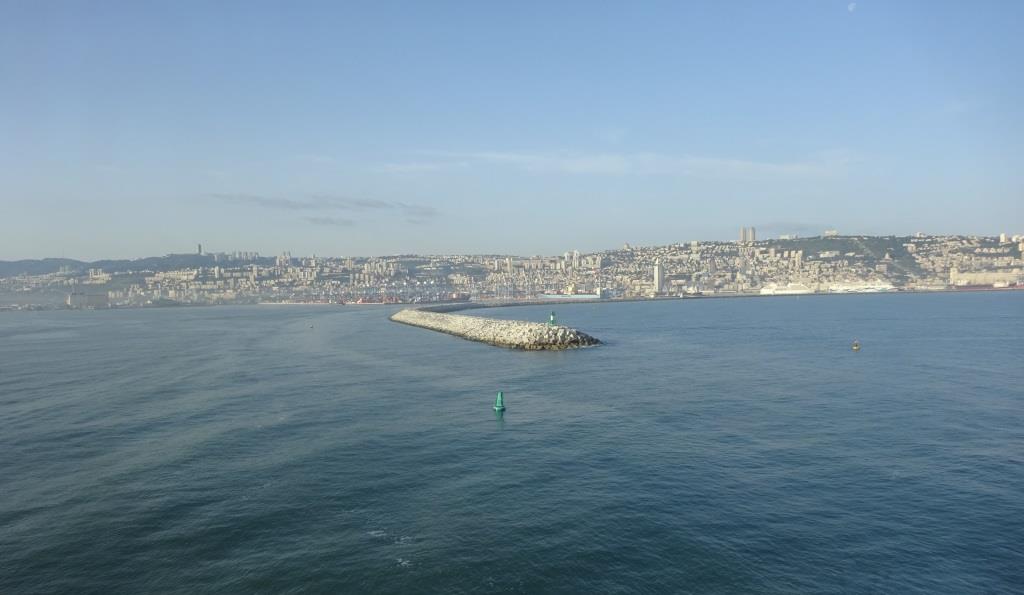
The port of Haifa as seen from the pilot station. Haifa is mostly located against the Northerly ridge of Mount Carmel.
Together with the Seven Seas Navigator we sailed along the coast towards Ashdod with the idea to arrive early as the clearance operations take time here. However the Navigator had to wait and we had to stay behind her and then she got clearance first. So the plan of sending the guests ashore, bright and early, did not exactly work out. We were still docked ahead of time but then we had to wait for the authorities to walk from one ship to the other, and once done they could finally start comparing all our faces with all our passports. (Everybody had to go through, Guests and Crew) Once that was accomplished you received a stamped landing card for going ashore.
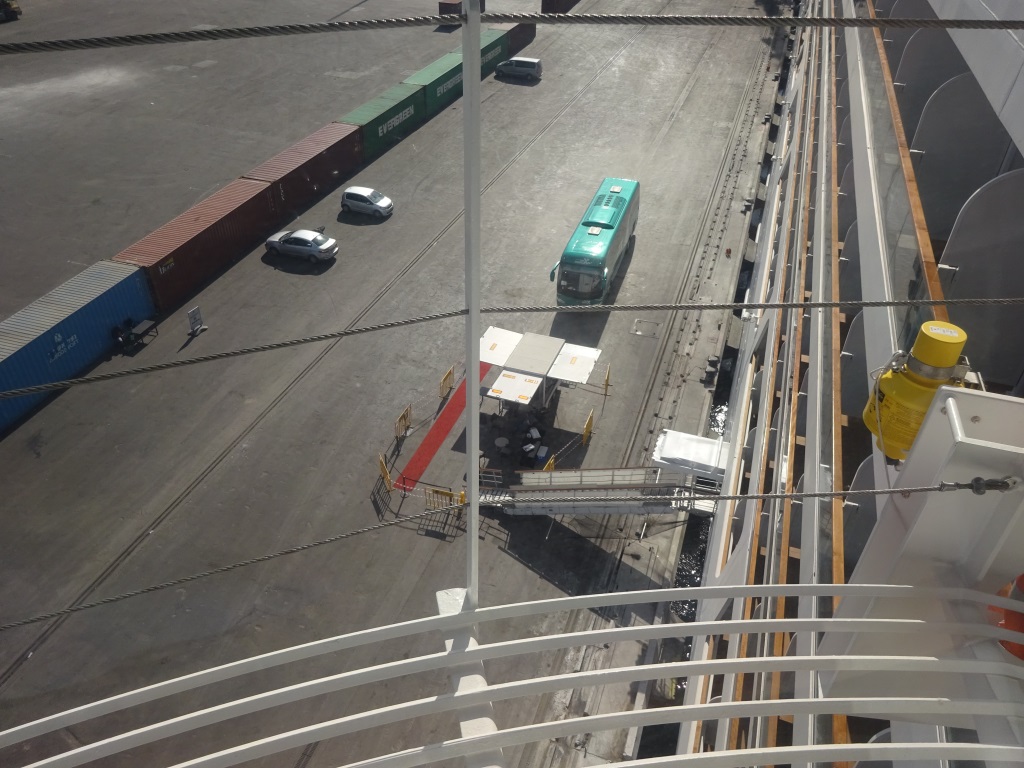
Extra, Extra Security at the gangway. This to complement our own scanning equipment inside.
When going off there was a mobile scanning post set up at the gangway and everybody was subject to a scan and a handbag inspection before they could board the coaches for their tours. Luckily we are staying until 23.00 hrs. tonight so the late departure will not result in a reduction of the tour time. As can be expected security is very tight here in the various ports and both cruise ships are surrounded by a row of containers with only a small entrance / exit for the coaches and the shuttlebuses. Continue reading
Captain Albert
© 2026 – Captain Albert's Website and Blog –
Theme by Anders Noren — Up ↑