- Captain Albert's Website and Blog -

Ocean Liner History and Stories from the Sea, Past and Present. With an In Depth focus on Holland America Line

Page 62 of 242

01 July 2017 in between ships.

Due to the time difference I currently post my blog the day after the date. That results today in a conflict of interests as I am leaving the Noordam and  transferring to the Zaandam, via a short visit to our NEW head office in Seattle.

So I will try to catch up tomorrow as I am flying today.

Thus today there will be no blog but hopefully there will be one tomorrow with some photos of our new head quarters.

Best regards

Capt. Albert


30 June 2017; Ketchikan, Alaska.

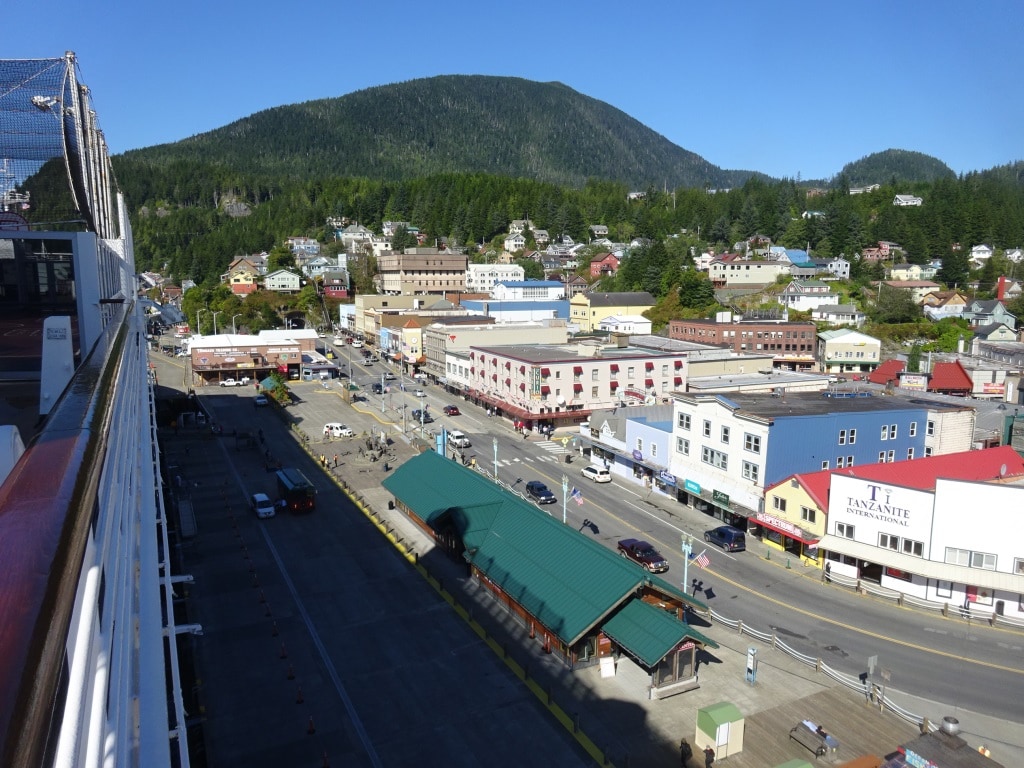
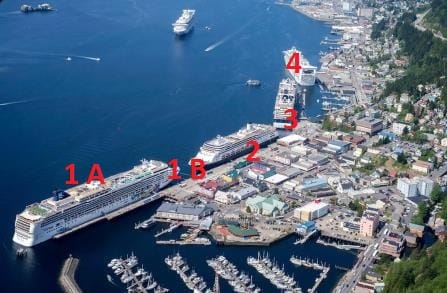
As mentioned yesterday the ms Noordam was on a tight schedule to get to Ketchikan on time and thus we raced through the night from Juneau, via Cape Spencer and Snow Passage to Ketchikan. As there was no traffic to hold us up, the ship docked nicely on time at Berth 4 in Ketchikan. Berth 4 is the farthest to the north and also the farthest away from down town. (Although is there is shopping board walk to guide you there) We have been assigned to this dock because we were the last one coming in. On berth 1 we had the Oosterdam which arrived early and left at 13.00 hrs. Her spot was then immediately taken by the Celebrity Infinity. On berth 2, facing north was the Seven Seas Mariner, and on berth 3 was the Norwegian Pearl who had left Juneau earlier than us and thus could dock earlier as well. Four ships, four docks and the port was full again. That leaves one anchorage space in the middle of the harbor but it is normally only used on congested days. I think they have the first one on July 3 when then Grand Princess has to anchor during a full day call.

Tongass Narrows as seen from the south out of an airplane. (Courtesy: thank you to the unknown maker)

Ketchikan is partly sheltered by Tongass Narrows and to get there you have to sail through it completely during the journey either Northbound or Southbound. As there are houses and docks on either side of the Narrows there are speed restrictions. So we have a whole protocol to abide by. The pilot is the person ensuring that we do abide as it is his license on the line as being the Government Representative on board. Only if the captain would ignore the pilot’s advice in regards to the regulations, then the ship would be held responsible. The whole of the South East Alaska ports are covered by a rule book. The S.E Alaska Waterway Guide.  All who are involved in navigating have to know its contents and if something changes, we will hear about it via the pilots, the ships agent and the Notices to Mariners; although the latter can be quite delayed in coming to us as it has to go through governmental pipe lines.

The Nautical Chart of the Tongass Narrows. (Courtesy Noaa 174286)

The north point of Tongass Narrows is defined by Guard Island (A), a clever name as indeed the lighthouse on top of it guards the entrance. At this point the ship will slow down its speed to full maneuverable. This means the engines come down from a most economical sea setting to where we can pull the handles without causing any issues with the propulsion. (The ships engines are always ready to slow down but a gentle way is preferred when high temperatures are involved) Then it is about two miles until we come to Rosa Reef (B) which is a small reef sticking out from the southern shore. There we have to be down to 16 knots. The next location is Ship Island (C) where we have to be down to 10 knots. This speed is universally considered a no-wake-speed and that will protect the boats and floats along the sides of the Narrows which are now becoming more and narrower here.

Next step is when we pass Tongass Dry-dock (D) opposite the airport. Due to the floating dry dock, the Narrows are now really narrow and thus we have to be down to 7 knots. Here is also a small ferry crossing for people to go from Ketchikan to the Airport and vice versa.  The seven knots speed limit is in force for the whole port area and thus we can adjust the speed for the rest of the distance to the dock to our own liking. Normally we approach the dock (E) with a speed of about 3 knots and then let the Azipods trail astern to come to a standstill in the right position.  That right position is where the gangways will be located and as dock 4 has a floating pontoon to accommodate a tide-less gangway, that is where we have to aim for.

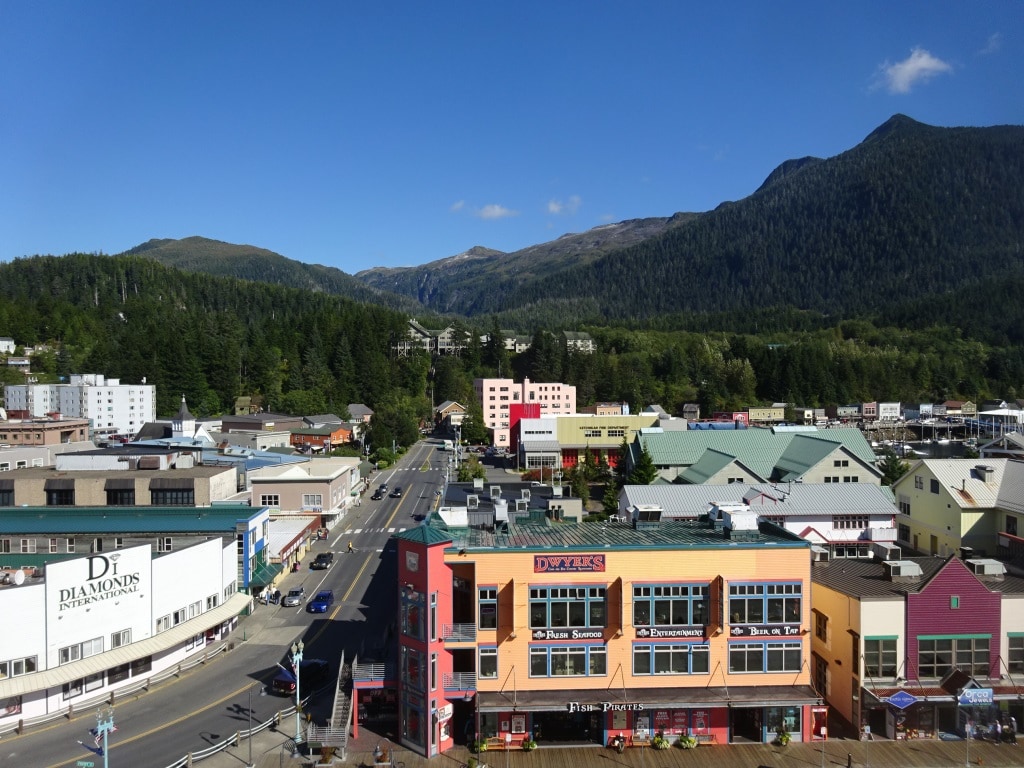
Downtown Ketchikan, with cruise ships in port on a congested port day as also the anchorage is occupied.

Ketchikan did let us know a few times during the day that it is the Rainy Capital of the World but there was no wind, so it was not that chilly when being ashore.

We will sail after 18.30 hrs. to get back to Canada ad after an hour forward to get back into the Canadian Time zone we will sail the Inside Passage from around noon time onwards. It is expected to remain a bit rainy.


29 June 2017; Juneau, Alaska.

During the night we sailed slowly towards Juneau to join the parade of incoming cruise ships. Today it was not so busy; only three ships arrived at more or less the same time. The parade was led this time by the Celebrity Infinity who had to go to the Steamship Dock, the dock furthest in before they put the new floating dock in position. Alaska Steam was always the dock for the smallest cruise ship and thus most of the time the Holland America S and R Class docked there.

The ms Noordam docked in Juneau today. this photo was taken from the ships tender as I was conducting sailor training today. In the back the Celebrity Infinity.

Now we have this new and very long dock there is space for the big boys as well. Next in line was the Noordam which docked in front of the Infinity at what we still call the Cruise Terminal although the name is now outdated. The name dates back from the days that the Alaska Ferry dock was converted in a cruise ship dock and if there was only one cruise ship in, it went to that dock. The Alaska State Ferry had by then moved to a new terminal at Auke Bay sometime in the early 80’s. Far out of town but much easier for cars and trucks to reach and park.  In port as well was the Norwegian Sun and in the afternoon we were joined by the Carnival Legend and that meant that all the major cruise docks were occupied.  There were no small cruise ships in port today which is unusual as there are a lot of wildlife enthusiasts who want to go very far off the beaten track. Something we do not offer with the larger ships and not even with our shore excursions.

The port of Juneau as seen on the Electronic chart. The red lines in the chart are the safe boundaries for the ship to sail in between. The little roundals indicates the moments for changing course and speed.

Carnival has committed one ship to Alaska since a number of years, although it’s focus is not on Alaska as such. As we are now one big family with the various brands under the Carnival Corporation Umbrella, Holland America and Princess are spear heading the Alaska cruise experience. But Carnival Cruise Lines is a big cruise company and thus they have sufficient clientele to offer one ship for the Alaska summer while having “fun” at the same time. It is for the same reason we see other company’s popping up with one ship for one or more cruises. Thus we have seen the Silver Shadow and the Seven Seas Mariner but also one of our own Seabourn Ships. Seabourn delivers a six star cruise experience and goes everywhere from the Artic to the Antarctic and from Europe to the Far East. It has only a few ships and so has to offer a few cruises everywhere which is also something its guests expect. Something different all the time.  I might be able to blog about Seabourn a bit more next year, as plans are that those ships will be become part of my fleet rotation program.

A bald eagle had taken up a prime look out spot on top of the rope winch for bringing mooring lines ashore.

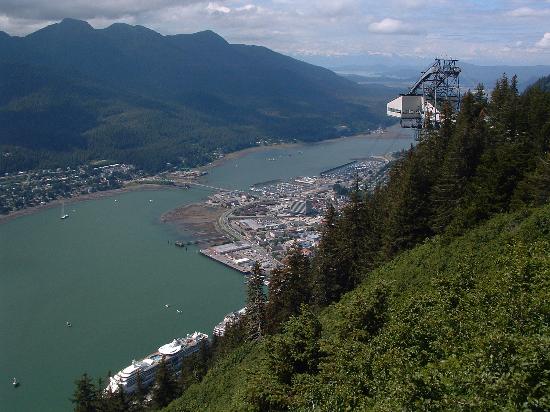
Juneau provided an overcast experience today but the clouds stayed up in the sky and thus the Cable Car to Mount Roberts could show Juneau from the air. It is not unusual for the top to be enclosed in clouds. It does not stop the cable cars from going up and down but it limits the experience at the top to visiting the little attractions (shops) on the platform. But Juneau is getting more and more attractions closer to the ship in the form of Wildlife. When I came to Alaska for the first time in 1982 seeing a Bald Eagle was big news. We made announcements and slowed down the ships. But with the years the conservation projects have paid off and now we see them everywhere. Even on the docks. This afternoon we had a full grown specimen sitting on the bow bollard of the dock watching the world go by. There is ample fish in Gastineau Channel and all around, not to mention all sorts of small animals (and they seem to like French fries as well) for them to live the good life.

We left just after 17.30 as all the guests were nicely back on board on time and the extra 30 minutes will help the captain to arrive timely in Ketchikan. It is a high speed run between these two ports and as you never know how much you have to slow down at Snow Passage, a bit of extra time up the sleeve does help. We are looking forward to real Ketchikan weather with temperatures around 55oF or 13oC and around noon time a 100% chance of rain. The locals must get worried as even for Ketchikan there has been much less summer than normal.

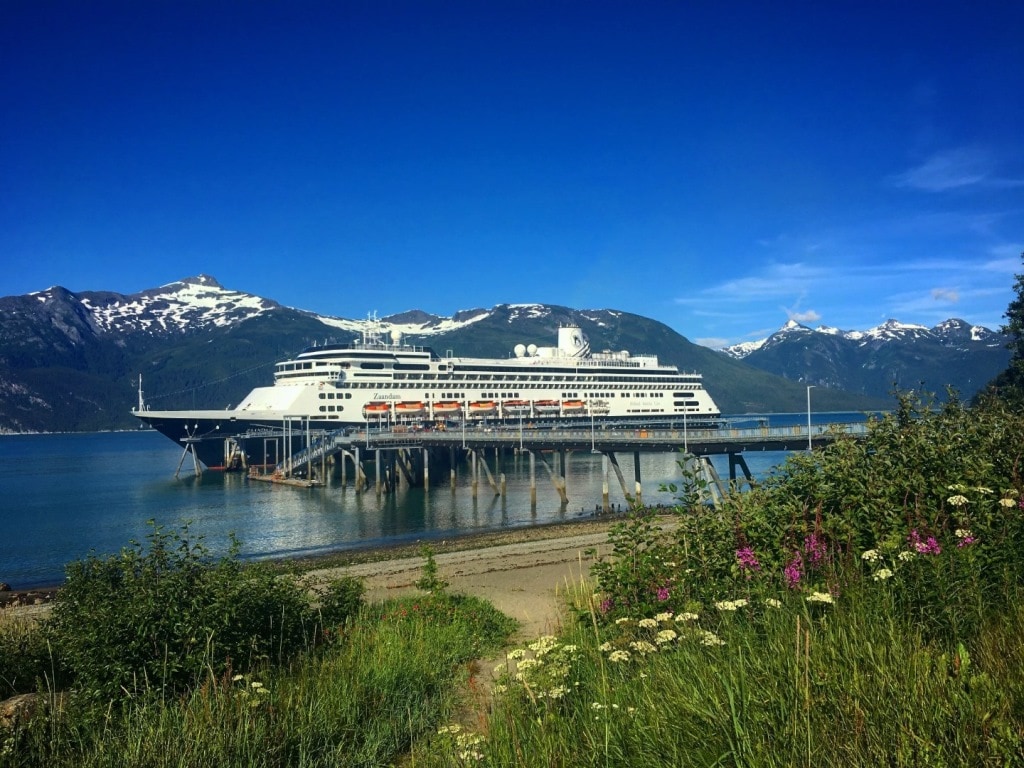
28 June 2017; Haines, Alaska.

Haines is special place. It really should not be there and you can see that as it looks totally different than the other Alaskan towns. And that gives it, its charm. Ketchikan, Juneau and Skagway are now the major tourist towns, while Haines in its little sheltered corner of Lynn Canal is somehow only a small part of it. Holland America was the company that started calling here on a regular basis, as it decided in the late 1990’s to make Haines the Southbound stop on its 14 day Alaska service to Seward giving the guests who made the 14 roundtrip from Vancouver at least one different port to look at. (If they need more T shirts, they can still take the ferry to Skagway which is available to those who joined in Seward for the southbound trip only).

The metropolis of Haines was originally an Indian Settlement and to put it simply the Indians choose the Valley on which edge Haines is located to sit out of the wind and to enjoy some good fishing. The wind can whistle up the Lynn Canal as a funnel wind with speeds of up to 50 or 60 miles an hour and it is not much fun if you have to face that every time you open your front door. When the United States bought Alaska they bought with it a border dispute with Canada. That resulted in the building of the William H. Seward Fort just south of the town.  As far as I know Canada has never invaded the USA over “the Haines Question” so it must all have been settled.  Haines got its names from a Mrs. Haines who was instrumental in providing funds for a mission school which was built here in the 1880’s.

Haines as seen from the ship with the ex military houses against the mountain ridge.

The fact that the town looks so different from any other town is caused by the Military houses against the hill above the dock. I suppose the military had some sort of standard house design and brought that with them when the fort was built and the subsequent expansion of the military activities through the years. One big difference between these military houses and the average Alaskan house is the size of windows. Everywhere along the inside passage and in the various towns, the locals construct their houses with as large as possible windows to let as much light in as possible. Understandable as for half the year, the weather is gloomy to very dark for most of the day. This area of Alaska does not have the midnight sun but it comes very close to it. A few days ago we had the day with the shortest night here in Alaska. On the ship the sun set at 22.50 and rose again at 03.20 hrs. In those 4.5 hours it never went really dark it was more of a prolonged dusk. During the winter it also works the other way around. It never gets really day light. So the more light that is being let in, the better.

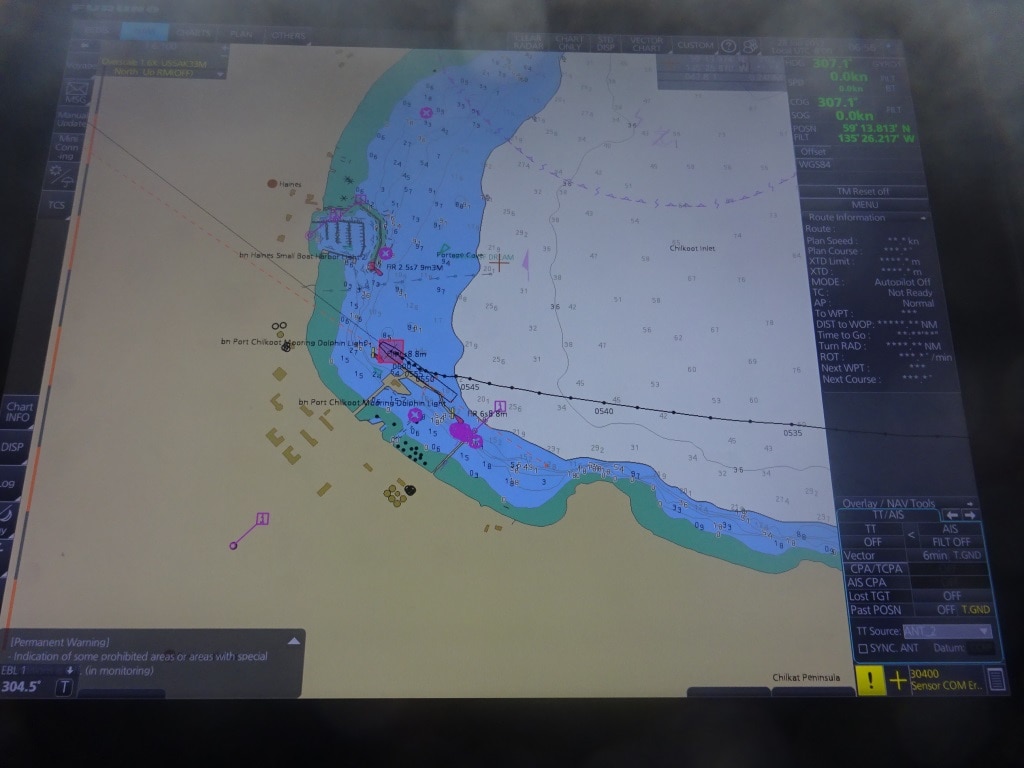
The electronic chart showing the ships approach and subsequent docking at the pier in Haines.

The port has only one dock for cruise ships although there are moves afoot to construct a second one. It is standard for us, to dock nose in, portside alongside. Partly because we do not like the ships Azi pods to come close to shallow water, partly because the first tours are leaving at 06.30 and going nose out / swinging over starboard would mean coming in another 30 minutes earlier. That means a lot of people have to get up even earlier than is already the case. If we swing in the evening, it will go faster as we move the ship away from the dock and into open waters and a lot of crew are still around working anyway.

From Haines there are tours to be made all over the Lynn Canal and Skagway. Quite popular is the local tour as there is a fair chance of meeting Moose. Our tour today spotted a Mama Moose and a baby Moose. Great excitement of course. Moose are not universally liked though by the locals. One of our pilots lives in Haines and when she is ready to harvest her tomatoes, a local Moose tends to come down and “help” with the harvest.  Our company also offers bike tours in Haines, as the Chilkoot valley is near flat and traffic is not such that you risk life and limb while peddling around.  Top of my Agenda is the local brewery (bring your own bottle) and the Hammer Museum. The latter is not a joke but has an enormous collection of everything you can hammer with from all around the world.  Deep in the archives of this blog you will find an entry where yours truly (instigated by the Art Auctioneer) donated an auctioneers hammer to the museum.  And they also sell a T-shirt, called”I got hammered in Haines”.  And that is one you cannot get in any of the other T shirt shops in Alaska.

Tomorrow we are in Juneau, where the plan is to arrive at 07.00 hrs. Weather: it is supposed to be an overcast day but with not much or any rain. Temperatures will soar up into the high fifties.

27 June 2017; Glacier Bay, Alaska.

The weather turned out to be quite decent in the end. Not much sunshine but also very little wind and that is important for good sightseeing. If we have a wind that blows into the bay and somewhere goes over a Glacier while coming in, then it becomes a very cold wind and that makes being on the outside deck a bit of a challenge. But not today. It was nice and quiet in the upper bay.

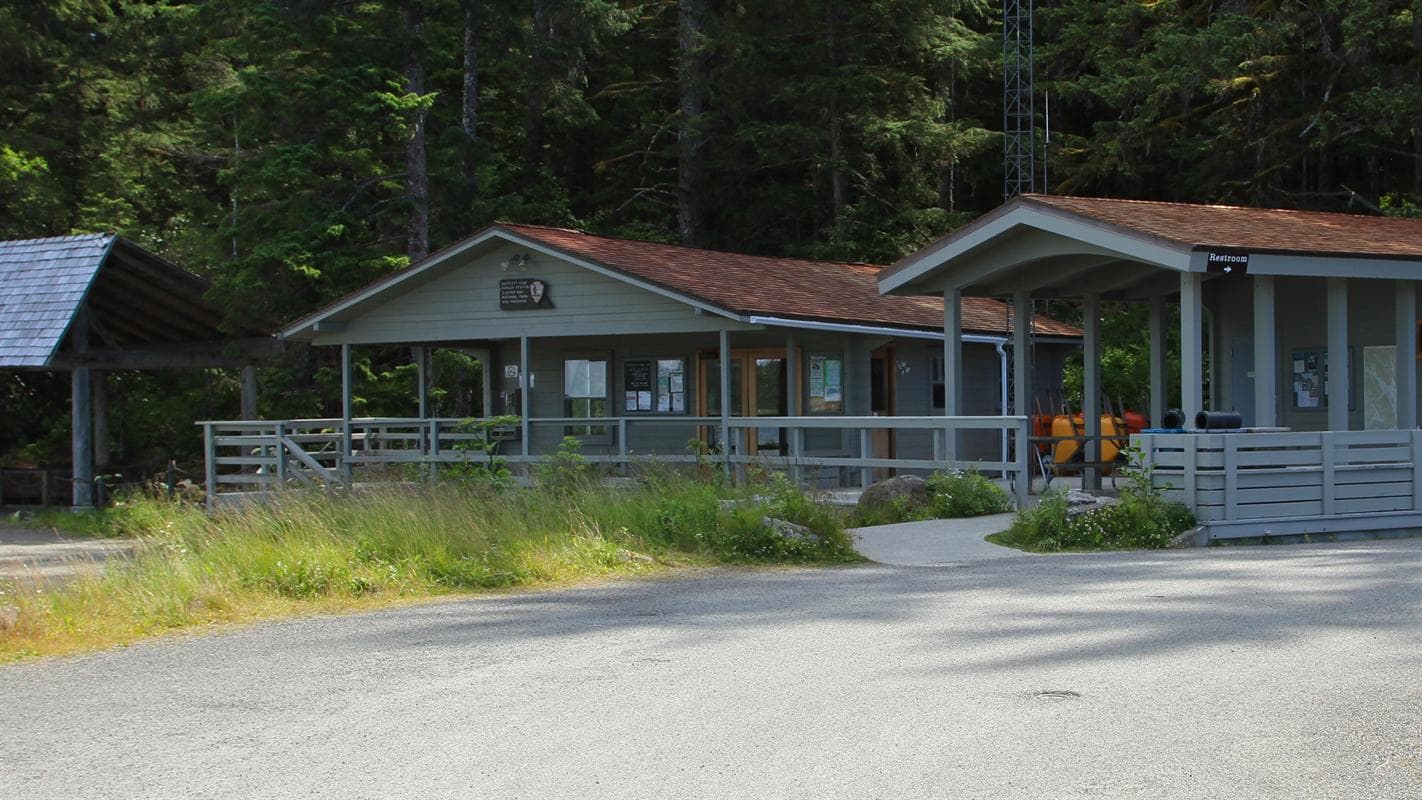
We normally pick up the Rangers between 06.30 and 07.00 hrs. at Bartlett Cove which is a small village at the entrance of the Bay and where also the Ranger Station is located. We return them between 16.30 and 17.00 hrs. after a full day in Glacier Bay. The Rangers come out in their own boat, called the Shirak, and they board via the pilot ladder. Normally there is a minimum of three Rangers, one for the announcements, one for the desk and shop they run in the crow’s nest and one who does the lecture in the show lounge. Then there is often an Indian interpreter from the local tribe who have lived near Glacier Bay for centuries and very often we also have a “spotter” on the forward deck. A Lady or a Gentleman who spends all day looking at wildlife and counting the sightings. I have the greatest respect for this person as he or she stands there all day long in wind, rain and cold, looking around and counts and observes. I always think how lucky I am to stand on the bridge behind glass and a steady temperature.

It is so simple to say” pick up at 07.00 hrs. and drop off at 17.00 hrs.”, but there is a whole puzzle behind it, a puzzle which the captain has to solve and adhere to. First of all there is the requirement of spending 4 hours in the upper bay, where the glaciers are. This 4 hour requirement was instigated in the past as there were captains who raced up and down the bay and managed to sail past all the glaciers in 2 hrs. time. That does not give the guests much time to enjoy the experience and thus the 4 hr. rule was imposed quite a few years ago.

Then we have to deal with “Whale Waters” as I mentioned last week. At the moment we can still do 20 knots in the middle of the bay but in the near future it will be reduced to 13 or 10 knots. As soon as more wildlife is taking up station in the Bay area. Then it will take much longer to sail up or down the bay. Finally the Rangers also give a presentation and during that time they want to have everybody as much as possible in the lounge, so we try to be in an area where there is not too much to see, because if there is wildlife, then we like the Rangers to be there to explain it.

That all together gives for the fact that it takes a bit of doing to cobble a workable schedule together. However we have been at it for a long long time so the guest does not even notice that they are being ran on a very strict schedule in order to comply with a lot of different rules (*)

Marjorie Glacier with a ice pinnacle sticking out into the bay. Very unusual.

Marjorie Glacier had calved a lot since last week and today there was a long straight pinnacle heading into the Bay. It will not stay there very long, a few times with the tide going up and down and it will break off. But at the moment we have two curved gaps in the face of the Glacier, where once Marjorie was one straight wall of ice. It will be interesting to see how this develops and if one day we can walk in front of the Glacier on dry land.

Tomorrow we will be in Haines where we will arrive before 06.30 in the morning as that is the time the first tour is leaving. The weather is supposed to be overcast but dry, so it should be a good day for everybody to be out and about.

(*) and of course do not forget the bingo a 17.00 hrs. as it would be lethal if we would have to cancel that one.

26 June 20117; Gulf of Alaska.

It was not the greatest weather we had today but it was quiet weather. Just a low swell was running and we had a following wind and thus we hardly noticed it on board. For all the new guests not a bad way to start a cruise, especially as we have a lot of new, new, guests on board who have never made a cruise before. Quite a few of them follow the logic: “if I do not like it, then at least I have not spoiled my complete holiday” as they will still have enjoyed the overland part of their Alaska trip. Most of them do enjoy the experience and we gain every cruise a lot of new Holland America Line passengers, who will then come back for our Caribbean or European cruises.

As mentioned yesterday, the crew were looking forward to the end of Ramadan and the special dinner that goes with it. Holland America is very focused on providing the food that the crew likes and that includes a lot of ethnic foods. With normal cruise operations the ship work’s on a 14 day menu cycle that repeats itself. The crew knows what is coming and also the company can fine tune the delivery and quality of each dish.

Normally the crew comes in, in staggered numbers. Not today; special food and the line was out into the crew corridor.

With high days and holidays there is always something extra and everybody joins in. It is amazing how many crew are Christians during the Christmas dinner and how many are Muslim during the Idul Fitri dinner. I think it would be beneficiary for the world’s peace if every religious leader would be required to have a cook’s license before being allowed to preach. I think it would make a difference.

Part of the serving line. In front of the counter Diningroom Stewards who now get served instead of serving themselves.

Another tradition is that the Ships Staff serves the food during dinner. We cannot do table service as there are too many crew but we stand behind the serving line and dish out all the special foods for the celebration. The officers rotate on 30 minute slots through the dinner period and at each period there are about 5 or 6 behind the serving line dishing out. As there was a gap at the start of the dinner, my colleague Captain Bos asked me to help out and that gave the unique situation of having two captains in the serving line at the same time. I was doing the rice and he was doing the spiced liver.

A dinner like this takes a bit of planning and through the years the company has figured out a menu for this celebration which pleases everybody. We cannot simply decide to do something at the last minute as the ingredients have to be purchased ahead of time and then have to be brought on board. Our provisioning takes place in Vancouver and that means that the Culinary Operations Manager (budget), the Executive Chef (menu decision and amount calculation) and the Provision Master (inventory control) have to decide at least 3 weeks in advance how much they need from the more exotic foods which are normally not part of the menu cycle. And then we all hope it arrives on board on time.

The special menu in the Indonesian language and English so the Philipinne community can also choose.

As usual itis the Cooks who suffer the brunt of all the work while the others feast on the results. The cooks in the crew kitchen under the leadership of Kokkie –Satoe, (Dutch/Indonesian for First Cook ) need to prepare it and that takes more than a few hours. Normally the marinating and other prep work starts a few days ahead of the official date. Then cooks seldom get to enjoy a good sit down to enjoy the fruits of their own labor. Still they must get the chance to eat as I seldom see a skinny cook on our ships, at least not after the first contract.

Tomorrow we are in Glacier Bay, picking up the Rangers at 07.00 hrs. and then sailing up and down the Bay until 17.00 hrs. The weather forecast is not that great, no sunny day is expected, but there are no plans for rain to occur. Still Glacier Bay has its own climate due to the high mountains on either side and the proximity of all that Glacier ice, so we really never know what we will get until we are sitting in the middle of it.


25 June 2017; Seward, Alaska.

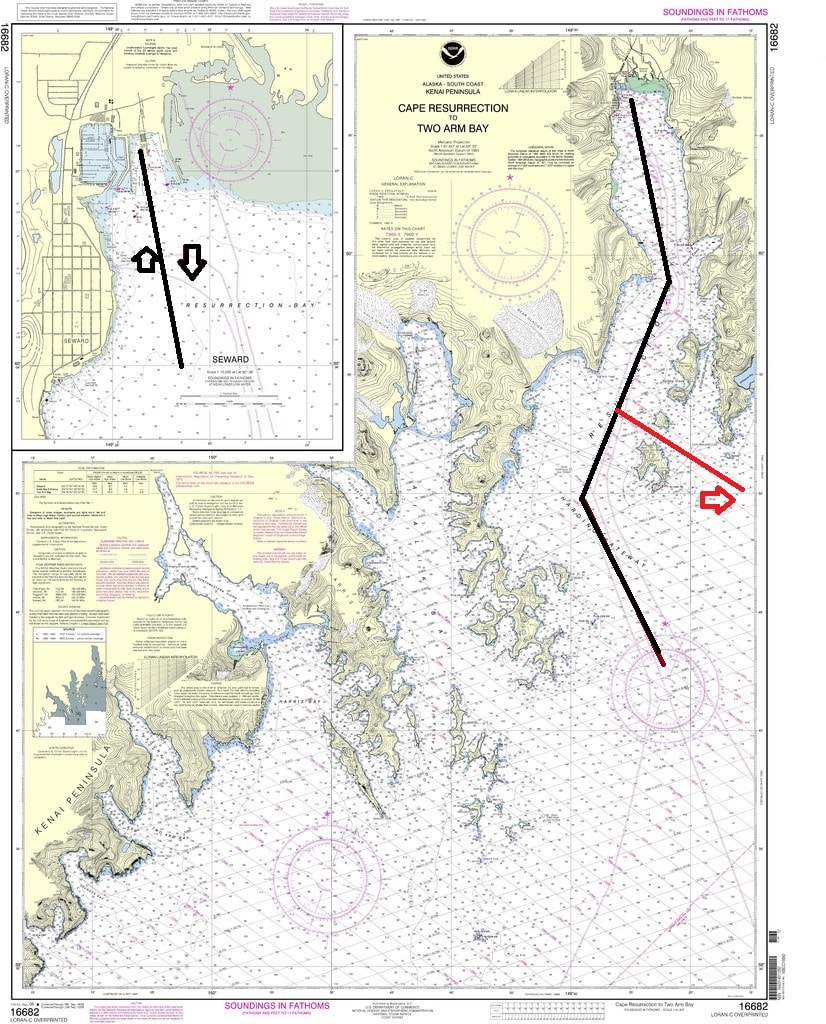
Seward is located at the end of Resurrection Bay and used to be the Ferry connection to the interior.

We had a glorious day today while the temperatures remained under the mid-sixties (18o Celsius) Just low enough not to cause restricted visibility and just low enough not to get hot and bothered while pulling suitcases. But high enough to enjoy a gentle summer morning while travelling. This is a very early morning arrival for everybody and certainly for the ship’s crew. The guests coming from the overland tours mostly arrive in Anchorage the night before, so do those who fly in for the cruise only experience do the same. They all converge on Anchorage, which is a 2.5 hours’ drive from Seward. How to get 2000 people down there and the same number back is logistical tour de force. And thus you have to start early.

The dock is to the left of the cargo ship which is docked at the Coal terminal. We do not like a ship at that location when we are in, as it makes it difficult for us to get in. But the Marina is nice for tender training. Wintery stock photo from somewhere on the internet.

The ship has to be docked by 05.30 and the first wave of disembarkation starts at 06.00 hrs. This means that the Bridge and Engine room go to battle stations around 03.30, when the ship approaches Resurrection Bay (*). The pilot comes on board at the entrance at 04.30 and then the ship will just be docked at 05.30 hrs. with the gangway out. Contrary to other disembarkation ports, most guests do not have to take their luggage with them on the coach. They either find it back at the airport or at their first hotel stop while going overland. So when the first wave leave at 06.00 hrs. to take the train to Anchorage, the luggage is still being offloaded and is following in a truck.  The system seems to work very well as I seldom hear about problems with a suitcase ending up somewhere else than where it was supposed to go.

(*) And I do not even mention the hotel department, as breakfast starts at 05.30. which means some of the cooks are already running around at 03.30 in the morning as well. If to boil an egg takes a lot of planning let alone to set up the complete lido buffet and be ready for 300+ guests who all show up at the same time.

We use the local train service from Seward, but they do have Panoramic Cars, before the guests move to our own trains to Denali.

Then for the remainder of the morning, groups are being called out, they call them “waves” here in Seward, as soon as the busses are available. These busses or coaches take some groups to Anchorage where they change to our inland trains or to other buses which go up into the interior. These shuttle buses then bring back the new guests to the ship. The result is a very staggered and non-rushed operation with the last guests arriving around 18.00 hrs. at the ship and the last luggage being on board by 19.00 hrs. The follows boat drill and then we are on our way south again. While a whole port call in Ft. Lauderdale takes (pilot to pilot) from 05.30 to 18.30, here the whole evolution lasts from 04.30 to 21.00 hrs. Although the pace is less hectic.

Today we also had the end of the Ramadan for our Muslim community and that is normally celebrated with an Idul-Fitri meal. Because of change over day we had to postpone that until tomorrow as such a celebration should not be rushed and the special food for the feast meal needs more time to prepare. In the same way as we sometimes move Christmas dinner for the crew as well, if it is too close to embarkation day.

I took my school class down in the tender today, for their first practical lessons of tender driving and a lot of the conversation was about if the Cook would get the fried rice (Nasi Goreng) exactly right. That seems to have been an issue in the past. I always like it when they are nattering away in their local language as you pick up interesting tid-bits of information and sometimes they are quite shocked that I understand much more than they think. 37 years of being involved with Indonesians gives you a good insight in the language even when they speak a sort of sailor slang.

Teaching a novice how to drive a tender and make him understand what is better is not so easy, as most of the trainee’s think that speed solves all problems. Either full ahead or full astern. This is not the case as it only makes the tender harder to control so I try to explain that driving a tender is like dancing with a very big and tall lady. You cannot get your arms around her, she is much taller than you are, and if you push her, you cannot stop the momentum. So you have to nudge her gently to sway with her over the dance floor in the right direction. So we spent a whole morning dancing around the ship and in and out of the Marina.

Tomorrow we are at sea again, retracing our steps to Glacier Bay. The Gulf of Alaska is to remain quiet for the coming days with only a low swell running from the South West. It should be a nice ride with a gentle breeze pushing in the back.

24 June 2017; At Sea, Gulf of Alaska.

The weather forecast today did not run in tune with the actual weather. Where the expectation had been for a clear morning followed by increasing cloudiness and rain in the afternoon, the reality was the other way around. Most of the day turned out to be gloomy but then it cleared in the late afternoon. Not good for today but certainly good for tomorrow as we should now have a sunny day in Seward. For the guests who leave us, it will be a nice way to start the overland journey.

Outside there was little to be seen, which was a pity as it was wind still for most of the day. It would not have been very difficult to spot wildlife in the waves. But all was quiet. So guests had to find things to do inside the ship and I am happy to advice that about 400 decided to attend my Holland America Lecture and thus now they all know where the company came from and where it is going.

The ceremony always opens with the singing of the National Anthem. Flag raising is doing done by the Security Guards and the song sung by a Lady from the Front Office.

With such a quiet day, it gives me chance to publish something I did not get the chance to do before. Philipino Independence day. On June 12 the Philipino community on board celebrated the 119th. Philipine Independence day and because of the inclement weather it was done inside the show lounge.  While the Indonesian celebrations follow a very strict script which is the same all over the world, Philipinos are a more freewheeling country so it depends very much on the organizing committee on board to decide what shape and structure it will follow.

Historical narrative read by a Front Desk attendant.

The show lounge gave them the option to work with a power point setup and thus a short review of the turbulent history of the Philippines was narrated. The Philippines count the year that they went independent from Spain as the birth of their nation. It was not a real independence yet as for a long time after they were governed and supervised by the USA, who had moved in after the USA- Spain war over Cuba and the Philippines.  The longtime presence of American influence resulted in the fact that most Philippino’s speak a sort of combined language. Their native Tagalog is the base language which is then interspersed with American English.  Basically if there is not a good word to describe a situation in one language then you just borrow it from the other language.

Wise words from Captain Pieter Bos, Master of the ms Noordam

Standard is always a short speech by the Chairman of the Philipino Communities and then there have to be a few wise words from the captain. What a captain says is entirely up to him as the important part is to sound genuine and you cannot do that with a scripted speech. So every captain does what he feels comfortable with and what feels natural to him. I normally insert a bit of philpino – Holland America history into the speech and captain Bos reflected more on the way we work together on board. As we say in the Dutch language: “there are many ways that lead to Rome” and so there also many ways to show your appreciation for a large group of hard working people on board.

You cannot celebrate anything in the Philippines without at least one song.

The celebration is always followed by a party in the evening and that is normally held on the evening that the clocks go an hour back so in our case the night before Ketchikan when we adjust for Alaska Time. Because we could not do anything outside, there were no independence games on the outside deck.  But as it was a sea day this time, there was hardly any time for that anyway as sea days are very busy days in Alaska with guest services, as we have so few sea days in the cruise.

Our next celebration will be the 4th of July for the Americans, then in August we have Indonesian Independence day, and the Dutch already had their Kings Day in April.  Then sometimes the Indian contingent on board (Cooks and Security), organize something as well when their day arrives but that does not always happen. Mainly because it is a much smaller group.

Tomorrow we are in Seward and we should have a glorious day.

23 June 2017; Glacier Bay, Alaska.

Between 18.00 hrs. and 21.00 hrs. the cruise ships left Skagway one by one and the ms Noordam was the one who closed the door behind them. Thus we had a steady parade sailing down the Lynn Canal with the highlight being the metropolis of Haines on our starboard side at 10 pm. We will be calling at Haines on our way back. As we had nice and sunny weather for most of the day in Skagway, we were all afraid that a white curtain would descend on the waters again but it did not happen. I think that the amount of warm air available was not yet enough to create a small world. We saw patches of wispy white smoke hanging over the valleys but there was not enough energy to solidify or extend to the open waters.

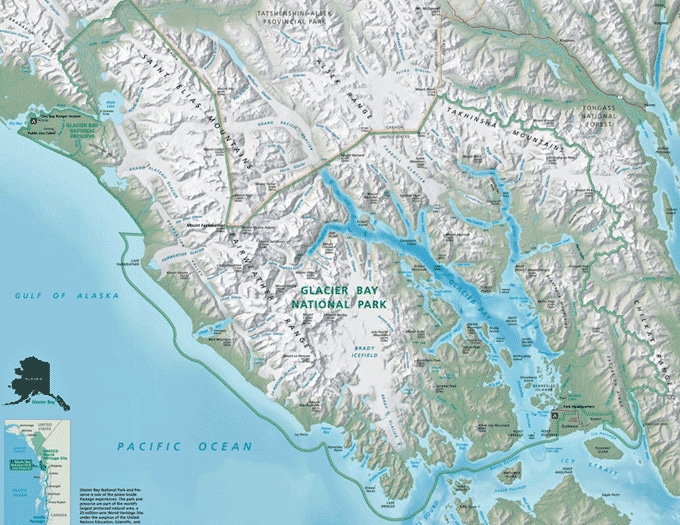
This diagram is send out regularly by the National Park Rangers to ensure safe traffic in Glacier Bay.

And so we sailed with glorious weather into Glacier Bay and boarded the Rangers at 07.00 hrs. I mentioned last week that if wildlife in the lower bay would increase then speed restrictions would be imposed so nobody was amazed when that announcement came in last night. We had to stay under 20 knots in the lower bay, the entrance of Glacier Bay, and there will be further speed restrictions in the future. On the West Arm side it has gone down to 15 knots but we always stay on the East side as there is more to see anyway. And we saw a lot, stellar sea lions, mountain goats and also a good number of Bears foraging around at the water’s edge. The bridge team has a sort of competition going about who spots the first Bear. A tray of soda drinks is provided by the captain as an incentive and thus everybody keeps a good look out. Not only at the navigation but also on the shore line. Bears are not easy to spot as they are black or brown, so what we normally do is not to look for a bear but look for a small rock that moves. In the same way as we look for ships. We do not search for ships; we scan the horizons for changes in the pattern and for anomalies and that normally turns out to be a ship or something else of interest.

We always have unwanted hitch hikers on board while in the Bay, sometimes because the guests feed them. We try to educate everybody not to do so but there are always a few who do not listen. It does not stop the sea gulls from patiently waiting…. in case of.

Glacier Bay is changing every year and as I have been coming here since 1982, I seen a fair number of changes. Marjorie and Grand Pacific Glacier moving forward and touching and then a few years later moving apart again. I have somewhere in the archives a photo of me touching with my right hand Marjorie Glacier and with the left hand Grand Pacific Glacier. That was in the days that we were still allowed to lower lifeboats and potter around taking photos and picking up a piece of glacier ice. Sweet memories.  Through the years I have seen more and more trees growing up and covering the lower slopes of the mountains that had been bare before. Global warming is definatelly having an impact. In the late 80’s the Glaciers started to retreat again and Marjorie has been doing that ever since albeit very slowly.

A big rock under Majorie Glacier now exposed. I wonder how long it will take until it will no longer be a Tide water glacier.

This year is seems to go a bit faster as we now have a rock exposed in the middle which I have never seen before. When looking at the Radar we can indeed see that the face of the glacier is further back than ever before. Also when we sailed passed Lamplugh Glacier near John Hopkins Inlet; we saw that had retreated now so far that you could walk in front of it. I will try for a photo next cruise. This time the ship had to alternate the route as the Crystal Serenity was also in the bay and during the time we passed Lamplugh I was somewhere in the dungeons of the ship. By 5 pm. we were saying good bye to the Rangers and then set course for the Gulf of Alaska and Seward.

I have never seen the gap this deep into the glacier.

Tomorrow we are at sea and then it is the end of the cruise for most guests in Seward. Weather: overcast with chance of showers and a low swell running from the south, so we might experience a gentle movement of the ship.

22 June 2017; Skagway, Alaska.

You have to sail around Admirality Island to get to Lynn Canal. (Map courtesy, Alaska E commerce on Line)

If there was a channel or fairway between Juneau and Skagway, we could cover the distance between the two ports in a few hours. However there is a big mountain range in between which means we have to sail in a big curve around it. First retracing our steps by sailing out of Gastineau channel again, the only way in to Juneau, and then sailing up and into Lynn Canal. We will have to repeat that sort of maneuver again when we leave Skagway as Glacier Bay is also “just on the side of the mountain” but we have to sail all the way south out of the Lynn Canal and then go north again.

90 mile long and narrow Lynn Canal with Haines half way up. (Map courtesy see left corner)

The name is Lynn Canal but it is not a canal at all. There are no locks nor is there any landscaping on the side of the water way which would suggest any human influence. So the “canal” connection mainly comes from the fact that is looks almost like a canal as its width does not vary that much. It is basically very straight with only a small bump in the middle, just north of the borough of Haines, half way up. Thus the proper name would be Lynn Fjord. It is also the deepest fjord in North America, going down to more than 600 meters in depth at places.  In Norway there are fjords which are deeper but then the Norwegians invented them so that sort of makes sense.

Lynn Canal is named after King’s Lynn in Norfolk England. This is a nice old town and located about a 45 minute’s drive from where my apartment is. That is 45 minutes if there is no “Farmer John” on the road. Otherwise it might take two hours, as Norfolk roads are not very wide and also not very straight. The first – non native – man who explored and surveyed Lynn Canal was Joseph Whidbey, who served with George Vancouver, and who came from Kings Lynn. He would also still recognize the roads on which we drive to King’s Lynn.

At the very end of Lynn Canal the town of Skagway is located. Home to about 400 inhabitants in the winter and about 1200 in the summer; when an army of shop attendants descend on the town and occupy a sort of camping in the valley behind the town. Skagway is mainly the result of the Klondike Gold Rush and then its existence continued with ore export coming down from Canada. There is still an ore dock and on occasion a bulk carrier will call in, but now the main source of income is tourism. Skagway is handy as it fits nicely into almost any cruise schedule. You can reach Juneau, Sitka and Glacier Bay from here in one night sailing and even Ketchikan if you plan in a late morning arrival.

For that tourism, we are there to help. And the cruise industry does indeed help; to the extent that all the docks were full today. We had the Noordam on Rail Road dock fwd. The Emerald Princess on Rail Road dock aft, the Grand Princess on the Broadway dock, the Disney Wonder on the ore dock and the very tiny American Spirit (sister to the American Independence , see my blogs about Bar Harbor) at the right side of the ferry dock. In late afternoon the Alaskan Marine Highway Ferry called in as well and thus all docks were full. Roughly 11,000 guests were ambling about or going with the train up and down the White Pass. History galore as many a gold prospector died while trying to go through this pass on the way to the Yukon to strike it rich.   Now these prospectors have been replaced by shop keepers and they do seem to strike it rich.

Stock photo of Skagway Docks O = Ore dock, N = Broadway dock, Ferry = left side ferry side, right small cruise ship side, RF and RA = Railroad forward and aft.

The Noordam was docked at the Rail road dock, which is handy as the guests can walk straight off the ship and onto the train. Also the town is not so far from here although then it is a little bit easier to be at the Broadway dock for that purpose. We stayed here until 21.00 hrs. partly to give guests the options to enjoy the excursions or to walk around the town. Glacier Bay is just next door and the only thing we have to do for that is to sail back down Lynn Canal again. We will be there by tomorrow morning 07.00 hrs.  During the day the sun came out and the temperature at once jumped up to the low sixties. We are expecting a similar day tomorrow.

Guests disembarking from the returning White pass train excursion.

« Older posts Newer posts »