Around midnight we rounded Cabo Maisi, the east point of Cuba and entered the Windward Passage. It takes about six hours to sail through the passage and then you emerge south of cape Tiburon in the Caribbean Sea. Cape Tiburon is the south western point of Haiti. This area is called the Jamaican Passage as it is connected to that body of water between Jamaica and Cuba. We do not get even close to Jamaica but the area is called so nonetheless. The island of Hispaniola, made up of Haiti and the Dominican Republic, acts as a sort of windbreaker, spoiler, for the trade winds that are blowing here. Thus the moment we disappeared under the coast of Haiti, the wind died down and that remained so until an un-interrupted flow could reach us again when we cleared Hispaniola mid morning. Then we were back to our regular trade wind influence of about 20 to 25 knots. That wind will remain with us all the way to Aruba and there on the lee side it should be slightly less as Oranjestad is on the Southside of the island. It is even in the shelter of the one mountain that they have there, (the Hooiberg, or haystack) which rises a majestic 300 feet above its surroundings. I want a weak wind on arrival as I have to angle the ship into the side pier, berth F, as the main cruise terminals are taken up by the Island Princess and the Horizon of Pullmantur. Berth F, is in principle the best berth as it has the shortest walking distance into the town. Easier for the guests, just a bit more work for me. Continue reading
Page 147 of 241
At the moment we are back to the regular weather for this area. North Easterly wind, force four to five with the occasional shower. As is the standard routine we try to hit the showers during the night time, to help the chief officer with getting the salt off the deck but we are trying to avoid the rain during the daytime so the guests do not get wet. Most showers in this area are well defined and isolated from each other and thus avoiding it normally works unless you have a whole string or curtain of rain showers coming over and then you get wet, whatever you try. Continue reading

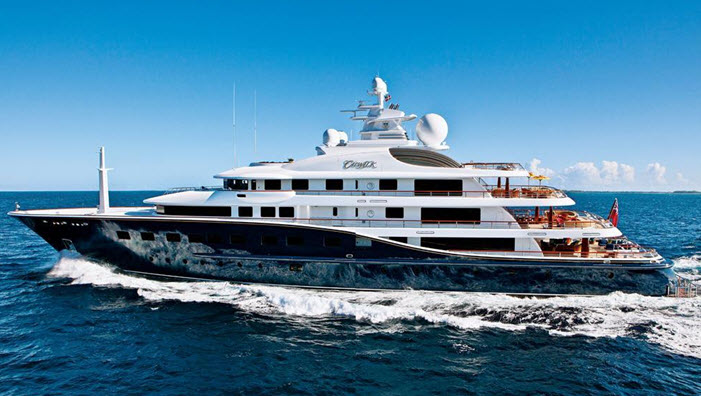
As was forecast it was a windy morning with about 25 to 30 knots blowing from the North East, while the Ocean Liner parade was lining up at the pilot station. Everybody was nicely on time and with a 15 minute sequence one cruise ship after another slipped into the port. While this lining up takes place, there are a number of more or less unusual routines carried out. First there is the rule to adhere to, not to come within 2 miles of the sea buoy before the pilot is on board. By doing that the pilot boarding and approach area is nicely kept clean of all sort of drifting ships that otherwise might parked themselves there. The second ritual is doing an astern test. This is a USCG requirement but more meant for ships where the engine has to stop and then reverse. It happens occasionally that such an engine does not do that and then you can have a serious problem when you want to slow down. After a long ocean voyage where the engine has been on full ahead all the time, this testing before coming into port then ensures that it still works. We are diesel electric with pitch and that means that we can only pull the handles astern and see if the pitch setting follows. We do that every time when we enter an American port. The third part of the ritual is to call the Night Auditing Officer and advise him at what time we pass the 3 mile boundary from land. When we are in Florida waters we have to pay Florida taxes over what is sold on board and thus he has to know at what magical moment he has to push the red button. Then the Florida Sales tax is automatically applied to each purchase on board. When we go out of the port, we do the same thing again and the sales tax stops. As you can see it is not all just about getting the pilot safely on board and then racing into the port.
By midnight we had come around the eastern corner of Cuba, called Cabo Maisi and we were heading North West into the Old Bahama Channel. We did not see much of the coast here as we are hugging the right hand side of the Vessel Traffic Separation Scheme, our highway at sea. It looked like all the captains had been reading their Rules of the Road booklet as every ship was in the right lane for its route. We only had one yacht that decided to sail in the separation zone between the two lanes but I think they suddenly saw the light when it became sandwiched between a South going ship and a North going ship; because suddenly she veered sharply to starboard and joined the right lane. Either there was an “Aha Erlebnis” with the officer of the watch or the skipper arrived on the bridge and saw what was going on. That was all the excitement that the navigators had to report during the course of the day and that is the way we like it. We do not mind a lot of traffic but we do not like anomalies in that traffic. You never know what such a ship will do next, if it is already not following the prescribed route. That is something that worries a navigator all the time and too much worrying is not good for your health. It is much better if everybody does what they are supposed to do. Continue reading
Today was our first of the two sea days that will bring us back to Fort Lauderdale. We need the first one to cross the Middle part of the Caribbean Sea on an almost northerly course and then the 2nd day to sail North of Cuba in the direction of Southern Florida. As long as there is no Canal through Cuba that would shorten the route, it will always take two days from the South Carib to get to Florida. In the course of the night the wind decided to abate and by morning there was just a gentle breeze blowing from the North East. That will remain so until we enter the Windward Passage where it will increase to wind force 5 and that wind will stay with us until we come to Florida. We will notice less of that wind while sailing North of Cuba because the Bahamian Islands will act as a windbreaker. Plus a north easterly wind is a partly following wind and thus on deck it will be nearly wind still. A great way to end our cruise. We have been quite lucky with the weather as it has been blowing quite extensively in the Carib and Gulf of Mexico but while in the North Pacific we were either too far away or in the lee of the Middle American mountain ranges to notice the influence. The only real wind we had was in Tehuantepec and that we always expect and know how to deal with. In September and October this good weather can be expected but when the winter cold fronts are starting, the story changes and thus I find that this cruise we have been very lucky with the weather. Continue reading
We made it on time to Cartagena, although the wind against us kept blowing and thus the lessening I had hoped for in the early morning hours did not occur. Not unusual; wind that reaches the Columbia Basin tends to be quite strong and can last a long time for it has lost all its momentum. Still I was happy, we were on time, even a little bit early, so we tried to get the pilot out a bit early as well. However all well laid plans fall apart if the navy decides to interfere. As we all know, wars start around 8 am in the morning and that was thus the time that the Columbian navy set sail to protect the motherland. They ordered port control to keep the fairway clear as two small navy ships were coming out. Nothing I can do then, they have got guns and I don’t. So we had to wait until the first one made it leisurely through the channel into open waters. By that time the pilot got involved and as the 2nd navy ship was way behind on its schedule, he simply told that ship to wait. Maybe he does have a big gun somewhere. Still it cost us 20 minutes; time I could not really afford to lose as it is a long way in. Luckily it was the senior pilot we got on board and he knows his Holland America captains, so he left it all to me and we could sail with maximum expedience through the lake and were docked by 0915. Continue reading
You have days where everything goes perfect and you have days where everything seems to conspire against you. This was one of those days. Not that it really affected the guests for their Canal experience but a few things occurred that made the shipboard operation run less smoothly than I like it, and nothing I could do about it. We were scheduled to receive the pilot on board at 0545 with the first locks at 0800. I prefer that to be a bit earlier as I need my time on the other side but I can only ask. The Pilot came on board nice and timely and then told us that 17Z; the ship scheduled in the convoy ahead of us was still at anchor, as far south as possible, with 8 lengths of anchor chain out. (4 is normal at this anchorage) On my question, why anchored so far out and in that way, we found out that the Chinese captain was so scared of the other ships that he did not want to come closer, was afraid of the weather that he put 8 lengths down (best weather in the world today) and on top of that refused to heave up the anchor without the pilot on board. On my request to go first, the pilot did not wanted to push Control in swapping pennants (e.g. go as 17 instead of being nbr 19) and thus we had to wait 40 minutes until 17Z came chugging by with a speed of 10 knots. That brought us in the locks around 0830, so I lost already 30 minutes on a late schedule. Continue reading
With again wind still weather the good ship Statendam sailed along the South Coast of Panama towards the Panama Canal Zone. Until 10 am we were on a 90o easterly course and we met several ships going in the opposite direction, coming from the Panama Canal. Guessing at their time of passing us where we were, they either had had a night crossing or came from the anchorage and had been loading fuel. We got our confirmation for the schedule and we were allowed to pick up the pilot at 16.45 near the Canal Seabuoy. Although the area is monitored by Flamingo Signal Station which is the Traffic Control for everything on the Pacific side of the canal; the anchorage area of Amador itself does not fall under it’s jurisdiction and thus we have to sail all the way around all the ships at anchor towards this anchorage. I prefer to cut through as it is great sightseeing for the guests but the authorities do not like it. So we go around. Continue reading
I woke up to a bumpy ship caused by a local wind field laying over Nicaragua. It was in the forecast but the forecast gave less than what we saw outside. In a similar way to Teheantepec, the wind here is caused by weather in the Caribbean and the Gulf of Mexico. As soon as a hurricane goes north, or as now during the winter, a weather front comes south and it invariably creates a high pressure ridge and the wind starts blowing. Nicaragua is a low country as well and thus there is no high mountain ridge which can stop the air flow. Remember, the country side of Nicaragua is nearly flat hence it has always been mentioned as a good alternative to the Panama Canal. Those plans never came to fruition but it is certainly feasible as there is not much of a central mountain ridge to deal with. The cold front coming down over Cuba stretched in this instance all the way over Nicaragua and this strong wind could nicely whip up the seas into a short and unpleasant swell. The long Pacific swell was going against it, so on occasion the two troughs would enhance each other and then the resulting high wave would catch under the bow with a nice bump. By 10 am we passed the border with Costa Rica and there the mountains started to rise again and that meant that by 11 am it was wind still again. The brown boobies and Starlets returned to the ship and started their “bow dance” again, floating on the air pressure and wind flow created by the bow pushing forward. As usual they marked their presence by leaving white spots on the deck and that resulted in a very unhappy bo’sun. Continue reading
Puerto Quetzal is always fun in the early morning, when you are trying to extract information out of Port Control. I have been coming to this place on and off for the last 10 years and I still have not figured out what the function of Port Control is. When you call the pilot an hour or so before arrival it is invariably Port Control who answers and never the pilot. They always have the standard answer: “pilot on arrival” and that is as far as their knowledge goes. Questions about wind in the port, swell at the entrance, ships movements around that time, are either met with a deep silence or with the remark, “ask the pilot”. And the pilot never answers. If you have never been there and are not used to it, it is very irritating. Especially for a cruise ship that runs on a tight schedule. After a few calls you get used to it and approach the issue from another angle. Just block the port entrance. That does have the required effect. Suddenly the pilot finds a VHF and a whole flood of information is coming out. Wait at the sea buoy, ship coming out passing port to port, no wind, no swell, pilot transfers from outgoing cargo ship to incoming cruise ship. In the mean time port control is advising the outgoing cargo ship that it has to go anchor, something the captain of that ship already knew, as the pilot on his ship had just told him so. I hope that before I retire, I will one day find out what this Port Control exactly does. Continue reading
Captain Albert
© 2026 – Captain Albert's Website and Blog –
Theme by Anders Noren — Up ↑