After two busy days, the Panama Canal and Cartagena, we now had the first of two sea days, giving all the guests some time to relax and catch their breath. Tomorrow the challenge will be for the majority to pack their suitcases as their cruise will be coming to an end. A small number will make the return voyage with us, although “small” is relative, there are about a 100, as far as I know. Making “back to back” cruises, which is getting more and more popular as it cuts out the need to fly and does not limit you in the amount of luggage that you can take with you. So if you have the time, why not? But we have two sea days in a row, 1143 nautical miles to travel and ample time to enjoy the ship. The weather looks good, although the word “changeable” is in the air as the whole area is settling down for the winter now the hurricane season is coming to an end. Winter season means that cold front after cold front will descend over Florida bringing with it cooler temperatures but also more wind. It looks like we will get the first of that wind over us just after docking in Fort Lauderdale. Continue reading
Category: CaptAlExport (page 94 of 203)
After a windy night we arrived at the Cartagena Pilot station at 08.30. We had seen on the radar that the Island Princess was on time for her 07.00 hrs arrival and as soon as she was inside a whole stream of cargo ships came out. I still have not been able to figure out, or get the answer from the pilots, about why this happens at this time. Whether the ships leave at sunrise from their berths for some special reason or that it is cheaper to sail after 06.00, I do not know but it is a remarkable pattern. Not that I mind, because it means that by the time we arrive the coast is clear and the entrance channel, open to sail, in without waiting. We had issues this morning to find the pilot boat and it turned out that it was because they had upgraded their equipment; in a rather strange way. More and more pilot boats, worldwide, are adding AIS to their equipment (Automatic Identification System) so approaching ships can recognize them from amidst all the clutter in a port. The Cartagena pilots had received one for their pilot boat here. However upon installing, it became apparent that the software for this box, could not display the text denoting it as a pilot boat, only as a fishing boat. Oops, somebody in government office far away had not done his/her homework. Our pilot was not foreseeing a quick correction to this forthcoming from the governmental decision making process and so he advised us to keep looking for the fishing boat during our coming calls. Continue reading
The Canal authority decided to keep the schedule unaltered and thus I was on the bridge at 0400 hrs. to start operations. Shortly before 5 we started picking up the anchor and as the holding ground is so good here, (very thick grey clay) I had to run the anchor over the top to break it out of the ground. (This is a maneuver whereby you slowly steam forward until the anchor is past the bow of the ship and is forced by the ships pull on the chain to “flip over” causing the flukes to break out of the ground). The one danger it has is that the flukes then fall the wrong way when coming up and the anchor does not want to fit in the hawse pipe. When the anchor party had finally washed about 5 tons of mud from the anchor it showed indeed that the flukes had falling the wrong way. So we kept the anchor outside the hawse pipe and slowly steamed towards the pilot waiting area. While there we let the anchor go again and when it hit the sea bottom the flukes fell back the right way and we could put the anchor in its housing. Continue reading
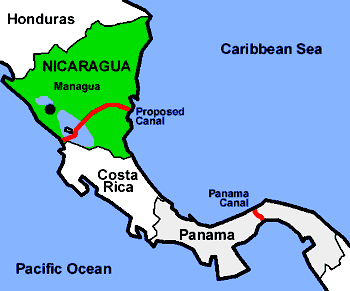
For the morning we sailed under the coast of Panama, seeing various cargo ships on the port and starboard side. By 11.00 we turned into the Gulf of Panama and then it is 70 miles to go to the pilot station. That is caused by this strange curve, or crook in the land of Panama. When you head for the Panama Canal anchorage, you get the flow of all traffic, to and from the canal. Basically on two routes or track lines. The one we are on; which is followed by the ships coming from or going to the West coast of North America and the track line that is used by for the ships coming from or going across the Pacific. The closer you come to the anchorage the more these two routes converge and the more interesting it gets navigation wise. Continue reading

It got quite windy by the time we started passing Nicaragua and for a while we had a good wind force 5 to 6 blowing from the landside. By 11 am we came into the lee of Costa Rican mountains and nearly wind still weather came back to the ship. With it was the return of the black starlings and the brown boobies; who started to drift on the upstream of the wind around the bow. We were doing 19 knots and that was too much for them to try and find a place to sit on the railing but they might try tomorrow when we most likely will slow down a bit, depending on whether we get the current much against us or not. As mentioned before, when we were sailing along the Mexican coast, the current is not behaving according the established patterns at the moment and thus I am building up some time and mileage “on the sleeve” to ensure that we will be on time. If the adverse current does not show itself, then we can always stop an engine and adjust speed accordingly. Continue reading
They were fully awake in the port; and at the correct time the pilot boat came speeding out of the port. On board hopped a pilot who was all excited about our visit and the prospect of having breakfast on board. After the master – pilot conference, during which we decided that the ship would be in good shape, if I kept it in the middle of the fairway, we sailed into the port. As explained yesterday, the lifeboat and davit committee had requested a starboard side docking and that meant making a swivel maneuver. The approach course to the port is 292o then when inside the breakwater you make a turn to 017o, and then a sharp turn back to port to 270o. (When you go portside alongside it is 292o, a continuous turn inside the breakwater to 090o and then backing up to the dock). That happens of course with slow speed, while the pilot keeps two tugboats buzzing around the ship. Officially “to assist” but I think they are more concerned with avoiding ships from run aground and block their beautiful port. Everybody has their priorities of course. Continue reading
As the Tehantepec wind blew itself out by 11 pm last night, I could get a good night’s sleep before facing the next challenge of getting into Puerto Chiapas or not. All depending on the swell that might run, or not run, into the harbor entrance. The swell in this area is hard to predict due to the proximity of the tehantepec and it’s out flowing wind, which can really disturb the regular wave patterns. It did so this morning as well but for all the good reasons. The long pacific ocean swell was nowhere to be seen and we only saw the occasional breaker thrashing against the piers sticking into the sea but nothing on the inside of the fairway and thus we had nothing to worry about. Our pilot had made it in time to the pilot station, coming all the way from his mango farm in the interior and hopped on board all excited about the weather. He was also happy that next year there would be 33 cruise ship calls instead of the 19 of this year. More money in the pocket and less having to rely on a good mango crop. Continue reading
With a partly cloudy sky and no rain in sight we approached the Huatalco pilot station. The peculiar thing was that during the night the current kept increasing. A strong following current, while we were supposed to have a slight current against us. By the time I was lining up for the approach, the ship was set considerably to the East. Not pleasant when you have to enter a bay that keeps getting more and more narrow. When the pilot hopped on board, he brought the exciting news that at the start of the outer bay, the current was going the other way, so even more fun. Now I had to figure out where the easterly current stopped and the westerly current started, without knowing how strong that current was going to be. I discerned a ripple through the water and thus I knew where the first current was ending. With an educated guess I steered more northerly to offset the expected counter current. I had to give more and more current angle (e.g. degrees away from the regular course) and in the end we were drifting under a 30 angle into the bay. Continue reading
Our developing tropical storm behind us and the moving away of Sandy on the other side of North America, have created quite a bit of unstable weather here. The day started as forecast with sunny but hazy weather, but then by lunch time a long and wide band of rain started to come across us. Or better said, we were sailing into it. The deepening of the Pacific tropical low creates a westerly flow and in the Caribbean Basin, the weather patterns are trying to return to normal after Sandy has raced through it. As a result we saw heavy rain clouds appearing on the ships radar, and not much later in reality near the ship. In the beginning the navigator tried to steer around them, as the boundaries of each cloud where quite sharply defined but later on we had to give up as the clouds turned into one wide band of precipitation. Continue reading
The weather did have a surprise in store for us but it was a nice one. To the West of Cabo San Lucas, there are two tropical lows developing. They might even merge and turn into a tropical storm. Not much concern to us as they are far to the West and we are sailing away from it anyway, as we are going south. However based on the principle of the “giant vacuum cleaner” these lows are now starting to suck/pull all the moisture in their direction. That resulted in a sky with a light cloud cover and that brought the temperatures down with about 10oF. Down to the low to mid 80’s. A lot better for the guests than during our call 5 days ago. We were again the only ship, and the pilot expects that we will have that privilege for the rest of the season. So we docked at the Cruise terminal again and today we went portside alongside. Continue reading
Captain Albert
© 2026 – Captain Albert's Website and Blog –
Theme by Anders Noren — Up ↑