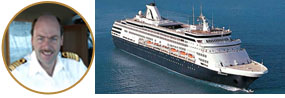
Time to start a new contract on the Prinsendam. Seldom I had it easier to get to the ship. I flew a few days early from England, to spend some time with my 95 year old mother, and then took the train to Amsterdam this morning and just walked to the ship. No jet lag, no airport immigration or having to stay overnight in a hotel. By the time that I will leave the ship on September 11th, I might have it even easier and will just drive home from Tilbury in England. However that is still faraway and today it was back to the regular business, which is with the Prinsendam not so regular at all as each cruise is different and with the multitude of ports that we are doing, we never know what might pop up along the way. Continue reading
Category: Captain’s Log (page 68 of 128)
It might be awhile before you visit my blog again but I am still (slowly) working on adding bits and pieces to the blog site. Today I have uploaded the history of the Nieuw Amsterdam (III) of 1983. So hopefully, you will find this entry eventually.
Enjoy.
Captain Albert
With three knots of current in the stern we were pushed up the Florida Strait towards the pilot station. With two cargo ships in the same approach, we lined up for the pilot who hopped on the ship at exactly 0600 hrs as planned. Fort Lauderdale has been a Holland America home port for a long long time and as a result we know all the senior pilots very well. Some of them since 10 or 15 years and even longer. That makes dealing with them very easy, they do the thing that they have to do and we do the thing that we have to do. The pilot brings the ship to the dock and the captain brings the ship alongside. So in good cooperation the Prinsendam was docked alongside by 0700 hrs. with the gangway in. Normally we say gangway out but here a shore gangway comes into the ship. In the same way as when an airplane arrives at the airport. This jet walk leads into the upper level of the terminal. Holland America’s standard terminal is pier 26, unless there are more ships in port, then we might get moved to somewhere else depending on the size of the other ships. Having a standard terminal makes life a lot easier as all the people involved, sea and shore side get used to the lay out and that makes things go much faster. Efficiency is important especially when there are more ships in port. Last Saturday there were 9 cruise ships in and they caused a total of 53,000 people movements. 26,000 coming off the ship and the same number going on. According to the pilot, the Oasis of the Seas was sailing with her first full house and that was over 6,200 guests for one ship alone. Continue reading
By the early morning the ship sailed above Cuba into the Old Bahama Channel. It was fairly busy with ships as the Windward Passage, the opening between the East point of Cuba and the West point of Haiti, is a very busy route to and from the Panama Canal. Four traffic flows meet here, as there is also traffic to and from the USA and the East Caribbean Sea including Puerto Rico. Since Recife we had not seen any other cruise ships (with the exception on those in port in Bridgetown Barbados) while at sea but now we met a few again. Most cruise ships leave Florida on a Saturday or Sunday and then they are past Cuba by Monday night. So now a steady stream of them coming by and speeding down towards the Caribbean Sea. Tuesday’s, Wednesday and Thursdays are the busy days in St Thomas and St. Maarten so by Friday they are all racing back again to Florida to end the cruise. For the Prinsendam with its long cruises and no steady home port that is a bit of an alien concept. We saw the Silver Shadow of Silver Seas and the Caribbean Princess of Princess cruises, they must have had a departure date out of the regular routine as well. Continue reading
If you want to make it back to Fort Lauderdale in one sea day, then you have to leave Ponce at 1 pm and race full speed North of the Bahamas’ towards Florida and hope for nice weather. Nice weather so that the wind and the waves will not slow you down. That is of course not the right way to end a 70 day cruise and thus we are spending two days at sea. Instead of full speed, we are sailing with a sedate speed of 15 knots all the way. There are two routes that you can take to sail to Fort Lauderdale. The shortest route is staying in the North Atlantic Ocean keeping to the East of the Bahamas and then approach Fort Lauderdale via North West Providence channel, south of Freeport. The second option is via the Old Bahama Channel; going North of Cuba and keeping the Bahamian islands and the banks to the North; this route is 10 miles longer. Thus a number of things have to be considered. 10 mile shorter saves fuel but being in the North Atlantic makes the ship bounce more on the ocean swell. That slows the ship down and also makes the ride more un-comfortable. Important is as well which route bring the most favourable winds and currents, (I do like a free ride when I can get it or at least a push in the back for free). All these items are looked at and then I make up my mind. Continue reading
Ponce is located on the Southside of Puerto Rico, just where the island has a little bit of an angle. That means that there is most of the time less wind than on the north side as the island provides a lee. That meant for us that on arrival it was wind still and that always makes things a lot easier. The pilot was nicely on time and as the approach channel is about 2 miles long and very deep, we sailed into port with 12 knots only slowing down at the last moment, when we made the turn towards our berth. Thus we were docked by 7 am. and I was nicely on time to receive the Custom and Border Protection onboard by 07.15 as had been arranged. However due to some communication muddle between them and the USCG they did not show up until 8 am. but at least I was on time. Still the clearing of the guests went fairly fast and a lot of eager people streamed ashore to inspect the town and surrounding area. For most of the guests this was a new place, as Holland America has not been calling here frequently and thus there was the excitement of something new. Feedback after departure was very good, so I expect that Ponce will become a regular port of call not too far into the future. Continue reading
At 5 am this morning, we entered the Caribbean Sea, passing between St. Lucia and Martinique. From there it is one straight North Westerly course towards the Ponce Pilot station. I have set a 6 am pilot station time for tomorrow, so we can be docked by 7 am to facilitate the clearance of the ship. When in Puerto Rico, American Immigration rules apply again and that means that they will have to see at least all non American citizens. Also as the crew has not been to the States in the 90 day clearance bracket; all crew has to see the Custom and Border Protection (CBP) officials as well and that will take some time. So while the ship sailed to the North West the purser’s department was sending multiple files to the CBP for the pre clearance to ensure that it will all go smoothly tomorrow morning. Continue reading
As planned we arrived exactly at 06.30 at the pilot station and as scheduled the pilot stepped onboard at the same time. The Oceana was ahead of us with a pilot time of 0600 and she was just docking when our pilot boarded. By the time that we entered the breakwater the Oceana Pilot was going outside again to board the Grand Princess who had an ETA of 0700. Docked in port already were the Freewinds and the Braemar. Thus all the berths in the main basin were occupied with cruise ships, leaving only the bulk terminal, in the outer harbour, open to cargo ships. The Oceana had a change over day with 2000 guests leaving and 2000 guest joining. As P&O caters mainly for the British public, these 2000 come flying into Barbados with direct flights from England. The Braemar, from Fred Olsen, also caters for the British public but spends three days in port. The last day of the ending cruise; the change over day and the first day of the starting cruise. The Grand Princess was in Barbados just on a day call. Continue reading
Barbados is a bit of an anomaly as it is an island that is located outside the chain of Caribbean islands that rests at the crest of a moon along the Eastern rim of the Caribbean Sea. It is a pleasant anomaly though, as somehow the Barbadians managed to retain their own culture and way of life irregardless of the onslaught of the daily invasion of the cruise ships. I always find it a very pleasant island to visit. The stretch of ocean that we have to cross from Guyana to get there is rather void of ocean shipping. No major shipping lines cross our route and thus we saw very few ships out there. Only one tanker crossed our track line about 20 miles in the distance. As we tracked him, we could call up his name on the radar and as it is such an exotic one, I do not want to leave it out. Sonangol Girassol; with a name like that everybody pays attention when you call on the VHF. Although the flag was Nassau, Bahamas our best guess was that it was either an Indian or a Pakistani ship. Continue reading
With the rising sun in the stern we approached the islands from the East. Going slowly as the water is very shallow here. There is a pilot that takes care of all the little harbors in the area but he had a pilot boat that would make bigger places very jealous. All the areas away from the homeland of France are treated equally as far as funding, medical and organization is concerned and so the pilot boat was of the same caliber as you will find in Le Havre or Bordeaux. Also he did exactly what I liked him to do; he pointed out the best anchorage in the lee of the island and then stood back and let me park my ship there. Both of us giving to the evolution the best of our mutual expertise. Thus we were happily and safely at anchor just before 7 am. There is a lot of wind and current around the three islands and the Prinsendam settled on a nice angle in balance with the force of the wind and the current and gave a good lee side for our tender operation. The pilot predicted that it would stay like this all day and he was right. Continue reading
Captain Albert
© 2026 – Captain Albert's Website and Blog –
Theme by Anders Noren — Up ↑