We were blessed with yet another beautiful day at sea. It was a bit breezy with moderate to fresh winds blowing from the North East but as that was more or less a following wind, it did not feel very windy on the decks. For most of the day we sailed in deep water away from the continental shelf but in the course of the evening we came closer to land and the depth of the water rapidly decreased until about a 100 feet under the keel. I had set my courses in the chart in such away that we sailed along the coast with this depth under the keel, as it kept us just outside the fishing grounds. The local fishermen set out long nets that are indicated with a buoy at one end and their boat at the other end. During the night they have strobe lights (very fast flashing light) on that buoy but as they forever seem to run out of batteries the buoys are hardly visible during the night time. They then have the tendency to either race in the direction of the buoy and that looks as if they are on a collision course, or start shining with a searchlight into the dark wheelhouse and blinding all of us. Neither of the two options is very pleasant and by staying a few miles further out, you can avoid it all.
In the mean time we are bombarded with emails from the agent about all sorts of rules that we have to comply with. These rules are more or less the same as any international regulation pertaining to the ships operation but sometimes with a local twist. Thus the electronic forms are flying from computer to computer to get all the paperwork in order for each arrival. These are busy days for the purser’s department and the navigators. Brazil is state with a federal setup in the same way as the United States. Also similar as the USA does each state has it’s own regulations on top of the federal regulations and as we are travelling through several of these states, or estados, the agent makes us aware of sometimes small deviations in requirements for each particular state that we will visit.
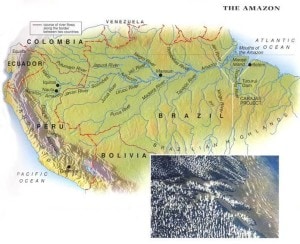 As can be seen Belem is to the south of the Amazon and located on the banks of the the river Rio Para.
Belem is located in a different area than Manaus. Belem lies at the shores of the Rio Para and to get to the Amazon we will have to go out to open sea again tomorrow night and sail around the land to the estuary of the Amazon River. Thus first we deal with what is needed to be in compliance with Belem and then later with the Amazon in Macapá. (The entrance/clearance port for the river and also the pilot station is located here). One of the requirements to deal with is Ballast water. Several areas in the world are suffering from the presence of non indigenous animals that have been brought in by ballast water. Water that ships dumped in the port before they started loading cargo and in some cases it has devastated the local eco system. To avoid that there are now worldwide rules and regulations to ensure that water taken in, in one part of the world, does not get dumped in another part of the world. We keep very detailed records of where we load and unload ballast water, needed to keep the ship upright, and regular reports are sent to a “clearing house” for verification. Brazil requires that first; on deep water you exchange the salt water in your tanks, so that water from another part of the world does not make it to the local shores. Secondly; when entering the river, you exchange that salt water for fresh river water. We did the first exchange when we left Antarctica on the way to the Falklands as that was the only area where we were 200 miles from land and in deep water. Both are requirements to comply with. Tomorrow morning when we sail up the river to Belem, we will discharge that sea water, although we do not carry that much ballast and then replace it with river water. It is not something that we like to do, as the river water is quite muddy so sand will deposit itself in the tanks and those we will have to clean later on again. However the rules do make sense. To put it simple, the USA is not looking forward to having piranha’s in their rivers and Brazil does not want king crabs. Both should stay were they belong and hence we ballast and deballast when ever it is needed.
The Belem and Rio Para pilot will board the ship tomorrow morning around 3 am, and then we will have about 6 hours to go to the anchorage south of Belem. The weather forecast is very tropical. Temperatures up to 95oF. with the occasional rain shower. The latter normally translates in a 5 minute drenching downpour. ………..we have arrived in the Amazon Forest.
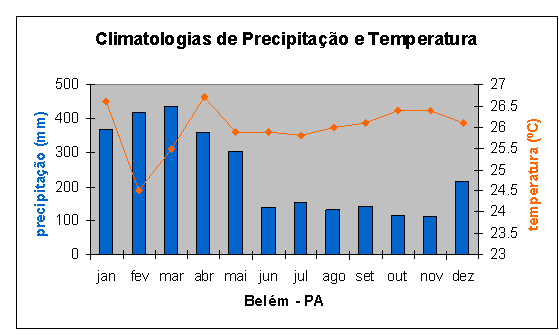 It can rain quite a bit in Belem and thus it is no suprise that thunderstorms have been forecasted for tomorrow.
March 8, 2010 at 7:57 pm
I am very much enjoying your articles each day, they are very interesting. Thanks so much for your efforts.