With the pedal to the metal we raced from the mouth of the Rio Para to the mouth of the Amazon, trying to make the up the lost time from Belem. I had squeezed the courses as close to the coast as possible, running the course line over the 20 meter depth line (60 feet) and tried that way to find a balance between the shortest run and the least shaking because of the squat. We did not shake, thus at least that worked. By 06.00 we were at the depth line where the water became less than 10 meters or 30 feet; at least according to the chart. Normally you then have a few feet more as the depth-numbers in the chart refer to minimum depths that seldom occur. The problem was that the tide was running against us and we would have to battle it instead of getting an extra free push in the back. When sailing in depths of less than 10 meters you will really notice squat when at full speed, so I came down to 15 knots to see how that worked. If the vibrating would start I only had to reduce more. No shaking occurred however and I could continue with that speed for the next three hours over the bar area.
The Bar (= sand/silt/mud bank in a river mouth) is caused by the fact that the Amazon estuary here widens so enormously. It looks as if you are sailing in a big brown sea with no land in sight. As the river widens here, it looses its velocity and the sediment in the water has a chance to sink to the bottom. The ebb and flood influence ensure that a lot of sediment gets churned further to open sea but still there is not much water to sail through, at least vertically. We had a minimum of 6 feet under the keel at all times, was more than enough to ensure a steady progress, although it was two feet less that I had calculated.
What I could not calculate was the strength of the current against us, at least not the full velocity. I knew that until lunch time I would be bucking the ebb tide but the strength is difficult ascertain as it also depends on how fast the Amazon is flowing and how much momentum it adds to the tidal movement. This time it added another knot even in open waters and so I was going over the bar with two knots against me. Things were livened up by the fact that the fishermen where out in force. One mother ship with normally 3 small boats around it and those small ones tend to have very long nets. I assume that the mother ship provides the cooking for the fishermen. Normally there are a few of them around but this time it was the complete fleet it seemed. And all of them on, or near our course line. The bar area does not have the same depth everywhere, so you cannot just decide to cross somewhere else, as there might not be enough water. Thus we had to do some fishing boat dodging. A problem was that with the out going current, the Easterly wind was blowing against the tide and that created choppy seas, making it impossible to see all the nets on the water. These were only visible by small Styrofoam blocks sewn to the net at regular intervals and an occasional little flag on a buoy. So we sailed around them as best as we could, keeping an eye on the fishing boats to see if somebody was starting to wave frantically as that most of the time indicates there is a net in the way.
By 9 am. We entered deeper water, 60 feet and more and I sped up again to full speed. However the ships speed did not increase that much as the hull was now coming under the full influence of the Amazon River itself and its much stronger current. A current also much stronger than expected.
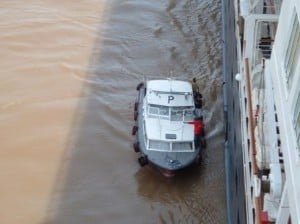 The pilot limousine coming alongside in Macapa. Fully airconditioned by means of open or closed windows and floating on the chocolate brown waters of the Amazon.
At 5 pm. We arrived at Macapá pilot station while having had 3 knots of current all the way against us. The flood current that was supposed to show some influence after the ebb ended was never noticed. The Amazon was simply flowing too strong. The pilots once onboard, were expecting 3 knots on average and that will mean that I will be slightly late tomorrow morning in Santarem.
The weather looks good. Although it is supposed to rain frequently at the moment, it seems that it only does so in the upper regions of the Amazon. Totally wrong according to the two Amazon pilots, who will be with us until just before Manaus, but I asked them not to start their rain dance until we are down river again. Better guests that are dry in 95oF than guests that are wet at the same time, as the air temperature does not change in the Brazilian rain.

Leave a Reply