In accordance with our hour forward the sun did indeed not rise until 08.15, which meant that the Dawn only set in just before 8 am. Not that it bothered many, as most of our guests were enjoying a lay in anyway. The weather is holding nicely and that meant, with following wind and seas, that it was going to be a warm day today. The ship was making the same speed as the wind velocity and thus it was nearly wind still on the deck and it was sunny, very sunny. By 11 am. We were coming closer to land and we could see the bare mountains and beaches of the coast of the California Peninsula. As Puerto Vallarta is located on the mainland east of the Peninsula we had to go around the southern tip of it and that gave a chance to do some sightseeing near Cabo San Lucas. The fact that is was at the most convenient time of 13.30 in the afternoon made it even better. No worries about disturbing the lectures or the bingo, most people were having lunch and so could see if from behind the panoramic windows of the Lido restaurant or the Crows nest. Continue reading
Category: Captain’s Log (page 45 of 128)
As the Navy was either tied up to the dock or playing outside, the sail away from San Diego was un-eventful and so it continued for the remainder of the evening and night. Until the Mexican border we sailed with a max. speed of 15 knots, to comply with the Clean Air Act of California. This is not compulsory for us but all the ships are requested to do so and it is the HAL standard that we comply with any voluntary environmental initiative where safely possible. What is compulsory is that we run the ships on Marine Gas Oil (MGO) instead of on HFO (Heavy fuel Oil) in order to keep the emissions down along the Californian coast. As it well-known, Los Angeles had to deal with smog quite often in the past and the local authorities have been quite active with measures to reduce it. One of those measures is that ships sailing along the coastal area here, or going in and out of port run on MGO, as slower speeds give less emissions. Which makes sense, because when you arrive or depart from a port you are not going that fast, do not have maximum load on the engines and thus there is not always optimum combustion. Once past the Mexican border we set an average speed of 17.5 knots with an engine configuration that enabled us to sail with maximum efficiency and thus the least amount of emissions possible. Continue reading
And so after 5 months of vacation, I rejoined the wonderful world of Holland America. The company had been so good to give me a split flight from England via Amsterdam and thus I could visit my 96 old mother. She is still doing very well but as I am the only child, she has the problem that when I disappear for three months, there is no family visiting. So I managed to get a stopover in before I had to face reality again. I was not the only one descending upon San Diego to join a ship. Today there were 3 cruise ships in port altogether. The Statendam, Westerdam and the Sapphire Princess which was for the port of San Diego not a bad way to kick off the cruise season. All three ships were there for their first call of the season and all three were coming down from Alaska. The last two weeks of the Alaska season had been a bit windy; the Statendam observed on one occasion wind speeds of up to 80 knots and 45 feet high waves, making all crews quite happy when the ships were leaving the Great Land behind. A lot of them were even more happy as the call at San Diego meant that a large number of them could go for a well earned vacation. Continue reading
I have been able to add some more information to the Captains from the Past sub directory on this blog.
Several new names were added to the list (click on the Captains from the Past header), namely the captains Burger, Buhse, Van Erp, Geldtelder, Sjerp, Swart, de Witt, Coerkamp E and Coerkamp R. (it will be interesting to find out if these two were brothers or family) Kimmerer and Soutendam. These were all cargo ship captains in the period 1915 to 1930.
Photos were added of some old timers from the early years. Captain Bote Bruinsma, Captain Aldert Potjer and his nephew Adries Potjer, Captain Herman van der Zee, Captain W. Bakker, Captain Willem Ponsen and Captain Adriaan Roggeveen.
Also the bio and obituary of Captain Hans Eulderink was added, together with two photos. More will be added as soon as I have the paperwork of those years scanned in from the years that I sailed with him.
Best regards
Capt. Albert
After several months of vacation, it is time for a blog update. I was able to visit the Muncipal Archives in Rotterdam a few times and that resulted in a lot of information for the captains project and other things that eventually will appear on this website, apart from the daily blog.
Updates:
1. My sailing dates, see Tab to the right: Notes for the Reader.
2. Photos of the following captains were added: Bak, Bakker G., Balen, Boerdam, Boschoff, Dekema, Gemert, Hollander, Dijk J.H, Jonkers, Kievit, Kooy, Kunst, Dekker L., Hemert, Maazen, Oldenburger, Roosendaal, Scale, Terpstra, Timmer, Timmermans, Werkhoven. More to follow.
3. A new listing of captains with updated first names (where known as of now) has been added as well, under the main title: Captains of the Past. About 40 new names were added. The total count has now passed the 170 of those who have passed away and will thus appear on this website. Some more will be added in the coming days.
4. Where known, I have updated the christian names of the captains and corrected the spelling of them. It seems that various publications from the past and even sometimes the HAL archives, have been quite creative in the spelling. Not that I am amazed, as those outside Holland also seldom get my last name right.
5. The following -full- bio’s are in preparation and will appear in due course on the website. Haagmans, Deddes, Van Deventer, Timmermans. With the help of the respective families I am gathering material and by the new year I hope to start uploading.
In my last blog I advised that I would be boarding the Statendam in mid october. This has now been brought forward to 29 September. Thus my blogging should start the next day again.
Best regards
Capt. Albert
My sailing period has finished and I am going on leave. And it will be a long leave. The company has decided that I have to use up some of my outstanding vacation days. I have about 8 months of paid leave outstanding and the idea is that I will take six months of that leave now.
The result is that I will fall out of the sailing cycle of the Prinsendam. With each captain doing three on, three on in principle, a six month off period simply does not work.
Thus I will transfer for one or more contracts to the Statendam in October. I love to sail in the summer in Europe; on the other hand to have the opportunity to have the whole summer off is something that is not to be discarded either.
The next daily blog should pop again around 17 October and then we will do Trans Canal cruises from San Diego to Fort Lauderdale.
I would like to thank all of you for taking the time to read my daily blog which I hope you found interesting. A special thank you to those readers who took the time to respond to the blogs.
Thank you for the remarks and the questions. I was glad to answer them.
As normal, there will be no daily blog during my vacation period. I do not think that you will be very much interested in “honey-do” list, which seems to be equal in length to my vacation time. Still there will be some activity.
I will be attending some training courses while at home and I might drop a note in, about captains sitting in a school class.
Also I will add some more captains memoirs to the site. There will be two large ones coming, Captain Haagmans who spent 54 years with the company from 1914 to 1958 and Captain Deddes, who was the 2nd captain of the company in 1871. Both families have graciously given permission for publication. Some others will be in the pipe line as families are gathering information. Eventually there will be more information about Capt. Van Deventer and Capt. Timmermans and hopefully quite a few more. Also a few ships biographies will be added. At least both Prinsendam’s and all the Statendam’s.
The company is going to roll out a revamped HAL BLOG site in the near future, so you might want to keep an eye out for that as well. Especially as quite a few of you have automatic updates/links to the site and I do not know if they will still work after the revamp.
Tot Ziens,
Captain Albert
The sun arose late over the Prinsendam, as was expected due to the time change, but all was well in the world. The wind had lessened off even more during the night but did not achieve the near wind still status as predicted by the weather forecast. We had still a wind force four to five blowing but by now it was a mostly following wind. That only helped by creating nearly wind still conditions on the deck as it balanced out the wind flow caused by the ships speed. With only a few clouds in the sky, it became a sunny day and that will remain so for the rest of the day. Also for tomorrow in Fort Lauderdale the weather forecast is good with regular warm Florida weather. It makes for a nice and good ending to this Grand voyage of 62 days. Continue reading
Why is it always that with bad weather the predictions seem to be right and with good weather it always seem to be worse. Today the weather forecast was right, maybe because it was worse…………….. The frontal system did deepen and increase in strength. The centre still lay above Bermuda so they must have had “a very nice day” there. I can say that, because with us being about 300 miles to the south of Bermuda we still had wind force 7 to 8 blowing around the ship. More than was mentioned in the forecast. With so many hundreds of miles of open sea over which the wind could blow, the seas were nicely whipped up to heights of 14 feet, which is nearly 5 meters. The good thing was that this swell was on the beam, so the stabilizers could take care of most of the movement. Still the ship was lively and “lurched” on occasion when an extra high wave was coming by. The worst was around mid day and then gradually it became less and less. By late evening the ship was quiet again. Tomorrow will be a quiet sea day and tomorrow evening will be as well as we will be in the shelter of the Bahamian islands. From now on the weather looks good, with nearly wind still weather when we arrive in Fort Lauderdale on the 13th. Continue reading
During the night we had thunder and lightning to the North of us, where the centre of this small weather system was passing by. We only noticed the rain and a little bit more swell than the day before. However by 09.00 hrs it had all past by and it turned into a nice sunny day. The temperatures are also starting to creep up. During the first day of the crossing the noon time temperature was around 66oF (19oC) it has now risen to about 70oF (or 20oC. Maybe not much of a rise in the absolute but with the wind chill factor disappearing it is becoming more and more pleasant on the decks even if it is a bit breezy. The latter has given the Front Office quite a headache. When it gets windy around the ship, the bridge phones the Front Office and asks them to put up signs on the doors that lead to the open decks. We have two sorts of them, signs I mean. Those to warn; to stay inside due to very strong winds; and those to open the doors carefully because of windy conditions. With the wind patterns continuously changing around the ship, the signs go up; the signs have to be changed and in between the signs go off and then might come back again. Still safety comes first, so the Front Office Ladies keep trotting around the ship with new signs. Continue reading
On 3 May 1971, Mr. Jaap Wisse joined Holland America as an electrician on board the Nieuw Amsterdam II. He was promoted to Chief Engineer in May 1990 on board the ss Rotterdam (V) and celebrated on 3 May 2011 his 40 years with the company. The ship organized various functions to honor this achievement. The letter of congratulations from Holland America Line President and CEO Stein Kruse was read aloud during the High Mariners party in the presence of all the 300+ day Mariners on board. I hosted a cocktail party in my quarters and a dinner was held for the engine department and other invitees. Jaap’s career spanned a period that included the transition from trans-Atlantic sailing to full time cruising and the subsequent growth of the company. Forty years of faithful and dedicated service to ONE company is an enormous achievement and therefore we should recognize and honor Jaap accordingly.
p.s: See also Captain Albert’s blog 6 may 2011
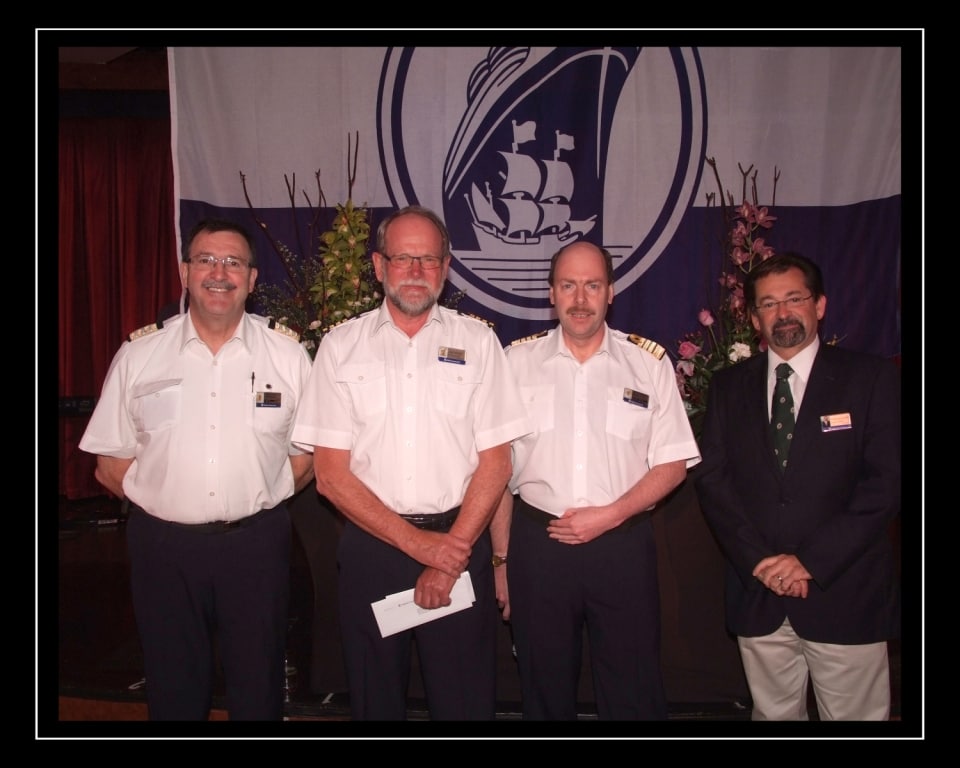
Special presentation for Jaap Wisse (second from the left) during the Mariners party.
Captain Albert
© 2026 – Captain Albert's Website and Blog –
Theme by Anders Noren — Up ↑