- Captain Albert's Website and Blog -

Ocean Liner History and Stories from the Sea, Past and Present. With an In Depth focus on Holland America Line

Page 39 of 240

24 July 2018: Flam, Norway.

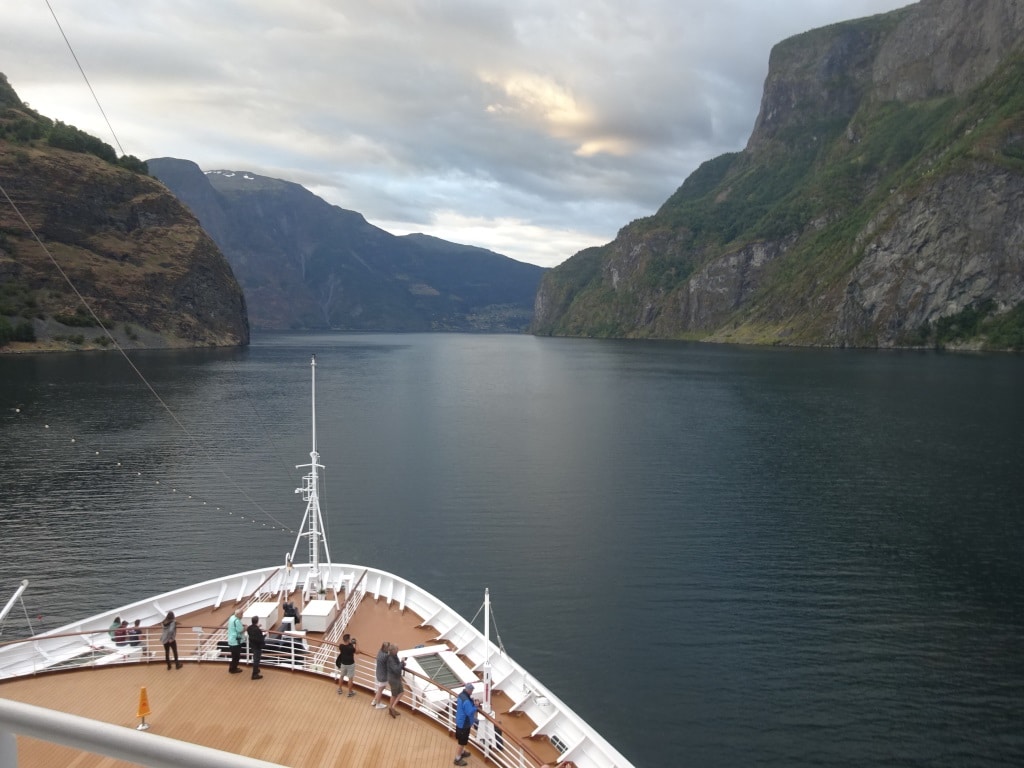
Sailing into Flam. This is the last turn before we arrive at the end of the fjord where Flam is located.

Flam is located at the end of Sognefjord and that is a long way in. For the first part it is quite wide and the ship can run at sea speed after boarding the pilot. Then it gets more and more narrow near the end, that is where it gets very scenic, and the speed has to come down to 15 and then to 10 knots. This reduction in speed has to do with not creating waves as there are boats moored at the various hamlets en route but also not to upset other floating items such as kayakers which can we found here all over the place and not all of them took their common sense with them when jumped into the kayak.
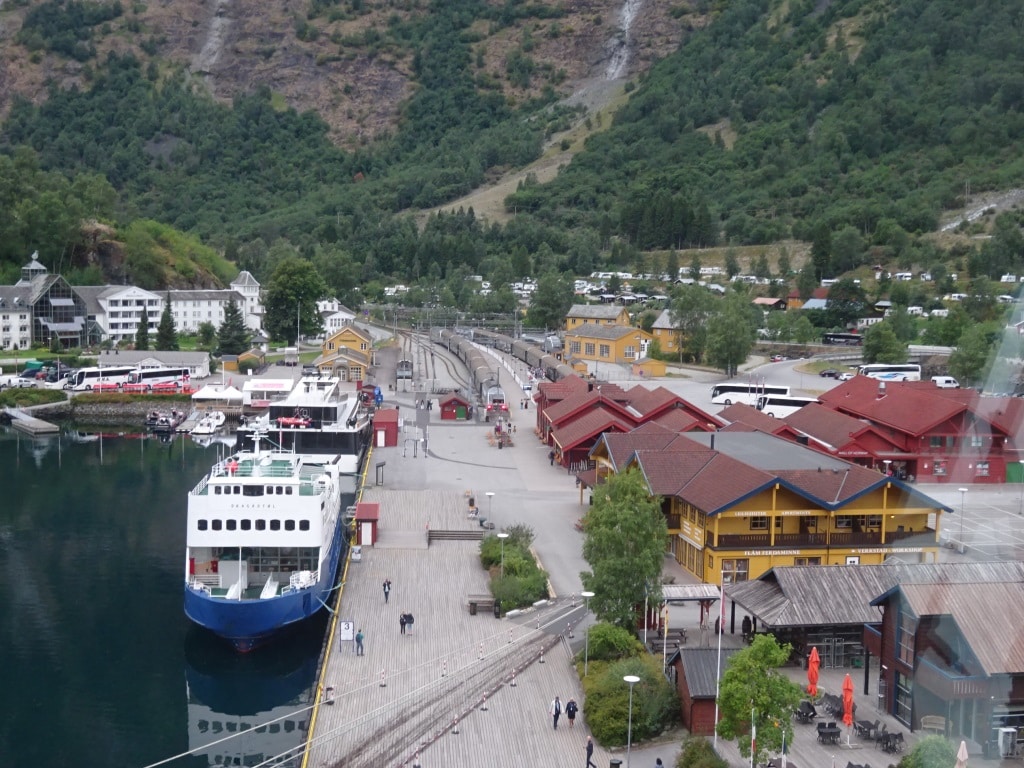
This is basically the whole town. all centered around the railway station. The trains are ready to take all the guests coming from the ship. You can do a 7.5. hrs. tours, a 3.5 hours tour and a 2.5 hrs. tours -un escorted. the long one is part coach trip and the shorter one includes lunch at the top of the mountain where the train stops to go back down again.

In Flam the focus is on the railway so it is our pure shore excursion port. In the coming days we have Kristiansand, Stavanger and Oslo where guests can do their own things and get about all over the place. Here in Flam it is more limited. There are souvenirs shops, eateries and restaurants but the main idea is to go on the train (Flamsbana) or take a shore excursion by Coach. The bus tour takes you inland and to local visits but also to have you experience the Stalheimskleivane which is the steepest road in Norway. I have done that tour in the past and if Norwegians say that the road is steep, believe me it is steep. It also offers some very nice pieces of scenery (horizontally and vertically…………… straight down)
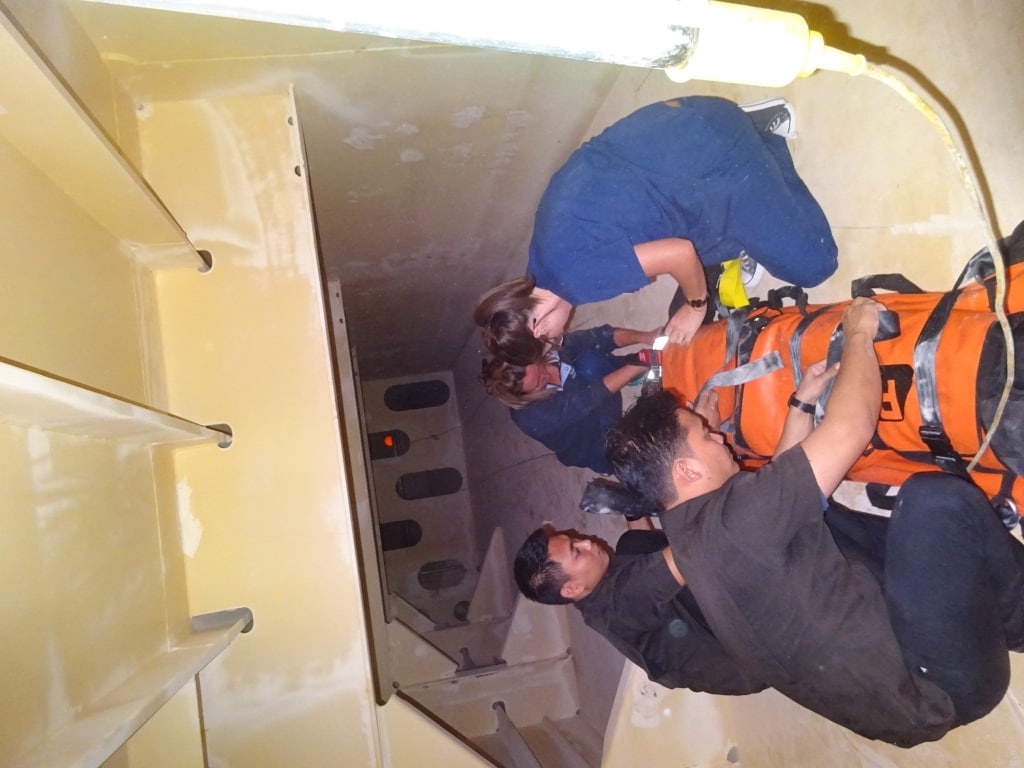
We can still surprise the medical department. None of them had ever been in a tank before. Mr. Dummy was very well looked after.

While the guests are doing their best to fall out of the train, to fall off the Cliffs and to fall in the Fjord (we have had that all happen in the past), ship side dealt this morning with somebody who had fallen in a tank. Simulated. One of the most dangerous activities on board is tank cleaning and we have to do it once in a while. For structural inspections or to get sediments out which had settled down after long periods of use. Oil tanks are particularly nasty but also ballast water tanks as the seawater we pump in is not always pure.  The Koningsdam is only 2 years old and thus cleaning is not an issue yet but inspections have to take place.

The engineers had potable water tank nbr 1. empty for quite a while and also open for quite a while and thus it could be considered a regular space in the Engine room as long as we took precautions; as there is normally only one way in and out. But what an opportunity to do a tank extraction with a casualty and give medical a chance to get familiar with the inside of a tank. In a real situation, we will not even let them get close but this time they could see what it really looked like, what sort of injuries crew could sustain in there and to exercise how to get a stretcher up the stairs. There is nowhere in the ship safety construction regulations that engine stairs need to be wide enough to accommodate a full stretcher team so it can be challenging.
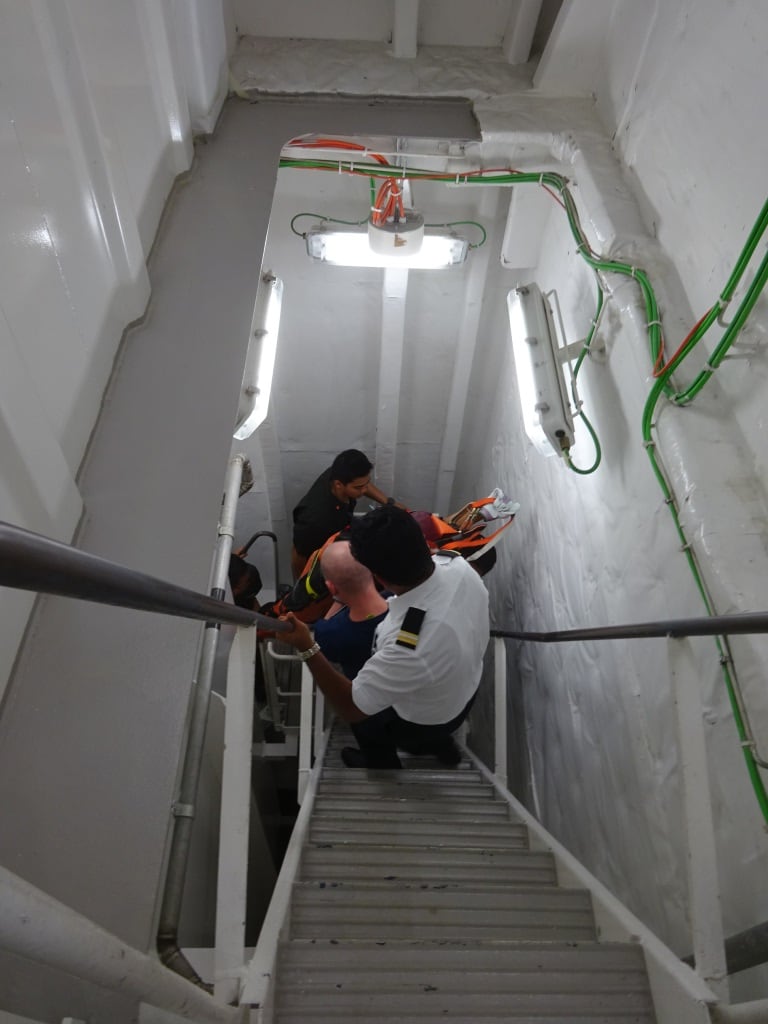
And this was the hard part. First a 90 degree turn and then climbing up a steep staircase with a dummy weighing 160 pounds (approx. 80 kg.)

And thus we put the dummy in the tank, got the stretcher in, let two very excited nurses have a go as well and then got the stretcher with the dummy on it out. As was expected carrying the stretcher up the stairs was the hardest thing of all. We have techniques for that so if the stretcher bearers would let the stretcher slip, it would not go bouncing back down again, but a lanyard anchorman going ahead of the group would stop the slipping. In our exercise we used the full stretcher team, in reality we would probably use four strong engineers working two by two to get it done faster……………. But if all the engineers would be occupied in another emergency then the housekeeping stretcher team would still have to do it. So we train and exercise.

The good ship Koningsdam will sail at 17.00 hrs. and for those who did not make it this morning during the sail in, they now have the chance to see the impressive scenery during the sail out. We have to sail all the way back to the entrance and then enter the next fjord to sail back in again. Next port of call is Stavanger.

This was the last port of call, when we sailed south back to Amsterdam. This time we are expecting more clouds and maybe a little drop of rain in the morning. Temperatures 68oF or 21o C.
 

23 July 2018: At Sea.

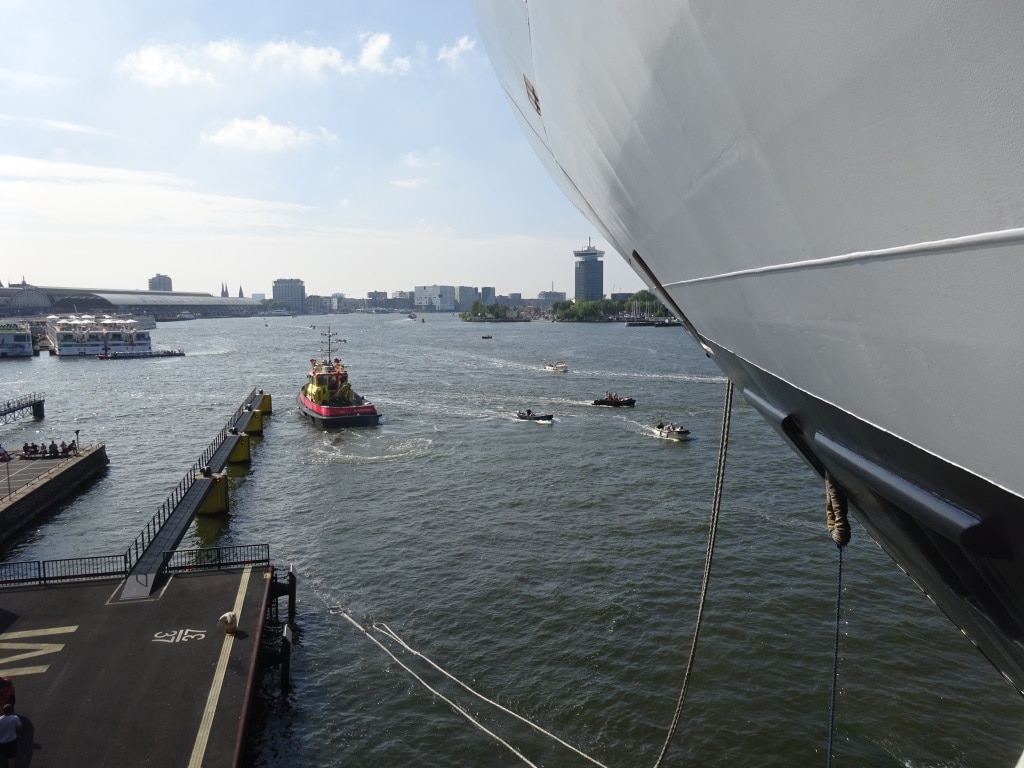
We departed right on time as the captain needed all the time available to make it to the first port, Flam (Also spelled as Flaam unless you can do a zero or O on top of the a) on time. When we left the dock we had an escort boat from the Harbor Master ahead of us to keep the Sunday sailors and the six pack navigators out of the way. Lots of them milling around in the main channel of the IJ (Or Y in English), sometimes with floating contraptions which should not be in such open and busy waters at all. Everybody in Holland who wants to operate a boat over 15 meters or anything that goes faster than 20 kilometers an hour needs a license. But it sometimes looks like as if all skippers, varying from bathtubs, to small sailing boats, motor yachts and even the Rhine barges seem to develop a general amnesia about what was learned when sailing around a large ship. For floating things of 14.99 meters and less, it is in general even worse. The Koningsdam has a dead angle of 60 meters from the line Bow to Bridge and once inside that line, the bridge has no clue of what is going on there below and just has to hope that things go ok and the officer forward can keep an oversight. While for the average small boater 10 feet of passing distance is more than adequate, ………………… it’s not for us. Thus a traffic control boat to help us out is well appreciated.

The escort boat in position. See how close the little boats come while the ship starts to maneuver? Only the white one is visible from the bridge. These will be out of the way before the ropes are in, so the escort boat is leaving them in peace.

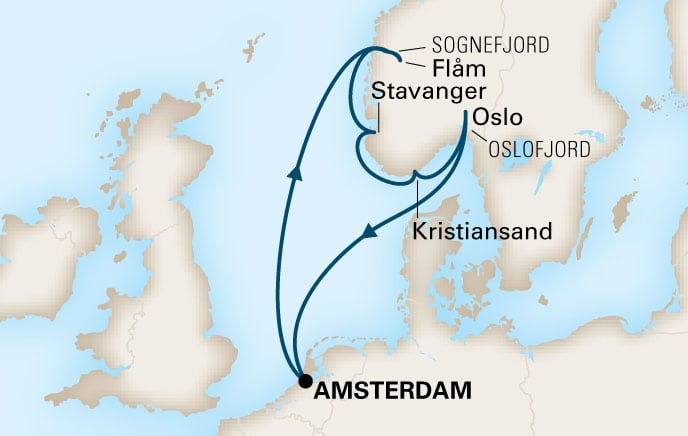
We are now embarking on a seven day “Viking Saga” cruise with calls at Flaam, Stavanger, Kristiansund, Oslo and then back to Amsterdam. In all the ports we stay until 5 or 6 pm. to ensure that the guests get as much scenic cruising as possible. Sunset is every evening after 11 pm. hence opportunity galore to see Norway at its best.

Just after 21.00 last night we were well into the open waters again and turned north towards Norway and the Sognefjord. And today we had a quiet day at sea. The officers on the bridge really appreciate these days as on cruises like this the port days are so hectic that a peaceful sea day is a nice way to recuperate and relax. The high light of this morning’s 4 -8 watch was: one course change of 3o to port to stay on the track line. That is one click on the button to confirm that the automatic pilot can do its job.  The equipment is now so sophisticated that we could sail into port, and almost to the dock, only on the instruments as long as there would be no traffic in the way. Similar but at the same time different to the airline industry. Airplanes normally fly in set lanes or corridors and do not meet traffic. If they do then you normally read about in the newspapers. Airlines can and do fly completely on instruments and can do this also for take off and landing. Ships sometimes follow Vessel Traffic Separation Schemes where traffic follows the same route.  But for most of the seas and ocean, it is a free for all (Mare Librium as the old folks used to say) so traffic can come from all sides.
Watch keeping on the ships has changed as well. We used to, and many shipping company’s still do, operate the 4 hours on and 8 hours off watch schedule. (Not off work but not standing on the bridge) That schedule worked quite well in my opinion as long as the captain allowed a rotation through the watches. I used to do as much as possible giving each officer in a 3 month period, a month in each watch.  4-8 was the gentleman’s watch; with time to do side duties the mornings, have a nap in the afternoon and dine with the guests in the evening or see a show. 8-12 was the party watch. Finishing at noon and the Officers Bar was just opening, finishing at midnight and in the ship or in the Officer Bar the party was just getting into full swing. Then finally there was the 12 – 4 watch. This was the lonely watch. In the afternoon the ships staff took a nap to prepare for the evening activities, so you hardly saw anybody and the same after midnight, it was very quiet as well. That is nice for some contemplation but it is not good to be in this watch month after month as it can get very lonely. In the past I knew a few people who had spent 10 years in this watch before they were promoted up into the 4 -8. One did notice a number of peculiarities that they had developed in those years and not all of them were positive. Which watch you went into depended on your seniority and if promotion was at a standstill, you could be stuck for years.

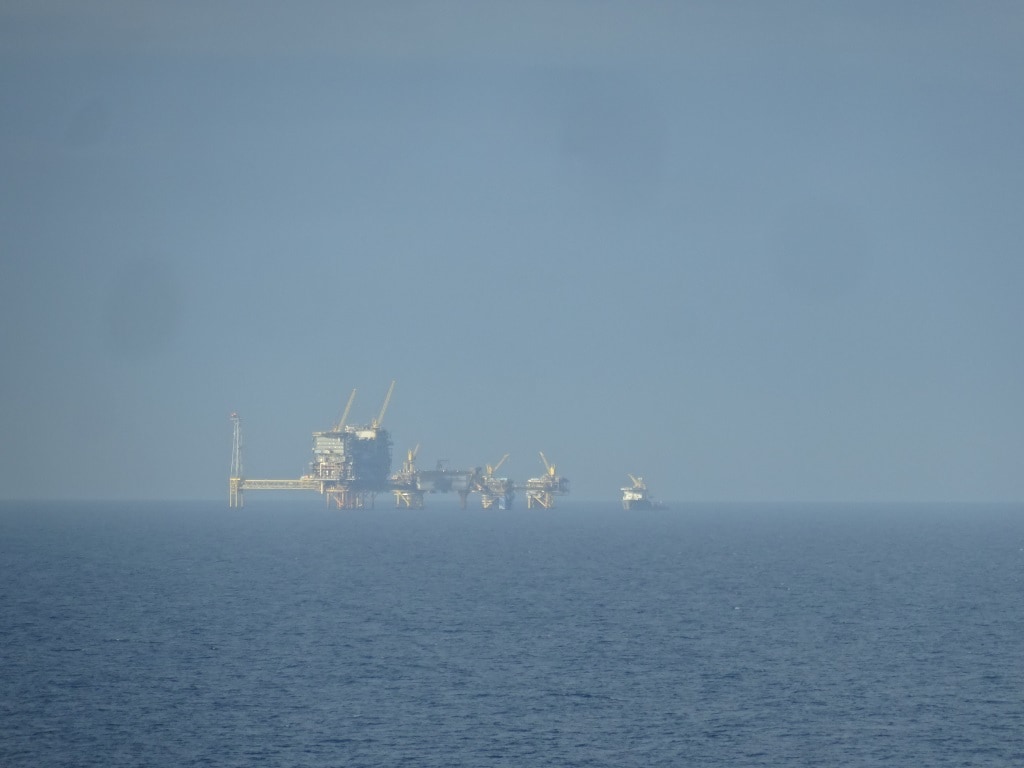
Even when it is quiet you have to be careful as the North Sea is full of these oil rigs. And the people on board there get very nervous when you come close. For ships coming too close they have a Guard Ship on duty as you can see to the left of the rig.

Since the arrival of the full time double watch system, two officers on the bridge at all times, the company has been experimenting with 6 and 2 and 5 and 3 hour watch systems. Basically to see if more rest hours could be taken in one block and to give some more time off. With the old watch system, taking out the side duties and eating and sleeping, you had to swap watch hours to get some decent time ashore. Now the hours are more together. In the end the company decided on 5 and 3 hours. As an example, the dog shift does 22.00 to 03.00 in the morning and then 09.00 to 12.00 hrs. The officers are off from 11.00 hrs in one go to 22.00 hrs. again. Or they do 00.00 hrs. to 05.00 hrs. and then 09.00 to 12.00 hrs. Again a nice long stretch of time off. The officers on the ships like the system and they also rotate through the watches during their contract. Nobody gets bored and everybody can get a share of the good life.

Late this evening we will be at the pilot station and then we enter the Sognefjord which is the longest and deepest fjord in Norway. All the way at the end is the town of Flam, known worldwide for its railway. We will be docking tomorrow morning and I will be forward again with the senior cadet to get the ropes ashore. Not just to get the ropes ashore but in accordance with Holland America Line standards and there is a big difference there.

Weather for Flam: Overcast with a chance of showers in the afternoon and 73oF or 23oC. It looks like that we have the real Norwegian summer weather back.

22 July 2018: Amsterdam, The Netherlands.

It was 02.15 this morning when the Koningsdam arrived at the Pilot station. Because of the sail in via the Vessel Traffic System, the captain had already been called an hour earlier, so he had a long morning as the ship only docked around 06.30 hrs. Then it was back to bed for him but not for very long as by 11 am. there was movie crew waiting for him to take shots for an American travel program. And then there was still a regular day to be followed by Guest Boat drill. Then departure again which will take until 21.30 tonight……………. And then we have guests asking, if the captain went ashore for the day because we are so close to downtown. Sometimes I wished that all the guests in the company read my blog, if it was only to understand how busy a ship’s captain is nowadays.  The days of the “jolly old salt” standing on the bridge and having not much to do besides arrival and departure are long gone. After 3 months in command, the ships captains are tired, very tired and ready for 3 months off.

Good ………………. That was my moan and groan for the day.

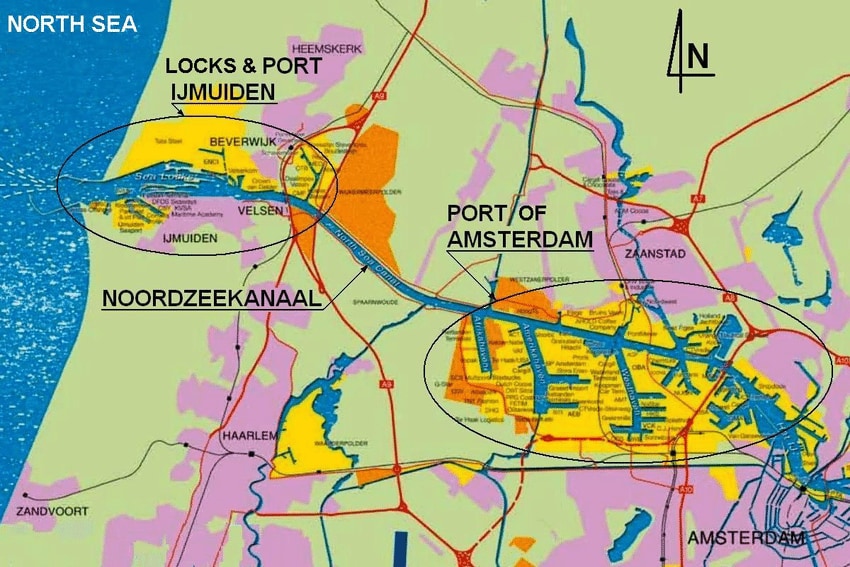
Ijmuiden Locks and the port of Amsterdam. Courtesy of an unknown publisher on the internet, who must have been thinking the same thoughts as I did.

The only option to avoid this long time of sailing in and sailing out again is to dock in Ijmuiden. It makes us as captains very happy as it is barely an hour from the pilot station to the dock as you do not have to go through the Ijmuiden locks. Plus you avoid the slow run through the North Sea Canal all the way to downtown. Some company’s do so and then run a shuttle service to downtown Amsterdam and for the turnover of the guests it is not a problem either. It takes as long from Ijmuiden to get to Schiphol as it does from Amsterdam.  Our Prinsendam has done it in the past for turn over calls. Although currently she is docking downtown Amsterdam but her calls are very infrequent and she has many guests on board for several voyages. And for them Amsterdam is a regular port of call and then…….the closer the better.

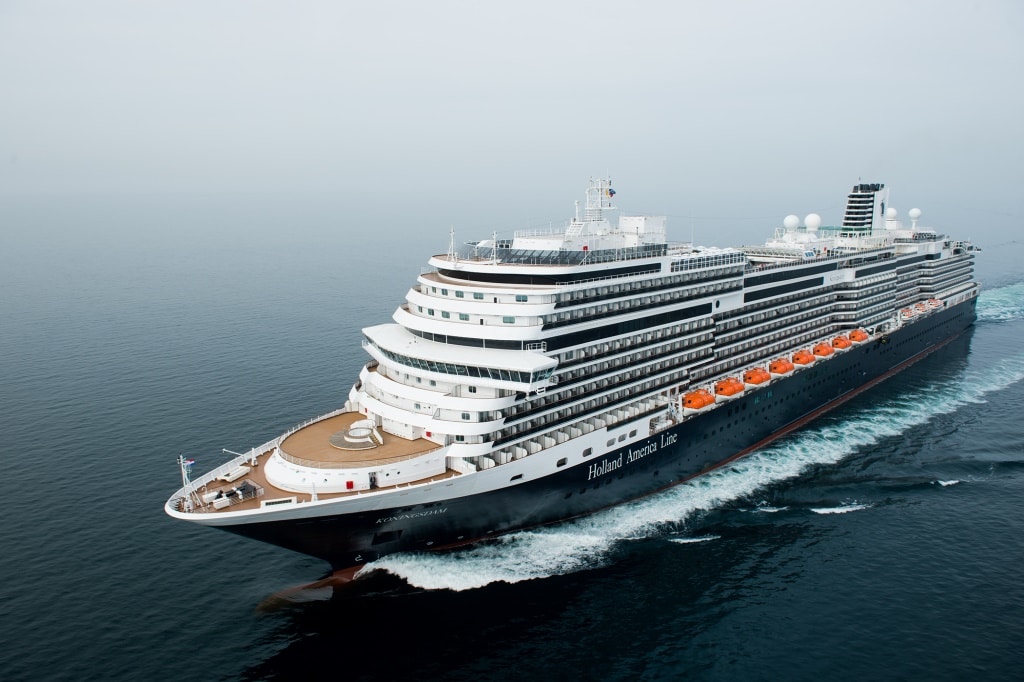
The ms Koningsdam aerial photo taken during her maiden arrival in Venice in 2016. She does fit in the cruise terminal in Ijmuiden but unfortunately the train does not stop in front of the cruise terminal. (Photo courtesy Holland America Line)

But; For the Koningsdam it is slightly different. The Koningsdam sails with a very large number of Dutch Guests often 50% or more. And a lot of these guests come to the ship by public transport. Central station is only 5 minutes away and you just roll with your suitcase down to the ship or take a taxi for the short distance. (If we had bicycle storage on board, I would not be amazed at all if a lot of them would come by bike towing a wheelie box with the suitcases behind it. Nothing unusual as everybody bikes in Holland, even the King and Queen. For those guests it makes good sense to park the Koningsdam right in downtown. Also this morning there was a long and steady flow of Dutch guests rolling their suitcases to and from Central Station. I could not get a photo of this phenomenon as we were just docked too much behind the Mövenpick Hotel.

Behind us was the Seven Seas Navigator and if she had been just a little bit longer then we would have been a little bit more forward and be able to peak around the hotel.

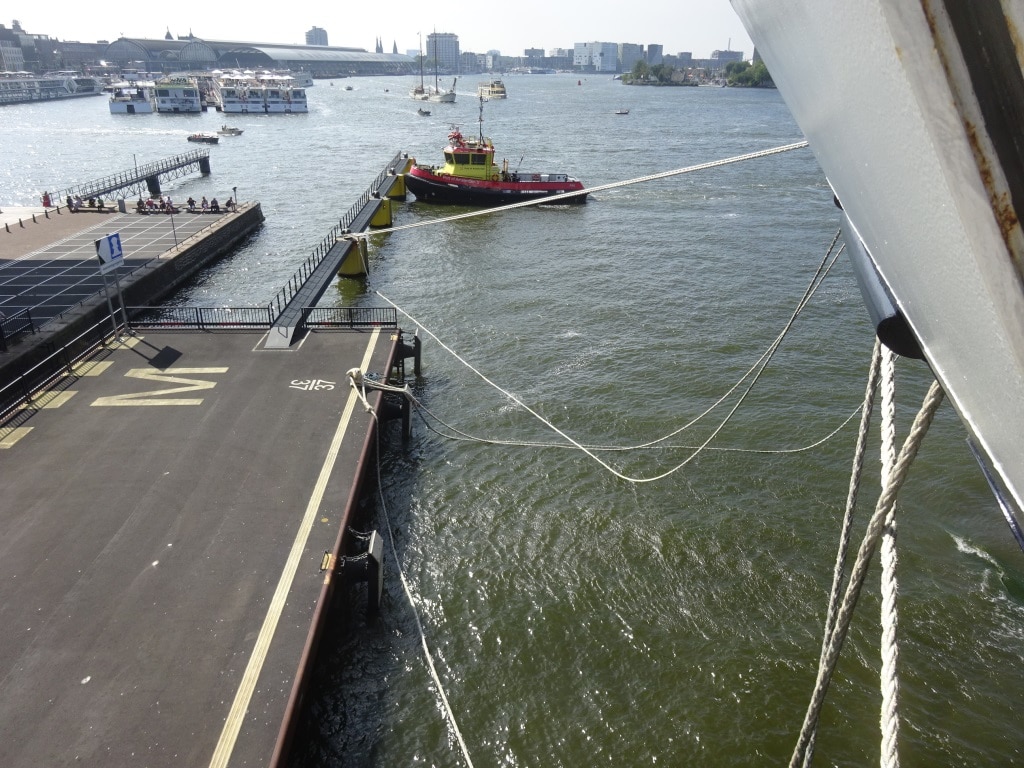
Departure Amsterdam. Coaching the senior Cadet on board so this photo is from the forward mooring deck. to have a good view of the city, the ships bow has to be where now the red harbor patrol boat is. She will later keep the “six pack navigators” out of the way when the ship sails through the canal. To the top left the rows of river cruise vessels. This was a group of 14 with more further down.

Apart from the SSN, the port was full with Rhine cruise vessels. River cruising has become extremely popular in the same way as deep sea cruising. I made my first Rhine cruise in 1972 as my mother loved it and in every town along the river we were the only ship in. Now that has changed drastically and I counted 20 river cruisers getting ready for their next cruise. As a result they were docked 4 deep or more alongside. Ships varying in quality from 3 star to 6 star and there is even a catamaran version out there that has a regular size swimming pool inside. Most of them were leaving today, with quite a few of them doing the same ports,  so they only way to avoid all this congestion is to sail on a Monday or Tuesday, when you follow “the crowd” instead of being part of it. In the same was as you see less cruise ships in the ports of the Caribbean and Alaska if you are on a 10 day cruise just because most ships are sailing on Saturday or Sunday so with an odd day departure you stay out of that cycle.

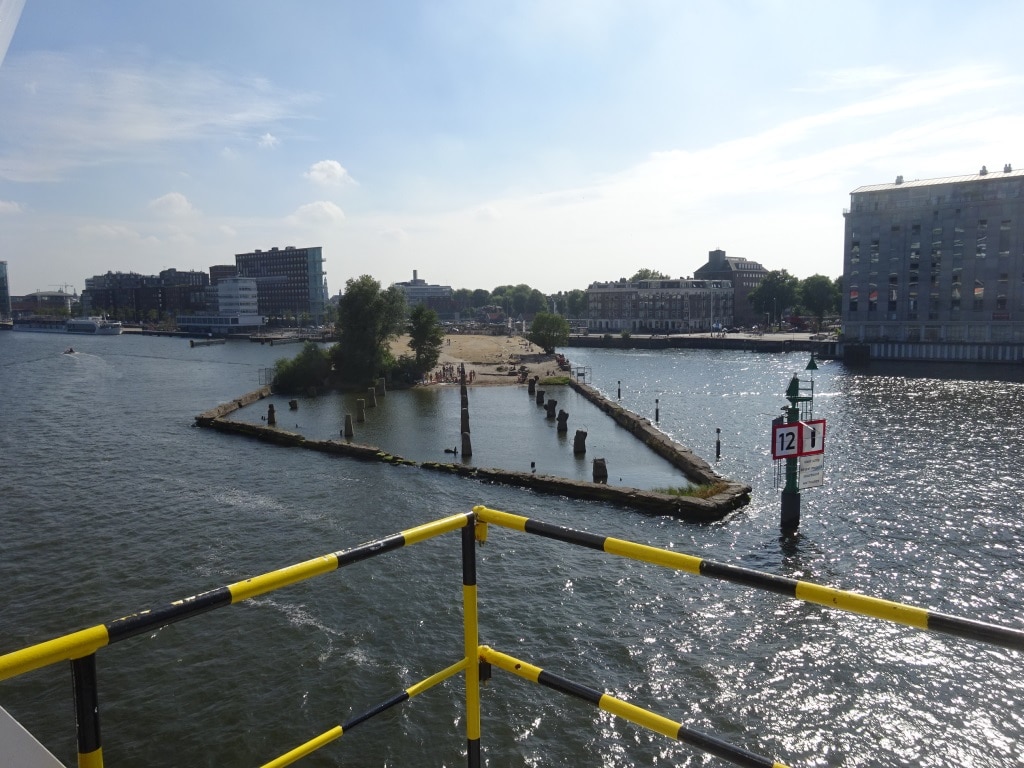
What is left from a 200 meter long cargo pier. You can see the support of the pier jutting out of the water. Each house, building, factory or other construction in Amsterdam has these, either from wood, stone or concrete. Without these supports, everything would just slowly sink into the muddy underground.

A little bit of nostalgia. When sailing out, we passed “Het Stenen Hoofd” (The Stone Head) now flat and due for redevelopment. But between 1905 and 1930 Holland America had this pier in lease (and the wooden one before that) for its ships that called at Amsterdam.

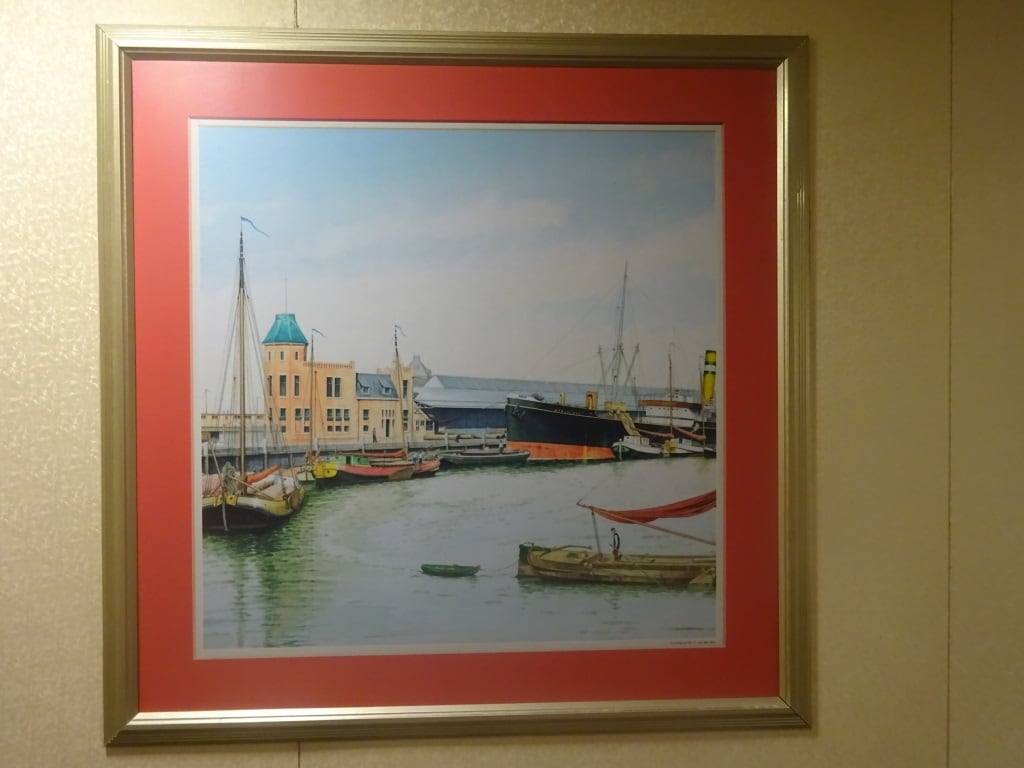
Het Stenen Hoofd in her glory days. This drawing is hanging on all the S and R class ships of the company, somewhere in a guest corridor. On the photo the ss Amsteldijk (I of 1901) .The tower housed the office of HAL for its Amsterdam business.

Tomorrow we are at sea and it has been promised that it will be a sunny day but maybe a bit breezy. We are on our way to Flam in Norway which is a tight schedule, due to the long sail in into the Fjord. So the captain is putting the pedal to the metal to get a bit of time up his sleeve as with fjord sailing you never know what can happen.

21 July 2018; At Sea.

After a glorious day the good ship Koningsdam set sail for Amsterdam early last evening. In Amsterdam this cruise will end and we will turn around for the next one. Stavanger had provided us with a cloudless day and made Norway look at its best. (And there are not that many days when Norway looks at it best, as it can rain here profusely) Because of this extensive high pressure system that is lying over the area, we had a nice day to day as well and we will also have a nice day tomorrow.

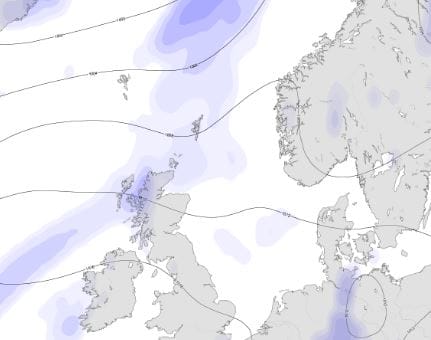
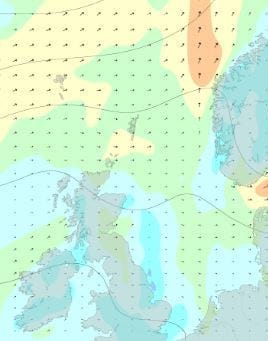
The isobars are very far apart. So hardly any wind and no wind means no rain clouds coming in from the Atlantic. (Both diagrams are courtesy of a weather site called Seaweed)

The wind picture today. Just a gentle breeze on the North Sea and even less around England.


Not everybody is happy about this very good weather. At home in England they have imposed the first hose pipe ban. This means that individual households are not allowed to water the garden or wash their car. Quite an achievement for a country that is known throughout the world for the amount of rain it gets. But it indicates how little rain has fallen recently in the area. The Netherlands are coming closer to this situation as well, although there is plenty water around, it is not evenly distributed. The greater part of the west might be below sea level, the east is well above and thus water shortage might become as issue here as well. The west is also dealing with a very peculiar issue and that is that the dykes are drying out.  The dykes are there to keep the water away from the low lying land and that that do very well. But the parts that are above water are now drying out and the strong clay of which most of them have been made is starting to pulverize. Thus there are now boats sailing around the canals and water ways which pump water up and spray it Fire brigade style over the surface of each dyke.

None of these problems here on board. The North Sea is only there to float in and we make all our own water on board, also courtesy of the North Sea. We do try to load water in port if it is cheaper than producing it on board; but often we can make a lot of water by using the hot exhaust gases from the engines before they are released into the outside air. For that purpose we have Exhaust Gas boilers fitted in the funnel and that water does not cost us anything to make as the engines have to run anyway.

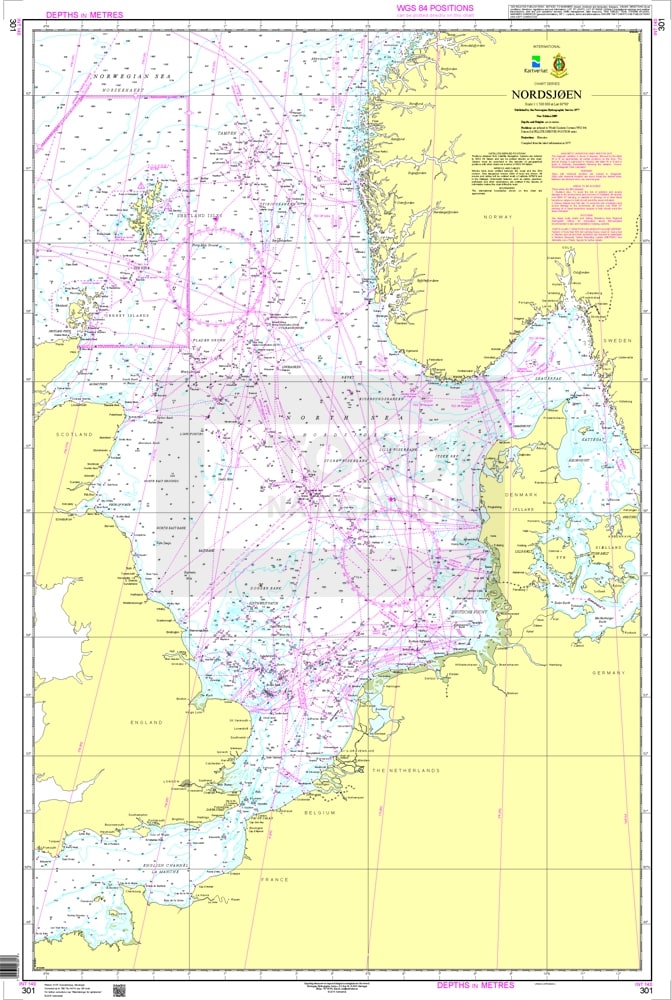
British Admiralty chart 301, re-issued by the Norwegian cartography services.The North Sea. Everything that is purple is either indicating a boundary, an under water cable or a Highway at Sea.

Sailing in the North Sea is nowadays a major headache and the place is getting so full and (over?) regulated. Thus we are following the vessel traffic separation schemes and being southbound we are basically right in the middle of the North Sea. In the good old days we could have hugged the Dutch Coast while coming down and save a few miles here and there. But there were so many ships doing that, that several bumped into each other and now the routes are (compulsory) spread out. Even if we wanted to deviate it would be hard as to starboard we have oil rigs and to port we have wind farm parks. Thus we have to find our way in between them and that has been made easier with the Vessel Traffic Routes.

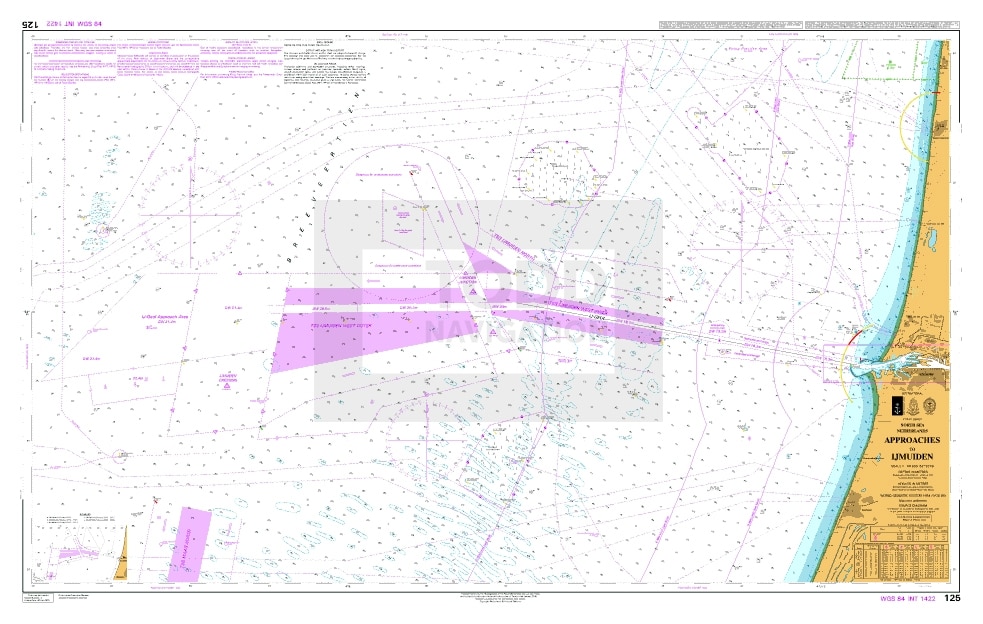
British Admiralty chart 125. Approaches to Ijmuiden. The Koningsdam will join the VTS where the triangle is located above the other purple blocks. It will merge here with East /West traffic coming / going to England and/or to Dover Strait. The pilot will join where the purple blocks of separation zones stop.

Early tomorrow morning we will make a 90o turn in the middle of the North Sea, a turn to port or to the East and then follow the approach channels to Ijmuiden pilot station. That will be around 02.00 in the morning and the pilot will board 45 minutes later. From there is about 4 hours to the cruise terminal in downtown. The Koningsdam will take 4 hours as it will swing on arrival so we can dock nose out. Because of the size of the ship, we go a little bit into the port than shorter ships as we go to the main turning basin. More about that tomorrow.

If we did not have a these regulations in the North Sea, our time at sea could be about 5 to 6 hours less but with the increased chance of hitting somebody who decided to do the same thing.

Weather for tomorrow; Partly Cloudy skies with temperatures around 26o C / 78oF with a gentle breeze.


20 July 2018; Stavanger, Norway.

Stavanger is the oil capital of Norway and although North Sea oil operation is a little bit in the doldrums at the moment, it is still an important part of the economy. It made Stavanger very rich and created very good living circumstances for the locals. Hence there are sufficient hotels to stay in and the company had no problems finding me a place for two nights. Today real life starts again as the Koningsdam promptly docked at 08.00 in the port at the same spot where the Seabourn Ovation was parked yesterday. But where the Ovation was docked bow in, the Master of the KODM preferred docking Nose out so the ship had its stern toward the end of the port basin. There where all the food stands were yesterday and still are today. I assume that the Festival will last until Sunday evening at least.

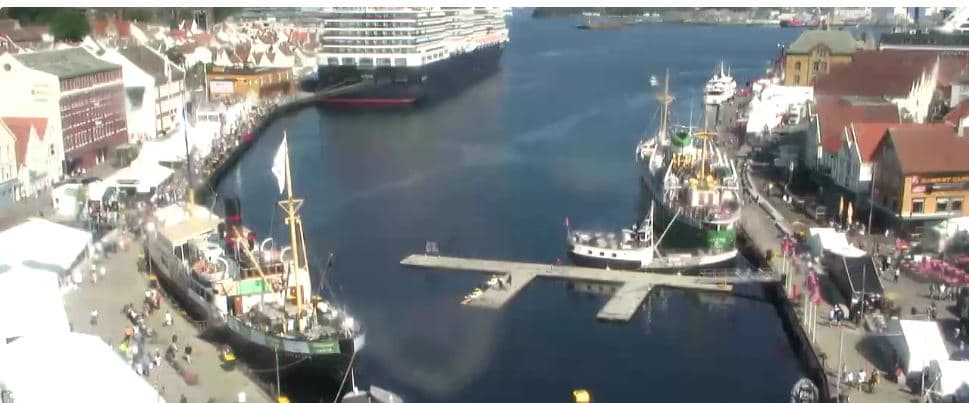
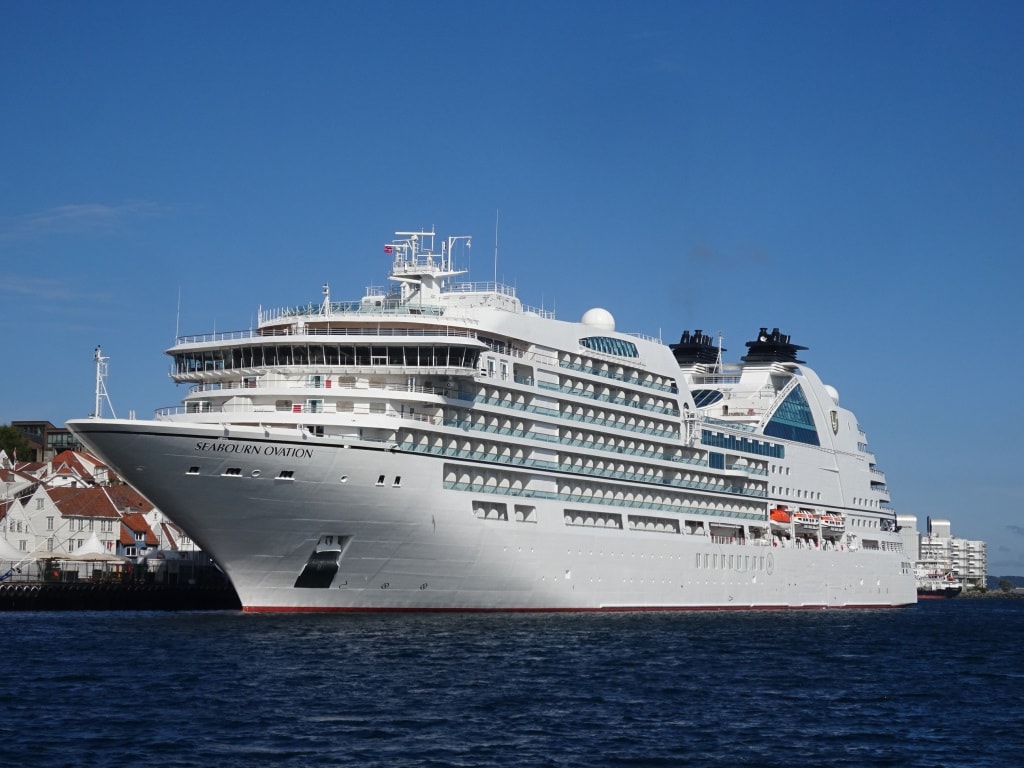
The old port of Stavanger. Yesterday my own photo of the Seabourn Ovation, this time a screen shot from the port webcam. In port also two museum ships, left the coastal steamer Roggaland, and to the right a slightly younger version the Sandnes. Both now in use as restaurants and exhibition centres. (Photo courtesy: Lesley Schoonderbeek, who has no hesitation to use Big Brother to try and keep track of me)

The Koningsdam is sailing to Norway for most of the summer and is now ending one of those cruises. Stavanger is the last port of the cruise and on the 22nd of July she will be back in Amsterdam to commence another 7 day cruise.  The ship is now two years old and this time on board I will find out what has changed in those two years, if anything.  What will be of even more interest is her sister, the ms Nieuw Statendam, coming out in December. The company has already said that there will be a number of changes based on the experience with the Koningsdam. Knowing Holland America then those changes, if successful, will also be applied to the Koningsdam. And this process will keep rolling forward when sister nbr 3, (which I call the X-dam for the time being) comes out in 2021.

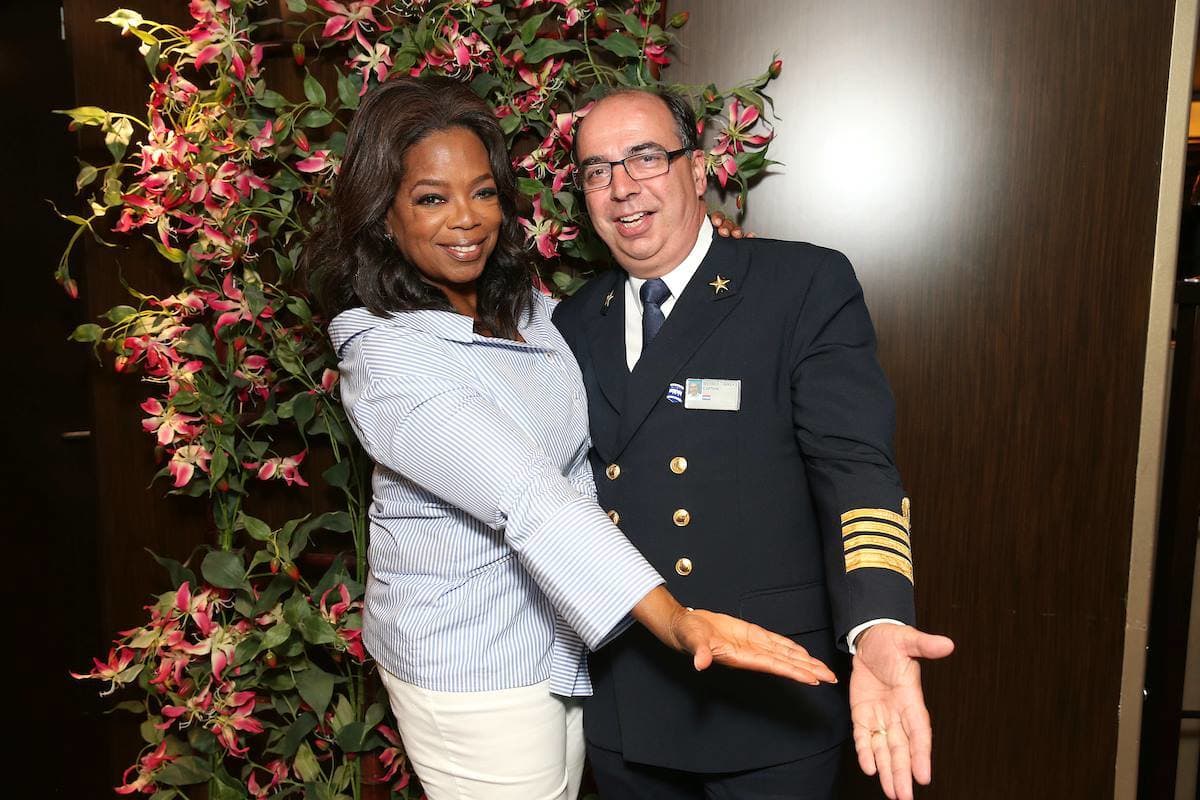
Captain Werner Timmers in a glamour shot taken during a cruise when Oprah Winfrey sailed to Alaska. (Photo courtesy: Holland America Line)

The Master of the vessel is Captain Werner Timmers, who I already know from when he joined Holland America back in the grey mists of time. He then followed me up the promotion ladder as he joined the company a few years after me. His previous ship was the Eurodam and has now come over after the latest “Musical Chair” operation from Nautical Operations to the Koningsdam. One of the two earlier Koningsdam captains is now in the shipyard for the new build of the Nieuw Statendam and the other one is currently instructor at our simulator in Holland. Sometime in the future he will then rotate back into the fleet.  The alternating captain for the Koningsdam is Captain Noel O’Driscoll, lately from the Veendam, who will take over later in the season.

From Stavanger the Koningsdam will sail straight south to Amsterdam and tomorrow we will spend our day in the North Sea. Sunday morning will see an early arrival at the pilot station as from there it is about four hours to the Cruise Terminal in downtown Amsterdam.

I will be on board until August 05 and the plan for me is this time to focus on drills and provide training when I observe weak spots. And yes we will be messing around again with tenders as the sailors are very eager to get their licenses renewed. One afternoon of Captain Albert is much more pleasing than a repeat 5 day course in Manilla if their license is expired.

Middle and southern Europe is suffering at the moment under a heatwave and that makes the prediction for the weather for the coming days, quite easy, it will be warm and sunny.

19 July 2018: Between Ships.

It was not really the plan to do a blog today as I did not expect much excitement apart from sitting on the Hop on Hop Off bus. That excitement died away quite quickly as the Hop service only runs when there are cruise ships in port. Today there was one cruise ship in port, the Seabourn Ovation, but she is smallish and thus they ran the service only in the morning and not at times that I was going to be about. But the excitement returned as the Seabourn Ovation belongs to our sister company Seabourn so I can get on board with my corporate ID. And that was a chance not to be missed. On top of that the captain was Andy Pedder who had been my chief officer back in the Veendam days. Good reason to have a look, plus a sudden opportunity to talk a bit of business as well.

The harbor of Stavanger is in the middle of the old town and because it is deep the cruise ships really park themselves in down town. So when the big boys are in they really tower over the area. If it is not for the fact that Stavanger is built on the rocks on either side of the port, the cruise ships would completely dominate the sky line. Now at least the hotels and apartment buildings on the hills to the East are still a little bit higher.

The ms Seabourn Ovation. She only came in service recently.

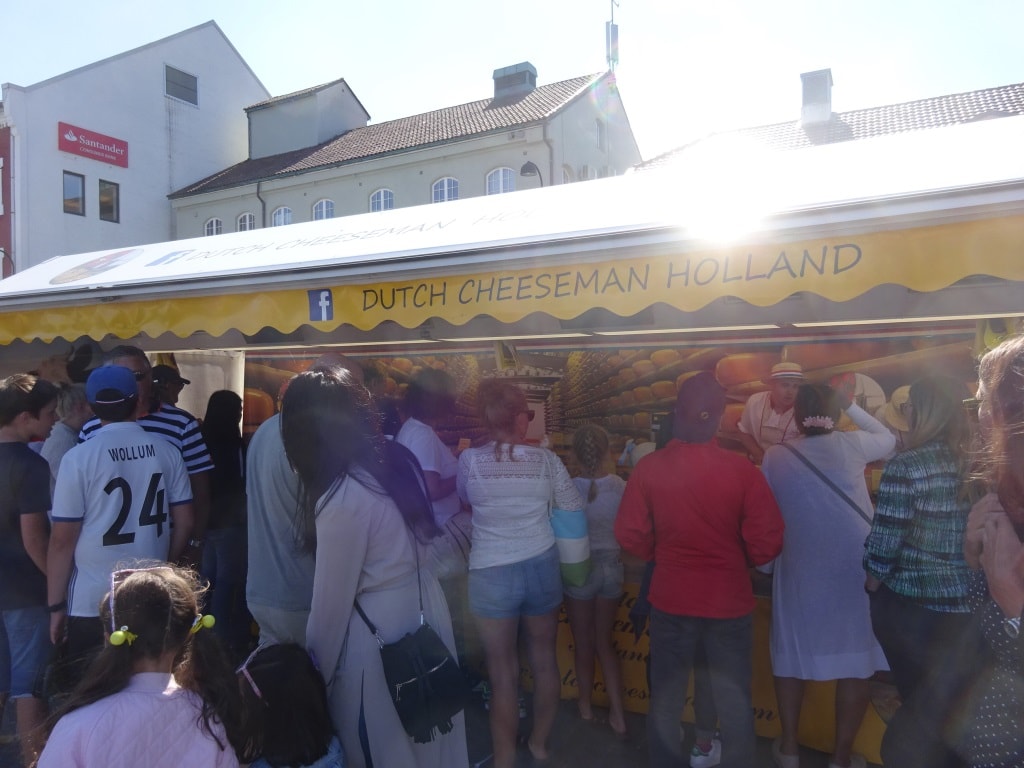
The Seabourn Ovation is not that big but she still dwarfed the downtown port. Which was buzzing as there was some sort of local fair going on. The whole area around the water was taken up with little stands selling local produce and delicatessens and lots of food and drink. Slap bang in the middle was a Dutch cheese cart, manned by Dutch cheese sellers. With their van they travel all over Europe attending these sorts of happenings. Something they can easily do as Norway is part of the European Community as far as open borders and free trade is concerned. They do not have the Euro as a payment but kept the Norwegian Kroner and are thus an associate member.

The Dutch Cheeseman. And they were really Dutch. As you can see, the Stavangernerians like Dutch Cheese. It gave me a very homey feeling to see this.

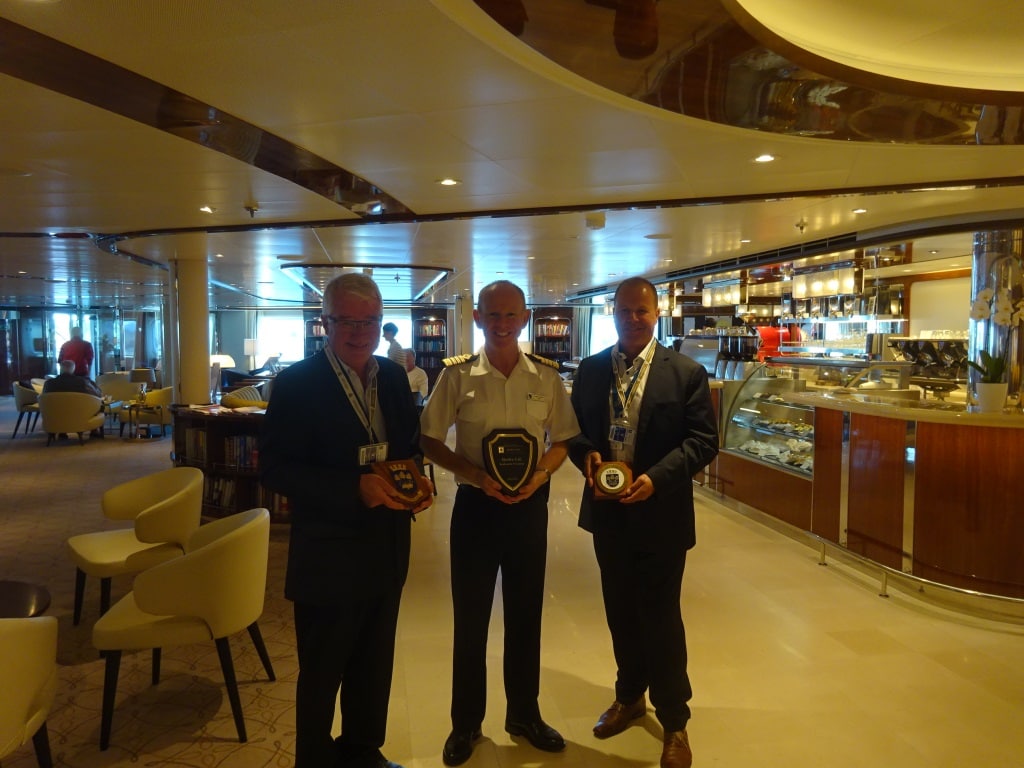
With the Ovation, (40,000 tons and 600 guests) being brand new, the captain has plaque exchanges in every port, as each port in the coming months will be a maiden port call. Some ports have given up doing this due to the large number of new cruise ships coming in but traditional seafaring countries of which Norway is one, Stavanger is a very important port, and still honor the tradition.

Plaque Exchange. Mr. Anders Bang-Andersen, Director of Cruise Development for the port of Stavanger, Captain Andrew Pedder, Master ms Seabourn Ovation and Mr. Odd Bjorn Bekkeheien CEO of the port of Stavanger.

The size of the Ovation is similar to our ms Prinsendam but where Holland America operates in the 5 star Premium Market Seabourn in the 6 star Luxury segment. Which means a higher crew to guest ratio and nearly everything included in the price, except shore excursions and premium wines and spirits.

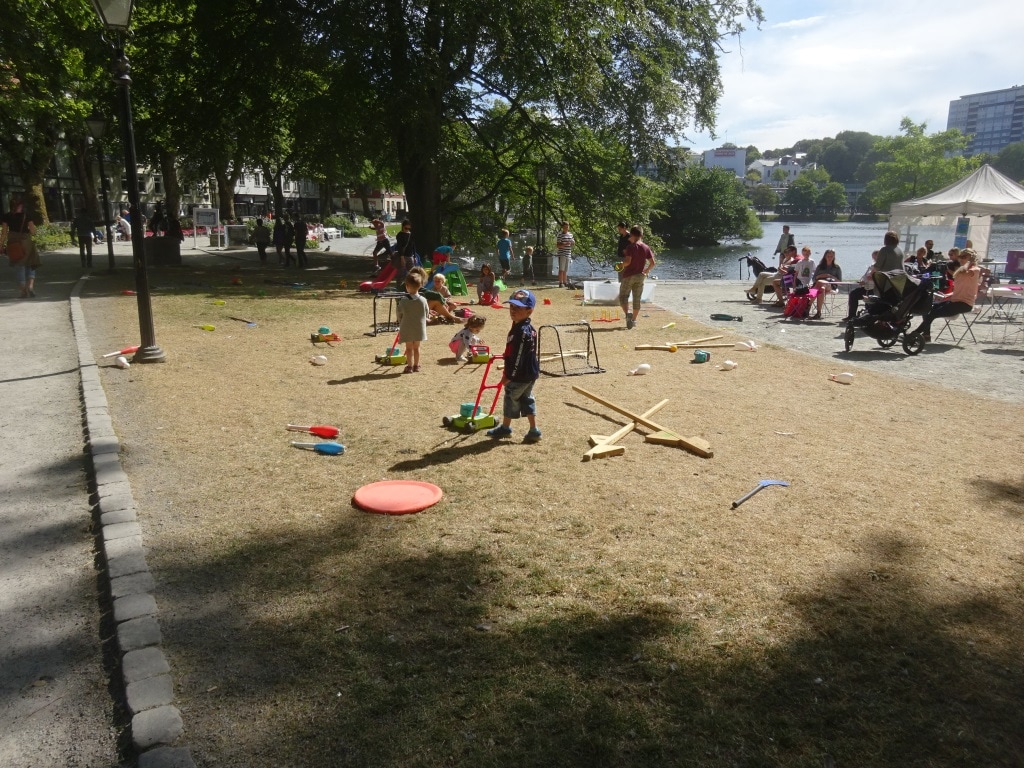
By the time I left, the area around the ship was heaving with people who were having a great time at this local fair. I walked backed through the old town and the shopping area to my hotel. While doing so I came through the park and although I am not often around children, I think this is quite unusual; little lawnmowers as toys; what a way to get kids into gardening while they are still young. They are just plastic toys but with a little gadget inside that gives a lawnmower noise when you push it.

Future Gardeners in training. If you give them a fire engine, they want to become a fireman. If you give them a lawn mover then I suppose cutting grass is the only future there is.

Our guests do love Stavanger when we call here, the old town, the petroleum museum, the country side. But not only our guests also those from  other cruise company’s and thus Holland America Line cannot get every ship to go there as the port is sometimes fully booked with 3 or 4 ships inside and sometime they are not the smallest ones.

Tomorrow the Koningsdam will arrive at 08.00 hrs. and I will join around 10 am. to see if I can start spreading “my wisdom” as I have just done on the Oosterdam. The city of Stavanger is having a few very nice days and also tomorrow it should be sunny without a cloud in the sky with temperatures of around 21oC / 70oF.

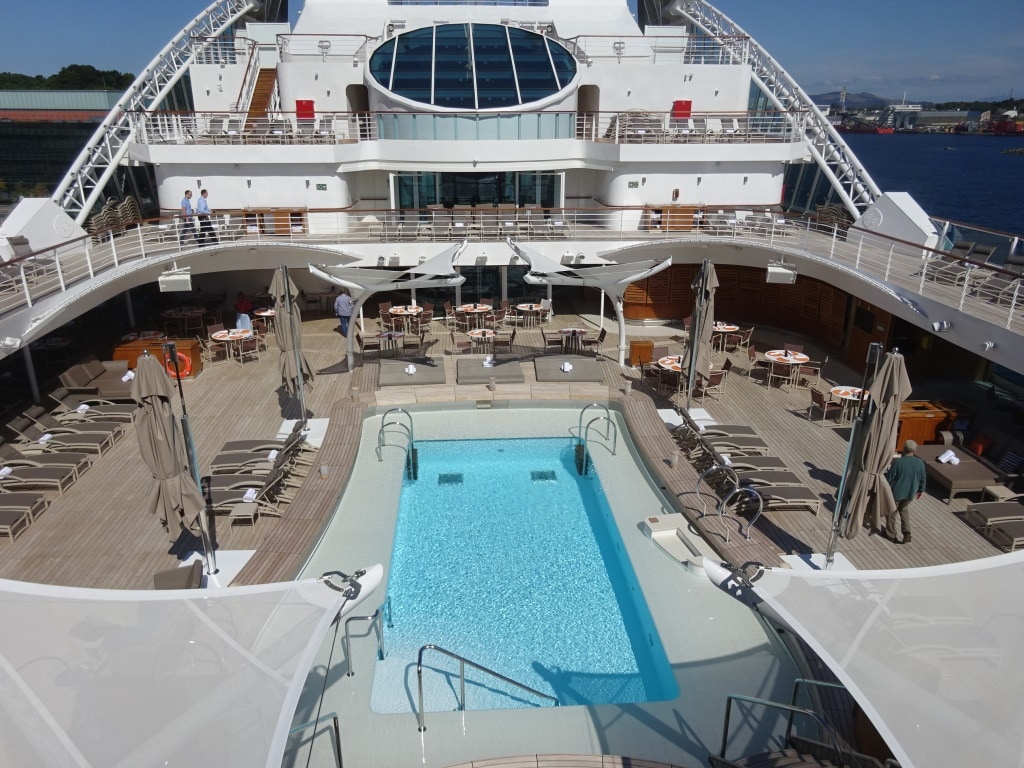
One more photo of the Ovation. the midships pool area, looking aft. Very quiet as all the guests were ashore. The round blue thing in the top middle is the sky light of the Main staircase. It runs through all the passenger decks and ends up with a glass roof. The Ovation has nearly all the public rooms aft, around this staircase and all the suites more towards the middle and the bow.

17 July 2018: Naples, Italy.

The weather front was much slower in passing by than had been forecast and the rain predicted for the very early morning hours was still lingering over the sea when we approached. All the dark clouds did disappear very quickly though while we were docking and the remainder of the day was sunny and very warm. Not so bad when you are on tour but a challenge if you decide to walk through the narrow streets in the old city. For the rest Naples was itself today with a lot of city noise, caused by cars and mopeds but also by the Neapolitans themselves who only seem to be able to communicate at the top of their voices, even when having a normal conversation. They say the people of Napoli live on the streets and I can understand why; the wife kicks them all out of the house as they are making way too much noise.

It is traditional that the ships dock noise out in Naples. On arrival in the morning it is normally wind still which makes it much easier then for departure to get out of the port.

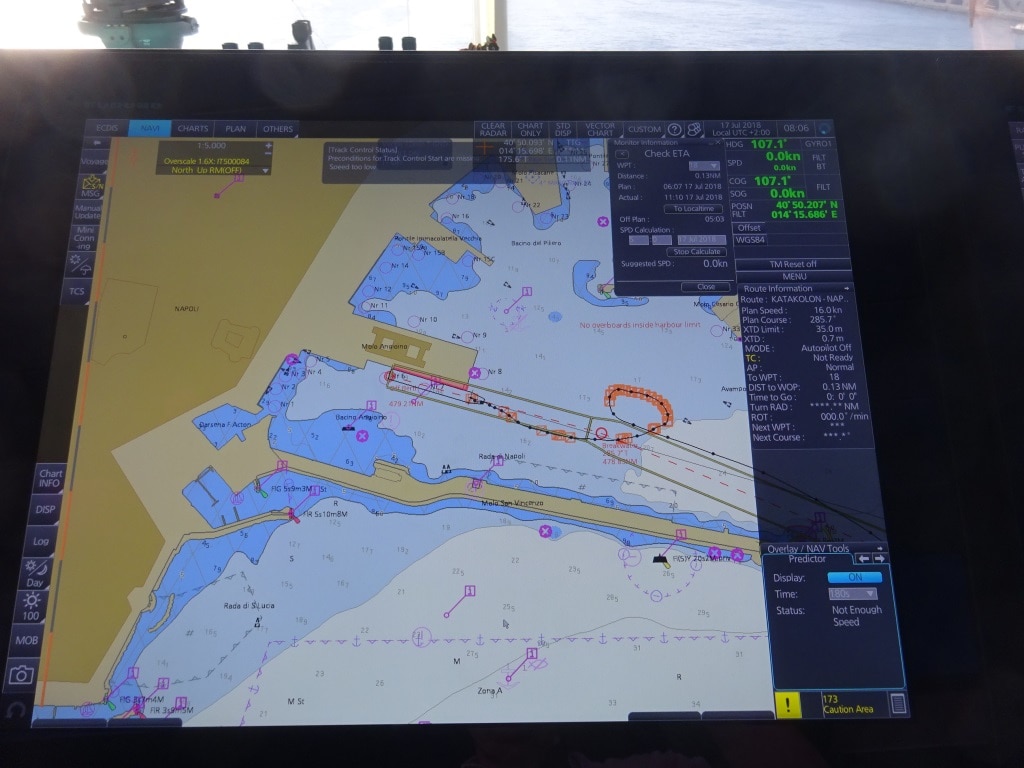
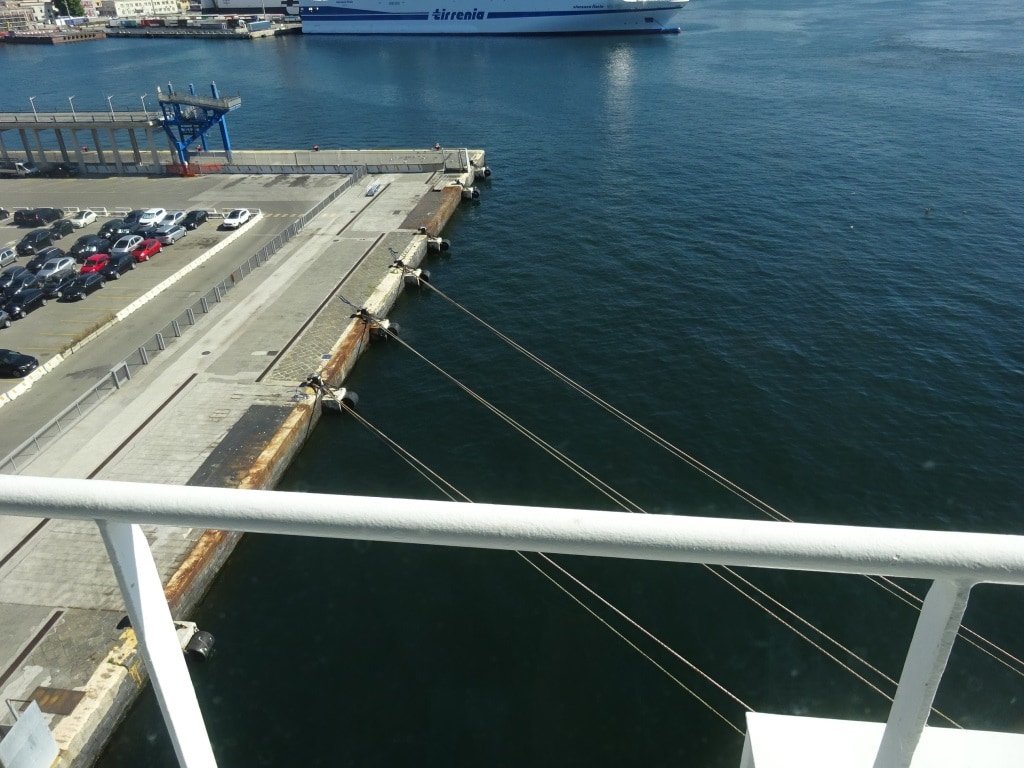
I was forward with one of the cadet this morning. In the past few days I have guided both of them through anchoring, docking and undocking. The last few ports were simple ones, straightforward with the mooring lines and the only thing he had to do was passing on the right information between Bo ‘sun and Bridge and monitoring the safe working practices of the sailors. Today the challenge was upped a little bit here in Napoli. Because we are much too big for a cruise terminal (constructed for the “large” ships of the 1930’s) and because the Norwegian Epic had the long berth on the East side, we were sticking out by about 50 meters. That meant that all the lines were running aft to the dock and to get the lines ashore you get a local line boat. We do not like all our lines running aft as it means that there is nothing to hold the bow if a cross beam wind would suddenly blow up. Our plan B is then to drop the anchor and/or call a tugboat.

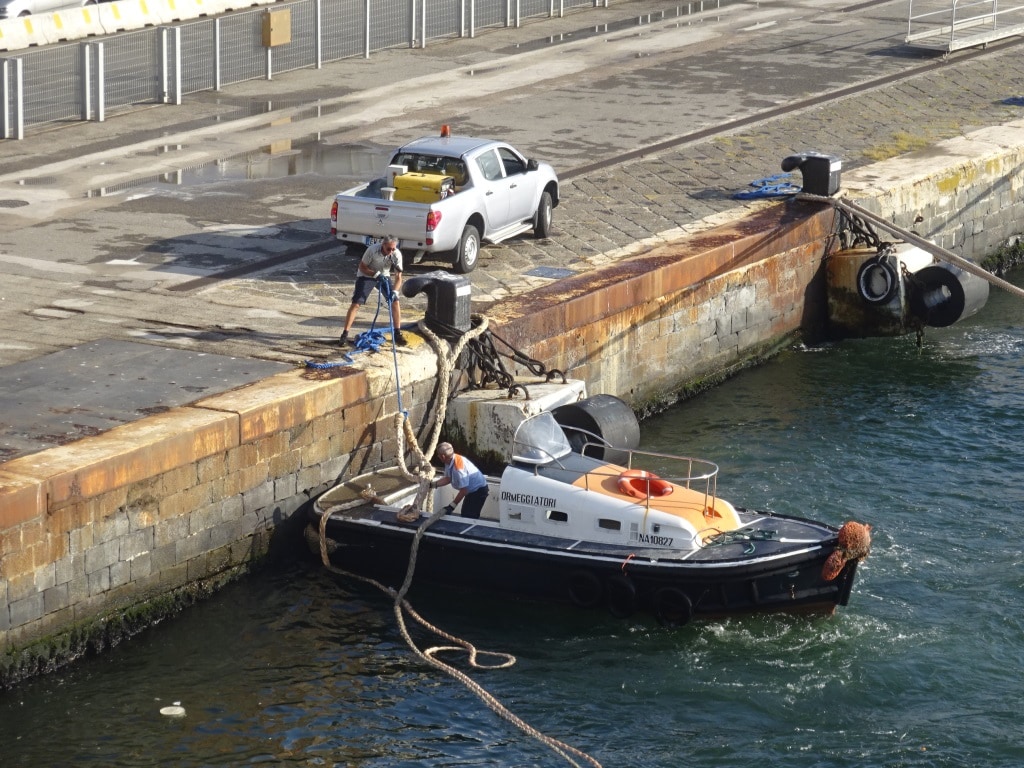
The Ormeggiatori, or linesmen using a powerful skiff to bring the mooring lines ashore.

Thus this morning the cadet had to keep oversight, communicate, direct the lines, yell at the Ormeggatiori (linesmen in the boat) and ensure that the sailors were not doing things too fast. Not easy if you have to do this without any previous experience. Luckily the Bo ‘sun is an experienced man and as backup I was hovering “benevolently” in the background. The tricky thing in this port is that the lines are very long as we are hanging over so far. So we have to pay out a lot of rope; rope that is then pulled ashore by the lines boat. If you do not pay out the mooring line fast enough, the linesmen will yell, if you pay out too much (too much spaghetti in the water), it slows down the boat and the linesmen will yell, and if you have not set things up properly, the sailors will yell. (Naples is a real good port for yelling…… ……. Everybody does it.


This was the end result. Six long lines which are normally running forward as head lines and two spring lines (not visible) which were running their regular way. We normally call this 6 and 2. Now it was more 0 and 8, but then there was no other option.

The solution to the challenge is, to first instruct the deck team in detail what is going to happen and how you want it done. Invite the Bo ‘sun to give his input as he has a lot of experience and then decide on the plan. 2nd step is to run out the ropes on an even pace that can be handled by the lines boat and also works for the sailors who guide the ropes of the mooring drums. In the meantime you have to keep up your reports to the bridge as they want to know what you are doing and how you are progressing. The bridge can see where the blow ropes are going but not the status of the belaying on the mooring deck.


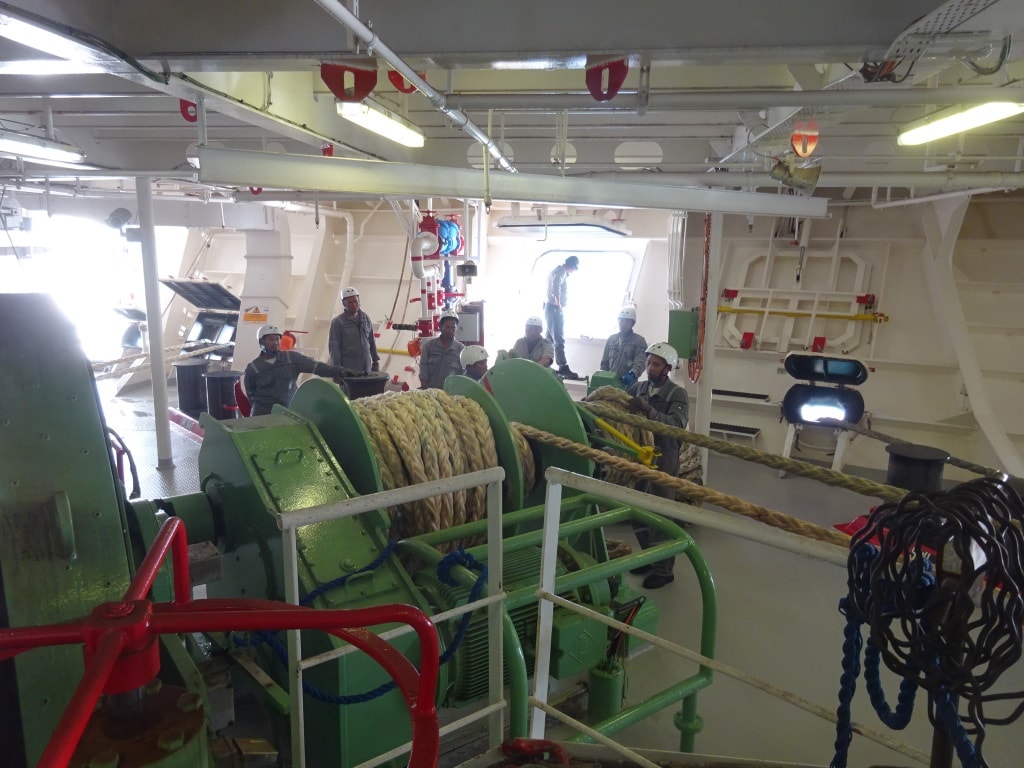
This is one of the more dangerous moments during docking. The belaying of the “extra rope” on the capstan. An extra rope does not have its own mooring drum and is handled completely by hand. As it can slip from the capstan, the guiding work is done by one sailor while the rest keeps out of the way until the rope is tight and safe on the capstan.

In the end it was real team work, the cadet communicated, the Bo; sun kept the oversight and I did the yelling. When we came back upstairs to report back to my colleague, he paid the cadet a compliment because it went so smooth and so fast. (It was of course the yelling that did it but we did not say that…..)

This afternoon the good ship ms Oosterdam sails for Civitavecchia. This is a regular port of call tomorrow and not a turn around day, which we often have here. Nearly everybody is on some sort of tour, either to Rome or in the area around the port. I will be leaving the ms Oosterdam and fly from Rome via Amsterdam to Stavanger to join the ms Koningsdam. I will join on the 20th. so for two days there will be no blog. I have to wait a day for the Koningsdam to catch up with me; but I have a hotel in the center of the city, opposite the cruise terminal, and there is a hop on / hop off bus so I will be set.

16 July 2018; At Sea.

The route from Katakolon to Naples takes us straight to the West across the Ionian Sea, then south of Italy into Messina Strait, then into the Tyrrhenian Sea and from there up the coast past Capri. We were very fortunate with the weather today as it was very calm and the Oosterdam provided a smooth ride. Navigational high light of the day was the passage through the Strait of Messina. Last cruise at the early time of 0500 in the morning, today it was at the more decent time of 1600 hrs. in the afternoon. A good excuse for an early cocktail hour. The EXC team provided a commentary about what was there to be seen and the Oosterdam raced with the great speed of 14 knots through the strait.

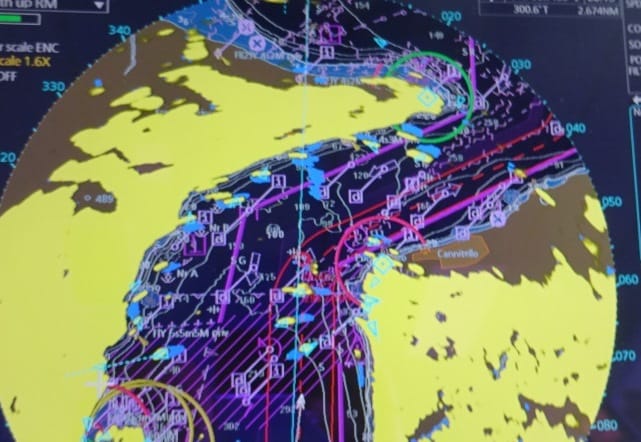
The Strait of Messina. Sicilia to the left and the Italian Mainland to the right. The purple lines are the safe boundary’s of the strait, and the red lines our intended path through the strait. As we are going north we try to hug the starboard side of the strait as much as possible; pending pilots agreement.

Pilotage here is compulsory, not so much for the sailing through as that is very straight forward, but to deal with the ferries which are constantly crossing from the Italian Mainland to Sicilia and back again. Then there are the fishing boats, the other deep sea ships and the six pack navigators and all together it is enough reason for pilotage to be compulsory here. The pilot knows exactly what the ferries are doing and the ferries are not worried as they know that the pilot will do the right thing. Rules of the road do not always work out of here to achieve the fastest crossing solution and so sometimes the ferries cross the bow of the ship and sometimes they go astern. And as long as the ship in question does not do something erratic then it is a safe operation. And the pilot ensures that.

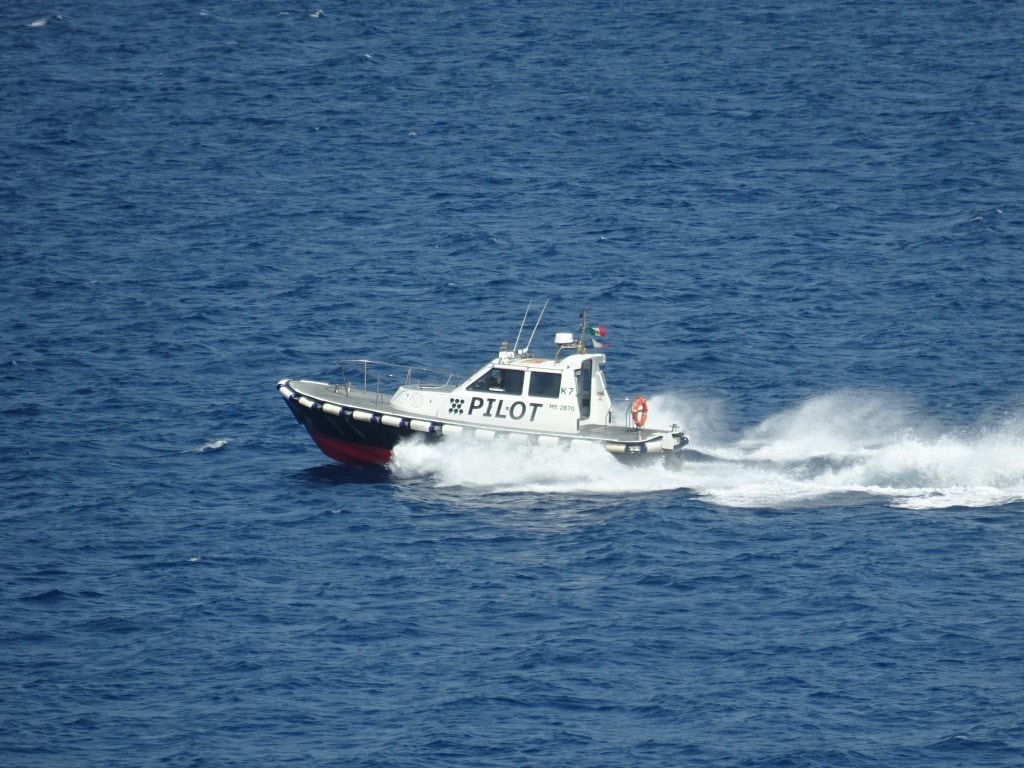
The Messina Strait pilot boat at full speed. This is also the speed they make when they come alongside the ship.

I have yet to meet one captain who is not very happy with the way the pilots come on board. In most ports there is always a fuss about slowing down, making a lee way and once done, the pilot boat skipper changes his/her mind again. Not here; just keep the speed steady and pilot hops on board whether we are sailing with 12 knots, 14 knots or 16 knots. I once did it even with 18 knots. I wish we could send all pilot boat operators for some lessons to Messina. The secret in them being able to it with such high speeds lays in the fact that once going fast the ship creates its own smooth water boundary around the hull. The water that flows away from the bulb is smoothed out and there are no waves, only a bit of swell.

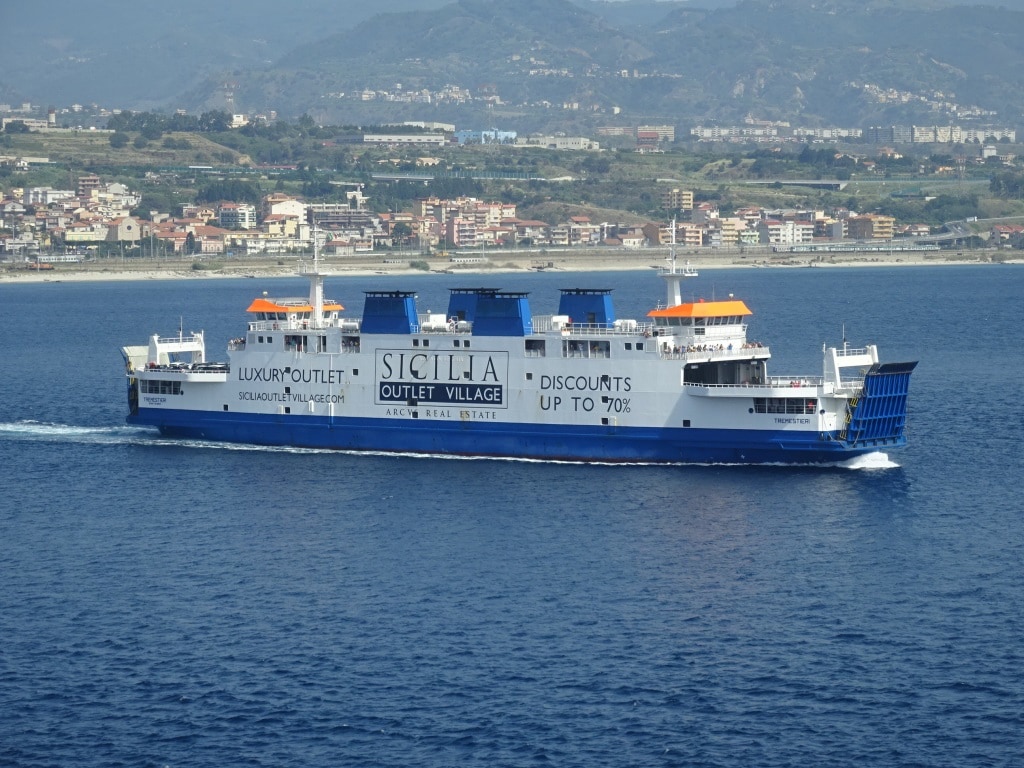
One of the car ferries. As you can see they also have an outlet village in Sicilia.

Also today the pilot raced on board; explained to the captain that the ferries were still going from one side to the other and back again………. and that this would not be a problem. And with that wise information we raced through the Strait. And yes the ferries crossed our bow and they crossed our stern. On the Sicilian side they all dock in Messina or just outside the City border and at the Calabrian side at the town of Villa San Giovanni. Different ferry companies provide nearly the same service. Some of the ferries carry cars and pedestrians and some of them are train ferries which connect the Sicilian railway system with the mainland. That is why the railroad ferries are our biggest worry as they are on a “railway timetable” and therefore do not change course or slow down. Hence the pilot anticipating the schedule and sailing around them. The car ferries have it a little bit easier and those we see slowing down once in all while. (Not too often……………….)

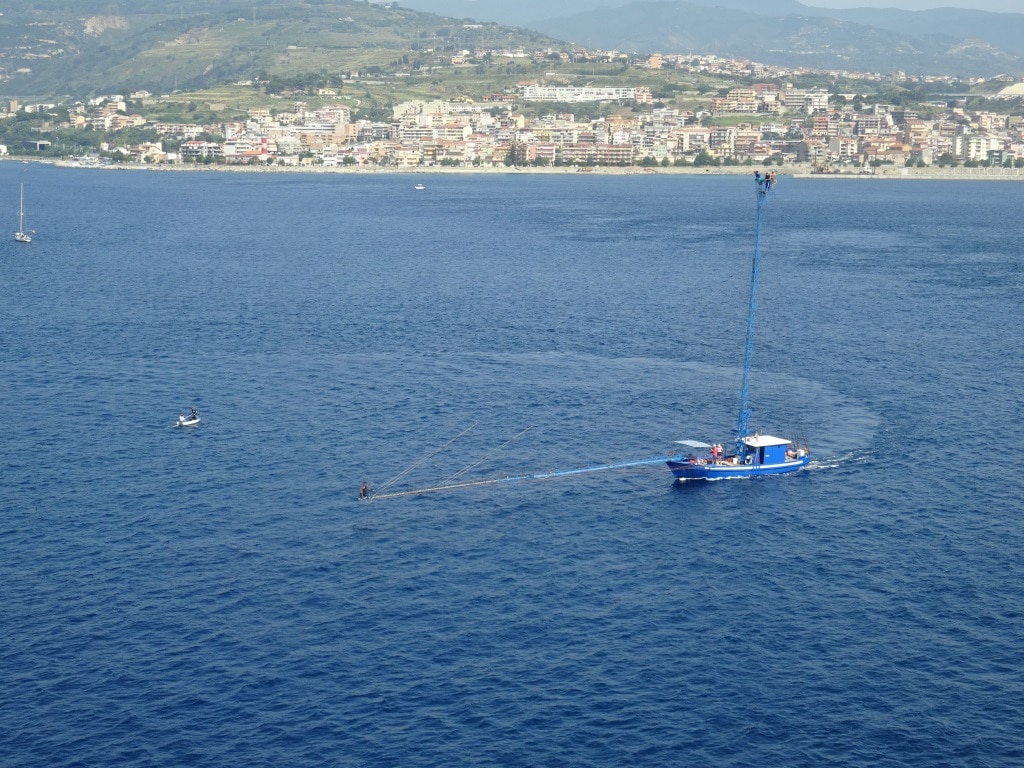
A Marlin hunt in full swing. The harpooner stands on the bow and the skipper and two spotters are high up in the lookout and steering cage.

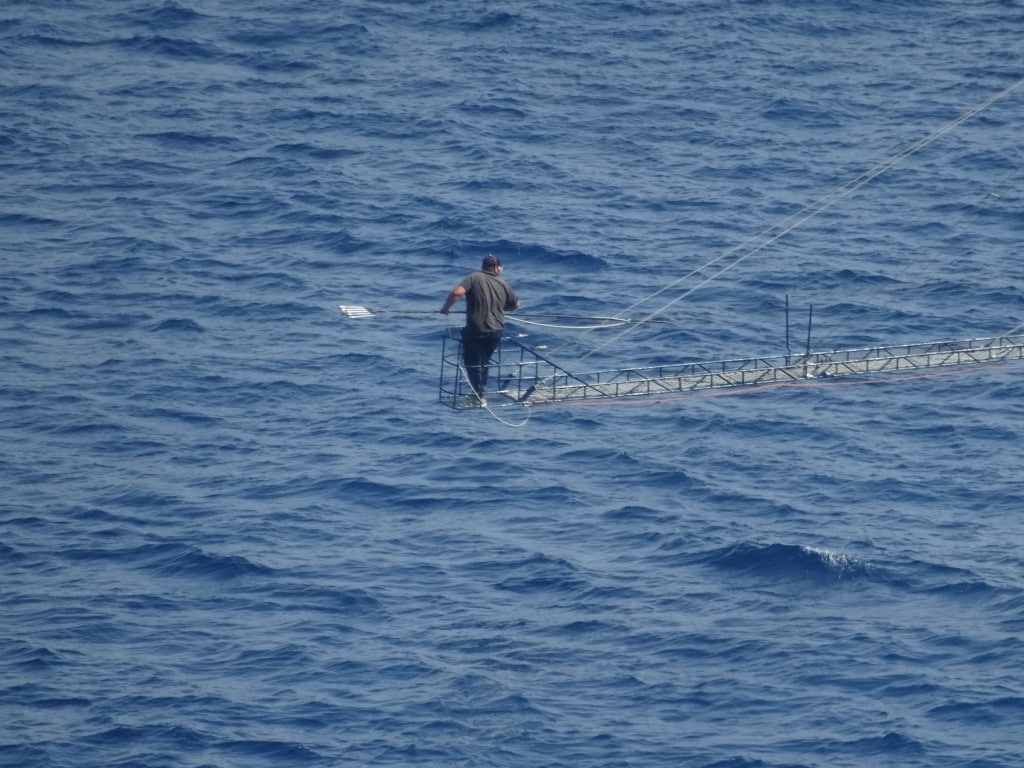
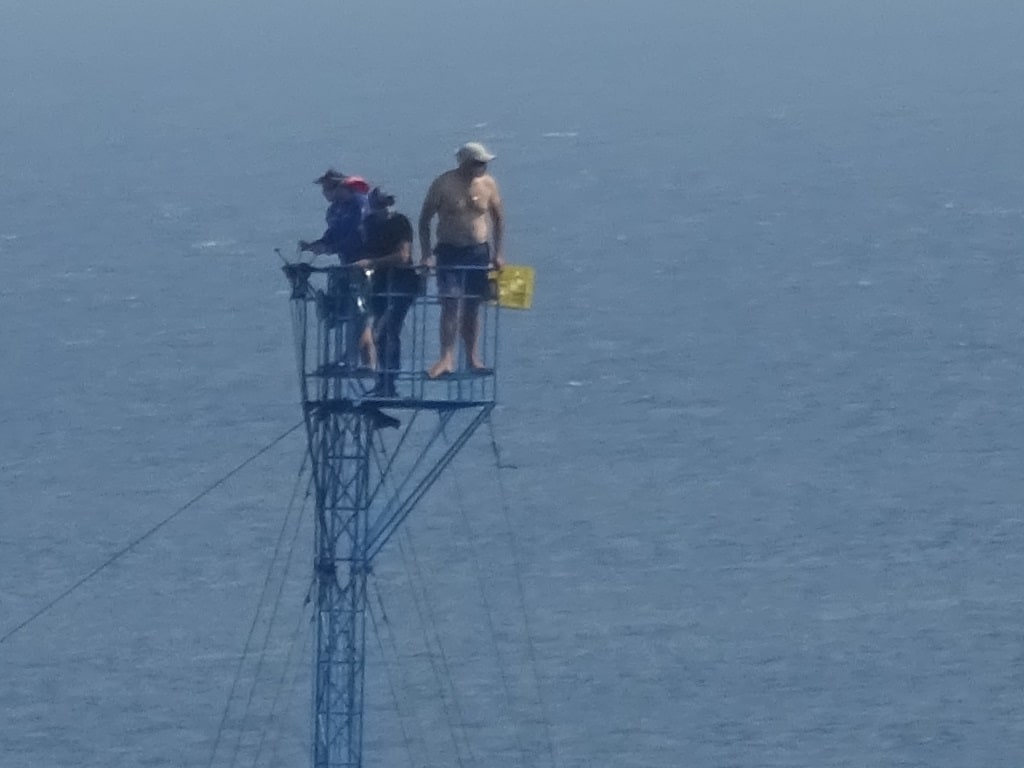
We had a nice show today with a Marlin fisherman in full operation about 500 feet from the ship. The guests at the starboard side got a real crash course in Marlin fishing. Marlin or Sword fishing is done by a fishing boat called a passerelle and it is not really fishing but a sort of hunting. Therefore the boat has a spotter; he is standing on a 30 meter high pole and looks for the marlin. Now with the modern boats they also have moved the skipper upstairs with the controls of the boat. Sticking out from the bow is a 45 meter long bridge or “passerella”. Here is the harpooner standing. The spotter with the skipper brings the harpooner right above the marlin and that makes the catch easier. The harpooner is standing so far away from the boat to ensure that the marlin cannot hear the boats engine. The average price for one Marlin is between $400 and $500 and that can make you a good living if you are skilled enough to find them and to catch them.

The harpooner with the harpoon ready to throw as soon as he is maneuvered above the marlin.

40 minutes after the pilot came on the bridge he left again and the ship continued to Naples. Around 18.30 we will do a quick sail by the Volcano Stromboli but although the Volcano is always active it is seldom active in a spectacular way. Hence we do not know if we will see something.

Tomorrow we are in Naples, together with the Norwegian Epic, that is that NCL cruise ship with the black shoe box on top of the bridge. We will follow her in and we should be docked just before 08.00 hrs.

Weather: sunny again 28oC / 82 oF and very little wind. There is supposed to be some rain during the coming night and that will help to freshen things up before we arrive.

The spotters and the skipper on the boat controls. 30 meters above water so not good if you have high anxiety. I also wonder if you get sea sick from the pendulum motion as the skipper is cutting the corners as tight as possible to get lined up behind the fish. And I also wonder if that guy climbed that steel lattice tower with his bare feet as I do not see shoes anywhere.


15 July 2018; Katakolon, Greece.

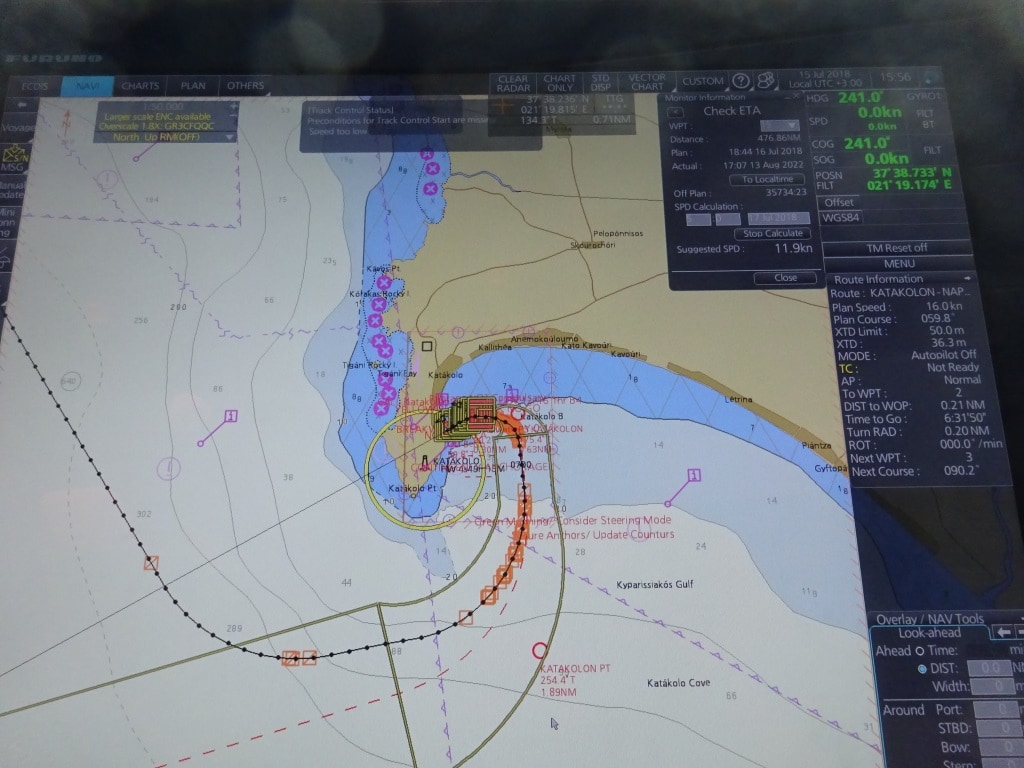
Katakolon, (The Greeks translated this into English as Katakolo) is located on the southwest side of the Peloponnesus and nicely tucked away on the inside of a mountain ridge; sort of in the same way as Sarande. Only here the natural bay it has created is much deeper and provides much more shelter. But because it is away from any major sea route it has never been a really important port. Only what was needed to reach Olympia from the sea would call here. And for a long long time it were only fishermen who used the harbor here while the town itself was focusing on tourism coming from the Athens and other larger cities. For Katakolon that resulted in being the end terminal of the first long distance railroad in Greece. Something they are very proud about and which has been running until the current day. The town itself is still small with no more than a 1000 real inhabitants but local tourism must provide work for many more. We were indeed the only cruise ship that came in this morning and thus we had the best spot in port, Berth 3, which causes us to in push our nose almost into the boulevard. With the port security that we have since 2001, there have to be fences and with that comes a large open area. If we would not have had that, then the restaurants would be been built up all the way to the gangway.

Sailing into Katakolon with the little port nicely tucked away behind a mountain ridge.

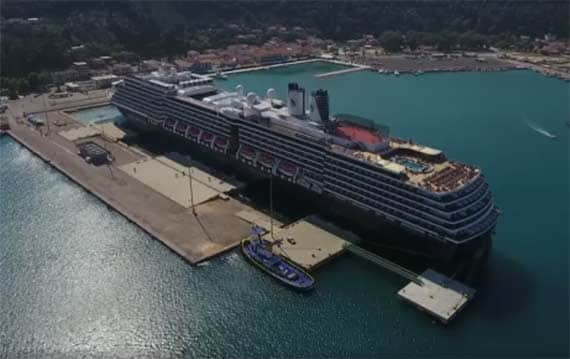
The port can take 3 ships alongside: Berth 1 is inside of the sea wall and a long way from downtown. The berth 2 is opposite of us, and the same pier but is slightly smaller than berth 3 where we are. Then you can have one or more large size ships at anchor. Which happens on occasion but as the town is so small and there are a lot of regular tourists as well, one ship is enough to keep all the shopkeepers happy.

It is amazing what you can find in the internet. Your own ship alongside. Note the pier construction. To save money it is made up of 4  platforms sticking out from the earlier pier. The south side, pier 2, can take a long ship as well, but it will be overhanging past the piers end.

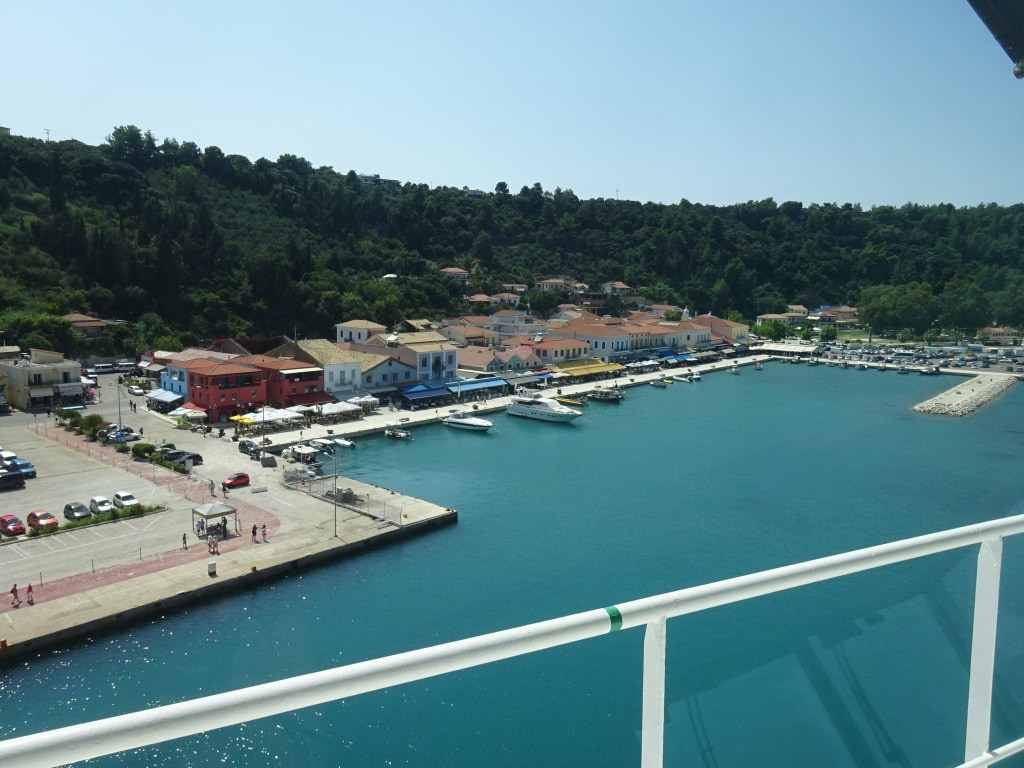
Yesterday the focus was on the beach but today most of the guests went tour. I counted about 30 coaches lined up outside the gate and 30 x 50 guests mean 1500 on a roll and going somewhere. Most of them to Olympia, Delos and the Corinth Canal. When the ship does the East Med cruise to Piraeus, then we run the same tours from Nafplion located on the east side of the Peloponnesus. Now we are running the west Med. cruise to Barcelona and then we use Katakolon. For those who stayed behind, Katakolon offers a nice and intimate Greek experience with all the small restaurants along a boulevard which starts at the cruise terminal and ends at the marina. In between small fishing boats tie up to the water’s edge in front of the restaurants. It is very touristy but somehow not spoiled. Fishing is still a “one man happening” here and this morning around 09.30 we saw a whole slew of them coming back. I do not know if they catch much in the area here but the boats looked well maintained so there must be money in it.

Katakolon is very small. Basically only three streets. The boulevard, a street with shops and then the last street with a museum and some regular houses. No big hotels or anything else. So once the day tourists are gone it returns to being itself.

I mentioned yesterday the sulpher smell and yes it was there this morning. Very distinct and very nasty to inhale. Luckily the Oosterdam has its main gangway amidships where it is less prominent as the earth fault lies close to the shore line, there were our bow was. Katakolon Mountain is an ancient volcano nearby and its old volcanic ash has ensured that this is a very fertile area for farming. But the cracks in the earth crust which once let the lava through are still there. Only now it lets water in, which gets warmed up and which then returns to the surface with a lot of nutrients only they are acid nutrients. Among them sulpher gas which once released by the water gives the port of Katakolon its characteristic smell. But that is as dangerous as it will get here. The local pilot (You will find him mentioned in previous blogs since 2007) told me once that they did not want volcanic action here as it was bad for business. So I suppose the local chamber of commerce has outlawed this from happening.

. On the bridge he still tells the captain the same thing; if you go here and if you go not too close to there, you will be in good shape. For the rest of the day he runs his restaurant on the seafront but I should say it is operated by the family. As mother is in the kitchen and daughter and son are serving at the tables.

Tomorrow we are at sea, sailing north towards Naples were we are on the 17th. It means sailing south of Italy and then going through the Strait of Messina. The marine weather forecast predicts with 90% accuracy that it will be another warm and sunny day, with temperatures in the high 80’s or high 20oC and a moderate breeze. As we are moving back to Central European time, we will have an hour back, which is appreciated as Today was a 13 hrs. day, spent on teaching the cadets to supervise sailors and mooring ropes on arrival and departure and a regular day in between.

14 July 2018; Sarande, Albania.

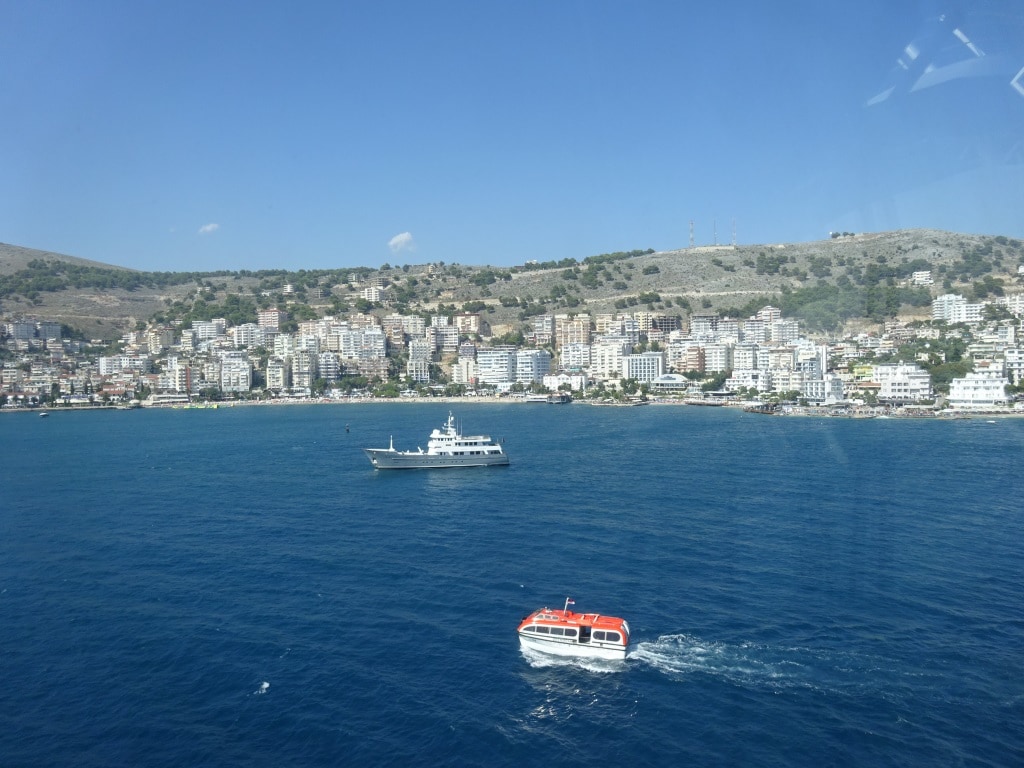
Sarande is a resort town in Albania just north of the Greek border. When are in the port you can see an island straight across the bay / channel and that is Kerkira / Corfu which we visited last cruise. The Albanian spelling of the name is more like Sarande with “.. on the top. As a lot of languages do not have letters with ” .. on the top it is often written as Sarande, Sarandes or Sarandee. The name in the navigational chart is spelled as Sarande and that is what we go by. The area has a long and troubled past and it was not until 1945 that a permanent own state was founded by communist freedom fighters of the 2nd world war.

The Resort -port of Sarande. At anchor the expedition yacht Axantha II. Available for a weekly charter of somewhere over 100,000 euros.  But is at least a yacht that can take some bad weather.

It remained communist and very much isolated until 1999 when it opened up more to the west. Since then going to Albania on a cruise has become more acceptable to travelers and now Sarande is considered the port that takes the overflow from other ports in the area. With the expansion of the cruise industry it will not be long before it is a full-fledged cruise call for many a company. Because of its ancient history and being a resort there is more than enough to do for every sort of cruise guest and that has been upping the guest ratings year by year, ever since we have been coming here.

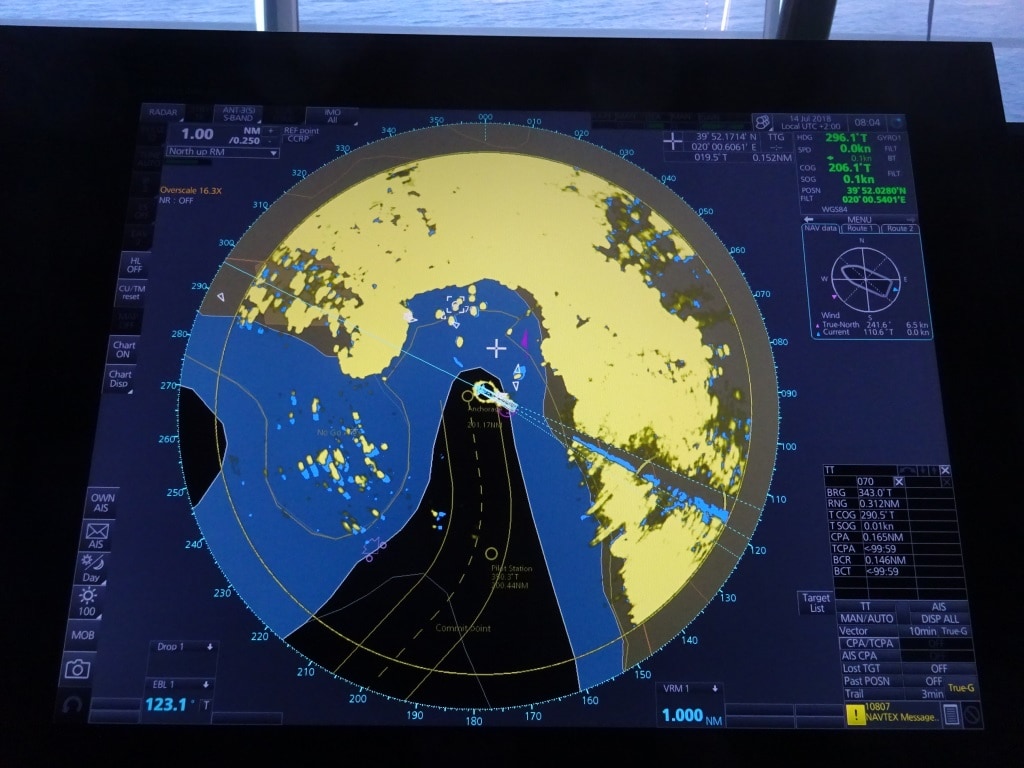
The deep water anchorage at Sarande. We anchored as close to the deep water edge as was safely possible. The first yellow blip upwards of the ship is the yacht Axantha II as seen in the previous photos.

But it is still an anchor port. The water is deep and becomes shallow very quickly once past the small cape which is the end of a mountain ridge that protects the Bay from winds from the South West, up to the South East. It is just a pity that the afternoon winds and swell comes in from the West, and can freely reach the anchorage. To mitigate this they could built a dock here but it would mean a considerable re-organization of the port as the current small dock area (in use for Hydrofoils to Greece / Corfu and small coastal cruise ships) would have to be extended and then a 2nd pier constructed in the shallower area further inside the bay, to help the now displaced ferries and cruise ships and I do not see that happening very quickly.

It leaves every larger cruise ship (with a draft of more than 5 meters) anchoring right on the edge of the land and thus out of the protection of the mountain ridge. We did as well, and anchored today in 40 meters of water, what is deeper than normal for cruise ports, but we could not go further in the bay. Every ship likes to be deep in the bay as in the afternoon the wind normally breezes up, only to die down again after sunset. Also today, it became quite choppy in the afternoon and the captain had to keep a good lee by having the port side anchor down and pushing the stern towards the wind to keep a lee for the tenders. So one Azipod was continuously pushing & holding the stern against the wind while the por tside anchor prevented the bow from moving. Ashore there was no issue as the mountain range kept all the wind away from the dock area but also from the town.

That made it “nice & toasty” in port and my initial resolve of exploring Sarande dissolved quickly and I made a quick U-turn when I walked between the first houses. I knew that white paint reflects the warmth of the sun but I can now confirm that yellow paint does the same.  My next “resolve” will have to wait until a spring or autumn visit. Many of the families we have on board opted for the beach but quite a few of them (often urged by their children) came back after a few hours as it was “too toasty”. The kids had already figured out that being on a cruise ship gave them all the same beach fun but with the option of running back into the A.C coverage when needed.

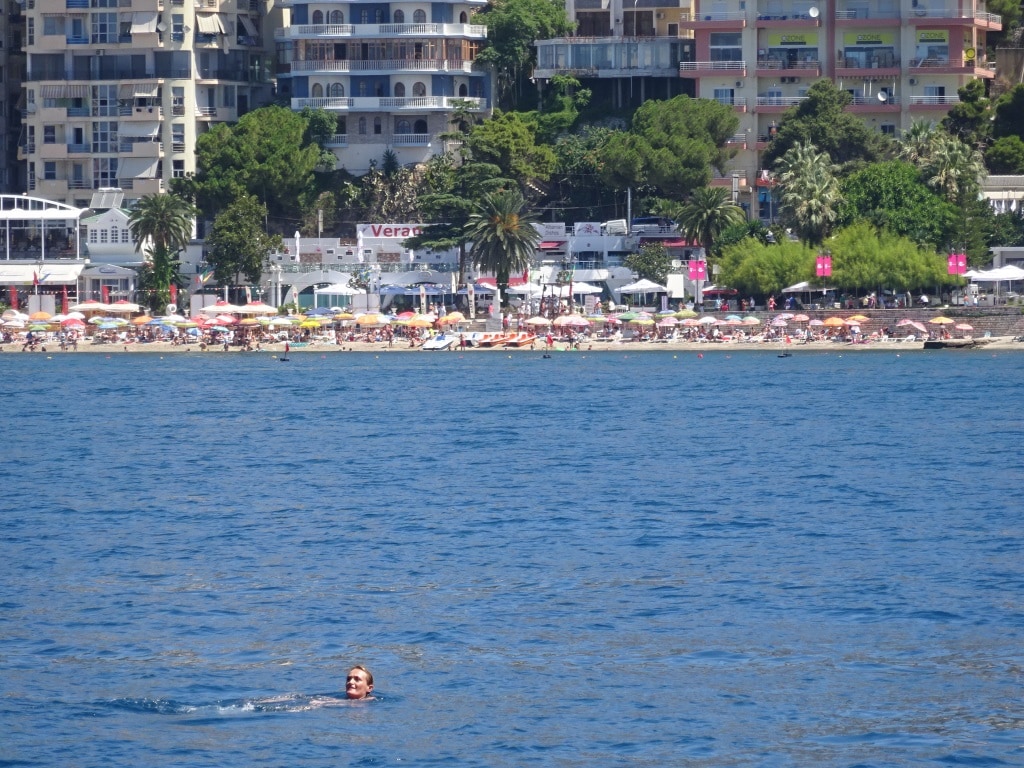
Our “swimmer” who thought it was a bright idea to swim between the tenders to the ship. This photo was taken from the tender platform alongside, so he came quite close. I could not get a tender in the photo to show you how dangerous it was, as our well trained tender operators kept a safe distance and waited until the swimmer had a bright moment and recognized the peril he was exposing himself to.

The local boats, large and small where not exactly in compliance with the Rules of the Road and we even had suddenly a swimmer near the ship, who had come from the beach to have a look. The lunatic did not understand how dangerous it was what he was doing as there was some swell so he bopped in and out of view all the time and the tender drivers cannot see everything around their tender. Thus the helper inside has to keep a good lookout as well. Which one helper did in the most admirable way; by climbing on top of the tender, keeping the person continuously in sight and at the same time made his feelings crystal clear. I do not know how much Indonesian the swimmer would have understood, but the guests in the tender were quite impressed. After we drew the attention of the swimmer to the fact that there were two propellers under each tender, he got the message and swam back to the beach.

Tomorrow we are in Katakolon, which is just a bit further to the south. Here we will dock and right through the port/docking area runs an earth fault line. Not a fault line which causes earthquakes or volcanoes, but water that comes welling up with a large sulpher content. So the first impression of the guests walking off the gangway is often the smell of rotten eggs. After that it gets better quite quickly.

According to the latest cruise schedule we should be by ourselves but things do change. The weather won’t. It will be Sunny with 32oC / 89oF, no wind in town and zero change of rain.


« Older posts Newer posts »