- Captain Albert's Website and Blog -

Ocean Liner History and Stories from the Sea, Past and Present. With an In Depth focus on Holland America Line

Page 232 of 241

13 September 2007, Halifax.

After a windy night, which quite nicely kept the fog away, we arrived at Halifax with the pilot ordered for 7 am. There is not much use to be any earlier, as we can only have the first line ashore at 8 am. due to the tripling docking costs if you are there before 8 am. So we adjusted the arrival time accordingly, and so did the other ships. First one to go in was the Maasdam, followed by the Carnival Victory, who was followed by us. The Maasdam had to go to the furthest dock, hence she went in first. While we had a windy day in Bar Harbor, they had an even worse day in Sydney Nova Scotia. Here it blew so hard that the Maasdam had to cancel calling at Sydney and spent the day at sea.

But today was going to be a great day. The sun was shining and with just a gentle breeze it was perfect for sightseeing in Halifax. This port has two cruise terminals and with three ships in, we were relegated to a cargo pier, as we are making the least number of calls to Halifax. The cargo pier was however quite close to the cruise terminal piers and the port authority had laid on a large number of shuttle buses, so there was no inconvenience for the guests. It was just a bit tight to get the ship in as at the opposite pier there was a tanker docked. While going into port, the tugboat Theodore II was sailing around the ship. This is a converted tugboat, which now sports a face with a big nose and a baseball cap on top of the funnel and it just looks as if it has come directly out of a children’s cartoon. This tugboat is part of a public relations drive by the port,
welcoming the ships into port. Tourism is becoming an important part of the local economy and Halifax is working very hard to make it even better than it already is.

Good weather meant we had time to do outside maintenance and training with the crew. The lifesaving officer has just started a CPSC course for new crew. CPSC stands for Course of Proficiency in Survival Craft. In normal language it means certified lifeboat/raft handler. This is a six week course that we give on board and about 45 crew members were enrolled this time. They are trained in lowering lifeboats and maneuvering the lifeboats with wind and current. Also part of it is the handling of life rafts and techniques for survival at sea. The course is concluded with an oral and a practical exam and when passed a CPSC certificate is issued by the Dutch Government. The trainer is allowed to do the exams with the chief officer or me sitting in to ensure a professional standard. For that we have done a training course ourselves in the past. There are companies who do this training via shore side schools but Holland America prefers to do it on board. This makes it more lifelike, more specialized in the company’s way of doing things and there is the peer support from the other crew when learning. The latter is something that is really appreciated by the Indonesians and Philipinno’s.

So the whole morning, lifeboats were going up and down the ships side and little sightseeing trips were made into the harbor. It was quite funny to see a small philipinna front desk attendant standing behind the wheel of the lifeboat and shouting out orders to some big cooks, so that the boat came correctly back under the falls.

Just before 5 pm. The ship pulled off the dock and we sailed out of Halifax harbor on our way to the next port of call, Sydney Nova Scotia. Hopefully we will have less wind there than the Maasdam.
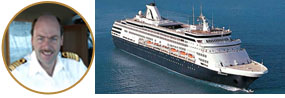
12 September 2007, Bar Harbor Maine

After another foggy night, we approached Bar Harbor, lobster capital of the world. Well at least it is the lobster pot capital of the world. The whole area around the port to about 10 miles out to sea is densely covered with little buoys bobbing on the sea surface, all attached to a pot somewhere below. With the good Radars that we have nowadays they all show up on the screen. The most important thing is then to figure out if all these echoes are lobster pots and that not one of them happens to be a fishing boat sitting in the middle, hauling in the catch of the day. That we can find out by plotting all the echo’s so we know if they move and also the size of the echo on the screen helps.

Avoiding lobster pots is nearly impossible. There are too many of them to sail around or to avoid hitting them. Most of the time the buoys simply pass unharmed under the ship but there is always the chance that one of the lines could get entangled in one of the propellers. To avoid this becoming an issue we have little knives sitting on the base of the propeller, there where the propeller joins the propeller shaft. This is the most critical place, as here could be a chance that a line ends up between the propeller hub and the shaft. That might damage the seal that keeps the water out from entering the propeller shaft and at the same time the lubrication oil from getting out.

Local authorities are trying very hard to regulate the areas where fishermen set their lobster pots and in doing so keeping them out of the traffic lanes. It helps us from running over lobster pots and helps the fishermen from loosing their pots when a ship propeller cuts through the lines. Thus far the results have been rather mixed. There are as many buoys in the traffic lanes as outside of them. It is now the season of harvest and according to the pilot, the fishermen are expecting as good as year as last year when they landed 76 million pounds of lobster in the State of Maine.

During sunrise the wind started to pick up and blew for most of the day near gale force strength. It had the advantage that it removed all the fog from the area and we had a glorious sunny day. Bar Harbor has only a tiny dock and thus the cruise ships have to anchor. But because we are in a bay, the hard blowing wind does not affect the tender service as there are no waves being built up. Just a few whitecaps form on the surface. In the bay, the harbor master is very good in keeping the lobsterpots away from the anchorage area of the ship. This is also in the interest of the fishermen, as our heavy anchor chain would create havoc with lobsterpots sitting on the sea bed.

As it was such nice weather we sailed almost an hour late as our guests made the most of it, enjoying the great sunshine and all trying to get back on the last tender. With the strong wind blowing, it was not really a matter of sailing out of the bay but mostly of being blown out of the bay. One positive effect of the all this wind, we are not expecting any fog during the coming night, so that should give me the first normal night since I came on board. Tomorrow we are in Halifax, Nova Scotia.

11 September 2007, Boston.

Well, nature was not to be denied and at 1 am the fog settled over the water. Good dense fog, we could hardly see the mast on the bow 120 feet away. The route from Newport to Boston is mainly via Traffic Separation Schemes, which are a sort of highways on the sea. That means that deep sea traffic is not a problem for sailing in the fog as long as everybody keeps to the system and follows the tracks, called traffic lanes, printed in the navigation chart. This then only leaves the fishing boats to content with as they tend to ignore the traffic lanes as they seem convinced that those area’s are the most perfect places to fish.

These traffic separation schemes are set up by local authorities, such as the USCG and are then formalized under IMO rules (International Maritime Organization). If you travel by deep sea ship from New York to Boston, you can sail all the way by following one of these routes. Your can stay out them as well by sailing closer to the coast, or going further out to sea. But the routes are set up in such a way that it provides, on average, the safest passage and most deep sea ships do follow them. We followed the route all the way around Nantucket, which has a sort of round-a-bout for ships coming from different directions, and ended up right outside the Boston pilot station.

The approach route to Boston has been recently changed in order to protect the Right Whale. This Whale is one of the most endangered whales in the world. It is estimated that there are no more than about 300 of them left and near Boston is one of the area’s where they tend to congregate. They seem to be more prone to be hit by ships than other whales so extensive measures have been taken to make them safe in their habitat. A whole area is indicated in the chart where they could be and when entering this area, the ship has to send an email to a monitoring station: giving the ship’s particulars, speed and intended route.

In the fog you can not see them of course but when in the early morning the fog lifted for a short time, we saw two of them nearby. Then there is a protocol to follow, that consists of slowing down to 13 knots or less, trying to steer away from them and trying to anticipate their next move. If you are completely uncertain about what they are going to do, stop the ship and wait until they have moved on. All bridge personnel on Holland America ships, from the captain down to the quartermaster-look-out on the bridge, have been trained in recognizing the various kinds of whales and what to look for when they are sighted. In this case we only had to slow down, giving the whales time to move away from our intended track. They seemed totally oblivious of our presence.

When Right Whales are sighted, we have to send in a report, with the location of the sighting and so we did. 15 minutes later the USCG made a security announcement to all shipping in the area to keep a sharp look-out for these whales while traversing the same area.

We picked up the pilot in dense fog and slowly sailed into Boston harbor. The fog only lifted after we made the final turn into the berthing area. While turning into the berth, we passed by the SW runway of Logan International Airport. Before we got there the ships pilot called Airport Traffic Control and advised them that we were on the way. Airport Traffic control then advises the approaching planes that there is a ship in the way and that they have to stay a little bit higher up than they otherwise might have planned to do. Our funnel reaches to about 140 feet above the water so a safe clearance of 160 feet is passed on. In the fog the ship can not see plane and plane can not see the ship, so it was quite interesting to hear a big 747 roaring over the ship during our approach without any visuals at all. We had a rainy day in Boston but the frontal system is moving out of the way and better weather has been predicted. But if it gets sunny, then we get even more fog…….

10 September 2007, Newport Rhode Island.

By 7 am. we were happily at anchor on the roads of Newport, Rhode Island, as per schedule. Only to find out that most of our guests preferred to stay in bed and only go ashore much later in the morning.

Due to the proximity of the remnants of Hurricane Gabrielle, it was overcast but luckily it remained dry. The hurricane was quickly dissipating of the coast of Cape Hatteras and was starting its crossing to Europe as a regular depression. However there is always the chance that some of the remnants come further north. This was not to be this time and after the departure the only thing we felt was a slight swell coming from the south but for that we have stabilizers.

Newport is a tender port with a fair distance to travel from the anchorage as the tenders have to go around Goat Island and then enter the town area. There is a small public dock but that only fits small ships and the rest of the docks are given over to luxury yachts, some of them Mega, Mega yachts. According to the pilot there is some talk about building a cruise ship dock but if that had to happen close to town, it would have to be near or attached to Goat Island where the water is deep enough. It looks like it that the owners of Goat Island are in no great hurry to sell out, unless persuaded by a very big bag of gold. So for the time being the ships are at anchor.

This was a short stop, last tender to be back by 2.30 pm. as we had a tight schedule for getting to Boston. However the last tours only returned by 2.30 so it was not before 3.15 that we had the boats back on board and could sail out of the harbor. By that time I had raised the anchor already for a long time. There is the unfortunate thing that Newport used to have a big Navy yard and that this yard used to dump all sorts of stuff in the area where the ships now anchor. So when you raise the anchor you never know what it brings up from the bottom and how long it will take before you have cleared the anchor. I remember that we picked up wires (always hoping that it is not a live one……) small and large bits of concrete and once even a prewar Ford truck. But of course if you are early and prepare for the worst, then all goes well and this time the anchor came up clean.

By 4 pm. We were out of the port and by 5 pm. I was standing in the receiving line as it was Captain’s welcome on board party. The company is in the process of revamping this party. No longer all that picture taking, and no longer we will have the elaborate introduction of all officers. We are still waiting for the props that go with the new set-up and you will read in this blog of course as soon as it starts. Second sitting introduction was finished by 8 pm. And by 8.30 pm. I was in bed. Reason; by 4 .15 pm. the Veendam had sailed into a white curtain. Fog. Routine is then that the chief officer is on the bridge from 6 to midnight and the captain from midnight to 6 With a short interval the fog lasted all night, only to clear by the time that we docked the ship alongside the Boston passenger terminal and thus it was a long night; staring at the Radar screen and listening to the 2 minute interval of the Fog horn.

9 Sept 2007. Joining in New York.

So; real life started again today with boarding the Veendam at pier 92 in New York. With two more ships in; the Norwegian Crown and the Norwegian Spirit, it was a busy day for the terminal. I had flown in the day before into JFK and spent the night at an airport hotel. The only thing that always takes the fun away from flying for us is the hassle with immigration. If I come in as a tourist (green waiver) or as a businessmen (B visa) then I can get through very quickly. However when I come in as a seaman (C visa) then suddenly I have to go through a second processing cycle that can take up to two hours. All sailors do. One of the vagaries of life I suppose. If it is the end of your flight then it is not too bad, although annoying, but if you have to catch a connecting flight then this delay can play havoc with your scheduling. But I made it to the hotel in reasonable time to have a good meal, a final beer before going dry for the next three months and then a good nights rest.

New York was the first USA port for the Veendam after the European season, so I knew it was going to be hectic. The ship had finished the 21 day Trans Atlantic cruise from Copenhagen with calls at Iceland and Greenland and now had to get ready for the Canadian Maritime season. Apart from lots of luggage to go off, there was very heavy storing of provisions and supplies, a full crew inspection, a full USCG inspection and a large crew change over.

When a ship calls at an USA port for the first time, all crew has to go through a full inspection by the Customs and Border Protection. If that first port is a turn over port, then that creates a bit of mayhem as the crew is called away from the work place to present themselves to the inspectors. The whole process can take up to 3 hours. This inspection is repeated every 90 days for ships regularly calling at USA ports. Crew that join in between is seen during the next home port visit. That is on top of the airport inspection.

When a ship calls at an USA port for the first time, the USCG comes on board for a full safety and security inspection which includes: scrutinizing certificates and licenses, a fire and boat drill that involves all crewmembers and the testing all the safety, security and environmental equipment. The inspection can last a full day. This inspection is repeated every six months.

So with all this going on, the Veendam had a hectic day in New York. I had to cancel shore leave for all crew as everybody was needed to get the ship ready for sailing while all this was going on. I hate to do that, as the crew loves New York with all these discount shops so near to the ship. USCG was very happy with the level of performance. They noted no deficiencies (this means observations made that require corrective action from our side) and because the crew performed so well the inspection went very quickly. Full complements to Team Veendam here, for scoring a clean sheet, during these hectic conditions. But,we are not off the hook yet. We still have to the United States Public Health Inspection, the Canadian Public Health Inspection and the Canadian Port State Inspection (Canadian version of USCG) to come.

In the end we sailed 90 minutes late from New York, due to the enormous amount of provisions we had to take on. After 21 days the store rooms were empty and the storing process slowed down during the period that the drills were going on. Luckily with the layout of our dining room at the stern of the ship, everybody could still see the ship sailing down the Hudson. As our next port is Newport Rhode Island, this delayed departure will not affect a timely arrival tomorrow morning.

22 Aug., Kangerlussuaq.

We arrived bright and early at the small port of Kangerlussuaq. A port so small that even the Ocean Majesty had to anchor. It is mainly a supply dock for anything needed in the area and for those people living and working at the airport. That is basically the only thing that is there, the airport. Built in 1941 by the US Air force, it played an important part in the Second World War and later during the cold war. It now belongs to the Greenlandic autonomic authority and is the only airport in Greenland big enough to accommodate Boeings 747’s.

Kangerlussuaq means Great Fjord in Greenlandic and when going with the bus from the seaport to the airport you drive for 20 minutes along the fjord. The little port is at the end of the deep-water part and the ship had to spent most of the night travelling through the fjord to get there. The end is very shallow with approx 5 miles of it falling dry during low tide. The airport is located at the very end, so planes coming in and taking off, are flying through the fjord with the mountains on either side.

Page and Moy has two charter planes coming to this place. One from Manchester and one from London-Gatwick. I went back with the Gatwick plane as it easier to get back home via London. Transport in England is mainly North South and getting across from East to West is a big challenge. So I left my wife on the Ocean Majesty and returned home after 10 days. I will see Lesley again in late September when she joins me for one of the Canadian Maritime cruises from Montreal on the Veendam.

Transport from the port is done by school buses, which means that you cannot do a change over of guests when the schools are open in the towns on the coast. Luggage is taken on and off the ship by barge and then it goes by truck to the airport. You leave your suitcase outside you cabin and you will get it back at the final airport that you are travelling to. Hand luggage is restricted to the same regulations as anywhere else in the world, and a lot of our guests had forgotten, although being told, that you are not allowed to have anything over 100 ml. in your hand luggage, so a lot of tax free bottles bought on board had to be left behind.

I found Greenland fascinating and as I do not like the cold I was very happy that we had 10 days of glorious sunshine and no wind. The towns are still un-spoiled by tourism and that makes a nice difference from where I normally sail. It is not a place to visit with a large cruise ship. Apart from Prinz Christians Sund and Nuuk, the towns along the coast can really only accommodate small number of visitors at one time.

You have to be really lucky with the weather. It can blow and rain, with freezing temperatures, even in mid summer. But fascinating it is. This time the only rain I saw was when arriving back home. It rained all the time, when I travelled home from Gatwick.

My Veendam blogs will start again on September 10th. I am rejoining the Veendam on 9th September at New York, when we start a number of Canadian Maritime cruises to Montreal.

21 Aug. Sissimiut

This was an afternoon stop. Again a little village on the edge of a fjord. With a population of around a 1000 it main source of income is the fishing industry. Tourism is slowly coming but there is hardly any infrastructure for it, and the sightseeing buses are those not in use for the regular bus services. However they do cherish their history and there is an open air museum with a 18th century church, a peat house, a house dedicated to the history of coffee drinking in Denmark and a house that shows the history of the colonisation of the area and the development. Coffee drinking is an important part of Danish culture and going around to the neighbours for coffee in the morning was and is still an integral part of the social fabric of the community. So we saw a plethora of coffee cans, coffee grinders, variations in coffee beans and all that comes with the art of drinking a good cup of coffee. Very nostalgic was the display of childerens books published by the Danish coffee houses. With each pack of coffee you got a picture that had to go in the book and the challenge was to get the book complete. I remember myself doing that with series of birds, ships and other topics that came with my father’s tobacco in Holland. A lively exchange system must have been in place among the children in order to try and get their collections complete.

Tours mainly consist of walking tours around the town with a guide and there is a panoramic bus tour. I escorted one of the walking tours that was led by an Inuit girl.
A highlight of this walking tour is a kayak demonstration. With the arrival of motorboats, the use of traditional kayaking has been declining. However in the 1980’s young people took kayaking up as a sport and there are now yearly Greenland championships. There are roughly a 1000 enthusiasts, which is considerable taking into account the total population of 40000 in the whole of Greenland. The demonstration consisted of showing how a kayaker protected itself against being hit by an iceberg, being swamped by a diving Whale or being pulled over while trying to pull in a seal or walrus. The main trick in most cases was to roll over, keep the kayak between you and the iceberg and surface again at a distance. So here we saw a guy rolling over in freezing cold water time after time. Rolling left, rolling right, rolling with the peddle, rolling without the peddle, with gear on the kayak, without gear on the kayak, etc.etc. In the old days they had seal skin clothing to protect them and the kayaks were made from whalebones and sealskin. Now the kayaker wore a wet suit and the kayak is made out of wood and canvas covering.

After visiting the open-air museum, our tour ended with listening to an Inuit choir. Apart from some local songs, they also sang Silent Night Holy Night in Greenlandic
With the request to us to sing along. Now is my Greenlandic not what it used to be, as was with most of the others in the audience, so we politely refused.

We had to anchor today, as the dock was taking by the local supply boat, which was a big brute of a North Sea Oil Rig supplier with an ice bow and so could service the community in summer and winter. The ships tenders docked at a floating platform, which rose and fell with the water movement, so boarding and leaving the tender was a bit of a tricky affair.

The ship sailed at 6 pm. to cover the final leg of the voyage to Kangerlussuaq (pronounce Kanga-lu-sak) of 152 miles, where we will all disembark tomorrow morning.

20 Aug. Llulissat and Godhavn/QeQetarsuaq.

20 Aug. Llulissat and Godhavn/QeQetarsuaq.

We were supposed to arrive at 7 am, so Lesley had to get up at 6 to be ready for dispatching the tours. Our cabin is right over the engine and when around seven we were not there and the engines stopped, we knew something was amiss.
Although the sun was brightly shining, the wind had picked up, wind force six to seven, which caused a swell to run. However the wind also kept the icebergs confined near Llulissat harbour, causing the ice pilot to advise the captain to stay out. There would not be enough room to anchor and as some of the icebergs were larger then the ship it was not a good idea to be in their way, as they could drift towards the ship due to the wind.

Thus time for plan B. Going to Godhavn on a little island in Disko Bay, another 45 miles up the coast. Godhavn, which mean Good harbour or sheltered port, has approx. 1000 people living there and was originally set up as a trading post and Christian centre by the Danes in 1773. The native name is Qeqetarsuaq (pronounce kwe-kwe-tar-su-ak). I was a bit disappointed as they had advertised that Llulissat had the biggest souvernirshop in the whole of Greenland, and I wanted to see what “big” was in Greenlandic terms. So now I have to forgo that cultural experience. The guests will be disappointed as well as Llulissat is the best place to see icebergs, they are much larger then the ones near Narsaq or those we saw last night at the Eqip Glacier.

Indeed Godhavn was a sheltered harbour being an inlet in the form of a natural Rock circle with a small entrance. We entered the port around 11.30 and found that a fishing boat had taken the prime anchorage. As the captain was not comfortable with staying on the engines in the harbour itself we went outside again and floated a mile off the port. The sun was shining brightly and the high mountains shielded the port from the wind. Once again a glorious day.

As the town is located on an island in Disko Bay, it is surrounded with big icebergs and one enormous one had stranded just outside the village. It was in process of falling apart there with large chunks of ice coming down. Apart from fishing and hunting, the town has a large Artic Research Station on top of the cliffs overlooking the village.

We saw a lot of wildlife, including pilot whales and humpback whales feeding near the ship. The town has a church in the form of an incomplete octagonal and it was the first one that I saw with a ships model. A kayak, hanging in the centre nave of the church. Most fishermen churches in the world have models hanging in the church, so I had been amazed that the churches I had seen thus far didn’t. This church, built in 1915, is called by the locals “God’s little Inkpot” due to its shape. The bell tower is separate and there is a little monument, crowned with an anchor from 1899, to commemorate the sailors and fishermen who lost their lives at sea.

One of the things I enjoy as part of my job as a cruise ship captain is the interaction with people or just watching people how they go about their business. Today I was amazed again and surprised. Although everybody went ashore to see the few sights that the town had to offer and to enjoy the impressive scenery, the main topic of interest was the village supermarket. Nearly everybody rushed in to compare the prices with home. Greenland is an expensive country, so for once the prices in England, did not look too bad. But I was amazed: here we have cruise people who travel nearly to the top of the world and what do they do, they go to a supermarket…………..

The tender dock is interesting as well; it is a nice floating platform but is overlooked by a series of little cannons, lined up in such a way as if they are there to keep the tourists out. However these cannons are from the whaling days. One was used to launch the harpoons against the whales and the rest where there to signal the islanders if and when whales were seen in the vicinity.

Tomorrow we are in our last port Sissimiut.

Aug. 19, at sea.

Today was a sea day and everybody was ready for it. There is something in the air of Greenland, maybe it’s the freshness of the air or the beautiful sunshine or the glare on the ice, that made everybody so tired after a full the day in port of Nuuk. But everybody was tired and rows of do-not-disturb-signs could be seen in the ships corridors. So today was a day to recuperate and make plans for the next two ports. We still have to call at Llulissat (pronounce lu-le-sat) and Sissimut (sis-se-mut) before the cruise ends in Kangeluusaq. Here everybody flies home with two charter planes, which at the same time bring the new guests on board.

Thus today we had the port talk for the next two ports and lectures about travel photography, whales in Greenland and volcanic smokers on the bottom of the mid Atlantic ridge. Also the ships crew was at it today, with a culinary demonstration, vegetable carving, a wine tasting class and Greek dancing for beginners. The latter is a bit of a happening as the dance floor cannot accommodate more than 10 people at the time. Plus seeing a group of septuarians trying to imitate Zorba the Greek is interesting to observe. The choir is still practising and will give a show on the last day.

The Old man, has invited me to come to the bridge whenever I want but they are so high-strung up there at the moment, as nobody has any ice experience, so I prefer to leave them in peace. I tried to find the captain to have a cup of coffee with him but at both times he was occupied. At least he sounded occupied but you are never sure, as the Greeks tend to be loud and noisy with whatever they are doing. I do not think that they would like my bridge operation at all, where everything happens in a quiet way and a serene peace is evident at all times. Only the regular ringing of the telephone disturbs it. I sailed in 1983 with Greeks at the end of the change over period from Monarch Sun to Volendam and although they are great people to party with, the different outlook on life between Anglo-Saxons and Greeks made for interesting times on the bridge.

In the evening we sailed into a fjord that houses the Eqip Glacier that is nothing else than a piece of the Greenland Icecap reaching down to the water. A soon as we entered the fjord the fog which had persisted most of the day lifted and with the evening sun shining, it was a beautiful sight. The sun was to set at approx. 21.00, but being at such a high latitude, it takes a long time before it gets dark. Although we are way past the mid night sun period.

The fjord is 50 miles deep so we approached the glacier around 9.30 pm. We stayed there for approx. an hour. The glacier has two parts with a protruding rock ridge in the middle. It does not really calve as some other glaciers do. No ice trashing down from great heights. The way it releases ice, is that the ice cap pushes relentlessly down the mountainside and the icebergs break off the way you separate sugar cubes that have stuck together. That creates the large squarish icebergs, which float to open sea.

The ship stayed at a fair distance, which gave a good overview, but you could not really see the way the bergs where breaking off. Glu-wine was served on the lido deck so we had few a few people in very good spirits milling about while looking at the glacier.

Tomorrow we are in Llulissat (pronounce Lu-le-sat) in the entrance of Disko Bay, where most of the icebergs are coming from that drift down the coast of Greenland to the south.

Note: most places in Greenland have reverted to their indigenous names. The Danish names hardly used anymore. The Greenlandic language is quite complicated so there tends to be various spellings around of the names of the places. I got the spellings I use from the chart but I have seen variations ashore to that, so bear with me if I have omitted a U, and S or an L, as the Inuit’s are very fond of stringing three of the same together.

Aug. 18, Nuuk.

Today we were in Nuuk, capital of Greenland and the biggest town on the island as well. The ship was in port from 9 am until 6 pm. as there was more than enough to do for a full day stop. Nuuk has basically 3 parts. The old town, the new town, and the new new town. The old town is the area where the Vikings landed 1000 years ago and where the first Danish trading post was located in more recent history. The new town is fairly new and is dominated by a number of flats or apartments buildings. Most of them do not look maintained too well. The new new town is basically an extension of the new town, it is just further away from the central area, and construction only started in the 1990’s.

Apart from seeing the old and the new town, there are sightseeing trips with fishing boats to see the whales and icebergs and tours to the new cultural centre for a cultural show. The port consists of three parts, the fishing port, the cargo port and the old steamer port. The latter is the dock where the regular mail steamer used to come. Nowadays it is a container ship from the Royal Artic Line who brings supplies and takes away everything for the export. Passenger traffic is now mainly with the airplane, or helicopter. The Ocean Majesty docked at the old steamer dock. The other option is to anchor in the old town but it is a very exposed anchorage and if the wind picks up, a very cold wind Northerly wind normally, then it is not pleasant to be there at all.

I spent the morning, walking around the town after uploading my blogs of the last few days on the computer of the tourist information centre. It takes a good 30 minutes to walk from the steamer dock over the hill into the town and the company had put on (for nominal charge) shuttle buses to take those into town who did not want to climb the hill.

The peculiar thing with Nuuk is, and for that matter all the Greenland towns, that because of the sever winter weather the shops do not look like shops. They do not stand out from the regular houses apart from a tentative sign over a door. It confused the guests on board, expecting a regular shopping street and finding no open inviting doors with large window displays. No, all is closed up, and you have to feel the doors to find out that the shops are indeed there and open for business. As most of the time the weather is inclement, it makes no sense to change your commercial ways for the few days a year that the sun shines, as it did today. We had once again glorious weather.

What does stand out is Santa Claus mailbox. In Europe every child is told that Santa Claus lives in Lapland, which is a northerly region of Scandinavia. In the States, Santa Claus comes from the North Pole but in Denmark the children are taught that Santa Claus lives in Greenland and has a mailbox in Nuuk. And yes he has, the thing is 17 feet high, and the mail slot is about 12 feet above the ground. It is standing right in the middle of the old town and behind it is a building that houses Santa’s Grotto. This mailbox is the most photographed object in Nuuk and is a most peculiar sight amongst the red houses of old Nuuk.

Another peculiar sight was the bar/restaurant called Crazy Daisy. Which is of course a very Greenlandic name. Just the name encouraged me to explore the place, as a landlord who gives his/her place a name like that, cannot be a bad person. Indeed a very friendly atmosphere was encountered upon entering but as I object to pay $7 for a bottle of beer, I made a hasty exit. However the locals seem to think that it must have been reasonable, as they were having a great time. Some of them deeply focused on studying the carpentry of the undersides of the tables and chairs.

In the afternoon, my help was needed to escort the tour to the Cultural Centre. A brand new and very modernistic building located right in the middle of the new town. The building was opened a few years ago and looks in the summer like a vertical wave of brown wood. In the winter, when covered with snow, it looks like an iceberg and that was the effect that the architect tried to achieve. As if there are not enough icebergs and glaciers in the surrounding area. It acts as community centre, cinema and during the summer season, local groups give performances for the tourists. Today it featured, three accordionists, the instrument having been made popular here by Dutch Whalers. There was Inuit/Eskimo singing and dancing, a classical recital by very talented teachers from the local school of music, and two ladies who performed a masked dance, which mainly consisted of climbing over the audience and scaring the wits out of them. The quality of performance was not always that great, apart from the classical stuff, but as it was pure, local and very native, it was fascinating to watch.

Tomorrow we are at sea, which is a good thing, as the beautiful weather and the very clean air makes everybody very tired.

« Older posts Newer posts »