- Captain Albert's Website and Blog -

Ocean Liner History and Stories from the Sea, Past and Present. With an In Depth focus on Holland America Line

Page 233 of 241

Aug. 17. First port of call Narsaq.

The ports in Greenland are small, very small. The Ocean Majesty docked and although she is a small ship, bow and stern stuck out considerably past the dock. Main Industry is fishing, although there are a few farmers. The Tourist industry is slowly starting to become a good source of revenue with tours going inland and trips in the fishing boats to see icebergs up close.

With a population of about 2000 in the summer time and a lot less in the winter, it is not a bustling town. But it is fascinating. Multicolored houses dotted on the hills around the harbour, located at the end of the fjord. To get there you have to dodge icebergs all the way from the entrance of the fjord to the end. There were even a few biggies floating near the dock. Luckily as the tide was going out during our call they floated away. Had the tide been coming in, one of them might have floated against the ship, delaying departure until the tide turned again.

The town had only three taxi’s and no busses, so the tours are walking tours. Weather was overcast with a bit of drizzle and that is good weather for Narsaq. Population is mainly Inuit’s or Eskimo’s with a few hundred Danes thrown in. The latter mainly being involved in the fish processing factory and the port.

As I had no tour to escort, I went for a walk. It takes a good two hours to walk around the whole town, as it is very spread out, and to climb the surrounding hills to get a good vantage point for photos. There are some remnants of the Viking settlers village from a 1000 years ago. You will find these all along the coast of Greenland and most of them have not been escavated yet. Time is not a big thing here, and nobody is in a hurry. So one day they will get to it.

The village central heating comes from hot volcanic water again and so the electricity. It has a very nice church, not too special from the outside but very nice on the inside. Typically Danish, although I thought that the altar, the font etc. had some very Greek Orthodox influences. But then I am not an expert on churches. There was no booklet available to find the answer either.

I was intrigued by a pile of stones of the top of one of the hills. So I climbed to it only to find a brass plaque commemorating the International Childeren’s village gathering in Narsaq in 1990. One of the participating towns was Apeldoorn in the Netherlands, a place about 30 minutes away from where I was born. So here I am thousands of miles away from my home country and I find that there has been an whole school class here before me. The Netherlands has only 16 million inhabitants but you can’t get away from them.

A shocking experience was the price of alcohol. A bottle of wine that costs $10,– in the supermarket in England, sold here for $56,– As Greenland is part of Danmark, the alcohol is very highly taxed, to keep consumption down. Eskimo’s have a problem with alcohol, something to do with their genes, and also the Danes tend to get carried away quite easily with drinking, thus the government keeps the prices high.

The ship only stayed for half a day but that was just enough to explore the town, see the church, the trading post and the small museums. It was soo very different from a normal touristy stop, that everybody was amazed. I can only advise, if you want to see Greenland, do it now, before Columbian Emeralds moves in.

Tomorrow we are in the Capital of Greenland. Nuuk.
Aug 16.Prinz Christians Sund

It takes two days with a speed of 15 knots to get from Reykjavik to Narsaq on the West coast of Greenland. On the second day, the afternoon gives the chance to go through Prinz Christians Sund, a fjord on the south side of Greenland. It is not always possible to get through as the current sometimes brings icebergs to the entrance and the larger ones can block the entrance completely. The Sund has an average width of about 3500 feet so it does not even take a very large iceberg to make the ship go around the Southern point of Greenland instead of providing a scenic afternoon for the guests.

The icepilot on board calls in the morning the ice patrol. This is an organisation set up not too long after the sinking of the Titanic that tracks the icebergs that are floating south in the summer time. It warns shipping in the area and it can also tell the ice pilot on the Ocean Majesty whether the Sund is clear. At both sides of course as it would not be nice to have sailed all the way through and then to find out that the Sund is blocked at the exit. Ice Patrol advised that both sides where clear and so the OM headed for the Eastern entrance passing quite a few big ice bergs on the way. Icebergs with dark blue colors, which indicate thick and compressed ice, and those are the guys that you really do not want to hit.

We were blessed with spectacular weather all day and had glorious sunshine while sailing through. The whole passage reminded me a bit about College fjord in Alaska with its hanging glaciers. Only the Sund is a lot more narrow and the mountains higher, similar to the Norwegian fjords. We could see that a few icebergs had been stranded in the Sund in the past week, as remnants, pieces of ice from collapsed bergs, where still floating around. In a way Greenland is comparable to Alaska, except that the ice bergs are much larger here and that there are signs of volcanic activity.

About three quarters through the Sund there is a little village tucked away behind a rocky ridge and under the Fjord Walls that rise up to Greenlands ice shelve. I did not catch the name of the village, but its claim to fame is, that in the past, they would invite the crew of passing ships to spend the night in the village and encourage the better specimen among the crew to have a short affair with the women of the settlement. This to avoid inbreeding in the colony. I do not know how they regulated the visiting of passing ships but I assume that going through the Sund in those days must have been a very popular route with the male crew on board the ships. Maybe the regular blocking of the Sund by the icebergs regulated traffic a little bit.

It takes approx. 5 hours to get through and when arriving at the other side fog descended upon the water, not un-expected with the sun shining all day.
Tonight was informal, which, this being a ships with British tourist, meant at least jacket and tie. Most Gents wear a three piece suit, or blue blazer, with regimental badge and tie. I do love it, when everybody applies a bit of style to their daily life and somehow, with everybody being spruced up, it makes my pre dinner pint taste even better.

I had a long conversation with the bar manager about selling wine in the dining room and the arguments for and against selling half bottles or not. We do not sell half bottles on Holland America ships and I am just wondering if it would not be an extra source of revenue. I will have to talk to the Hotelmanager when I get back on board. Tomorrow we are in our first port of call in Greenland. Narsaq

Aug 15, at sea.

Today was the first seaday of two, while the ship crossed the Northern part of the North Atlantic Ocean, with an average speed of 15 knots. We were lucky with the weather, as most of the time it rains and blows here. Today it was just overcast with some confused swell rolling about. Confused means that the swell comes from several directions at the same time. In this case I recognized a south Eastern and a North Eastern swell. It made the ship wobble a bit, but nothing much to worry about.

For the guests on board the day was filled with shorex talks, port talks, and lectures about what there will be to seen in Greenland. As Greenland is for about 97% covered with ice, everything that is there to see is located on a narrow strip of land at the shore line. A total of about 40.000 people inhabit the island, of which 10.000 are Danes, as Greenland is still part of the kingdom of Denmark. Capital is Nuuk and there you have the wondrous situation that they have built an apartment building which houses 1% of the total population of Iceland. Just project that idea to a bigger country. You are happily driving down to New York city and while doing so, you see a co-op on the side of the road which houses 1% of the total population of the USA……………….

One thing I have never seen on another cruise ship is the choir rehearsal. Amid the option of doing deck quoits, shuffleboard, ping pong, golf putting, you can sign up for the choir, which will perform on the last day of the cruise. Among retired middle England it is very popular and the choir normally grows to about 40 to 50 people. Compare it with the fact that bingo here does not draw more than about 25 during the snowball, you have an idea about the level of interest.

The ship is not completely full, because of the fact that they had to reduce the numbers on board for safety reasons. Last cruise the ship bumped into another cruise ship while in Geirangerfjord and crushed lifeboat nbr 6. so the number of pax. carried is now reduced until the lifeboat has been repaired and put back on. This meant that for the captains welcome on board cocktail party, there was plenty of room for everybody. With a full house, it tends to get rather cramped.

The senior staff is mostly from Greece, including the captain. The Hotelstaff is an international mixture, with the chief cook being a Chinese from Vietnam, but who is a wizard at making Indian curries, and therefore very popular with the crew. Quite a few of the crew comes from India,the rest from the Philipines and Indonesia.There are also a number of the Ukraine thrown in.Page and moy staff and the entertainment is all British. As matter of fact the crew hosted a party in the crew mess last evening to celebrate Indian Independence day.

I had dinner with the ice pilot, who will take the ship into Prinz Christian Sund (Fjord)tomorrow, zigzagging between the icebergs. The pilot is a retired cruise ship captain who for decades pottered around Greenlands coast with a very small cruise ship taking guests into all sorts of nooks and crannies to see the local wildlife and vegetation. So he was there years before Greenland caught the eye of mainstream tourism.

14 Aug. Exploring Iceland.

The Ocean Majesty clientele is mostly retired English folk and they enjoy a comfortable and simple product. They are looked after very well by the Page and Moy team on board, who run the entertainment and the shore excursion side. The ship is owned by Majestic Cruises of Athens, Greece and the catering is done by a franchise called Ligabuye. The ship itself is slowly fading and will have to be replaced by something better in the near future. As far as I understand, Page and Moy is looking into that.

The strength of Page and Moy lays in its shore excursions. The guests are really onboard to see things and to be culturally enriched by the experience. So in each port, nearly the whole ship is on tour. Apart from a local tour guide, each bus has also a Page and Moy team member on the tour, and that is where I get my chance to do all the excursions. The idea is that you make sure the tour is carried out as specified, that you help the ladies off and on the bus, that you do not loose anybody and that you write a report at the end of each tour with notes for improvement etc. I try not to tell people what I do for a living, I am just Lesley’s husband, and as most British people are not that inquisitive I normally manage to stay incognito for most of the cruise.

Today I did the full day tour, which they call the Golden Circle. It lasts for 8 hours and gives a great overview of the spectacular nature of Iceland. It starts with a stop at Thingvellir National Park, made up of Volcanic Rock formations and the Law Speakers rock. It is an impressive area of great natural beauty and was added to the UNESCO’s World Heritage List in 2004. This is where the first Icelandic parliament met in 980. Great Britain prides itself to be the Mother of all democracies, having had a parliament since the 12th. Century, but here we have the grand mother of all parliaments as the Icelanders preceded them by almost 200 years. There is a 45 minute walk through the park, and I always bring up the rear, to make sure that nobody ends up with another group or gets lost somewhere, or stuck in a toilet. Toilet stops are very important on tours like this, and we have a list with our paperwork with where the toilet stops are and how much time they are apart.

Next stop after an hour of driving through volcanic scenery, was a geyser area, with several geysers, of which one, called the Strokkur, erupts every 3 to 8 minutes, so you can catch it on camera. It is easy walkable and if staying upwind you do not smell the suphur. Here lunch is served, which comprises out of cauliflower soup, salmon and potatoes, similar to what an Icelander will eat. From there it goes to the Gulfoss or Golden Waterfall. It looks a little bit like a miniature Niagara Falls. Very impressive with a massive amount of water dropping into a narrow gulley from about 300 feet in two stages. You can walk all they way up to the waterfall but then a rain coat is of the essence. From there it is a 20 minute ride to the Kerid Crater. This is a dormant volcano crater, 30 meters deep, with a crystal clear lake of another 30 meters depth in the centre. It gives a very good inside into how a volcano is laid out.

All the time while driving, you see signs of thermic activity, especially where the Icelanders have tapped into the earths crust to get hot water out. All the houses and other buildings on the island are heated by hot volcanic water and also electricity is generated with volcanic steam as its source. The only form of pollution they have on the island is caused by transport. Cars, trucks air planes and ships. For the cars there is a trial program going on to see if they can run them on hydrogen fuel. If that proves feasible, then also cars and trucks will not cause any pollution anymore.

Next was a stop at a garden centre which had an extensive souvenir shop and toilets. This garden centre was built right on top of a thin lava crust and that causes small thermal springs to pop up all over the place without warning. Due to the volcanic activity Iceland has minor earthquakes everyday and if the ground shifts, hot sufpheric water might suddenly pop out of a crack in the lava. This time they had a little spring right out side the main entrance but everybody expected it to disappear again, next time the earth shakes.

Final stop was at the Pearl Vantage point in Reykjavik. This is a glass dome built on water tanks. As the whole town is heated with water from volcanic activity, they have large tanks (same as the round oil storage tanks that you see at refineries) on the top of hill sides around the city. As Rekjavik has 200000 inhabitants, which is 66% of the Icelandic population, there are quite a few of these tanks. The tanks act as reservoirs, but also to keep sufficient water pressure in the pipe lines. Now some smart person has come up with the idea to put a glass dome on the top, with a lookout gallery and a revolving restaurant. Quite a expensive restaurant as well. It is a great way to see what the city looks like. On the main floor there was a shoe sale going on so I knew where I could find Lesley, who had arrived ahead of me on another bus. I must complement our passengers, they all ignored the shoes and focused totally on they scenery at hand.

According to the tour guide, if you want to see Iceland completely, you have to do a 7 to 10 day bus tour. We only had one day to see the most of it. But the country is impressive. That the sun shone all day, did not make things worse either of course.

In general Iceland is very bare. It used to be covered for about 70% with forest, but through the ages it all disappeared, used for housing and fuel. As part of the Kyoto agreement, the government is planning to recover at least 7% of the island with trees again and has already made a start with restoring what was left of the Icelandic Forest. The most recent joke about that one is: What do you do when you get lost in the Forest of Iceland. ??? Answer: you get up from you knees and look around…………………….

On departure, there was passenger boatdrill in the form of mustering in the lounge. My job; helping the old ladies put on their lifejackets. After that, I could finally retire to the bar, where they have one thing, which I sadly miss at HAL, and that is draft beer. A pint of good English ale, is perfect to wet ones appetite before going to dinner.
Tomorrow will be a sea day, while we head West towards Greenland.

13 Aug. On my way.

As promised in my last blog of 22 june, here we go with a daily blog of the captain not on the bridge, but in the bar.
A number of years ago, my wife Lesley started working, summertime/part time, for a British Travel Company called Page and Moy. She did so, as with me doing Alaska in the summers, it was not much fun to be onboard. During the Alaska season, for a Captain it is either working or being in bed. The working hours are continuously broken up with Standby’s on the bridge, or extended hours on the bridge during fog. As you then as well have to run the ship, there is not much free time left and you try to catch as much sleep as you can, every moment that you can. So Lesley, who has been working on the cruise ships for over 30 years, decided to find herself a job, on a ship of course. As Holland America had discontinued the hostess job, which she used to do for the company a number of years ago, there was nothing in the company available that she liked, hence Page and Moy.

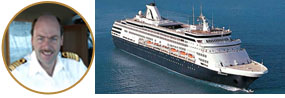
This company had started 17 years ago organising tours to motor crosses and the Grand Prix’s for the British Public. They had slowly expanded into other fields including Ocean cruising, chartering Greek cruise ships for the summer season. The ship they currently use is the Ocean Majesty (see separate page for ships bio)and Lesley has worked on board as tour escort in the last few years and this year as future cruise executive. I do not mind this at all, on the contrary, I like it, as it gives me the chance to join her as a spouse, and to get ashore to see the sights in the ports that I visit with my own ship but not having the chance to step off the gangway. This is my 3rd cruise. First year was the Baltic where I finally saw the Hermitage and last year it was Norway, with full day tours into the interior, up and over the glaciers. This year it is Iceland and Greenland.

The funny thing is, is that the Veendam is doing partly the same cruise on its way back from Europe to Montreal. So I am going the same route as my ship is doing, I am just doing it from a different perspective.

Today I flew from Gatwick-London airport with a Page and Moy charter plane to Kevjlavik which is the airport for Reykjavik. Coming from the green pastures of England and Holland, where cows nearly graze on the tarmac of the runway, it was very different to see the area around the airport. It more or less resembled a lunar or marsian landscape. The ship was waiting in the cargo port of Reykjavik as the downtown berth was taken up with other cruise ships. The Ocean Majesty was parked under the bow of the AidaVita, one of the ships of Aida cruises, which are easily recognizable due to the eyes and the hot-reds lips painted on the bow. It must have been a bit disconcerting for those on the bridge of the Ocean Majesty to look all day at those lips, as with the AidaVita being so much bigger then the OM, the red lips where at bridge level. The Ocean Majesty is staying overnight in port and tomorrow the tours start to explore Iceland.

22 June, at Sea.

From Dover to Copenhagen it is almost 700 miles as we have to take the long route. There is short cut through the Kieler Kanal, (see also one of my other pages, A Gentlemen’s cruise to the openeing of the Kieler Kanal) but there is a bridge over this canal and the Veendam is too high for it. There are plans to raise this bridge, so maybe in a few years from now, we can go through it as well. Which would be nice as it is a very scenic sailing. Most of guests are packing,as they will be leaving tomorrow at the end of the cruise. 188 are staying on they have booked a back-to-back cruise and they will leave 10 days later.

My final day was filled with clearing away the paperwork and writing my end of term report and hand-over. The ship is sailing off the coast of Denmark and in this area there is not much traffic so I do not have to be on the bridge. I just walk in and out occasionally, to keep an eye on things. I will be on the bridge for most of the night during our approach to Copenhagen. Denmark is made up of a peninsula that is stuck to the top of Germany. Most of it is called Jutland and there are a number of islands as well. Copenhagen is located on the East side of this Peninsula and thus we sail around the top and then come down on the east side. That east side is called the Sont. It is a very shallow area and most of the time there is considerable traffic. Thus I will be present on the bridge.

Tomorrow I will go on vacation for three months until 9 September. Since two years the company has a policy that each ship has two captains who alternate. It is better for the continuity on board. The crew only has to deal with two different sorts of management instead of somebody totally different every few months. Because we alternate, we are doing three months on, three months off. This is really a necessity because of the long working days. You can not do four months of Alaska or four months of Europe if you have days between 10 to 14 hours each day. Holland America asks a lot of its captains and that makes for long days. Thus 3 on 3 off, to keep us smiling and to keep us sane.

A few people have asked me, how long does it take me to write my daily blog and do I have time for it. It takes me about 20 minutes to write one A4 page. Then I have my breakfast. When finished, I check for spelling mistakes and then it takes 5 minutes to upload. So about 30 minutes in total, in the period after docking the ship and before my ships round starts.

This will be my last blog for awhile. But check again between 14th of and the 21st of August. Then I will be sailing with my wife on her ship. Normally my wife sails with me, but in the summer time when I do boring things, such as 12 Alaska cruises in a row, she sails on the Ocean Majesty. She started doing that a few years ago and although the past period with the Veendam was not exactly boring, she promised her boss to be there, and thus she left the ship in Venice to join the Ocean Majesty.

The Ocean Majesty is a small Greek ship and is chartered by an English company called Page and Moy. They cater for the retired middle class of England with cruises in the Med, the Baltic and they go up to Greenland and Iceland as well. Lesley works on board this year as the Future Cruise Consultant. She advises guests about the cruises of the Ocean Majesty for the next year. They have a spouse policy, so there I go.

I love being a captain on the bridge, but being a captain sitting in the bar, has definitely its appeal as well. Also it gives me the chance to do each and every tour they offer and see a bit of the ports and the countries that I normally visit with the ship but never get to enjoy.

So I will report my captains observations from the bar about what there is to be seen in Iceland and Greenland and what the special cocktail of the day is.

Also I will try to add a few more articles Of days gone by to the website. Ralph Grizzle the editor of The Avid Cruiser, places them on the last page end of each quarterly issue but that is the short version. The long version is posted on my blog. I have close to 1500 books in my library about ocean liners and cruises. Among them there are a quite a few obscure travel books, reports and other published items from the early days of sea travel, that merit some attention.

Thank you for reading my blog everyday. I will be back on the Veendam on September 9, sailing from New York to the Canadian Maritimes. Please join me then.

21 June, White cliffs of Dover.

I knew this was going to be a long day for me and I was not disappointed. Approach started at 3 am in the morning. The whole Strait of Dover has been divided into North to South Shipping lanes to keep the traffic separate. It is together with the Strait of Malacca the busiest water way in the world and hundreds of ships are passing through each day. There is Dover and Gris Nez traffic control who regulate it all and the lanes are suposed to do the rest. When you go north, as we were doing coming from Le Havre, you sail on the French side, keeping the Right hand side of the English Channel (This is another name for Dover Strait). If you sail south you hug the English side.

This means that if you have to go to Dover, then you will have to cross somewhere. The Rules of the Road dictate that you will do this, under a straight angle, so all the ships can see what you are doing. However as there a lot of ships around it can be quite a puzzle. Thus I wanted to be on the bridge, when the time was there. This morning we were quite lucky as there was a nice gap in the south bound traffic. By sailing close behind a big bulk carrier, we managed to pass ahead of two big container ships, just by speeding up for 10 minutes. That is the nice thing of having a fast passenger ship. Unless you are running full out already, you can always give a kick ahead and get out of a hairy situation. That “kick ahead” made us a little bit early and as the pilot was in an eager mood, he was early as well and we entered the port 15 minutes ahead of the planned time.

Dover has two narrows openings that lead into a wider basin. As it was spring tide, the currents running in front of the harbor openings were up to three knots. To compensate for this current you approach the entrance not in a straight line but steer against the current, heading directly for the breakwater wall. By keeping an eye on the way the current is setting, you adjust the ships heading, and bring the bow into the entrance. As soon as the bow is inside the opening, you start loosing the current so you then have to watch the stern of the ship; otherwise it gets set to towards the sea wall. It is a bit unnerving if you have never seen it done before, so it was a good learning experience for the juniors.

For the pilot it was a piece of cake as the Veendam is one of the most maneuverable ships in the world. Inside the basin there is not much room either. The West side is shallow and just of the South side there is a wreck in a position where it is most convenient to turn the ship for docking. It has been there for years, but as the cruise ships are getting bigger, there are now finally plans to have it removed. Dover has a nice terminal, a bit on the small side for the mega liners, but perfect size for the Veendam. We fitted with 30 feet to spare in the main berth.

As I sail with quite a few British Officers on board, it was a busy day on board with lots of family and friends. At the same time Holland America is focusing on the British Market so we had a lot of British travel agents on board for the day as well. Most of guests where on tours to ancient sides in the area, Leeds Castle, Canterbury or Dover Castle itself. The latter having a long and distinguished history from the 11th century. It played a vital role in the Battle of Britain in the Second World War and all these facilities, called Hell fire corner, are open for visitors.

Dover is nominated by white cliffs that tower high above the port and as the sun was shining directly on the cliffs the scenery was very beautiful. On a good day you can see France from here and vice versa, so for the Germans in WWII it must have been very frustrating to see England so close and not being able to get there.

By 4 pm. we sailed as the schedule to Copenhagen is very tight. Departure is a simple affair. Line the bow up towards the opening, give full ahead, and sail out as fast as possible so that the current can not catch the ship. We had to cross the traffic lanes again, as we were going further north, and then most of the evening we were busy with dodging other ships coming from Calais, Dunkerque, Antwerp and Rotterdam. If you want a good area to learn navigating the hard way, try sailing the English Channel. Luckily it was a weekday, so we had only a few sailing boats to contend with. By 10 pm. I really was ready for bed.

20 June, Le Havre.

Passenger ships have been calling at Le Havre since the start of Trans Atlantic Travel. It was the home port of the French Line and every major liner has called there. Since the demise of the regular liner service, cruise ships call here using Le Havre as a gateway to Paris. It is a very busy port with a continuous flow of traffic going in and out. That traffic is regulated by Le Havre port control. Port control operates in a similar way as traffic control does at an airport. It assigns the pilot times, berths in the harbor, sequence of arrival and departure etc. etc. Occasionally it settles disputes between ships captain’s who all want to do something at the same time, as nowadays we are all in a hurry and time is money. As a cruise ship, we seldom have scheduling problems as, with the exception of local ferries; we normally have preference over cargo traffic.

Approaching Le Havre is very straight forward. The approach channel or fairway is covered by two very strong lights, called leading lights, and as long as you keep these two lights in line, you are in the middle of the channel. It was a breezy morning and as I wanted to park the ship portside alongside the pier, that is nose to open sea, it meant swinging around in the harbor and then backing to the dock. The harbor is not that wide for a comfortable swing and with about 20 knots blowing full on the beam, it was a tight maneuver.

There is a large tidal difference in the port, 8 to 10 feet is a normal range and for that we needed a shore gangway, as the Veendam has no crane capacity to carry its own long gangway. The agent was excited about the long shore gangway as it was a brand new one. With ever larger cruise ships visiting the port, having their break doors high up in the ship, the normal gangways were becoming too short. So the port had invested in a new one. It was indeed a very nice one and although it was of the step up kind, the steps where sufficiently close together to make wheelchair use possible.

In the afternoon we were regaled by a French choir, singing Russian Folksongs. I never got to the bottom of that combination but it was very pleasing to listen to. Although about 800 guests were on tour, there were still sufficient of them around to create an audience. The cruise terminal is a converted cargo shed but it was done up very nicely with a little bar, tourist stands and a lady selling maritime paintings. These maritime paintings were not of the ships as such but artists impressions. And although they were very professionally executed some of them where a bit too culturally advanced, to be fully understood by me. If I see a painting of a ship, then it has to be a painting of a ship, regardless whether it is a harbor scene or the ship itself. So give me the paintings of Spurling, Shoesmith or Stephen Card any day. All the tours from Paris were back on time, and we sailed on schedule at 19.30 hrs., for our run up the English channel to Dover, England.

19 June, Gulf of Biscay.

The weather system did what the experts had predicted; it remained offshore, West of Cape Finisterre. We were crossing the Gulf of Biscay on a North Easterly course and so steering away from it. By midnight the wind and the swell started to die down and the guests could enjoy a peaceful night. A wind force four remained, pushing us in the back and that gave an extra knot of speed, which pleased the chief engineer as it helped with the fuel consumption.

The cruise is slowly coming to an end with only two ports to go and today we had our Mariners party, the party for all our repeat guests. On a complement of 1250 guests there were 802 who had done two or more cruises. The top scorer this time having 1157 days clocked up. I have made cruises where we had everybody on board as a repeat guest and I have done cruises (Alaska) where there were as few as 250. Most of the time the figure hovers around 75 – 80%. Holland America has a recognition system for loyal guests. Not only can you get better deals if you have traveled before, with early booking options and extra discounts, but we also have a medal system.

We have pins for 25 and 50 days, a copper medal for 100, a silver for 300, gold for 500 and platinum for 700 days. 700 days is the top level and we have guests who go way over. There are one or two ladies who do all the long cruises with HAL, and they are somewhere near 4500 days. That is a lot of sailing days. To put that in perspective:
I have been at sea now since 1979 and clocked up about 6100 days, with having on average 4 months leave a year. 4500 days is nearly 12.5 years full time at sea. It helps when you do world cruises, each one is over a 100 days, but you still have to do a lot besides that to get to that level. It makes sense that the holders of these numbers, get a bouquet of flowers from the President of the company, each time they sail.

Most of the route along the French coast is regulated by Traffic separation schemes. Highways at sea, which keep the South bound traffic apart from the North bound traffic. Most commercial traffic, except the fishing boats, adheres to it. I had taking a two hours watch today, as the chief officer wanted to have lunch with all the navigators as a part of his teambuilding effort. I like to stand a watch once in a while, as it keeps the routine going of dealing with the regular watch issues. It was great fun to listen to the VHF and to hear all the conversation going on between the various ships, voices with different accents, different styles of talking and varying levels of English proficiency. Far away on the port bow, a tanker was not behaving according the rules and was getting into a muddle with two bulk carriers and another tanker. When they started talking to each other, getting more agitated while the conversation progressed, it turned out that they were all from Indian decent and their sing-song English filled the airwaves. VHF remark of the day of one ship to the other:
Captain, captain, if your grand mother would see what you are doing, she would call you a very very naughty boy…………………

Tomorrow we are in Le Havre, gateway to Paris.

18 June, Vigo.

Vigo is located in the North Western part of Spain, just south of Cape Finisterre which marks the border with the Gulf of Biscay. We were just going to make the schedule for Vigo when I was called at 4.30 by the navigator on duty that there were Tuna fishers in the way. Their method of fishing is to set long surface nets and then sit nearby waiting for the fish to come in. Most of them will attach little strobe lights to buoys, to mark the end of the nets. If they are attached, those battery operated lights work fine in the beginning of the night but by early morning the batteries start to weaken and then the fun starts.

In the pitch dark of the night you can not see the buoys or the nets and the fishing boat skipper suddenly realizing that the ship might run over his net, speeds up and start crossing the bow. By doing this he hopes that the ship will change course and will miss the net. The problem is you do not know were the net starts as the fishing boat is not always lying at the end of his net. He might be in the middle or have drifted away and not even being close. Also the crew tends to take a nap between the setting and retrieving of the net leaving the youngest deckhand to monitor the traffic and the boat. When a ship is coming close he calls the skipper, who jumps in the wheelhouse and starts racing towards his net.

So we also had them tonight. The navigator on duty is of course completely capable of dealing with the situation, otherwise he would not be on duty, but as the actions of the fishing boat might be totally erratic, it is better to have the captain on the bridge, even if it was only as a witness and to concur with the actions taken. Based on the behavior of the boats we took a quantified decision of where the nets had to be and the best option was to steer for open sea. That we did, but it cost us quite a bit of time and thus we arrived late in Vigo. Talking to these fishing boats does not work, due to language barriers, and also because they only monitor a private working channel for among themselves. So we sailed around them and lost some time. Also in port was the Sea Princess, docked ahead of us and as the part of the pier assigned to us was just long enough, I had about 100 feet clearance, to park the ship where it had to go. Thus I had to come in very slowly to fit the ship in between the stern of the Sea Princess and the pier of the fishing port just behind us.

The weather forecast for the crossing of the Gulf of Biscay had been very good. Until right at departure, when the wind suddenly picked up from 10 knots to 40 knots within 30 minutes. By the time we had departed the bay of Vigo there was a good gale blowing. It turned out that a frontal system south of Ireland had come further south than forecasted and had started to intensify right off the coast of Spain. Luckily it produced southerly winds, so the Veendam was running with it, reducing the relative wind on the deck. But as it brought the swell with it from the North Atlantic, the ship started to move somewhat. According to the latest weather chart we will stay out of the worst part and then the system is supposed to go to the Irish Sea and, hopefully, we can avoid the most of it.

« Older posts Newer posts »