- Captain Albert's Website and Blog -

Ocean Liner History and Stories from the Sea, Past and Present. With an In Depth focus on Holland America Line

Page 231 of 241

23 September 2007, Charlotte town.

With a heavy heart I arrived at 04.30 at the pilot station west of the Confederation Bridge. Wind around us was gusting up to 30 knots from the WNW and things did not look good. The pilot came on board and also he admitted that it would be a very breezy day for being at anchor, especially with the current running out of the river down to the anchorage location. He commended me on cancelling the previous call (see 15 September blog) as things had indeed turned very nasty after the ship left.

So with anchoring not being an option, the question was is there a plan B. Well the dock is supposedly 5 days from completion so maybe that was an option. If a dock is five days from being ready, then, there can not be much left un-finished. The pilot confirmed that all the bollards were in place but that the dock surface was not ready yet for people to walk on. But if I could dock alongside with the ship and then run a tender service into the town, then at least it meant I would not have to cancel. So as soon as we passed the Bridge, we called the agent out of bed and put the proposal to her. Either she got me permission to dock the ship or otherwise I would cancel with the town losing a major amount of revenue. Well our agent has guts and she was not to be denied. Shelley, if you ever read this, thank you very much. She did convince the port authority and we got permission. It would however take an hour or so as now the dock needed a full security sweep and the boys had to be called out of bed first.

The pilot in the mean time took care of the linesmen, who had to come out of bed as well, to handle the ropes. But the linesmen are his daughter, his son and some other near family so that was easily arranged. (Also, the man who runs the pilot boat is family, it is his brother……..) As it was very early Sunday morning, I assume that they were not too happy with the ideas of this Captain of the Veendam but they all showed up in time. Cruise ships are indeed a major source of income for the town and every dollar helps to get the kids through college.

After hovering for an hour near the sea buoy, we got the security clearance and sailed into the harbor. When we came closer and closer, the wind suddenly picked up to 40 knots on the beam and I thought this is not going to work; I better look for an abort point. The best abort point (= last chance to decide not to make the final maneuver) was close to the dock, so we might as well go there, swing the ship around and then review the situation. By the time I had swung the ship around there was 20 to 25 knots blowing but it was full on the bow and it did not make the ship drift. Slowly but steadily we worked the ship astern and sideways to the dock. The pilot on the phone all the time explaining to his family what the plan was, as nobody had ever thought about the combination of running a tender service and docking at the same time. We were docked with the first guests going ashore about 45 minutes late but at least we did not have to cancel. It turned out that the dock was indeed not finished yet. Bollards are in place, the concrete shell is there but it still has to be filled up and resurfaced, before people can safely walk on it.

Tendering went well and although the wind remained, the sun came out and everybody had a great day. Except one elderly lady. She broke her hip that day by tripping over her shoe laces in the cabin. She was disembarked just before departure. Thus the Veendam had the distinction of not only being the first cruise ship to dock at the new pier but also having the first medivac on the pier. Tomorrow we are in Sydney and the weather forecast calls for lots of wind during the night and morning…….Will see, what that brings.
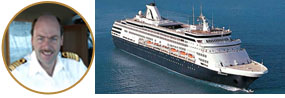
23 September 2007, at Sea.

Today we sailed down the St Lawrence River and via the Laurentian channel into the Gulf of St. Lawrence. The weather forecast had predicted very windy weather and that prediction came true. The wind blew all day long. First with us, so on deck it was quite pleasant as the relative wind over the deck became a pleasant breeze but later it swung to the East. As the ship was going South East we had for the afternoon and evening the wind almost full on the bow; creating a good gale which whistled around the ship.

The organizational issue of this cruise is, is that there is only one sea day. That’s today. For the rest we have a port everyday until arrival in New York. Now we face on board the contradiction that a lot of guests complain about the lack of sea days, while at the same time they book this cruise because they see so many ports in one cruise. The maximum port group on board is happy and the maximum sea day proponents huff and puff. With only one sea day, the Hotel manager faces the problem of how to schedule all the standard HAL activities that we are supposed to do during a cruise on this one day, while we normally have two or three days to accomplish this. As you will understand it does not work. There are only 16 available hours in the day and we need at least 32.

So we decided to free up some time by doing the captains welcome on board in a different way. The company is already in transition with this as well. Captain intros are going to be reduced to a brief staff introduction, a champagne toast and the popping of confetti just before the show starts. So no more captains’s receiving line and picture taking with the captain. Here on the Veendam we have not implemented that yet as we are waiting for the props. Namely a confetti popping thing which I have been told is some sort of gun in the form of a champagne bottle. Only the ships staff, the cruise consultant and the employee of the month will then be introduced. It all takes about 5 minutes and ends with a champagne toast and a few positive words about the following show.

Thus as the HM needed the time, I thought let’s do it in a similar way but then from the balcony in the dining room. The guests get their free drinks while entering the dining room, same way as when entering the lounge and I do a little speech, between appetizer and main course. It took a lot less time and as far as I have heard the guests thought it was oke.

I personally do not mind doing captain’s introduction at all. I find it a pleasant challenge to deliver a welcome on board speech that keeps the audience entertained and brings a positive atmosphere to the whole ship. A harder gig is the picture taking in the receiving line. Again I do not mind doing the photo’s, although getting 600 people through the line in 40 minutes, during each sitting, takes a bit of doing; I just do not like it when people are not dressed up.

It is fine with me whatever dress code is but if the dress code says formal, then it should be adhered to. It is part of the Holland America product, which people buy, to have two or more formal nights during a cruise. They select a cruise on that basis and then they walk around in shorts and T shirts on a formal, or change after dinner. It boggles my mind. Unfortunately there is no law of the sea that gives me the right to enforce a dress code……………If you do not dress up, you walk the plank……… or something like that and I will have to live with it. Because of that I won’t mind not doing the receiving line anymore. But, I can still dictate the dress code at the captain’s table and that is what I will continue to do.

Tomorrow we are in Charlotte town Prince Edward Island. Last cruise we cancelled the call due to bad weather and for tomorrow it again does not look good.

21 September 2007, Saguenay fjord Baie de Ha Ha.

After making four days ago our maiden call here, we now returned coming from Quebec. Departure Quebec was in interesting experience as I had to turn the ship 180o on the river, as due to the morning current we were facing the same way as whence we came and that was not the way we were going in the evening. So after a great day in port we left on time and after letting go the lines I let the current come between the ship and the dock and that pushed us nicely off the dock.

Before we could make the swing we had a good look around the ship. It was a nice day and late in the afternoon and that normally means plenty of “Sunday sailors” round the ship. The moment the ship starts the swing on a river with current, you can not easily stop if there suddenly a small yacht or canoe in the way. Luckily nothing in sight except a German cargo ship, the Uta, on its way to Montreal. So when that ship cleared we put the rudders hard a port, a kick on the sb engine and off we went. The Veendam has a rudder behind each propeller so she steers extremely well. I got a nice swing going very quickly and the pilot was watching in amazed silence how quickly the Veendam spun around on the river. Well it gave him an idea of how fast the ship could move if necessary.

We sailed down the St. Lawrence until 1 am and then entered the Saguenay fjord, dropping the anchor at 5 am. It was again a glorious day with wind still weather and sunny skies. On departure I made a 360o swing in front of the dock as it seemed that all the locals had assembled on the dock to see the ship sail. So a nice chance to score some brownie points for the company. Departure was set for 4 pm. and thus still full day light, with the sun slowly setting on the trees and about half of them already turning red, brown and yellow. The return trip through the Saguenay fjord was stunning. After 25 miles we came to the statue of the Virgin Mary. This was erected in 1881 and is perched on a cliff about 500 feet above water. The original statue was made of wood and has been restored three times since.

It was erected by a local trader called Charles Robitaille who had some time before nearly lost his life when going through the ice with his horse. He was convinced that due to his extensive praying to the Virgin Mary he was saved. When later he fell gravely ill he promised to do something extra ordinary for her, if he survived. He did survive and had a 50 feet high wooden statue sculpted of the Virgin Mary, by one of the most famous sculptors in Quebec. The statue was taken by boat in three pieces to Cap Trinite in Saguenay fjord and erected on the edge of the cliff. The statue is painted white with a blue robe.

Since then the cruise ships stop there and the narrator tells about the history and the Ave Maria is played over the P.A system. As our narrator was playing several versions by different artists, I decided to swing the ship slolwy through 360o while all this music was played, so that everybody in all the lounges could see the statue and not just those on deck or in the crows nest. Then we sailed on to pilot station at the town of Escomin on the north shore of the St. Lawrence, to disembark the pilots and to continue our cruise to the next port of call Charlotte Town.

20 September 2007, Quebec.

Today a little story about how the St. Lawrence river with it’s current dictates the cruise schedule and how it can affect the docking time in Montreal and Quebec. Sailing to Quebec from Montreal and also towards Montreal is regulated by the time that the ship can pass under the bridge at Quebec. The Veendam is 46.3 meters high above the water and the bridge has a clearance of 50 meters above chart datum. Chart datum means, the imaginary level that is used as zero. Heights start above this line, depths start under this line. The tide on the St. Lawrence river coming from the sea, reaches past this bridge and reduces the clearance under the bridge. Also the water level sustained by the water brought down can add to this. If heavy rainfall occurs upstream, then it severly affects the window of opportunity for pasing under the bridge. Thus the pilots calculate the times when due to the ebbing, the water level drops sufficiently that the ship can pass under the bridge. Some ships, such as our Vista Class, or the Queen Mary 2, are too big in principle and can not pass under the bridge at all. The Veendam can, but only at half tide or low tide. This can play havoc with the cruise schedule, if low tide is late in the morning, or way before sailing time. This could mean that instead of a normal arrival of 8 am. the ship would only be able to dock at noon time in Quebec. Same with going up river to Montreal. We have to be on time there, due to the flights from the disembarking guests and that could mean cutting the call at Quebec short. This time I could pass any time after 03h06 in the morning, so I set the bridge time for 05.00 hrs. and that meant docked by 06.30 in Quebec with an official 08.00 arrival time. The 05.00 am was choosing as that is the regular time that the sailors start working each day, so all arrival work would fall in their regular hours.

The approach to the dock is also depending on the tide. If the current is flooding, that is going towards Montreal, than the ships dock portside alongside. Is the tide ebbing, that is going towards open sea, then the ships dock sb alongside. This is done so that the bow of the ship always heads into the current, which makes it easier to control the vessel. Unfortenately on departure the ship might have to make a 360o turn if the heading of the ship is opposite to the intended direction of sailing. I would have preferred to dock portside alongside, during this call, so on departure the Veendam would already be pointing to open sea.

But this was not to be. The ebbing current was still too strong according to the pilots. In the middle of the river there was over 5 knots and at the dock more then 2 knots. Thus we made a big turn, starting close to the south shore and heading across the river to the North shore. While doing that the ship gets the ebbing current full on the beam and drifts considerably down stream. We started the turn, half a mile above our docking location and by the time that we had the bow into the current, we had drifted over a mile downstream. This manuevre is done by the pilot. The moment the ship is lined up, approx. 300 feet off the dock, the captain takes over and brings the ship alongside.

The trick with such a current running, is use the current to push the ship slowly towards the dock. By using the bowthruster you can keep the current just on the port bow or just on the sb bow and in thus control the speed of the push to the dock. The ships propellors are used to keep the ship in position abeam the dock where the final location will be. Ships that have no thrusters use tugboats to get the same effect. Docking at the passenger terminal in Quebec is a bit special, as due to the shoreside gangway, we have to dock on the inch. The gangway location is fixed and so the ship has to be parked in the exact position so that this gangway fits into the hull opening. The saying, docking on the inch, is quite true here. We had once again a glorious day, with constant sunshine and no wind.
Tomorrow we go further down river to visit Saguenay again.

Note: dear readers, for some unknown reason some of your comments disappear directly into the spam box of the web manager and I can not get them out of it. If you do not see you comment appearing at the bottom of the blog entry the next day: please re-enter. I do not censure any comments but do filter out emails about viagra etc………………

19 Sept. 2007 Montreal.

During the night we traveled up the 2nd part of the St. Lawrence River to Montreal which is the final destination of the cruise and our change over port. The whole route is done during the night time so there is very little to see for the guests apart from the occasionally lit up refinery along the river bank.

There are some tricky parts along the river. First of all the current caused by the river flow coming down, is a bit of a concern in regards to maintaining a good speed to get to Montreal on time. Average speed to maintain is only 10 knots over the ground, but with strong currents, the necessary slow downs for traffic and shallow patches, the real speed needed is around 16 knots. At a few places where the river gets rather narrow the current can increase up to 7 or 8 knots and it is a bit unsettling to see that with the engine setting on 18 knots, the ship barely makes the 10. I alternate with the chief officer in stand by’s on the bridge to make sure that it all gets done in a safe way.

Apart from the current, there is also a bit of diversion while sailing along. About 30 miles upstream from Quebec is a point where they play the national anthem for each ship. A great number of years ago, a couple who are living on a hill at a prominent bend in the river, decided that it would be nice to salute all the ships with playing their national anthem and raising the flag of the country of registration. So he built a very heavy loudspeaker set and she sewed flags for each and every country that might be represented by a ship on the river.

The couple is now getting rather old but the tradition has been taking over by the daughter. Thus in our case the Dutch national anthem was played, the “Wilhelmus van Nassouwe”. This is a battle song from the 16th century, when the low lands battled the Spanish occupation for 80 years, before we were able to throw them out. It is a bit peculiar to hear this Dutch song while sailing on a Canadian river so far from home. The version that is played has a tongue in cheek ending. I do not know if that version was picked on purpose or if somebody played a joke with the couple in charge. In Dutch the first verse ends with the line: and I always respected the King of Spain. However the version being played ends with: and I always longed for the King of Spain. With the word longing in the context of longing for your girlfriend. The words in Dutch being only one letter different.

But is a nice tradition and we honk the horn as a thank you. It is a bit difficult to announce this to the guests as it is in the middle of 2nd sitting and the first show. Half way up the river, there is the village of Trois Rivieres, where we change pilots for the last part to Montreal. More about that in another installment We had another gorgeous day, so hopefully the leaving guests appreciated that.

18 September 2007, Quebec.

oday we were in Quebec and what a lovely city it is. As a matter of fact it is the highest rated port of all the Holland America line ports as per our guest’s comments on board forms. Holland America line ships call at almost 400 different destinations and Quebec scores the best with an average of 8.33.out of a 9. We all know on the ship that with Quebec in the schedule, the guests will have a good time. Getting there from Saguenay is an all night sailing up the St. Lawrence River. Part of the river is semi canalized. This means, that is still has the regular river flow but the river bed has been dredged straight and is buoyed. The river is still very wide here but it flows over very shallow banks, interspersed with islands and only the dredged part is good for navigation, for almost all sorts of ships and sizes. However as the ships have to travel in this channel, they pass each other in close proximity and that meant that I was up for most of the night again. The pilots know what they are doing and I fully trust them but there is Murphy’s Law and it seems that the captain’s presence on the bridge is a very good way of keeping Murphy quiet. Docking it a bit of a happening. First of all you get a docking pilot who does the last five miles on the river towards the docks on the West shore. He brings the ship to about 500 yards from the dock and then hands over to the captain for the final docking. At least that is the way with the cruise ships. Cargo ships docking often require tugs and then the docking pilot does the docking as well. Even if a cargo ship captain would like to do the docking himself, the language barrier with the tug boat captains would prevent it. Regular French does not get you very far on the sea front. They speak French Canadian or Quebecois and on the water front they have a very specific version of it. Docking here is as if you are going to sit down on a tray of eggs without breaking them. The current plays around the ship and bounces off the dock walls,so you move the ship side ways, inch by inch, preventing the current from either pushing you away from the dock or bashing you into it. So you have to be patient and take you time.

By 6 am. we were docked at the Quebec Coast guard dock. The passenger terminal being used by the Norwegian Dawn. Not that it mattered the docks are being close to together and you just have to cross the street and there are the shops, the cafe’s and the little restaurants for which Quebec is famous. Quite a bit of the hustle and bustle of the town is caused by the lively student population and that liveliness attracts people. Thus there are apartment buildings being built for the affluent and student flats being converted into upscale apartments. The problem is that the people who buy these (expensive) apartments are most of the time not the most outgoing. So the success of Quebec is now endangered by its very own success. However according to the pilot there is hope as there is a movement going to limit the building of these apartments and to prevent the student from becoming an endangered species in down town.

Even if you do not leave the ship, just the view from the ship is amazing. On one side is the wide view of the river with the ships sailing by and the houses on the far side. On the dock side there is the town against the hill, dominated by Chateau Frontenac, the hotel looking like a big castle. We had a glorious day again with little wind and sunshine all day long. Tomorrow we are in Montreal which is the end of our cruise.

Tuesday 17 September 2007, Saguenay. Baie de HA HA.

Today we had a new port for the ship. In the past few years the ships had already been cruising up and down the Saguenay fjord for sightseeing purposes but now the ships are stopping here for the day. The Amsterdam tried it last year for the first time and as the guests were very positive about the tours, Maasdam and the Veendam are calling here now as well a regular basis. Next year the new Euro Dam will take the place of the Veendam and bring even more guests to Saguaney.

At 4 am in the morning we were at Escomin to embark the pilots and then an hour later we entered the Saguenay fjord. Turning into the fjord can be a bit tricky as the ship has to make a 90 degree turn which brings it full abeam on the current, a current which can be considerable. This time it was only 4 knots, so not too bad and as it was flooding it pushed us nicely towards the entrance. It takes about four hours to get to the end of the fjord where the town is located and we did most of it in the dark. The town of Saguenay, which is quite big, is located at the very end of the fjord which is called Baie de HA HA. This is a bit of a strange name but in the 17th century, when this area was explored by the French, HA HA meant a pleasant surprise and that was what they thought of this area when they got there. The pleasant surprise bay; La Baie de HA-HA.

The town used to thrive on forestry but at the moment, with the Canadian dollar being so high against the American dollar, export is a bit of a problem. Due to the proximity of cheap electricity coming from waterfalls, there are aluminum factory’s and now tourism is up and coming. We still had to anchor but the Quebec and local government is investing $ 30 million dollars in a new pier, tourist centre and shops and that should put the town very much on the cruise map. A dock is very much necessary as it is the only way to get the real big cruise ships in. The big Carnival and RCI ships do not have ships tenders, so they have to have ports with docking facilities. I think this port is going to get very busy in the coming years.

Until they get the shops going, our stop was mainly meant for the tours. Great tours can made into the interior and we had over 500 people on the full day trips alone. I was occupied in the morning with the local dignitaries. The Vice- Mayoress, the Chairman of the local business association, the tourist buro ladies and the Minister of Labor and Tourism of Quebec, all came to the ship, to celebrate the first call and to emphasize how important tourism is for them. It is estimated that when the new pier is finished an additional 400 peoples will find work in the tourist industry. So we exchanged gifts and plaques and great was my amazement, when five of them, one by one, took out a paper and started reading out an official speech in English. As their first language is French, they had taken the trouble to prepare an English speech for the Dutch captain. Well I do understand French and still speak it a little bit, but as the official language on board is English I do tend to stick to that. If I had had to do my thank you speech in French, I probably had to write it down as well, to avoid too many grammar mistakes. Now it was not a problem with doing it in English and with throwing a few French phrases, as I found out that the Vice Mayoress was the only one who did not speak any English at all. Their presents will go on the bulkheads in the ship staircases and hopefully they will find a place for the framed ships photos and crests that I gave in return.

After a glorious day of sunshine we left at 1800, sailing down the fjord and pausing briefly at the Maria statue. I will write about that one on September 21st. when we call here again southbound. By 21.30 the ship was in the St. Lawrence again heading to Quebec and I was heading for bed, after having been on my feet for 16 hours.

Monday 16 September 2007, At Sea.

Today was our regular, scheduled, sea day with the ship making its way up the St. Lawrence River. The weather was still very windy, up to 40 knots blowing down the river, so I was happy that we could do it all with slow speed as a result of cancelling Charlotte town. Had we had to go full speed as per regular schedule, we would have been pounding into the waves and it would have been an uncomfortable ride.

The first part of the river is so wide, almost sixty miles, that there is no pilotage. The ship travels under own navigation about 160 miles up the river until we come to the little town of Escomin where the pilots embark. This is the point where the river gets narrower, more shoals are coming and where the current becomes noticeable. So for this first part on the river, it is for us not much different then when sailing in the open sea.

On this 10 day cruise we only have one full real sea day and that means that most of the official activities had to be scheduled for today. This means the special lunch for our Suite guests; and the gathering of the Society of Holland America Line Mariners. The latter one is something that can create a scheduling issue, as we never know until half way through the cruise how many repeat guests we have on board. The company has made great strides with individual ID numbers and a database but much still depends on the diligence of the guest in providing the data. Not only are sometimes cruises not accounted for, for all sorts of reasons,;but people get married, divorced, change names and sometimes book under other initials. That all can create mistakes, so during the first few days of the cruise, we try to get the latest info from those guests who for some reason are not in the system or forgot to count certain cruises.

As soon as we know, how many we have, there is the question of what sort of party we will throw. Company regulations say on a cruise of 14 days or longer it should be an evening party. Is the cruise shorter, then it should be a morning party. However this was set up with total disregard of the various sorts of cruises that we do, so the hotel manager has to deviate from it. This cruise we had just over 730 Mariners on board, which is on the 1200, about 60%. This is just below average. In Alaska where we have a lot of first timers the number is much lower and on longer cruises, such as crossings or the world cruise the number is much higher. On the Transalantic of last April with the Veendam, the percentage was 92. Meaning that 92% of our guests had at least made two cruises with Holland America before they embarked for that Trans Atlantic cruise. The company is the envy of the cruise industry with such high return rates.

Although this cruise is shorter than 14 days we had schedule the party in the early evening, due to having only one sea day; and we had to do it in two groups. We can not get 700+ people in the lower show lounge. Lower and upper lounge only take 750 together, and we want all the people down stairs, for the handing out of the medals. Thus two parties, one for first and one for 2nd sitting. Most guests were on the 25 and 50 day level, thus not too many medals around, and only 3 guests with 700+ days. There were only 15 people who received a 100 day medal this time so I had to expand my speech a little bit to fill up the time. But the mariners get-together is a thankful thing to do as it is these people who form the backbone of Holland America’s success. Most of them make great efforts to introduce newcomers to Holland America and as a not un-important side issue, they happen to pay my salary………….

15 September 2007, Charlotte Town.

Last evening, the first gale warnings started to come in over the weather radio for the area of Prince Edward Island and the Gulf of St. Lawrence. Strong winds followed by rain were to come from the South East in the course of the day. There were two reasons for me to be concerned about this. One, because the winds were to come from the South East and thus blow straight into the harbor and two, we had to anchor instead of docking.

Charlotte Town is working very hard to get more cruise ships in especially during the autumn season. Thus after a number of years the townspeople had decided to rebuilt the dock so it could accommodate larger ships. Thus far anything longer than 500 feet was overhanging the dock with bow and stern and forced to put the ropes for and aft on mooring buoys. The completion of this upgrade has been delayed as, due to the late clearing of the ice in the spring time, the project started later then planned. This means that visiting ships can not dock at the moment but have to anchor. Completion of the dock is now set for sometime October.

The anchorages in Charlotte town are not very good, certainly not for larger ships. And for a town the size of Charlotte town the Veendam is a larger ship. One anchorage is located at the centre of where three rivers are coming together plus the current from the sea tide. That results in the ship constantly swinging around its anchor, continuously pushed one way or the other, depending on which of the four currents is the strongest at one given time. The second anchorage is right off the dock, so very close for the guests but the ship cannot swing freely around there. It has to remain lined up in the fairway. That means using thrusters all day long or the combination of bow and stern anchor. Southerly winds blow full on the beam there and if the wind is too strong, then the anchor drags and the ship is set upon the dock.

With the above in mind, I arrived at 6 am at the pilot station. The pilot came to the bridge and we discussed the expected weather, especially the moment that the wind would start to increase. We both agreed that this would happen before lunch time and that it would be very dangerous even to contemplate trying to anchor. So the pilot left again and I cancelled the port call. While we were hovering near the pilot station, the wind already started to increase from 12 to 20 knots, so it made good sense to leave as quickly as possible. We sailed back the way came in and by 11 am we measured peak winds of 50 knots on the anemo meter.

Because we now had an extra day at sea, there were no alternative ports in the area that I could have called at instead, the ship rode the waves very nicely and only white caps indicated the strength of the wind. The fact that the ship does not always move when the weather is bad, can make it very hard for a captain “to sell” his decision to the guests. Most guests relate bad weather to a greatly moving ship with everybody hanging on for dear life. So I made my announcement to all on board at 08.30 and hopefully everybody understood the situation. Later in the day, the sea’s got a bit higher, slowly being whipped up by the ever increasing wind and drizzle and fog appeared. So at least the weather now also looked bad.

This weather system is supposed to last until tomorrow afternoon and then it should get better. Tomorrow is a regular sea day and thus we have now two sea days in a row. For the guests there was a full day program made by the cruise director but extra activities. Tomorrow should be getting better, when we start entering the St Lawrence river. For the remainder of the day we will cross the SW part of the St. Lawrence bay.

14 September 2007, Sydney.

At 6 am. we arrived at the Sydney pilot station and after embarking we sailed into the fjord at which end the town of Sydney is located. The weather looked very good, at least a lot better than the Maasdam had two days earlier, when there was so much wind that the Captain decided to sail straight out again.

Sydney is located at the very end of the inlet and the deepwater part is so limited that the ship has to back up for nearly half a mile to get to the dock. There is no room to turn. The town is an up and coming cruise destination and the local authorities are working very hard to make the cruise ship calls a great success. They have revamped the cargo shed on the dock into a very nice terminal and the dock is perfect for my size ship. A new item was that they built a music stand on the NW side of the dock so that the terminal forecourt also has a local use when there are no cruise ships.

Music is very important in the area and plays a great part in the local social life, especially during the long and harsh winters. During the day we had bag pipe players on the dock and on departure a little brass band that played local music and the appropriate national anthems when the ship pulled out. Fiddling is also a popular pastime and as a sign of this there is 20 feet high violin statue erected on the far end of the pier. Always nice for having your picture taken with.

I find sailing out of Sydney most interesting due to all the little villages located on the hills on both sides of the water. Each village has a church and more prominently a grave yard. As a matter of fact, as the hills are mostly barren, it are the grave yards that are very conspicuous from the ship. But also the churches are a matter of interest. I am not an expert on churches but what I find peculiar is that each village church has its own very individual style. Churches that would be at home in a Bavarian village, a church with definite Mediterranean influence, a church that would not go amiss in England and a church style that looked more at home in the southern part of the USA, then in the Cape Breton area. Many Styles, shapes and colours.

Each church has its own grave yard and these are very prominently visible from the sea side. On the West side of the fjord there is a lot of erosion going on and the grave yard of one church is slowly falling into the sea. I suppose it is a race between the Verger and the sea for who gets to the graves first before they tumble down when the next part of the coast subsides.

We had an absolutely glorious day in Sydney. I have been coming there now for several years and this was by far the best call. Sunny all day, not too warm, not too cold and just a gentle breeze to make it perfect. Tomorrow we are in Charlotte town on Prince Edward Island and the weather forecast does not look good at all.

« Older posts Newer posts »