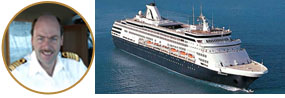
Beautiful day today, docking at pier 20, with the shopping trolley, (sorry, Grand Princess) next to us at Pier 20/21. When we arrived there was no wind and we had the regular mini version of the highland band on the dock with the town crier rolling behind them in his wheel chair. (see previous Halifax blog)
Today was the first port that I got a chance to get ashore for a little while since boarding. Halifax has several nice 2nd hand bookshops and one of them, Doulls, has a very large selection of books on maritime subjects. I had found out via the internet that he had a book in store about passenger ships which I have been looking for, for a long long time. I had seen it on the internet before but it was very expensive. Being very old and of limited numbers printed. I do not mind to lash out once in awhile, it would be my birthday present, but an expensive book you do not buy unseen, and here was the chance to get my hands on it for an inspection. On arrival it turned out that he had two copies, including a first edition in very good state, so I was sold and paid even more to get the first edition. So I am out of pocket money now, till about Christmas.
On board the chief officer was still busy with the cruise planning for Tampa, apart from the other jobs of the deck department. There are basically three groups within deck. That is navigation, deck maintenance and security. The chief officer’s function is not always that easy, yes he is the head of the deck department but also no, as there is always the interfering captain around. Partly the captain has to be involved as the navigation is his end responsibility but sometimes, as the captain was the chief officer before, the chief officer also gets the “benefit” from his wisdom when not needed. Some of my colleagues have remained “super chief officers” when they were promoted to captain, and others have moved away completely. I think that I hover somewhere in the middle and I try to divide my “interfering” equally over the three departments and the Environmental officer.
What a lot of people do not notice is that the time spent on security is so much nowadays. Because you do not see very much of it, apart from the X-ray machine at the gangway and whatever port/shore side security comes up with, but there is a lot involved beyond that. Each company has a company security plan that is broken down into a specific plan for each ship. That plan basically lists what to do in certain situations, when and how. This plan is kept with the chief officer and based on that he can setup his plan for each port and each region. In order to not divulge any information that the outside world could use, it is even off limits for port state control inspectors such as USCG or the Dutch NSI or Transport Canada. When they audit us they check if we comply with ISPS code. (International Ship & Port Facility Security Code) That we also comply with the company standards is for the chief officer to know and enforce only. HAL standards happen to go over and above ISPS but that is only audited by our Company Security Officer.
To get the whole world on the same page (or as best as is possible) there are Marsec levels. Normally when the world is at peace, we are at Marsec 1. or Maritime Security level 1. This is the normal operation level and we apply the standard routines. If there is the chance of a heightened chance of a security risk, we go to level two. If there is an imminent risk, we go to level three. The latter basically means that there could be a terrorist in a speed boat around the corner. The ports where we dock, have the same set-up and they are normally also on Marsec 1. Countries as a whole can be on different levels, such as the USA who was on code orange for a while. The Marsec level is normally set by organizations as Homeland Security but nothing stops the company to declare a higher level by itself for its ships. This sometimes happens.
If we go to a port, where the dock facility is not in accordance with the ISPS we raise the onboard level, to make sure that the ship is not going to suffer from the lack of shore side security. For the chief officer it can be almost a full day job, but because this is neither seen nor talked about, people do not always understand that it has increased the work load for all on board, and deck especially, considerably.