- Captain Albert's Website and Blog -

Ocean Liner History and Stories from the Sea, Past and Present. With an In Depth focus on Holland America Line

Page 229 of 241

15 October 2007, at sea.

Today we had a quiet day at sea. The weather was good and we were going at a slow speed. The distance between Bar Harbor and Newport is too long to make it in one night and if we would go full speed we would arrive there in the course of the evening and after sunset. So we happily trundled along with 13 knots, giving the guests the chance to enjoy a day at sea and to enjoy all that the Veendam had to offer. This is the day in the middle of the cruise, where nothing special is happening, no welcome on board, no farewell, so the Cruise director can pull out all the stops and offer a great diversified program. For me it was a chance to catch up with paperwork and to review the coming cruises. We have not been to the Caribbean since March and that means checking up on what has changed since then. The big thing is that the docks have been washed away in Costa Maya by one of the visiting hurricanes. Repairs will not be ready until mid 2008 and so the good ship Veendam will deviate to Cozumel. It is really the only option, as there is no other port within steaming distance.

A sea day for the deck and engine department gives time for training. Big maintenance projects take place in port, when the guests are ashore, and a sea day is ideal for small training courses as all the crew is on board anyway. Those who are in permanent training are the cadets. We normally carry four of them. Two upstairs and two downstairs. We are the “British” ship in the company as we have British cadets; the other Holland America Line ships carry Dutch cadets. Since 1996 we have British officers and cadets in the fleet as the Maritime Academies in Holland do not deliver sufficient Dutch officers to satisfy the needs of the company. Great Britain was chosen very carefully as a second supplier of officers. Both the British and the Dutch are from the Anglo Saxon seafaring tradition and have the same way of thinking. We fought some wars against each other in the 17th and 18th century and as both won and both lost, there is no animosity. Plus the Dutch speak fluent English so there is no problem with communication. (Although we have issues sometimes with the Scottish and Welsh officers………..)

The British cadets have a training program that is totally different to the Dutch. While the Dutch do two years at school, then a year at sea and then a final year at school, the British do it in steps. Also Dutch cadets get trained both as Navigator and Engineer, the British are mono disciplined. The British cadets go to school for three months and are then assigned to a ship for four months. The advantage is that if they do not like the sea, they only loose a few months of their lives in going the wrong way. The disadvantage for the ship is that they know absolutely nothing yet. They just observe and try to understand shipboard life. Most of the time, however, they get the hang of “shipboard life” in the Officer Bar quite quickly. After the first four months, they return to school for four, return to the ship for four, etc. etc. until they have accumulated 12 months of sailing time and can finish their studies. Upon completion they receive a 3rd Mates license and will have to go back to school two years later for their 2nd mates and then for their 1st mates and finally their Masters.

The British method has been the same for a long long time. The Dutch system has been varying through the years. Until the 1970’s we did the same as the British. When my generation came along they tried something new. You did three years at school, at year at sea and then a year back at school. When finished you had your Masters license in theory and a Bsc. in Nautical Science.Then you only had to accumulate sailing days to validate your next rank. This was great if you did not want to sail forever, your Master license and Bsc. opened many doors but quite a few students, who would have made excellent seafarers dropped out as it was very hard to complete. From my intake of 87 about 25 made it and only 6 are still at sea. All having their own command now.

Next idea was to have a combined training. Qualifying for both a bridge and an engine license. Many Dutch container and tanker ships started to sail with integrated crews, who stood a watch on the bridge and did work in the engine room. These engine rooms were so automated that they could run un-supervised during the night with had the Engine control panels on the bridge. That system is still in place, except that Holland America does not take part and has the cadets make a choice when they have obtained their license. Either upstairs or down stairs. The work on a cruise ship is too different and to extensive to effectively being able to master both disciplines to the required standards.

At the moment they are thinking in Holland to go back to the mono discipline schooling system as some cargo company’s do not seem to be too happy with the ships integrated system. What goes around, comes around I suppose.

Tomorrow we are in Newport and it is going to be an early arrival.
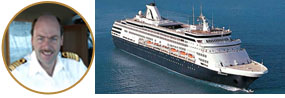
14 October 2007, Bar Harbor.

I arrived two hours ahead of time in Bar Harbor as the whole ship had to go through the US Custom and Border Protection Inspection. Our official arrival time was 9 am. but I had the hook down and the door open at 07.00 awaiting the officials. They showed up shortly after and the ship was cleared just before 9 am. It is just a pity that this procedure takes so long and not all the guests understand that this is something that is completely out of the ships hands. So the only thing I can do is arrive as early as possible and hope for the best.

The day turned out to be quite nice. The rain passed by before arrival but there was a cold North westerly breeze blowing. The season is definitely ending with the dropping temperatures and more and windier days. The scenery around Bar Harbor looked spectacular. 90% of the trees had turned color now and in the evening when the sun set, shining on the hills to the east, it was one feast of gold and purple.

We had some excitement in the afternoon, when I had to ring the fire alarm. Smoke was reported coming from a bathroom ceiling in a guest cabin and nothing excites a shipboard community more than a report about smoke. Because where there is smoke, there is fire. In the end it was just an electric light fixture that burned out but on board we are always afraid, that when there is a fire, that this fire will spread. However innocent it looks in the beginning.

Shipboard firefighting routines are very different from the shore side. If ashore your house goes on fire, you call the fire brigade and watch from a distance while they, also from a distance, start tackling the blaze. On board a ship you can not fight the fire “from a distance” as there is no distance; you are always right on top of it. So on ships the emphasis lays on prevention, early detection, containment and rapid response. To deal with the latter, the company has a fire fighting doctrine that calls for raising the fire alarm, even if the situation could have been dealt with without doing so. We could have dealt with this light fixture without saying anything and only the two occupants of the cabin would have known. However there is always a small chance that it could have gone beyond just a light fixture and we do not take that chance. Thus we prefer to keep all our guests informed to the best of our capabilities. The more is known, the less rumors there are and the less panic if something more serious might ensue.

So we rang the fire alarm. The whole ship knows. I make announcements to the guests and crew (my apologies to those on board who were taking a nap) and the crew gets to their stations on the double. There are at least 80 crew involved in an evolution like this. We have four firefighting teams of six in full gear with Scuba. They are supported by about 20 people carrying extra equipment and they are directed by two On Scene Commanders (OSC), one for engine spaces and one for non engine spaces. All the sailors report for standby for lowering lifeboats, all cooks report for standby for lowering life rafts. All cabin stewards are alerted incase cabins have to be evacuated. There is a special passenger notification team in the Front office to answer questions and the bridge keeps them fully briefed. There is an evacuation squad for evacuating people from nearby area’s and crowd control. There is a wheel chair squad for moving less ambulant people. There is a team for refilling Scuba bottles. There is a Rescue squad with stretchers and nurses and there are emergency elevator operators to handle the three elevators that will run to the very last on emergency power. The bridge is manned by Captain (overall command) CO (firefighting) HM (Hotel control) Cruise director (announcements), Provision Master (administration) Radio officer (emergency communication) The engine control room is manned by the chief engineer and first engineer and all non duty officers from deck and engine are called out as well. The medical team goes on full alert and prepares an alternative hospital in case the source of the alarm is too close to the regular ships hospital.

This whole machinery gets started up, when the fire alarm sounds and it all has to do with getting there quickly, before a small thing becomes a bigger issue. Our normal response time, from the moment the alarm sounds to having all teams fully deployed (that is dressed up in full gear and in position surrounding the endangered area) is 6 minutes.(*) Before that time, there are already “first responders” rushing to the scene to take initial action and to evaluate the situation.

Some guests consider it a nuisance to be woken up by a fire drill on a sea day and think, yet again a crew drill a we want to relax. But to get down to that six minutes reaction time, takes some training. Especially as it is done by crew whose daily job it is to serve the guests and not to save the world. I was very happy with the crew’s action during this minor affair today. They managed the six minutes and the first responders had the situation under control even before that time. ………….I am not so happy with all the paper work that it generated.

(*It is an industry given that you should tackle any shipboard emergency within 10 minutes in order to prevent it from be coming a bigger issue.)

13 October, Halifax. 2007.

During the course of the night the wind died further down and by the time we arrived at the pilot station it was blowing just under 20 knots from the SW. Thus no problems with docking and we were alongside on time. As the wind had been blowing in the Halifax area for quite some time, there was a long swell running into the harbor which made the Veendam pitch gently while docked alongside. It is always a strange sight to see the bow going up and down a few inches while the ship is not underway and it kept doing this until early in the afternoon when the swell slowly became less and less.

The black Watch, also coming from Sydney, made it into the port 2.5 hours later and the Grand Princess scheduled for an 8 am. arrival did not dock until noon time. Why I do not know and the pilots did not know either. Yesterday it had been a horrible day in Halifax when the Maasdam was there. Our sister ship the Maasdam is running a day ahead of us with doing almost the same ports. She made it into Halifax before the winds came through but when it was time to leave she could not. There was 50 knots of wind full on the beam. Even with the help of two tugboats and the ships thrusters, so in total 20000 HP pushing and pulling, the ship did not want to budge. In the end they had to wait for an hour and a half for the wind to shift away from the beam and then she could get out of port.

I paid a quick and final visit, for awhile, to the maritime 2nd hand book shop in Halifax for a few small purchases. This time I was not alone, there were several other ship buffs going with me including Stephen Card the painter, so the shop had a good day. Another development on the hobby front is that about 250 photos out of my HAL photo collection will grace the corridors walls of the new EuroDam. When Holland America had it’s ships going through the SOE dry-docks last year, it was decided to put pictures in the corridors of all the decks. One deck with flowers, one deck with Dutch scenes, one deck with HAL historical photos, etc. etc. The idea was to liven things up a bit and that guests would recognize the deck they had to go to easier if there was a theme to each deck.

Well, the feedback from our guests indicated that they did not care very much about the flowers and the landscapes but they loved the historical photos. So for the EuroDam the idea was to find more photos and try to do all the decks. I made a selection of approximate 10% of my HAL photos, out of a collection of over 3000 and 250 are now going on the walls. Some had to be rejected as the copyright issue was not completely clear. Although most photos are copyright free after 50 years, there are exemptions but the rules are a bit vague. Thus the architect and I decided to err on the safe side. The interior designer of the EuroDam, VFD architects, who have also designed the other HAL ships, did also put an advertisement in HALLO. This is a magazine for retired HAL employee’s in Holland (There is also an North American version) and they got flooded with all sorts of photo’s. So now all the decks of the ship will show ships photos, deck photos, crew photos, destination photos and other Holland America highlights from the ancient days to the recent past.

Some of the photos are also going to be hung in the parent-rooms of the Ronald McDonald childerens home of the Sophia hospital in Rotterdam. They are building a section with 7 rooms so that parents can stay near to their –mostly very sick- child without having to commute all the time. As most of these people will know the Holland America Line, there was the idea of using HAL photos. This is something I enjoy about collecting. I collected all sorts of things when I was young, stuff that other people threw away and 30 years later it can be used for something very nice. I hope the photos will divert the visitors minds a little bit, while they are waiting for their child to be operated on. Dreaming about far way destinations always helps to lift the mind a little bit.

We left Halifax on time, after a last minute medical disembark, and sailed slowly away from the berth. Very slowly this time, as the Grand Princess had a bunker barge alongside for loading fuel. If you pass too fast, then there is the danger of pulling the barge away from the ship and even the mooring lines might snap. So slowly, slowy was the word. I honked the horn for a final goodbye and the Grand Princess had the good grace to answer. She is a bigger ship and thus she has a deeper sounding horn than the Veendam. By the time we had finished the greeting sequence everybody was well aware of who was pulling out of port.

The swells were dying off and we sailed into a glorious sunset, so tomorrow should be a good day.

12 October 2007, Sydney.

Well things worked out well. The brunt of the bad weather that was forecasted was delayed and when we approached the pilot station there was only 30 knots blowing. That meant the harbor would be calm of wind as it is sheltered. It blows in Sydney harbor from every direction except from the ENE and that was the wind direction today. So we got in as quickly as possible and were docked nicely on time. The chief officer put an extra number of mooring ropes in case the wind would pick up during the day, which it only did a little bit, so nothing to be worried about. It was not a great day in Sydney but at least we made it.

We were together with two other ships. The Norwegian Dawn on the first anchorage and the Black Watch supposedly at the 2nd anchorage. However she decided to anchor much further out, so far, that in the drizzle we could not even see her. That meant an awful long tender ride for those guests to the shore.

During the day the weather forecasts were advising that the winds would not reach their peaks of 50 knots but would not come higher then about 40 knots. That was good news of course but still 40 knots over the open ocean is a lot. The frontal system was to come through in the mid evening and that would mean that the swells would not reach such great heights as the sustaining winds would change direction from the NE to the SW.

I was trying to get out as quickly as possible after all the tours were back on board, as the more time I would have at sea, the lower average speed I would have to run and the smoother the ride would be. However we had to wait until the Norwegian Dawn had gotten herself out of the way as she was lying exactly and fully across the fairway. After some pilot to pilot conversation, the ship finally started moving and I could slip by. As we are both tall ships it looks as if we are passing very very close even when we are over 1000 feet apart.

Coming out in the open, the swell did not look that bad but we still had the banks to cross around Cape Breton. So I could promise the guests a reasonably smooth ride later during the evening but the first bit was going to be a bit wobbly. The problem with the banks is that the shallowness of the water makes the swells run shorter and more pronounced and that makes the ship move more erratically. Even the stabilizers then have a hard time keeping up. So I had advised the guests at my departure announcement that it was going to be wobbly for a while. It is however hard to explain how the ship will exactly move and for how long.

The frontal passage final came near midnight. It brought torrential rains for awhile and then the wind shifted to the SW. At once the ships movement became less as the swells were no longer whipped up any longer. The ship kept moving of course as it will take sometime for the swells to die down. That won’t be until late tomorrow evening as they had quite a bit of wind in the Halifax area as well.

For us it looks good. Apart from the ocean swell, the weather is to improve and after some drizzle in the morning, it supposed to remain overcast in Halifax but with little wind and that helps the wind-chill factor.

11 October 2007 at Sea

Departure Quebec, last evening, was one of those departures where the elements are doing the job for you. We had nearly 20 knots on the starboard beam and that is close to the edge of the thruster capacity. It did not matter; the flood current pushed itself between the ship and the dock and carried us away to mid river. Once again I was giving 6 knots ahead on the main engines just to keep the Veendam in place. Amazing, you are over 200 miles from open sea and there is over 4 knots of flood coming up the river.

The flood turned to ebb shortly after we left the dock and the Veendam was almost flushed down the river. At a certain moment we were doing 24 knots with only 17 knots on the engines. It brought us to the pilot station 1.5 hours ahead of schedule which pleased the pilots as they got home so much earlier. In the mean time I was getting pre-occupied with the weather. Coastguard Canada was starting to issue navigational warnings to all shipping about expected wind. They always start early with those warnings in order to get the Sunday sailors back into the marina’s. But the wind forces predicted were a bit unsettling. Up to 60 knots North of Sydney, where we are supposed to go tomorrow. 14 days ago, I sailed straight out of Sydney harbor again, just because of those winds.

However I can only cancel a port when it really happens and when I have seen it with my
own eyes, so course was set for Sydney. However I kept the ships speed higher than needed, with the idea, that once the swell would start, I could slow down a bit more and the Veendam would ride the waves in a more pleasant way. When the wind is from the West, there is no swell in the St. Lawrence estuary but when the wind comes from the East, from open sea, there is a chance that the swell will start to roll in.

This morning, I woke up to an unusually quiet ship and found out that there was no wind blowing at all. The marine weather forecast however got grimmer and grimmer so it must have been silence before the storm. The result of course was that the fog came down and by noon time it was a small small world. By 1.30 pm the wind finally started to pick up and the fog lifted. In the evening the wind increased to 30 knots but still not what it should have been according to the weather forecast. If the this wind just gets delayed for another 12 hours, I will just be able to slip into Sydney, as with 30 knots in open waters, the turning basin should be nearly wind still and that is what I need. Anchoring is not an alternative as the Black Watch and Norwegian Dawn have been assigned to the two anchorages.

This evening we did the new Captain’s welcome on board toast for the second time. We have now received the Champagne bottle with confetti. Thus I do my speech, I introduce the ships staf, and then the cellar master comes on the stage with a 3 feet high champagne bottle. Just before I make the toast, he aims the bottle towards the ceiling, the employee of the month pulls the trigger and the confetti bursts into the audience. Very nice effect. Once the speech is done, I plug the show. This time it was Paul Tanner, whom I have known for years and that means that I can get away with a less formal announcement.

We are all waiting to hear if the guests prefer the old captains welcome on board setup or the new one. There is something to be said for both versions so the verdict is still out. I am now tinkering with my speech as I want to increase the entertainment factor a bit. The punch lines now have to come a bit closer after another to keep the audience focused as there are less officers to be introduced. I only have 8 minutes now for the whole intros instead of 15, plus I now also have to give a little personal background of each staff member and that latter is something that is really appreciated by the audience.

Tomorrow we are in Sydney, hopefully, as long as the weather forecast keeps being wrong.

08, 09 and 10 October 2007, The River dictates.

The last three days we have been under the influence of the currents on the St. Lawrence River. The down stream current of the river itself and the ocean current that pushes sea water all the way past Quebec. When we left the Saguenay fjord it was flooding and so we had the current all the way with us until docking in Quebec. On one side it is good for the fuel consumption, we got up tot three knots of speed free of charge, on the other hand it makes steering more difficult when slowing down. It is the same as if you are walking on one of these moving walk ways in the airport. You try to walk slower when it is time to step off the walk way and then somebody keeps pushing you forward. The amount of fuel that you save can be considerable. Two knots of speed given by the river can be the difference of running on 3 or 4 engines. If you can do with one engine less then you save approx. $350 an hour. Do that for a few hours and the savings mount up quite quickly.

Docking in Quebec is also regulated by the current. Unless it is slack tide, you always dock with the nose into the current, as it is much easier that way to keep the ship in position. If you dock and the current is pushing against the stern, the blunt end, then the ship is much more difficult to control. So, although we were going up river in the evening, we had to dock with the nose downstream, as the ocean current was still stronger, up to 4 knots, then the river current. Therefore we made a big turn in the river and then let the current slowly push us to the dock. Even when alongside, I had to keep the engines on 3 knots ahead to remain sitting still at the dock until the ropes were tied up. We were docking at the passenger terminal with a fixed shore gangway so it was docking on the inch with the full current running.

We had a bit of a drizzly day in Quebec but the advantage was that it took the chill out of the air, the chill that we had experienced yesterday. Whatever the weather, it did not deter our guests. While it was Canadian Thanksgiving Day, the shops in the lower town were open, so both shop-a-holic- and tour aficionado could be pleased to day.

Departure from Quebec is also dictated by the current. Just North of Quebec is a bridge, and the Veendam only fits under it at low tide. The Veendam is the tallest ship that goes under the bridge and the ships height makes for a very short time that is available for passing. That is when the water is retreating to sea and there is only the regular water level caused by the river. Thus the Quebec departure time depends on when we can and have to go under the bridge. This “bridge time window” changes on a daily basis. The strength of the incoming tide depends of a lot of factors. Apart from the regular moon/sun cycle which creates the tides, there is also the wind influence, which can help push up or help diminish the water height. Then there is the water of the river coming down stream which depends on the amount of rainfall up river.

All these things together make it impossible to calculate the bridge window very much ahead of time. As the cruise schedules are publicized in the cruise brochures two years in advance, we can not advise anybody about it any earlier. The only we can do is to put a foot note in the brochure, advising that Quebec departure times will vary. About 14 days in advance the pilots have a reasonable idea and as long as there is no storm or heavy rainfall, they have it right most of the time. But even then they can be an hour off.

That makes it very difficult to base a cruise on this with regular departure and arrival times. However most of the time the bridge window is within workable limits. We might have to leave a bit earlier from Quebec, to arrive on time in Montreal but that is about it. Last cruise we had to leave Quebec at 18.00, as the bridge window was shortly after 1900. That cut our visit to Quebec short, but we had a timely arrival in Montreal, our change over port.

This cruise it was more complicated. With the bridge window being after 23.05 it meant a 22.00 departure. Such a late departure means a later arrival in Montreal and that can affect the flights of the guests. I had informed the company ahead of time, as soon as I received the latest estimates about the bridge window, that the tentative arrival in Montreal would be. 09.00 versus 07.00. This gave the head office time to advise the guests.

When the pilots came on board, they told me that, due to not too much rain up river we could go under the bridge a little bit earlier. Good news for me, maybe I could get to Montreal a bit earlier as well. So we let go the lines as quickly as we could; I spun the Veendam around in the river so fast that the pilot said he felt dizzy and up the river we charged. We made it to the bridge 20 minutes earlier than originally planned, sailed under with a clearance of 9 feet and with having high hopes for making good time for Montreal.

During the first part of the night we made good progress. There was no traffic in the way and we could keep the pedal to the metal. Just after 3 am. we came to Trois Rivieres and changed pilots. Shortly after the fun began. The current was much stronger then normal, somewhere between 1 and 2 knots more and that did not help. There were more ships docked along the river then I had ever seen before and that required each time a no wake passage with slowing the ship down to 10 knots. Within no time, all what I had gained in time earlier in the evening was now lost.

Then the pilots came up with something new. Slow downs for erosion on the river banks. I tried to explain that the Veendam does not create much of a wake, when going very fast, or going very slow, (the worst is around 14 knots) but they opted for the slow speed. There is nothing I can do about that. If somebody along the shore complains and it is found out that I went against the pilot’s advice, the company would be in deep doo doo.
So slow speed is was. I started to run behind schedule now.

On approaching Montreal it got even worse. A ship docked alongside the river was carrying out under water repairs; thus: slow down. There was a clean up crew working on the river bank, thus, another slow down. In the end we arrived 1 hour later as planned. The turning basin is soo tight, that de docking maneuver head has to be done very slowly. I have no more then 30 feet clearance on the bow and about the same on the stern. No way I could make up time there by a fast docking. Thus we came alongside by 09.50. With one spring ashore, forward and aft, I ordered the gangway out and by 09.55 the first guests were going off the ship. By 10 am. the luggage was going and by 10.10 the ship was all fast. Until that time I kept the Veendam alongside with the thrusters.

However fun was not over yet. We also had to get back to Quebec. The bridge window now was at 01.30 in the morning. If we missed that one then we had to anchor north of the bridge until lunch time and that would mean cancelling the call at Quebec. So I set departure for 16.00 hrs. SHARP, regardless if whether al guests would be on board or not. Not a nice decision but leaving one guest behind makes more sense then cancelling a port call for 1200. The boarding of the new guests was delayed as we had to get all the disembarking guests of first. But with checking in being done both ashore and on board, we managed to get everybody on by 15.45. I had just started to let go lines, when another bus pulled up with 35 guests on board. We managed to get them on board by 16.05 and at 16.08 I was off the dock. We were only 58 guests short, but they missed the ship because their airplane broke down, so they were re-directed to Quebec regardless o my departure.
The pilots were very accommodating this time and we charged full speed down the river, with the ship slightly rolling from one side to the other, each time itwas caught by the river current. The only thing to hope for was that there was no traffic on the river that would slow the ship down. There was not.

We went all night as fast as we could, greatly helped by the river current now running with us, and we made the Quebec Bridge, 30 seconds behind schedule. Not bad planning on a 9 hour trip down river. By 02.30 we approached the dock. This time it was almost slack tide. I slowly brought the Veendam alongside; very slowly, as we did not know the exact moment that the tide would turn. It turned at 0.2.42.
Within one minute the current went from 1.5 knots of ebbing to 2 knots of flooding. That did not make it easy to “dock on the inch”, which we had to do due to the fixed shore side gangway. To add to the fun, at that moment the wind decided to pick up from 8 to 15 knots pushing the ship towards the dock with an increased momentum. But by 03.50 we were safely alongside and the two pilots could walk ashore. I was ready for bed. It had been a 19 hour day with going up and down the river and the fun in Montreal. The weather did not look that good for the day but my bed did.

07 October 2007, Saguenay fjord.

Winter is definitely coming. It was cold today, what I would call crisp and chilly. Somehere in the mid 40’s. It was a very clear day but with a fresh Westerly breeze blowing over the town, it was weather for two at least two pairs of socks.

We slowd down at the statue of the Virgin Mary in the morning this time as in the evening it would be dark. The sun rose at 06.55 and I had the Veendam abeam at 07.10 when the first rays of sun were just coming over the mountain ridge behind us, bathing the statue in a glorious gold-red color. I had announced it the day before and a lot of guests had made the effort to get up and to have a look. Luckily the sun did not let me down and there were no clouds in the sky.

Today we were in with the Seabourn Pride who arrived very early as they had a medivac to disembark at the pilot station during the early night. By the time we came to the Saguenay anchorage the ship was sitting pretty, but exactly at the spot reserved for the bigger ships. So I had to move the Veendam a bit closer to the shore to create a workable tender distance. Had he anchored himself just another 1000 feet to the West, I would have gone a 1000 foot to the East and we both had had a perfect spot. Now he had to face the Veendam’s big blue hull looming over him. All of course at a safe distance but it could have been more perfect.

The fjord was spectacular today with almost all of the trees having turned their leaves and it was a kaleidoscope of red, yellow, red with only a few of greens left. It was a busy day for the port anyway with two bulk carriers at anchor and one at the dock. The town has an ore dock where bauxite is off loaded. As energy is very cheap here with abundant waterfalls in the area that can be used for generating electricity, there are two factories that turn bauxite into aluminum. This bauxite is transported by the Bulk carriers from Jamaica on a regular service. I do not envy the crew on board at all. Sailing from warm Jamaica to cold Saguenay in the winter and sailing between two ports where R&R is not exactly top class.

I know a bulk carrier captain who is very happy in his job and would get sleepless nights just by thinking about what I do. But I could not do his. A bulk carrier travels with a speed of around 13 knots from port to port. There are quite often long waiting times before the berth is available for loading and unloading. The ore berths are far away from civilization and since 7/11 a lot of ports do not let the crew ashore anymore, finding it easier to keep them on board instead of providing terminal security to enable shore leave. A fully loaded bulk carrier has a very bad sea movement due to the heavy weight of the cargo and no stabilizers of course. Long monotonous sea days where nothing happens and the ships are staffed with a very small crew of 15 or 16 men. It would not be my piece of cake. If I do not have my daily dose of “controlled mayhem”, I start to wonder if something is wrong. But there are more bulk carriers than cruise ships around and they are all manned. As a matter of fact, the biggest ship in the world, the Berge Stahl, is a Bulk carrier. So there a mariners out there who like this sort of ship and the trade in which these ships ply. Luckily we are all not the same and we all have a different angle towards finding satisfaction in seafaring life.

The Seabourn Pride left early in the afternoon to go whale watching and then would arrive after us in Quebec. They were scheduled for an 1800 departure but the captain had heard there were whales, so off they went. That is the one thing that is nice with small ships, that have the chance to play with their itinerary. As soon as you go over 400 guests on board you have to stick to the announced times. With pre booked tours, the size of the ship and the grater variety of guests on board, there is very little leeway to make a big change in the sailing schedule and to do something totally different, just because the opportunity is there. By the time we had all guests back on board and sailed, it was dark when we passed through the whale area and you do not see whales very well in the dark, even when they happen to be white belugas. This was our last call at Saguenay as the winter is quickly approaching, and the town gets ready to say farewell to the last cruise ship. Next year their cruise dock and terminal should be finished, making it a lot easier for the guests to enjoy the area.

06 October 2007, At Sea.

We had a sunny but very windy day at sea. In fact it was a stormy day. It blew over 40 knots at times straight down the St Lawrence. But because there was no swell built up and the ship was going at a slow speed, the ride was not uncomfortable. Thus a very windy day. Most people associate bad weather with a rocking and rolling vessel and quite often it is the case. If you have a storm in the open ocean, then the wind can freely blow over vast expanses of water and whip up the waves. If the wind blows for a continuous period, the waves will get higher and higher and then the ship will move accordingly. If the winds only blow for a short while, or over a small expanse of water, then the waves cannot build up momentum and the ship does not move. The latter makes it then very difficult for a captain to explain that the weather is indeed bad, especially if the sun is brightly shining and the ship is as steady as a rock. That is when I get the comment cards from guests, saying: “…..And the captain cancelled the port and it was such a beautiful day, so we think he did not know what he was doing……….we want compensation.”

Apart from attending the Suite luncheon and the Mariners party, it was a quiet day for me. Time to send all my ETA’s to the various agents in the various ports. ETA’s (Estimated Time of Arrival) are being sent by the Master a few days in advance to confirm with the agent that the ship will indeed arrive on the planned day. Docks and anchorages are being booked up to two years in advance by the company but until the agent hears from the captain that the ship will indeed arrive, he waits with making arrangements. Those arrangements include gangways, water loading, Garbage off load, dock confirmation, tugboats and whatever else the ship might need. Sometimes the chief officer wants a cherry picker for outside maintenance, the chief engineer needs spare parts (there is always that one special size bolt short to complete a project) or the hotel manager needs more bananas, that all goes via the ships agent. He/she is the person who has the contacts and gets the right people to attend the ship. A good agent is worth its money in gold. Like everywhere else in the world, we have good ones and we have not so good ones. When we get back with the ship to Tampa, I will tell you about the very best one we have, Sandy, who has looked after us for 24 years now.

My special project today was Crew Washing Machines. Not exactly a topic you might think that is of direct interest to the captain, but it is. On the crew decks, we have various spaces where we have washing machines and dryers installed for crew use. According to the crew there are never enough and that is a partially true. There are enough hours in the day for the machines to be used for everybody but also the crew wants to sleep and does not get up at 3 am, to do the laundry. So during peak hours there is lack of availability. The chief engineer orders the new machines and he is really trying very hard to do his best for the crew. Thus he got an extra machine. But where to put it. That is where I come in. As a captain I can cut through all the arguments of the three department heads and decide things. All three department heads also want that washing machine to be there but not in THEIR space. Because they already have too little storage space as it is, and now they re going to loose more because of THAT washing machine that should be put SOME WHERE else.
I walked around with the Chief and he pointed out which lockers he could install a washing machine, due to the availability of cold and hot water supply and drainage.
Then I made my pick. I try to run my ship on consensus and in close agreement with the head of departments but not when it comes to locker allocation. So now we will install a new machine, add two existing machines from another location and make a whole new crew laundry area. The crew will be happy, except the person who had this locker and who has now been allocated a smaller space somewhere else. But that is the way it is. At home you never argue about washing machines with your wife, at sea you do not do so with the captain………….. In both cases you do not win.

05 October 2007, Charlotte town.

This was our last call at Charlotte town, Prince Edward Island for the season. As we left Sydney 1.5 hours late, I arrived an hour later in Charlotte town but as we were also going to leave an hour later it did not affect anybody. We had one gentleman who was extremely worried about his Tee-off time of 09.30 but as we had the gangway out by 08.50 he must have been able to get to the golf course on time. The dock is now almost finished and temporary pavement had been installed to make it possible to walk on. Thus we did not need our ships tenders and that make life a lot easier.

Arriving a little later, has its advantages, as the guests have the chance to see the ship sailing into port, instead of only seeing the shore side lights in the dark. Charlotte town arrival is quite scenic with nice houses on either side. Rolling hills with green pastures interspersed by lumps of forest. The channel that gives access to charlotte town is slowly eroding the shores on either sides and thus we can see brittle red sandstone cliffs. For those who have houses or summer cottages there, it must be an unnerving idea to see the front gardens getting smaller year after year.

The soil that comes away with this erosion is flushed out of the port by the current caused by three rivers that converge just outside the port. What ever does not get flushed out that way is removed by the ebbing and flooding of the sea. These four currents coming together causes quite a bit of turmoil in the water and therefore none the cruise ship captains likes to sit at anchor here. You never know which way one of the currents is going to push your ship in the next five minutes. You need, very very nice weather here, will you be able to sit safely at anchor with a big ship. Thus the availability of the dock is of extreme importance.

Departure was a bit of a tense affair. During the day the wind had steadily increased in force and on departure it was blowing 25 knots with gusts to 40 knots. The tricky bit of leaving then, is the moment when all the mooring ropes are gone from the bollards but still in the water. Because of the danger of fouling the propellers you can not maneuver until these are clear of the water. Thus with all thruster power to the dock, you try to stay alongside, or at least try to control the drift until the all clear comes and then it is full ahead to built up speed as quickly as possible. The faster you go, the less drift angle you have and the easier it is to stay in the channel.

As was to be expected, the moment we were ready to let go the last ropes and give full ahead, there was a Sunday sailor in the way again. Happily crossing our bow, first to port, and when we thought that he was gone, he swung around, came back and crossed our bow for the second time. So I waited until he was well clear for the second time and then put the pedal to the metal. While we were gaining speed, we saw him turning around for a 3rd time but luckily he stopped in the middle of the tack. Whether he just remembered it was cocktail time or whether he got disconcerted by a charging Veendam bearing down on him, I do not know. But suddenly his sails went down and he disappeared into the Marina.
Good bye Beautiful Charlotte town. It might be a few years before I get back, as the Veendam is going to Alaska again next year.

04 October 2007, Sydney.

Sydney turned out to be a great day, very little wind, so it was safe to dock and the sun shone all day. We were the only ship in port apart from a Canadian Frigate who called in un-expectantly. According to the pilot the ship had a rope in the propeller and needed divers to clear it.

This morning the deck dept. was involved with lifeboat drills. The Veendam crew exercises on a regular basis but not every port lends itself for lowering the boats into the water and to sail around. Today with very little wind it was an ideal opportunity. At the same time there was a little current running so the boat commanders had to take that into consideration when coming back to the falls. (Falls are the wires that lower and hoist the boats) During training the emphasis is firstly on getting away from the ship safely as that is needed in an emergency. However as we like to take the boats with us from port to port it is also important that they know how to return to the ship and park the boat correctly under the falls, so the boat can be retrieved again.

A little bit of excitement developed towards the end of the afternoon. Around 4 pm. I was called with the message that one of our tour busses had broken down, completely broken down, somewhere far away in the interior while on the full day tour. The tour operator was already thinking in contingency plans of keeping the guests, all 45 of them, overnight in Sydney and then to bus them the next day to Charlotte town. I did not like that idea very much. Forty-five, mainly quite mature people without overnight bags in a basic Sydney hotel (Marriott and Hyatt have not opened up here yet), does not add very much to the cruise experience.

When I heard that they could be back on board by 18.30, 1.5 hours late, I knew that there was going to be another option. If, I could arrive an hour or so later in Charlotte town, our next port, without having to cancel the shore excursions there because of it then the ship could wait. In the age of the cell-phone these things are quite easily organized. By arriving an hour later and leaving an hour later, all tours could go and thus we waited for the stranded bus to return. Another bus had been dispatched in the mean time to collect the guests.

I felt sorry for the singing lady on the dock side. She had started at 4 pm. singing along with the miners (union?) brass band and the plan was that she would do so until just after sailing time, which was 5 pm. However as the ship did not sail, she tried to keep going for awhile, but by 5.30 pm. she had gave up. Beautiful voice and there was a lot of interest from the starboard balcony people. We have music there every week as the town is plugging hard to get more and more cruise ships interested in calling in.

They have also created a nice, but small museum on the top floor of the cruise terminal which gives a good overview of life in the area. Samuel Cunard who founded later the Cunard line, was an agent for the coal mining industry here, and the abundance of coal in the area gave them the idea to run an Trans Atlantic liner service by steamships instead of by sailing ships. The delayed guests returned by 18.40 and by 18.50 I had the Veendam charging down the fjord to open sea.

« Older posts Newer posts »